Flavour physics at LHCb
B. Adeva1,a, on behalf of the LHCb Collaboration.
1University of Santiago de Compostela, Spain
Abstract.Some selected results of the LHCb experiment, running at the LHC withpp collisions at 7 TeV and 8 TeV, are reported here, after operation with a total integrated luminosity of 3.0 fb−1(Run 1). We focus on the most recent analyses on flavour physics,
that include measurements of the CKM invariant phasesγandβ, precision determination of the quark coupling strengthVub, observation of the very rare decays B0(s) → μ+μ−,
search for new physics in the anomalous branching ratio ofB → D∗τν, and precision¯ angular analysis of the rare decaysB0 →K∗0μ+μ−andB0
s →φμ+μ−. Detailed compar-isons are performed in all cases with the predictions of the Standard Model, and a few interesting tensions are observed.
1 The LHCb experiment
The LHCb detector [1, 2] is one of the four major detectors at the Large Hadron Collider. It is instrumented in a cone arround the proton beam axis, covering the angles between 10 and 250 mrad, where mostb hadron decays produced in proton-proton collisions occur. The detector includes a high-precision tracking system with a dipole magnet, providing a measurement of momentum and impact parameter (IP), defined for charged particles as the minimum distance of a track to a primary ppinteraction vertex (PV). Different types of charged particles are distinguished using information from two ring-imaging Cherenkov detectors, a calorimeter and a muon system. Simulated samples of specific signal and background decay modes ofbhadrons are used at many stages throughout the analysis. These simulated events model the experimental conditions in full detail, including thepp collision, the decay of the particles, and the response of the detector [3–5].
Candidates of the different signal modes reported in this article are required to pass a trigger system [6] which reduces in real time the rate of recorded collisions from the readout clock of the LHC to approximately 4 KHz. For muon channels, a muon is typically selected withpT >1.48 GeV/c
in the √s=7 TeV collision data (pT >1.76 GeV/c in the 8 TeV data), and at least one of the
final-state particles is required to have bothpT >0.8 GeV/c and impact parameter larger than 100μm with
respect to all of the PVs in the event. For hadron channels, a multivariate algorithm is used for the identification of secondary vertices consistent with the decay of abhadron [7]. In all cases, the tracks of two or more of the final-state particles are required to form a vertex that is significantly displaced from the PVs.
2 Measurement of the
γ
CKM phase
In the Standard Model (SM), the Flavor Changing Charged Current processes of quarks are described by a unitary complex-valued Cabibbo-Kobayashi-Maskawa (CKM) mixing matrix [8], whose ele-mentsVi j, withi =u,c,tand j=d,s,b, quantify the relativei↔ jcoupling strength. This matrix
originates from the misalignment between up and down type quark couplings to the Higgs boson, and being unitary, it has only one independent phase.
Every CP violation phenomenon (in the quark sector) should be related, in the SM, to this unique phase. However, up to four measurable phases can be formed from combinations of the type VαiVα∗jVβjVβ∗i, and it is important to measure all of them because loop-level contributions from addi-tional high-mass particles beyond the SM, may alter the unitarity relationships they must fulfil.
The measurement of the phaseβ=arg−VcdVcb∗/(VtdVtb∗), that provided the first evidence for CP-violation in theb-quark sector [9], is a historical example. A new competitive measurement of this pa-rameter has been provided this year by the LHCb experiment, which is reported in the next section. Yet another sensitive test of the SM comes from measurements of the phaseβs=arg−VtsVtb∗/(VcsVcb∗)
, only accessible fromB0
s meson decays, which is predicted to be very small in the SM. LHCb has
initiated a series of measurements of this parameter using different channels, which we are not dis-cussing here [10]. Within the precision attained so far, these measurements appear to confirm the SM prediction.
In order to disentangle the nature of new physics contributions from quantum loops, in case a significant deviation from unitarity is found, it is particularly important to have a CP-observable that only receives contributions from tree-level diagrams, and can therefore be used as a test-bench for the SM. This is precisely the case with the phaseγ=arg[−VudVub∗/(VcdVcb∗)] [11], the least well-measured to date of those in the unitarity triangleVudVub∗ +VcdVcb∗ +VtdVtb∗ =0.
Figure 1. Mass distributions ofB−→ DXs−candidates using GLW selections , forB− →[K+K−]DXs−(left),
B−→[K+K−]DXs+(center), and the suppressed ADS mode,B±→[K∓π±]DK±π∓π∓, sum ofB+andB−(right).
The phaseγcan be probed by studying the interference betweenb → uandb → ctransitions, such as the interference betweenB− → D0K−andB− → D¯0K−, when states accessible to both D0
and ¯D0mesons are selected. A number of methods have been discussed in the literature, and are often
grouped into three categories, depending on the D decay mode: (i) CP eigenstates, such asD→K+K− andD→π+π−(GLW) [12]; (ii) flavor-specific final states, such as the Cabibbo-favored and double Cabibbo suppressedD→ K±π∓decays (ADS) [13]; and (iii) multi-body self-conjugate final states, such asD→K0
sπ+π−(GGSZ) [14].
Measurements ofγhave been performed from averages over several decay modes from individual experiments, and the current experimental status isγ = (73+9
−10)
γ=(73+−1716)◦by the BaBar collaboration [17], andγ=(68+−1514)◦by the Belle collaboration [18]. The overall precision onγfrom a global fit is about 7◦[19]. In order to improve the overall precision, it is important to study a wide range of final states. It has been suggested that other multi-body final states of the recoiling strange quark system could be useful [15], due to their larger branching fractions, and potentially larger interference contribution.
LHCb has performed the first ADS and GLW analyses of the decayB−→DX−s, where theD
me-son is observed through its decay toK±π∓,K+K−andπ+π−, and a multibody final stateX−s ≡K−π+π− is defined for the recoil system [20]. Some invariant mass spectra for theB−→DX−s ADS and GLW signal modes are shown in Fig.1. The analysis uses an integrated luminosity of 3.0 fb−1and includes the modesB−→DXd−, with lower sensitivity toγ, for normalization purposes. Significant signals are observed in the CP modes for both the favored and the suppressedB−decays, and first evidence is seen for the ADS DCSB−→D[K+π−]DK−π+π−decay. A fit forγis performed, from whichγ=(74+−2022)
◦
is found with onlyB−→DX−s modes. Values ofγbelow about 25◦ and larger than approximately
165◦are not excluded by these modes, but are excluded when other modes are considered [16]. The
sensitivity toγfrom this analysis makes it a promising channel for future studies.
LHCb has also explored additional multibody final states leading to possible improvement of the global precision on theγparameter, and performed a measurement of CP observables fromB±→Dh±
decays, where D mesons are reconstructed in the ADS channelD → K∓π±π0 and the quasi-GLW
modesD→π+π−π0andD→K+K−π0 [21]. In such cases, the interference effects that are sensitive
toγ vary over the phase space of the D decay, due to the role of strongly-decaying intermediate
resonances, and the integration over the phase space in general dilutes the net sensitivity. For multi
body ADS/GLW modes the dilution factor can be measured withDD¯ pairs coherently produced at
theψ(3770) resonance [22]. Recent measurements of this type [23] indicate that the dilution effects inD → K∓π±π0 andD → π+π−π0 are rather small, making these decays particularly suitable for an inclusive analysis. In particular the latter is very close to being a CP-even eigenstate, and the interference terms suffer very little dilution.
Figure 2.Invariant mass distributions of
selectedB∓→[π+π−π0]
Dh∓candidates, separated by B hadron charge.B∓→DK∓
signal events are in the upper plots and
B∓→Dπ∓in the lower plots.The red curve representsDK∓events and the green curve representsDπ∓events. The grey shape indicates partially reconstructedB∓decays and the dotted red curve indicates wrongly reconstructed D decays. The blue line represents the total PDF
As it is described in Ref. [21], twelve observables are measured by LHCb in total, includ-ing CP-asymmetries and amplitude ratios between Cabibbo favored and suppressed modes, for the
above-mentioned ADS and quasi-GLW modes. Two-dimensional scans are performed forγvs.rB
andγ vs. δB, where the hadronic amplitude ratio rB and the phase difference δB are defined as:
A(B−→D¯0K−)/A(B−→D0K−)=r
Bei(δB−γ). The results are compatible with the values obtained
from a global analysis of other LHCb measurements sensitive toγat tree level (also sensitive torB
andδB) [16]. No evidence of CP violation is seen with the current experimental precision. First
evidence is obtained for the mode B∓ → [K+K−π0]
DK∓, and the channels B∓ → [π∓K±π0]Dπ∓
B∓→[K+K−π0]
shown in Fig.2, separated by the charge of theB∓candidate, as an indication of the signal significance for CP violating observables.
When analysed in the context of the underlying physics parameters, the results exhibit good con-sistency with other LHCb measurements, and they will be valuable in improving knowledge ofγin the unitarity triangleVudVub∗ +VcdVcb∗ +VtdVtb∗ =0, when combined with results fromB∓ → DK∓ measurements using other D decay channels.
3 New precision measurement of the
β
CKM phase
The violation of CP symmetry in processes involvingB mesons was first observed in the "golden mode"B0 → J/ψK0
s by the BaBar and Belle experiments at the asymmetrice+e−colliders PEP-II
and KEKB. Since then, measurements of CP violation in this decay mode have reached a precision at the level of 10−2[24]. LHCb has performed a new competitive measurement obtained at a hadron collider [25], where a reduced flavor tagging capability, as compared to B-factories, is compensated by a higherbhadron cross-section, with the integrated luminosity of 3.0 fb−1from Run 1.
m(MeV/c2)
5240 5260 5280 5300 5320
Candidates / (1 MeV / c 2) 0 500 1000 1500 2000 2500 3000 3500 LHCb
(a) Figure 3.The distribution of the reconstructed mass of taggedB0→J/ψK0
s candidates is shown. The solid black line shows the fit projection, while the dashed (dotted) line shows the projection for the signal (background) components only.
As theJ/ψK0
s final state is common to both B0 and ¯B0 meson decays, the interference between
the amplitudes for the direct decay and for the decay afterB0−B¯0oscillation results in a decay-time
dependent CP asymmetry as follows
A(t)≡Γ( ¯B
0(t)→J/ψK0
s)−Γ(B0(t)→J/ψKs0) Γ( ¯B0(t)→J/ψK0
s)+ Γ(B0(t)→J/ψKs0)
= Ssin(Δmt)−Ccos(Δmt)
cosh(ΔΓ2t)+AΔΓsinh(ΔΓ2t)
whereB0(t) and ¯B0(t) indicate the flavor of theBmeson at production, whiletindicates the decay
time. The parametersΔmandΔΓare the mass and decay width differences between the heavy and light mass eigenstates of theB0−B¯0system, andS,CandA
ΔΓare CP observables. AsΔΓis negligible
for theB0−B¯0system, the time dependent asymmetry simplifies toA(t)=S sin(Δmt)−Ccos(Δmt).
The B0 → J/ψK0
s decay is dominated by a ¯b → c¯cs¯transition, and CP violation in the decay is
expected to be negligible at the current level of experimental precision, givingC≈0, which allows to identifyS with sin(2β).
t(ps) 5 10 15
Signal
yield
asymmetry
−0.4
−0.3
−0.2
−0.1 0 0.1 0.2 0.3 0.4
LHCb
Figure 4.The time-dependent signal-yield asymmetry
(NB¯0−NB0)/(NB¯0+NB0) is shown. HereNB0(NB¯0) is the number of
B0→J/ψK0
sdecays with aB0( ¯B0) flavor tag. The solid curve is the projection of the signal PDF.
of the selected candidates is shown in Fig. 3, and the measured decay-time dependent signal-yield asymmetry is shown in Fig. 4.
The CP observablesS andCare measured to be
S= 0.731±0.035 (stat)±0.020 (syst) C=-0.038±0.032 (stat)±0.005 (syst)
with a statistical correlationρ(S,C) = 0.483. WhenC is fixed to zero the measurement yields S = sin(2β) = 0.746±0.030 (stat). This result represents the most precise time-dependent CP violation measurement at a hadron collider to date. Furthermore, it has a similar precision to, and is in good agreement with, previous measurements performed at the Belle and BaBar experiments at the KEKB and PEP-II colliders [24]. This result is in excellent agreement with expectations from other measurements and improves the consistency of the CKM sector of the Standard Model. Other measurements that constraint this angle of the unitarity triangle predict sin(2β) as 0.771+−00..017041[26].
4 Precision determination of the coupling strength
|
V
ub|TheVubmatrix element governs the most sensitive misalignment in the couplings between the up and
down type quark flavors to the Higgs boson. Its apparent proportionality to the third power ofλ(sine of the Cabibbo angle) remains unexplained, and it best quantifies the minimal flavor violation structure of the Standard Model. A precision measurement of the magnitude ofVub is naturally achieved via
the semileptonic quark-level transitionb→ul−νl¯, which minimizes hadronic uncertainties. There are two complementary methods to perform such measurement. The simplest is to measure the branching fraction of a specific (exclusive) decay such as ¯B0→π+l−ν¯orB−→π0l−ν¯, where the influence of the strong interaction in the decay, encompassed by the ¯B0→π+form factor, is predicted by lattice QCD
(LQCD) [28] or QCD sum rules [29]. The world average from Ref. [30] isVub=(3.28±0.29)×10−3,
where the most precise inputs come from the Babar [31] and Belle [32] experiments. The uncertainty is dominated by the LQCD calculations, recently updated [33]. The alternative method is measure the differential decay rate in an inclusive way over all possibleBmeson decays containing theb→ul−νl¯ quark level transition. This results inVub = (4.41+−00..1517)×10−3 [34], where the second uncertainty
comes from theoretical calculations. The above results are summarized in Fig.5 (left).
Figure 5.Summary of the exclusive and inclusive measurements indicated in the text (left) and experimental constraints on left-handed coupling,VL
uband the fractional right-handed (RH) couplingR. While the overlap of the 68% CL bands for the inclusive and exclusive world averages suggested a RH coupling of significant magnitude, the inclusion of the LHCb measurement does not support this.
The discrepancy between the exclusive and the inclusiveVub determinations has a significance of
approximately 3σand has been a long standing puzzle in flavor physics. Several explanations have been proposed, such as the presence of a right-handed (V+A) W coupling [35].
LHCb has performed a measurement of the ratio of branching fractions of theΛ0binto pμ−ν¯μand
Λ+
cμ−ν¯μfinal states [27]. This has been done using pp collisions from the LHC, corresponding to
2.0f b−1of integrated luminosity at 8 TeV. Theb→utransitionΛ0
b→ pμ−ν¯μcould not be considered
Figure 6.Fits are made forΛ0
b→pμ−ν¯(left) and
Λ0
b→Λ+c(pK−π+)μ−ν¯(right) candidates. Data are represented by the black points, and the open boxes represent the statistical uncertainties from the finite size of the simulation samples used to model the mass shapes. There are no data above the nominalΛ0
bmass due to the removal of unphysicalq2solutions.
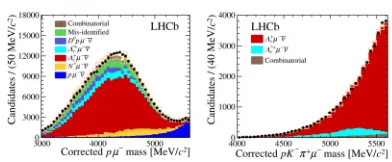
To facilitate Λ0b reconstruction at a hadron collider, LHCb introduces a corrected mass Mcorr=
m2
hμ+p⊥2+p⊥2wherehrepresents either the proton or theΛ+c candidate,mhμis the visible
mass of thehμpair, and p⊥is the momentum of thehμpair transverse to theΛ0b flight direction.The recoil squared massq2(μν) can be determined from the above direction, up to a two-fold ambiguity.
For kinematic reasons in the experiment, it is restricted to high values, precisely where the precision on the form factors is best. Secondary vertex isolation criteria are used, and from a detailed com-parison between theMcorr spectra shown in Fig. 6, a measurement of the ratio of branching ratios is
achieved:
B(Λ0
b →pμ−ν¯μ)q2>15GeV/c2
B(Λ0b→Λ+cμ−ν¯μ)q2>7GeV/c2
=(1.00±0.04±0.08)×10−2
using the form factor information from [36] for the restricted q2 regions, the measurement
|Vub|/|Vcb|=0.083±0.004±0.004 is obtained, where the second uncertainty arises from the uncertainty in the LQCD prediction. When the exclusive world average is used for|Vcb|[34], the measurement is obtained
|Vub|=(3.27±0.15±0.17±0.06)×10−3
where the uncertainties indicate experimental, LQCD prediction and normalization toVcb. The
determination of|Vub|from the ratio of branching ratios depends on the size of a possible right-handed coupling [35], according to an effective Lagangian of the type
Le f f =−4GF √
2 V
L ub
¯
uγμPLb+Ru¯γμPRb
(¯νγμPLl)+h.c.
withPR,L = (1±γ5)/2. The sensitivity can be appreciated in Fig. 5 (right) which shows the
experimental constraints on the left-handed coupling|VL
ub|and the fractional right-handed coupling
added to the SM,R for different measurements. Unlike the case for the pion in ¯B0 → π+l−ν¯ and
B−→π0l−ν¯decays, the spin of the proton is non-zero, allowing an axial-vector current, which gives
a different sensitivity toR. The overlap of the bands from the previous measurements suggested a significant right-handed coupling, but the inclusion of the LHCb|Vub|measurement does not support that assumption.
5 Observation of the very rare decays
B
0(s)
→
μ
+μ
−The decay of theB0
smeson into dimuons is suppressed strongly, to the level 10−9−10−10. It represents
a powerful probe in testing new physics effects, because the suppression originates from essential features of the heavy particle spectrum of the SM, namely: the GIM mechanism, helicity suppression and the fact that the SM contributions involve an off-diagonal element of the CKM matrix.
Since these features are of course not generally respected by generic extensions of the SM, the above decay has been searched for many years at most generations of accelerators. The Feynman dia-grams are shown in Fig. 7, illustrating the suppression in the SM and the sensitivity to Supersymmetry models.
The first evidence for theB0
s →μ+μ−decay was presented by the LHCb collaboration in 2012 [47].
The LHCb and CMS experiments have presented a joint analysis [48], in order to fully exploit the sta-tistical power of the LHC data, and take into account the correlation between the physical quantities in common to the two analyses. The data correspond to total integrated luminosities of 25.0 fb−1and 3.0 fb−1 for the CMS and LHCb experiments, respectively. This is equivalent to a total of approxi-mately 1012B0
sandB0mesons produced in both experiments together, determined from the number of
expected events assuming the SM branching fractions.
The branching fractions of these two decays, accounting for higher order electromagnetic and strong interaction effects, are reliably calculated in the SM. The untagged time-integrated SM predic-tions areB(B0
s →μ+μ−)S M =(3.66±0.23)×10−9andB(B0→μ+μ−)S M=(1.06±0.09)×10−10[37],
which use the latest lattice QCD results to computeB0
sandB0meson decay constants [38].
Figure 7.Some Feynman diagrams for theB0
s →μ+μ−decay in (a) the SM and (b) Minimal Supersymmetric model.
Many theories that seek to go beyond the SM (BSM) include new phenomena and particles [39], such as in the diagram shown in Fig. 8(b), that can considerably modify the SM branching fractions. In particular, theories with additional Higgs bosons [40] predict possible enhancements of the branching fractions. A significant deviation of either of the two measurements from the SM predictions would give insight on how the SM should be extended. Alternatively, a measurement compatible with the SM could provide strong constraints on BSM theories.
The ratio of the branching fractions of the two decay modes additionally provides
powerful discrimination among BSM theories [41]. In the SM it is predicted to be
B(B0→μ+μ−)
S M/B(B0s→μ+μ−)S M = 0.0295+−00..00280025 [44], [45], [46]. Notably, BSM theories with the property of minimal flavor violation [42] predict the same value as the SM for this ratio.
The two experiments measure at different angular regions with respect to the LHC beams,
ac-cording to their different design purposes. Their dimuon mass resolution are also different, namely
≈ 25 MeV/c2 for LHCb, and ranging from 32-76 MeV/c2, depending on the pseudorapidity of the
two tracks for CMS. The separation between genuineB0
s → μ+μ−decays and random combinations
of two muons, most often from semi-leptonic decays of two differentbhadrons, is achieved by means of boosted decision trees (BDTs) [43]. Each experiment selected the best set of discriminating vari-ables in their respective BDT. One example is the decay length with respect to the PV. Having lifetimes of about 1.5 ps,B0
relevant BDT discriminant, to whether they were detected in CMS or LHCb, and to the kinematical configuration of both muons, in the case of CMS. 20 different categories were so defined, as described in Ref. [48].
A single dimuon mass distribution, extended over all categories, is shown in Fig. 8. Event can-didates are weighted according to their values ofS/(S +B), whereS is the expected number ofB0
s
signals andBthe number of background events under theB0
speak in each category.
Figure 8.Weighted distribution of the dimuon invariant massmμ+μ−
for all categories defined within the CMS and LHCb experiments. Superimposed on the black data points are the combined fit (solid blue line) and its components: theB0
s(yellow shaded area) andB0
(light blue shaded area) signal components, the combinatorial background (dashed-dotted green line); the sum of the semileptonic backgrounds (dotted salmon line); and the peaking backgrounds (dashed violet line).
Likelihood contours for B(B0
s → μ+μ−) versus B(B0 → μ+μ−) are shown in Fig. 8.
One-dimensional likelihood scans for both decay modes are displayed in the same figure. A combined fit leads to the measurementsB(B0
s →μ+μ−)=2.8−+00..76×10−
9andB(B0 →μ+μ−)=3.9+1.6
−1.4×10− 10,
where the uncertainties include both statistic and systematic sources. The statistical significance is computed to be 6.2σfor theB0
s → μ+μ− mode and 3.0σfor theB0 → μ+μ−mode (we report the
significance obtained with the FC method) .
Figure 9.Likelihood contours in the
B(B0
s→μ+μ−) versusB(B0→μ+μ−)
plane. The (black) cross in (a) marks the best-fit central value. The SM expectation and its uncertainty is shown in the (red) marker. Each contour encloses a region corresponding to the reported confidence level. Variations of the test statistic -2lnL are also shown forB(B0
s →μ+μ−) (b) and
B(B0→μ+μ−) (c). The dark and light (cyan) areas define the±1σand±2σ confidence intervals, respectively. The SM prediction and its uncertainty is denoted with the vertical (red) band.
A fit for the ratios of the branching fractions relative to their SM predictions yields
SB0
s
S M=0.76+
0.20
−0.18 andSB 0
S M = 3.7+
1.6
−1.4. The ratio of branching ratios themselves yieldsR =0.14+ 0.08
−0.06 which is compatible with the SM at the 2.3σlevel.
The combined analysis of the data from CMS and LHCb establishes conclusively the existence of theB0
s →μ+μ−decay and produces a 3σevidence for theB0→ μ+μ−decay. ForB0s, this concludes
a search that started more than three decades ago. A phase of even higher sensitivity and precision measurements is initiated for both decays.
6 Anomalous branching fraction of
B
→
D
∗τ
ν
¯
Lepton universality, which is preserved within the Standard Model, requires equality of couplings
B+→K+e+e−andB+→K+μ+μ−decays have been seen [50] , but no definitive observation of a de-viation has yet been made. However, a large class of models that extend the SM contain additional interactions involving enhanced couplings to the third generation that would violate the above princi-ple. Semileptonic decays ofbhadrons to third generation leptons provide a sensitive probe for such effects. In particular, the presence of additional charged Higgs bosons, which are often required in these models, can have a significant effect on the rate of the semitauonic decay ¯B0→D∗+τ−ν¯τ[51].
Semitauonic decays have been observed by BaBar and Belle collaborations [52],[56].
Re-cently BaBar reported updated measurements [55],[56] of the ratios of branching fractions,
R(D∗)≡ B( ¯B0→D∗+τ−ν¯τ)/B( ¯B0→D∗+μ−ν¯τ) and R(D)≡ B( ¯B0→D+τ−ν¯τ)/B( ¯B0→D+μ−ν¯τ),
which show deviations of 2.7σ and 2.0σ, respectively, from the SM predictions [57],[58]. These
ratios have been calculated with high precision, owing to the cancelation of most of the uncertainties associated with the strong interaction in theBtoD(∗)transition. Within the SM they differ because of phase-space effects due to the differing charged lepton masses.
LHCb has achieved a new measurement of R(D∗) using hadron collisions at the LHC with an
integrated luminosity of 1.0 fb−1 and 2.0 fb−1collected at ppcenter-of-mass energies of 7 TeV and 8 TeV, respectively [49]. The ¯B0 → D∗+τ−ν¯τdecay withτ− → μ−ν¯μντ(the signal channel) and the
¯
B0→ D∗+μ−ν¯τdecay (normalization channel) produce identical visible final-state topologies;
conse-quently both are selected by a common reconstruction procedure. The selection identifies semilep-tonic ¯B0decay candidates containing a muon candidate and aD∗+candidate through the decay chain
D∗+ → D0(→ K−π+)π+. The selected sample contains contributions from the signal and the nor-malization channel, as well as several background processes from hadron collisions, which include partially reconstructedBdecays and candidates from combinations of unrelated particles from
dif-ferentb hadron decays. The kinematic and topological properties of the various components are
exploited to suppress the background contributions. The signal, the normalization component and the residual background are statistically disentangled with a multidimensional fit to the data, using template distributions derived from control samples, or from simulation validated against real data.
Figure 10.Distributions ofm2
miss(left) andE∗μ(right) of one of the fourq2bins of the signal data used in the fit (9.35<q2<12.60 GeV2/c4), overlaid with projections of the fit model with all normalization and shape parameters at their best-fit values. Below each pannel differences between the data and fit are shown, normalized by the Poisson uncertainty in the data. The bands give the 1σtemplate uncertainties.
The separation of the signal from the normalization channel, as well as from background pro-cesses, is achieved by exploiting the distinct kinematic distributions resulting from theμ-τmass dif-ference and the presence of extra neutrinos from the decayτ−→μ−ν¯μντ. The most discriminating kinematic variables, computed in theBrest frame, are the following quantities: the muon energyE∗μ;
the missing mass squared, defined asm2
miss=(pμB−pμD−pμμ)2; and the squared four-momentum
transfer to the lepton system,q2=(pμ
B−pμD)2, wherePBμ,PμD, andPμμare the four momenta of theB
knowl-ege of theBcandidate momentum vector, which is estimated from the measured parameters of the reconstructed final-state particles. TheBmomentum direction is determined from the unit vector to theBdecay vertex from the associated PV.
The results of the fit to the signal sample are shown in Fig. 10. Values of the ¯B0 → D∗+μ−ν¯ μ form factor parameters determined from the fit agree with the current world average values. The fit finds 363000±1600 ¯B0 → D∗+μ−ν¯
μdecays in the signal sample and an uncorrected ratio of yields N( ¯B0 → D∗+τ−ν¯τ)/N( ¯B0 → D∗+μ−ν¯μ) = (4.54±0.46)×10−2. Accounting for the τ− → μ−ν¯μντ
branching fraction and the ratio of efficiencies results inR = 0.336±0.034, where the uncertainty includes the statistical uncertainty, the uncertainty due to form factors, and the statistical uncertainty in the kinematic distributions used in the fit. The measured value is in good agreement with
previ-ous measurements by BABAR and Belle [52],[54] and is 2.1σgreater than the SM expectation of
0.252±0.003 [57].
7 Angular analysis of
b
→
s
μ
+μ
−decays
The decayB0 → K∗0(→ K+π−)μ+μ−is ab → sμ+μ−flavor-changing neutral current (FCNC)
tran-sition that has attracted a great deal of interest at B-factories and hadron machines, in recent years. In the Standard Model (SM) the decay is forbidden at tree level and, at lowest order, only occurs via electroweak penguin and box processes. In extensions of the SM, new, heavy particles can enter in competing processes and can significantly change the branching fraction of the decay and the angular distribution of the final state particles. In Fig. 11 some representative diagrams of either case are shown.
Angular observables are of particular interest, since theoretical predictions of such observables tend to be less affected by form-factor uncertainties in theB0→K∗0transition. HereafterK∗0is used to refer to theK∗0(892).
Figure 11.Some illustrating diagrams indicating the penguin loops
and box contributions from the SM toB0→K∗0μ+μ−decay (left side
ones), and contributions from new Higgs particles in physics beyond the SM (right side ones)
Based on 1.0 fb−1, the LHCb collaboration published in 2013 an analysis of theB0 → K∗0μ+μ− final state, and determined a set of angular observables that have reduced theoretical uncertainties and cannot be determined from the single angular projections [61]. The above analysis found a local deviation from the SM prediction, with a significance corresponding to 3.7σin one observable,P5. Possible interpretations of this discrepancy and the consistency of all of the measurements ofb→ s transitions have been widely discussed in recent literature [59]. LHCb has performed an updated analysis using the full LHCb Run 1 data sample [60], corresponding to an integrated luminosity of 3.0 fb−1.
The final state of the decayB0 → K∗0μ+μ−can be fully described byq2, the invariant mass of the dimuon system squared, and three decay anglesΩ = (cosθl,cosθK, φ), whereθl,Kare the helicity
angles in theK∗0and dimuon system, andφdescribes the angle between theμ+μ−plane and theK+π−
plane, defined in theB0rest frame. The differential decay rates of ¯B0→K¯∗0μ+μ−andB0→K∗0μ+μ−
d4Γ[ ¯B0→K¯∗0μ+μ−]
dq2dΩ =
9 32π
j
Ij(q2)fj(Ω) ,
d4Γ¯[B0 →K∗0μ+μ−]
dq2dΩ =
9 32π
j
¯
Ij(q2)fj(Ω)
where the terms fj(Ω) arise from spherical harmonics and the Ij(q2) are eleven q2 dependent
angular observables. The Ij(q2) can be expressed as bilinear combinations of six complex decay
amplitudesAL0,,R,⊥, which correspond to different transversity states of the K∗0 and different
(left-and right-h(left-anded) chiralities of the dimuon system. Following the notation in [65], CP-averaged observables can be defined as
Sj=
Ij+I¯j
dΓ dq2 +
dΓ¯ dq2
If q2 is sufficiently large (q2 1 GeV2/c4), the muons can be considered massless and
the CP-averaged observables S1 and S2 obey the relations S1s = 3S2s, S1c = −S2c and
3
4(2S1s+S1c)− 1
4(2S2s+S2c)=1 (see for example Ref. [65]). These relationships reduce the
num-ber of observables from eleven to eight. TheS1cobservable is more commonly expressed in terms of
the longitudinal polarization fraction of theK∗0,
FL=S1c=
|AL
0| 2
+|AR
0| 2
|AL
0| 2+|AR
0| 2+|AL
|2+|AR|2+|AL⊥|2+|AR⊥|2
It is also conventional to replaceS6sby the forward-backward asymmetry of the dimuon system
AFB, whereAFB = 34S6s. Additional sets of observables, for which the leading form-factor
uncer-tainties cancel, can be built fromFL andS3 throughS9. Examples of such "optimized" observables
include the transverse asymmetryA(2)T [63], where A(2)T = S3/(1−FL) and theP
series of observ-ables [64] with, for example,P4,5=S4,5/
√
FL(1−FL).
Figure 12.The CP-averaged observables FL(left) andAFB(right) in bins ofq2.
The shaded boxes show the SM prediction taken from Ref. [71].
An unbinned maximum likelihood fit has been used to determine the CP-averaged observables FL, AFB, and S3 through S9. Additional observables related to the introduction of the S-wave in
theK+π− system are explicitely included as nuisance parameters (see Ref. [60] for more details). The data are analysed in approximately 2 GeV2/c4 q2 bins. The SM predictions are based on the
description in Ref. [62]. Light-cone sum rule predictions which are valid in the low-q2 region, are
combined with lattice determinations at highq2 [66, 67]. The predictions are made in the regions
0.1<q2 <6.0 GeV2/c4and 15.0 < q2 <19.0 GeV2/c4. No predictions are included for the region
close to the narrowc¯cresonances, theJ/ψandψ(2S), where many of the assumptions that go into the SM predictions are thought to break down.
We refer the reader to Ref. [60] for the full set of measuredq2dependent distributions, and just show
in Fig. 11 theFLandAFBresults, including the comparison with the SM predictions.
Figure 13.The observableP5in bins ofq2. The data of the full
3.0 fb−1data sample are shown as black dots. The shaded boxes
indicate the SM prediction taken from Ref. [68]. The blue open markers show the result of the 1.0 fb−1analysis from Ref. [61].
The tension in S5 can also be seen in the related distribution ofP
5 = S5/
√
FL(1−FL) which
is shown in Fig. 13. This observable is determined by reparametrising the angular distribution ac-cordingly. For theP5observable, a prediction from Ref. [68] is shown. This prediction is computed in the region 0.1 < q2 < 8.0 GeV2/c4, where a local tension with the SM prediction was seen in
the earlier 1.0 fb−1 LHCb data analysis [61]. In the present analysis, a tension with the SM
pre-diction (from Ref. [68]) at a level of 2.9σis observed in each of the 4.0 < q2 < 6.0 GeV2/c4 and
6.0 < q2 < 8.0 GeV2/c4 bins. A naïve combination of these deviations, based on a χ2
probabil-ity with two degrees of freedom and assuming the SM predictions in the two bins are uncorrelated, yields a local tension of 3.7σ. Although completely consistent with the SM predictions, theAFBfit
results are systematically1σbelow the SM prediction in the region with 1.0<q2<6.0 GeV2/c4. The
zero-crossing point ofAFB,q20, has been determined to be (3.7+−10..81) GeV2/c4, where the uncertainty
is purely statistical. The value ofq2
0 is in good agreement with SM predictions which are typically
around 4.0 GeV2/c4, with a relative uncertainty smaller than 10% [69, 70].
Figure 14.CP-averaged angular observableFL(left) and differential branching fraction of the decayB0s →φμ+μ− (right). Data are shown by black dots, overlaid with SM predictions [62, 71], indicated as blue shaded boxes. The vetoes excluding the charmonium resonances are indicated by grey areas.
Another b → sμ+μ− channel of interest recently studied by LHCb is the decay B0
s→φ(→K+K−)μ+μ−[72]. Contrary to B0 → K∗0μ+μ−, the above decay is self conjugate, since
the final state particles provide no specific information on theb/b¯ quark flavor. Subject to essen-tially the same new physics sensitivity, the B0
s → φμ+μ− channel provides good complementarity
to B0 → K∗0μ+μ−, having an observed yield of 432±24 events. With similar four-body kine-matics, the full angular analysis as function ofq2(μ+μ−) allows to determine four CP averages and four CP asymmetries, all of which have been determined by LHCb for the first time, using the full 3.0 fb−1data sample from Run 1. Physics-wise however, the observables are different from those of
there are new CP-violating asymmetries, while theS5andAFBobservables of the former channel are
not accessible.
As a result of theq2 dependent analysis of the eight angular observables, good consistency is
found with the SM predictions forB0
s→φμ+μ−[72]. However, the differential branching fraction of
(2.58+0.38
−0.31±0.08±0.19)×10−
8GeV−2c4forB0
s→φμ+μ−in the range 1 <q2 <6 GeV2/c4, where
precise theoretical calculations are available, is found to be more than 3σbelow the SM prediction of (4.81±0.56)×10−8GeV2/c4[62, 71]. In Fig. 14 the CP-averaged longitudinal polarization fraction
FL (left) and the differential branching fraction of B0s→φμ+μ−(right), are shown, along with the
theoretical predictions.
8 Summary
The LHCb experiment has performed a successful physics program after completion of Run 1 at the LHC, and some recent topics on flavor physics have been selected in this article. The sensitivity to B0
(s) →μ+μ−has reached the level of 10−
10and is expected to improve with integrated luminosity. A
detailed comparison with the SM predictions shows general good agreement for the selected topics, although a few interesting tensions are observed, which deserve further study. Those include hints onτ lepton non-universality inR(D∗), a discrepancy on theS5 observable inB0 → K∗0μ+μ−, and
consistently low rates ofb→sμ+μ−. A precision determination ofVub has been achieved from a
new exclusive channel, Λ0
b → pμ−ν¯μ, which does not support the hypothesis of W± right-handed
currents as a possible explanation for the still standing discrepancy between inclusive and exclusive measurements of this important parameter. The Run 2 has just started at the LHC, and we hope to learn more about the above and other flavor physics issues in the near future.
References
[1] LHCb collaboration, Alves, A.A. Jr et al., JINST 3, S088005 (2008) [2] LHCb collaboration, Aaij et al. Int. J. Mod. Phys. A30, 1530022 (2015).
[3] T. Sjöstrand, S. Mrenna and P. Skands, Comput. Phys. Commun. 178 (2008) 852. [4] D. J. Lange, Nucl. Inst. Meth. A462 (2001) 152.
[5] I. Belyaev et al., J. Phys. Conf. Ser. 331 (2011) 032047. [6] Aaij et al., JINST 8, P044022 (2013).
[7] V. V. Gligorov and M. Williams, JINST 8 (2013) P02013.
[8] M. Kobayashi and T. Maskawa, Prog. Theor. Phys. 49 (1973) 652. [9] BaBar collaboration, B. Aubert et al. Phys. Rev. Lett. 87 (2001) 091801.
Belle collaboration, K. abe et al. Phys. Rev. Lett. 87 (2001) 091802. [10] The LHCb collaboration, R. Aaij et al., Phys. Lett. B736 (2014) 186.,
The LHCb collaboration, R. Aaij et al., Phys. Rev. D87 (2013) 112010, and The LHCb collaboration, R. Aaij et al., Phys. Rev. Lett. 113 (2014) 211801. [11] J. Brod and J. Zupan, JHEP 01 (2014) 051.
[12] M. Gronau and D. Wyler, Phys. Lett. B265 (1991) 172. M. Gronau and D. London, Phys. Lett. B253 (1991) 483.
[13] D. Atwood, I. Dunietz, and A. Soni, Phys. Rev. Lett. 78 (1997) 3257. D. Atwood, I. Dunietz, and A. Soni, Phys. Rev. D63 (2001) 036005.
[16] Improved constraints onγ: CKM2014 update, LHCb-CONF-2014-004. [17] BaBar collaboration, J. P. Lees et al., Phys. Rev. D87 (2013) 052015.
[18] K. Trabelsi, on behalf of the Belle collaboration at CKM2012, Cincinnati, USA, October 2012, arXiv:1301.2033.
[19] J. Charles et al. Phys. Rev. D91 (2015) 073007.
[20] The LHCb collaboration, R. Aaij et al. LHCb-PAPER-2015-020, arXiv:1505.07044. [21] The LHCb collaboration, R. Aaij et al. Phys. Rev. D91 (2015) 112014.
[22] D. Atwood and A. Soni, Phys. Rev. D68 (2003) 033003. [23] M. Nayak et al., Phys. Lett. B740 (2015) 1.
[24] BaBar collaboration, B. Aubert et al., Phys. Rev. D79 (2009) 072009. Belle collaboration, I. Adachi et al., Phys. Rev. Lett. 108 (2012) 171802. [25] The LHCb collaboration, R. Aaij et al., Phys. Rev. Lett. 115 (2015) 031601.
[26] J. Charles et al.Current status of the Standard Model CKM fit and constraints onΔF =2New Physics, arXiv:1501.05013.
[27] The LHCb collaboration, R. Aaij et al., Nature Physics DOI:10.1038/NPHYS3415. [28] H.J. Rothe,Lattice Gauge Theories: An introduction, World Scientific Lecture Notes
World Scientific, Singapore, 2012.
[29] C. A. Dominguez, Mod. Phys. Lett. A28 (2013) 1360002. [30] Heavy Flavor Averaging Group, Y. Amhis et al., arXiv:1412.7515
http://www.slac.standord.edu/xorg/hfag/
[31] BaBar collaboration, J. P. Lees et al., Phys. Rev. D86 (2012) 092004. P. del Amo Sanchez et al., Phys. Rev. D83 (2011) 032007.
[32] Belle collaboration, H. Ha et al., Phys. Rev. D83 (2011) 071101 A. Sibidanov et al., Phys. Rev. D88 (2013) 032005.
[33] RBC and UKQCD collaborations, J. M. Flynn et al., arXiv:1501.05373. [34] Particle Data Group, K. A. Olive et al. Chin. Phys. C38 (2014) 090001. [35] F. U. Bernlochner, Z. Ligeti, and S. Turczyk, Phys. Rev. D90 (2014) 094003
and other references quoted in [27].
[36] W. Detmold, C. Lehmer, and S. Meinel, arXiv:1503.01421. [37] C. Bobeth et al., Phys. Rev. Lett. 112, 101801 (2014).
[38] RBC-UKQCD Collaborations, Witzel O, http://arXiv:org/abs/1311.0276 (2013). HPQCD Collaboration, H. Na et al., Phys. Rev. D86, 034506 (2012).
Fermilab Lattice and MILC Collaborations, Bazakov et al., Phys. Rev. D85, 114506 (2012). [39] C. Huang et al., Phys. Rev. D59, 011701 (1998).
S. Rai Choudhury and N. Gaur, Phys. Lett. B 451, 86-92 (1999). [40] K. Babu and C. Kolda, Phys. Rev. Lett. 84, 228-231 (2000).
C. Bobeth et al., Phys. Rev. D64, 074014. [41] A.J. Buras, Phys. Lett. B566, 115-119 (2003). [42] D’Ambrosio et al., Nucl. Phys. B645, 155-187 (2002).
[43] Hoecker et al. Proc. Sci. Adv. Comput. Anal. Techn. Phys. Res. 040. [44] S. Aoki et al., Eur. Phys. J. C74, 2890 (2014).
[45] Particle Data Group, J. Beringer et al., Phys. Rev. D86, 010001 (2012).
[49] R. Aaij et al. (LHCb collaboration), Phys. Rev. Lett. 115, 111803 (2015). [50] R. Aaij et al. (LHCb collaboration), Phys. Rev. Lett. 113, 151601 (2014). [51] M. Tanaka, Z. Phys. C67, 321. (1995).
[52] A. Matyja et al. (Belle collaboration), Phys. Rev. Lett. 99, 191807 (2007). [53] B. Aubert et al. (BABAR collaboration), Phys. Rev. Lett. 100, 021801 (2008). [54] A. Bozek et al. (Belle collaboration), Phys. Rev. D82, 072005 (2010). [55] J. P. Lees et al. (BABAR collaboration), Phys. Rev. Lett. 109, 101802 (2012). [56] J. P. Lees et al. (BABAR collaboration), Phys. Rev. D88, 072012 (2013). [57] S. Fajfer, J. F. Kamenic, and I. Nisandzic, Phys. Rev. D85, 094025 (2012). [58] J. A. Bailey et al. (Fermilab Lattice and MILC collaborations),
Phys. Rev. Lett. 109, 071802 (2012).
[59] S. Descotes-Genon, J. Matias, and J. Virto, Phys. Rev. D88 (2013) 074002. W. Altmannshofer and D. M. Straub, Eur. Phys. J. C73 (2013) 2646.
F. Beaujean, C. Bobeth, and D. Van Dyk, Eur. Phys. J. C74 (2014) 2897. T. Hurth and F. Mahmoudi, JHEP 04 (2014) 097.
S. Jäger and J. Martin Camalich, JHEP 05 (2013) 043. J. Lyon and R. Zwicky, arXiv:1406.0566.
W. Altmannshofer, S. Gori, M. Pospelov, and I. Yavin, Phys. Rev. D89 (2014) 095033. A. Crivellin, G. D’Ambrosio, and J. Heeck, Phys. Rev. Lett. 114 (2015) 151801. R. Gauld, F. Goertz, and U. Haisch, JHEP 01 (2014) 069.
F. Mahmoudi, S. Neshatpour, and J. Virto, Eur. Phys. J. C74 (2014) 2927. A. Datta, M. Duraisamy, and D. Ghosh, Phys. Rev. D89 (2014) 071501. [60] R. Aaij et al., The LHCb collaboration, LHCb-CONF-2015-002.
[61] R. Aaij et al, the LHCb collaboration, Phys. Rev. Lett. 111 (2013) 191801. [62] W. Altmannshofer and D. M. Straub, Eur. Phys. J C75 (2015) 8, 382. [63] F. Kruger and J. Matias, Phys. Rev. D71 (2005) 094009.
[64] S. Descotes-Genon, J. Matias, M. Ramon, and J. Virto, JHEP 01 (2013) 048. [65] W. Altmannshofer et al., JHEP 01 (2009) 019 (2009).
[66] R. R. Horgan et al., Phys. Rev. D89 (2014) 094501. [67] R. R. Horgan et al., PoS LATTICE 2014 (2015) 372.
[68] S. Descotes-Genon, L. Hofer, J. Matias, and J. Virto, JHEP 1412 (2014) 125. [69] C. Bobeth et al. JHEP 01 (2012) 107.
![Figure 1. Mass distributions of B− → DXs− candidates using GLW selections , for B− → [K+K−]DXs− (left),B− → [K+K−]DXs+ (center), and the suppressed ADS mode, B± → [K∓π±]DK±π∓π∓ , sum of B+ and B− (right).](https://thumb-us.123doks.com/thumbv2/123dok_us/8153723.1359911/2.482.76.391.389.493/figure-mass-distributions-candidates-selections-center-suppressed-right.webp)
![Figure 2. Invariant mass distributions ofrepresentsseparated by B hadron charge.selected B∓ → [π+π−π0]Dh∓ candidates, B∓ → DK∓signal events are in the upper plots andB∓ → Dπ∓ in the lower plots.The red curverepresents DK∓ events and the green curve Dπ∓ eve](https://thumb-us.123doks.com/thumbv2/123dok_us/8153723.1359911/3.482.43.268.421.528/figure-invariant-distributions-ofrepresentsseparated-hadron-selected-candidates-curverepresents.webp)