Defining phylogenetic relationship of
Nepeta
x
tmolea
and its parents via DNA barcoding
Taner Özcan1
1 Balıkesir University, Faculty of Necatibey Education, Department of Biology Education Balıkesir, Turkey
Corresponding author:Taner Özcan ([email protected])
Academic editor:Eberhard Fischer | Received 13 July 2019 | Accepted 29 September 2019 | Published 23 October 2019
Citation: Özcan T (2019) Defining phylogenetic relationship of Nepeta × tmolea and its parents via DNA barcoding. PhytoKeys 134: 83–96. https://doi.org/10.3897/phytokeys.134.38238
Abstract
Nepeta viscida and N. nuda subsp. nuda and N. × tmolea were examined in this study. Mainly fresh leaf pieces, dried with silica grains, were used for DNA extraction procedures via DNA isolation kits. Standard PCR techniques were executed using three different primer sets (one nuclear DNA region (nrITS) and two chloroplast DNA regions (rpl32-trnL and trnA(Leu)-trnA(Phe)-trnL-F). DNA sequences were analysed and evaluated using different molecular approaches and software. Consequently, the inconstant molecular structure and hybrid nature of N. × tmolea specimens were shown and interpreted in this study. According to our result, N. × tmolea have some intermediate characters compared to its parents. nrITS data give more information phylogenetically, and also the most polymorphic loci are seen in nrITS data. Morphological and molecular data contribute to define separation of N. × tmolea. Consequently, the inconstant molecular structure and hybrid nature of N. × tmolea specimens were shown and interpreted in this study.
Keywords
hybrid, molecular, Nepeta, phylogeny, Turkey
Introduction
Lamiaceae family – the mint family – members are well known for their medicinal and aromatic properties in the pharmaceutical industry. The Nepeta L. genus is mainly na-tive to Europe, Western Siberia, Far East and North Asia and consists of approximately 300 species with its being one of the largest genera in Lamiaceae (Pojarkova 1954; Hedge 1986; Jamzad et al. 2000, 2003b; Tzakou et al. 2000; Mojab et al. 2009). In
http://phytokeys.pensoft.net
Copyright Taner Özcan. This is an open access article distributed under the terms of the Creative Commons Attribution License (CC BY 4.0), which permits unrestricted use, distribution, and reproduction in any medium, provided the original author and source are credited.
recent studies, Turkish Nepeta members have been represented by 44 species. Twenty-two of these species are endemic to Turkey (Aytaç and Yıldız 1996; Güner et al. 2000; Dirmenci 2003) with the distribution areas of the species being mainly in east Anatolia and the Taurus Mountains in Turkey (Dirmenci 2005). Nepeta nuda L. subsp. nuda is a widespread and well-known subspecies of N. nuda in Turkey with its distinguishing characters of violet-blue calyx and corolla (Hedge and Lamond 1982; Dirmenci 2003). Nepeta nuda subsp. nuda and N. viscida Boiss. are members of Group A, according to the Flora of Turkey classification (Hedge and Lamond 1982; Dirmenci 2003). Nepeta viscida is readily separated from N. nuda subsp. nuda by its viscous glandular trichomes and general habit.
It is mentioned in the Flora of Turkey that N. viscida hybridises with N. nuda in overlapping areas and forms the hybrid described as N. × tmolea Boiss. (Hedge and Lamond 1982). In the field trips during this study, we found some N. nuda subsp. nuda and N. viscida individuals that reflect their typical characters. Some individuals had, however, some intermediate morphological characters: they were not viscid and their stem, leaf and corolla colours were quite different from N. nuda subsp. nuda and N. viscida. Thus, we recognised these specimens as N. × tmolea. Some N. × tmolea hy-brid individuals were more similar to N. viscida in terms of general habits, calyx and leaf characters; on the other hand, some samples were more similar to N. nuda subsp. nuda in terms of their bluish colour on the verticillasters and their having no adhesive glandular trichomes.
According to literature, trichome types, density, presence/absence etc. are very im-portant characters for identifying different taxa in the Lamiaceae family (Husain et al. 1990; Ecevit-Genç et al. 2015, 2017, 2018; Krawczyk and Głowacka 2015; Sajna and Sunojkumar 2018) and, of course, the genus Nepeta (Kolalite 1988; Dirmenci 2003; 2005; Kaya et al. 2007; Açar et al. 2011; Yarmoohammadi et al. 2017; Özcan 2019). Ad-ditionally, it is mentioned in the studies that, although the type and density of trichomes are distinctive amongst species, they can vary in different organs of the same individual.
DNA barcoding methods have been frequently used in differentiating taxa in recent years (Hebert et al. 2003). Specimens can be separated by obtaining a standard DNA region using a very small sample (Kress and Erickson 2007). According to Jamzad et al. (2003a), nuclear ITS DNA sequences are correlated with some morphological charac-ters and, thus, this region can be helpful in defining the phylogenetic positions of the Nepeta species. Molecular approaches are also used to reveal heterozygotic and polymor-phic structures of some hybrid taxa belonging to the Lamiaceae family in literature (Bar-iotakis et al. 2016; Kokubugata et al. 2011; Jedrzejczyk 2018; Dirmenci et al. 2018a, 2018b, 2019a). Some Single Nucleotide Polymorphisms (SNPs), which are are the most common type of genetic variation among plants and meaning replacing of a nucleotide (i.e. C) to another (i.e.T) in a certain stretch of DNA, were identified in this study.
Materials and methods
Plant materials
The different individuals of N. viscida, N. × tmolea and N. nuda subsp. nuda were collected during the field trips (2016–2018) from their natural habitats in Balıkesir (Dursunbey-Çamlık) (Fig. 1), İzmir (Ödemiş-Bozdağ) and from Kütahya in 2002. Voucher specimens are deposited in the Herbarium of Necatibey Education Faculty of Balıkesir University in Balıkesir, Turkey.
DNA isolations
DNA isolations were performed using the DNeasy Plant Mini Kit (QIAGEN, Ger-many), following the manufacturer’s instructions with some modifications. Eight different N. × tmolea specimens and different specimens of N. viscida and N. nuda subsp. nuda were used for DNA isolations. Taxon name, voucher number and locali-ties are given in Table 1.
PCR amplification
In this study, molecular analyses of N. × tmolea, N. viscida and N. nuda subsp. nuda were carried out using three different DNA regions: the nuclear internal transcribed spacer (nrITS), trnA (Leu)-trnA (Phe) (trnL-F) and rpl32-trnL regions of the chlo-roplast DNA (cpDNA). PCR amplification of the ITS nrDNA were performed us-ing ITS5a (5'-CCT TAT CAT TTA GAG GAA GGA G-3') (Stanford et al. 2000) and ITS4 (5'-TCC TCC GCT TAT TGA TAT GC-3') (White et al. 1990) primers. The rpl32- trnL cpDNA amplifications were performed using rpl32-F (5'-CAG TTC CAA AAA AAC GTA CTT C-3') (Shaw et al. 2007) and trnL (UAG) (5'-CTG CTT CCT AAG AGC AGC GT-3') (Shaw et al. 2007) primers and the trnL-F am-plifications were performed with trnL-c (5’-CGA AAT CGG TAG ACG CTA CG-3’) (Taberlet et al. 1991) and trnL-f (5’-ATT TGA ACT GGT GAC ACG AG-CG-3’) (Taberlet et al. 1991) primers.
DNA data analysis
Table 1. Voucher information of Nepeta species examined for DNA extractions.
Taxon Voucher
number Locality
N. viscida 4759 Balıkesir: Dursunbey, Alaçam Mount., Gölcük, around Karaveli Hill, 39.42650N, 28.53057E, 4970 ft alt., 19/06/2017.
4762 Balıkesir: Dursunbey, Alaçam Mount., Sokuldak area, 39.43673N, 28.51373E, 4790 ft alt., 19/06/2017.
4766 İzmir: Ödemiş, around Bozdağ ski resort, 20/06/2017. 4768 İzmir: Ödemiş, around Bozdağ ski resort, 20/06/2017.
5024 Balıkesir: Dursunbey, Alaçam Mount., around Karaveli Hill, 39.42625N, 28.53123E, 4930 ft alt., 11/06/2018.
5027 Balıkesir: Dursunbey, Alaçam Mount., around Karaveli Hill, 39.42682N, 28.52975E, 4960 ft alt., 11/06/2018.
5030 Balıkesir: Dursunbey, Alaçam Mount., Sokuldak area, 39.43662N, 28.51364E, 4780 ft alt., 11/06/2018.
N. × tmolea 4758 Balıkesir: Dursunbey, Alaçam Mount., Gölcük, around Karaveli Hill, 39.42650N, 28.53057E, 4970 ft alt., 19/06/2017.
4761 Balıkesir: Dursunbey, Alaçam Mount., Sokuldak area, 39.43673N, 28.51373E, 4790 ft alt., 19/06/2017.
4765 İzmir: Ödemiş, around Bozdağ ski resort, 20/06/2017. 4770 İzmir: Ödemiş, around Bozdağ ski resort, 20/06/2017.
5023 Balıkesir: Dursunbey, Alaçam Mount., around Karaveli Hill, 39.42625N, 28.53123E, 4930 ft alt., 11/06/2018.
5026 Balıkesir: Dursunbey, Alaçam Mount., around Karaveli Hill, 39.42682N, 28.52975E, 4960 ft, 11/06/2018.
5029 Balıkesir: Dursunbey, Alaçam Mount., Sokuldak area, 39.43662N, 28.51364E, 4780 ft alt., 11/06/2018.
1073 Balıkesir: Dursunbey, above Tahtalık Hill, 5413 ft alt., 07/05/2000. N. nuda
subsp. nuda 4757 Balıkesir:28.53057E, 4970 ft alt., 19/06/2017. Dursunbey, Alaçam Mount., Gölcük, around Karaveli Hill, 39.42650N, 4764 İzmir: Ödemiş, around Bozdağ ski resort, 20/06/2017.
4769 İzmir: Ödemiş, around Bozdağ ski resort, 20/06/2017.
5021 Balıkesir: Dursunbey, Alaçam Mount., Soğucak area, 39.45649N, 28.53786E, 3818 ft alt., 11/06/2018.
5022 Balıkesir: Dursunbey, Alaçam Mount., around Karaveli Hill, 39.42625N, 28.53123E, 4930 ft alt., 11/06/2018.
5025 Balıkesir: Dursunbey, Alaçam Mount., around Karaveli Hill, 39.42682N, 28.52975E, 4960 ft alt., 11/06/2018.
5028 Balıkesir: Dursunbey, Alaçam Mount., Sokuldak area, 39.43662N, 28.51364E, 4780 ft alt., 11/06/2018.
1940 Kütahya: Radar road, 3935–4920 ft alt., 07/10/2002.
Results
stated that N. × tmolea is quite different from its parents but micromorphologically more similar to N. nuda subsp. nuda. The indumentum is a distinctive character for dis-tinguishing N. viscida and N. nuda subsp. nuda. As with many hybrids (Clevinger and Panero 2000; Baumel et al. 2002; Lowe and Abbott 2004; Liu et al. 2017; Szczecińska et al. 2017; Jaźwa et al. 2018; Van Valkenburg et al. 2018; Dirmenci et al. 2019b), N. × tmolea hybrid individuals show transition/intermediate characteristics between N. visci-da and N. nuda subsp. nuda. However, some specimens of N. × tmolea have higher simi-larities to N. nuda subsp. nuda, while others have high morphological similarities to N. viscada. Namely, N. × tmolea is distinguished from N. nuda subsp. nuda by its bracteoles 5–10 mm (not 2.5–4 mm), calyices 6–9 mm (not 3.5–4 mm), calyx teeth 3.5–5 mm (not 1.5–2 mm), corolla 7.5–10 mm (not 5.5–6.5 mm). Also, it differs from N. viscida by its bracteoles 5–10 mm (not 8.5–11 mm), calyices 6–9 mm (not 8.5–12 mm), calyx teeth 3–5 mm (not to 6.5 mm), and corolla 7.5–10 mm (not 9–13 mm).
We used three different loci, one nuclear DNA loci-nrITS- and two DNA loci from chloroplast genome-rpl32-trnL and trnA(Leu)-trnA(Phe)- in this study.
Nuclear DNA data
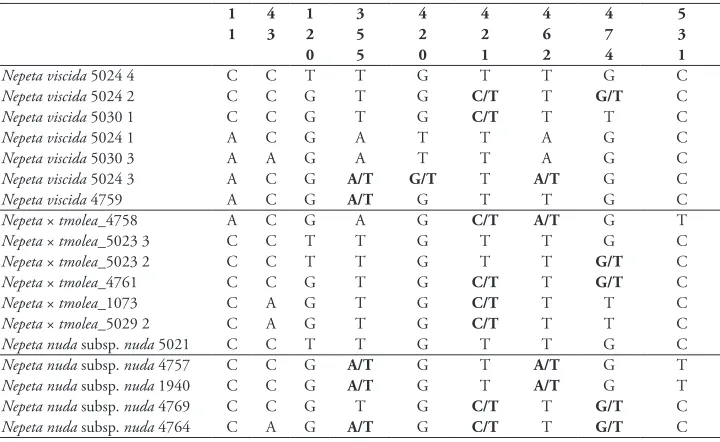
In total, 21 taxa were sequenced for the ITS sequence matrix. In the parsimony heuris-tic search, consistency, retention and homoplasy indices were identified as 0.75, 0.78 and 0.25, respectively. According to Fig. 2, N. viscida and N. nuda subsp. nuda are sister taxa and belong to the same clade in comparison to other Group A members with a strong bootstrap value (86). When Fig. 1B is analysed, the N. viscida-N. nuda subsp. nuda group has a close relationship with N. kurdica Hausskn. & Bornm., N. fissa C.A.Mey, N. scrophularioides Rech.f. and N. lamiifolia Adam ex G.F.Hoffm. When the nrITS sequences of N. × tmolea and its parents are compared, N. × tmolea has 8 single nucleotide polymorphisms (Table 2). As mentioned above, N. × tmolea has some intermediate characters between its parents, such as leaf size and indumentum density, and our DNA data contribute further with the morphological characters. N. nuda subsp. nuda (1940) and N. nuda subsp. nuda (4764 and 4769) individuals (distribut-ing in Ödemiş, see Table 1) differed the specimens from Balıkesir-Dursunbey (4757 and 5021). Thus, nrITS data also gave us intra-individual differentiations.
Figure 2. Phylogenetic position of N. viscida and N. nuda subsp. nuda amongst different Nepeta species and outgroups (based on nrITS sequences and Maximum Likelihood phylogram (A) and Neighbour-Net Diagram (B) without hybrids.(* examined taxa in this study).
Table 2. Separated loci of N. viscida, N. nuda subsp. nuda and N. × tmolea based on nrITS data.
1 4 1 3 4 4 4 4 5
1 3 2 5 2 2 6 7 3
0 5 0 1 2 4 1
Nepeta viscida 5024 4 C C T T G T T G C
Nepeta viscida 5024 2 C C G T G C/T T G/T C
Nepeta viscida 5030 1 C C G T G C/T T T C
Nepeta viscida 5024 1 A C G A T T A G C
Nepeta viscida 5030 3 A A G A T T A G C
Nepeta viscida 5024 3 A C G A/T G/T T A/T G C
Nepeta viscida 4759 A C G A/T G T T G C
Nepeta × tmolea_4758 A C G A G C/T A/T G T
Nepeta × tmolea_5023 3 C C T T G T T G C
Nepeta × tmolea_5023 2 C C T T G T T G/T C
Nepeta × tmolea_4761 C C G T G C/T T G/T C
Nepeta × tmolea_1073 C A G T G C/T T T C
Nepeta × tmolea_5029 2 C A G T G C/T T T C
Nepeta nuda subsp. nuda 5021 C C T T G T T G C
Nepeta nuda subsp. nuda 4757 C C G A/T G T A/T G T
Nepeta nuda subsp. nuda 1940 C C G A/T G T A/T G T
Nepeta nuda subsp. nuda 4769 C C G T G C/T T G/T C
Nepeta nuda subsp. nuda 4764 C A G A/T G C/T T G/T C
and backcrossing amongst the parents and N. × tmolea. Additionally, it can be seen from the Table 1 that, not only studied N. viscida members (7 specimens), but also N. nuda subsp. nuda (5 specimens) members have heterozygous structures, not only constant characters, at the given nucleotide positions.
putative hybrid specimens share the same clade at clades 4 and 5, N. nuda subsp. nuda and N. × tmolea are more similar at clades 2 and 3. Therefore, it can be considered that the phylogenetic position of N. × tmolea is not constant and that ancestral spe-cies show transitions in different clades. When the hybrid individuals are not included in the phylogenetic analysis, N. viscida and N. nuda subsp. nuda tend to be closer to individuals of their own species, but ancestral species are divided into different clades after adding hybrid sequences in the analysis.
Chloroplast DNA data
rpl32-trnL and trnL-F DNA regions were examined from the chloroplast genome. The longest data of studied regions were obtained from rpl32-trnL sequences. A total of 891 nucleotides were obtained from 29 specimens belonging to the parents and hybrid taxa; 855 of 891 characters were constant and parsimony-informative characters were 31. On the other hand, 847 characters were obtained from 32 specimens belonging to the parents and hybrid taxa, 833 of which were constant and 10 characters of the rest of the sequences were parsimony-informative for the trnL-F region.
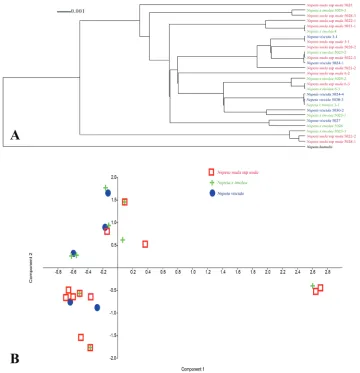
When we analyse Fig. 4, the phylogenetic tree and PCA diagram show us the tran-sition amongst the species and hybrid individuals. This means that neither N. viscida nor N. nuda subsp. nuda specimens are monophyletic. Some clades have only one pu-tative ancestor and hybrid and some of them have parents and hybrid taxa. These three taxa are mixed together and grouped at different clades in the cladogram (Fig. 4A) or at different regions in the PCA diagram (Fig. 4B). In addition, three N. × tmolea samples have completely similar DNA sequences with three N. nuda subsp. nuda samples and this can also be seen from the PCA diagram (with black arrows) (Fig. 4B).
Figure 4. Dendroscope cladogram and PCA diagram based on rpl32-trnL data.
Single nucleotide polymorphisms (SNPs) were mostly seen in rpl32 data. G-T polymorphisms at positions 22, 41, 135, A-G polymorphisms at positions 24, 160, 311, A-C polymorphisms at positions 45, 331, 334 and C-T polymorphism at position 758 are significant for distinguishing specimens. Insertion-deletion sites are very significant, especially at the nucleotide positions between 140–150, 312–314, 325–328, 340–353, 603–608 and the longest one between positions 764–810 (Fig. 5).
Figur
e 5.
Inser
tions, deletions and single nucleotide polymorphisms based on
rpl
32-tr
n
L sequences.
Figur
e 6.
Inser
tions, deletions and single nucleotide polymorphisms based on
tr
n
Conclusions
Possible hybridisation between N. nuda subsp. nuda and N. viscida was estimated by Boissier (1859) for the first time but N. × tmolea was not presented as a hybrid. Ac-cording to morphological studies, although general habitus, calyx and leaf characters of N. × tmolea are more similar to N. viscida, its indumentum (especially glandular trichome) is very different and separated. Molecular data overlaps with morphological data. As in the morphological data, hybrid individuals have intermediate characters in DNA sequences, and these characters occur as polymorphic loci.
DNA sequences, especially nrITS data, have been used by many scientists to dis-cover the phylogenetic position and relationship of numerous species in literature. In this study, nrITS gave information about SNPs and rpl32-trnL and trnL-F were used to specify the parents’ taxa N. × tmolea. Having some polymorphic loci of N. nuda subsp. nuda (Table 2) has probably caused introgression. Hybrid forming areas (Dur-sunbey and Ödemiş districts) of N. nuda subsp. nuda and N. viscida are mostly con-tacted and formed N. × tmolea. In these hybrid swarm regions, N. × tmolea individuals possibly do backcrossing with its parents. Additionally, because of this backcrossing, some N. nuda subsp. nuda specimens have different nucleotides from the other N. nuda subsp. nuda samples which are the original parental individuals. According to literature, while chloroplast DNA gives us information about maternal or paternal inheritance, this study did not provide a completely reasonable result based on rpl 32-trnL and trnL-F data.
In addition, we could not see logical clustering among the specimens growing in the same location (Dursunbey or Ödemiş), and nrITS data also gave us intra-individ-ual differentiations of N. viscida and N. nuda subsp. nuda.
Acknowledgements
This study was supported by the Balıkesir University Research Foundation Centre (project number: 2017/144). I am also very appreciative to Dr. Tuncay Dirmenci for helping to collect plant specimens and his valuable comments on morphological fea-tures and phylogenetic relationships of the species.
References
Açar M, Özcan T, Satıl F, Dirmenci T (2011) A comparative anatomical study on two endemic
Ne-peta L. species (N. baytopii and N. sorgerae). Biological Diversity and Conservation 4: 58–70.
Aytaç Z, Yıldız G (1996) A new record for the Flora of Turkey. Turkish Journal of Botany 20: 385–386.
hybrid zone of Origanum (Lamiaceae) on the island of Crete. Ecology and Evolution 6(24):
8727–8739. https://doi.org/10.1002/ece3.2560
Baumel A, Ainouche ML, Bayer RJ, Ainouche AK, Misset MT (2002) Molecular phylogeny of
hybridizing species from the genus Spartina (Poaceae). Molecular Phylogenetics and
Evolu-tion 22(2): 303–314. https://doi.org/10.1006/mpev.2001.1064
Boissier PE (1859) Diagnoses Plantarum Orientalium Novarum vol. 2(4). Liepzig & Paris, 146 pp.
Clevinger JA, Panero JL (2000) Phylogenetic analysis of Silphium and subtribe
Engelmannii-nae (Asteraceae: Heliantheae) based on ITS and ETS sequence data. American Journal of
Botany 87(4): 565–572. https://doi.org/10.2307/2656600
Dirmenci T (2003) Taxonomical researches on Nepeta L. (Lamiaceae) species growing in
Tur-key. PhD Thesis, Balıkesir University, Balıkesir.
Dirmenci T (2005) A new subspecies of Nepeta (Lamiaceae) from Turkey. Botanical Journal of
the Linnean Society 147(2): 229–233. https://doi.org/10.1111/j.1095-8339.2005.00355.x
Dirmenci T, Yazıcı T, Özcan T, Çelenk Ç, Martin E (2018a) A new species and a new natural
hybrid of Origanum L. (Lamiaceae) from the west of Turkey. Turkish Journal of Botany 42:
73–90. https://doi.org/10.3906/bot-1704-35
Dirmenci T, Özcan T, Yazıcı T, Arabacı T, Martin E (2018b) Morphological, cytological, pa-lynological and molecular evidence on two new hybrids: An example of homoploid
hybrid-ization in Origanum (Lamiaceae). Phytotaxa 371(3): 145–167. https://doi.org/10.11646/
phytotaxa.371.3.1
Dirmenci T, Özcan T, Açar M, Arabacı T, Yazıcı T, Martin E (2019a) A rearranged homoploid
hybrid species of Origanum (Lamiaceae): O. × munzurense Kit Tan & Sorger. Botany
Let-ters 166(2): 153–162. https://doi.org/10.1080/23818107.2019.1585283
Dirmenci T, Özcan T, Arabacı T, Çelenk S, İsmailova G, Yıldız B (2019b) Hybridization among
three Cirsium (Asteraceae) species and important evidence for three new hybrids from
Turkey. Turkish Journal of Botany 43(3): 366–385. https://doi.org/10.3906/bot-1806-53
Ecevit-Genç G, Özcan T, Dirmenci T (2015) Micromorphological characters on nutlet and leaf
indumentum of Teucrium sect. Teucrium (Lamiaceae) in Turkey. Turkish Journal of Botany
39: 439–448. https://doi.org/10.3906/bot-1406-18
Ecevit-Genç G, Özcan T, Dirmenci T (2017) Nutlet and leaf micromorphology in some Turkish
species of Teucrium L. (Lamiaceae). Phytotaxa 312(1): 71–82. https://doi.org/10.11646/
phytotaxa.312.1.5
Ecevit-Genç G, Özcan T, Dirmenci T (2018) Leaf indumentum in some Turkish species of Teucrium (Lamiaceae). Istanbul Journal of Pharmacy 48: 6–11.
Güner A, Özhatay N, Ekim T, Başer KHC (2000) Flora of Turkey and the East Aegean Islands. Edinburgh: Edinburgh University Press, Vol. 11.
Hall TA (1999) BioEdit: a user-friendly biological sequence alignment editor and analysis pro-gram for Windows 95/98/NT. Nucleic Acids Symposium Series 41: 95–98.
Hammer Q, Harper DAT, Ryan PD (2001) Past: Paleontological statistics software package for education and data analysis. Palaeontologia Electronica 4: 1–9.
Hebert PDN, Cywinska A, Ball SL, DeWaard JR (2003) Biological identifications through DNA barcodes. Proceedings of the Royal Society of London. Series B, Biological Sciences
Hedge IC (1986) Lamiaceae of south-west Asia: Diversity, distribution and endemism.
Proceedings of the Royal Society of Edinburgh 89: 23–25. https://doi.org/10.1017/
S0269727000008873
Hedge IC, Lamond JM (1982) Nepeta L. In: Davis PH (Ed.) Flora of Turkey and East Aegean
Islands, Vol. 7. Edinburgh University Press, Edinburgh, 264–288.
Husain SZ, Marin PD, Šilić Č, Qaiser M, Petcović B (1990) A micromorphological study of some representative genera in the tribe Saturejeae (Lamiaceae). Botanical Journal of the
Linnean Society 103(1): 59–80. https://doi.org/10.1111/j.1095-8339.1990.tb00174.x
Huson DH, Bryant D (2006) Application of Phylogenetic Networks in Evolutionary
Stud-ies. Molecular Biology and Evolution 23(2): 254–267.
https://doi.org/10.1093/mol-bev/msj030
Huson DH, Scornavacca C (2012) Dendroscope 3- An interactive viewer for rooted
phyloge-netic trees and networks. Systematic Biology 61(6): 1061–1067. https://doi.org/10.1093/
sysbio/sys062
Jamzad Z, Harley MM, Ingrouille M, Simmonds MSJ, Jalili A (2000) Pollen exine and nutlet
surface morphology of the annual species of Nepeta L. (Lamiaceae) in Iran. In: Harley
MM, Morton GM, Blackmore S (Eds) Pollen and Spores: Morphology and Biology. Royal Botanic Gardens, Kew, 385–397.
Jamzad Z, Chase MW, Ingrouille M, Simmonds MSJ, Jalili A (2003a) Phylogenetic
relation-ships in Nepeta L. (Lamiaceae) and related genera based on ITS sequence data. Taxon
52(1): 21–32. https://doi.org/10.2307/3647435
Jamzad Z, Ingrouille M, Simmonds MSJ (2003b) Three new species of Nepeta (Lamiaceae)
from Iran. Taxon 52(1): 93–98. https://doi.org/10.2307/3647304
Jaźwa M, Jedrzejczak E, Klichowska E, Pliszko A (2018) Predicting the potential distribution
area of Solidago × niederederi (Asteraceae). Turkish Journal of Botany 42: 51–56. https://
doi.org/10.3906/bot-1703-17
Jedrzejczyk I (2018) Study on genetic diversity between Origanum L. species based on
ge-nome size and ISSR markers. Industrial Crops and Products 126: 201–207. https://doi.
org/10.1016/j.indcrop.2018.10.010
Kaya A, Demirci B, Başer KHC (2007) Micromorphology of glandular trichomes of Nepeta
congesta Fisch. & Mey. var. congesta (Lamiaceae) and chemical analysis of the essential oils.
South African Journal of Botany 73(1): 29–34. https://doi.org/10.1016/j.sajb.2006.05.004
Kokubugata G, Kurihara T, Hirayama Y, Obata K (2011) Molecular Evidence for a Natural
Hybrid Origin of Ajuga × mixta (Lamiaceae) Using ITS Sequence. Bulletin of the National
Museum of Nature and Science. Series B, Botany 37: 175–179.
Kolalite MR (1988) Comparative analysis of ultrastructure of glandular trichomes in two
Nepe-ta caNepe-taria chemotypes (N. cataria and N. cataria var. citriodora). Nordic Journal of Botany
18(5): 589–598. https://doi.org/10.1111/j.1756-1051.1998.tb01542.x
Krawczyk K, Głowacka G (2015) Nutlet micromorphology and its taxonomic utility in
La-mium L. (Lamiaceae). Plant Systematics and Evolution 301(7): 1863–1874. https://doi.
org/10.1007/s00606-015-1199-9
Kress WJ, Erickson DL (2007) A two-locus global DNA barcode for land plants: The coding rbcL gene complements the non-coding trnH-psbA spacer region. PLoS One 2(6): e508.
Liu Q, Liu H, Wen J (2017) Relationships between Sorghum bicolor (Poaceae) and its close relatives based on genomic in situ hybridization evidence. Turkish Journal of Botany 41:
11–24. https://doi.org/10.3906/bot-1606-8
Lowe AJ, Abbott RJ (2004) Reproductive isolation of a new hybrid species, Senecio
ebora-censis Abbott & Lowe (Asteraceae). Heredity 92(5): 386–395. https://doi.org/10.1038/ sj.hdy.6800432
Mojab F, Nickavar B, Hooshdar TH (2009) Essential Oil Analysis of Nepeta crispa and N.
men-thoides from Iran. Iranian Journal of Pharmaceutical Research 5: 43–46.
Özcan T (2019) Micromorphological comparison of Nepeta viscida, N. nuda subsp. nuda and
their putative hybrids N. × tmolea. Journal of Institute of Science and Technology 21: 30–42.
Pojarkova AI (1954) Nepeta L. In: Shishkin BK (Ed.) Flora of The U.S.S.R., Vol. 20. Academy
Science of the U.S.S.R., Moskva-Leningrad, 191–293.
Sajna M, Sunojkumar P (2018) Trichome micromorphology and its systematic significance in
Asian Leucas (Lamiaceae). Flora 242: 70–78. https://doi.org/10.1016/j.flora.2018.03.007
Shaw J, Lickey EB, Schilling EE, Small RL (2007) Comparison of whole chloroplast genome se-quences to choose noncoding regions for phylogenetic studies in angiosperms: The tortoise
and the hare III. American Journal of Botany 94(3): 275–288. https://doi.org/10.3732/
ajb.94.3.275
Stanford AM, Harden R, Parks CR (2000) Phylogeny and biogeography of Juglans
(Juglandace-ae) based on matK and ITS sequence data. American Journal of Botany 87(6): 872–882.
https://doi.org/10.2307/2656895
Swofford DL (2003) PAUP*. Phylogenetic analysis using parsimony (* and other methods). Version 4. Sinauer Associates, Sunderland.
Szczecińska M, Łazarski G, Bilska K, Sawicki J (2017) The complete plastid genome and
nu-clear genome markers provide molecular evidence for the hybrid origin of Pulsatilla ×
hackelii Pohl. 41: 329–337.
Taberlet P, Gielly L, Pautou G, Bouvet J (1991) Universal primers for amplification of three noncoding regions of chloroplast DNA. Plant Molecular Biology 17(5): 1105–1109.
https://doi.org/10.1007/BF00037152
Tzakou O, Haruda C, Galati EM, Sanogo R (2000) Essential Oil Composition of Nepeta
argol-ica Bory et Chaub. subsp. argolica. Flavour and Fragrance Journal 15(2): 115–118. https://
doi.org/10.1002/(SICI)1099-1026(200003/04)15:2<115::AID-FFJ877>3.0.CO;2-9
Van Valkenburg JLCH, Schoenenberger N, van de Vossenberg BTLH, Man in’t Veld WA,
Westenberg M, Boer E (2018) A natural hybrid of Impatiens, in the introduced range,
demonstrated by sequence analysis of the nuclear ribosomal DNA-gene repeat. Botany
Letters 166(2): 144–152. https://doi.org/10.1080/23818107.2019.1584863
White TJ, Bruns T, Lee S, Taylor J (1990) Amplification and direct sequencing of fungal ri-bosomal RNA genes for phylogenetics. In: Innis MA, Gelfand DH, Sninsky JJ, White TJ (Eds) PCR Protocols: a guide to methods and applications. Academic Press, New York,
315–322. https://doi.org/10.1016/B978-0-12-372180-8.50042-1
Yarmoohammadi M, Talebi SM, Nohooji MG (2017) Infraspecific variations in essential oil
and glandular trichomes in Nepeta heliotropifolia. Biodiversitas (Surakarta) 18(3): 964–