Camellia debaoensis
(Theaceae), a new species of yellow
camellia from limestone karsts in southwestern China
Renchuan Hu1, Sujuan Wei2, Yongqing Liufu3, Yunkai Nong1, Wei Fang4
1 Guangxi Institute of Chinese Medicine and Pharmaceutical Science, Nanning, Guangxi 530022, China 2 Guangxi Institute of Botany, Guangxi Zhuang Autonomous Region and the Chinese Academy of Sciences, Guilin, Guangxi 541006, China 3 Guangxi Museum of Natural History, Nanning, Guangxi 530012, China 4 Kunming Institute of Botany, Chinese Academy of Sciences, Kunming, Yunnan 650201, China
Corresponding author:Yongqing Liufu ([email protected])
Academic editor:C. Morden | Received 8 August 2019 | Accepted 1 October 2019 | Published 28 November 2019
Citation: Hu R, Wei S, Liufu Y, Nong Y, Fang W (2019) Camellia debaoensis (Theaceae), a new species of yellow camellia from limestone karsts in southwestern China. PhytoKeys 135: 49–58. https://doi.org/10.3897/phytokeys.135.38756
Abstract
Camellia debaoensis R.C.Hu & Y.Q.Liufu, sp. nov. is described and illustrated as a new species from
southwestern Guangxi, China. It is morphologically similar to Camellia pubipetala Y. Wan & S. Z. Huang,
C. mingii S.X. Yang and C. tuyenquangensis D.V. Luong, N.N.H. Le & N. Tran, but it differs from these species in having glabrous young branches, glabrous petiole, glabrous sepals, glabrous petals, glabrous stamens and glabrous ovary, 10 petals, cylindrical ovary and style 3-lobed to 1/6 style length.
Keywords
Camellia, China, limestone flora, taxonomy, Theaceae
Introduction
Guangxi Zhuang Autonomous Region of southern China is an area noted for its karst landscapes (Hou et al. 2010). The limestone region in southwestern Guangxi harbors very high levels of biological diversity and is recognized as one of 20 centers of plant endemism in China (Myers et al. 2000, López-Pujol et al. 2011). Yellow camellia, a sub-group of Camellia (Theaceae), are characterized by yellow, waxy and shiny petals (Chang and Ren 1998). Because of their beautiful flowers and useful chemical constituents, yel-low camellias have considerable economic value in breeding, as well as traditional Chi-nese medicine and commercial tea production (He et al. 2016). Before 2007, fewer than
http://phytokeys.pensoft.net
Copyright Renchuan Hu et al. This is an open access article distributed under the terms of the Creative Commons Attribution License (CC BY 4.0), which permits unrestricted use, distribution, and reproduction in any medium, provided the original author and source are credited.
20 yellow camellias from China were recognized, according to the literatures (Ye and Xu 1992; Chang and Ren 1998; Min 2000; Min and Bruce 2007). Most of them are only distributed in southwestern Guangxi, which had been considered as a center of diversity of the yellow camellia. In recent years, many new species of yellow camellia have been reported from northern Vietnam and southern China (e.g. Tran and Nguyet 2005; Orel 2006; Orel and Wilson 2010, 2012; Orel et al. 2012, 2013, 2014a, b; Tran et al. 2012; Tran and Luong 2013; Huang et al. 2014; Orel and Curry 2015; Tran and Le 2015; Luu et al. 2015; Dung et al. 2016; Luong and Le 2016; Luong et al. 2016a, b; Le et al. 2017; Nguyen et al. 2018; Liu et al. 2019), increasing the total to more than 50 species (Tran et al. 2019) and making northern Vietnam another center of yellow camellia diversity. Generally, yellow camellias are rare and highly endemic due to their small population, narrow distribution and excessive gathering. Recently, almost all Chinese yellow camellia species were categorized as Critically Endangered, Endangered, or Vulnerable species in the Threatened Species List of China’s Higher Plants (Qin et al. 2017).
During our floristic survey in limestone karsts of Debao County, southwestern Guangxi, in 2015, we collected several specimens from a population of Camellia with yellow flowers. In the following three years, this population was documented for flow-ering and fruiting regularly at the same locality. Morphological comparison between the newly collected specimens and other yellow camellias suggested that the specimens from Debao differed from all the previously described species. Therefore, we here de-scribe this material as a new species.
Materials and methods
Several specimens were collected at the entrance of one of the karst caves of Debao County, Jingde Town, Tuoliang village from 2015 to 2018, and were deposited in the herbaria GXMI, IBK, NHMG, KUN. The morpho-photographs of the plants were taken with a Panasonic LX100 camera. This material was confirmed as a new spe-cies based on detailed comparison with all other heretofore known yellow camellias, including specimens deposited at PE, KUN, IBSC, IBK, GXMI, HIB, SYS, GXMG, and description from botanical websites (e.g. http://www.cvh.ac.cn/, https://plants. jstor.org/). Herbarium acronyms follow Thiers (2018). The morphological characters were measured using M & G ARL96004.
Taxonomic treatment
Camellia debaoensis R.C.Hu & Y.Q.Liufu, sp. nov.
urn:lsid:ipni.org:names:77203187-1 Figs 1, 2
N. Tran, but it differs from these species in having glabrous young branches, glabrous petiole, glabrous sepals, glabrous petals, glabrous stamens and glabrous ovary, 10 pet-als, cylindrical ovary and 3-lobed to 1/6 style length.
Type. China. Guangxi Zhuang Autonomous Region: Debao County, Jingde Town, Tuoliang village, at the entrance of one of karst caves, rare, 23°29'23.12"N, 106°9'47.27"E, 760 m a.s.l., 13 January 2017 (fl.), R.C. Hu HRC170113002 (holo-type: GXMI!, isotypes: GXMI!, KUN!, NHMG! and IBK!).
Description. Shrubs, 1–3 m tall. Young branches cylindrical, thick, glabrous, yellow-ish brown or grayyellow-ish brown, and current year branchlets purplyellow-ish red. Leaf blade leathery, ovate to long ovate, 6–13 × 3–5 cm, adaxial surface dark green and glabrous, abaxial surface pale green, brown glandular punctuate and veins sparsely spreading villous, veins abaxially elevated and adaxially impressed, secondary veins 5–6 on each side of midvein and con-nected at the proximal edge, base cuneate to broadly cuneate, apex caudate tip, margin serrulate; petiole 5–12 mm long, glabrous. Flowers subterminal axillary, solitary, 3–4.5 cm diam. Pedicel ca. 4(–6) mm long, thick; bracteoles 4 (or 5), unequal, 1–3 × 2–4 mm, ap-pressed and covering pedicel, oval-triangle, leathery, green and glabrous, margin ciliolate. Sepals 5 (–6), semiorbicular to broadly ovate, 3–5 × 5–8 mm, leathery, glabrous, lightly yellow and occasionally with pink patches, fruiting stage green, margin ciliolate. Petals 10, in three whorls of 3–4 petals, golden yellow, glabrous; outer 3 or 4 petals suborbicular, occasionally with pink patches, 0.7–1.1 × 1 cm; inner orbicular-ovate or oval, 1.2–1.8 × 1.2–2.6 cm, basally connate for 1–3 mm. Stamens numerous, glabrous, ca. 2 cm long; anthers ca. 3 × 1mm; outer filaments connate ca. basal 1/4, ca. 1.6 cm, inner filaments nearly distinct, ca. 1.7 cm. Ovary cylindrical, ca. 2 mm in diam., glabrous, 3-loculed; style 2 cm long, glabrous, base connate, apex 3-lobed to 1/6 style length. Capsule triangle oblate, glabrous, 1.4–1.6 × 1.6–2.8 cm; Seeds brown, hemispherical, pubescent.
Phenology. Flowering from December to February of the next year; fruiting from July to August.
Distribution and habitat.Camellia debaoensis grows at the entrance of one of the limestone caves in the karst region of Debao County (Fig. 3), Guangxi, China, ac-companied by Ageratina adenophora (Sprengel) R. M. King & H. Robinson (Composi-tae), Boehmeria penduliflora Wedd. ex Long (Urticaceae), Fallopia multiflora (Thunb.) Harald (Polygonaceae), Flueggea virosa (Roxb. ex Willd.) Voigt (Euphorbiaceae), Pteris vittata L. (Pteridaceae), Ficus tikoua Bur (Moraceae), and Pueraria montana (Lour.) Merr. var. lobata (Willd.) Maesen et S. M. Almeida ex Sanjappa et Predeep (Fabaceae).
Conservation status. According to currently available data, Camellia debaoensis
is only found in its type locality and there are only nine adult trees and four saplings, with the distribution restricted to a very limited region (less than 200 m2). Considering
this situation, we consider Camellia debaoensis as ‘Critically Endangered’ (CR) based on the IUCN categories and criteria (IUCN 2017).
Figure 1.Camellia debaoensis R.C.Hu & Y.Q.Liufu, sp. nov. A flowering branch B lateral view of flower
C fruit and style D fruit, sepals and bracteoles E stamen F pistil. Drawn by Xincheng Qu.
Etymology. The specific epithet is derived from the type locality, Debao County, Guangxi.
Figure 2.Camellia debaoensis R.C.Hu & Y.Q.Liufu, sp. nov. A habit B flowering branch C face view of
flower D fruit, sepals and bracteoles E fruiting branch F pistil. Photographed by Renchuan Hu.
Tab
le 1.
M
orphological comparison of
C. debaoensis
with other y
ello
w camellias with connate style. D
ata fr
om M
in and B
ruce (2007), O
rel and
W
ilson (2010),
O
rel et al. (2013, 2014a), L
uong et al. (2016a, b), Le et al. (2017), Liu et al. (2019).
Tax on Section Leaf shape, leaf siz e
Pedicel length
N
o. of bracts
N
o. of petals
Style, extent to which
cleft, hairiness Ov ar y, carpels, hairiness Filaments morphology C. capitata C apitatae
Elliptic to o
val, 24.0–27.0 × 10.0–12.0 cm
Sessile
8–10
6
Apex 3-lobed, apically cleft for 1–2 mm, glabr
ous
3-carpellate, glabr
ous
G
labr
ous, outer filaments
basally attached to inner petals
for ca. 10 mm
C. luteocer
ata
D
alatia
Elliptic to br
oadly elliptic, 22.0–27.5 × 9.0–11.0 cm
Sessile
6
11–13
Apex 5-lobed, apically cleft to 1/3 style length,
glabr
ous
5-carpellate, glabr
ous
G
labr
ous, filaments basally
connate for 1/3 of their length, and par tially joined to the inner petals
C. bugiamapensis
D
alatia
Elliptic, o
val to widely elliptic, 18.0–27.5 × 12.0–14.0 (–15.0) cm
Sessile
7
9–11
Apex 5-lobed, apically shortly lobed, white hairs 5–6-carpellate, glabr
ous
G
labr
ous, outer filaments
basally attach to inner petals for
20–25 mm
C. luteopallida
D
alatia
Elliptic to o
vate, 16.0–20.0 × 5.0–9.0 cm
Sessile
6–9
12–14
Apex 3-lobed, apically cleft 3–6 mm, dense white hairs 3-carpellate, glabr
ous
Spar
ely hair
y, filaments basally
united to each other to form a
10–13 mm fleshy tube
C. tuy enquangensis Chr ysantha O blong o
vate to narr
ow elliptic, 14.0–18.0 ×
5.0–8.0 cm
10 mm
4–5
12
Apex 3-lobed, apically cleft to 1/2 style length,
glabr
ous
3-carpellate, glabr
ous
G
labr
ous, outer filament whole
basally connate for 10–14 mm,
adnate to petal base
C. thuongiana
Chr
ysantha
Elliptic to oblong elliptic, 9.0–17.0 ×
4.0–6.5 cm
8–10 mm
3–4
11–13
Apex 3-lobed, apically cleft to 1/2 style length,
glabr
ous
3-carpellate, pubescent
G
labr
ous, outer filaments
basally connate for 4–5 mm
C. oconoriana
Chr
ysantha
N
arr
owly elliptic, 30.0–36.5 × 8.0–8.5 cm
30–40 mm
6
6
Apex 3–5-lobed, apically cleft 9–11 mm, finely hair
y pr
oximally
, glabr
ous
distally
4–5-carpellate, densely tomentose
G
labr
ous, outer filaments
basally connate for ca. 6 mm
C. pubipetala
Ster
eocarpus
Elliptic to o
vate, 10.0–17.0 × 5.0–8.0 cm
Subsessile
(4–)6–8
9–13
Apex 3(or 4)-lobed,
apically cleft 5–10 mm,
tomentose 3(or 4)-loculed, yello wish tomentose D istinct par
t pilose, outer
filament whorl basally connate
for ca. 1/3 of its length
C. mingii
Ster
eocarpus
Elliptic-o
vate to narr
owly o
vate, 10.0–15.0 ×
4.0–6.0 cm
3–6 mm
4 or 5
12 or 13
Apex 3-lobed, apically cleft ca.2–3 mm, glabr
ous or
sparsely pubescent
3-carpellate, densely
tomentose
Puber
ulent, outer filaments
basally connate for ca. 1/2 of
their length
C. debaoensis
Ster
eocarpus
Ov
al to long o
val, 6.0–13.0 × 2.5–5.0 cm
4(–6) mm
4 (or 5)
10
Apex 3-lobed, apically cleft to 1/6 style length,
glabr
ous
3-carpellate, glabr
ous
G
labr
ous, outer filaments
basally connate for ca. 1/4 of
Camellia debaoensis resembles many other yellow-flowering camellia species with connate style, such as Camellia pubipetala Y. Wan & S.Z. Huang, C. mingii S.X. Yang,
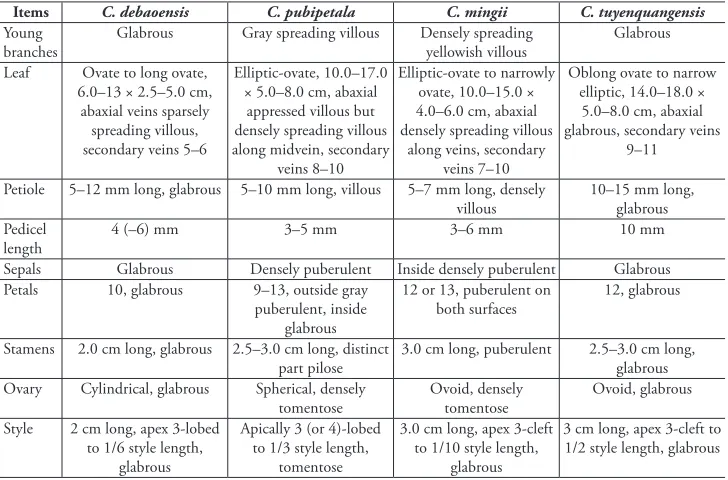
C. tuyenquangensis D.V. Luong, N.N.H. Le & N. Tran, C. oconariana Orel, Curry & Luu, C. thuongiana Luong, Anna Le & Lau, C. luteocerata Orel, C. luteopallida Luong, T.Q.T. Nguyen & Luu, C. bugiamapensis Orel, Curry, Luu & Q.D. Nguyen and C. capitata Orel, Curry & Luu. These species are placed in various sections within the ge-nus including sections Stereocarpus Chang, Chrysantha Chang, Dalatia Orel and Capi-tatae Orel (Table 1). A key to identifying species of yellow camellia with connate style is provided below. Of these species, the new species is more similar to C. pubipetala, C. mingii, C. tuyenquangensis than to other species by sharing small leaflets, subterminal axillary flowers, 9–13 petals, differentiated bracts, outer filament whorl basally con-nate, 3-locular ovary, connate style. However, it is well distinguished from these species in having glabrous young branches, glabrous petiole, glabrous sepals, glabrous petals, glabrous stamens and a glabrous ovary (vs. villous in C. pubipetala and C. mingii), 10 petals (vs. 9–13 in C. pubipetala, 12–13 in C. mingii and 12 in C. tuyenquangensis), cy-lindrical ovary (vs. ovoid in C. mingii and C. tuyenquangensis, spherical in C. pubipetal) and style 3-lobed to 1/6 style length (vs. 3 (or 4)-cleft to 1/3 style length in C. pubi-petala, 3-cleft to 1/10 style length in C. mingii, 3-cleft to 1/2 style length in C. tuyen-quangensis). The comparisons between C. debaoensis and these species are provided in Table 2. Based on hairs, lamina length, flower size, number of carpels and other char-acteristics, the new species is also a taxonomic entity distinct from C. oconariana, C. thuongiana, C. luteocerata, C. luteopallida, C. bugiamapensis and C. capitata (Table 1).
Table 2. Morphological comparison of C. debaoensis with C. pubipetala, C. mingii and C. tuyenquangensis.
Items C. debaoensis C. pubipetala C. mingii C. tuyenquangensis
Young
branches Glabrous Gray spreading villous Densely spreading yellowish villous Glabrous Leaf Ovate to long ovate,
6.0–13 × 2.5–5.0 cm, abaxial veins sparsely spreading villous, secondary veins 5–6
Elliptic-ovate, 10.0–17.0 × 5.0–8.0 cm, abaxial
appressed villous but densely spreading villous along midvein, secondary
veins 8–10
Elliptic-ovate to narrowly ovate, 10.0–15.0 × 4.0–6.0 cm, abaxial densely spreading villous
along veins, secondary veins 7–10
Oblong ovate to narrow elliptic, 14.0–18.0 ×
5.0–8.0 cm, abaxial glabrous, secondary veins
9–11
Petiole 5–12 mm long, glabrous 5–10 mm long, villous 5–7 mm long, densely
villous 10–15 mm long, glabrous Pedicel
length 4 (–6) mm 3–5 mm 3–6 mm 10 mm
Sepals Glabrous Densely puberulent Inside densely puberulent Glabrous Petals 10, glabrous 9–13, outside gray
puberulent, inside glabrous
12 or 13, puberulent on
both surfaces 12, glabrous
Stamens 2.0 cm long, glabrous 2.5–3.0 cm long, distinct
part pilose 3.0 cm long, puberulent 2.5–3.0 cm long, glabrous Ovary Cylindrical, glabrous Spherical, densely
tomentose Ovoid, densely tomentose Ovoid, glabrous Style 2 cm long, apex 3-lobed
to 1/6 style length, glabrous
Apically 3 (or 4)-lobed to 1/3 style length,
tomentose
3.0 cm long, apex 3-cleft to 1/10 style length,
glabrous
Key to identification of species of yellow camellia with connate style
1 Ovary 3 carpellate, style 3-parted; if ovary 3 (or 4) carpellate, style 3 (or 4)-parted, young branches and leaves spreading villous (C. pubipetala) ..2 – Ovary 4–6 carpellate, style (3–) 4–6-parted ...8 2 Petals 9–14 ...3 – Petals 6 ...C. capitata
3 Young branches, petiole, petals, stamens, ovary and style piliferous ...4 – Young branches, petiole, petals, stamens, ovary and style glabrous ...5 4 Petals puberulent on both sides, suborbicular ...C. mingii
– Petals adaxial puberulent, inside glabrous, elliptic ...C. pubipetala
5 Petals with dense appressed brown hairs; style with dense white appressed hairs ...C. luteopallida
– Petals and style glabrous ...6 6 Leaf 6–13 × 2.5–5 cm, abaxial veins sparsely spreading villous, secondary
veins 5–6; ovary cylindrical; style apex 3-lobed to 1/6 the length of style ... ...C. debaoensis
– Leaf glabrous; style apex 3-cleft to 1/2 the length of style ...7 7 Stamens 2.5–3 cm long; style 30 mm long ...C. tuyenquangensis
– Stamens 1.3–1.4 cm long; style 8–9 mm long ...C. thuongiana
8 Leaf secondary veins 8–11; pedicel sessile, 1–5 mm long ...9 – Leaf secondary venation 24 pairs; pedicel 30–40 mm long ....C. oconoriana
9 Petals 9–11, with margins sparsely ciliate; style finely tomentose ... ...C. bugiamapensis
– Petals 11–13, outer 5-petaloid concave; style glabrous ...C. luteocerata
Acknowledgements
References
Chang HT, Ren SX (1998) Theaceae. In: Wu CY (Ed.) Flora Reipublicae Popularis Sinicae, vol. 49(3). Science Press, Beijing, 101–112.
Dung LV, Son HT, Ninh T, Nhan PH (2016) Camellia quangcuongii (Theaceae), a new species from Vietnam. Shokubutsu Kenkyu Zasshi 91: 226–230.
He DY, Li XY, Wang LL, Zhang P, Li SY, Xu YP (2016) Chemical constituents and pharma-cological effects of Camellia nitidissima. Zhongguo Shiyan Fangjixue Zazhi 22: 231–234. Hou MF, López-Pujol J, Qin HN, Wang LS, Liu Y (2010) Distribution pattern and
conserva-tion priorities for vascular plants in Southern China: Guangxi Province as a case study. Botanical Studies (Taipei, Taiwan) 51: 377–386.
Huang LD, Liang SY, Ye CX (2014) A new species of Camellia from Guangxi, China. Journal Guangdong Landscape Architecture 36: 69–70.
IUCN (2017) Guidelines for using the IUCN red list categories and criteria. Version 13. Pre-pared by the standards and petitions subcommittee.
Le NHN, Uematsu C, Katayama H, Nguyen LT, Tran N, Luong DV, Hoang ST (2017) Ca-mellia tuyenquangensis (Theaceae), a new species from Vietnam. Korean Journal of Plant Taxonomy 47(2): 95–99. https://doi.org/10.11110/kjpt.2017.47.2.95
Liu ZW, Fang W, Liu ED, Zhao M, He YF, Yang SX (2019) Camellia mingii, a new species of yellow camellias from Southeast Yunnan, China. Phytotaxa 393(1): 047–056. https://doi. org/10.11646/phytotaxa.393.1.4
López-Pujol J, Zhang FM, Sun HQ, Ying TS, Ge S (2011) Centres of plant endemism in China: Places for survival or for speciation? Journal of Biogeography 38(7): 1267–1280.
https://doi.org/10.1111/j.1365-2699.2011.02504.x
Luong VD, Le NHN (2016) Camellia ninhii – a new yellow camellia species from Vietnam. International Camellia Journal 48: 117.
Luong VD, Luu HT, Nguyen TQT, Nguyen QD (2016a) Camellia luteopallida (Theaceae), a new species from Vietnam. Annales Botanici Fennici 53(1–2): 135–138. https://doi. org/10.5735/085.053.0224
Luong VD, Le A, Nguyen TH, Nguyen TL (2016b) Camellia thuongiana – A new yellow ca-mellia species from Vietnam. Dalat University Journal of Science 6(3): 338–344.
Luu HT, Luong VD, Nguyen QD, Nguyen TQT (2015) Camellia sonthaiensis (Theaceae), a new species from Vietnam. Annales Botanici Fennici 52(5–6): 289–295. https://doi. org/10.5735/085.052.0502
Min TL (2000) Monograph of the genus Camellia. Yunnan Science & Technology Press, Kum-ming, 78–239.
Min TL, Bruce B (2007) Theaceae. In: Wu ZY, Raven PH, Hong DY (Eds) Flora of China. Science Press (Beijing) and Missouri Botanical Garden Press (St. Louis), 366–478. Myers N, Mittermeier RA, Mittermeier CG, Fonseca GAB, Kent J (2000)
Nguyen LT, Tran N, Chiyomi U, Hironori K, Luong DV, Hoang ST, Nguyen KD, Nguyen HV, Thai TC (2018) Two new species of Camellia (Theaceae) from Vietnam. Korean Jour-nal of Plant Taxonomy 48(2): 115–122. https://doi.org/10.11110/kjpt.2018.48.2.115
Orel G (2006) A new species of Camellia section Piquetia (Theaceae) from Vietnam. Novon 16(2): 244–247. https://doi.org/10.3417/1055-3177(2006)16[244:ANSOCS]2.0.CO;2
Orel G, Curry AS (2015) In pursuit of hidden camellias: 32 New Camellia Species from Viet-nam and China. Theaceae Exploration Associates, Sydney, 339 pp.
Orel G, Wilson PG (2010) Camellia luteocerata sp. nov. and a new section of Camellia ( Dala-tia) from Vietnam. Nordic Journal of Botany 28(3): 281–284. https://doi.org/10.1111/ j.1756-1051.2010.00652.x
Orel G, Wilson PG (2012) Camellia cattienensis: a new species of Camellia (sect. Archaeca-mellia: Theaceae) from Vietnam. Kew Bulletin 66(4): 565–569. https://doi.org/10.1007/ s12225-012-9317-0
Orel G, Wilson PG, Curry AS, Luu HT (2012) Camellia inusitata (Theaceae), a new species forming a new section (Bidoupia) from Vietnam. Edinburgh Journal of Botany 69(2): 347–355. https://doi.org/10.1017/S0960428612000170
Orel G, Wilson PG, Curry AS, Luu HT (2013) Camellia oconoriana (Theaceae), a new species from Vietnam. Edinburgh Journal of Botany 70(3): 439–447. https://doi.org/10.1017/ S0960428613000103
Orel G, Wilson PG, Curry AS, Truong LH (2014a) Four new species and two new sections of Ca-mellia (Theaceae) from Vietnam. Novon 23(3): 307–318. https://doi.org/10.3417/2012076
Orel G, Wilson PG, Luu HT (2014b) Camellia curryana and C. longii spp. nov. (Theaceae) from Vietnam. Nordic Journal of Botany 32(1): 42–50. https://doi.org/10.1111/j.1756-1051.2013.00399.x
Qin HN, Yang Y, Dong SY, He Q, Jia Y, Zhao L, Yu S, Liu H, Liu B, Yan Y, Xiang J, Xia N, Peng H, Li Z, Zhang Z, He X, Yin L, Lin Y, Liu Q, Hou Y, Liu Y, Liu Q, Cao W, Li J, Chen S, Jin X, Gao T, Chen W, Ma H, Geng Y, Jin X, Chang C, Jiang H, Cai L, Zang C, Wu J, Ye J, Lai Y, Liu B, Lin Q, Xue N (2017) Threatened Species List of China’s Higher Plants. Shengwu Duoyangxing 25(7): 696–744. https://doi.org/10.17520/biods.2017144
Thiers B (2018) Index Herbariorum: A global directory of public herbaria and associated staff. New York Botanical Garden’s Virtual Herbarium.
Tran N, Le NHN (2015) A new yellow Camellia species from North Vietnam. International Camellia Journal 47: 36–39.
Tran N, Luong VD (2013) Camellia dilinhensis: A new species from Vietnam. Internal Camel-lia Journal 45: 87–89.
Tran N, Nguyet HN (2005) Camellia hamyenensis: A new yellow species from Vietnam. Inter-nal Camellia JourInter-nal 37: 125–127.
Tran N, Hakoda N, Luong VD (2012) A new species of yellow camellias (Sect. Piquetia) from Vietnam. Internal Camellia Journal 44: 161–162.
Tran DM, Nguyen TT, Hoang TS, Dang VT, Phung DT, Nguyen VT, Dao TD, Mai TL, Vu TL, Nguyen HT, Nguyen TTP, Tran VD (2019) Golden Camellia: A review. Archives of Current Research International 16(2): 1–8. https://doi.org/10.9734/acri/2019/v16i230085