R E S E A R C H
Open Access
Human serum-derived hydroxy long-chain fatty
acids exhibit anti-inflammatory and
anti-proliferative activity
Shawn A Ritchie
1*, Dushmanthi Jayasinghe
1, Gerald F Davies
1,2, Pearson Ahiahonu
1, Hong Ma
1and
Dayan B Goodenowe
1Abstract
Background:Circulating levels of novel long-chain hydroxy fatty acids (called GTAs) were recently discovered in the serum of healthy subjects which were shown to be reduced in subjects with colorectal cancer (CRC), independent of tumor burden or disease stage. The levels of GTAs were subsequently observed to exhibit an inverse association with age in the general population. The current work investigates the biological activity of these fatty acids by evaluating the effects of enriched human serum extracts on cell growth and inflammation. Methods:GTAs were extracted from commercially available bulk human serum and then chromatographically separated into enriched (GTA-positive) and depleted (GTA-negative) fractions. SW620, MCF7 and LPS stimulated RAW264.7 cells were treated with various concentrations of the GTA-positive and GTA-negative extracts, and the effects on cell growth and inflammation determined.
Results:Enriched fractions resulted in poly-ADP ribose polymerase (PARP) cleavage, suppression of NFB, induction of IBa, and reduction in NOS2 mRNA transcript levels. In RAW264.7 mouse macrophage cells, incubation with enriched fractions prior to treatment with LPS blocked the induction of several pro-inflammatory markers including nitric oxide, TNFa, IL-1b, NOS2 and COX2.
Conclusions:Our results show that human serum extracts enriched with endogenous long-chain hydroxy fatty acids possess anti-inflammatory and anti-proliferative activity. These findings support a hypothesis that the reduction of these metabolites with age may result in a compromised ability to defend against uncontrolled cell growth and inflammation, and could therefore represent a significant risk for the development of CRC.
Keywords:Long-chain fatty acid colorectal cancer, aging, screening, inflammation, NFκB
Background
Fatty acid metabolism is intricately linked to the regula-tion of inflammatory processes, which underlie numer-ous diseases including cancer. For example, arachidonic, decosahexanoic and eicosapentanoic acids (AA, DHA and EPA) can be metabolized into both pro-inflamma-tory prostaglandins and leukotrienes, as well as into inflammation-resolving lipoxins, protectins and resolvins [1-3]. The failure to resolve acute inflammation through a lack of conversion to these latter products can result in a chronic inflammatory state, which over time can
drive the development of inflammation-associated con-ditions including cancer, neurodegeneration, and others [4-10]. Functionally, many of these lipids have been shown to mediate their inflammation-associated effects through pathways involving the transcription factor
NFB and subsequent downstream pro-inflammatory
molecules such as TNFa, IL-1b, COX2, and NOS2, for example [11-16].
Recently we reported on a novel class of hydroxylated long-chain fatty acids (called GTAs for gastrointestinal tract acids) present in the serum of healthy subjects and significantly reduced from the serum of colorectal cancer (CRC) patients [17,18]. Structurally, the molecules resem-ble very long chain (28 carbon) mimetics of the resolvins
* Correspondence: [email protected]
1Phenomenome Discoveries, Inc. Saskatoon, Saskatchewan, Canada
Full list of author information is available at the end of the article
and protectins, containing multiple double bonds and at least two hydroxyl groups. The levels of GTAs do not change following treatment and show no correlation with tumor stage, suggesting that the reduction is not caused by the presence of the disease [17,18]. An inverse associa-tion between GTAs and age in the average-risk populaassocia-tion further suggests that the reduction exists prior to cancer development, and may therefore represent a causal factor for the establishment and/or progression of the disease [18]. However, little is currently known about the bio-chemical role these molecules play in the disease process. The work reported herein, therefore, was carried out to investigate the effects of GTAsin vitrothrough the treat-ment of various cell lines with semi-purified GTA-enriched human serum extracts.
Methods
Cell lines and tissue culture
SW620, MCF-7 and RAW264.7 were purchased from ATCC and cultured in high glucose DMEM, 10% FBS at 37°C, 5% CO2. Cells were seeded at 1 × 10⁶/well in
6-well plates 24 hours prior to treatment with varying concentrations of GTA+ve extract, GTA-ve extract or vehicle (DMSO). RAW264.7 cells were pretreated with the extracts for 4 hours followed by the addition of LPS at 1 ug/ml (cat. No. L4391, Sigma) for 20 hours. Cells were harvested using a 2:1 ratio of Versene and TryPLe express (Gibco). The cell pellet was washed twice with phosphate buffered saline (PBS) and the stored at -80°C until extracted. Cell photographs were taken at 200× magnification on a phase-contrast EVOS digital micro-scope. All experiments were performed at least three times in duplicate or triplicate wells.
Serum extraction, chromatography and mass spectrometry
Commercially available lyopholized human serum (Ran-dox Laboratories, Canada) was resolubilized in double de-ionized water. The serum was extracted with 1:5 ratio of 1% ammonium hydroxide:ethyl acetate (Com-mercial grade, VWR) as previously described [17]. Ethyl acetate extracts were evaporated to dryness under reduced pressure (37°C/100 rpm) and re-suspended in methanol. Reverse phase silica (15 - 20 mg; WP C18 silica, 45μm, 275 Å) was added into the serum metha-nol extract and evaporated to complete dryness under reduced pressure (45°C/150 rpm), which was then sub-jected to reverse phase flash column chromatography (FCC) with a step gradient elution; acetonitrile - water 25:75 to 100% acetonitrile. Eluent was fractionated into 12 aliquots (F1 - F12), which were each analysed for GTA content using HPLC-coupled tandem mass spec-trometry on an ABI QSTAR XL mass spectrometer as previously described [17].
Proliferation assays
Cell proliferation was determined using the MTT assay (3-(4,5-dimethylthiazol-2-yl)-2,5-diphenyltetrazolium bromide). Cell suspensions were prepared at a concen-tration of approximately 105 cells per ml as determined by standard hemocytometry, and cultured in 6-well multi-well plates. Prior to MTT analysis, cells were sub-cultured in phenol red-free DMEM medium to avoid interference with the colorimetric analysis of the purple formazan MTT product. Following treatment with serum extracts, cells were treated with MTT followed by washing with PBS, DMSO solubilization of the for-mazan product, and subjected to spectrophotometric analysis at 570 nm.
Protein analysis
Cell pellets were resuspended in ice-cold lysis buffer (20 mM Tris (pH 7.5), 150 mM NaCl, 0.5 mM EDTA, 0.1 mM EGTA, 0.1% NP-40 plus 1X mammalian cell anti-protease cocktail (Sigma)). The cells were lysed using mul-tiple freeze-thaw cycles followed by pulse sonication on ice and centrifugation at 3000 rpm for 5 minutes at 4°C to remove cell debris. Western blot analysis of these pro-tein lysates was performed as previously described [19]. Briefly, equivalent amounts of protein were assessed by Bradford protein assay using BioRad Protein Reagent and resolved by 10% sodium dodecyl sulfate-polyacrylamide gel electrophoresis (SDS-PAGE). Following electrophor-esis the proteins were trans-blotted onto nitrocellulose membranes (Pall-VWR). The membranes were blocked overnight at 4°C on a gyratory plate with 5% molecular grade skim milk powder (BioRad Laboratories) in phos-phate-buffered saline (PBS) containing 0.1% Tween-20 (PBST). Primary and secondary antibody incubations and subsequent washes were carried out in the same buffer. Primary antibodies were obtained from Santa Cruz Bio-technology. The primary antibody for GAPDH was pur-chased from Sigma. Secondary HRP antibodies were purchased from BioRad. Blots were immunoprobed over-night with primary antibodies at a 1:1000 dilution. Sec-ondary HRP antibody was applied at room temperature on a gyratory plate at a concentration of 1:10,000 for 30 min. Following multiple washes, an enhanced chemilumi-nescence detection system (Dupont-NEN) was used to detect the target antigen/antibody complexes. Blots were then stripped at 50°C for 30 minutes in a Tris-buffered 20% SDS/1% 2-mercaptoethanol stripping solution, washed and re-probed with GAPDH antibody (Sigma) to verify protein loading equivalency. For ELISA analysis, raw cells were treated as described above and conditioned medium or cell lysates were used to determine concentra-tions of TNFa(Cat. No. KMC3011, Invitrogen), and IL-1b(Cat. No. MLB00B, Quantikine), according to the man-ufacturer’s instructions.
Ritchieet al.Journal of Experimental & Clinical Cancer Research2011,30:59 http://www.jeccr.com/content/30/1/59
Nitric oxide assay
Nitrite concentration in conditioned media was mea-sured by Griess Reagent (Cat. No. G2930, Promega) according to the manufacturer’s instructions.
Quantitative Real-Time PCR
Total RNA was isolated from cell pellets using Trizol (Cat. No.15596-018, Invitrogen) as per manufacturer’s instruction. RNA was resuspended in 50 μL of DEPC treated water and stored at -80°C. RNA concentration and purity was determined by spectrophotometry at 260 and 280 nm. Reverse transcription was performed using qScript cDNA super mix (Cat No. 95048-100, Quanta Biosciences). PCR was conducted by using Fast SYBR Green Master Mix (Cat No. 4385612, AB Applied Bio-systems) on an Applied Biosystems Step One Plus Real-time PCR system. The relative number of each tran-script copy was normalized by house-keeping gene Beta Actin. Real-time PCR primers used were as follows: NOS2 forward, CACCTTGGAGTTCACCCAGT; NOS2 reverse, ACCACTCGTACTTGGGATGC; COX2 for-ward, CCCCCACAGTCAAAGACACT; COX2 reverse,
CTCATCACCCCACTCAGGAT; TNFa forward, AG
AAGTTCCCAAATGGCCTC; TNFa reverse, GTC
TTTGAGATCCATGCCGT; IL-1b forward, TGTGA
AATGCCACCTTTTGA; IL-1b reverse, TGAGTG
ATACTGCCTGCCTG.
Clinical Samples
Serum from a previously reported CRC patient and con-trol population originating from Chiba University was equally pooled [17]. Ethyl-acetate extracts of the pooled control and CRC serum were subject to HPLC-coupled tandem mass spectrometry to determine relative GTA levels as previously described [17].
Statistical Methods
Where data is averaged, error bars represent 1 standard deviation (S.D.) of the mean. Significance was deter-mined if p < 0.05 using unpaired Student’s T test (Microsoft Excel).
Results
Treatment of cells with un-enriched human serum extracts
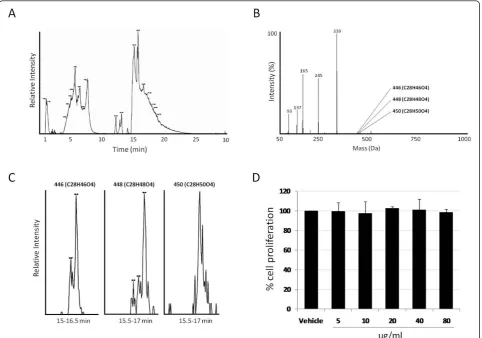
We first determined whether crude serum ethyl acetate extract, prior to chromatographic enrichment of GTAs, would have any effect on cellular growth by treating cells with commercially available bulk human serum extracts (see methods). The total ion chromatogram (TIC) of the organic fraction following HPLC-coupled time-of-flight (TOF) mass spectrometry is shown in Fig-ure 1A. The extracted mass spectra of the complete TIC is shown in Figure 1B, which was dominated by various
free fatty acids but contained detectable levels of GTAs including those with masses of 446 (C28H46O4), 448 (C28H48O4) and 450 (C28H50O4) Da (Figures 1B and 1C). By calculating the peak areas of the three chroma-tograms, we estimated that these three GTAs repre-sented no more than 0.15% of the total ion current in the sample. Incubation of SW620 cells with up to 80 ug/ml of the extract for 48 hours showed no effect on cell proliferation (Figure 1D) or any effects on cell mor-phology as assessed by light microscopy (not shown).
Organic serum extract was next subjected to flash col-umn chromatography as described in the methods, resulting in 12 fractions which were subsequently ana-lyzed by HPLC-MS to determine GTA content. Although other components were present in all the frac-tions, only fraction 9 out of the 12 was enriched for the C28 GTAs (referred to as the GTA+ve fraction). A GTA negative control fraction (fraction 8, lacking any detectable GTAs) was also selected for the studies described below. Representative total ion chromato-grams, extracted mass spectra and selected ion chroma-tograms of the three C28 GTAs for the GTA-ve and GTA+ve fractions are shown in Figures 2A and 2B, respectively. By comparing the sums of the selected ion chromatograms of the three GTAs to the total ion cur-rents, we estimated that the GTA+ve fraction contained approximately 21% C28 GTAs while the GTA-ve frac-tion had no detectable levels (bottom panel of Figures 2A and 2B). The non-GTA background components for both fractions were similar, and the most abundant non-GTA components in the GTA+ve fraction were also the most abundant components in the GTA-ve fraction. Therefore, the two fractions were composition-ally similar other than the 21% GTA content of the GTA+ve fraction, which represented an approximately 143-fold enrichment of the three C28 GTA metabolites over the crude organic serum extract (as shown in Fig-ure 1A). These fractionations were repeated several times with consistent results. We therefore concluded that the fractions were sufficiently matched for investi-gating biological activity as described below. For com-parison, the relative levels of the three C28 GTAs from
40 pooled CRC patients’ serum and serum from 40
matched control subjects is shown in Figure 2C.
GTA+ve human serum extracts inhibit cell proliferation and induce PARP fragmentation
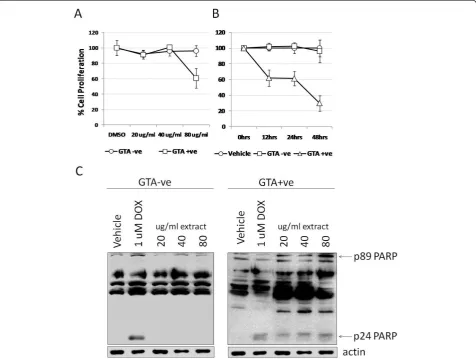
no effect. Treatment up to 48 hrs using 80 ug/ml showed the same 40% reduction as early as 12 hrs, which dropped further to 70% by 48 hrs (Figure 3B). No effect on cell proliferation was observed with the GTA-ve fraction or GTA-vehicle (DMSO). Evidence of apoptotic activity was determined by the detection of poly(ADP-ribose) polymerase (PARP) cleavage products through Western blot (Figure 3C). A number of PARP cleavage products including the hallmark 89 and 24 kDa frag-ments, as well as others (Figure 3C), were induced fol-lowing 48 hrs treatment with GTA+ve fraction, but not with GTA-ve treatment, suggesting a possible pro-apop-totic function of GTAs.
We repeated the studies in MCF7 cells, which upon treatment with GTA+ve fraction showed gross cellular changes visible through phase-contrast microscopy including the appearance of apoptosomes and enlarged nuclei that were not observed with vehicle or GTA-ve treatments (Figures 4A, B and 4C). GTA+ve treatment
in MCF-7 cells also resulted in the exclusive induction of the 24 kDa PARP cleavage product relative to vehi-cle or GTA-ve treatment (Figure 4D), further suggest-ing a pro-apoptotic activity of GTA-containsuggest-ing extracts.
GTA+ve extracts inhibit pro-inflammatory markers
The structural resemblance of GTAs to the inflamma-tion-resolving protectins and resolvins prompted us to investigate the effect of GTA+ve extract on pro-inflam-matory markers. Treatment of SW620 cells for 24 hours resulted in a profound inhibition of NFB protein level with as little as 20 ug/ml GTA+ve extract, accompanied by an equally profound induction of IBa, neither of which was observed with GTA-ve extract (Figure 5). Protein levels of nitric oxide synthase (NOS2) were also inhibited in cells treated with the GTA+ve fraction (par-ticularly 20 and 40 ug/ml), but not in cells treated with the GTA-ve fraction (Figure 5).
Figure 1Total ion chromatogram of crude serum organic extract. (A) Total ion current of bulk serum following liquid/liquid extraction and HPLC-coupled mass spectrometry as explained in the methods. (B) Extracted mass spectra of all masses from (A). (C) Extracted ion
chromatograms of GTAs 446, 448 and 450 from the total ion current shown in A. (D) Cell proliferation, as assayed by MTT, for SW620 cells treated with up to 80 ug/ml of the crude serum extract.
Ritchieet al.Journal of Experimental & Clinical Cancer Research2011,30:59 http://www.jeccr.com/content/30/1/59
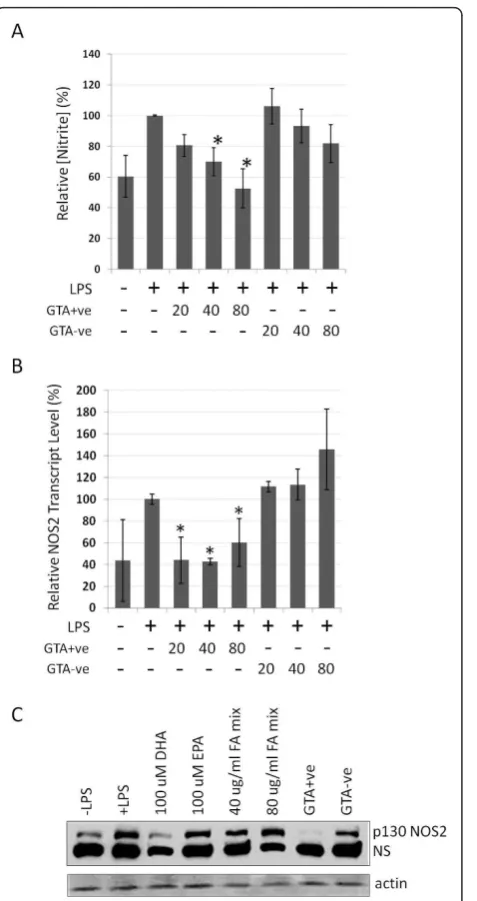
To explore further the effect of GTAs on modulating inflammation, we employed the RAW264.7 mouse macrophage line in which a pro-inflammatory state can be induced by treatment with lipopolysaccharide (LPS). RAW264.7 cells were treated for 4 hours with GTA+ve and GTA-ve fractions prior to the addition of LPS, and the effects on various proinflammatory mar-kers evaluated. We observed no affect on RAW264.7 cell growth or proliferation rates during the 20 hours post-GTA treatment. RAW264.7 cells treated with GTA+ve fractions prior to LPS stimulation showed a significant dose-dependent reduction (p < 0.05) in the generation of nitric oxide as assessed through the pro-duction of nitrite using the Griess reagent system (Fig-ure 6A), which was mirrored by low levels of NOS2 mRNA transcripts (Figure 6B) and protein levels (Fig-ure 6C). For comparison (and as controls), cells were
also treated with various combinations of free fatty acids including EPA, DHA and equimolar mixtures of 18:1, 18:2 and 18:3 (FA mix), of which only 100 uM DHA showed any protective effect on NOS2 protein induction (Figure 6C).
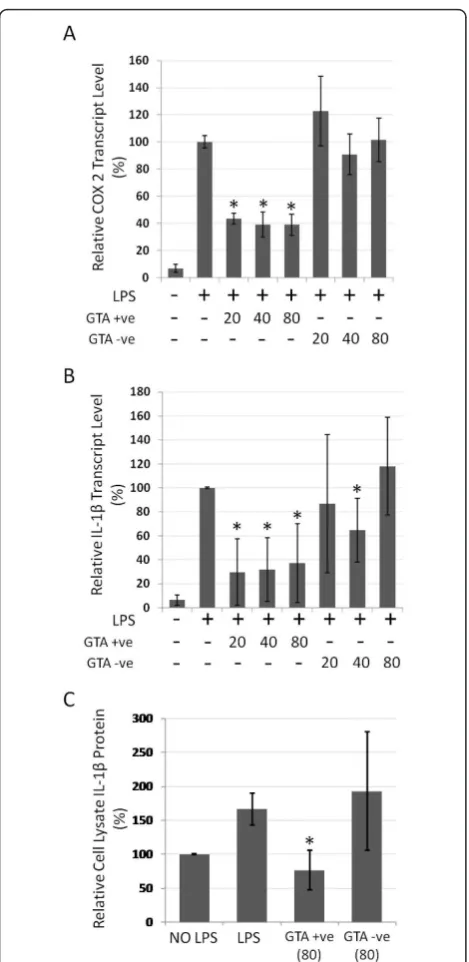
Similar effects were observed with TNFa upon treat-ment with GTA+ve extract, which showed significantly reduced mRNA transcript levels (p < 0.05, Figure 7A) as well as protein levels in cell lysates and conditioned media (Figures 7B and 7C, respectively). Consistent with the above findings, transcript levels of COX2 and IL-1b (Figures 8A and 8B), as well as IL-1bprotein levels (Fig-ure 8C), were also significantly reduced (p < 0.05) with GTA+ve treatment. The results indicate that human blood extracts containing GTAs have anti-proliferative and anti-inflammatory properties that GTA-ve extracts lack.
Figure 3Proliferation of SW620 cells treated with GTA+ve and GTA-ve extracts. (A) SW620 cells were incubated with increasing concentrations of GTA+ve and GTA-ve extracts for 24 hours and proliferation assayed by MTT. (B) The 80 ug/ml concentration of GTA+ve and GTA-ve extracts was then used to treat cells for up to 48 hours and the effect on cell proliferation assayed by MTT. Data are expressed as percent of vehicle or 0 hrs ± 1S.D. (C) Representative Western blot analysis of caspase-mediated PARP cleavage fragments resulting from treatment with GTA+ve and -ve extracts. Experiments were repeated at least three times.
Ritchieet al.Journal of Experimental & Clinical Cancer Research2011,30:59 http://www.jeccr.com/content/30/1/59
Discussion
The regulation of inflammation and the ability to con-trol cell growth are two processes intricately linked with cancer. When acute inflammatory processes are not resolved by the appropriate enzymatic conversion of fatty acid mediators into specific oxygenated products [1,20,21], a state of chronic inflammation can ensue, which can further lead to sporadic DNA mutations, the activation of pro-oncogenic pathways and ultimately cancer (for example see [22]). When such detriments occur, they normally trigger a cascade of intracellular events leading to the induction of apoptotic-mediated cell death. Thus it is the fine control between inflamma-tory and apoptotic processes, likely early in life, which might be a key determinant of one’s risk of subsequent cancer development.
Based on the tumor-independent reduction of GTAs previously reported in CRC patient serum [17], their age-related reduction in the general population [18], and their structural resemblance to the inflammation-resol-ving protectins and resolvins, we hypothesized that GTAs might represent a novel endogenous cancer-pro-tective metabolic system. Although we focused
Figure 4Treatment of MCF7 cells with GTA+ve and GTA-ve extracts. MCF7 cells were incubated with vehicle (A), 80 ug/ml GTA+ve extract (B), and 80 ug/ml GTA-ve extract (C) and cells photographed using phase-contrast light microscopy (200×). (D) Western analysis of PARP cleavage products; ns, non-specific.
specifically on a subset of 28-carbon GTAs, the GTA family comprises a large number of structurally related novel hydroxylated polyunsaturated ultra long-chain fatty acids ranging in size between 446 and 596 Da and containing up to 36 carbons [17].
In studies completed to date, GTAs appear to repre-sent a human-specific metabolic system as they have only been detected in human serum (or plasma) and not in the serum or plasma of other mammals including mice, rats, cows, dogs, and rabbits. Likewise, GTAs are Figure 6Determination of nitric oxide status in RAW264.7 cells
treated with GTA+ve and GTA-ve extracts. RAW264.7 cells were pre-treated for 4 hours with GTA+ve or GTA-ve extracts followed by the addition of LPS (1 ug/ml) for 20 hours. (A) Nitric oxide levels in cells were determined using Griess reagent, (B) NOS2 mRNA transcript levels were determined by real-time rtPCR, and (C) NOS protein (treatment with 80 ug/ml) assessed by Western blot (NS, non-specific). Asterisks indicate p < 0.05 relative to LPS treatment alone, and FA mix in (C) represents a 100 uM equal mixture of 18:1, 18:2 and 18:3 fatty acids. Data are expressed as the average of three duplicate experiments ± 1S.D.
Figure 7TNFaresponse in RAW264.7 cells treated with GTA +ve and GTA-ve extracts. RAW264.7 cells were pre-treated for 4 hours with GTA+ve or GTA-ve extracts followed by the addition of LPS (1 ug/ml) for 20 hours. (A) TNFamRNA transcripts as determined by real-time rtPCR, (B) TNFarelative protein levels in cell lysates following 80 ug/ml treatment, and (C) TNFaprotein levels in conditioned media as determined by ELISA. Asterisks indicate p < 0.05 relative to LPS treatment alone. Data are expressed as the average of three duplicate experiments ± 1S.D.
Ritchieet al.Journal of Experimental & Clinical Cancer Research2011,30:59 http://www.jeccr.com/content/30/1/59
absent from several types of plant-based products such as grains and seed oils, as well as human tissues includ-ing colonic tumors and normal colon epithelium (unpublished observations). This human exclusivity has lead us to speculate that the gut microbiota, in
combination with currently unknown dietary precursors, may be involved in their catabolism. The results shown here represent the first report of GTA biological activity, which revealed that cells treated with GTA+ve extracts had reduced proliferative capacity coinciding with PARP fragmentation, significantly down-regulated NFB expression, increased IBa levels, and numerous down-regulated inflammatory markers including nitric oxide, NOS2, IL-1b, TNFaand COX2. Given the critical role of NFB in regulating both apoptosis and inflammation and its association with aging, our data suggests that the protective effects of GTAs are mediated, at least in part, through NFB signalling. A reduction of GTAs over time could therefore be involved in compromising one’s ability to protect against chronic inflammation and pos-sibly cancer.
GTAs, fatty acids, and proliferation
Our observation that GTA+ve extracts dose-depen-dently reduce cell proliferation, accompanied by the appearance of multiple PARP cleavage products with different molecular weights in SW620 cells but only the 24 kDa fragment in MCF-7 cells, suggests a com-plex cell-specific interplay between different proteases. Although it has been reported that caspase-3 activation can result in the 89 and 24 kDa fragments and that cathepsin-b and granzyme-b can produce fragments of 50 and 64 kDa, respectively [23], further work will be required to investigate GTA-specific protease activa-tion. Our evidence of apoptosis upon treatment with GTAs is consistent with numerous other reports show-ing pro-apoptotic effects mediated through polyunsatu-rated long chain fatty acids (PUFAs). For example, docosahexanaeoic acid (DHA) has been shown to pro-mote apoptosis through numerous pathways including cytochrome-c mediated caspase activation [24,25], inhi-bition of the regulatory subunit of PI3-kinase, and reduction of PTEN phosphorylation [24,26]. Others have shown that DHA and the PUFA punicic acid ulti-mately exert their intrinsic effects through dissipation of the mitochondrial membrane potential [27,28], and that DHA and butyrate can promote apoptosis by altering mitochondrial Ca2+ levels [29]. Treatment of various cell lines, for example LAPC-4 prostate cancer-derived cells, with PUFAs, has been shown to reduce proliferation and induce apoptosis [30]. There are also studies demonstrating the inhibitory effects of omega-3 PUFAs on growth and angiogenesis of chemically induced as well as transplanted tumor model systems [31-33]. The observation of reduced cell growth in the presence of GTA+ve extract is therefore consistent with a large body of literature showing similar effects with exposure to long-chain PUFAs (see [34] for review).
In addition to its anti-proliferative effect, GTA+ve extract also protected against the LPS-mediated induc-tion of several pro-inflammatory proteins including TNFa, IL-1b, NOS2 and COX2, and inhibited the pro-duction of nitric oxide. Central to these two effects (reduced proliferation andinflammation) was the con-comitant inhibition of NFB upon GTA+ve treatment in SW620 colonic epithelial cells, which correlated pre-cisely with increased levels of the inhibitory protein IBa, likely due to stabilization stemming from compro-mised ubiquitin-dependent proteosomal targeting [35]. The inhibition of NFB is relevant to both apoptotic processes and inflammation, as discussed further below.
NFB and cell proliferation
NFB, a transcription factor represented by a series of subunits harbouring discrete DNA binding and transac-tivational functionality, is implicated in both intrinsic and extrinsic apoptotic pathways (see [36] for review) and has been shown to prevent apoptosis as well as pro-mote transformation in epithelial-derived cancers [37]. Mechanistically, in the absence of NFB signalling, inhi-bitor-of-apoptosis proteins (IAPs) fail to suppress assembly of the death-inducing complex II, which allows for the TRADD-mediated activation of caspase-8 and subsequent apoptosis [36,38]. Furthermore, IAPs can directly promote the ubiquitin-mediated degradation of the NFB-inducing serine/threonine kinase (NIK), ulti-mately resulting in NFB activation [39]. Although a detailed discussion on this topic is out of scope, it is well established that activated NFB is associated with an anti-apoptotic pro-survival advantage which is rele-vant given our data showing that GTA+ve extracts reduced NFB expression. These observations are con-sistent with the reported biological activity of the resol-vins and protectins, which have been shown to exert both pro-apoptotic effects [40] and the resolution of inflammation by attenuating cytokine levels in an NFB-dependent manner [41]. One limitation of our
study was that we were unable to determine NFB
levels in RAW264.7 cells, which will require further investigation upon the generation of sufficient quantities of either enriched extract, or more preferably, purified synthetic GTAs. However, the dramatic reduction of
NFB upon GTA treatment in colon tumor cells is
highly relevant given the reduced levels of circulating GTAs in CRC patients [17,18] and the well-established inflammatory component of this disease [42].
NFB and inflammation
Besides its anti-apoptotic role, NFB represents a key link between inflammation and cancer (see [43] for review), and in particular, is considered a master regula-tor of intestinal immunological function and activaregula-tor of
factors involved in driving intestinal inflammation [44-46]. NFB activation has been observed in numer-ous GI-related conditions including inflammatory bowel disease [47], Crohn’s disease [48], ulcerative colitis [35], inflamed intestinal mucosa [49] as well as CRC [50-53]. It has been shown that the NFB transcriptional activity in gastric mucosa is induced during aging [53], that positive NFB expression as assessed through immuno-histochemistry is observed in 73.5% of human CRC tumors independent of age [50], and that levels of NFB, IKKa and COX2 in tumor epithelial cells from CRC patients are significantly higher than adjacent nor-mal tissue [52].
Also relevant to NFB activation and intestinal inflam-mation is the reported differential regulation of Toll-like receptors (TLRs) by fatty acids with differing saturation states [54-56]. TLRs are single membrane-spanning pro-teins involved in the recognition of microbial-derived molecules harbouring pathogen-associated molecular patterns (PAMPs) and activation of various immune cell responses [57]. Upon activation, TLRs activate NFB though a complex signalling network culminating with the activation of IKKa, followed by ubiquitination and subsequent degradation of IBaand translocation of the P65 Rel A domain to the nucleus where it binds to and activates the expression of numerous pro-inflammatory genes [44]. Specifically, TLR4 has been shown to confer responsiveness to a number of lipids including lipid A, the primary biologically active component of LPS, and that in contrast to saturated fatty acids similar to those found in lipid A, unsaturated fatty acids inhibit NFB activity through inhibition of TLR4 or other TLR-asso-ciated molecules [55,56]. Therefore, it is possible that the anti-inflammatory effects associated with GTAs are being exerted through inhibition of TLRs upstream of NFB. Further work to investigate this hypothesis is warranted.
NFB, aging and gut microbiota
A final point concerning NFB and GTA metabolism is that both have age-related implications. We previously showed that in the general population, there is an inverse association between the circulating levels of GTA-446 and age, and that the rate of decline corre-lated precisely with the increase in CRC incidence with age [18]. As for NFB, there is substantial literature regarding its various age-related facets [53,58-63]. For example, it has been shown that NFB protein levels, as well as several NFB-targeted pro-inflammatory cyto-kines, are elevated in endothelial cells of old versus young subjects, which were also accompanied by decreased IBa levels in the older group [60]. Microar-ray analysis further showed that the NFBciselement is the motif most strongly associated with aging [64] and Ritchieet al.Journal of Experimental & Clinical Cancer Research2011,30:59
http://www.jeccr.com/content/30/1/59
that blockade of NFB in the epidermis of chronologi-cally aged mice resulted in the reversion of both tissue and gene expression characteristics to those of young mice [59]. These and numerous other reports clearly associate increased NFB activity with multiple aspects of aging including immunosenescence, antigenic stress, innate immunity, tissue atrophy, inflammation, cellular danger responses, apoptosis, DNA damage, oxidative stress and caloric restriction (see [62] for review). Left unchecked, therefore, NFB activation is a probable driving force for many of these critical aging-related processes.
Given the selectiveness of GTAs in human blood and their novel hydroxylated and unsaturated fatty acid structures, the possibility that human-specific gut micro-bial processes may be involved in the metabolism of GTAs from dietary sources cannot be excluded. It is also well known that the intestinal microbiome compo-sition changes with age due to a number of contributing factors including reduced mucosal secretion, decreased nutritional status, changes in luminal pH and increased drug and antibiotic use [65-68]. There is also evidence that the gut microbiota is intricately linked to obesity and metabolic syndrome, and can perpetuate insulin-resistance and chronic inflammation [69-71], all of which have been previously implicated with colon can-cer [42,72-75]. Lastly, it is intriguing to consider that the modulation of gut microbial composition through the consumption of probiotics and/or fermented milk products has been shown to reduce inflammation and protect against cancer [76-78]. Therefore, investigating the possible interaction between various gut micro-organisms and dietary precursors with respect to GTA metabolism is highly justified.
In summary, our findings collectively suggest a mechanism whereby the age-related decline in GTAs in a subset of the general population results in an impaired ability to control chronic inflammation, which over time may lead to oncogenic cellular changes. The measure-ment of GTAs may therefore represent an opportunity for the early identification of subjects with elevated inflammatory status and subsequent risk of CRC.
List of abbreviations
CRC: colorectal cancer; GTA: gastrointestinal tract carboxylic acid; PARP: poly (ADP)-ribose polymerase; ADP: adenosine diphosphate; nuclear factor kappa B; NOS2: nitric oxide synthase 2; IL-1β: interleukin 1 beta; TNFα: tumor necrosis factor alpha; COX2: cyclooxygenase 2; AA: arachidonic acid; DHA: docosehexaenoic acid; EPA: eicosapentanoic acid; TIC: total ion current; TOF: time-of-flight; PUFAs: polyunsaturated fatty acids; IAPs: inhibitor of apoptosis proteins; NIK: NFκB inducible kinase; TLR: Toll-like receptor; PAMP: pathogen-associated molecular pattern; IKKα: IkappaB kinase alpha.
Acknowledgements
We acknowledge Dr. Paul Wood and Alix Hayden for careful review of the manuscript.
Author details
1Phenomenome Discoveries, Inc. Saskatoon, Saskatchewan, Canada. 2
University of Saskatchewan, Saskatoon, Saskatchewan, Canada.
Authors’contributions
All authors have read and approved the final manuscript. SR: Lead author, wrote the manuscript, directed and oversaw the research presented. DJ: Purification of serum extracts, chromatography, interpretation of MS data, GFD: western blots, PA: lead development of chromatographic methods, interpretation of MS data, WJ: analysis of samples on HPLC-tandem MS, HM: ELISA experiments, nitrite determinations, cell culture and treatments, and DBG: group leader, interpretation and contribution to writing.
Competing interests
All authors were employees of Phenomenome Discoveries, Inc. during the course of the work presented in the manuscript. Dayan B. Goodenowe is the president and CEO, and primary shareholder of Phenomenome.
Received: 30 March 2011 Accepted: 17 May 2011 Published: 17 May 2011
References
1. Schwab JM, Chiang N, Arita M, Serhan CN:Resolvin E1 and protectin D1 activate inflammation-resolution programmes.Nature2007,447:869-874. 2. Serhan CN:Novel chemical mediators in the resolution of inflammation:
resolvins and protectins.Anesthesiol Clin2006,24:341-364. 3. Schwab JM, Serhan CN:Lipoxins and new lipid mediators in the
resolution of inflammation.Curr Opin Pharmacol2006,6:414-420. 4. Hong S, Lee HJ, Kim SJ, Hahm KB:Connection between inflammation and
carcinogenesis in gastrointestinal tract: focus on TGF-beta signaling. World J Gastroenterol2010,16:2080-2093.
5. Demaria S, Pikarsky E, Karin M, Coussens LM, Chen YC, El-Omar EM, Trinchieri G, Dubinett SM, Mao JT, Szabo E, Krieg A, Weiner GJ, Fox BA, Coukos G, Wang E, Abraham RT, Carbone M, Lotze MT:Cancer and inflammation: promise for biologic therapy.J Immunother2010,
33:335-351.
6. Senthil K, Aranganathan S, Nalini N:Evidence of oxidative stress in the circulation of ovarian cancer patients.Clin Chim Acta2004,339:27-32. 7. Itzkowitz SH, Yio X:Inflammation and cancer IV. Colorectal cancer in
inflammatory bowel disease: the role of inflammation.Am J Physiol Gastrointest Liver Physiol2004,287:G7-17.
8. Das UN:Folic acid and polyunsaturated fatty acids improve cognitive function and prevent depression, dementia, and Alzheimer’s disease– but how and why?Prostaglandins Leukot Essent Fatty Acids2008,78:11-19. 9. Spiteller G:Peroxyl radicals: inductors of neurodegenerative and other
inflammatory diseases. Their origin and how they transform cholesterol, phospholipids, plasmalogens, polyunsaturated fatty acids, sugars, and proteins into deleterious products.Free Radic Biol Med2006,41:362-387. 10. Mrak RE, Landreth GE:PPARgamma, neuroinflammation, and disease.J
Neuroinflammation2004,1:5.
11. Sumariwalla PF, Palmer CD, Pickford LB, Feldmann M, Foxwell BM, Brennan FM:Suppression of tumour necrosis factor production from mononuclear cells by a novel synthetic compound, CLX-090717. Rheumatology (Oxford)2009,48:32-38.
12. Simmonds RE, Foxwell BM:Signalling, inflammation and arthritis: NF-kappaB and its relevance to arthritis and inflammation.Rheumatology (Oxford)2008,47:584-590.
13. Jin JQ, Li CQ, He LC:Down-regulatory effect of usnic acid on nuclear factor-kappaB-dependent tumor necrosis factor-alpha and inducible nitric oxide synthase expression in lipopolysaccharide-stimulated macrophages RAW 264.7.Phytother Res2008,22:1605-1609. 14. Yun KJ, Koh DJ, Kim SH, Park SJ, Ryu JH, Kim DG, Lee JY, Lee KT:
Anti-inflammatory effects of sinapic acid through the suppression of inducible nitric oxide synthase, cyclooxygase-2, and proinflammatory cytokines expressions via nuclear factor-kappaB inactivation.J Agric Food Chem2008,56:10265-10272.
15. Nakanishi Y, Kamijo R, Takizawa K, Hatori M, Nagumo M:Inhibitors of cyclooxygenase-2 (COX-2) suppressed the proliferation and differentiation of human leukaemia cell lines.Eur J Cancer2001,
16. Jobin C, Morteau O, Han DS, Balfour Sartor R:Specific NF-kappaB blockade selectively inhibits tumour necrosis factor-alpha-induced COX-2 but not constitutive COX-1 gene expression in HT-29 cells.Immunology1998,
95:537-543.
17. Ritchie SA, Ahiahonu PW, Jayasinghe D, Heath D, Liu J, Lu Y, Jin W, Kavianpour A, Yamazaki Y, Khan AM, Hossain M, Su-Myat KK, Wood PL, Krenitsky K, Takemasa I, Miyake M, Sekimoto M, Monden M, Matsubara H, Nomura F, Goodenowe DB:Reduced levels of hydroxylated,
polyunsaturated ultra long-chain fatty acids in the serum of colorectal cancer patients: implications for early screening and detection.BMC Med
2010,8:13.
18. Ritchie SA, Heath D, Yamazaki Y, Grimmalt B, Kavianpour A, Krenitsky K, Elshoni H, Takemasa I, Miyake M, Sekimoto M, Monden M, Tomonaga T, Matsubara H, Sogawa K, Matsushita K, Nomura F, Goodenowe DB:
Reduction of novel circulating long-chain fatty acids in colorectal cancer patients is independent of tumor burden and correlates with age.BMC Gastroenterol2010,10:140.
19. Davies GF, Roesler WJ, Juurlink BH, Harkness TA:Troglitazone overcomes doxorubicin-resistance in resistant K562 leukemia cells.Leuk Lymphoma
2005,46:1199-1206.
20. Serhan CN:Controlling the resolution of acute inflammation: a new genus of dual anti-inflammatory and proresolving mediators.J Periodontol2008,79:1520-1526.
21. Seki H, Tani Y, Arita M:Omega-3 PUFA derived anti-inflammatory lipid mediator resolvin E1.Prostaglandins Other Lipid Mediat2009,89:126-130. 22. O’Connor PM, Lapointe TK, Beck PL, Buret AG:Mechanisms by which
inflammation may increase intestinal cancer risk in inflammatory bowel disease.Inflamm Bowel Dis2010,16:1411-1420.
23. Chaitanya GV, Babu PP:Differential PARP cleavage: an indication of heterogeneous forms of cell death and involvement of multiple proteases in the infarct of focal cerebral ischemia in rat.Cell Mol Neurobiol2009,29:563-573.
24. Toit-Kohn JL, Louw L, Engelbrecht AM:Docosahexaenoic acid induces apoptosis in colorectal carcinoma cells by modulating the PI3 kinase and p38 MAPK pathways.J Nutr Biochem2009,20:106-114.
25. Narayanan BA, Narayanan NK, Reddy BS:Docosahexaenoic acid regulated genes and transcription factors inducing apoptosis in human colon cancer cells.Int J Oncol2001,19:1255-1262.
26. Engelbrecht AM, Toit-Kohn JL, Ellis B, Thomas M, Nell T, Smith R:
Differential induction of apoptosis and inhibition of the PI3-kinase pathway by saturated, monounsaturated and polyunsaturated fatty acids in a colon cancer cell model.Apoptosis2008,13:1368-1377. 27. Grossmann ME, Mizuno NK, Schuster T, Cleary MP:Punicic acid is an
omega-5 fatty acid capable of inhibiting breast cancer proliferation.Int J Oncol2010,36:421-426.
28. Chapkin RS, Seo J, McMurray DN, Lupton JR:Mechanisms by which docosahexaenoic acid and related fatty acids reduce colon cancer risk and inflammatory disorders of the intestine.Chem Phys Lipids2008,
153:14-23.
29. Kolar SS, Barhoumi R, Lupton JR, Chapkin RS:Docosahexaenoic acid and butyrate synergistically induce colonocyte apoptosis by enhancing mitochondrial Ca2+ accumulation.Cancer Res2007,67:5561-5568. 30. Kobayashi N, Barnard RJ, Henning SM, Elashoff D, Reddy ST, Cohen P,
Leung P, Hong-Gonzalez J, Freedland SJ, Said J, Gui D, Seeram NP, Popoviciu LM, Bagga D, Heber D, Glaspy JA, Aronson WJ:Effect of altering dietary omega-6/omega-3 fatty acid ratios on prostate cancer membrane composition, cyclooxygenase-2, and prostaglandin E2.Clin Cancer Res2006,12:4662-4670.
31. Rose DP, Connolly JM:Antiangiogenicity of docosahexaenoic acid and its role in the suppression of breast cancer cell growth in nude mice.Int J Oncol1999,15:1011-1015.
32. Reddy BS, Maruyama H:Effect of dietary fish oil on azoxymethane-induced colon carcinogenesis in male F344 rats.Cancer Res1986,
46:3367-3370.
33. Reddy BS, Burill C, Rigotty J:Effect of diets high in omega-3 and omega-6 fatty acids on initiation and postinitiation stages of colon
carcinogenesis.Cancer Res1991,51:487-491.
34. Wendel M, Heller AR:Anticancer actions of omega-3 fatty acids–current state and future perspectives.Anticancer Agents Med Chem2009,
9:457-470.
35. Visekruna A, Joeris T, Seidel D, Kroesen A, Loddenkemper C, Zeitz M, Kaufmann SH, Schmidt-Ullrich R, Steinhoff U:Proteasome-mediated degradation of IkappaBalpha and processing of p105 in Crohn disease and ulcerative colitis.J Clin Invest2006,116:3195-3203.
36. Gyrd-Hansen M, Meier P:IAPs: from caspase inhibitors to modulators of NF-kappaB, inflammation and cancer.Nat Rev Cancer2010,10:561-574. 37. Greten FR, Eckmann L, Greten TF, Park JM, Li ZW, Egan LJ, Kagnoff MF,
Karin M:IKKbeta links inflammation and tumorigenesis in a mouse model of colitis-associated cancer.Cell2004,118:285-296.
38. Varfolomeev E, Vucic D:(Un)expected roles of c-IAPs in apoptotic and NFkappaB signaling pathways.Cell Cycle2008,7:1511-1521. 39. Varfolomeev E, Blankenship JW, Wayson SM, Fedorova AV, Kayagaki N,
Garg P, Zobel K, Dynek JN, Elliott LO, Wallweber HJ, Flygare JA, Fairbrother WJ, Deshayes K, Dixit VM, Vucic D:IAP antagonists induce autoubiquitination of c-IAPs, NF-kappaB activation, and TNFalpha-dependent apoptosis.Cell2007,131:669-681.
40. Vassiliou EK, Kesler OM, Tadros JH, Ganea D:Bone marrow-derived dendritic cells generated in the presence of resolvin E1 induce apoptosis of activated CD4+ T cells.J Immunol2008,181:4534-4544. 41. Arita M, Bianchini F, Aliberti J, Sher A, Chiang N, Hong S, Yang R,
Petasis NA, Serhan CN:Stereochemical assignment, antiinflammatory properties, and receptor for the omega-3 lipid mediator resolvin E1.J Exp Med2005,201:713-722.
42. Harpaz N, Polydorides AD:Colorectal dysplasia in chronic inflammatory bowel disease: pathology, clinical implications, and pathogenesis.Arch Pathol Lab Med2010,134:876-895.
43. Karin M:NF-kappaB as a critical link between inflammation and cancer. Cold Spring Harb Perspect Biol2009,1:a000141.
44. Spehlmann ME, Eckmann L:Nuclear factor-kappa B in intestinal protection and destruction.Curr Opin Gastroenterol2009,25:92-99. 45. Karrasch T, Jobin C:NF-kappaB and the intestine: friend or foe?Inflamm
Bowel Dis2008,14:114-124.
46. Gadjeva M, Wang Y, Horwitz BH:NF-kappaB p50 and p65 subunits control intestinal homeostasis.Eur J Immunol2007,37:2509-2517.
47. Schreiber S, Nikolaus S, Hampe J:Activation of nuclear factor kappa B inflammatory bowel disease.Gut1998,42:477-484.
48. Ellis RD, Goodlad JR, Limb GA, Powell JJ, Thompson RP, Punchard NA:
Activation of nuclear factor kappa B in Crohn’s disease.Inflamm Res
1998,47:440-445.
49. Rogler G, Brand K, Vogl D, Page S, Hofmeister R, Andus T, Knuechel R, Baeuerle PA, Scholmerich J, Gross V:Nuclear factor kappaB is activated in macrophages and epithelial cells of inflamed intestinal mucosa. Gastroenterology1998,115:357-369.
50. Abdullah M, Sudoyo AW, Pranowo BS, Rini D, Sutrisna B, Rani AA:
Expression of NF-kappaB and COX-2 in young versus older patients with sporadic colorectal cancer.Acta Med Indones2009,41:70-74.
51. Sun XF, Zhang H:NFKB and NFKBI polymorphisms in relation to susceptibility of tumour and other diseases.Histol Histopathol2007,
22:1387-1398.
52. Charalambous MP, Lightfoot T, Speirs V, Horgan K, Gooderham NJ:
Expression of COX-2, NF-kappaB-p65, NF-kappaB-p50 and IKKalpha in malignant and adjacent normal human colorectal tissue.Br J Cancer
2009,101:106-115.
53. Xiao ZQ, Majumdar AP:Induction of transcriptional activity of AP-1 and NF-kappaB in the gastric mucosa during aging.Am J Physiol Gastrointest Liver Physiol2000,278:G855-865.
54. Lee JY, Zhao L, Youn HS, Weatherill AR, Tapping R, Feng L, Lee WH, Fitzgerald KA, Hwang DH:Saturated fatty acid activates but polyunsaturated fatty acid inhibits Toll-like receptor 2 dimerized with Toll-like receptor 6 or 1.J Biol Chem2004,279:16971-16979. 55. Lee JY, Plakidas A, Lee WH, Heikkinen A, Chanmugam P, Bray G,
Hwang DH:Differential modulation of Toll-like receptors by fatty acids: preferential inhibition by n-3 polyunsaturated fatty acids.J Lipid Res
2003,44:479-486.
56. Lee JY, Sohn KH, Rhee SH, Hwang D:Saturated fatty acids, but not unsaturated fatty acids, induce the expression of cyclooxygenase-2 mediated through Toll-like receptor 4.J Biol Chem2001,276:16683-16689. 57. Kirschning CJ, Schumann RR:TLR2: cellular sensor for microbial and
endogenous molecular patterns.Curr Top Microbiol Immunol2002,
270:121-144.
Ritchieet al.Journal of Experimental & Clinical Cancer Research2011,30:59 http://www.jeccr.com/content/30/1/59
58. Kriete A, Mayo KL:Atypical pathways of NF-kappaB activation and aging. Exp Gerontol2009,44:250-255.
59. Adler AS, Kawahara TL, Segal E, Chang HY:Reversal of aging by NFkappaB blockade.Cell Cycle2008,7:556-559.
60. Donato AJ, Black AD, Jablonski KL, Gano LB, Seals DR:Aging is associated with greater nuclear NF kappa B, reduced I kappa B alpha, and increased expression of proinflammatory cytokines in vascular endothelial cells of healthy humans.Aging Cell2008,7:805-812. 61. Giardina C, Hubbard AK:Growing old with nuclear factor-kappaB.Cell
Stress Chaperones2002,7:207-212.
62. Salminen A, Huuskonen J, Ojala J, Kauppinen A, Kaarniranta K, Suuronen T:
Activation of innate immunity system during aging: NF-kB signaling is the molecular culprit of inflamm-aging.Ageing Res Rev2008,7:83-105. 63. Salminen A, Ojala J, Huuskonen J, Kauppinen A, Suuronen T, Kaarniranta K:
Interaction of aging-associated signaling cascades: inhibition of NF-kappaB signaling by longevity factors FoxOs and SIRT1.Cell Mol Life Sci
2008,65:1049-1058.
64. Adler AS, Sinha S, Kawahara TL, Zhang JY, Segal E, Chang HY:Motif module map reveals enforcement of aging by continual NF-kappaB activity.Genes Dev2007,21:3244-3257.
65. Enck P, Zimmermann K, Rusch K, Schwiertz A, Klosterhalfen S, Frick JS:The effects of ageing on the colonic bacterial microflora in adults.Z Gastroenterol2009,47:653-658.
66. He F, Ouwehand AC, Isolauri E, Hosoda M, Benno Y, Salminen S:
Differences in composition and mucosal adhesion of bifidobacteria isolated from healthy adults and healthy seniors.Curr Microbiol2001,
43:351-354.
67. Hopkins MJ, Sharp R, Macfarlane GT:Age and disease related changes in intestinal bacterial populations assessed by cell culture, 16S rRNA abundance, and community cellular fatty acid profiles.Gut2001,
48:198-205.
68. Saunier K, Dore J:Gastrointestinal tract and the elderly: functional foods, gut microflora and healthy ageing.Dig Liver Dis2002,34(Suppl 2):S19-24. 69. Musso G, Gambino R, Cassader M:Obesity, diabetes, and gut microbiota:
the hygiene hypothesis expanded?Diabetes Care2010,33:2277-2284. 70. Fava F, Lovegrove JA, Gitau R, Jackson KG, Tuohy KM:The gut microbiota
and lipid metabolism: implications for human health and coronary heart disease.Curr Med Chem2006,13:3005-3021.
71. Petruzzelli M, Moschetta A:Intestinal ecology in the metabolic syndrome. Cell Metab2010,11:345-346.
72. Gunter MJ, Leitzmann MF:Obesity and colorectal cancer: epidemiology, mechanisms and candidate genes.J Nutr Biochem2006,17:145-156. 73. Ehrmann-Josko A, Sieminska J, Gornicka B, Ziarkiewicz-Wroblewska B,
Ziolkowski B, Muszynski J:Impaired glucose metabolism in colorectal cancer.Scand J Gastroenterol2006,41:1079-1086.
74. Pais R, Silaghi H, Silaghi AC, Rusu ML, Dumitrascu DL:Metabolic syndrome and risk of subsequent colorectal cancer.World J Gastroenterol2009,
15:5141-5148.
75. Saydah SH, Platz EA, Rifai N, Pollak MN, Brancati FL, Helzlsouer KJ:
Association of markers of insulin and glucose control with subsequent colorectal cancer risk.Cancer Epidemiol Biomarkers Prev2003,12:412-418. 76. Kumar M, Kumar A, Nagpal R, Mohania D, Behare P, Verma V, Kumar P,
Poddar D, Aggarwal PK, Henry CJ, Jain S, Yadav H:Cancer-preventing attributes of probiotics: an update.Int J Food Sci Nutr2010,61:473-496. 77. Pufulete M:Intake of dairy products and risk of colorectal neoplasia.Nutr
Res Rev2008,21:56-67.
78. Saikali J, Picard C, Freitas M, Holt P:Fermented milks, probiotic cultures, and colon cancer.Nutr Cancer2004,49:14-24.
doi:10.1186/1756-9966-30-59
Cite this article as:Ritchieet al.:Human serum-derived hydroxy long-chain fatty acids exhibit anti-inflammatory and anti-proliferative activity.
Journal of Experimental & Clinical Cancer Research201130:59.
Submit your next manuscript to BioMed Central and take full advantage of:
• Convenient online submission
• Thorough peer review
• No space constraints or color figure charges
• Immediate publication on acceptance
• Inclusion in PubMed, CAS, Scopus and Google Scholar
• Research which is freely available for redistribution