Open Access
Research
Public access defibrillation: Suppression of 16.7 Hz interference
generated by the power supply of the railway systems
Ivaylo I Christov*
1and Georgi L Iliev
2Address: 1Center of Biomedical Engineering, Bulgarian Academy of Sciences, Acad. G.Bonchev str., blok 105, 1113 Sofia, Bulgaria and 2Technical
University of Sofia, Department of Telecommunications, Kliment Ohridski str. 8, 1000 Sofia, Bulgaria
Email: Ivaylo I Christov* - [email protected]; Georgi L Iliev - [email protected] * Corresponding author
Abstract
Background: A specific problem using the public access defibrillators (PADs) arises at the railway stations. Some countries as Germany, Austria, Switzerland, Norway and Sweden are using AC railroad net power-supply system with rated 16.7 Hz frequency modulated from 15.69 Hz to 17.36 Hz. The power supply frequency contaminates the electrocardiogram (ECG). It is difficult to be suppressed or eliminated due to the fact that it considerably overlaps the frequency spectra of the ECG. The interference impedes the automated decision of the PADs whether a patient should be (or should not be) shocked.
The aim of this study is the suppression of the 16.7 Hz interference generated by the power supply of the railway systems.
Methods: Software solution using adaptive filtering method was proposed for 16.7 Hz interference suppression. The optimal performance of the filter is achieved, embedding a reference channel in the PADs to record the interference. The method was tested with ECGs from AHA database.
Results: The method was tested with patients of normal sinus rhythms, symptoms of tachycardia and ventricular fibrillation. Simulated interference with frequency modulation from 15.69 Hz to 17.36 Hz changing at a rate of 2% per second was added to the ECGs, and then processed by the suggested adaptive filtering. The method totally suppresses the noise with no visible distortions of the original signals.
Conclusion: The proposed adaptive filter for noise suppression generated by the power supply of the railway systems has a simple structure requiring a low level of computational resources, but a good reference signal as well.
Background
More than 35 years ago external cardiopulmonary resusci-tation (CPR) and defibrillation were first described as effective treatments for sudden cardiac arrest. However, survival after out-of-hospital cardiac arrest is still poor.
The American Heart Association (AHA) previously addressed this problem by emphasizing the importance of the 'chain of survival' [1]: early access, early CPR, early defibrillation, and early advanced life support. Because early defibrillation is the single most important Published: 15 March 2005
BioMedical Engineering OnLine 2005, 4:16 doi:10.1186/1475-925X-4-16
Received: 10 January 2005 Accepted: 15 March 2005
This article is available from: http://www.biomedical-engineering-online.com/content/4/1/16
© 2005 Christov and Iliev; licensee BioMed Central Ltd.
intervention, the AHA challenged manufacturers to develop simple, low-cost automatic PADs for use at loca-tions in which large numbers of people congregate: stadi-ums, airports, railway stations, etc [2].
It has been reported that the chance of survival of a patient at a state of ventricular fibrillation decreases by approxi-mately 10% with each minute that passes after the time of attack [3]. There also exists a probability of irreversible brain (cortical) damage due to systemic hypoxia after 5 minutes. However, response time for paramedics or emer-gency medical technicians to arrive on site with a defibril-lator is often more than ten minutes, resulting in average survival rates of less than 5%. Widespread deployment of automated PADs is the only feasible method of achieving early defibrillation. The strategy for time reduction is that defibrillators can be used by non-healthcare personnel (for example, untrained bystanders and trained members of the staff at the public place) before the emergency med-ical services arrive.
A specific problem using the PADs arises at the railway sta-tions. Some countries as Germany, Austria, Switzerland, Norway and Sweden are using AC railroad net power-sup-ply system with rated frequency of 16.7 Hz [4]. According to the Official journal of the European communities[5] the interference is frequency modulated from 15.69 Hz to 17.36 Hz.
The power supply frequency is magnetically induced and can contaminate the electrocardiogram (ECG). It is diffi-cult to be suppressed or eliminated due to the fact that it considerably overlaps the typical rhythms analysis spectra between 1 to 30 Hz of the ECG. The interference impedes the automated decision of the public access defibrillators whether a patient should be (or should not be) shocked, no matter of the high accuracy reported recently by some authors [[6,7] and [8]].
Schlimp et al [9] have tested two automated external defi-brillators near high-voltage power lines run by the Aus-trian railway company with an AC of 16.7 Hz and 15 kV (overhead of railway tracks) or 16.7 Hz and 110 kV (over-land). The reported errors are: i) failed operation due to artifacts; ii) misinterpretation of the artifact, resulting in failure to treat an underlying ventricular fibrillation and ventricular tachycardia or failure to recommend proper bystander action in the cases of underlying asystolia; iii) failure to identify clearly detectable rhythm and misinter-pretation of the noise as motion artifact or ventricular fibrillation, resulting in a shock advice.
Kanz et al [10] have tested eleven automated external defi-brillators with 16.7 Hz, 15 kV AC (S-Bahn) and a subway system powered with 750 V DC (U-Bahn). The authors
have recorded 5280 tests concluding that high voltage AC interferes more (shock decision sensitivity reduction of 9.7% and no-shock decision specificity reduction of 10.6%) than low voltage DC (shock decision sensitivity reduction of 0.6% and no-shock decision specificity reduction of 1.4%). The interference is minimized, if patient position is parallel and electrode cables are per-pendicular to overhead power lines. Four of the devices have demonstrated an unacceptable performance in respect of accuracy.
We could not find any material dealing with 16.7 Hz noise suppression generated by the power supply of the railway systems. That is why we referred to some standard real-time methods used for main interference (50 or 60 Hz) suppression, from the point of view whether it is pos-sible to adopt them to the specific problem:
- The QRS suppression introduced by notch filters tuned to reject a band from 15.69 Hz to 17.36 Hz is so high that it makes them unacceptable.
- 'Comb' filters averaging in a time interval of the interfer-ence from 57 ms to 64 ms are over-smoothing the QRS complexes, making it sometimes undistinguished from the T wave.
- The good performance of the mains interference subtrac-tion method [[11-13] and [14]] is mostly due to the cor-relation between the interference and the ECG sampling frequency. In the conditions of huge noise modulation the method seems inapplicable.
- Adaptive filtering described by some authors [[15,16] and [17]] does not disturb the electrocardiogram (ECG) frequency spectrum, but requires re-adaptation at any change of the normal ECG course, such as arrhythmias or appearance of an extra systolic ectopic beat. The re-adap-tation period is characterized by the appearance of a tail of gradually attenuating unsuppressed interference. The same effect can be observed at any change of the interfer-ence frequency [16].
The aim of this study is to investigate the suppression of the 16.7 Hz interference generated by the power supply of the railway systems.
Method
ECG data for reference. We assume that a reference noise signal can be easily picked up and used. A block-diagram of adaptive filtering is shown in Fig. 1.
The primary input of the adaptive filter is the active chan-nel d(i), which is a mixture of a clear ECG signal s(i) and the interference generated by electrical train n1(i), where i
is the consecutive number of the sample:
d(i) = s(i) + n1(i) (1)
The noise has a sinusoidal waveform and it can be expressed as:
n1(i) = b*cos(2π*F/Fd*i + φ) (2)
where b, F, Fd and φare amplitude, frequency, sampling frequency and phase of the noise signal, respectively.
The reference input of the adaptive filter is a noise signal collected by an antenna:
n2(i) = a*cos(2π*F/Fd*i), (3)
which differs from n1(i) only in amplitude and phase.
The task of the adaptive algorithm depicted in Fig. 1 is to adjust the coefficients w1(i) and w2(i) to compensate the amplitude and phase difference between n1(i) and n2(i). In other words, y(i) should resemble n1(i) as close as possible.
We rearrange the reference noise signal in the following manner:
x1 (i) = a*cos(2π*F/Fd*i) (4)
x2 (i) = a*sin(2π*F/Fd*i) (5)
where x2 (i) is the noise reference signal phase shifted on 90 degrees by Hilbert transform.
Conventionally the Hilbert transformer is realized as a FIR system [19]. The transition band reduction needs a very high order FIR system, which requires complicated com-putational structure. Considerable reduction in computa-tional resources is achieved by all-pass structure which highest order is 5. In our structure the Hilbert transformer is realized as a parallel 3 all-pass sections. Two of them are intended to make the 90 degree shift and one - to prevent the distortion in the x1(n) signal. The order of the three sections is 4, 5 and 4 respectively. The advantage of this structure compared to the conventional one is that it allows very fine tuning of the signal phase and amplitude which is proved later with the experiments.
Then
y(i) = w1(i)*x1(i) + w2(i)*x2(i), (6)
and the error signal is formed as:
e(i) = d(i) - y(i). (7)
We apply a Least Mean Square adaptive algorithm [20] with a cost-function e2(i) and finally get a system of two equations for adapting the coefficients w1(i) and w2(i):
w1(i+1) = w1(i) + 2*µ*e(i)*x1(i) (8)
w2(i+1) = w2(i) + 2*µ*e(i)*x2(i), (9)
where µcontrols the adaptation rate.
Results
The adaptive filtering method was tested with ECG record-ings taken from the AHA database. Each recording has duration of 30 min and includes two leads. The sampling frequency is 250 Hz and the resolution is 5 µV*bit-1.
The experiments were performed by generating a sinusoi-dal-like noise n1 having a main frequency of 16.7 Hz with frequency modulation of 20% for 10 s, and adding it to the ECG signals. The same noise but with different ampli-tude and phase from n1was considered as a reference input n2 for the adaptive filtering method.
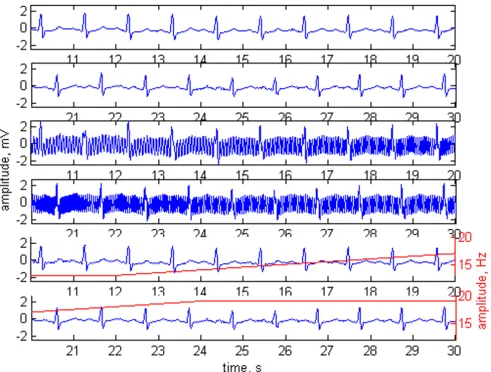
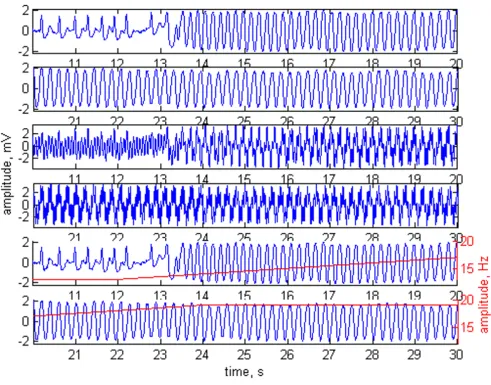
The method was tested with normal ECG signals (Fig. 2), tachycardia (Fig. 3) and ventricular fibrillation (Fig. 4). The first two plots of any of the figures represent 20 s of the original ECG signal. Plots 3 and 4 present the ECG contaminated by a frequency-modulated noise. Plots 5
Block-diagram of adaptive filtering Figure 1
and 6 depict the processed signal as well as the frequency of the added interference, shown by red trace and red scale on the right.
The experiments were performed with phase shift of 52° between n1 and n2. The amplitudes of the noise were n1= 2 mV, n2= 3 mV in Fig 2, and n1= 3 mV, n2= 2 mV in Fig. 3 and Fig. 4.
With no change of the coefficients of the Hilbert trans-former, the same adaptive filter structure can be used for 50 Hz (or 60 Hz) power-line suppression. The first two
plots in Fig 5 depict 20 s epoch of original ECG signal. Sinusoidal noise with carrier frequency of 50 Hz (fre-quency modulated at a rate of 0.1 Hz* sec-1), and 3 mV
amplitude (amplitude modulated at a rate of 0.2 mV*sec -1), is presented in plots 3 and 4. The noise added to the
original ECG is shown in plots 5 and 6. The same noise, but phase shifted with 90° is applied on the reference channel. The filtered signal is presented in plots 7 and 8.
Adaptive filtering applied on normal sinus rhythm Figure 2
Adaptive filtering applied on normal sinus rhythm. Plots 1 and 2 – original ECG signal. Plots 3 and 4 – the ECG contaminated with n1= 2 mV noise. Plots 5 and 6 – processed signal. The frequency modulation of the added interference is shown by red trace and red scale on the right. Interference amplitude at the reference channel n2= 3 mV. Phase shift of 52° between n1and
Discussion
Most often the interfering signal is presented not only with its carrier frequency but also with its third harmonic. The proposed adaptive filtering using a reference input can easily control signals with multiple harmonics by cas-cade or parallel structures based on the configuration shown in Fig. 1.
No visual distortions of the processed ECG signal due to the superimposed modulated interference are observed. The amplitude and phase difference between n1 and n2
affect mostly the initial adaptation time until the
coeffi-cients w1 and w2 reach some stable levels. With an adapta-tion rate of µ = 0.0001 the adaptation time is from 0.1 s to 20 s. The increase of µcuts down the adaptation time but the filter results are getting worse.
After the initial adaptation time any amplitude and phase changes between n1 and n2 will be small and the system will succeed to readapt at a rate of µ = 0.0001. If a huge difference between n1and n2 appears, the re-adaptation period will depend on the gradient of the change, but in any case will be less than the initial adaptation time. The
Adaptive filtering applied on a patient with symptom of tachycardia Figure 3
reaction of the system will be not to suppress enough the 16.7 Hz.
In an attempt to decrease the adaptation time we used a stepwise decrease of the adaptation rate after the start of the algorithm. First we make 30 iterations with µ = 0.1, then gradually reduce the step to 0.01 and 0.001 making 10 iteration at each, until a finally µ= 0.0001 is reached.
The starting number of 50 iterations was chosen empiri-cally, considering that the amplitude of noise in one of the adaptive filter input should not be 3 times higher than the
amplitude of the noise in the other input and the phase shift has to be lower than 60°.
The embedding of a reference channel in the PADs presents some practical difficulties. The antenna has to be designed in a way so that the reference noise does not sig-nificantly depend on the PADs position or possible peo-ple/object moving around the PAD during resuscitation. This needs to be subjected to further investigations fol-lowing the publication. The final decision should be done after comparison to other methods, usually very complex and inflexible.
Adaptive filtering applied on a patient with ventricular fibrillation Figure 4
Plots 1 and 2 – original ECG with ventricular fibrillation Figure 5
Publish with BioMed Central and every scientist can read your work free of charge "BioMed Central will be the most significant development for disseminating the results of biomedical researc h in our lifetime."
Sir Paul Nurse, Cancer Research UK
Your research papers will be:
available free of charge to the entire biomedical community
peer reviewed and published immediately upon acceptance
cited in PubMed and archived on PubMed Central
yours — you keep the copyright
Submit your manuscript here:
http://www.biomedcentral.com/info/publishing_adv.asp
BioMedcentral
Conclusion
The proposed adaptive filter for suppression of 16.7 Hz noise generated by railroad net power-supply system has an excellent performance and its simple structure requires a low level of computational resources. With no change of Hilbert transformer coefficients, the same filter structure can be used for suppression of the 50 Hz (or 60 Hz) power-line interference.
Acknowledgements
This study has been supported by Schiller AG, Switzerland and Schiller-Medical SA, France
References
1. Cummins RO, Ornato JP, Thies WH, Pepe PE: Improving survival from sudden cardiac arrest: the 'chain of survival' concept: a statement for health professionals from the Advanced diac Life Support Subcommittee and the Emergency Car-diac Care Committee. American Heart Association.
Circulation 1991, 83:1832-1847.
2. Cobb LA, Eliastam M, Kerber RE, Melker R, Moss AJ, Newell L, Par-askos JA, Weaver WD, Weil M, Weisfeldt ML: Report of the American Heart Association Task Force on the Future of Cardiopulmonary Resuscitation.Circulation 1992, 85:2346-2355. 3. Cummins RO: From concept to standard care? Review of the clinical experience with automated external defibrillators.
Ann Emerg Med 1989, 18:1269-1275.
4. Angerer M: Cardiac pacemaker and railroad net systems.
Herzschrittmachertherapie und Elektrophysiologie 2004, 15:40-46. 5. Commission decision concerning the technical specification
for interoperability relating to the energy subsystem of the trans-European high-speed rail system.Official journal of the European communities 2002, 45:280-369.
6. Jekova I, Mitev P: Detection of ventricular fibrillation and tach-ycardia from the surface ECG by a set of parameters acquired from four methods.Physiol Meas 2002, 23:629-634. 7. Jekova I, Krasteva V: Real time detection of ventricular
fibrilla-tion and tachycardia.Physiol Meas 2004, 25:1167-1178.
8. Mitov I: Detection of shockable ECG arrhythmias. Electrotech-niques & Electronics E+E 2003, 7–9:19-24.
9. Schlimp CJ, Breiteneder M, Lederer W: Safety aspects for public access defibrillation using automated external defibrillators near high-voltage power lines. Acta Anaesthesiol Scand 2004,
48:595-600.
10. Kanz KG, Kay MV, Biberthaler P, Russ W, Wessel S, Lacker CK, Mut-schler W: Susceptibility of automated external defibrillators to train overhead lines and metro third rails.Resuscitation 2004,
62:189-98.
11. Levkov C, Michov G, Ivanov R, Daskalov I: Subtraction of 50 Hz interference from the electrocardiogram.Med Biol Eng Comput 1984, 22:371-373.
12. Christov II, Dotsinsky IA: New approach to the digital elimina-tion of 50 Hz interference from the electrocardiogram.Med Biol Eng Comput 1988, 26:413-434.
13. Dotsinsky IA, Daskalov IK: Accuracy of 50 Hz interference sub-traction from an electrocardiogram.Med Biol Eng Comput 1996,
34:489-493.
14. Christov I: Dynamic powerline interference subtraction from biosignals.Jour of Med Eng & Tech 2000, 24:169-172.
15. Thakor NV, Zhu YS: Application of adaptive filtering to ECG analysis: noise cancellation and arrhythmia detection.IEEE Trans Biomed Eng 1991, 38:785-794.
16. Ziarani AK, Konrad A: A nonlinear adaptive method of Elimina-tion of power line interference in ECG signals.IEEE Trans on Biomed Eng 2002, 49:540-546.
17. Hamilton PS: A comparison of adaptive and nonadaptive filters for reduction of powerline interference in the ECG.IEEE Trans on Biomed Eng 1996, 43:105-109.
18. Widrow B, Clover J, McCool J, Kaunitz J, Williams C, Hearn R, Zei-dler J, Dong E, Goodlin R: Adaptive noise cancelling: Principles and applications.Proc of the IEEE 1975, 63:1692-1716.
19. Handbook for Digital Signal Processing. Edited by: Sanjit K Mitra, James F Kaiser. John Wiley & Sons, Inc; 1993.