RESEARCH
Scaling up and scaling down the
production of galactaric acid from pectin using
Trichoderma reesei
Toni Paasikallio, Anne Huuskonen and Marilyn G. Wiebe
*Abstract
Background: Bioconversion of d-galacturonic acid to galactaric (mucic) acid has previously been carried out in small scale (50–1000 mL) cultures, which produce tens of grams of galactaric acid. To obtain larger amounts of biologically produced galactaric acid, the process needed to be scaled up using a readily available technical substrate. Food grade pectin was selected as a readily available source of d-galacturonic acid for conversion to galactaric acid.
Results: We demonstrated that the process using Trichoderma reesei QM6a Δgar1 udh can be scaled up from 1 L to 10 and 250 L, replacing pure d-galacturonic acid with commercially available pectin. T. reesei produced 18 g L−1 galac-taric acid from food-grade pectin (yield 1.00 g [g d-galacturonate consumed]−1) when grown at 1 L scale, 21 g L−1 galactaric acid (yield 1.11 g [g d-galacturonate consumed]−1) when grown at 10 L scale and 14 g L−1 galactaric acid (yield 0.77 g [g d-galacturonate consumed]−1) when grown at 250 L scale. Initial production rates were similar to those observed in 500 mL cultures with pure d-galacturonate as substrate. Approximately 2.8 kg galactaric acid was precipitated from the 250 L culture, representing a recovery of 77% of the galactaric acid in the supernatant. In addi-tion to scaling up, we also demonstrated that the process could be scaled down to 4 mL for screening of producaddi-tion strains in 24-well plate format. Production of galactaric acid from pectin was assessed for three strains expressing uronate dehydrogenase under alternative promoters and up to 11 g L−1 galactaric acid were produced in the batch process.
Conclusions: The process of producing galactaric acid by bioconversion with T. reesei was demonstrated to be equally efficient using pectin as it was with d-galacturonic acid. The 24-well plate batch process will be useful screen-ing new constructs, but cannot replace process optimisation in bioreactors. Scalscreen-ing up to 250 L demonstrated good reproducibility with the smaller scale but there was a loss in yield at 250 L which indicated that total biomass extrac-tion and more efficient DSP would both be needed for a large scale process.
Keywords: Galactaric acid, Mucic acid, d-Galacturonic acid, Pectin, Trichoderma reesei, Scale-up, Scale-down
© The Author(s) 2017. This article is distributed under the terms of the Creative Commons Attribution 4.0 International License (http://creativecommons.org/licenses/by/4.0/), which permits unrestricted use, distribution, and reproduction in any medium, provided you give appropriate credit to the original author(s) and the source, provide a link to the Creative Commons license, and indicate if changes were made. The Creative Commons Public Domain Dedication waiver (http://creativecommons.org/ publicdomain/zero/1.0/) applies to the data made available in this article, unless otherwise stated.
Background
There is considerable interest in replacing chemicals derived from petroleum with bio-derived chemicals, i.e. chemicals obtained by bioconversion and/or chemical conversion from renewable biological resources, primar-ily plants. Both galactaric and glucaric acids have been identified as substrates for chemical conversion to adipic
acid, furandicarboxylic acid (which is being developed as a substitute for terephthalic acid) and other platform chemicals, including anhydrides, diesters and diallyls which can be used in the synthesis of higher value prod-ucts [1–3]. Both compounds can be prepared by nitric acid oxidation of the corresponding monosaccharide (d-glucose or d-galactose) [4]. Although biotechnologi-cal conversions may be preferable to nitric acid oxida-tion, biotechnological conversion of d-glucose to glucaric acid continues to be challenging [5]. However, galactaric acid has been produced from d-galacturonic acid using
Open Access
*Correspondence: [email protected]
genetically modified Escherichia coli and Trichoderma reesei at concentrations of 10 [6] to 20 [7] g L−1, which are high enough concentrations for precipitation from the culture broth, making biotechnologically derived galactaric acid available for assessment in further chemi-cal conversions [6]. The genetically modified E. coli or T. reesei convert d-galacturonic acid to galactaric acid by the action of a uronate dehydrogenase (UDH), which is expressed in a strain in which normal d-galacturonic acid metabolism has been disrupted [6, 8]. In the case of T. reesei, deletion of the gene encoding NADPH-dependent d-galacturonate reductase (gar1), the first step in the fun-gal pathway for d-fun-galacturonic acid metabolism, is suf-ficient to disrupt the pathway and expression of the A. tumefaciens udh gene results in a strain which produces galactaric acid [8].
Although chemically produced galactaric acid is com-mercially available, biotechnologically produced galac-taric acid will contain different impurities and the effect of these on specific chemical reactions needs to be assessed to provide feedback on the purity requirements and consequent implications for downstream processing (DSP) in the biotechnological process. For this reason it may be necessary to produce substantial quantities of galactaric acid using biotechnology, even though the pro-cess is not ready for commercialisation.
The substrate for biotechnological production of galac-taric acid is d-galacturonic acid, which can be obtained by hydrolysis of pectin. Zhang et al. [6] demonstrated that galactaric acid could be produced from enzymati-cally hydrolysed sugar beet pulp, but noted that the yield of galactaric acid on sugar beet pulp was relatively low (0.14 g galactaric acid per g sugar beet pulp), reflecting the high concentration of other compounds in the pulp, particularly d-glucose and l-arabinose. d-Galacturonic acid is currently available only at high prices (more than €3000 per kg) and is thus not suitable for producing kilo-gram amounts of galactaric acid for chemical testing. However, food grade pectins are commercially available at prices in the range of €10–100 per kg, making them a reasonable source for preparation of large amounts of galactaric acid. It should be noted that food grade pectin may be diluted with additives such as sucrose or glucose. Having received a request to provide a 2 kg sample of bio-technologically produced galactaric acid for use in chem-ical reactions, we decided to use pectin as the source of d-galacturonic acid in scaling up the process of galactaric acid production with T. reesei Δgar1 udh. An industrial process would be expected to use sugar beet pulp, cit-rus waste and other pectin-rich waste streams or crude extractions of pectin from these sources, which would not compete with the food use of current pectin pro-duction, but these were not readily available at the scale
needed. T. reesei Δgar1 udh was used in scaling up the process since it has already been demonstrated to pro-duce up to 20 g L−1 galactaric acid from d-galacturonic acid [7]. Since T. reesei does not hydrolyse pectin [9] and to facilitate sterilisation of viscous pectin solutions, enzymatic pre-hydrolysis of the pectin was necessary. An alternative approach would be to develop a consoli-dated process using a production strain such as Asper-gillus niger, which produces native pectinases. However, A. niger can metabolise galactaric acid [8] and a strain in which this pathway has been disrupted has only recently become available [10]. A production process with A. niger has not yet been developed.
In addition to scaling up the process of producing galactaric acid to provide galactaric acid for chemical reactions, we were also interested in providing a scaled down process, which would enable the screening of new strains [11]. Galactaric acid production by T. reesei has previously been demonstrated in flask cultures [8], but at much lower concentrations than can be obtained in bio-reactors [7]. Running and Bansal [12] demonstrated that 24-well plates can have as good or better oxygen trans-fer as shaken flasks, depending on the shaking regime applied, and 24-well plates are increasingly being used for the cultivation of filamentous fungi [13–15]. It is therefore useful to assess whether galactaric acid produc-tion by T. reesei could be scaled down for producproduc-tion in 24-well plates using pectin as substrate.
In this paper we describe the production of galactaric acid by T. reesei VTT D-161646 from enzyme hydrolysed pectin at 1, 10 and 250 L scales. We also demonstrate that the process can be scaled down to 4 mL for strain screening, for example in considering the effectiveness of alternative promoters for expression of the uronate dehy-drogenase gene, as shown here.
Results
Scaling down production of galactaric acid in 24‑well plates
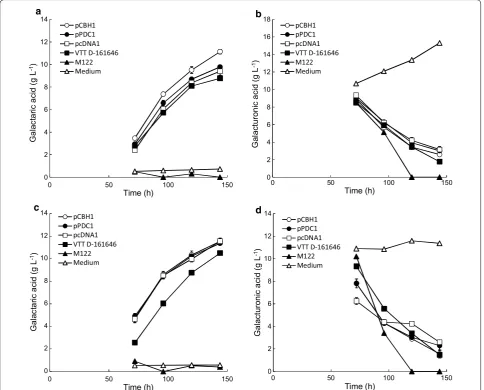
inoculated (Fig. 1). The increase in concentration of d-galacturonic acid (Fig. 1b) and lactose in the uninoc-ulated wells provided evidence of the extent of evapo-ration in the wells and this data was used to calculate the actual concentrations of galactaric acid produced in other wells. Hydrolysis of the pectin was not com-plete within 72 h, so changes in the concentrations of d-galacturonic acid and lactose in the well with medium containing d-galacturonate were used to adjust for evaporation in the pectin containing wells.
Each of the new transformants produced similar amounts of galactaric acid to VTT D-161646 and to each other (Fig. 1; Table 1). The strain expressing udh
under control of the CBH1 (cellobiohydrolase I) pro-moter produced significantly more (p < 0.05) galactaric acid (11.2 ± 0.2 g L−1) from d-galacturonic acid than the
other three strains, but there were no significant differ-ences (p > 0.05) in the amounts produced from Sigma pectin (Fig. 1). The yield of galactaric acid on d-galactu-ronic acid was between 0.87 and 1.00 g g−1 in the 24-well plates when d-galacturonic acid was used as the sub-strate, and between 0.76 and 0.90 g g−1 when pectin was used as substrate (Table 1). Production rates between 72 and 120 h were 0.11–0.13 g L−1 h−1 with either pure d-galacturonic acid or with pectin as the source of d-galacturonic acid (Table 1).
0 2 4 6 8 10 12 14
0 50 100 150
Ga la ct ar ic ac id (g L -1) Time (h) pCBH1 pPDC1 pcDNA1 VTT D-161646 M122 Medium 0 2 4 6 8 10 12 14
0 50 100 150
G al ac tu ro ni c ac id (g L -1) Time (h) pCBH1 pPDC1 pcDNA1 VTT D-161646 M122 Medium 0 2 4 6 8 10 12 14
0 50 100 150
Ga la ct ar ic ac id (g L -1) Time (h) pCBH1 pPDC1 pcDNA1 VTT D-161646 M122 Medium 0 2 4 6 8 10 12 14 16 18
0 50 100 150
G al ac tu ro nic ac id( g L -1) Time (h) pCBH1 pPDC1 pcDNA1 VTT D-161646 M122 Medium a b c d
In lactose-d-galacturonic acid fed-batch cultures (0.5 L, using the optimised process described by [7]) transfor-mants expressing udh under the gpdA (glyceraldehyde-3-phosphate dehydrogenase, strain VTT D-161646), CBH1, cDNA1 (unidentified hypothetical protein), and PDC1 (pyruvate decarboxylase) promoters produced 20, 16, 14 and 16 g L−1 galactaric acid, respectively (Table 1). Yields were 0.85, 0.90, 0.82 and 1.11 g galactaric acid [g d-galacturonate consumed]−1, respectively. However, the strain producing galactaric acid under the pdc1 pro-moter grew slower than the other strains, producing less biomass, and the initial production rate (between 0 and 72 h) of d-galactaric acid (0.09 g L−1 h−1) was slower than that of the other three strains (0.19–0.20 g L−1 h−1, Table 1).
Production of galactaric acid from pectin at 1, 10 and 250 L scale
Strain VTT D-161646 was used in the scaling up experi-ments since production conditions have been developed specifically for this strain [7] and there was no improve-ment in galactaric acid production with the new strains under these conditions. In order to scale up produc-tion of galactaric acid, d-galacturonic acid was replaced with pectin, using either Sigma or Meridianstar pec-tin (Table 2). A process scheme for the production of galactaric acid from pectin is shown in Fig. 2. The 10 L culture was carried out using Sigma pectin while wait-ing for the Meridianstar pectin to arrive. Because of the high d-glucose content in the Meridianstar pectin it was necessary to adjust the process at 1 L scale to assess the extent to which the high d-glucose content would repress
galactaric acid production. Therefore both 1 and 250 L cultures were carried out using Meridianstar pectin.
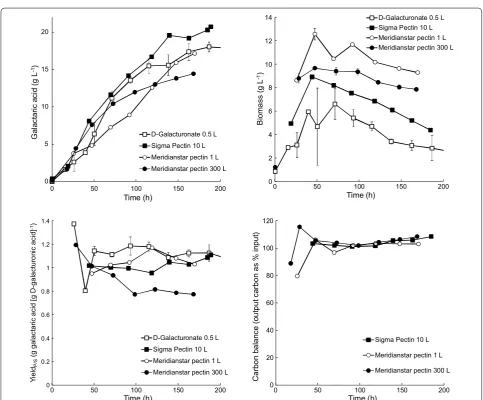
When Sigma pectin replaced d-galacturonic acid in the T. reesei galactaric acid production process, 21 g L−1 galactaric acid was produced with a yield of 1.11 g galac-taric acid [g d-galacturonic acid]−1, assuming that the pectin had been fully hydrolysed. The yield of galactaric acid on pectin was 0.73 g g−1. The production rate dur-ing the first 140 h (0.14 g L−1 h−1) was comparable to that observed previously with pure d-galacturonic acid during the same time interval (0.15 g L−1 h−1; Fig. 3) [7] and the process generally showed good reproducibility with the 500 mL scale production from d-galacturonic acid. No accumulation of d-galacturonic acid or other carbohydrates (lactose, glucose, galactose or arabinose) was observed during the feeding phase. Biomass pro-duction on pectin with lactose was a bit higher than on d-galacturonic acid with lactose, even though the lactose concentration had been reduced to take into account the
Table 1 Galactaric acid production by T. reesei expressing udh under promoters pCBH1, pcDNA1, pPDC1 or pGPDA
Galactaric acid production (titre, rate of production and yield on d-galacturonic acid) in 24-well plates and in 0.5 L bioreactors using either d-galacturonic acid or
pectin (Sigma) as substrate, with lactose as co-substrate. Maximum biomass in bioreactors was observed at 50 (pCBH1, pcDNA1, pGPDA) or 72 (pPDC1) h after which time biomass decreases (see also Fig. 3). Values are mean ± sem for three replicates
a Strain VTT D-161646
Strain pCBH1 pcDNA1 pPDC1 pGPDAa
24-well plates—d-galacturonate
Galactaric acid (g L−1) 11.1 ± 0.2 9.4 ± 0.4 9.8 ± 0.1 8.8
Galactaric acid production rate (72–120 h) (g l−1 h−1) 0.13 ± 0.01 0.12 ± 0.00 0.12 ± 0.00 0.11
Yield galactaric/d-galacturonic (g g−1) 0.95 ± 0.02 0.87 ± 0.02 0.89 ± 0.00 0.89 24-well plates—pectin
Galactaric acid (g L−1) 11.6 ± 0.2 11.5 ± 0.3 11.4 ± 0.1 10.5
Galactaric acid production rate (72–120 h) (g L−1 h−1) 0.12 ± 0.04 0.11 ± 0.00 0.11 ± 0.00 0.13
Yield galactaric/d-galacturonic (g g−1) 0.84 ± 0.03 0.90 ± 0.03 0.89 ± 0.03 0.76 0.5 L bioreactors—d-galacturonate
Galactaric acid (g L−1) 15.7 13.6 16.0 19.7
Galactaric acid production rate (0–72 h) (g L−1 h−1) 0.22 0.21 0.09 0.19
Yield galactaric/d-galacturonic (g g−1) 0.90 0.82 1.11 0.85
Maximum biomass (g L−1) 9.5 ± 0.2 9.0 ± 0.3 6.5 ± 0.5 7.9 ± 0.3
Table 2 Carbohydrate composition (% dry matter) of pec-tin
Pectin was hydrolysed by addition of 0.5–1.0 mL L−1 Pectinex Ultra with 0.1 mL L−1 Pectinex Smash and incubation at 40 °C. d-Galactose and d-xylose were not separated on the HPLC column used
Pectin Sigma P1935 Meridianstar
rapid set
d-Galacturonate 65.6 43.0
d-Glucose 1.7 35.5
l-Arabinose 1.2 1.5
Feed vessel Reactor Pectin Water Pectinase (45°C) Sterilisation Pectin Water Pectinase Fungal cells YE Mineral salts YE Cell separation Biomass Crystalisation Supernatant
HCl Galactaricacid
Liquid waste Washing
Separation Lactose
Fig. 2 Process scheme for production of galactaric acid from pectin. Input concentrations are given in the methods and outputs are described in
“Results”. Process steps carried out here are indicated with solid lines. Broken lines illustrate the potential for an additional biomass extraction step,
with liquid recycling. Filtration was used for cell separation and for collection of galactaric acid crystals
0 2 4 6 8 10 12 14
0 50 100 150 200
Bi om as s (gL -1) Time (h)
D-Galacturonate 0.5 L Sigma Pectin 10 L Meridianstar pectin 1 L Meridianstar pectin 300 L
0 20 40 60 80 100 120
0 50 100 150 200
Ca rb on ba la nc e (o ut pu tc ar bon as %i np ut ) Time (h)
Sigma Pectin 10 L Meridianstar pectin 1 L Meridianstar pectin 300 L 0
5 10 15 20
0 50 100 150 200
G ala ct ar ic ac id( g L -1) Time (h)
D-Galacturonate 0.5 L Sigma Pectin 10 L Meridianstar pectin 1 L Meridianstar pectin 300 L
0 0.2 0.4 0.6 0.8 1 1.2 1.4
0 50 100 150 200
Yi
el
dP/S
(g gal ac ta ric ac id [g D-ga la ct uro ni c ac id ] -1) Time (h)
D-Galacturonate 0.5 L Sigma Pectin 10 L Meridianstar pectin 1 L Meridianstar pectin 300 L
carbohydrates introduced with the pectin (Fig. 3). d-Glu-cose remained limiting throughout the feeding phase.
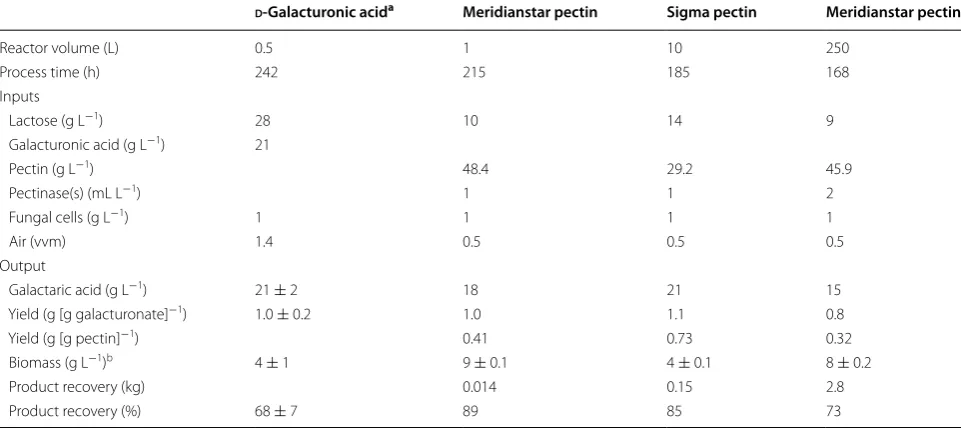
The culture broth was collected at the end of the culti-vation and the biomass separated by filtration, generat-ing 8.8 L clear liquid and 282 g wet biomass. Precipitatgenerat-ing and collecting the crystals of galactaric acid resulted in 154 g galactaric acid, representing 85% of the galactaric acid produced (Table 3).
Using Meridianstar Rapid Set pectin, 19 g L−1 taric acid was produced with a yield of 1.00 g galac-taric acid [g d-galacturonic acid]−1, assuming complete hydrolysis of the pectin (Fig. 3). The yield of galactaric acid on Meridianstar pectin was 0.41 g g−1. Feeding was not started until all d-glucose and lactose had been con-sumed, but this resulted in d-galacturonic acid limitation during the batch phase and reduced the initial galactaric acid production rate. The initial production rate (0–70 h) was only 0.10 g L−1 h−1, but during the feeding phase (90–150 h) it increased to 0.13 g L−1 h−1. Although there was no accumulation of d-glucose during the feeding phase, there was initial accumulation of d-galacturonic acid (up to 4.3 g L−1) in the culture supernatant and the feed rate was reduced to allow more complete conversion to d-galactaric acid. More biomass was produced when T. reesei VTT D-161646 was grown on Meridianstar pectin than on Sigma pectin and the biomass concentra-tion was maintained during the feeding phase (Fig. 3). Approximately 89% of the galactaric acid was recovered by precipitation in acid (Table 3).
Based on the results at the 1 L scale, T. reesei VTT D-161646 was grown in a 300 L bioreactor and 256 L of 14 g L−1 galactaric acid was produced. The initial (0–73 h) production rate of 0.15 g L−1 h−1 was only sus-tained for 72 h, after which time both the rate of galac-taric acid production and the yield of galacgalac-taric acid on d-galacturonic acid decreased. The final yield was 0.77 g galactaric acid [g D-galacturonic acid]−1 or 0.32 g [g pec-tin]−1 (Fig. 3). Crystals were observed among the mycelia under the microscope and were also present in the foam which had been produced in the bioreactor. After precip-itation, collection and drying, 2.81 kg galactaric acid was obtained, or 73% of the amount present in the superna-tant (Table 3). Biomass was not extracted.
Discussion
The process of producing galactaric acid using T. reesei was scalable both up and down, with little loss in produc-tivity, even with the substitution of pectin for d-galac-turonic acid. Pectin was found to be a suitable substrate for galactaric acid production, although for T. reesei this required the addition of commercial pectinases. Addition of pectinases also facilitated sterilisation of the pectin feed, so even though T. reesei could be engineered to express a full range of pectinases to reduce the cost of enzyme addi-tion, a fully consolidated process may not be desirable. The only other adjustment required for the use of pectin was a reduction in the amount of added substrate, since co-substrates were provided with the pectin, particularly in
Table 3 Process parameters for galactaric acid production at 0.5, 1, 10 and 250 L
a Data from [7]. Values are mean ± sem for four cultivations
b Biomass measurements are mean ± sem for 2–3 replicates, except for 0.5 L cultivations (mean ± sem for 4 cultivations), at end of cultivation
d‑Galacturonic acida Meridianstar pectin Sigma pectin Meridianstar pectin
Reactor volume (L) 0.5 1 10 250
Process time (h) 242 215 185 168
Inputs
Lactose (g L−1) 28 10 14 9
Galacturonic acid (g L−1) 21
Pectin (g L−1) 48.4 29.2 45.9
Pectinase(s) (mL L−1) 1 1 2
Fungal cells (g L−1) 1 1 1 1
Air (vvm) 1.4 0.5 0.5 0.5
Output
Galactaric acid (g L−1) 21 ± 2 18 21 15
Yield (g [g galacturonate]−1) 1.0 ± 0.2 1.0 1.1 0.8
Yield (g [g pectin]−1) 0.41 0.73 0.32
Biomass (g L−1)b 4 ± 1 9 ± 0.1 4 ± 0.1 8 ± 0.2
Product recovery (kg) 0.014 0.15 2.8
the case of the food-grade pectin, which contained a high concentration of d-glucose. Earlier results had indicated that d-glucose-limited fed-batch culture was less effective than lactose-limited fed-batch culture for galactaric acid production with T. reesei VTT D-161646 [7], but this did not appear to be the case when d-glucose was supplied with hydrolysed pectin in the feed.
Pectin was also used in the 24-well plates, with no apparent problems with mixing. Evaporation could be a problem at this scale, however, as seen in the increasing concentration of substrates in uninoculated wells, and needed to be taken into account. Production from hydro-lysed pectin was comparable to that observed when pure d-galacturonic acid was provided. Production of galac-taric acid was much higher in these 4 mL batch cultures than has previously been reported for flask cultures with filamentous fungi (around 4 g L−1; [8, 10]). The medium in the 24-well plates contained spent grain extract, which
was expected to induce the CBH1 promoter [16], but
not necessarily other promoters. Spent grain extract also provides organic nitrogen, resulting in a richer medium, which may contribute to the good conversion of d-galac-turonic acid into galactaric acid. Kuivanen et al. [10] recently found that providing yeast extract and peptone to a A. niger galactaric acid producing strain, resulted in improved galactaric acid production, although the amounts were still low.
Production of galactaric acid by three new strains was compared in the 24-well plates, but production of all strains was found to be similar. This suggested that the amount of uronate dehydrogenase produced under the control of each of the promoters tested (pCBH1, pcDNA1, pPDC1 and the original pGPDA) was adequate to catalyse the conversion of d-galacturonic acid to galactaric acid at the rate at which it was taken up under these conditions. The effectiveness of these strains in producing galactaric acid was confirmed in 0.5 L biore-actors, however, the bioreactor cultures also revealed a slow growth (and production) phenotype for the strain expressing udh under the PDC1 promoter, which was not observed in the microtiter plates. The PDC promoter is expected to be particularly well induced when d-glucose is the main carbon source, and conversion of d-galactu-ronic to galactaric acid may be better with d-glucose as co-substrate [17], rather than lactose, as used here. The provision of better aeration and substrate-limited feeding in the bioreactors may also contribute to the phenotype.
The yield of galactaric acid on d-galacturonate was close to the theoretical yield of 1.08 g g−1 in the 1 and 10 L cultures, but in the 250 L culture the yield decreased to 0.8 g galactaric acid [g d-galacturonate consumed]−1 after 72 h. The carbon balance (Fig. 3) indicated that all of the input carbon was accounted for in the output.
This suggests that galactaric acid crystals may have been included with inadequately washed biomass in the dry weight determination, or that some d-galacturonate con-tributed to CO2 production through an unknown path-way. Up to around 7% galactaric acid was expected to be removed with the biomass, but is expected to be washed off during rinsing for the dry weight determination. However, when harvesting the 250 L culture we observed a decrease in galactaric acid concentration during the filtration process, which indicated that galactaric acid crystals were trapped as more biomass accumulated in the filter. The concentration of galactaric acid was deter-mined after filtration. Large scale extraction of the bio-mass was not possible at this time, but it is clear that this would be needed to obtain the maximum galactaric acid output from a scaled up process.
In spite of the low yield at the 250 L scale, around 3.8 kg galactaric acid was produced and 2.8 kg was recovered by acid precipitation. Poor mixing and inadequate cooling in the vessels used for the crystallisation step will have contributed to the recovery of only 73% of the galactaric acid. This was adequate for supplying material for further chemical conversions, but highlights the need for further DSP development.
Conclusions
The process of producing galactaric acid by bioconver-sion with T. reesei was demonstrated to be equally effi-cient using hydrolysed pectin as d-galacturonic acid as the substrate, and d-glucose present with the pectin did not inhibit the process. Scaling up to 250 L demonstrated good reproducibility with the smaller scale but there was a loss in yield at 250 L which indicated that both total biomass extraction and more efficient DSP would be needed for a large scale process. It would also be neces-sary to obtain higher production titres and production rates before a biotechnological process for producing galactaric acid would be considered for commercial pro-duction. However, the low solubility of galactaric acid [7] made it feasible to produce kilogram amounts of galac-taric acid with the currently available strains so that assessment on purity requirements and further chemi-cal transformations can proceed in parallel with further strain engineering. The 24-well plate batch process will be useful in screening new constructs, but cannot replace process optimisation in bioreactors.
Methods Strains
by cultivating the fungus on potato-dextrose agar (BD, Sparks, Maryland, USA) for 5–7 days, after which the spores were harvested, suspended in a buffer containing 0.8% NaCl, 0.025% Tween-20 and 20% glycerol, filtered through cotton and stored at −80 °C. Saccharomyces cer-evisiae strain H3488 (FY834, obtained from Jay C. Dun-lap) was used to clone expression construct plasmids. Escherichia coli TOP10 (Invitrogen) was used for propa-gation of the plasmids.
Expression vectors
Expression plasmids contained the 5′ and 3′ flanking regions of T. reesei d-galacturonic acid reductase (gar1, [18]), T. reesei promoter (cbh1, cDNA1 or pdc1), Agro-bacterium tumefasciens UDH gene, Aspergillus trpC ter-minator, T. reesei pyr4 selection marker with a loop-out fragment for marker removal, and the pRS426 plasmid as vector backbone.
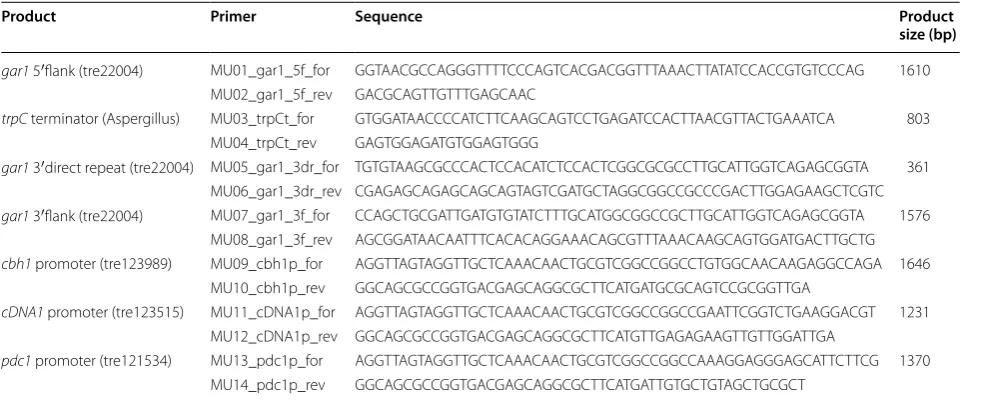
Plasmid pRS426 (ATCC77107), used in cloning expres-sion construct plasmids in yeast, was obtained from Jay C. Dunlap. For cloning, pRS426 was digested with restriction enzymes EcoRI and XhoI. A plasmid con-taining A. tumefasciens d-galacturonic acid dehydro-genase (udh gene, GenBank no. BK006462.1) codon optimised for Aspergillus niger, [8] was digested with NcoI and SacII to release the udh gene from the vector backbone. The 5′ and 3′ flank (1572 and 1500 bp) frag-ments of gar1, the three promoters (cbh1, cDNA1 and pdc1) and 285 bp of the gar1 3′ flank as a direct repeat for looping out the selection marker were obtained by PCR using strain QM6a as template. The Aspergillus trpC terminator (773 bp) was obtained by PCR from a plasmid containing the element. PCR amplification was performed with a KAPA HiFi HotStart ReadyMix PCR
kit (KAPABiosystems) using the primers listed in Table 4. The selection marker pyr4 was obtained from an exist-ing plasmid with NotI digestion. All PCRs and digestions were separated with agarose gel electrophoresis and cor-rect fragments were extracted with a gel extraction kit (Qiagen).
The appropriate purified DNA fragments were trans-formed to S. cerevisiae FY834 using the method described in Gietz and Woods [19]. The plasmids obtained through homologous recombination reactions were isolated from S. cerevisiae, amplified in E. coli and checked by restric-tion enzyme digesrestric-tions and sequencing.
Strain generation
Expression plasmids (10 µg) were digested with MssI, resulting in approximately 6 µg of released expression cassette from each. To generate 3′ single stranded over-hangs and thus to improve transformation efficiency, digestion mixtures were further treated with T7 exonu-clease [20] and used without further purification.
Strain M1123 was transformed with each of the three expression constructs and positive transformants were selected on minimal medium as described previously [21, 22]. Transformants were sub-cultured onto agar-solidi-fied minimal medium containing 1 mL L−1 Triton X-100. The isolates were screened by PCR to verify correct inte-gration at the gar1 locus and a few correctly integrated transformants were purified as single spore isolates. Deletion of gar1 was verified by PCR.
Media
The low phosphate medium described by [7] was used
for 24-well plate, flask and bioreactor cultivations, with d-galacturonic acid, pectin and lactose provided as
Table 4 Primers used to generate fragments for cloning by PCR amplification
The gene identifiers (tre-numbers) refer to Joint Genome Institute T. reesei assembly release version 2.0
Product Primer Sequence Product
size (bp)
gar1 5′flank (tre22004) MU01_gar1_5f_for GGTAACGCCAGGGTTTTCCCAGTCACGACGGTTTAAACTTATATCCACCGTGTCCCAG 1610 MU02_gar1_5f_rev GACGCAGTTGTTTGAGCAAC
trpC terminator (Aspergillus) MU03_trpCt_for GTGGATAACCCCATCTTCAAGCAGTCCTGAGATCCACTTAACGTTACTGAAATCA 803 MU04_trpCt_rev GAGTGGAGATGTGGAGTGGG
gar1 3′direct repeat (tre22004) MU05_gar1_3dr_for TGTGTAAGCGCCCACTCCACATCTCCACTCGGCGCGCCTTGCATTGGTCAGAGCGGTA 361 MU06_gar1_3dr_rev CGAGAGCAGAGCAGCAGTAGTCGATGCTAGGCGGCCGCCCGACTTGGAGAAGCTCGTC
gar1 3′flank (tre22004) MU07_gar1_3f_for CCAGCTGCGATTGATGTGTATCTTTGCATGGCGGCCGCTTGCATTGGTCAGAGCGGTA 1576 MU08_gar1_3f_rev AGCGGATAACAATTTCACACAGGAAACAGCGTTTAAACAAGCAGTGGATGACTTGCTG
cbh1 promoter (tre123989) MU09_cbh1p_for AGGTTAGTAGGTTGCTCAAACAACTGCGTCGGCCGGCCTGTGGCAACAAGAGGCCAGA 1646 MU10_cbh1p_rev GGCAGCGCCGGTGACGAGCAGGCGCTTCATGATGCGCAGTCCGCGGTTGA
cDNA1 promoter (tre123515) MU11_cDNA1p_for AGGTTAGTAGGTTGCTCAAACAACTGCGTCGGCCGGCCGAATTCGGTCTGAAGGACGT 1231 MU12_cDNA1p_rev GGCAGCGCCGGTGACGAGCAGGCGCTTCATGTTGAGAGAAGTTGTTGGATTGA
carbon sources, as indicated. Medium for 24-well plate cultivations contained 15 g L−1 lactose with 10 g L−1 d-galacturonate or 10 g L−1 lactose with 20 g L−1 pectin (Sigma P1935, Table 2). Immediately before inoculation, 1 mL L−1 Pectinex Ultra SP-L (Novozymes) was added to pectin-containing medium. All 24-well plate medium also contained 100 mM PIPPS and 1 g L−1 spent grain extract, with the pH adjusted to 5.5.
Pre-cultures for bioreactors were grown in low phos-phate medium with 20 g L−1 lactose and 1 g L−1 yeast extract.
Media for bioreactors contained 15 g L−1 lactose and 7.5 g L−1 Sigma pectin or 9 g L−1 lactose and 11 g L−1 Meridianstar Rapid set pectin (Table 2) in the batch phase, plus 3 g L−1 yeast extract. Filter sterilised Pectinex Ultra SP-L (1 mL L−1) was added to the reactors after sterilisation at 1 and 10 L scale, but unsterilized enzyme was added before sterilisation for the 250 L pilot. Feed for the fed-batch cultivations contained 1 g L−1 yeast extract and either 50 g L−1 Sigma pectin with 6 g L−1 lactose or 78 g L−1 Meridianstar pectin. Pectin in the feed was hydrolysed by the addition of 1.0 mL L−1 Pectinex Ultra SP-L with 0.1 mL L−1 Pectinex Smash (Novozymes) and incubation at ~45 °C, with agitation, prior to sterilisa-tion. Hydrolysis was allowed to proceed until the vis-cosity had been reduced to allow adequate sterilisation. The d-galacturonic acid concentration was assessed by HPLC and if hydrolysis was not yet complete, additional sterile Pectinex Ultra SP-L was added after sterilisation to ensure the availability of d-galacturonic acid for the process.
Culture conditions
Twenty-four-well plates (Whatman 10 mL round bottom Uniplate) contained 4 mL medium per well, with either 10 g L−1 d-galacturonate or 20 g L−1 pectin (Sigma), which was enzymatically hydrolysed simultaneously with the cultivation, as the substrate and lactose as the carbon source for growth. Wells were inoculated with approxi-mately 105 spores in 10 µL suspension (~2.5 × 10⁴ spores mL−1 final concentration). One well for each medium was not inoculated and used as a control. Three wells were inoculated with each new transformant (express-ing udh under the CBH1, PDC1 and cDNA1 promot-ers) and one well each with M122 (negative control) and VTT D-161646. The plates were covered with adhesive, breathable rayon fibre film for culture plates (VWR) and incubated at 28 °C, 800 rpm (Infors HT Microtron, Swit-zerland), 85% relative humidity for up to 7 days. Samples (100 µL) were taken daily after 72 h using wide-mouth 200 µL pipette tips and either diluted and analysed imme-diately or stored at −20 °C. Sample size was minimised
for the 24-well plates to ensure adequate culture volume for continued incubation.
Pre-cultures for bioreactor inocula were started in Erlenmeyer flasks (500–2000 mL containing 20% volume medium) inoculated with ~1 × 10⁵ spores mL−1 (final concentration) to provide a 10% v/v inoculum for 1, 10 or 32 L reactors. The 32 L reactor (New Brunswick 32 L BioFlo 510, Eppendorf) was used to provide inoculum for the 300 L reactor. Flasks were incubated at 30 °C with 200 rpm agitation for approximately 45 h before being transferred directly to bioreactors to provide an initial biomass of about 1 g L−1.
Bioreactor cultures were grown in Multifors (Infors HT, Switzerland, max. working volume 0.5 L), Biostat Q (Sartorius AG, Germany, 1 L max. working volume), Biostat C (Sartorius AG, Germany, 10 L max. work-ing volume), BioFlo 510 (Eppendorf) or New Brunswick Scientific IF400 (Eppendorf, 350 L max. working vol-ume) bioreactors. Cultures were maintained at 35 °C, with 500–900 rpm (0.5 L), 350–500 rpm (1 L), 400 rpm (10 L), 200 rpm (32 L) or 125–200 rpm (350 L reactor) agitation and approximately 0.5 volume gas (volume cul-ture)−1 min−1 (vvm). Culture pH was kept constant at pH 4.0 by the addition of sterile 2–4 M NaOH or 1 M H3PO4. Gas concentration (CO2, O2, N2 and Ar) was analysed continuously using a Prima Pro Process mass spectrom-eter (Thermo Scientific, UK) calibrated with 3% CO2 in Ar, 5% CO2 with 0.99% Ar and 15% O2 in N2, 20% O2 plus 20% Ar in N2, and 0.04% ethanol in N2. Fed-batch cul-tures were provided feed at a constant rate after at least 5 g L−1 biomass had been produced. The start of feeding for the 1 L culture was delayed to allow complete utilisa-tion of the lactose, but this appeared to reduce produc-tivity and the feed for the 250 L culture (using the same substrate) was started with about 2 g L−1 lactose still pre-sent in the medium, as was the 10 L culture.
Chemical analyses
The concentrations of d-glucose, lactose, d-galactose, d-galacturonic acid, and galactaric acid were deter-mined by HPLC using a Fast Acid Analysis Column (100 × 7.8 mm, BioRad Laboratories, Hercules, CA) linked to an Aminex HPX-87H organic acid analysis col-umn (300 × 7.8 mm, BioRad Laboratories) with 5 mM H2SO4 as eluent and a flow rate of 0.3 or 0.5 mL min−1. The column was maintained at 55 °C. Peaks were detected using a Waters 410 differential refractom-eter and a Waters 2487 dual wavelength UV (210 nm) detector.
were diluted without separation of biomass and super-natant, heated at 100 °C for 0.5–1 h, then centrifuged at room temperature to remove biomass.
Downstream processing
Culture broth was collected from the 1, 10 and 250 L cultures and the mycelium separated from the super-natant by filtration. At the 1 and 10 L scale, the myce-lium was filtered through thick cleaning cloth under vacuum. The 250 L culture was warmed to 45 °C before biomass was separated from the liquid using Seitz K300 depth filter sheets (Pall Corporation) in a Seitz 40–30A4 filter press to obtain approximately 250 L filtrate and 20 kg wet biomass. The supernatant was transferred during filtration to 2 large vessels (165 and 85 L) which were cooled via cold jackets operated with water circu-lated from a chiller to give temperatures between 7 and 12 °C. One and 10 L volumes were stored at 4 °C. HCl was added to all culture supernatants to reduce the pH to between 1.5 and 2.2. Supernatants with precipitating galactaric acid crystals were mixed periodically by shak-ing (1 and 2 × 5 L) or stirring with a paddle (165 and 85 L) until it was convenient to collect the crystals of galactaric acid.
Galactaric acid crystals were collected by filtration through Whatman GF/A filter paper. For large volumes, the crystals were first allowed to settle to the bottom of the container and the clear liquid decanted to a clean ves-sel. The decanted liquid was expected to contain some galactaric acid and was returned to the cold to allow fur-ther crystal formation, precipitation and collection. The process was repeated twice for the 1 L culture superna-tant and four times for the 10 and 250 L volumes.
Biomass determination
Mycelia were collected by filtration through Whatman GF/B filters under vacuum and washed twice with an equal or greater volume of distilled H2O. Mycelia were dried to a constant weight at 105 °C.
Authors’ contributions
AH carried out all work related to scaling down the process (transformations and 24-well plate cultivations). TP carried out the scaling up cultivations. MW designed the study, supervised the scaling-up and carried out HPLC analysis and DSP. MW and AH drafted the manuscript. All authors read and approved the final manuscript.
Acknowledgements
We thank Merja Aarnio for technical assistance.
Competing interests
The authors declare that they have no competing interests.
Availability of data and materials
The datasets used and analysed during the current study are available from the corresponding author on reasonable request.
Funding
This research was supported by the VTT BioEconomy Programme.
Publisher’s Note
Springer Nature remains neutral with regard to jurisdictional claims in pub-lished maps and institutional affiliations.
Received: 14 April 2017 Accepted: 6 July 2017
References
1. Boussie TR, Dias EL, Fresco ZM, Murphy VJ, Shoemaker J, Archer R, et al. Adipic acid composition. 2011; Patent WO2011/109051 A1.
2. Thomas D, Asikainen M, Harlin A. Method for producing muconic acids and furans from aldaric acids. 2015; Patent WO2015189481 A1.
3. Lavilla C, Alla A, Martínez de Ilarduya A, Benito E, García-Martín MG, Galbis JA, Muñoz-Guerra S. Carbohydrate-based polyesters made from bicyclic acetalized galactaric acid. Biomacromolecules. 2011;12:2642–52. 4. Kiely DE, Kirk RHS. Method of oxidation using nitric acid. 2010; Patent
US7692041 B2.
5. Liu Y, Gong X, Wang C, Du G, Chen J, Kang Z. Production of glucaric acid from myo-inositol in engineered Pichia pastoris. Enzym Microb Technol. 2016;91:8–16.
6. Zhang H, Li X, Su X, Ang EL, Zhang Y, Zhao H. Production of adipic acid from sugar beet residue by combined biological and chemical catalysis. ChemCatChem. 2016;8:1500–6.
7. Barth D, Wiebe MG. Enhancing fungal production of galactaric acid. Appl Microbiol Biotechnol. 2017;101:4033–40.
8. Mojzita D, Wiebe M, Hilditch S, Boer H, Penttilä M, Richard P. Metabolic engineering of fungal strains for conversion of d-galacturonate to
meso-galactarate. Appl Environ Microbiol. 2010;76:169–75.
9. Wiebe MG, Mojzita D, Hilditch S, Ruohonen L, Penttilä M. Bioconversion of d-galacturonate to keto-deoxy-l-galactonate (3-deoxy-l
-threo-hex-2-ulosonate) using filamentous fungi. BMC Biotechnol. 2010;10:63. 10. Kuivanen J, Wang Y-MJ, Richard P. Engineering Aspergillus niger for
galac-taric acid production: elimination of galacgalac-taric acid catabolism by using RNA sequencing and CRISPR/Cas9. Microb Cell Fact. 2016;15:210. 11. Formenti LR, Nørregaard A, Bolic A, Hernandez DQ, Hagemann T, Heins
AL, Larsson H, Mears L, Mauricio-Iglesias M, Krühne U, Gernaey KV. Chal-lenges in industrial fermentation technology research. Biotechnol J. 2014;9:727–38.
12. Running JA, Bansal K. Oxygen transfer rates in shaken culture ves-sels from Fernbach flasks to microtiter plates. Biotechnol Bioeng. 2016;113:1729–35.
13. Linde T, Hansen NB, Lübeck M, Lübeck PS. Fermentation in 24-well plates is an efficient screening platform for filamentous fungi. Lett Appl Micro-biol. 2014;59:224–30.
14. Dana CM, Dotson-Fagerstrom A, Roche CM, Kal SM, Chokhawala HA, Blanch HW, Clark DS. The importance of pyroglutamate in cellulase Cel7A. Biotechnol Bioeng. 2014;111:842–7.
15. Landowski CP, Mustalahti E, Wahl R, Croute L, Sivasiddarthan D, Wester-holm-Parvinen A, Sommer B, Ostermeier C, Helk B, Saarinen J, Saloheimo M. Enabling low cost biopharmaceuticals: high level interferon alpha-2b production in Trichoderma reesei. Microb Cell Fact. 2016;15:104. 16. Nguyen EV, Imanishi SY, Haapaniemi P, Yadav A, Saloheimo M, Corthals
GL, Pakula TM. Quantitative site-specific phosphoproteomics of Tricho-derma reesei signaling pathways upon induction of hydrolytic enzyme production. J Proteome Res. 2016;15:457–67.
17. Li J, Wang J, Wang S, Xing M, Yu S, Liu G. Achieving efficient protein expression in Trichoderma reesei by using strong constitutive promoters. Microb Cell Fact. 2012;11:84.
18. Kuorelahti S, Kalkkinen N, Penttilä M, Londesborough J, Richard P. Iden-tification in the mold Hypocrea jecorina of the first fungal d-galacturonic
acid reductase. Biochemistry. 2005;44:11234–40.
• We accept pre-submission inquiries
• Our selector tool helps you to find the most relevant journal
• We provide round the clock customer support
• Convenient online submission
• Thorough peer review
• Inclusion in PubMed and all major indexing services
• Maximum visibility for your research
Submit your manuscript at www.biomedcentral.com/submit
Submit your next manuscript to BioMed Central
and we will help you at every step:
20. Korppoo A. Development of the CRISPR/Cas9 method for use in T. reesei. University of Helsinki; 2017. https://helda.helsinki.fi/bitstream/han-dle/10138/175220/developm.pdf?sequence=1. Accessed 19 Mar 2017. 21. Gruber F, Visser J, Kubicek CP, Degraaff LH. The development of a heter-ologous transformation system for the cellulolytic fungus Trichoderma reesei based on a pyrg-negative mutant strain. Curr Genet. 1990;18:71–6.