International Journal of Engineering
J o u r n a l H o m e p a g e : w w w . i j e . i rSurface Methodology
M. N. Hosseinpoura, G. D. Najafpoura *, H. Younesib, M. Khorramia, Z. Vaseghia
aFaculty of Chemical Engineering, Babol Noshirvani University of Technology, Babol, Iran
bDepartment of Environmental Sciences, College of Natural Resources & Marine Sciences, Tarbiat Modares University, Nour, Iran
A R T I C L E I N F O
Article history: Received 27March2012
Received in revised form 17 April 2012 Accepted 26May2012
Keywords: Lipase
Rice Bran Design Expert
A B S T R A C T
Among enzymes, lipases have been widely investigated because of their numerous industrial applications. In this study, optimization of lipase production by Aspergillus niger in solid state fermentation from rice bran as solid substrate was investigated. The optimal conditions were obtained with the aid of central composite design (CCD) under response surface methodology (RSM). In the analysis of 20 experimental runs, effects of three variables such as olive oil concentration, glucose concentration and humidity ratio on lipase activity were evaluated. The interaction between lipase activity and independent paired parameters were illustrated by three-dimensional diagrams while other factors were set at zero level. The optimum values of oil concentration, glucose concentration and humidity ratio were 1.78, 2.54 and 1.95% (g/gdss), respectively and the enzyme activity for optimum
conditions was121.53 (U/g dss). Also, the effect of temperature and pH on the relative lipase activity in
enzyme reaction was evaluated. The lipase produced was highly active at 30.3°C and pH value of 6.87.
doi:10.5829/idosi.ije.2012.25.03b.01
1. INTRODUCTION1
Enzymes are protein catalysts that enhance the rate of biochemical reactions [1]. Lipases are well-known as one of the important group of enzymes in international market and have the most influential economy in terms of sales after proteases and amylases [2]. Lipases (triacylglycer- ol acylhydrolases, EC 3.1.1.3) catalyze the hydrolysis reaction of triacylglycerols to free fatty acids and mono- diglycerols in the oil-fat interface [3-4].
Lipases have broad variety of industrial applications such as food industry (improvement of flavor), detergent (hydrolysis of oil and fats), pharmaceutical (synthesis of chiral drug), paper (control of pitch),
medicine (triglycerides measurement), cosmetics
(exclusion of lipids), wastewater (decomposition and removal oil), leather (elimination of fat from animal skin) [5-8]. Uses of lipase in food industries are generally regarded as safe (GRAS) by the United States Food and Drug Administration (US-FDA) [9-10].
In literature review, several substrates with various organisms are used for lipase production. Table 1
*Corresponding Author Email:[email protected](G. D. Najafpour)
summarized the feedstock sources and microorganism used in lipase synthesis. Lipases were produced by microorganisms, animals and plants. The enzymes which are originated from microorganisms are preferable choice for industrial applications, because they are more stable even in organic solvents with low costs. Generally, bacteria, yeast and fungi are three main sources of lipase synthesis. About 75% of industrial enzymes markets were captured by lipase for the purpose of hydrolysis. In recent reported literature about 90% of produced lipases were obtained from microbial sources [4, 11-14]. Among the fungi,
Aspergillus niger is known as one of the best
extracellular enzyme producers.
Solid state fermentation (SSF) and submerged fermentation (SmF) are considered as two fermentation techniques for enzyme production [15]. The solid state fermentation system involves growth and metabolism of moist solid substrate in absence of free water [16]. SSF has many preferences to SmF for microbial enzyme production including: high yield and productivities, decreased capital and operating costs, facilitated fermentation media, superior oxygen distribution, fewer operational troubles, simpler equipment and control sy-stem and opportunity of using biomass and
agro-Aspergillus niger
Lipase Production in Solid State Fermentation Using
Aspergillus niger
: Response
TABLE 1.Lipase production by differentmicroorganisms and various feed stock sources
industrial residues as main substrate [17-19]. Due to low humidity requirements in SSF system, fungi have greater productivity toward other microorganisms. Various solid substrates for lipase production are reported in the literatures including: gingelly oil cake, babassu oil cake, soybean meal, wheat barn, polymeric resin and mixture of rice, corn flour, wheat flour, wheat bran, rice bran and soybean powder [2, 18, 20-26]. Rice bran is a rich source of nutrients and known as an agricultural waste in our country. Rice bran is found in abundance in north of Iran. it can be used as inexpensive substrates for production of valuable enzyme.
Process conditions and medium composition are considered as two important parameters that affect on lipase activity and production in solid state fermentation. The classical optimization method for the medium and culture condition involves varying one parameter at a time while keeping the others at constant level. This method is inappropriate for optimization and has various disadvantages since the effects of interact-ion among variables are neglected. In additinteract-ion, as the process is time consuming, determination of the optim-um levels would be expensive and necessitates a noptim-umb- numb-er of expnumb-eriments [27-30]. Central composite design (CCD) and response surface methodology (RSM) are useful design tools for optimization of experiments that indicate correlations between variables and responses [31-33].
The aim of the present research was to investigate the optimum fermentation conditions for lipase product-ion using Aspergillus niger (National Collection of
Industrial Microorganisms)!584 in solid state fermentat-ion with rice barn. The effects of three parameters on enzyme production were examined with central compo-sed design.
In addition, the influence of temperature and pH on the relative lipase activity in the enzyme reaction was investigated.
2. EXPERIMENTALTAL
In this study, Aspergillus niger NCIM 584 was used.
The organism was supplied by National Collection of Industrial Microorganisms (Chandigarh, India). The
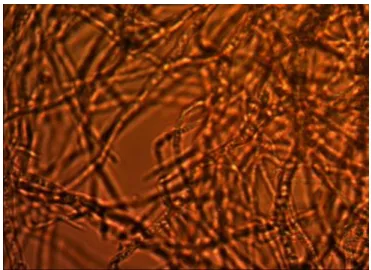
Fungus strain was stored and maintained in nutrient agar slants at 4°C. Morphological features of Aspergillus nigerNCIM 584 with fibrous and cylindrical symmetric
morphology of mycelia are presented in Figure 1.
Figure 1.Morphology of A. nigerNCIM 584
The fermentation medium for lipase production contained: KH2PO4, MgSO4·7H2O, KCl and yeast
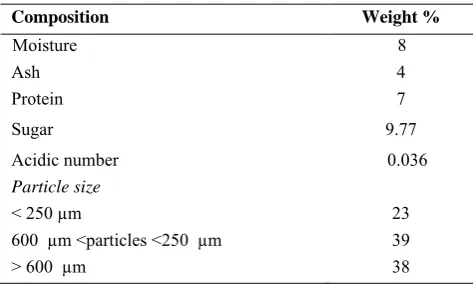
extract with concentration of 2, 0.5, 0.5 and 0.5 g/l, respectively. Glucose and olive oil concentrations were design variables and changed according to experimental design (Table 2). All chemicals and reagents used in experiments were analytical grade supplied by Merck (Darmstadt, Germany). Rice bran was used as the solid substrate that was locally supplied from north of Iran. The chemical composition and physical properties of rice bran is summarized in Table 3.
The microorganism was grown in a 100 ml Erlenmeyer flask which contained 50 ml of the fermentation medium. The seed culture was cultivated as inoculum. The inoculated media were incubated at 180 rpm and 30°C in an incubator-shaker for 2 days. The prepared seed culture in form of mycelium was added to solid substrate.
A 5 gram of rice bran which was initially sterilized and dried was placed in a Petri dish with diameter of 7.8 cm. The substrate was moistened with defined volume of 2 days old fungous culture and then incubated in a desiccator for the period of 4 days. The bottom of
Feed stock Fermentation Microorganism Lipase activity Reference
Whey and soybean meal SmF Aeromonas sobria LP004 419.84 (Units/ml) [25]
Wheat bran SSF Rhizopus oligosporous 48.0 (U/g s) [15]
Wheat bran SSF Aspergillus niger 9.14( IU/g dss) [17]
Wheat bran SSF Aspergillus niger 630 (IU/g DSS) [18]
desiccator was filled with distilled water. The desired moisture content within the desiccator was provided by means of a spurger which was connected to an external air pump.
At the end of fermentation period, the mold substrate was added to a 100-ml Erlenmeyer containing 50 ml of the aqueous solution of NaCl (1%) and triton X-100 (1%). The resulting mixture was then agitated in an incubator shaker at 30°C and 180 rpm for 2 hours [18]. The biomass was separated by filtration, using Whatman filter paper (no. 41; diameter of 125mm); for the enzyme extraction from the fermented rice barn and then the remaining mycelia was removed by centrifuge at 1000g for 5 minutes.
TABLE 2.Experimental ranges and levels of the!independent variables
Variables Symbol Range and levels
-2 -1 0 1 2
Olive oil concentration
(g/gdss) % X1 1 1.5 2 2.5 3
Glucose concentration
(g/g dss) % X2 1.5 2 2.5 3 3.5
Humidity ratio X3 1 1.5 2 2.5 3
TABLE 3. Chemical composition and physical properties of
rice bran
Composition Weight %
Moisture 8
Ash 4
Protein 7
Sugar 9.77
Acidic number 0.036
Particle size < 250 µm
600 µm <particles <250 µm > 600 µm
23 39 38
Several factors influence the stability of enzyme in enzyme reaction. Lipase activity measured at various
temperatures and pHs. The optimum temperature and pH for lipase stability in enzyme reaction by central composite design with two parameters and 13 experiments were determined.
The hydrolytic activity of lipase was determined by spectrophotometric method with p-nitrophenyl palmitate
as chromatic substrate. The assay mixture was incubated for 5 min and the p-nitrophenol released was measured
at 410 nm according to the method discussed in literature [34-35]. Based on definition, one unit (U) of lipase activity was defined as the amount of enzyme liberates one micromole of p-nitrophenol per minute
under the standard assay conditions.
For lipase production in solid state fermentation, culture conditions were optimized by means of central composite design (CCD) under response surface methodology (RSM). The RSM include statistical and mathematical techniques useful for developing, improving and optimizing processes. Also, the RSM appraises correlation between controlled experimental parameters and measured responses according to route for one or more selected criteria [36-37]. Optimization studies were carried out by studying the effect of three variables including olive oil, glucose concentrations and humidity ratio (The volume of liquid/The weight of solid substrate). The chosen independent variables used in this study were coded according to Eq. (1):
i 0
i
i
X X
X
x
(1)
where xi is the dimensionless coded value of the ith independent variable, X0is the value of Xiat the center point and Δx is the step change value. The behavior of
the system is explained by the following empirical second-order polynomial model Eq. (2):
1 2 0
1 1 1 1
k k k k
i i ii i ij i j i i i j
Y X X X X
(2)where Y is the predicted response, Xi, Xj, . . ., Xkare the input variables, which affect the response Y, X2i,X2j, . .
. , X2
k the square effects, XiXj, XiXk and XjXk the interaction effects, β0is the intercept term, βi(i=1, 2, . .
., k) the linear effect, βii (i=1, 2, . . ., k) the squared
effect, βij (i=1, 2, . . ., k; j=1, 2,. . ., k) the interaction
effect and εa random error [37-38].
Design Expert 7.01 (Stat-Ease Inc., Minneapolis, MN, USA) software was used for the regression and graphical examination of the experimental results. The optimum values of the variables were acquired by solving the regression equation. Also, the analyzing response surface plots indicated effects of the parameters on lipase production. Each of the parameters was coded at five levels: ( −α,−1, 0, +1 and +α; α=2) [37].
3. RESULTS AND DISCUSION
In solid state fermentation, the range and level of three
parameters (olive oil concentration, glucose
Maximum enzyme activity obtained with 20 experiments for three factorial designs (23) at five level
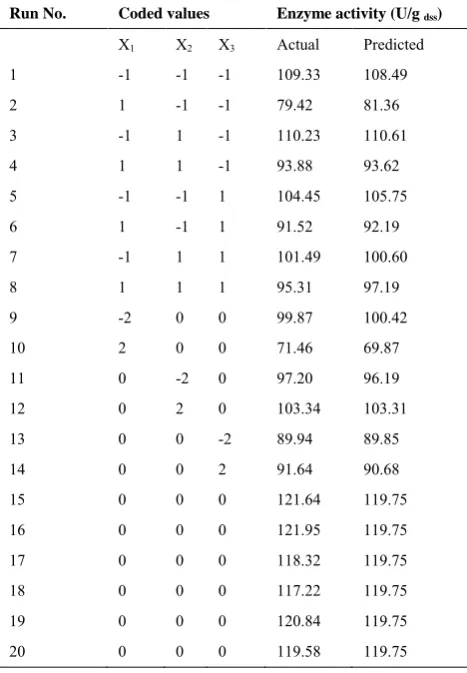
and six star points and six replicated points. Actual value and statically predicted lipase activity for experiments are shown in Table 4. Mathematical model (Eq. 3) represents relationships between lipolytic activity (Y) and oil concentration (X1), glucose
concent-ration (X2) and humidity ratio (X3) in coded units.
1 2 3 1 2
2 2 2
1 3 2 3 1 2 3
119.75 – 7.64 1.78X 0.21X 2.54X X
3.39X X 1.82X X 8.65X 5.0X 7.37X
Y X
(3)
TABLE 4.Experimental design based on central composite
design (CCD) used in this study.
Run No. Coded values Enzyme activity (U/g dss)
X1 X2 X3 Actual Predicted
1 -1 -1 -1 109.33 108.49
2 1 -1 -1 79.42 81.36
3 -1 1 -1 110.23 110.61
4 1 1 -1 93.88 93.62
5 -1 -1 1 104.45 105.75
6 1 -1 1 91.52 92.19
7 -1 1 1 101.49 100.60
8 1 1 1 95.31 97.19
9 -2 0 0 99.87 100.42
10 2 0 0 71.46 69.87
11 0 -2 0 97.20 96.19
12 0 2 0 103.34 103.31
13 0 0 -2 89.94 89.85
14 0 0 2 91.64 90.68
15 0 0 0 121.64 119.75
16 0 0 0 121.95 119.75
17 0 0 0 118.32 119.75
18 0 0 0 117.22 119.75
19 0 0 0 120.84 119.75
20 0 0 0 119.58 119.75
Variables X1X2, X1X3and X2X3are interaction effect
of oil concentration-glucose concentration, glucose humidity ratio and oil concentration-humidity ratio, respectively. Whereas X1, X2 and X3
express the values of the main effect of variables including oil concentration, glucose concentration and humidity ratio, respectively. The adequacy of the second-order response surface model fitted in the form of analysis of variance (ANOVA) and the importance of
the coefficients are observed in Table 5. The significance of each coefficient was determined by F-values (variation of data about mean value) and P-values (probability). It was observed from Table 4 that F-values and P-values were high and very low, respectively. The results showed that the model is in good prediction of experimental result. Low P-values of linear and quadratic terms for olive oil concentration, glucose concentration showed high linear and quadratic effects of these parameters on response factor. Humidity ratio had high quadratic effect, but the P-value (0.6635) for the linear term of this variable was high; that indicated insignificant linear effect. In addition, values of interaction effect of variables were significant.
The ANOVA for response surface quadratic model is given in Table 6. The F-value (129.68) and low P-values (P < 0.0001) indicate that the regression model were valid. The lack of fitness of more than 0.05 demonstrated significance of model for lipase production. The correctness of the model was also ensured by the multiple correlation coefficients (R2).
The R2Value varied from 0 to 1 and when R2value is
quite close to 1, the predicted value is relatively close to actual value. This means the model definitely predicted the actual value and the response was excellent The multiple correlation coefficient (R2) was
0.9915; even less than one percent (only 0.85%) of total variation cannot be expressed by the regression model. The predicted multiple correlation coefficient (Pred.- R2
= 0.963) was in reasonable agreement with the adjusted multiple correlation coefficient (Adj. R2= 0.984). Also, the coefficient of variance (C.V. =1.79 %) was low, which indicates significant precision and reliability of the experimental data. Adequate precision, measures the signal to noise ratio. A ratio greater than 4 isdemanded.
TABLE 5. Regression analysis using the 23factorial central
composite design.
Model term
Coefficient estimate
Standard
error F-value P-value
Intercept 119.75 0.74
X1 -7.64 0.46 274.54 < 0.0001
X2 1.78 0.46 14.90 0.0032
X3 0.21 0.46 0.20 0.6635
X1X2 2.54 0.65 15.16 0.0030
X1X3 3.39 0.65 27.10 0.0004
X2X3 -1.82 0.65 7.77 0.0192
X12 -8.65 0.37 553.70 < 0.0001
X22 -5.00 0.37 184.98 < 0.0001
Adequate precision was 38.263, indicating that the model could be used to navigate the design space.
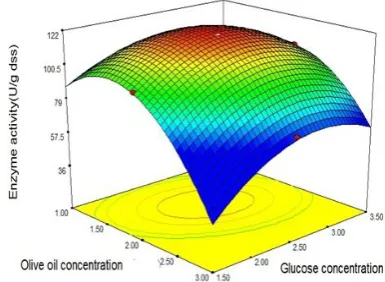
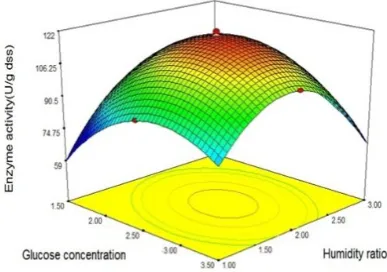
The interaction of the lipase activity and independent variables were demonstrated by three-dimensional response surface diagram. In each 3D curve, effect of two factors on enzym activity are shown, maintaining other variable constant at level zero. Figure 2 indicates the relationship between olive oil concentration and glucose concentration on lipolytic activity. The low P-value (0.0030) shows significant interactions between variables. Lipase activities increased with an increase of olive oil concentration from 1 to 1.8 % (g/gdss) as well
as with media glucose concentrations ranging from 1.5 to 3.5 % (g/gdss). Also enzyme activity was significantly
reduced at concentrations higher than 1.8 % (g/gdss).
Maximum lipase activity was obtained at 2.5 % (g/gdss)
of glucose concentrations. Use of glucose was compared with oils as fatty acids were assimilated faster than carbohydrates in the cells, but presence of fatty carbon source is necessary, since olive oil was used as carbon sources and inducers of microorganism for lipase production. Increasing the olive oil and glucose concentration in the media over the optimum value may impose an inhibitor effect on lipase production that was
most probably due to catabolite repression.
Nevertheless, disincentive effect of olive oil concentrations was more than glucose concentrations. In solid state fermentation lipase production, optimum condition for A. niger was also found by Falony et al. .[17]; the maximum enzyme activity occurred when the
concentrations of olive oil and glucose were 1.5 and 1.5
% (g/g dss), respectively.
Experiments were performed to investigate the influence of olive oil concentration and humidity ratio on lipolytic activity, in the range of 1 to 3 %(g/gdss) and
1 to 3, respectively, (Figure 3). The P-value was low (0.0004), that indicates significant interaction of independent variables. The optimum concentration of olive oil was defined at 1.76 % (g/gdss) . Enzyme
activity has increased with an increase in humidity ratio ranging from 1 to 1.96. When the ratio of humidity was higher than optimum level of the moisture, the lipase activity decreased. This means, the water content has influenced on the physical properties of the solid substrate. Increasingthe humidity ratio above the optimum value led to a significant decrease in lipase activity. That was probably due to decrease in substrate porosity, reduced oxygen transfer and also changes occurred in the texture of solid particles. In addition, for the values lower than the optimized level, the humidity ratio has decreased the solubility of the solid substrate, lowered the degree of swelling and produced a high water tension [31].
The interaction of glucose concentration and humidi-ty ratio on enzyme activities are shown in Figure 4. Optimum lipase activity was observed in mid-values of
both variables. The P-value (0.0192) was low, which depicted the good interaction of the two variables. The maximal lipase activity was obtained at optimum glucose concentration and humidity ratio of 2.58 % (g/gdss) and 2.01, respectively. Falony et al. [17, 31]
have demonstrated that the best moisture value for A. niger in a solid state fermentation with wheat bran as
substrate was 65 % (g/g dss). Also, Mahadik et al. [18]
have reported that the best ratio of water content to wheat bran was 2.5 for the lipase produced from A. nigerNCIM 1207.
The best conditions for lipase production obtained were at olive oil concentration of 1.78 % (g/gdss) ,
glucose concentration of 2.54 % (g/gdss) and humidity
ratio of 1.95. Lipase activity obtained at optimal conditions and at a desirability value of 0.982 was 121.53 (U/g dss). The obtained value was in the range of
reported data for lipase production in literature.
Figure 2.The effect of olive oil and glucose concentration on
lipase activity (other variable was set at zero level), showing the effect of olive oil and glucose concentrations and their interaction effects on lipase production
TABLE 6. Analysis of variance (ANOVA) for response
surface quadratic model
Source Sum of
squares
Degrees of freedom
Mean
square F-value
Probability (P) > F
Model 3967.30 9 440.81 129.68 <0.0001 Lack of
fit 16.11 5 3.22 0.9 0.5443
Residual 33.99 10 3.40 Pure
error 17.88 5 3.58
Total 4001.30 19
reaction were investigated by central composite deign. The ranges and level of variables are shown in Table 7. The results of CCD experiments for studying the interaction effect of two independent variables on enzyme relative activity are summarized in Table 8. The correlation between lipase activity (Y1) as a function of
temperature (X1) and pH (X2) are represented in
following regression:
1 2 1 2
2 2
1 2
94.12 11.77 X 2.18X 3.19 X X 5.95X 2.17 X
Y
(4)
Figure 3. The effect of olive oil concentration and humidity
ratio on lipase activity (other variable was set at zero level), showing the effect of olive oil concentration and humidity ratio and their interaction effects on lipase production
Figure 4. The effect of glucose concentration and humidity
ratio on lipase activity (other variable was set at zero level), showing the effect of glucose concentration and humidity ratio and their interaction effects on lipase production.
TABLE 7.Experimental ranges and levels of the variables for optimization of enzymatic reaction
Variables Symbol Range and levels
-2 -1 0 1 2
Temperature˚C X1 25 30 35 40 45
pH X2 6 6.5 7 7.5 8
TABLE 8. Experimental design based on CCD for
optimization of enzymatic reaction
Run No. Coded values Relative enzyme activity
X1 X2 Actual Predicted
1 1 1 77.534 79.60
2 -1 1 97.82 96.77
3 1 -1 66.949 68.85
4 -1 -1 100 98.78
5 -2 0 92.511 93.86
6 2 0 48.538 46.76
7 0 -2 81.213 81.08
8 0 2 90.112 89.82
9 0 0 91.827 94.12
10 0 0 93.597 94.12
11 0 0 96.361 94.12
12 0 0 92.958 94.12
13 0 0 96.732 94.12
TABLE 9.Regression analysis using CCD for optimization of
enzymatic reaction
Model termCoefficient estimate Standard errorF-value P-value
Intercept 94.12 0.92
X1 -11.77 0.64 339.64 <0.0001
X2 2.18 0.64 11.64 0.0112
X1X2 3.19 1.11 8.32 0.0235
X12 -5.95 0.46 165.82 < 0.0001
X22 -2.17 0.46 22.01 0.0022
ANOVA for response surface quadratic model
Source Sum of squares Degrees of freedom Mean square F-value Probability (P) > F Model 2579.16 5 515.83 105.32 <0.0001
Residual 34.28 7 4.90 Pure error 18.57 4 4.64
Lack of fit 15.71 3 5.24 1.13 0.4377 Total 3504.90 12
Figure 5. The effect of temperature and pH on relative lipase
activity, showing the effect of temperature and pH and their interaction effects on lipase activity in enzymatic reaction
Figure 5 demonstrates the interaction between temperature and pH on the relative lipase activity on enzyme reaction, in the range of 25 to 45°C and 6 to 8, respectively. The low P-value (0.023) indicates signifi-cant interaction between variables. From Figure 5, the relative enzyme activity increased with an increase in temperature from 25 to 30.3°C, and when the temperature was greater than 30.3°C, the relative lipase activity was reduced. Pera et al. [10] reported that an optimum temperature for the lipase activity obtained from A. niger ATCC MYA-135 was 37°C. The
maximum lipase activity for Rhizopus oryzae was
obtained at optimum temperature, of 30°C [39].
Optimum pH for enzymatic reaction was 6.87. Generally, most of enzymes have great activities at optimum pH near neutral condition. Kamini et al. [25]
have reported that the best pH for the lipase obtained from A. niger, strain MTCC 2594 was 7. In addition,
Adham and Ahmed [40] have obtained optimum pH for the lipase from A. niger NRRL3, the pH value was
reported to be near 7.2.
4.CONCLUSION
Lipase was produced by A. niger in solid state
fermentation using rice bran as the solid substrate.
Application of response surface methodology (RSM) under central composite design for determination of the optimal culture conditions for lipase production was successfully demonstrated.The concentrations of olive oil, glucose and humidity ratio had considerable influence on lipase activities and the optimum value of
these variables were 1.78, 2.54 % (g/gdss) and 1.95,
respectively. Maximum lipase activity at optimum conditions predicted by RSM was 121.53 U/g and the obtained value in actual experiment was 119.74 (U/g
dss). Also, the highest performance of the produced
lipase was obtained at 30.3ºC and pH value of 6.87.
5. REFERENCES
1. Najafpour, G. D., "Biochemical engineering and biotechnology", Elsevier Science, (2007), pp. 10-11.
2. Rigo, E., Ninow, J. L., Di Luccio, M., Oliveira, J. V., Polloni, A. E., Remonatto, D., Arbter, F., Vardanega, R., De Oliveira, D. and Treichel, H., "Lipase production by solid fermentation of soybean meal with different supplements", LWT-Food Science and Technology, Vol. 43, (2010), 1132-1137.
3. Gupta, R., Gupta, N. and Rathi, P., "Bacterial lipases: an overview of production, purification and biochemical properties", Applied Microbiology and Biotechnology, Vol. 64,
(2004), 763-781.
4. Treichel, H., de Oliveira, D., Mazutti, M. A., Di Luccio, M. and Oliveira, J. V., "A review on microbial lipases production", Food and Bioprocess Technology, Vol. 3, (2010), 182-196.
5. Aravindan, R., Anbumathi, P. and Viruthagiri, T., "Lipase applications in food industry", Indian Journal of Biotechnology,
Vol. 6, (2007), 141-158.
6. Burkert, J., Maugeri, F. and Rodrigues, M., "Optimization of extracellular lipase production by Geotrichum sp. using factorial design", Bioresource technology, Vol. 91, (2004), 77-84. 7. Houde, A., Kademi, A. and Leblanc, D., "Lipases and their
industrial applications", Applied biochemistry and biotechnology, Vol. 118, (2004), 155-170.
8. Sharma, R., Chisti, Y. and Banerjee, U. C., "Production, purification, characterization, and applications of lipases", Biotechnology Advances, Vol. 19, (2001), 627-662.
9. Mhetras, N., Bastawde, K. and Gokhale, D., "Purification and characterization of acidic lipase from Aspergillus niger NCIM 1207", Bioresource technology, Vol. 100, (2009), 1486-1490. 10. Pera, L. M., Romero, C. M., Baigori, M. D. and Castro, G. R.,
"Catalytic properties of lipase extracts from Aspergillus niger", Food Technology and Biotechnology, Vol. 44, (2006), 247-252.
11. Ellaiah, P., Prabhakar, T., Ramakrishna, B., Taleb, A. T. and Adinarayana, K., "Production of lipase by immobilized cells of
Aspergillus niger", Process Biochemistry, Vol. 39, (2004),
525-528.
12. Hasan, F., Shah, A. A. and Hameed, A., "Influence of culture conditions on lipase production byBacillus sp. FH5", Annals of microbiology, Vol. 56, (2006), 247-252.
13. Kumar, S. S. and Gupta, R., "An extracellular lipase from Trichosporon asahii MSR 54: Medium optimization and enantioselective deacetylation of phenyl ethyl acetate", Process Biochemistry, Vol. 43, (2008), 1054-1060.
14. Orlando Beys Silva, W., Mitidieri, S., Schrank, A. and Vainstein, M. H., "Production and extraction of an extracellular lipase from the entomopathogenic fungus Metarhizium anisopliae", Process Biochemistry, Vol. 40, (2005), 321-326.
16. ul-Haq, I., Idrees, S. and Rajoka, M. I., "Production of lipases by Rhizopus oligosporous by solid-state fermentation", Process Biochemistry, Vol. 37, (2002), 637-641.
17. Falony, G., Armas, J. C., Mendoza, J. C. D. and Hernández, J. L. M., "Production of extracellular lipase from Aspergillus nigerby solid-state fermentation", Food Technology and Biotechnology,
Vol. 44, (2006), 235-240.
18. Mahadik, N. D., Puntambekar, U. S., Bastawde, K. B., Khire, J. M. and Gokhale, D. V., "Production of acidic lipase by
Aspergillus niger in solid state fermentation", Process Biochemistry, Vol. 38, (2002), 715-721.
19. Miranda, O., Salgueiro, A., Pimentel, M., Lima Filho, J., Melo, E. and Duran, N., "Lipase production by a Brazilian strain of< i> Penicillium citrinum using an industrial residue", Bioresource technology, Vol. 69, (1999), 145-147.
20. Pandey, A., "Solid-state fermentation", Biochemical Engineering Journal, Vol. 13, (2003), 81-84.
21. Rodriguez, J., Mateos, J., Nungaray, J., González, V., Bhagnagar, T., Roussos, S., Cordova, J. and Baratti, J., "Improving lipase production by nutrient source modification using Rhizopus homothallicus cultured in solid state fermentation", Process Biochemistry, Vol. 41, (2006),
2264-2269.
22. Adinarayana, K., Raju, K., Zargar, M. I., Devi, R. B., Lakshmi, P. J. and Ellaiah, P., "Optimization of process parameters for production of lipase in solid-state fermentation by newly isolated
Aspergillus species", Indian Journal of Biotechnology, Vol. 3, (2004), 65-69.
23. Christen, P., Angeles, N., Corzo, G., Farres, A. and Revah, S., "Microbial lipase production on a polymeric resin", Biotechnology techniques, Vol. 9, (1995), 597-600.
24. Gombert, A. K., Pinto, A. L., Castilho, L. R. and Freire, D. M. G., "Lipase production by Penicillium restrictum in solid-state fermentation using babassu oil cake as substrate", Process Biochemistry, Vol. 35, (1999), 85-90.
25. Kamini, N., Mala, J. and Puvanakrishnan, R., "Lipase production from Aspergillus nigerby solid-state fermentation using gingelly
oil cake", Process Biochemistry, Vol. 33, (1998), 505-511.
26. Sun, S. Y. and Xu, Y., "Solid-state fermentation for" whole-cell synthetic lipase"production from Rhizopus chinensis and identification of the functional enzyme", Process Biochemistry, Vol. 43, (2008), 219-224.
27. A Ikel, Ü., Ersan, M. and Sag A Ikel, Y., "Optimization of critical medium components using response surface methodology for lipase production by Rhizopus delemar", Food and Bioproducts Processing, Vol. 88, (2010), 31-39.
28. He, Y. Q. and Tan, T. W., "Use of response surface methodology to optimize culture medium for production of lipase with Candida sp. 99-125", Journal of Molecular Catalysis B: Enzymatic, Vol. 43, (2006), 9-14.
29. Kaushik, R., Saran, S., Isar, J. and Saxena, R., "Statistical optimization of medium components and growth conditions by
response surface methodology to enhance lipase production by
Aspergillus carneus", Journal of Molecular Catalysis B: Enzymatic, Vol. 40, (2006), 121-126.
30. Teng, Y. and Xu, Y., "Culture condition improvement for whole-cell lipase production in submerged fermentation by Rhizopus chinensis using statistical method", Bioresource technology, Vol. 99, (2008), 3900-3907.
31. Contesini, F. J., da Silva, V. C. F., Maciel, R. F., de Lima, R. J., Barros, F. F. C. and de Oliveira Carvalho, P., "Response surface analysis for the production of an enantioselective lipase from
Aspergillus nigerby solid-state fermentation", The Journal of Microbiology, Vol. 47, (2009), 563-571.
32. Liu, C. H., Lu, W. B. and Chang, J. S., "Optimizing lipase production of Burkholderia sp. by response surface methodology", Process Biochemistry, Vol. 41, (2006), 1940-1944.
33. Rezaei, P. S., Darzi, G. N. and Shafaghat, H., "Optimization of the fermentation conditions and partial characterization for acido-thermophilic -amylase from Aspergillus nigerNCIM 548", Korean Journal of Chemical Engineering, Vol. 27, (2010),
919-924.
34. Chiou, S. H. and Wu, W. T., "Immobilization of Candida rugosa lipase on chitosan with activation of the hydroxyl groups", Biomaterials, Vol. 25, (2004), 197-204.
35. Hung, T. C., Giridhar, R., Chiou, S. H. and Wu, W. T., "Binary immobilization of Candida rugosa lipase on chitosan", Journal of Molecular Catalysis B: Enzymatic, Vol. 26, (2003), 69-78. 36. Amini, M. and Younesi, H., "Biosorption of Cd (II), Ni (II) and
Pb (II) from aqueous solution by dried biomass of Aspergillus niger: application of response surface methodology to the
optimization of process parameters", CLEAN–Soil, Air, Water, Vol. 37, (2009), 776-786.
37. Ghorbani, F., Younesi, H., Ghasempouri, S. M., Zinatizadeh, A. A., Amini, M. and Daneshi, A., "Application of response surface methodology for optimization of cadmium biosorption in an aqueous solution by Saccharomyces cerevisiae", Chemical Engineering Journal, Vol. 145, (2008), 267-275.
38. Daneshi, A., Younesi, H., Ghasempouri, S. M. and Sharifzadeh, M., "Production of poly‐3‐hydroxybutyrate by Cupriavidus necator from corn syrup: statistical modeling and optimization of biomass yield and volumetric productivity", Journal of Chemical Technology and Biotechnology, Vol. 85, (2010), 1528-1539.
39. Essamri, M., Deyris, V. and Comeau, L., "Optimization of lipase production by Rhizopus oryzae and study on the stability of lipase activity in organic solvents", Journal of Biotechnology, Vol. 60, (1998), 97-103.
40. Adham, N. Z. and Ahmed, E., "Extracellular lipase of
Surface Method
M. N. Hosseinpoura, G. D. Najafpoura, H. Younesib, M. Khorramia, Z. Vaseghia
aFaculty of Chemical Engineering, Babol Noshirvani University of Technology, Babol, Iran
bDepartment of Environmental Sciences, College of Natural Resources & Marine Sciences, Tarbiat Modares University, Nour, Iran
A R T I C L E I N F O
Article history: Received 27 March 2012
Received in revised form 17 April 2012 Accepted 26 May 2012
Keywords: Lipase
Rice Bran Design Expert
هﺪﯿﮑﭼ
ﻢﯾﺰﻧآ نﺎﯿﻣ رد زﺎﭙﯿﻟ ﻢﯾﺰﻧآ دراد ﯽﻋﻮﻨﺘﻣ ﯽﺘﻌﻨﺻ دﺮﺑرﺎﮐ ﺎﻫ
. زا ﻖﯿﻘﺤﺗ ﻦﯾا رد ﺎﺑ ﺪﻣﺎﺟ ﺖﻟﺎﺣ ﺮﯿﻤﺨﺗ رد ﺮﺠﯿﻧ سﻮﻠﯿﺠﯾرﺎﭙﺳا
هدﺎﻔﺘﺳا ﻮﺳ اﺮﺘﺴﺑ ) ﺮﺘﺴﺑ ( ﺪﯾدﺮﮔ هدﺎﻔﺘﺳا زﺎﭙﯿﻟ ﻪﻨﯿﻬﺑ ﺪﯿﻟﻮﺗ ياﺮﺑ ﺞﻧﺮﺑ سﻮﺒﺳ .
راﺰﻓا مﺮﻧ زا هدﺎﻔﺘﺳا ﺎﺑ ﻪﻨﯿﻬﺑ ﻂﯾاﺮﺷ ﺑﻪ
شور
ﺪﯾدﺮﮔ ﻞﺻﺎﺣ ﺢﻄﺳ ﺦﺳﺎﭘ .
ﻧآ رد زا ﺎﻫ هداد ﺰﯿﻟﺎ 20
و ﺰﮐﻮﻠﮔ ،نﻮﺘﯾز ﻦﻏور ﺖﻈﻠﻏ ﻞﻣﺎﺷ ﺮﯿﻐﺘﻣ ﻪﺳ ﺮﯿﺛﺎﺗ ﯽﺑﺮﺠﺗ ﺶﯾﺎﻣزآ
ﺖﻓﺮﮔ راﺮﻗ ﯽﺳرﺮﺑ درﻮﻣ ﻢﯾﺮﻧآ ﺖﯿﻟﺎﻌﻓ ﺮﺑ ﺖﺑﻮﻃر .
ﺑ ﻞﻘﺘﺴﻣ ﺮﮕﯾد ﺮﺘﻣارﺎﭘ ود ﺮﺑ نآ ﺮﯿﺛﺎﺗ و ﯽﻤﯾﺰﻧآ ﺖﯿﻟﺎﻌﻓ ﺶﻨﮐرﺪﻧا ﻪ
ترﻮﺻ
ﯽﻟﺎﺣ رد يﺪﻌﺑ ﻪﺳ رادﻮﻤﻧ ﺳﺮﺗ ﺪﻨﺘﺷاد راﺮﻗ ﺮﻔﺻ ﺢﻄﺳ رد يﺎﻫرﻮﺘﮐﺎﻓ ﺮﯾﺎﺳ ﻪﮐ
ﺪﯾدﺮﮔ ﻢﯿ . ،نﻮﺘﯾز ﻦﻏور ياﺮﺑ ﻪﻨﯿﻬﺑ ﺖﻈﻠﻏ
ﺖﺑﻮﻃر و ﺰﮐﻮﻠﮔ ﯽﺒﺴﻧ
ﺐﯿﺗﺮﺗ ﻪﺑ 78 /1 ،
) %
g/gdss)
54 /2 و 95 /1 ﯽﻣ ﺪﺷﺎﺑ . و ﺎﻣد ﺮﯿﺛﺎﺗ
pH
درﻮﻣ زﺎﭙﯿﻟ ﯽﺒﺴﻧ ﺖﯿﻟﺎﻌﻓ ﺮﺑ
ﺖﻓﺮﮔ راﺮﻗ ﯽﺑﺎﯾزرا .
يﺎﻣد رد هﺪﺷ ﺪﯿﻟﻮﺗ زﺎﭙﯿﻟ ﻢﯾﺰﻧآ 3/
30 و 87 /6 ﺪﯿﺳر دﻮﺧ ﺖﯿﻟﺎﻌﻓ ﺮﺜﮐاﺪﺣ ﻪﺑ .
doi:10.5829/idosi.ije.2012.25.03b.01
Aspergillus niger