R E S E A R C H
Open Access
Structural and functional characterization of
human apolipoprotein E 72-166 peptides in
both aqueous and lipid environments
Yi-Hui Hsieh, Chi-Yuan Chou
*Abstract
Backgrounds:There are three apolipoprotein E (apoE) isoforms involved in human lipid homeostasis. In the present study, truncated apoE2-, apoE3- and apoE4-(72-166) peptides that are tailored to lack domain interactions are expressed and elucidated the structural and functional consequences.
Methods & Results:Circular dichroism analyses indicated that their secondary structure is still well organized. Analytical ultracentrifugation analyses demonstrated that apoE-(72-166) produces more complicated species in PBS. All three isoforms were significantly dissociated in the presence of dihexanoylphosphatidylcholine.
Dimyristoylphosphatidylcholine turbidity clearance assay showed that apoE4-(72-166) maintains the highest lipid-binding capacity. Finally, only apoE4-(72-166) still maintained significant LDL receptor lipid-binding ability.
Conclusions:Overall, apoE4-(72-166) peptides displayed a higher lipid-binding and comparable receptor-binding ability as to full-length apoE. These findings provide the explanation of diverged functionality of truncated apoE isoforms.
Introduction
Human apolipoprotein E (apoE)1 comprises 299 amino
acids and there are three isoforms, apoE2, apoE3, and apoE4, encoded by theε2,ε3, andε4 genes, respectively. These isoforms differ from each other only at residues 112 and 158 i.e. Cys112 and Arg158 in apoE3, a cysteine at both positions in apoE2, and an arginine at both posi-tions in apoE4 [1]. The amino-terminal (NT) domain of
apoE contains four amphipathic a-helices and has
pronounced kinks in the helices near the end of the four-helix bundle that correlates with the lipid binding ability (Figure 1) [2,3]. The residues between 140-150 in the fourtha-helix, comprising many basic amino acids, has been identified as the low-density lipoprotein recep-tor (LDLR) binding region [4], with the lipid binding region shown to be in the carboxyl-terminal (CT) domain [5,6]. The lipid association is required for high affinity binding of apoE to the LDLR because of the increased exposure of basic region on the fourtha-helix after interacting with lipids [7].
ApoE is involved in facilitating the transportation of plasma chylomicron remnant to the liver through either the remnant receptor or LDLR [8,9]. Owing to distinct domain interactions, apoE2 and apoE3 bind preferen-tially to small lipoproteins such as high-density lipopro-tein (HDL), whereas apoE4 has a higher affinity to very-low-density lipoprotein (VLDL) [6,10]. Different to apoE3, apoE4 is prone to raise the plasma LDL to high levels and cause high oxidative stress that can facilitate atherosclerosis progression [11,12], whilst apoE2 is asso-ciated with type III hyperlipoproteinemia [13]. The ε4 allele is also associated with familial late-onset and sporadic Alzheimer’s disease (AD) [14,15]. ApoE4 has been found to interact with beta-amyloid peptides (Ab) and induce neurofibrillary tangle (NFT) formation [16,17]. It preferentially undergoes proteolysis to yield NT- and CT-truncated that interact with cytoskeletal components to form NFT-like inclusions in neuronal cells [16]. To understand the pathogenesis of different isofomic apoE, most studies are focused on the delinea-tion of the structure and funcdelinea-tion characterizadelinea-tion of
the full-length apoE, varied length CT, or a “four
a-helix bundle”NT domain [18-21].
* Correspondence: [email protected]
Department of Life Sciences and Institute of Genome Sciences, National Yang-Ming University, Taipei 112, Taiwan
In the present studies, we attempted to clarify the structural and functional consequences of NT- and CT-truncated apoE peptides, i.e. apoE-(72-166). This truncation still maintains the LDLR binding region, and removes the first two a-helices and the complete CT domain. The aim is to create a shorter but still functional apoE for potential therapeutic approach. Analytical ultra-centrifugation was used to elucidate the quaternary struc-tural properties of the three apoE-(72-166) isoforms. In the presence of lipid, the degree of apoE-(72-166) disso-ciation and extended conformation was significantly elevated. The functional assays conclude that apoE-(72-166) peptides still maintain comparable LDLR and higher lipid binding ability as to full-length apoE, particularly apoE4-(72-166). These findings suggest a crucial role of shorter NT-domain in the biological function of apoE and provide the basis for the explanation of diverged functionality of truncated apoE isoforms.
Materials and methods Plasmids
The construction of pET-apoE2, apoE3, apoE4, apoE3-(72-166), and apoE4-(72-166) vectors were described previously [22]. The apoE2-(72-166) DNA fragment was amplified by PCR, and the forward primer was 5’ -AAA-CATATGAAGGCCTACAAATCGGA, whereas the
reverse primer was 5’-AACTCGAGGGCCCCGGCCT.
TheNdeI-XhoI digested apoE2-(72-166) cDNA was then ligated to the 5.2-kbNdeI-XhoI pET-29a(+) fragment.
Expression and Purification of ApoE Proteins
Protein induction and purification procedures have been described previously [22,23]. Typical yields of the apoE-(72-166) proteins were 5-10 mg after purification from 1 liter ofE. coliculture medium. The purity of all recombi-nant proteins was estimated by SDS-PAGE to be > 95% and the molecular mass of the apoE-(72-166) proteins was 12 kDa. The purified proteins were buffer-changed to phosphate buffered saline (PBS) (pH7.3) using Amicon Ultra-4 10-kDa centrifugal filter (Millipore).
Preparation of Micelle Solution
Dihexanoylphosphatidylcholine (DHPC) has a critical micelle concentration of 16 mM, at which micelle mono-mers are formed containing 19 to 40 molecules based on ultracentrifugation, NMR, and small angle neutron scat-tering, respectively [24-26]. We used several concentra-tions of DHPC (5, 50, and 100 mM) to establish an appropriate lipid environment containing submicelles or micelles. In current studies, all experiments related to DHPC were executed at 20°C for the same lipid state.
Circular Dichroism Spectroscopy
Circular dichroism (CD) spectra of the apoE-(72-166) peptides using a JASCO J-810 spectropolarimeter (Tokyo, Japan) showed measurements from 250 nm to 190 nm at 20°C in PBS (pH 7.3) with or without 50 mM DHPC. The protein concentration was 0.5 mg/ml. In wavelength scanning, the width of the cuvette was 0.1
mm. The far-UV CD spectrum data were analyzed with the CDSSTR program [27,28]. In this analysis, the a-helix,b-sheet, and random coil were split. To estimate the goodness-of-fit, the normalized root mean square deviation (NRMSD) was calculated.
Unfolding of the ApoE-(72-166) Proteins in Guanidinium Chloride
ApoE-(72-166) proteins (0.1 mg/ml) with or without 50 mM DHPC were unfolded with different concentrations of GdnCl in PBS (pH 7.3) at 4°C overnight to reach equilibrium. The unfolding of the proteins was moni-tored by measuring the CD signal of 222 nm at 20°C and the width of the cuvette was 1 mm. The unfolding data were analyzed using thermodynamic models by global fitting of the measurements to the two-state unfolding model [29] as follows:
y y y e
e
obs N U
G m GdnCl
RT
G
H O N U N U
H O N
= + •
+
−⎛ − [ ]
⎝
⎜⎜ ⎞⎠⎟⎟
−
→ →
→
Δ
Δ
( )
( ) 2
2
1
U
U mN U GdnCl
RT
− [ ]
⎛ ⎝
⎜⎜ → ⎞⎠⎟⎟
(1)
where yobs is the observed biophysical signal;yN and
yUare the calculated signals of the native and unfolded
states, respectively.GdnCl is the GdnCl concentration, and ΔG(H O N2 ) →U is the free energy change for the
N®U process.mN®Uis the sensitivity of the unfolding
process to a denaturant concentration.
Sedimentation Velocity
Sedimentation velocity (SV) experiments were per-formed with an XL-A analytical ultracentrifuge (Beck-man, Fullerton, CA) as described previously [23]. All studies were performed at 20°C with a rotor speed of 42,000 rpm in PBS (pH 7.3) with or without DHPC. The protein concentration was 0.5 mg/ml. Multiple scans at different time periods were then fitted to a con-tinuous c(s) distribution model using the SEDFIT program as described previously [30,31]. All continuous size distributions were calculated using a confidence level ofp= 0.95, a best fitted average anhydrous friction ratio (fr), a resolution value N of 200, and sedimentation coefficients between 0 and 20 S. For the data fitting of apoE-(72-166) in PBS and 5 mM DHPC, the partial spe-cific volume was set to 0.73 for proteins species. Differ-ently, for those in 50 and 100 mM DHPC, the value was set to 0.86 because the influence of DHPC micelle. Previous studies have suggested that DHPC’s partial spe-cific volume is 0.99 ml/g [32]. According to our calcula-tion, higher partial specific volume will lower the best fitted average fr, while the c(s) distribution will not have any difference.
Sedimentation Equilibrium
Sedimentation equilibrium (SE) experiments were per-formed with six-channel epon charcoal-filled center-pieces as described previously [22]. The cells were then mounted into an An-60 Ti rotor and centrifuged at 10,000 rpm, 15,000 rpm, and 20,000 rpm, respectively, each for 18 h at 20°C. Ten A280 nmmeasurements with a time interval of 8-10 min were performed for each dif-ferent rotor speed to check the equilibrium state. The SV and SE spectrum of each apoE-(72-166) protein under the same environments were combined and then fitted to a global discrete species model using SEDPHAT program as described previously [22,33].
DMPC Turbidity Clearance Assay
The preparation of DMPC (Sigma, St Louis, MO) multi-lamellar vesicles (mLV) has been described previously
[22,34-36]. ApoE (250 μg) was added to DMPC mLV
solution (0.5 mg/ml) in a quartz cuvette which had been preincubated at 24°C in a Perkin-Elmer Lambda 35 spectrophotometer with water circulated temperature control. Vesicle solubilization was monitored as a decrease in the absorbance at 325 nm. The time course of the clearance measurements were fitted by nonlinear regression to the biexponential decay equation,
Y = ⋅A e− ⋅k t1 + ⋅B e− ⋅k t2 +C (2)
where Y is the absorbance at 325 nm and k, k1or k2
are the rate constants for different kinetic phases of the solution clearance.AandBare the changes in turbidity for different phases (pool sizes),tis the time, and Cis the remaining turbidity at the completion of the reaction.
In vitro VLDL Binding Assay
the VLDL band was shifted with the binding of apoE proteins.
LDLR Binding Assay
The detailed procedures for the LDLR binding assay have been described previously [22,37,38]. Briefly, human hepatoblastoma cells (HepG2) were incubated in DMEM with 10% fetal bovine serum at 37°C followed
by incubation with DMEM containing 3H-LDL and
different receptor binding competitors (apoE proteins) at 4°C for 2 h. After washing, cells were released, lysed, and the radioactivity was determined using a liquid scintillation counter (Beckman, Fullerton, CA).
Results and Discussions
Secondary Structures of the apoE-(72-166) peptides is well organized anda-helical dominant
Based on the far-UV CD measurements we made, apoE2-, apoE3-, and apoE4-(72-166) peptides main-tained 49, 48, and 53% a-helical structure in PBS; and 47, 49, and 45% in DHPC micellar solution, respectively (Additional file 1: Figure S1A, B, and Table S1). The structure of apoE-(72-166) peptides was estimated to be
a-helix dominant in both aqueous and DHPC micellar
solution, although the content ofa-helix was lower than the value from the solved crystal structure of NT domain (residues 23-166, pdb code: 1LPE), which is 74% [39]. The shorter length of our peptides and lower pro-tein concentration used in CD may be the reason. Over-all, the content ofa-helix in all three isoforms did not change too much in the two environments, while the content ofb-strand increased by 8-10% in DHPC micel-lar solution. Consequently, their random coil decreased by 1-11%. These data indicated that in the aqueous or DHPC micellar solution, the secondary structure of apoE-(72-166) was well organized and did not show very significant isoformic difference.
The secondary structure of apoE-(72-166) was more stable in the solution containing DHPC micelles
To delineate the structural stability of the apoE-(72-166) peptides with or without DHPC, the GdnCl denaturation
experiments were executed. The denaturation of the three apoE-(72-166) proteins followed a two-state transi-tion (Additransi-tional file 1: Figure S1C, D). Our experimental data was then fitted using equation 1 to calculate the change of free energy, m value, and [GdnCl]0.5(Table 1). In the presence of DHPC micelle, the m value of the three isoforms showed a significant decrease, while
ΔG(H O N2 ) →U did not. It resulted in the [GdnCl]0.5of the
three isoform increased by 0.8-0.86 M, respectively, com-paring to those in PBS. These differences suggested that the secondary structure of apoE-(72-166) was more stable in the solution containing DHPC micelles. Recent studies for apolipoprotein C-II amyloid fibrils have shown similar phenomenon that phospholipid interac-tions can stabilize regular secondary structure formainterac-tions and molecular-level polymorphisms [40].
Similar to full-length apoE proteins in a lipid-free solution [20], the differences between the apoE-72-166 protein isoforms in terms of structural stability was in the order of apoE2 > apoE3 > apoE4. Previous structural studies indicated that Cys112 of apoE3 is partially buried between helices 2 and 3, while Arg112 of apoE4 could be easily accommodated by filling the solvent region surrounding the helix pair [39]. This variation may cause apoE4 more unstable. By the way, it further suggests that the structure of apoE4-(72-166) is more easily opened and exposed more hydrophobic residues. Indeed, by 1-anilino-8-naphthalenesulfonic acid titration analysis (our unpublished data), the apoE4-(72-166) shows the highest hydrophobic exposure, which can further explain the highest ability of DMPC turbidity clearance of apoE4-(72-166) (see below). Differently but not surprisingly, apoE-(72-166) displayed a two-state transition, whereas full-length apoE showed a three-state unfolding process. We also found that the [GdnCl]0.5 values for apoE2-, and apoE3-(72-166) were about 1.1-1.4 M, very close to the [GdnCl]0.5,N-I of full-length
apoE2 and apoE3. However, the [GdnCl]0.5 of
apoE4-(72-166) was only 0.6 M, which was lower than the [GdnCl]0.5,N-Imeasurement of full-length apoE4 (0.9 M). Remarkably, the relatively unstable apoE4-(72-166) frag-ment still possessed a 53 %a-helical structure. More
Table 1 Guanidine hydrochloride denaturation of apoE-(72-166) proteins with and without DHPC
Buffer Protein ΔG(H O N2 ) →U
a(kcal mol-1) m (kcal mol-1M-1) [GdnCl] 0.5(M)
PBS apoE2-(72-166) 1.93 ± 0.14 1.37 ± 0.09 1.40 ± 0.14
apoE3-(72-166) 1.71 ± 0.18 1.51 ± 0.13 1.13 ± 0.15 apoE4-(72-166) 1.52 ± 0.20 2.45 ± 0.27 0.62 ± 0.11
PBS + 50 mM DHPC apoE2-(72-166) 1.89 ± 0.24 0.84 ± 0.11 2.25 ± 0.41 apoE3-(72-166) 2.18 ± 0.23 1.13 ± 0.11 1.93 ± 0.28 apoE4-(72-166) 1.30 ± 0.26 0.88 ± 0.15 1.48 ± 0.39
a
detailed structural analysis may be required to explain the reciprocal low structural stability and higha-helical content of apoE4-(72-166) in aqueous environment.
Our SV experiments and c(s) distribution analysis demonstrate a different species distribution of apoE-(72-166) in aqueous and lipid environments
In PBS, apoE-(72-166) proteins showed a distribution pattern of two major species (Figure 2A). The first of these showed a sedimentation coefficient distribution of 20 % for apoE2-(72-166) and 23 % for apoE3-(72-166) at s = 2.0, but only 6 % for the same species of apoE4-(72-166). The second major species was a broad peak at s = 3.5 to 6.5, with a total occupancy of 46 % for apoE2-(72-166), 55 % for apoE3-(72-166), and 59 % for apoE4-(72-166). This region may be the result of a con-tribution by multi-oligomers. Besides, there were 22-35 % distribution belonged to large aggregated forms. In the 5 mM DHPC submicellar solution, the small species (s = 2) of the three apoE-(72-166) increased by 1.3 to 4 % (Figure 2B), whereas the major species at s = 3.5-6.5 decreased by 2 to 8 %. It suggested that submicellar DHPC can induce the dissociation of apoE-(72-166)
peptides but not very significantly. In 50 mM DHPC, 76 to 82 % of the apoE-(72-166) proteins dissociated to a species at s = 1.2-1.5 (Figure 2C). Finally, whilst apoE2-(72-166) maintained a two species distribution (s = 1.1 and 2.0) in 100 mM DHPC, its apoE3 and apoE4 coun-terparts maintained a single major species at s = 1.1 (Figure 2D). Furthermore, by c(s) distribution analysis we found that the average fr of apoE-(72-166) in PBS was around 1.3-1.5, but in 5-50 mM DHPC was around 1.7-1.8, which increased to 1.7-2.1 in 100 mM DHPC (partial specific volume at 0.86). These differences indi-cated that when the DHPC concentration increases, apoE-(72-166) not only displays a dissociation tendency, but also adopts a more elongated conformation.
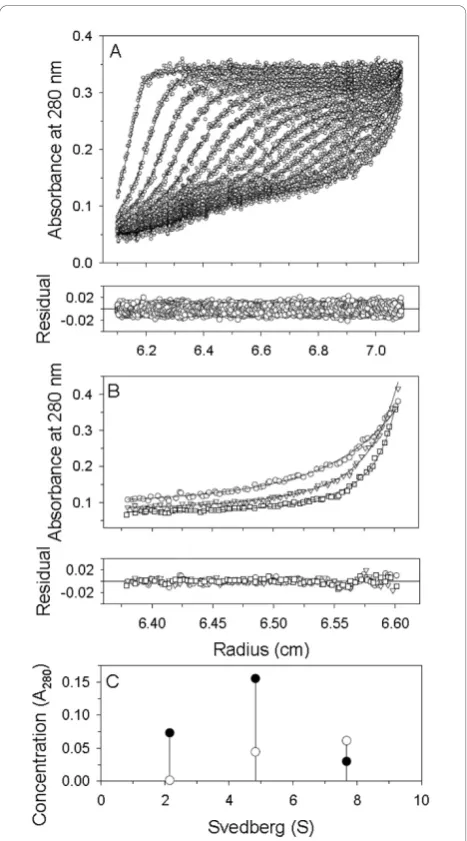
The mass variation of the apoE-(72-166) in PBS and in DHPC was analyzed by global discrete species model To further clarify the mass variation of the three apoE-(72-166) peptides in PBS and also in the presence of DHPC, SE experiments were performed. The SE and SV data were combined and globally fitted to a multiple discrete species model using SEDPHAT. Figure 3 showed the best-fit results of apoE3-(72-166) in PBS.
According to the results of c(s) distribution (Figure 2), the data were adequately described and fitted by a three (those in PBS and 5 mM DHPC) and two (those in DHPC micelle) discrete species model, respectively. The best-fit results are summarized in Table 2. The
calculated local concentration and sedimentation coeffi-cient of each discrete species showed a similar content to those in c(s). Most major species detected in SV were also detected in SE experiments. In the aqueous PBS solution, apoE-(72-166) peptides showed a major species of dimer, tetramer (for apoE4-(72-166)) or hexamer (for apoE2- and apoE3-(72-166)), and large aggregates, respectively, which indicated a significant polymerization. In the 5 mM DHPC submicellar solution, the content of each species did not show significant change, although the hexamer of apoE2- and apoE3-(72-166) dissociated to tetramer. It may suggest that apoE-(72-166) peptides begin to dissociate, which is consistent with the observa-tion by c(s). In the presence of 50 mM DHPC micelles, all three apoE-(72-166) proteins maintained a major spe-cies of 19-20 kDa, which may be a complex structure of a monomeric apoE-(72-166) peptides (12 kDa) with a smaller DHPC micelle (20 molecules, 9 kDa). As a ellip-soid micelle with 20 DHPC molecules, the radius of gyra-tion of the fatty acyl core region is 15.6 Å [41], whose circumference is about 100 Å, just identical to the length of apoE-(72-166)a-helical region. Besides, by SE experi-ments, apoE-(72-166) showed a major species of dimer (for apoE3- and apoE4-(72-166)) or tetramer (for apoE2-(72-166)) with a larger DHPC micelle (40 molecules, 18 kDa). As a micelle with 40 DHPC molecules, which has surface area of 2 times, the circumference will be about 140 Å. It may result in that apoE-(72-166) peptides do not form a complete belt around the micelle but are stag-gered at a suitable angle to each other [42]. Similarly, most apoE-(72-166) proteins in the presence of 100 mM DHPC micelles were found to have a major complex spe-cies of monomeric peptides with a micelle. The peptide-lipid complex with higher molar mass was also found by SE experiments.
Nevertheless, our study demonstrates that DHPC may provide a lipid or hydrophobic rich environment that will facilitate the maintenance of a dissociated and extended conformation for apoE-(72-166). This tendency also positively correlates with the increasing concentration of DHPC.
Protein-lipid interactions and Protein-LDLR binding of ApoE-(72-166) Proteins
To identify and compare the lipid binding ability of the three apoE-(72-166) peptides, we assessed the DMPC turbidity clearance ability of apoE2-(72-166) (Additional file 1: Figure S2). Compared with the other two isoforms [22], apoE4-(72-166) had the highest DMPC turbidity clearance ability. By fitting to biexponential decay model (Eq. 3), it suggested that the rate constants of apoE4-(72-166) in both phase were 4-13 times faster than apoE2 and apoE3 counterparts and 99.9% turbidity was removed, which indicated that all DMPC mLV have
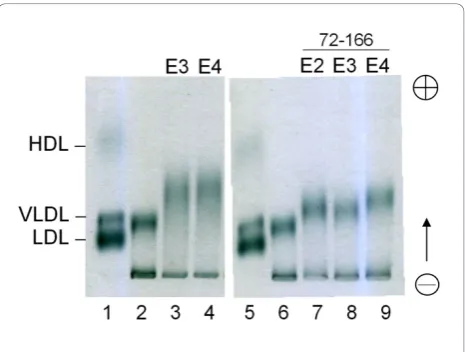
been solubilized by apoE4-(72-166) (Additional file 1: Table S2). Furthermore, to evaluate if apoE-(72-166) peptides can bind to lipoprotein particles, the in vitro binding experiment of apoE(-) mice VLDL with the apoE proteins was analyzed using zone electrophoresis, which can separate the lipoproteins by their charge [43]. In these experiments, the interaction of VLDL and apoE proteins increased the charge of VLDL particles, result-ing in the migration of VLDL band (lane 2 vs. lane 3-4 in Figure 4). Remarkably, the three apoE-(72-166) proteins also showed significant VLDL shifts (lane 6 vs. 7-9 in Figure 4), which indicated that the region con-taining residues 72-166 was sufficient for binding VLDL. In our previous study, we have evaluated the LDLR binding ability of apoE3-(72-166) and apoE4-(72-166) [22]. Here we further analyzed the LDLR binding ability of apoE2-(72-166) peptides as a comparison with apoE3 and apoE4 counterparts (Additional file 1: Figure S3). As previously, we employed HepG2 cells as the LDLR carriers [22]. 3H-LDL was used as the ligand and the apoE proteins with or without DMPC were therefore the competitors. Overall, apoE-DMPC complex showed better3H-LDL competition than apoE. Among the three isoforms, apoE4-(72-166)-DMPC complex decreased the 3
H-LDL binding by 55%, comparing with 19% for apoE2-(72-166)-DMPC and 26% for apoE3-(72-166)-DMPC. At the same dose, apoE4-(72-166)-DMPC main-tained almost identical LDLR binding ability to that of full length apoE-DMPC, while those of apoE2- and apoE3-(72-166) were significantly lower [22]. This indi-cated that alone of the three isoforms, only apoE4-(72-166) did not lose its LDLR binding ability. Comparing
to the apoE2 and apoE3 counterpart, apoE4-(72-166) shows the highest lipid binding ability (Additional file 1: Figure S2 and Table S2). The lipid association is required for high affinity binding of apoE to the LDLR because of the increased exposure of basic region on the fourtha-helix after interacting with lipids [7].
Table 2 Global discrete species analysis of apoE-(72-166) with different environmentsa
Inb ApoE2-(72-166) ApoE3-(72-166) ApoE4-(72-166)
Sc (Svedberg)
Md (kDa)
Local C of SV and SE (A280)
e S
c
(Svedberg) Md (kDa)
Local C of SV and SE (A280)
e S
c
(Svedberg) Md (kDa)
Local C of SV and SE (A280)
e
PBS 2.2 19 0.07, 0.10 2.1 18 0.07, 0 2.7 24 0.02, 0
5.3 67 0.17, 0 4.8 68 0.16, 0.04 4.7 51 0.18, 0.05
7.8 186 0.05, 0.11 7.7 251 0.03, 0.06 8.6 210 0.05, 0.12 5 mM
DHPC
2.3 25 0.07, 0.08 2.5 21 0.08, 0.08 2.2 22 0.01, 0
4.9 49 0.18, 0 4.9 52 0.15, 0 4.8 51 0.17, 0.07
8.2 190 0.04, 0.09 8.4 232 0.03, 0.06 8.5 217 0.04, 0.19 50 mM
DHPC
1.3 19 0.35, 0.13 1.2 20 0.34, 0 1.1 19 0.29, 0
4.3 71 0.01, 0.15 3.1 40 0.02, 0.15 3.8 45 0.03, 0.14 100 mM
DHPC
1.2 30 0.31, 0 1.0 19 0.32, 0.08 0.8 20 0.27, 0.04
3.3 49 0.05, 0.17 2.3 50 .0, 0.10 3.0 58 0.01, 0.11
a
The SV and SE experiments of apoE-(72-166) were combined and fitted to the global discrete model by SEDPHAT [33]. The best-fit local root mean square errors of SE were from 0.0041 to 0.0118 and those of SV were from 0.0054 to 0.0088.
b
The partial specific volume was set by 0.73 in PBS and 5 mM DHPC and by 0.86 in 50 and 100 mM DHPC (see materials and methods for detail).
c, d, e
Best-fit calculated sedimentation coefficients (s), molar mass (M), and local concentrations (C) of different species were shown. The local concentration of SV was from the discrete distribution of SV and that of SE was from the SE experiments. The concentration units were signal units (A280).
Conclusion
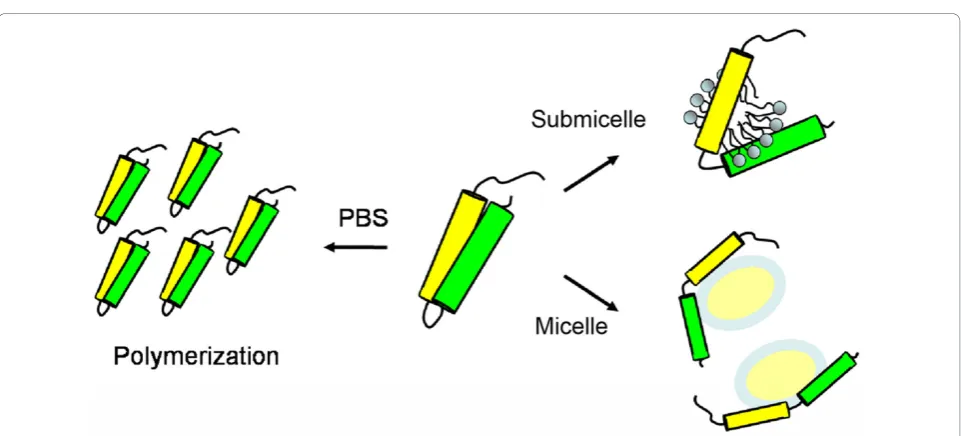
To illustrate the interaction of apoE-(72-166) peptides with lipids, a model for apoE-(72-166) in PBS with or without DHPC is proposed (Figure 5). ApoE-(72-166) was found to be prone to polymerize in PBS. When apoE-(72-166) interacts with DHPC submicelles, these DHPC mole-cules will intercalate into its hydrophobic region causing hydrophobic exposure. In the DHPC micellar solution, apoE-(72-166) will dissociate and interact to a DHPC micelle with an extended conformation. We demonstrate herein that unlike the foura-helical bundle NT domain which maintains a stable monomer [22], apoE-(72-166), as a less structured peptide, may have less lateral contacts and tend to aggregate in PBS, but dissociates at the exis-tence of DHPC micelle which may stabilize back these contacts. Besides, the truncated apoE peptides, especially apoE4-(72-166), still displays the comparable LDLR bind-ing and higher lipid bindbind-ing abilities as to full-length apoE [22]. Compared with a fused peptide which may have shorter half-life [44,45], the remarkable lipid binding and LDLR binding avidity of the apoE4-(72-166) suggests the possible feasibility for designing a competitive peptide against atherosclerosis or AD.
Additional material
Additional file 1: Tables S1 and S2. Figures S1-S3.
Abbreviations
1Aβ:β-amyloid peptide; AD: Alzheimer’s disease; apoE: apolipoprotein E; CD: circular dichroism; CT: carboxyl-terminal; DHPC: dihexanoylphosphatidylcholine;
DMPC: dimyristoylphosphatidylcholine; fr: frictional ratio; GdnCl: guanidinium chloride; HDL: high-density lipoprotein; LDLR: low-density lipoprotein receptor; Meq: equivalent molar mass; mLV: multilamellar vesicles; NFT: neurofibrillary tangle; NRMSD: normalized root mean square deviation; NT: amino-terminal; PBS: phosphate buffered saline; SE: sedimentation equilibrium; SV: sedimentation velocity; VLDL: very-low-density lipoprotein
Acknowledgements
We are grateful to Prof. Sheh-Yi Sheu in the same faculty for providing the apoE model structure. This research was supported in part by grants from the Taiwan National Science Council (NSC 98-2320-B-010-026-MY3) and National Health Research Institute, Taiwan (NHRI-EX99-9947SI) to CYC. We also thank NYMU for its financial support (Aim for Top University Plan from Ministry of Education).
Authors’contributions
YHH carried out most experiments and helped to draft the manuscript. CYC conceived the study, participated in experimental design, analyzed the AUC data, and drafted and revised the manuscript. Both authors read and approved the final manuscript.
Competing interests
The authors declare that they have no competing interests.
Received: 17 September 2010 Accepted: 10 January 2011 Published: 10 January 2011
References
1. Weisgraber KH, Rall SC Jr, Mahley RW:Human E apoprotein heterogeneity. Cysteine-arginine interchanges in the amino acid sequence of the apo-E isoforms.J Biol Chem1981,256:9077.
2. Aggerbeck LP, Wetterau JR, Weisgraber KH, Wu CS, Lindgren FT:Human apolipoprotein E3 in aqueous solution. II. Properties of the amino- and carboxyl-terminal domains.J Biol Chem1988,263:6249.
3. Wetterau JR, Aggerbeck LP, Rall SC Jr, Weisgraber KH:Human apolipoprotein E3 in aqueous solution. I. Evidence for two structural domains.J Biol Chem1988,263:6240.
4. Mahley RW:Apolipoprotein E: cholesterol transport protein with expanding role in cell biology.Science1988,240:622.
5. Westerlund JA, Weisgraber KH:Discrete carboxyl-terminal segments of apolipoprotein E mediate lipoprotein association and protein oligomerization.J Biol Chem1993,268:15745.
6. Dong LM, Wilson C, Wardell MR, Simmons T, Mahley RW, Weisgraber KH, Agard DA:Human apolipoprotein E. Role of arginine 61 in mediating the lipoprotein preferences of the E3 and E4 isoforms.J Biol Chem1994,
269:22358.
7. Lund-Katz S, Zaiou M, Wehrli S, Dhanasekaran P, Baldwin F, Weisgraber KH, Phillips MC:Effects of lipid interaction on the lysine microenvironments in apolipoprotein E.J Biol Chem2000,275:34459.
8. Mahley RW, Rall SC Jr:Apolipoprotein E far more than a lipid transport protein.Annu Rev Genomics Hum Genet2000,1:507.
9. Strittmatter WJ, Bova Hill C:Molecular biology of apolipoprotein E.Curr Opin Lipidol2002,13:119.
10. Saito H, Dhanasekaran P, Baldwin F, Weisgraber KH, Phillips MC, Lund-Katz S:Effects of polymorphism on the lipid interaction of human apolipoprotein E.J Biol Chem2003,278:40723.
11. Gregg RE, Brewer HB Jr:The role of apolipoprotein E and lipoprotein receptors in modulating the in vivo metabolism of apolipoprotein B-containing lipoproteins in humans.Clin Chem1988,34:B28. 12. Greenow K, Pearce NJ, Ramji DP:The key role of apolipoprotein E in
atherosclerosis.J Mol Med2005,83:329.
13. Weisgraber KH, Innerarity TL, Mahley RW:Abnormal lipoprotein receptor-binding activity of the human E apoprotein due to cysteine-arginine interchange at a single site.J Biol Chem1982,257:2518.
14. Lane RM, Farlow MR:Lipid homeostasis and apolipoprotein E in the development and progression of Alzheimer’s disease.J Lipid Res2005,
46:949.
15. Tanzi RE, Bertram L:Twenty years of the Alzheimer’s disease amyloid hypothesis: a genetic perspective.Cell2005,120:545.
16. Huang Y, Liu XQ, Wyss-Coray T, Brecht WJ, Sanan DA, Mahley RW:
Apolipoprotein E fragments present in Alzheimer’s disease brains induce neurofibrillary tangle-like intracellular inclusions in neurons.Proc Natl Acad Sci USA2001,98:8838.
17. Strittmatter WJ, Saunders AM, Schmechel D, Pericak-Vance M, Enghild J, Salvesen GS, Roses AD:Apolipoprotein E: high-avidity binding to beta-amyloid and increased frequency of type 4 allele in late-onset familial Alzheimer disease.Proc Natl Acad Sci USA1993,90:1977.
18. Barbier A, Clement-Collin V, Dergunov AD, Visvikis A, Siest G, Aggerbeck LP:
The structure of human apolipoprotein E2, E3 and E4 in solution 1. Tertiary and quaternary structure.Biophys Chem2006,119:158. 19. Chroni A, Pyrpassopoulos S, Thanassoulas A, Nounesis G, Zannis VI,
Stratikos E:Biophysical analysis of progressive C-terminal truncations of human apolipoprotein E4: insights into secondary structure and unfolding properties.Biochemistry2008,47:9071.
20. Clement-Collin V, Barbier A, Dergunov AD, Visvikis A, Siest G, Desmadril M, Takahashi M, Aggerbeck LP:The structure of human apolipoprotein E2, E3 and E4 in solution. 2. Multidomain organization correlates with the stability of apoE structure.Biophys Chem2006,119:170.
21. Hatters DM, Zhong N, Rutenber E, Weisgraber KH:Amino-terminal domain stability mediates apolipoprotein E aggregation into neurotoxic fibrils.J Mol Biol2006,361:932.
22. Chou CY, Jen WP, Hsieh YH, Shiao MS, Chang GG:Structural and functional variations in human apolipoprotein E3 and E4.J Biol Chem
2006,281:13333.
23. Chou CY, Lin YL, Huang YC, Sheu SY, Lin TH, Tsay HJ, Chang GG, Shiao MS:
Structural variation in human apolipoprotein E3 and E4: secondary structure, tertiary structure, and size distribution.Biophys J2005,88:455. 24. Chou JJ, Baber JL, Bax A:Characterization of phospholipid mixed micelles
by translational diffusion.J Biomol NMR2004,29:299.
25. Lin TL, Chen SH, Gabriel NE, Roberts MF:The use of small-angle neutron scattering to determine the structure and interaction of
dihexanoylphosphatidylcholine micelles.J Am Chem Soc1986,108:3499. 26. Tausk RJ, Karmiggelt J, Oudshoorn C, Overbeek JT:Physical chemical
studies of short-chain lecithin homologues. I. Influence of the chain length of the fatty acid ester and of electrolytes on the critical micelle concentration.Biophys Chem1974,1:175.
27. Sreerama N, Woody RW:Estimation of protein secondary structure from circular dichroism spectra: comparison of CONTIN, SELCON, and CDSSTR methods with an expanded reference set.Anal Biochem2000,287:252. 28. Whitmore L, Wallace BA:DICHROWEB, an online server for protein
secondary structure analyses from circular dichroism spectroscopic data.
Nucleic Acids Res2004,32:W668.
29. Pace CN:Measuring and increasing protein stability.Trends Biotechnol
1990,8:93.
30. Brown PH, Schuck P:Macromolecular size-and-shape distributions by sedimentation velocity analytical ultracentrifugation.Biophys J2006,
90:4651.
31. Schuck P:Size-distribution analysis of macromolecules by sedimentation velocity ultracentrifugation and lamm equation modeling.Biophys J2000,
78:1606.
32. Koynova R, Koumanov A, Tenchov B:Metastable rippled gel phase in saturated phosphatidylcholines: calorimetric and densitometric characterization.Biochim Biophys Acta1996, 1285:101.
33. Schuck P:Modern Analytical Ultracentrifugation: Techniques and Methods.InCambridge.Edited by: Scott DJ, Harding SE, Rowe AJ. The Royal Society of Chemistry; 2005:26-50.
34. Choy N, Raussens V, Narayanaswami V:Inter-molecular coiled-coil formation in human apolipoprotein E C-terminal domain.J Mol Biol2003,
334:527.
35. Pownall HJ, Massey JB, Kusserow SK, Gotto AM Jr:Kinetics of lipid–protein interactions: interaction of apolipoprotein A-I from human plasma high density lipoproteins with phosphatidylcholines.Biochemistry1978,
17:1183.
36. Segall ML, Dhanasekaran P, Baldwin F, Anantharamaiah GM, Weisgraber KH, Phillips MC, Lund-Katz S:Influence of apoE domain structure and polymorphism on the kinetics of phospholipid vesicle solubilization.J Lipid Res2002,43:1688.
37. Krempler F, Kostner GM, Friedl W, Paulweber B, Bauer H, Sandhofer F:
Lipoprotein binding to cultured human hepatoma cells.J Clin Invest
1987,80:401.
38. Lundberg BB, Suominen LA::Physicochemical transfer of [3H]cholesterol from plasma lipoproteins to cultured human fibroblasts.Biochem J1985,
228:219.
39. Wilson C, Wardell MR, Weisgraber KH, Mahley RW, Agard DA: Three-dimensional structure of the LDL receptor-binding domain of human apolipoprotein E.Science1991,252:1817.
40. Griffin MD, Mok ML, Wilson LM, Pham CL, Waddington LJ, Perugini MA, Howlett GJ:Phospholipid interaction induces molecular-level polymorphism in apolipoprotein C-II amyloid fibrils via alternative assembly pathways.J Mol Biol2008,375:240.
41. Bockmann RA, Caflisch A:Spontaneous formation of detergent micelles around the outer membrane protein OmpX.Biophys J2005,88:3191. 42. Peters-Libeu CA, Newhouse Y, Hatters DM, Weisgraber KH:Model of
biologically active apolipoprotein E bound to
dipalmitoylphosphatidylcholine.J Biol Chem2006,281:1073.
43. Campos E, Fievet P, Caces E, Fruchart JC, Fievet C:A screening method for abnormally high lipoprotein(a) concentrations by agarose lipoprotein electrophoresis.Clin Chim Acta1994,230:43.
44. Datta G, Garber DW, Chung BH, Chaddha M, Dashti N, Bradley WA, Gianturco SH, Anantharamaiah GM:Cationic domain 141-150 of apoE covalently linked to a class A amphipathic helix enhances atherogenic lipoprotein metabolism in vitro and in vivo.J Lipid Res2001,42:959. 45. Gupta H, White CR, Handattu S, Garber DW, Datta G, Chaddha M, Dai L,
Gianturco SH, Bradley WA, Anantharamaiah GM:Apolipoprotein E mimetic Peptide dramatically lowers plasma cholesterol and restores endothelial function in watanabe heritable hyperlipidemic rabbits.Circulation2005,
111:3112.
46. DeLano WL:The Pymol manual.San Carlos, CA: DeLano Scientific; 2002.
doi:10.1186/1423-0127-18-4
Cite this article as:Hsieh and Chou:Structural and functional characterization of human apolipoprotein E 72-166 peptides in
both aqueous and lipid environments.Journal of Biomedical Science2011


![Figure 2 c(s) distribution of apoE-(72-166) proteins in PBS with or without DHPC. The sedimentation velocity data was fitted with theSEDFIT program using the continuous c(s) distribution model [30]](https://thumb-us.123doks.com/thumbv2/123dok_us/9015644.1894425/5.595.57.541.380.679/figure-distribution-proteins-sedimentation-velocity-thesedfit-continuous-distribution.webp)