[Bethu* et al., 3(12): December, 2016] ISSN 2349-4506
Impact Factor: 2.785
G
lobal
J
ournal of
E
ngineering
S
cience and
R
esearch
M
anagement
STRUCTURING ELECTRONIC WARFARE TECHNIQUE USING SERVICE
ORIENTED ARCHITECTURE IN DATA MINING AND WEB SECURITY
Srikanth Bethu*, B Sankara Babu
*
Asst. Prof, Department of Computer Science and Engineering, Holy Mary Institute of Technology
and Science, JNTU Hyderabad, India
Assoc. Prof, Department of Computer Science and Engineering, Gokaraju Rangaraju Institute of
Technology and Science, JNTU Hyderabad, India
DOI: 10.5281/zenodo.220886
KEYWORDS
:
Electronic Warfare System, Service Oriented Architecture, Web service.ABSTRACT
Over the last few years, electronic warfare systems have grown in number of functionalities, to handle increasingly complex system architectures. Traditional system architectures have reached to the limit of their capabilities, while traditional requirements of electronic warfare systems persist. In order to a system be rapid in production and to have low cost, the system should have the following characteristics: Adaptability to various changes, Enhancement of system quality, Reduction of operation and maintenance cost. Combat Management systems are based on a federation of dedicated and heterogeneous systems, and because of that their operational integration deals with the following difficulties: Lack of operational interoperability, Weak integration of Information Systems services for Situation Awareness (from the strategic level to the tactical level and, Lack of global system management, prohibiting dynamic (re)configuration of systems. Today’s military solution for information exchange, the information flow is typically defined by a set pattern from sender to recipient. It is pre-planned and preconfigured, and changes normally require manual assistance. The solutions used are often stove piped, tailored for certain applications within one military service and with no interoperability with other types of systems. Another problem is the limited exchange of information between security domains [9]. Service Oriented Architecture (SOA) was identified as a possible solution to the above-mentioned problems. Moving towards a Service Oriented Architecture (SOA) is a way to achieve the seamless information and service sharing required in a future electronic warfare. The aim of this paper is investigating the affects of SOA on the architecture of Electronic Warfare Simulation software in terms of reusability and performance. In this paper, common functionalities of electronic warfare systems developed in DLRL are implemented as services.
INTRODUCTION
“Electronic Warfare is a military action that involves using electromagnetic spectrum to detect, analyze and prevent the enemies’ spectrum and also protecting our own spectrum. EW uses electromagnetic waves in the battlefield. Several trans-receivers are placed in the battlefield in various locations. The electromagnetic waves generated by these trans-receivers are used to determine the enemies’ movement, direction.” Electronic Warfare aims at reducing the enemy’s electronic activity and
2 B. Sankara Babu is an Research scholar at Nagarjuna University, A.P, and India. Simultaneously safeguarding own electronic systems from the enemy’s EW activities [3].EW is divided into three measures:
Electronic support measure (ESM)
[Bethu* et al., 3(12): December, 2016] ISSN 2349-4506
Impact Factor: 2.785
G
lobal
J
ournal of
E
ngineering
S
cience and
R
esearch
M
anagement
recognizing hostile radars and other noncommunications sources of electromagnetic energy Provide targeting information for ECM operations, Initiate self-measuring protection, Support ECCM efforts, Create and modify SIGNIT databases and Provide warning to the supported user.
Electronic counter measure (ECM)
ECM involves actions taken to prevent or reduce an adversary’s effective use of the electromagnetic spectrum through the use of electromagnetic energy.
a) Jamming: The deliberate radiation, re-radiation, of electromagnetic energy with the object of impairing the effectiveness of electronic devices, equipment being used by an adversary. Jamming enemy communications or radar, and disrupting enemy equipment using high-power microwaves.
b) Deception: The goal of deception is to mislead the enemy by manipulating his perceptions in order to counter measure. It includes manipulation, simulation, imitation, confusion, seduction, distraction
c) Neutralization: The deliberate use of electromagnetic energy to either temporarily or permanently damage adversary devices, which rely exclusively on the electromagnetic spectrum.
Electronic Counter Counter measure (ECCM)
ECCM, which ranges from designing systems resistant to jamming, through hardening equipment to resist high power microwave attack, to the destruction of enemy jammers using anti-radiation missiles.
ELECTRONIC WARFARE, SOA, WEB SERVICES
Service Oriented Architecture (SOA) was identified as a possible solution to the above-mentioned problems. Moving towards a Service Oriented Architecture (SOA) is a way to achieve the seamless information and service sharing required in a future electronic warfare. In this, an electronic warfare simulated system is restructured to service oriented architecture. Service Oriented Architecture (SOA) is a paradigm that realizes rapid and low cost system development. The most important characteristics of SOA are standard based interoperability, which allows services developed on different platforms to run together, and dynamic composition via discovery, which provides dynamic composition of application at runtime using the existing services [10]. In this project, we have focused on the dramatic effect of reusability when SOA is introduced to the electronic warfare system simulation. Wherever Times is specified, Times Roman or Times New Roman may be used. If neither is available on your word processor, please use the font closest in appearance to Times. Avoid using bit-mapped fonts if possible. True-Type 1 or Open Type fonts are preferred. Please embed symbol fonts, as well, for math, etc. The application software of EW simulation project is designed based on a pattern that isolates the business logic from user interface so it is easy to modify the business rules without affecting the user interface. The EW System features are selected to be as services and extracted from the application software. This makes the application software to become a service consumer to various EW services. The key is independent services with defined interfaces that can be called to perform their tasks in a standard way, without the service having pre-knowledge of the calling application, and without the application having or needing knowledge of how the service actually performs its tasks.
Difficulties with CORBA, DCOM and RMI and Why Web Services:
[Bethu* et al., 3(12): December, 2016] ISSN 2349-4506
Impact Factor: 2.785
G
lobal
J
ournal of
E
ngineering
S
cience and
R
esearch
M
anagement
some limitations, important dimensions may be eliminated because of which the accuracy of the process may be affected. The complexity of the process may increase because of the lot of processing has to take place.
Table.1. Comparisons of corba, dcom and webservices
Characteristic CORBA DCOM Web Services
Remote
Distributed
Computin g procedure Internet
Inter(ORB
) environment remote Hyper Text Transfer call(RPC)mech
Protocol
(IIOP) procedure call(DCE-RPC)
Protocol(HTTP) anism
Common Data
Network Data Extensible Markup Encoding
Representation(C DR)
Representation(NDR) language(XML)
Interface Interface Definition Interface Definition
Web Service Description description
language(I DL)
Language(ID L)
Language(WSD L)
Namingservice and
Universal Discovery
Discovery Registry Description and trading service Integration(UD
DI) Firewall
NO NO YES
friendly Complexity
High High Low of protocols
Cross-
Partly No Yes platform
[Bethu* et al., 3(12): December, 2016] ISSN 2349-4506
Impact Factor: 2.785
G
lobal
J
ournal of
E
ngineering
S
cience and
R
esearch
M
anagement
Fig.1. In the web service architecture, you use WSDL to describe a service, UDDI to advertise and discover a service, and SOAP to communicate with web service.
Figure.1. gives WSDL, UDDI, and SOAP are the three core technologies most often used to implement Web services. WSDL (Web Description Language) provides a mechanism to describe a Web service. UDDI (Universal Description Discovery and Integration) provides a mechanism to advertise and discover a Web service. And SOAP (Simple Object Access Control) provides a mechanism for clients and services to communicate. A service provider provides an interface for software that can carry out a specified set of tasks. A service requester or service consumer discovers and invokes a software service to provide a business solution. The requester will commonly invoke a remote procedure call on the service provider, passing parameter data to the provider and receiving a result in reply.
Service Oriented Architecture (SOA) is a term that represents a model in which automation logic is decomposed into smaller, distinct units of logic. Collectively, these units comprise a larger piece of business automation logic [5]. The design principles of SOA are loosely coupling, service contract, autonomous, abstraction, reusability, compos ability, statelessness, discoverability.
ELECTRONIC WARFARE SIMULATION
EW simulation is artificially created so that equipment can be tested and operators can be trained under realistic conditions. EW engagements are typically complex, with many threat emitters seen in constantly changing [3]. The operation of equipment and the performance required of operators cannot be adequately tested under static conditions with only one threat emitter present. This has led to the development of simulators that can simulate many threats grouped and maneuvered in realistic ways.
Simulation: Simulation is the creation of an artificial situation or stimulus that causes an outcome to occur as though a corresponding real situation or stimulus were present. Simulators can also be used to develop and evaluate tactics to deal with almost any kind of external event affecting almost any kind of equipment in almost any field [3]. Ex: Rifle firing, Flight-simulator computer program.
Simulation in the EW field: Due to the nature of EW systems, EW simulation often involves the creation of signals like those generated by an enemy's electronic assets. These artificial signals are used to train operators or to evaluate the performance of EW systems and subsystems. The EW simulation field also involves the prediction of the performance of enemy electronic assets or the weapons they control. Through simulation, an operator or piece of EW equipment can be caused to react as though one or more threat signals were present and doing what they would be doing during a military encounter. Typically, the simulation involves interactive changing of the threat situation or the way it is processed as a function of what the operator or equipment does in response to the perceived presence of the threat signals. EW Simulation Approaches: Simulation is divided into 3 categories computer simulation, operator interface simulation, emulation.
[Bethu* et al., 3(12): December, 2016] ISSN 2349-4506
Impact Factor: 2.785
G
lobal
J
ournal of
E
ngineering
S
cience and
R
esearch
M
anagement
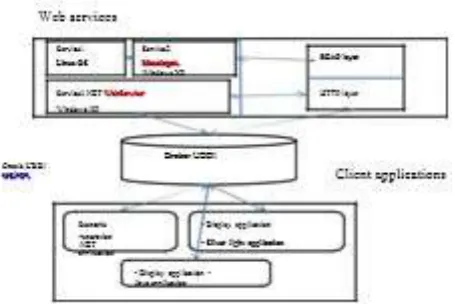
Each service runs on heterogeneous environment, namely different platforms, operating systems and programming languages. Hence, the service should be easily added or replaced or re-used. The granularity of the service differs according to functionality that it implements. As in the other business fields, service-oriented architecture has emerged as a solution to the complex requirements of electronic-warfare systems. In electronic warfare systems, the design functionalities, which have almost the same functionality, as a separate services which guides us to SOA. The main reason of choosing SOA as the implementation architecture is the foreseen improvements in code reusability and maintainability. By SOA usage we plan to increase the code reusability and decrease the implementation duration. The application software of EW simulation project is designed based on a pattern that isolates the business logic from user interface so it is easy to modify the business rules without affecting the user interface. The EW System features are selected to be as services and extracted from the application software. This makes the application software to become a service consumer to various EW services [8]. Implementing SOA on the architecture of Electronic Warfare Simulation software in terms of reusability and performance.
Fig .2. Showing web services, UDDI, client applications
The aim of this is to investigating the affects of SOA on the architecture of Electronic Warfare Simulation software in terms of reusability and performance. In this project, common functionalities of electronic warfare systems developed in DLRL are implemented as services.
The key is independent services with defined interfaces that can be called to perform their tasks in a standard way, without the service having pre-knowledge of the calling application, and without the application having or needing knowledge of how the service actually performs its tasks
[Bethu* et al., 3(12): December, 2016] ISSN 2349-4506
Impact Factor: 2.785
G
lobal
J
ournal of
E
ngineering
S
cience and
R
esearch
M
anagement
Successful publish of .NET Web Service in ISS7 server under windows Vista. Only when published in ISS7 server, these services can be published and consumed. Bottom to top. Creating Java client application using WSDL source file in Linux operating systems.
The Radio Service Is Developed Using Java Language in Oracle JDeveloper in Windows XP
CONCLUSION AND FUTURE SCOPE
The services are developed using different languages under any operating systems. These services can be consumed by any language under any operating systems. The paper aim for interoperability by developing the common functionalities in electronic warfare as services has been achieved successfully. When the particular web services technology is implemented to develop services, development becomes easier. Moreover picking out this feature from the application software makes the programmer’s life easier in the modification of the software by replacement of existing services. Also it provides rapid and low cost system development by combination of implemented services. The common functionality implemented as a service can be reused anywhere in order to achieve interoperability.
Developing private Universal Description Discovery Integration (UDDI), Registry for implementing Service Oriented Architecture for individual Organization. Developing multiple UDDI registries and connecting them to form as single UDDI structure. UDDI as Web Service., Database as Web Service .Achieving interoperability among diverse languages under diverse operating systems.
REFERENCES
1. Anurag Guruge, Web Services: Theory and practice: ELSEVIER DIGITAL PRESS, 2004. 2. Anne Thomas Manes, Web Services: A Manager’s Guide: Pearson Education, 2003.
3. David L. Adamy, Introduction to Electronic Warfare Modelling and Simulation: British Library Cataloguing in Publication Data, 2003.
4. Department of Defense, Electronic and Information Warfare .
5. T. Erl, Service-Oriented Architecture (SOA): Concepts, Technology, and Design: Prentice Hall, 2005. 6. Frank P. Coyle, XML, Web Services, and the Data Revolution: Pearson Education, 2002.
7. N. A. B. Gray, "Comparison of Web Services, Java-RMI, and CORBA service implementations. 8. Heidi Buelow, Manas Deb, Jayaram Kasi, Demed L'Her, Prasen Palvankar Getting Started with Oracle
SOA Suite 11g: PACKT Publishing, 2009