Volume 3, Special Issue 1, ICSTSD 2016
Parallel Resource Allocation in Cloudlet with
Wireless Sensor Network
Ingale Pragati Purushottam
Dept. Computer science and engg.
SGBAU, Amravati
INDIA
Email:
[email protected]
V. M. Thakare
Dept. Computer science and engg.
SGBAU, Amravati
INDIA
Email:
[email protected]
Y.M.Kurwade
Dept. Computer science and engg.
SGBAU, Amravati
INDIA
Email:
[email protected]
Abstract — Connecting mobile devices with the cloud, suffers
from high network latency and the huge transmission power consumption. Main obstacle for today’s mobile devices is lack of resource, and requires increasing the processing power of device, increasing memory capacity, a need for greater durability of the battery etc. Cloudlets can provide available resources to nearby mobile devices with lower access overhead and energy consumption. To stimulate service provisioning by cloudlets and improve resource utilization, a feasible and efficient incentive mechanism is required to charge mobile users and reward cloudlets. WSNs are also facing great challenges on the network level and on the individual sensor node level that form the sensor network. One of the most important issues that need to be addressed on the sensor node level is the power consumption of sensor nodes. Power consumption is considered to be very important in WSNs due to the fact that sensor nodes have small and limited power supplies.
In this paper introduces parallel resource sharing among cloudlets, to minimize the average waiting time, to minimize the completion time and to maximize the utilization of the resources in wireless sensor network.
Keywords—Cloudlets, parallel resource sharing,resource utilization, WSNs.
Introduction
Many offloading systems, allow partition processing between a local device and a remote surrogate for wired cloud computing environments. However, offloading applications in a mobile cloud computing environment is complicated by unreliable wireless links, node mobility, battery capacity and varying QoS requirements for applications. Furthermore, compared with those mobile computing environments that mobile devices can offload tasks to remote data centers or local cloudlets via cellular networks or wireless access points, in mobile clouds, mobile devices are connected via wireless mobile networks, and tasks from one mobile device can only be offloaded to other mobile devices or other mobile cloudlets. Mobile cloud computing can not only overcome the unavailability of infrastructure networks, but also can save time and energy by offloading tasks to nearby devices. This paper proposes a mobile cloud computing environment with network-CloudSim model and virtual machine (VM) migration in wireless sensor network (WSNs) that consisted of a collection of resource-constrained mobile devices (client nodes) and some more powerful high-performance cloudlets
(cloudlet nodes). By assuming the devices keep on moving and the topology and connectivity of the network keep on changing, propose method is used to choose cloudlet nodes available for the tasks that dynamically arrive at the client nodes, to minimize the average waiting time, to minimize the completion time and to maximize the utilization of the resources.
Background
Software Defined Networking (SDN) is an layered structure with decoupled network control plane and data plane. The control plane is represented as a centralized controller and the data plane is distributed to multiple switches/routers. With OpenFlow protocols, the centralized controller generates per-flow based forward per-flow entries and distributes them to each switch/router, while the switches/routers differentiate flows using flow matching fields and processes them based on the flow entries generated by the controller. The OpenFlow flow matching fields include up to 40 fields covering the major fields from layer 2 to layer 4 headers, which provides primitives for optimized packet routing and QoS management over SDN architecture. Therefore, OpenFlow based SDN can be used to address the integration issue in building a MC via MCC technologies [1].
A Markov decision process (MDP) based offloading algorithm used for the mobile users in a cloudlet system. The mobile user has an application to be executed. As the application is divided into code sections (denoted as phases), during the execution, the mobile user can dynamically decide to execute application phases locally on the mobile device or offload to nearby cloudlets. The MDP model considers the random mobility feature of each mobile user as well as a priority-based cloudlet admission control policy to analyze the intermittent connections between the mobile user and cloudlets [2].
Volume 3, Special Issue 1, ICSTSD 2016 first. On their basis, communication costs were considered and
integrated into the design of new algorithms. Their performance will be examined under different scenarios with respect to different performance metrics [3].
Multiple cyber-foraging systems have been developed that differ in terms of the strategy that they use to leverage remote resources- where to offload, when to offload, and what to offload. Where to offload varies between remote clouds and local servers located in proximity of mobile devices. When to offload varies between a runtime decision or an “always offload” strategy. To support runtime offload decisions, one strategy is to manually or automatically partition code into portions that either run on the mobile device or on a remote machine. At runtime an optimization engine typically targeted at optimizing energy efficiency, performance, or network usage decides whether the code should execute locally or be offloaded to a remote machine (surrogate) [4].
CAARETA (Cloud Assisted Architecture for Anonymous and Resource – Efficient Targeted Advertising), It leverages the pervasive and low cost cloud infrastructure, where each user is assigned a personal cloudlet. The personal cloudlet acts as a mediator between the ad network and user devices and undertakes the expensive computations, communications and storage operations [5].
Offloading to the cloud is not always a solution, because of the high WAN latencies, especially for applications with real-time constraints such as augmented reality. Therefore the cloud has to be moved closer to the mobile user in the form of cloudlets. Instead of moving a complete virtual machine from the cloud to the cloudlet, cloudlet concept manages applications on a component level. Cloudlets do not have to be fixed infrastructure close to the wireless access point, but can be formed in a dynamic way with any device in the LAN network with available resources [6].
This paper used parallel resource sharing among cloudlets, to minimize the average waiting time, to minimize the completion time and to maximize the utilization of the resources in wireless sensor network. This Paper organized as follows Section I Introduction. Section II discusses Background. Section III discusses previous work done. Section IV discusses existing methodology. Section V discusses analysis and discussion. Section VI proposed method Section VII outcome possible result. Finally section VIII concludes this review paper and Section IX related future work.
Previous Work Done
Lingxia Liao et al. (2015) [1] proposed a novel SDN based cloudlet approach that deploys cloudlets in a Mobile Telephone Switch Office, where a SDN based transport network that supports an enhanced OpenFlow 1.3 protocol is enabled. With this enhanced OpenFlow 1.3 protocol, each switch/ router and controller within this transport network can extract the source IP of a user packet encapsulated by a GTP header, so that the user packets from a particular remote mobile service front end can be identified and redirected to a
local cloudlet without modifying the existing mobile network elements and routing paths. Also proposed software Defined Mobile Cloudlet (SDMC) which is used in a Mobile Telephone Switching Office (MTSO), where a SDN based mobile transport network that supports an enhanced OpenFlow 1.3 protocol to differentiate mobile network packets is enabled.
Yang Zhang et al. (2015) [2] proposed a Markov decision process (MDP) based offloading algorithm for the mobile users in a cloudlet system. The mobile user has an application to be executed. As the application is divided into code sections (denoted as phases), during the execution, the mobile user can dynamically decide to execute application phases locally on the mobile device or offload to nearby cloudlets. The MDP model considers the random mobility feature of each mobile user as well as a priority-based cloudlet admission control policy to analyze the intermittent connections between the mobile user and cloudlets. But offloading failures caused by both user mobility and cloudlet admission control have been considered.
Bo Li et al. (2015) [3] focused on a mobile ad hoc cloud computing environment that consisted of a collection of resource-constrained mobile devices (client nodes) and some more powerful high-performance cloudlets (cloudlet nodes). Assuming the devices keep on moving and the topology and connectivity of the network keep on changing, also investigated the problem about how to choose cloudlet nodes available for the tasks that dynamically arrive at the client nodes, to minimize the average waiting time, to minimize the completion time and to maximize the utilization of the resources.
Based on some scheduling heuristics traditionally used for parallel multiprocessor systems, author also proposed a set of online and batch scheduling heuristics for offloading computational applications among mobile nodes interconnected with wireless ad hoc networks. Their performances with respect to both user-centric and system-centric metrics were investigated with comprehensive experiments.
Grace A. Lewis et al. (2014) [4] proposed cloudlet-based cyber forging in which resource-intensive computation is offloaded to cloudlets – discoverable, generic servers located in single hop proximity of mobile devices. Cloudlet-based cyber-foraging relies on discoverable, generic, stateless servers located in singlehop proximity of mobile devices. These characteristics make cloudlets a good match for the characteristics of resource constrained environments.
Volume 3, Special Issue 1, ICSTSD 2016 revealing only the higher level interest categories, which
requires ad network adaptation to send an array of advertisements than the present way of sending a single advertisement matching fine grained interests. CAARETA requires additional effort from user side to integrate the devices with the personal the cloudlet, to maintain the personal cloudlet. Furthermore, ad networks are required to change the current architecture.
Tim Verbelen et al. (2012) [6] presented a new cloudlet architecture, where applications are managed on component level. These application components can be distributed among the cloudlets. The cloudlet infrastructure is not fixed, and devices can join and leave the cloudlet at runtime. There are two types of cloudlets, the ad hoc cloudlet and the elastic cloudlet. The ad hoc cloudlet consists of dynamically discovered nodes in the LAN network. ad hoc cloudlets and a component management layer is beneficial for mobile rich media application that generate heavy load and have real-time constraints such as the augmented reality.
Existing methodology
In SDN based cloudlet architecture the front end is placed in a remote cloud and the cloudlet is placed in a local MTSO with connection to the front end through the Internet. The front end receives the user requests and redirects them to the local cloudlet to process the user requests locally. SDN infrastructure used to form the MTSO transport network, where EPC components and the cloudlet are connected through OpenFlow switches/routers, and an OpenFlow controller is used to supervise all the switches/routers within MTSO transport network. OpenFlow switchs/routers are used to inspect, modify, and redirect packets, and hence enforce the offloading policies without modifying the existing EPC elements and routing paths. OpenFlow based SDN architecture has a centralized control plane, which can oversee all the data paths within the network, the traffic routing/forwarding among data paths is controlled by flow entries generated by the control plane and loaded to each data path [1] .
An MDP-based model used for a mobile user in an intermittently connected cloudlet system to obtain an optimal offloading policy. The policy determines offloading/local execution actions based on the state of the mobile user to achieve the minimum cost [2].
In order to make offloading decisions, there are three architectural choices: centralized, distributed and hierarchical. In the online scheduling mode, a job is scheduled immediately as soon as it arrives, without considering any other jobs and their scheduling. This scheduling mode is usually more simple and efficient than the batch mode and especially suitable for distributed scheduling environments. Besides the online scheduling mode, batch scheduling mode can also be used for computation offloading, but only for the centralized or the hierarchical offloading architecture [3].
In cloudlet-based cyber-foraging applications are statically partitioned into a very thin client that runs on the mobile
device and a computation-intensive server that runs on the cloudlet. The main elements of the architecture are the Mobile Client and the Cloudlet Host. A Discovery Service running inside the cloudlet host publishes Cloudlet Metadata that is used by the Cloudlet Client to determine the appropriate cloudlet for offload and to connect to the cloudlet. Metadata can range from a simple IP address and port to connect to the cloudlet server to complex data structures describing cloudlet capabilities. Every application is composed of a Cloudlet-Ready Client App that corresponds to the client portion, the Server Offload Code that corresponds to the server portion, and the Client App Metadata that contains information that is used by the cloudlet client and the cloudlet server to negotiate and carry out the code offload process. Once a cloudlet is identified for offload, the cloudlet client sends the server offload code and client app metadata to the Cloudlet Server. The cloudlet server then deploys the server code inside a Guest VM inside the VM Manager. The server offload code can range from provisioning instructions, to source code, to application packages, to complete VMs. Once the deployment is complete, the cloudlet server is notified that the server is ready for execution and the client app is launched [4].
In CAARETA personal cloudlet is defined as a node which can run a virtual server on behalf of the Smartphone user. It will have access to a fixed network where the bandwidth is relatively cheap and the power is not battery-limited. In CAARETA Context information collector is a background service running on the smartphone, which collects contextual data and securely uploads to the personal cloudlet. Context information archiver securely stores data received from the smartphone in the cloudlet. User profile service - Analyzes the information stored in the context information archiver and maps each user in to one or more low level interest categories. Advertisement service - Acts as the central contact point for ad requests from all ad-supported apps on a particular device. Context prediction engine predicts the users’ future context in terms of coarse-grained location, apps to be used, WiFi availability and allows advertisement service to periodically interrogate this information [5].
Cloudlet architecture composed of three layers: the component level, the node level and the cloudlet level. There are two types of cloudlets: the ad hoc cloudlet and the elastic cloudlet. The ad hoc cloudlet consists of dynamically discovered nodes in the LAN network. These nodes run a Node Agent that can spawn Execution Environments to deploy components in. When nodes join or leave the cloudlet, the Cloudlet Agent will recalculate the deployments, migrating components if needed. The elastic cloudlet runs on a virtualized infrastructure, where nodes run in virtual machines. Here, the Cloudlet Agent can spawn new nodes when more resources are needed, or stop nodes when too many resources are allocated [6].
Analysis and discussions
Volume 3, Special Issue 1, ICSTSD 2016 and mobile network intends to use Network Function
Virtualization technology to virtualized mobile core network elements and integrate them to a controller or a switch/router of the SDN. This approach has flexible network management and routing policies to allow cloudlets to be integrated with or without modifying the existing mobile network elements. However, this virtualization is a full redesign of mobile core network, which can be very complicated and hard to be realized. A Markov decision process (MDP) model used to obtain an optimal policy for the mobile user with the objective to minimize the computation and offloading costs. A set of online and batch scheduling heuristics were proposed to offload dynamically arriving independent tasks among mobile nodes. CAARETA provides several incentives for ad networks, encouraging the adaptation. CAARETA preserves user privacy by revealing only the higher level interest categories, which requires ad network adaptation to send an array of advertisements than the present way of sending a single advertisement matching fine grained interests. Cloudlet architecture will manage the application on a component based level, being able to configure and/or distribute application components within the cloudlet or to other cloudlets. Cloudlet architecture with ad hoc cloudlets and a component management layer is beneficial for mobile rich media application that generate heavy load and have real-time constraints such as the augmented reality.
Following table summarizes discussions of above methods.
Method Advantages Disadvantages
SDN based cloudlet architec ture support
More mobile
devices with higher availability.
Longer network
latency. SDN
technology cannot be applied over peer-to-peer mobile network. Markov
decision process model
Minimize the
computation and offloading costs.
offloading failures caused by both user mobility and cloudlet.
Online and Batch Schedul ing
User-centric and system-centric. Offload dynamically arriving independent task among mobile nodes
More energy
consumes. cloudlet -based cyber-foraging Cloudlets are discoverable, generic, stateless servers located in single-hop proximity of mobile
devices, that can operate in disconnected mode
and are virtual-machine (VM)
based to promote flexibility,
Most solutions do not address the challenges of “being
at the edge.”
mobility, scalability, and elasticity CAARE
TA
Preserves user privacy. saves Smartphone
resources in
multiple ways
CAARETA requires additional effort from
user side to integrate the devices with the personal the cloudlet,
to maintain the personal cloudlet. Cloudle
t architec ture
Provides a
middleware framework to man- age and distribute component based applications, with a Focus on rich media applications such as augmented reality that have strict real-time requirements.
remains dependent on service providers to actually deploy such cloudlet
infrastructure in LAN networks. VM based cloudlets is the coarse granularity of VMs as unit of distribution.
Table1: Comparative analysis of various resources allocation methods in cloudlet.
Proposed Methodology
Network cloudSim with cloud datacenter:NetworkCloudSim is a simulator extends CloudSim’s functionality. NetworkCloudlet class represents a task executing in several phases/stages of communication and computation. There are three main Entities in the Network CloudSim: Switch, NetworkDatacenter, and NetworkDatacenterBroker.
111 1 11 SimEntity Edge Switch Aggregate switch
Switch Network Datacenter Network Datacenter Broker Root switch Network Host Network VM allocation policy Network VM
Network cloudletscheduler
Volume 3, Special Issue 1, ICSTSD 2016
Figure 1: Block diagram of NetworkCloudSim
To model a network within the datacenter, the following classes have been added to the NetworkCloudSim.
Switch: represents a network entity which can be configured as a router or switch. It can model delays in forwarding any data to either host or another switch based on where the data belongs. The edge switch is directly connected to hosts and has uplinks connected to another switch. Aggregate switch has uplinks and downlinks to switches. The root switch is modelled as a network entity that is directly connected to the
Internet/outside data center and has downlink to other switches.
NetworkPacket and HostPacket: These classes represent a data flow from one VM to another in a data center. HostPacket is a packet that travels through the virtual network, whereas NetworkPacket is the packet which travels from one server to another. Each packet contains ids of the sender VM and receiver VM, time at which it is send and receives type and virtual ids of tasks, which are communicating.
Application Modelling: To model generalized applications and simulate communication between different tasks the following Classes have been designed.
NetworkCloudlet: The Cloudlet class has been extended to represent a generalized task with various stages (TaskStage). Each stage can be computation, sending some data or receiving some data. This class also contains information of the application to which this cloudlet belongs. Each NetworkCloudlet represents the smallest entity executing on a VM.
AppCloudlet: It represents an application with multiple tasks (NetworkCloudlet(s)).
All scheduling classes are extended to make them aware of tasks with communication, and thus being able to simulate their execution.
VM Migration:
In Infrastructure as a Service (IaaS) environment, represented by a large-scale data center consisting of N heterogeneous physical nodes. Each node i is characterized by the CPU performance defined in Millions Instructions per Second (MIPS), amount of RAM and network bandwidth. The servers do not have local disks, the storage is provided as a Network Attached Storage (NAS) to enable live migration of VMs. The type of the environment implies no knowledge of application workloads and time for which VMs are provisioned. Multiple independent users submit requests for provisioning of M heterogeneous VMs characterized by requirements to processing power defined in MIPS, amount of RAM and network bandwidth. The fact that the VMs are managed by independent users implies that the resulting workload created due to combining multiple VMs on a single physical node is mixed. The mixed workload is formed by various types of
applications, such as HPC and web-applications, which utilize the resources simultaneously.
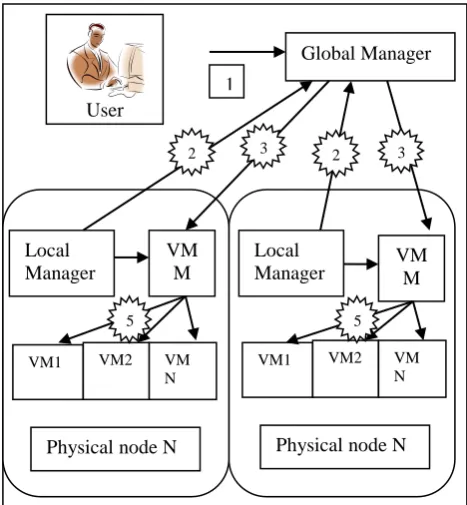
The software layer of the system is tiered comprising local and global managers as shown in figure 2. The local managers reside on each node as a module of the VMM. Their objective is the continuous monitoring of the node’s CPU utilization, resizing the VMs according to their resource needs, and deciding when and which VMs should to be migrated from the node (4). The global manager resides on the master node and collects information from the local managers to maintain the overall view of the utilization of resources (2). The global manager issues commands for the optimization of the VM placement (3). VMMs perform actual resizing and migration of VMs as well as changes in power modes of the nodes (5).
Figure 2: System model with VM migration.
WSN Localization: A typical WSN consists of N sensor nodes scattered among a field of M M meters. Each node has a transmission range of R and may or may not be equipped with various sensors such as temperature or humidity sensors, or radios such as GPS. Each node also holds a state of being localized, i.e. aware of it's own position in the global or local positioning system, or unlocalized, i.e. not aware of its own position in space. Each node in the WSN can eventually be localized with the help of three already localized neighbor nodes that a node can communicate with over 1-hop connections .Two nodes are said to have a 1-hop connection if the distance between them is less than or equal to the transmission range, R. The localization procedure is the step that precedes actual network transmissions which, in the long run, will help in data forwarding and routing procedures between nodes in the network.
Outcomes and Possible Result
User
Global Manager
1
Local Manager
VM M
VM1 VM2 VM
N
Physical node N
5 3 2
Local Manager
VM M
3 2
VM1 VM
N
Physical node N
Volume 3, Special Issue 1, ICSTSD 2016 Allocation of resources and sharing them among cloudlets by
using parallel way could be minimize the average waiting time, completion time of task and could be maximize resources utilization in wireless sensor network.
Conclusion
The study resource allocation in cloud computing discusses the most relevant cloud computing and cloudlets techniques developed in recent years with their offloading challenges. NetworkCloudlet class represents a task executing in several phases/stages of communication and computation. The bandwidth is equally shared by the active flows, i.e each flow gets bw/n bandwidth if there are n flows. NetworkCloudSim provides a facility to users to design their own routing algorithms, and configure network and switching latencies. They can add routing/switiching delays by sending an event to ‘switch’ itself. Based on the decision, the packet is either forwarded to other switches or to a connected host with a delay which is calculated based on available bandwidth and packet (data) size.
Dynamic adaption of VM allocation at run-time according to the current utilization of resources applying live migration, switching idle nodes to the sleep mode, and thus minimizing energy consumption.
Future Scope
In future NetworkCloudSim can help in building advance scheduling and resource allocation mechanisms for Clouds.
References
[1] Lingxia Liao1 · Meikang Qiu2 · Victor C. M. Leung1 “Software Defined Mobile Cloudlet” @ springer science+business media new yark 2015 page no. 20:337-347. DOI: 10.1007/s11036-015-0616-1. [2] Yang Zhang, Dusit Niyato, and Ping Wang
“Offloading in Mobile Cloudlet Systems with Intermittent Connectivity” IEEE Transactions on
Mobile Computing page no. 1-14.
DOI:10.1109/TMC.2015.2405539.
[3] Bo Li1 · Yijian Pei1 · Hao Wu1 · Bin Shen2 “Heuristics to allocate high-performance cloudlets for computation offloading in mobile ad hoc clouds” @ springer science+business media new yark 22 Aprile 2015 page no. 71:3009-3036. DOI: 10.1007/s11227-015-1425-9.
[4] Grace A. Lewis, Sebastian Echeverría, Soumya Simanta, Ben Bradshaw, James Root Carnegie Mellon Software Engineering Institute” Cloudlet-Based Cyber-Foraging for Mobile Systems in Resource-Constrained Edge Environments” page no. 412-415. ICSE companion’14, May 31-june7,2014, Hyderabad, India ACM.
[5] Suranga Seneviratne, s.seneviratne, aruna.seneviratne “Personal Cloudlets for Privacy and Resource
Efficiency in Mobile In-app Advertising” page no. 33-39. MobileClode’13, july 29,2013, Bangalore, India. Copyright 2013 ACM.