Copyright © The Author(s). All Rights Reserved. Published by American Research Institute for Policy Development DOI: 10.15640/jmm.v6n1a7 URL: https://doi.org/10.15640/jmm.v6n1a7
An Empirical Test of a Model of Resistance to
Political Marketing
Samer Elhajjar
1Abstract
The aim of this research is to develop a better understanding of the reasons underlying resistance to political marketing campaigns. To our best knowledge, this is the first research studying political marketing through a resistance approach. Drawing on a literature review, this study adopts nethnographic and quantitative methods to explore the resistance to political marketing campaigns in Lebanon. The findings show that skepticism, cynicism, frustration, and dissatisfaction have an impact on resistance to political marketing campaigns. Finally, we discuss several relevant theoretical and strategic implications, and point out directions for future research.
Keywords: Political Marketing; Resistance; Skepticism; Cynicism; Netnography.
Introduction
There have been several studies that state that marketing can be applied to politics (O‟Shaughnessy, 1990; Bowler and Farrell, 1992; Newman and Taylor, 1994; Maarek, 2008). Research into political marketing has emerged into four main tracks; (1) studies of the effect of political marketing on the population (Ben-Ur and Newman, 2002; O‟Cass, 2002; Reeves and De Chernatony, 2003); (2) studies of political marketing communication tools (Dermody and Hanmer-Lloyd, 2005; Harris et al, 2005); (3) studies of public policy implications and critical discourse in relation to the use of political marketing practices (O‟Shaughnessy, 1990; Scammell, 2016), and; (4) studies of internal political marketing techniques and tactics within political movements (O„Cass, 2002; Wring, 1997). Despite the growing literature in political marketing, there are fundamental conceptual considerations which remain somewhat under-researched. Thus, this research aims to fill these gaps in the literature and to provide a better understanding of people‟s resistance to Lebanese political marketing campaigns. More precisely, through this research we intend to answer the following research question: What are the factors that influence people‟s resistance to political marketing campaigns?
Identifying factors that constrain people to have positive attitudes toward political marketing campaigns is vital for marketers as it holds important implications for the adjustment of their strategies and techniques (O‟Cass, 2002). Thus, this research aims to give political marketers recommendations to improve the efficiency of their political campaigns, and to avoid people‟ resistance. Moreover, this article should not only be interesting for practitioners, but also for researchers, as it brings together literature from different fields of study, including marketing, politics and psychology. Although academics in these subfields have shown a substantial interest in resistance, these streams of literature are poorly connected, and this paper aims to facilitate the exchange of knowledge between these subfields. The remainder of the paper is divided into three sections. The first section offers a literature overview of resistance to political marketing campaigns in Lebanon. Then, the second section depicts the methodology and presents the results. In the last section, the results of the research are discussed and some strategic implications are developed.
1.Literature Review 1.1.Political Marketing
Scammell (1999) and Lees-Marshment (2001) believe that there is a significant level of confusion among academics regarding the general understanding and definition of the political marketing concept. By 1999, a consensus on a definition of political marketing had still not been even reached (Scammell, 1999). The definitions of political marketing often classify the political marketing process as related more to the communication process between voters and political entities (Wring, 1997). It is a process by which political actors (parties, movements, governments, and politicians) publicize their ideologies and their dogmas to citizens through masterly-crafted communications in order to gain support from the public (Newman, 2010). So, political marketing seeks to influence the population about political issues and particular candidates (Scammel, 1999). Political marketing can utilize many of the same techniques and tools that other forms of commercial marketing do, it is actually used to market a political idea, rather than a specific product or brand (O‟Cass, 1996). Nowadays, it has literally become very difficult not to incorporate a marketing orientation in politics (O‟Cass, 1996). Politics is being impacted more and more by marketing, and the same technological methods used by the firms are being used by politicians to market themselves and their ideologies (Speed et al., 2015). And, the politician has to rely on marketing not only to win the election but to be successful after the elections. So, political marketing is the outcome of the marriage between marketing and politics as an activity and method (Menon, 2008).
The efficiency of a political marketing campaign is measured by the ability of political actors, individuals, and parties to move public opinion in the direction they want it to move in (Cwalina et al., 2016). This is a short-term measure of success, but it is also the one factor which every politician will look at on election day before the results come in. Moving public opinion in the desired direction is the political marketing challenge to politicians (Verma, 2015).However, political marketing has been criticized as nothing more than a marketing strategy that plays more on the emotional aspects than on the specific programs and technical points (Henneberg, 2004). The political marketing is viewed as a manipulative tool that attempts to manage the behaviors of the voters. In fact, media and marketers do what Lippmann (1925) calls a construction of reality. They build a pseudo-environment that becomes for most individuals the social mirror of reality. Now, this mirror, is composed of: framing, shaping, constructing and marketing (Norris, 1997; Davis and Owen 1998). Thus, Breton (1997) demonstrates how manipulation involves breaking into someone's mind to file an opinion, without anyone knowing that there has been a break-in. Everything is there, in this gesture that hides itself as manipulative. For Campbell (1995), there is an inference of intention to manipulate when the individual identifies that the advertiser/marketer is trying to persuade him by inappropriate, unfair or manipulative means. So when the citizen realizes that the advertiser tries to persuade him, this decreases persuasive power and risks to lead him to the resistance. Also, previous studies (Newman, 1999; Scammel. 1999) indicate that the expectations of voters are influenced by the gaps that exist between their own perceptions and those of the politicians. When the politicians are not able to respond and deliver what it is important to the voters, this will develop negative attitudes and resistance to the political campaigns among the voters. In the marketing literature, there is a lack of research examining the phenomena of resistance for two reasons. First, most of the criticisms regarding political marketing come from political scientists as few marketers find the use of marketing instruments and concepts inpolitics objectionable (Henneberg, 2004). Second, marketing, politics and psychology were three fields that were poorly connect in previous research on political marketing. Although, successful political marketers regularly employ psychology in appealing to voters in their political marketing campaigns (Jost, 2017). It is also to be noted that the academic development of political marketing as discipline is still at its infancy stage and till now, there is still much debate over the nature of the role of marketing tools and strategies and its applicability in politics.
1.2.Resistance
Resistance has been defined as "the way individuals and groups practice a strategy of appropriation in response to structures
of domination"(Poster 1992, p. 94). According to Sherman et al. (2004), resistance is defined as a response by an
individual attempting to eliminate or limit the impact of persuasive communication. In this sense, Briñol et al. (2004) indicate that the resistance designates a motivation referring to the purpose of resisting the change of attitude; mechanisms that allow consumers to protect themselves from messages; a result that corresponds to the observation of maintaining an attitude and a personal characteristic.
In fact, some authors consider resistance as an intention or behavior (Kleijnen et al., 2008), others as an attitude (Ellen et al., 1991) and yet others as a combination of attitude and behavior. Dominique Roux, a marketing researcher, has devoted several research work on resistance and noted how people can rebel against systems located outside of their control. For Roux (2006), there are three grounds for resistance: resistance as a libertarian expression, as a sanction of the non-ethical behavior of organizations and as a citizen engagement (Opposition to the principles of the system). This kind of resistance can be directed against the firms, products, advertisements, practices, and partnerships associated with a structure of dominance (Lee, Roux, Cherrier, & Cova, 2011).
Resistance to political marketing expresses the impossibility of accepting and appropriating the marketing practices by the political movements and parties (Knowles and Linn, 2004). The resistance to political marketing can go as far as a complete rejection of: all the political parties, the attempts of the civil society to change and the system. This resistance can be passive if the citizen feels reluctant to participate in the political life (e.g. voting) or it can be active if the citizen postpones his participation (McGuire, 1961). Finally, resistance can be very active if the citizen decides to engage in actions or attacks against the marketing practices of the political parties (Kjellberg and Helgesson, 2010).
1.3.Resistance to Political Marketing in Lebanon
In Lebanon, for some time, the political actors have not hesitated to use the sectarian discourse (Farah and Samad, 2015). This discourse has been able to attract supporters and to help politicians gain popularity. The main aim of such a message is to persuade the sectarian communities that they are under attack and that fortresses are the only way to protect the group. The reaction to fears often leads to self-fulfilling prophecies, as the same attitude prevails across confessions (Mikdashi, 2017). The Lebanese political leaders may do not incite sectarian hatred, but the way they were empowered and their monopoly on religious matters inhibit social and political integration among various religious communities and reinforce sectarian divisions in the Lebanese society. In addition, almost all the political parties in Lebanon are dependent on foreign countries that prefer to support various partisan interest and sectarian formations (Mohsein and Wilcox, 2016). In other words, elections in Lebanon are nothing but a four-year assessment of the size of Lebanese sectarian communities and the balance of power between them. Moreover, the power and charisma of local leaders are a basis of success among Lebanese politicians. The concept of power in Lebanon is a bit different. It means above anything the ability and the quality of services offered to voters: jobs, monthly subsidies, or even hospital bills (Terpstra and Frerks, 2016). So, there is also a fear among the Lebanese population deriving from the ongoing, current social and economic difficulties. Today, young people believe that the only path to obtain social services is to go through the sectarian channels. For example, according to Love (2010), the robust social services program is the glue that binds the people to the political army of Hezbollah in Lebanon.
Next to the sectarian discourse, Lebanese politicians are more than talented in sending emotional messages to their supporters (Maarek, 2011). Political assassinations, war, socio-economic disenfranchisement, and the recommendations of the clergy provide the milieu from which these emotional discourses emerge. The affective messages are also driven by the fact that many political actors do not have clear ideologies since they were militias with sectarian views. Even young politicians who start with a political ideology, they end up using a purely emotional message without mentioning their political ideologies.
Even if these listed tools of the political marketing campaigns in Lebanon are still extant but one of the main current challenges faced by Lebanese political parties is to regain confidence among the population. This lack of confidence in the political parties may lead to a resistance among the citizens toward all their marketing efforts and practices.In the case of Lebanon, many Lebanese become guarded and wary when faced with a proposal and message by the political parties. They wonder what the motive behind the message might be, what the true facts are. This face of resistance underlies both affective and cognitive reactions to influence. Actually, rubbish crisis, the bad economic situation, the delays of parliamentary elections, and other factors, have served to create a decided political alienation among younger citizens against the parties in power (AbiYaghiet al., 2017), and to lead a hyper-skepticism toward these parties and a rejection to the political discourse (Heyberger, 2013).
2.Research model
2.1.Formulation of Hypotheses Regarding Resistance to Political Marketing
Netnography is a qualitative research method that uses the Internet as a source of data based on virtual communities such as forums and pages on different social networks (Bernard, 2004). The interest of the netnography is that it allows observing the interaction of individuals online. The application of this method required an immersion within several virtual communities. The objective was to understand the reasons for the resistance to political marketing campaigns in Lebanon.
The first stage of the netnographic study is to enter some virtual communities with a concordance with our research questions. We focused on Lebanese online virtual communities (news pages on Facebook) debating politics in social media. In total, eight virtual communities were selected. The following step was to filter these pages and the most relevant ones compared to the research problem. Then, we downloaded all of these messages through “copy-paste” in a Word file. Later, we have classified the messages (comments) in order to identify the on-topic messages. Finally, we coded these messages using Nvivo in order to generate and organize the coding. Concerning the verification by the online members, we have adopted the posture of Langer and Beckman (2005) which recommends that the researcher does not come into contact with the members. The netnographic study was conducted between June and September 2017.In the following, we present each driver of resistance (according to the netnography study) and formulate a related research hypothesis.
2.2.Hypothesis
People reject the political marketing messages because they have a general tendency to be wary of the motivations of the politicians when they launch any marketing campaign, “a new advertising to hide his bad intentions to this
country” (Sarah). Also, people tend to not believe and doubt the whole political message of the politicians, “I don’t think
these numbers are true, I can’t believe him” (Tony). So, skepticism of the citizens negatively influences the resistance to the
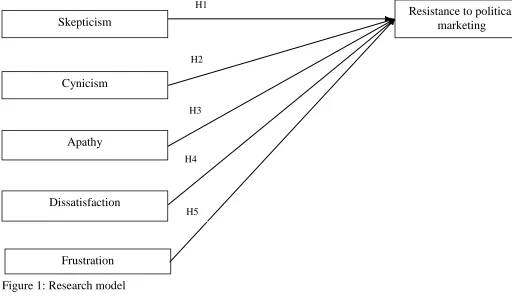
political marketing campaigns. Skepticism is the tendency to doubt or not to be convinced of the truthfulness of the political marketing efforts of the politicians. This is a negative attitude of the citizens in relation to the motivations and claims of the politicians. It represents the tendency to question oneself in relation to the information of political messages, but that does not mean that people do not believe in it in a systematic way. Consequently, we postulate the following hypothesis:H1: Skepticism of the citizens positively influences the resistance to the political marketing campaigns.
The Lebanese population show in their comments that they are losing confidence in the politicians and having an opinion that the politicians abuse them. Many online users are cynics as they see political parties as frequently manipulating people, “asusual, he is clearly manipulating the people, I just want to know who can believe all these lies?”
(Dany). Other determinants of cynicism towards environmental advertising are present in the messages in the virtual communities. The analysis highlights the following: (1) the systematic doubt: “I tend not to believe the political campaigns in
general and to systematically doubt this kind of advertisements” (Jasmin); (2) lack of confidence in politicians “they are all liars!”
(Karl). Consequently, the cynicism of the citizens negatively influences the resistance to the political marketing campaigns. Cynicism is an attitude that involves looking at everything negatively. Although many researchers associated cynicism with skepticism, there is a big difference in these attitudes; skepticism basically refers to not believing anything without evidence, but cynicism refers to not believing in or trusting in general. The following hypothesis is, therefore, formulated: H2: Cynicism of the citizens positively influences the resistance to the political marketing campaigns.
In their messages, the citizens show a loss in energy, interests, and emotion in everything related to the Lebanese politics, “I don’t care anymore”; “I am not interested to watch new lies”; “politics in Lebanon mean nothing to me, just
nothing” (Diana). Accordingly, apathy of the citizens negatively influences the resistance to the political marketing
campaigns. Apathy is actually the reduced motivation corresponding to goal-directed behaviors. Consequently, we formulate the following hypothesis:H3: Apathy of the citizens positively influences the resistance to the political marketing campaigns. The online users seem to be dissatisfied with the services of the Lebanese government and with the discourse of the Lebanese politicians. The social and economic situations, the power crisis, the bad infrastructure, the traffics, the pollution and other daily life problems led to this dissatisfaction among the population, “I pay two bills
for electricity and I don’t have electricity” (Karim); “why should I vote for them, I have been unemployed for three years?” (Marc); “I will
vote for him when he gets stuck in traffic like we do every day” (Mohamad).
Dissatisfaction of the citizens positively influences the resistance to the political marketing campaigns. Lebanese population rejects the political marketing campaigns because they are frustrated with the government and the politicians, “that’s enough! I don’t want to watch politics anymore” (Nelly), “Disgusting, I am really upset and frustrated and I
don’t want to watch anything related to this government” (Karim). Hence, the frustration of the citizens negatively influences
the resistance to the political marketing campaigns. Scholars define frustration as the blocking or prevention of a potentially rewarding or satisfying act or sequence of behavior (Colman, 2001, p. 291; Anderson and Bushman, 2002, p. 37; Bessière et al., 2004). The two constructs: dissatisfaction and frustration are different as frustration is considered as a strongly negative emotion while dissatisfaction as a weakly negative emotion. Consequently, we formulate the following hypothesis: H5: Frustration of the citizens positively influences the resistance to the political marketing campaigns.
So, the results of the qualitative study led us to develop a research model of the political marketing‟s resistance.
3.Methodology and results 3.1.Research Design
The research design is the plan of the study that indicates its objectives, the sources from which the researcher wants to collect data. Research design consists of research tools, research choices and time horizons of the study. It provides the strategy of enquiry which moves from the underlying philosophical assumption to the research design and data collection (Saunders et al., 2007). This research is a study of political marketing in Lebanon in 2017; the resistance to the political marketing campaigns. The study seeks to identify elements that lead people to resist the political marketing campaigns.
This research employed the quantitative research method. According to Hopkins (2008), quantitative studies primarily deal with quantifying relationships that exist between the various variables under study through the use of statistical measures.
Skepticism
Cynicism
Apathy
Dissatisfaction
Frustration
Resistance to political
marketing
H1
H2
H3
H4
H5
3.2.Measurements
Resistance to political marketing was measured through items adapted from the works of Kleijnen et al. (2008), Roux (2008) and Szmigin and Foxall (1998). To measure the skepticism of the citizens, we used Obermiller and Spangenberg (1998) scale. For cynicism, we adopted items from Boyer (2006) scale. Regarding the apathy, we got inspired from Thompson and Barton (1994). Dissatisfaction was measured using the scale of Westbrook (1980). Frustration was measured by adapting (Chen et al., 2014) scale. We opted for five-point Likert scales ranging from 1 (strongly agree) to 5 (strongly disagree).
3.3.Data Collection and Sample Characteristics
Practically, it is impossible for a research like this to cover the entire Lebanese population, for this reason, choosing a representative sample becomes a crucial task (Malhotra, 2008). Our quantitative research aims at getting a sample which is representative enough of the Lebanese population so as to be able to generalize the results (Malhotra, 2008). In order to have a diversified sample of consumers in terms of degrees of attitudes towards political marketing campaigns, we decided to follow the approach of McDonald and Adam (2003): 1) to spread the survey throughout the day; (2) changing neighborhoods every day; (3) interrogate every day of the week and 4) change the street every two hours. The principle implies that all individuals must have, at best, the same likelihood of being part of our sample. To ensure this diversity in sampling, we also respect quotas in terms of sex (Burton et al., 1999), age (Burton et al., 1999) and CSP (Darpy and Volle, 2003). The survey was conducted in several cities in Lebanon and allowed 420 consumers to be interviewed face-to-face.
The employed procedure in this research was to solicit data through the use of structured questionnaires. The questionnaire was structured based on our research objectives.The questionnaire was divided into three sections. In the first section, participants were introduced to the study. In the second section, we included questions about people perceptions of political marketing campaigns. The final section was focusing on demographic variables. We should note that the ethical considerations are an important aspect of this research. In view of this, participants were assured of the confidentiality of both the information that the research sought to solicit from them.
3.4.Test of the Research Model
The research hypotheses were examined using a structural equation modeling. Results show that the theoretical model has acceptable indicators of fit. The RMSEA is .085 which could be considered as a reasonable error of approximation (Browne and Cudeck, 1993). CFI and IFI show an acceptable overall fit quality (CFI = .78, IFI = .78) and the chi-square value is 7387.82 (p < .001). The results show that the skepticism has a significant positive impact on people‟s resistance to political marketing campaigns (β = .63, CR = 6.6, p < .001). Hypothesis H1 is therefore supported. Moreover, cynicism has a positive impact on people‟s resistance to political marketing campaigns (β = 0.25, CR = 3.49, p < .001). This result supports H2. However, hypothesis H3 is not supported by the effect of apathy on people‟s resistance is not statistically significant (p >.05). Dissatisfaction has a significant positive impact on people‟s resistance to political marketing campaigns (β = .36; CR = 7.08, p < .001). Our results confirm hence the hypothesis H4. Finally, frustration has a positive significant effect on people‟s resistance to political marketing campaigns (intrusiveness: β = .46, CR = 8, p < .001). This result supports H5.
4.Discussion
This result is consistent with similar studies by Cottet et al. (2009), and Maniema and Roux (2014) that consider skepticism as one of the antecedents of the resistance to marketing and advertising campaigns. The second hypothesis states that the cynicism of the citizens positively influences the resistance to the political marketing campaigns. The analysis shows that the cynicism toward the political marketing campaigns is another resistance factor. Actually, cynicism has been associated in the literature with many negative elements such as apathy, resignation, alienation, lack of hope, lack of trust in others, suspicion, disillusion or low performances, interpersonal conflicts, absenteeism, exhaustion (Andersson, 1996). It can also be understood as self-defense from the part of the people, a way of facing enigmatic or disappointing events (Reichers et al., 1997). In reality, skepticism and cynicism are rooted in doubt (Boyer, 2006). However, the cynical person‟s doubt is deeper than that of the skeptical person (Boyer, 2006). Cynical people have hidden motivations behind the political parties‟ commitments and initiatives. People‟s confidence in political parties is completely absent in the case of the cynical people. This suspicion could lead to a rejection or avoidance of political marketing campaigns, whether credible and honest or deceptive. This result is consistent with several studies (Stanley et al., 2005; Odou and De Pechpeyrou; 2011) which consider cynicism as an indicator of resistance.
Hypothesis three states that the apathy of the citizens positively influences the resistance to the political marketing campaigns. However, the results show that people who have a lack of interest or motivation to form views about politics seem to not be resistant to the political marketing campaigns. These apathetic people are in a state of indifference, or the suppression of emotions such as concern, excitement, motivation, or passion toward the political topics (Lorenzon and Russell, 2012). Actually, apathy is something that all people face in some capacity. In fact, it is a natural response to disappointment and dejection. As a response, apathy is a way to forget about these negative feelings (Stafford, 2005) but that does not lead to a resistance to the political marketing campaigns. This result is in contrast with the findings of similar studies (Coghan, 1993; Coetse; 1999; Lapointe and Rivard, 2005) that consider apathy as an antecedent of the resistance.
Hypothesis four states that the dissatisfaction of the citizens positively influences the resistance to the political marketing campaigns. In fact, people satisfaction is one of the key factors that influence their reactions and perceptions towards the political marketing campaigns. The Lebanese people are becoming increasingly dissatisfied with political parties. Actually, this public dissatisfaction has been fed by anger over several problems like the rubbish crisis and electricity and resulted in a higher intention to reject the political marketing campaigns (Richardson, 2011). Being dissatisfied with the political parties will lead to reject all forms of political campaigns. Even, people may become pessimistic about the political situation and start forming negative views on the country in general (Richardson, 2011). This result is consistent with similar studies (Ellen et al., 1991; Heidenreich et al., 2016) that consider the dissatisfaction as an indicator of resistance.
The fifth hypothesis states that the frustration of the citizens positively influences the resistance to the political marketing campaigns. Lebanese people seem to be frustrated when they receive a political message. The frustration quickly becomes resistance. Frustration is experienced whenever there is a mismatch between the expectation of people and the actions of political parties. So, frustration will occur whenever the actions of politicians are producing less and fewer results than people think they should (Backeberg and Tholen, 2017). Another main cause of the frustration is the past bad experiences of the citizens with the politicians. (Backeberg and Tholen, 2017). In this case, the political marketing campaigns would not be enough to develop positive attitudes among the citizens. This result is consistent with similar studies (Piderit, 2000; Kiefer, 2005; Cottet et al., 2009) that consider negative emotional responses such frustration as antecedents of resistance.
Conclusion
The results would indicate to political marketers that one of the first things they can do is to gain more credibility before launching any political marketing campaign. Political marketing initiatives should concentrate on using tools that are designed to avoid skepticism and cynicism. For people, it is important to feel the campaign is trustworthy in order to accept it. Also, the best way to avoid apathy and dissatisfaction among people is to get them involved in the political campaigns. Finally, in order to overcome the frustration, political marketers should launch positive campaigns. One way marketers can maximize the positivity of their campaigns is by eliminating those parts of their campaigns that make people feel negative emotion.
References
AbiYaghi, M. N., Catusse, M., & Younes, M. (2017). From isqat an-nizam at-ta‟ifi to the Garbage Crisis Movement:
Political Identities and Antisectarian Movements. In Lebanon Facing The Arab Uprisings (pp. 73-91). Palgrave
Pivot, London.
Andersson, L. M. (1996). Employee cynicism: An examination using a contract violation framework. Human
relations, 49(11), 1395-1418.
Backeberg, L., & Tholen, J. (2017). The frustrated generation youth exclusion in Arab Mediterranean societies. Journal
of Youth Studies, 1-20.
Baines, P. R., & Egan, J. (2001). Marketing and political campaigning: mutually exclusive or exclusively
mutual?. Qualitative Market Research: An International Journal, 4(1), 25-34.
Banikema, A. S., & Roux, D. (2014). Consumers‟ propensity to resist: A contribution to the study of the Disposition
to oppose market influence attempts. Recherche et Applications en Marketing (English Ben‐Ur, J., & Newman, B. I.
(2002). Motives, perceptions and voting intention of voters in the 2000 US presidential election. Psychology &
Marketing, 19(12), 1047-1065.
Bernard, Y. (2004). La netnographie: une nouvelle méthode d'enquête qualitative basée sur les communautés virtuelles
de consommation. Décisions marketing, 49-62.
Bessiere, K., Ceaparu, I., Lazar, J., Robinson, J., & Shneiderman, B. (2004). Social and psychological influences on
computer user frustration. Media access: Social and psychological dimensions of new technology use, 169-192.
Bowler, S., & Farrell, D. M. (Eds.). (1992). Electoral strategies and political marketing. Houndmills et al.: Macmillan Press.
Boyer, J. (2006). Le scepticisme du consommateur face à la publicité: modèle intégrateur et effets du signal" satisfait ou
remboursé" (Doctoral dissertation, Grenoble 2).
Breton, P. (1997). La parole manipulée. Paris: La découverte.
Brinol, P., Petty, R. E., & Tormala, Z. L. (2004). Self-validation of cognitive responses to advertisements. Journal of
consumer research, 30(4), 559-573.
Browne, M. W., & Cudeck, R. (1993). Alternative ways of assessing model fit. Sage focus editions, 154, 136-136.
Burton, S., Lichtenstein, D. R., & Netemeyer, R. G. (1999). Exposure to sales flyers and increased purchases in retail
supermarkets. Journal of Advertising Research, 39(5), 7-15.
Campbell, M. C. (1995). When Attention‐Getting Advertising Tactics Elicit Consumer Inferences of Manipulative
Intent: The Importance of Balancing Benefits and Investments. Journal of Consumer Psychology, 4(3), 225-254.
Chen, B., Vansteenkiste, M., Beyers, W., Boone, L., Deci, E. L., Van der Kaap-Deeder, J., ... & Ryan, R. M. (2015).
Basic psychological need satisfaction, need frustration, and need strength across four cultures. Motivation and
Emotion, 39(2), 216-236.
Coetsee, L. (1999). From resistance to commitment. Public Administration Quarterly, 204-222.
Colman, A. M. (2001). A dictionary of psychology. Oxford University Press, USA.
Cottet, P., Ferrandi, J. M., & Lichtlé, M. C. (2009). L‟effet du scepticisme et du cynisme sur le comportement de
résistance à la publicité: une étude exploratoire. 14 es Journées de Recherche en Marketing de Bourgogne.
Cwalina, W., & Falkowski, A. (2016). Morality and competence in shaping the images of political leaders. Journal of
Political Marketing, 15(2-3), 220-239.
Davis, R., & Owen, D. M. (1998). New media and American politics. Oxford University Press on Demand.Dermody, J., &
Hanmer-Lloyd, S. (2005). Promoting distrust? A chronicle of the 2005 British general election advertising
campaigns. Journal of Marketing Management, 21(9-10), 1021-1047.
Dobscha, S. (1998). The lived experience of consumer rebellion against marketing. ACR North American Advances.
Ellen, P. S., Wiener, J. L., & Cobb-Walgren, C. (1991). The role of perceived consumer effectiveness in motivating
Farah, M. F., & El Samad, L. (2015). An Assessment of Advertisements for Controversial Products in Lebanon: The
Influence of Gender. Advertising & Society Review, 16(2).
Garrett, D. E. (1987). The effectiveness of marketing policy boycotts: Environmental opposition to marketing. The
Journal of Marketing, 46-57.
Harris, P., Fury, D., & Lock, A. (2005). The evolution of a campaign: tracking press coverage and party press releases
through the 2001 UK General Election. Journal of Public Affairs, 5(2), 99-111.
Henneberg, S. C. (2004). The views of an advocatus dei: Political marketing and its critics. Journal of Public Affairs, 4(3),
225-243.
Heyberger, B. (2013). Hindiyya, Mystic and Criminal, 1720-1798: A Political and Religious Crisis in Lebanon. James Clarke &
Co.
Hunt, S. D. (1991). Modern marketing theory: Critical issues in the philosophy of marketing science. South-Western Pub.
Jost, J. T. (2017). The marketplace of ideology:“Elective affinities” in political psychology and their implications for
consumer behavior. Journal of Consumer Psychology, 27(4), 502-520.
Kiefer, T. (2005). Feeling bad: Antecedents and consequences of negative emotions in ongoing change. Journal of
Organizational Behavior, 26(8), 875-897.
Kleijnen, M., Lee, N., & Wetzels, M. (2009). An exploration of consumer resistance to innovation and its
antecedents. Journal of economic psychology, 30(3), 344-357.
Kozinets, R. V., & Handelman, J. (1998). Ensouling consumption: a netnographic exploration of the meaning of
boycotting behavior. ACR North American Advances.
Langer, R., & Beckman, S. C. (2005). Sensitive research topics: netnography revisited. Qualitative Market Research: An
International Journal, 8(2), 189-203.
Lapointe, L., & Rivard, S. (2005). A multilevel model of resistance to information technology implementation. MIS
quarterly, 461-491.
Lee, M., Roux, D., Cherrier, H., & Cova, B. (2011). Anti-consumption and consumer resistance: concepts, concerns,
conflicts and convergence. European Journal of Marketing, 45(11/12).
Lees‐Marshment, J. (2001). The marriage of politics and marketing. Political studies, 49(4), 692-713. Lorenzon, K., &
Russell, C. A. (2012). From apathy to ambivalence: How is persuasion knowledge reflected in consumers'
comments about in-game advertising?. Journal of Marketing Communications, 18(1), 55-67. Love, J. B.
(2010). Hezbollah: Social services as a source of power (No. JSOU-10-05). JOINT SPECIAL OPERATIONS UNIV
HURLBURT FIELD FL.
Maarek, P. J. (2011). Campaign communication and political marketing. John Wiley & Sons. Maarek, P. J. (2008). Political
marketing. John Wiley & Sons, Ltd.
Malhotra, N. K. (2008). Marketing research: An applied orientation, 5/e. Pearson Education India.
McDonald, H., & Adam, S. (2003). A comparison of online and postal data collection methods in marketing
research. Marketing intelligence & planning, 21(2), 85-95.
McGuire, W. J. (1961). Resistance to persuasion conferred by active and passive prior refutation of the same and
alternative counterarguments. The Journal of Abnormal and Social Psychology, 63(2), 326. Menon, S. V. (2008).
Political marketing: A conceptual framework.
Newman, J., & Taylor, A. (1994). Family training for political leadership: Birth order of United States state governors
and Australian prime ministers. Political Psychology, 435-442.
O'cass, A. (2002). Political advertising believability and information source value during elections. Journal of
Advertising, 31(1), 63-74.
O'Shaughnessy, N. J. (1990). The phenomenon of political marketing. Springer.
Piderit, S. K. (2000). Rethinking resistance and recognizing ambivalence: A multidimensional view of attitudes toward
an organizational change. Academy of management review, 25(4), 783-794.
Poster, M. (1992). The question of agency: Michel de Certeau and the history of consumerism. diacritics, 22(2), 94.
Reeves, P., de Chernatony, L., & Carrigan, M. (2006). Building a political brand: Ideology or voter-driven
strategy. Journal of Brand Management, 13(6), 418-428.
Reichers, A. E., Wanous, J. P., & Austin, J. T. (1997). Understanding and managing cynicism about organizational
change. The Academy of Management Executive, 11(1), 48-59.
Richardson, C. (2011). Relative deprivation theory in terrorism: A study of higher education and unemployment as
Roux, D. (2007). Consumer resistance: proposal for an integrative framework. Recherche et Applications en Marketing (English Edition), 22(4), 59-79.
Saunders, M. N. (2007). Research methods for business students, 5/e. Pearson Education India.
Scammell, M. (1999). Political marketing: Lessons for political science. Political studies, 47(4), 718-739. Scammell, M.
(2016). Designer politics: How elections are won. Springer.
Speed, R., Butler, P., & Collins, N. (2015). Human branding in political marketing: Applying contemporary branding
thought to political parties and their leaders. Journal of Political Marketing, 14(1-2), 129-151. Stafford, T. (2005).
Consumer apathy and the emerging revenue model of the internet: the economic case for spyware. Journal of
Electronic Commerce in Organizations, 3(4), I.
Szmigin, I., & Foxall, G. (1998). Three forms of innovation resistance: the case of retail payment
methods. Technovation, 18(6-7), 459-468.
Terpstra, N., & Frerks, G. (2016). Rebel Governance: the cases of the LTTE and Hezbollah.
Thompson, S. C. G., & Barton, M. A. (1994). Ecocentric and anthropocentric attitudes toward the
environment. Journal of environmental Psychology, 14(2), 149-157.
Verma, H. V. (2015). Political Leaders and Marketing: A Brand Identity Study. International Journal on Leadership, 3(1),
21.
Volle, P., & Darpy, D. (2003). Comportements du consommateur et décisions marketing (No. halshs-00164829).
Westbrook, R. A. (1980). A rating scale for measuring product/service satisfaction. The Journal of Marketing, 68-72.
Wring, D. (1997). Reconciling marketing with political science: theories of political marketing. Journal of Marketing