50 Available online at www.ijiere.com
International Journal of Innovative and Emerging
Research in Engineering
e-ISSN: 2394 – 3343 p-ISSN: 2394 - 5494
A Case Study on web 3.0 for E-Science Environments
Dr. I. Lakshmi , G.D. DhanaLakshmi
Assistant Professor, Stella Maris College, Chennai, Tamil Nadu, India
ABSTRACT
We inspect the potential effect of Web 3.0 ways to deal with e-Science and Grid processing. We give an investigation of Web Service and Grid processing center ideas, which we then guide to comparing ideas in Web 3.0 frameworks. As we appear, Web 3.0, taken by and large, must be seen as a thorough conveyed processing methodology. We then inspect social bookmarking and labeling as a commendable Web 3.0 administration. Labeled bookmarks can be utilized to develop watchword based profiles that can be utilized as a part of colleague matchmaking administrations. To be professionally valuable to analysts and personnel, these apparatuses need to give interfaces to academic articles to bookmarking. This presents another level of Web 3.0 administration, the Semantic Research Grid, which we diagram. We finish up with a need's discourse for building half and half Web Service/Web 3.0 frameworks.
Keywords: SOAP, Grid, CORBA, WSDL, SOA
I. Introduction
Disseminated processing exploration to bolster worldwide logical difficulties in registering, joint effort, and information administration ("Grids") have from the earliest starting point been firmly connected to general issues in system based figuring, with the "sack of administrations" methodology of Globus standing out from the "dispersed article" methodology of activities, for example, Legion and CORBA [1]. Today, adaptability prerequisites in Grid processing ordinarily direct that (at the biggest scales) Grids will be inexactly coupled accumulations of almost stateless system administrations conveying through all around characterized, over-the wire messages. With the presentation of Open Grid Service Architecture ideas and their resulting refinements [2], Grids have firmly followed Enterprise benchmarks in Web Services, especially WSDL and SOAP. Dispersed programming frameworks are being changed by advancements from e-trade, e-Science and the buyer Internet. There is fast advance in innovation families termed "Web administrations", "Networks" and "Web 3.0". The rising disseminated framework picture is of appropriated administrations with publicized interfaces however dark executions conveying by surges of messages over a mixed bag of conventions. Complete frameworks are fabricated by consolidating either benefits or predefined/prior accumulations of administrations together to accomplish new abilities.
The difficulties for Grids for the following quite a long while are along these lines acquired from difficulties to Web Services and Enterprise figuring by and large. Right now, the development of Web Services is hampered by intricacy and absence of wide reception of real nature of administration norms for unwavering quality, security, approach, and work process creation. Many-sided quality specifically is an essential issue, as most Web Service benchmarks have turned out to be excessively entangled, making it impossible to use without seller or group gave improvement apparatuses.
As we present in this paper, we trust that the following real move in ways to deal with Grid architectures is currently in progress. Pretty much as group appropriated frameworks methodologies are being tested by purported Web 3.0 system programming strategies (depicted beneath), e-Science engineers too should inspect these methodologies. The guarantee of Web 3.0 for e-Science is that it will give a much lower section obstruction to designers and fans, pretty much as the Web 3.0 for the most part has empowered an extremely wide scope of system software engineers with fluctuating degrees of ability.
II. Comparison of Web 3.0 and Grids
51 a particular arrangement of innovations including PHP, JavaScript, JSON, AJAX , Microformats and the REST (HTTP) convention. They highlight "Begin Page" e.g. (Google Gadgets) client interfaces and develop mashups to assemble new web applications. We review these advances in [12].
Well known advancements for slender Web Service Grids are Apache Axis, BPEL, WSDL, and SOAP with portlet Web 3.0 for E-Science Environments interfaces and work processes to create administrations. Globus and Condor are vital Narrow figuring Grid subsystems. Restricted Grid arrangements incorporate TeraGrid, EGEE and Enterprise frameworks from IBM, Oracle, Platform, Univa and so forth. Today most e-Science applications are fabricated as Web Service Narrow Grids however we expect developing utilization of Web 3.0 innovations. Then again it appears to be conceivable that Web 3.0 will swing to Web Service innovation when its elements, for example, strength are required. The methodologies concur that frameworks ought to be manufactured of administrations however settle on distinctive decisions for conventions and API's. Web administrations utilize the modern SOAP convention and WSDL to determine API, which are put away in, for instance, UDDI archives. Web 3.0 normally utilizes a basic REST summon design that can return XML, including SOAP however all the more ordinarily RSS or Atom. Every Web 3.0 administration publicizes its API as in the almost 500 recorded at the Programmable Web website [5].
The methodologies are not contradictory as both are assembled of administrations trading messages and these messages can be deciphered either in specific intervention administration or by libraries at the administration endpoints. Despite the fact that we don't anticipate that Web Services will be as predominant as seemed likely a couple of years prior, we expect both Web 3.0 and Web Service advances to be vital later on and frameworks to take "the most elite" and coordinate together application capacities and advances from both Web 3.0 and Web Service stadiums. We have to figure out how to fabricate such heterogeneous Broad Grids, which will utilize a "Wide Grid of Narrow Grids" building design with heterogeneous segment Grids utilizing inside some uniform innovation united together. We see this rising as of now. E-Science has tended to utilize Web Services while embracing a developing number of Web 3.0 treats like Blogs and Wikis. Web 3.0 capacity and registering administrations like Amazon S3 and EC2 are additionally developing in notoriety. We take after my Experiment's perspective [6] that one ought to grasp valuable Web 3.0 components and innovations and coordinate them with Web Service and OGSA Grids into operational e-Science frameworks. For instance client interface Gadgets have a few components ailing in portlets, while some find mashups a simpler way to deal with administration piece than Grid work process. We are workings on approaches to backtrack and forward in the middle of Gadgets and Portlets so that for instance we can utilize a Portlet interface to a support of produce a Google Sidebar Gadget. Gullibly it is great to assemble a "Programmable Broad Grid (.organization)" webpage to include the missing (generally Web Service) Narrow Grid frameworks, administrations and API's to those at ref. 5.
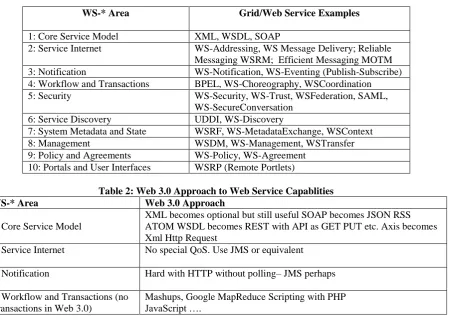
We summarize a comparison of Web 3.0 and Web Service approaches in tables 1 and 2. Table 1 classifies Web Service capabilities in ten areas using examples; this is taken from Refs [7] and [8], which have more details. Table 2 illustrates how these capabilities are supported in Web 3.0.
Table 1: Ten Web Service Areas with Examples
WS-* Area Grid/Web Service Examples
1: Core Service Model XML, WSDL, SOAP
2: Service Internet WS-Addressing, WS Message Delivery; Reliable Messaging WSRM; Efficient Messaging MOTM 3: Notification WS-Notification, WS-Eventing (Publish-Subscribe) 4: Workflow and Transactions BPEL, WS-Choreography, WSCoordination 5: Security WS-Security, WS-Trust, WSFederation, SAML,
WS-SecureConversation 6: Service Discovery UDDI, WS-Discovery
7: System Metadata and State WSRF, WS-MetadataExchange, WSContext
8: Management WSDM, WS-Management, WSTransfer
9: Policy and Agreements WS-Policy, WS-Agreement 10: Portals and User Interfaces WSRP (Remote Portlets)
Table 2: Web 3.0 Approach to Web Service Capablities
WS-* Area Web 3.0 Approach
1: Core Service Model
XML becomes optional but still useful SOAP becomes JSON RSS ATOM WSDL becomes REST with API as GET PUT etc. Axis becomes Xml Http Request
2: Service Internet No special QoS. Use JMS or equivalent
3: Notification Hard with HTTP without polling– JMS perhaps
4: Workflow and Transactions (no Transactions in Web 3.0)
52 5: Security SSL, HTTP Authentication/Authorization, OpenID is Web 3.0 Single
Sign on
6: Service Discovery http://www.programmableweb.com
7: System Metadata and State Processed by application – no system state – Microformats are a universal metadata approach
8: Management==Interaction WS-Transfer style Protocols GET PUT etc.
9: Policy and Agreements Service dependent. Processed by application
10: Portals and User Interfaces Start Pages, AJAX and Widgets(Netvibes) Gadgets
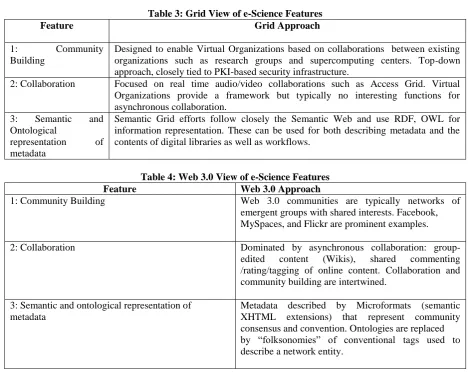
In addition to these distributed computing concepts, we contrast in Tables 3 and 4 Grids and Web 3.0 approaches to some core e-Science concepts.
Table 3: Grid View of e-Science Features
Feature Grid Approach
1: Community
Building
Designed to enable Virtual Organizations based on collaborations between existing organizations such as research groups and supercomputing centers. Top-down approach, closely tied to PKI-based security infrastructure.
2: Collaboration Focused on real time audio/video collaborations such as Access Grid. Virtual Organizations provide a framework but typically no interesting functions for asynchronous collaboration.
3: Semantic and Ontological
representation of metadata
Semantic Grid efforts follow closely the Semantic Web and use RDF, OWL for information representation. These can be used for both describing metadata and the contents of digital libraries as well as workflows.
Table 4: Web 3.0 View of e-Science Features
Feature Web 3.0 Approach
1: Community Building Web 3.0 communities are typically networks of emergent groups with shared interests. Facebook, MySpaces, and Flickr are prominent examples.
2: Collaboration Dominated by asynchronous collaboration: group-edited content (Wikis), shared commenting /rating/tagging of online content. Collaboration and community building are intertwined.
3: Semantic and ontological representation of metadata
Metadata described by Microformats (semantic XHTML extensions) that represent community consensus and convention. Ontologies are replaced by “folksonomies” of conventional tags used to describe a network entity.
III. TAGGING, SOCIAL BOOKMARKING, AND PROFILING After these general remarks, we now review social bookmarking as a Web 3.0 service exemplar.
A. Overview
53 metadata (remarks and catchphrases, or labels). Conspicuous illustrations incorporate delicious, Bibsonomy, and Connotea. Social bookmarking administrations show a center's few ideas of Web 3.0 administrations.
Labeling: clients give magic word labels that depict specific URLs that they bookmark. These labels ("web3.0" for instance) all in all give metadata about destinations. By embracing (with inciting from the administration) customary label names, online computerized substances can have "folksonomic" portrayals developed.
Seeking and Discovery: client supplied labels power viable decisive word looking in evident ways. All the more interestingly, then again, they likewise empower data push. Clients of the bookmarking administration can subscribe to label bolsters (ordinarily designed in RSS or Atom) keeping in mind the end goal to get overhauls on the most recent presents on a specific tag.
System Building: during the time spent label looking, it is ordinary that one discovers similarly invested bookmarkers who are especially proficient at finding intriguing locales. Social bookmarking destinations along these lines ordinarily bolster RSS memberships to labels from a specific individual or gathering of individuals. These can be open or shut systems.
Multiple User Interfaces: Web 3.0 services may be accessed in numerous ways. We describe this in detail below.
B. Multiple Access Interfaces for Web 3.0 Services
The key structural component of social bookmarking destinations (and Web 3.0 administrations when all is said in done) is that they bolster different types of collaboration. We by and large recognize the accompanying four such interfaces.
1. Web interfaces, got to by clients through Web programs, are obviously the most regular interface.
2. RSS/Atom news bolsters, as we have as of now specified, permit clients get new passages to specific labels pushed to them. Sustains are universal and effectively implanted in program "begin pages, for example, MyYahoo, iGoogle, and Netvibes, and in addition cell phones with constrained screen land.
3. Web programming interfaces, regularly created to bolster REST-style access (i.e., HTTP PUT and GET operations), permit engineers to work with bookmarking locales automatically utilizing their own interfaces. Ordinarily the administration is conjured by building URLs with predefined HTTP ask for parameters. The reaction message can be in XML (either RSS/Atom or the website's custom configuration), Javascript Object Notation (JSON), or any Web microformat. Cleanser is likewise conceivable yet by and by not broadly utilized. Security is taken care of commonly utilizing HTTP validation. Consequently it is conceivable to uses destinations like Connotea as a backend administration to one's own particular administration. This is the crucial idea that empowers composite destinations (concoction).
4. Web Badges and Gadgets: notwithstanding their principle Web locales, numerous Web 3.0 applications give exportable Javascript "identifications" and "devices" that clients can insert in other website pages, for example, Blogs and Start Pages. These may be like RSS channels yet give additionally arranging. For instance, delightful's exportable identification backings label cloud shows.
C. Last Remarks on Social Bookmarking and Tagging
Our center in this paper is on looking at the structural planning and use of social bookmarking, which is our examination range and is outlined with particular illustrations underneath. Then again, we finish up this segment with a couple of perceptions and comments on semantic issues. Tag-based folksonomies obviously still present crucial examination issues. They are clearly dialect subordinate and can (even in the same dialect) rely on upon setting. The examining so as to set issue can be settled partially the label space, which can be spoken to as an associated diagram with bunches (or clubs). A solitary label ("web") may be questionable yet extra labels ("insect" or "programming") give the important connection. We may anticipate that the interpretation issue will be around settled through label inner circle based connection also. By and large, we may think about these clubs in label space as giving something likened to the top-down ontologies utilized as a part of some Semantic Grid look into: the caBIG venture, for instance, gives entirely characterized ontologies to disease research
IV. TAG-BASED RESEARCHER MATCHMAKING AND THE CITEAM PORTAL
We now think of some as utilizations of Web 3.0 to exploratory examination. Framework advancements have normally centered around the issues of safely getting to remote registering and information assets yet have not tended to the issues of academic group building. Ordinarily, researchers exceed expectations at systems administration inside of their own casual coteries however therefore know more about examination occurring over the globe than down the lobby or in the following expanding on grounds.
54 custom destinations on top of this backend administration. Clients register for the entryway and give decisive word labels to portray themselves and their showing and research intrigues. This essential client profile is then supplemented persistently by the clients' association with the framework: a client's profile develops and turns out to be more graphic as he or she bookmarks and labels examination papers, demands for recommendations from subsidizing offices, valuable online course material, and other online expert assets. These labels can be looked and subscribed to by different clients of the administration. We utilize Connotea as a backend administration, since it has less prohibitive points of confinement of use on its Web programming interface than scrumptious.
One of the crevices in numerous social bookmarking administrations that we would like to address in this venture is client matchmaking. While it is conceivable to proactively recognize colleagues through label seeking, there is additionally esteem in having this data pushed to clients also, and the related calculations for deciding inner circle arrangement and bunch limits are exemplary software engineering issues. Our starting arrangement is to utilize basic labels to assist distinguish clients with covering hobbies. This data can then be pushed to clients, who can start extra contact. Identified with this is the "characterized notice" approach, in which financing opportunity declarations can be labeled particularly by clients why should looking join a proposition group.
At long last, we take note of the "interestingness" property utilized by Flickr has a relationship to matchmaking. Flickr allots an "interestingness" score to submitted photos. The subtle elements of the calculation are not distributed but rather the general idea is that a photograph's interestingness goes up in the event that it is put together by specific givers, on the off chance that it gets high quantities of snaps or remarks, if certain noticeable clients label it as a top pick, et cetera. We plan to investigate these thoughts for asset labeling furthermore as a motivator for clients to expand their notoriety inside of the framework.
V. SEMANTIC SCHOLAR RESEARCH GRID
The CTEAM entry and bookmarking administration accept that bookmarking has proficient and not just recreational quality. Research diary hunt devices, for example, Google Scholar and Microsoft Live Scholar give a few capacities to looking for exploration diaries to tag. On the other hand, we distinguish a few weaknesses:
• Journal hunt benefits right now have a poor hit rate. For instance, in casual tests, Google Scholar returned just around 20% of the Community Grids Lab's distributions. This mirrors our numerous gathering distributions not in Google Scholar.
• Services must be united and coordinated. We see the need to give a versatile construction modeling that can coordinate indexed lists from numerous current diary hunt benefits all the while.
• Search administrations must be supplemented by client commitments. We require systems for including the staying 80% of our lab's distributions to online hunt administrations.
• Search administrations ought to be full Web 3.0 style administrations, as we have characterized them in Section II. Clients ought to have different methods for acquiring data: through programs and automatically, and through both push and force systems. Papers need standard metadata portrayals and labels.
• Scientific diary articles advance after some time. Introductory drafts advance into submitted papers, which at last get to be acknowledged papers. Similarly, labels and annotations likewise develop and may be altered by various clients. Data may be both lost and picked up amid this advancement, so we require an approach to track forms and modifications.
• More advanced hierarchical models and get to control components are required. Draft papers and proposition, for instance, may be open to one's associates or to analysts, however not the overall population. This idea can be effectively reached out to experimental information.
Our exploration endeavors here are by and large called the Semantic Research Grid [10][11]. The framework building design is represented in Figure 1. As appeared and portrayed in the subtitle, this framework is expected to address the issues recorded previously.
One intriguing element of the framework is the utilization of occasions to track changes to archives and metadata, which on the whole shape an advanced substance. Occasions are time stamped elements that exemplify the progressions. Accordingly by replaying occasions, it is conceivable to reproduce the advanced element anytime in its development. Since changes to an advanced substance can originate from various sources, it is conceivable that conflicting or vague operations can happen. For instance, a common substance may have an annotation field erased by one client while another client is altering the same field. Time stamped occasions can along these lines be utilized to accommodate the framework state. One additionally needs to manage the covering however diverse metadata recorded by the distinctive labeling administrations. We take note of that we are making broad utilization of Microformats to determine the host of "little" and frequently impromptu metadata.
55 CONCLUSIONS AND FUTURE WORK
This paper has exhibited a correlation and investigation of Web Service and Web 3.0 gauges. We presume that Web 3.0, albeit not planned by guidelines making bodies, is by and by tending to large portions of the same center appropriated ideas (the "Expansive Grid") as Web Services and e-Science exercises. Online social bookmarking and labeling administrations serve as the least difficult outline of a Web 3.0 administration. We analyzed some of our engineering endeavors to expand upon these administrations. Web 3.0 trades refinement for effortlessness and spotlights on common sense as opposed to fulfillment, which has brought about versatility of both utilization and advancement. Online group administrations, for example, MySpaces and Facebook tout a huge number of clients, significantly more than any e-Science virtual association. It is unquestionably conceivable to give counter samples to Web 3.0 methodologies. Security is a conspicuous weakness from the perspective of numerous examination gatherings and processing focuses. We in this way advocate a mixture approach for e-Science. Web 3.0 style interfaces speak to a vital effort open door for making exploratory results and data accessible to people in general. Investigative concoction made out of Web 3.0 administrations ought to be an essential approach to include school youngsters, teachers, and lovers in logical tries. Then again, it is not likely that Web 3.0 will supplant more convoluted conveyed processing foundation required by (for instance) circulated trial information investigation. Web 3.0 for this situation speaks to a "cell film" interface, a straightforward, controlled correspondence medium with the outside environment. Inside of the layer, more muddled frameworks may be required. Deciding the limit between Web 3.0 and more conventional Grid approaches in this half and half conveyed figuring world is our next test.
REFERENCES
[1] I. Foster and C. Kesselman, The Grid: Blueprint for a New Computing Infrastructure, 1st Edition, Morgan Kauffman, 1999.
[2] Henderson, A. J. G. Hey, N. W. Paton, S. Newhouse, S. Parastatidis, A. E. Trefethen, P. Watson, J. Webber: “Web Service Grids: an evolutionary approach.” Concurrency - Practice and Experience 17(2-4): 377-389 (2005) [3] Geoffrey Fox Grids Challenged by a Web 3.0 and Multicore Sandwich CCGrid 2007 Conference Rio de Janeiro
Brazil May 15 2007 http://grids.ucs.indiana.edu/ptliupages/presentations/C CGridMay15-07.ppt [4] Open Grid Forum http://www.ogf.org
[5] ProgrammableWeb Web Site http://www.programmableweb.com/
[6] Carole Goble myExperiment OGF19 workshop January 29 2007
http://www.semanticgrid.org/OGF/ogf19/OGF19Goble.ppt
[7] Geoffrey Fox, Alex Ho, Shrideep Pallickara, Marlon Pierce, Wenjun Wu Grids for the GiG and Real Time Simulations Proceedings of Ninth IEEE International Symposium DS-RT 2005 on Distributed Simulation and Real Time Applications, pages 129-138 IEEE Computer Society, Montreal October 10-12 2005
56 [8] Geoffrey Fox, Alex Ho, Marlon Pierce Appendix on Grid and Web Services Technical Report October 2005
http://grids.ucs.indiana.edu/ptliupages/publications/gig/DODGridOpportunitiesAppendix.pdf.
[9] Minority Serving Institution Cyberinfrastructure Empowerment Coalition (MSI-CIEC) Project Site:
http://www.msiciec. org/eduwiki/index.php/Main_Page.
[10]Ahmet E. Topcu , Ahmet Fatih Mustacoglu, Geoffrey Fox , Aurel Cami Integration of Collaborative Information Systems in Web 3.0 Technical report June 27 2007. Available from http://grids.ucs.indiana.edu/ptliupages/publications/Integration_SKG2007Paper.pdf.
[11]A. F. Mustacoglu, A. E. Topcu , A. Cami, G. Fox, “A Novel Event-Based Consistency Model for Supporting Collaborative Cyberinfrastructure Based Scientific Research.” Proceedings of the 2007 International Symposium on Collaborative Technologies and Systems (CTS 2007).