Medical Journal of the Islamic Republic of Iran (MJIRI)
Med J Islam Repub Iran. 2019(18 Nov);33.123. https://doi.org/10.34171/mjiri.33.123
______________________________
Corresponding author: Dr Mona Ebrahimipour, [email protected]
1.Department of Speech and Language Pathology, University of Social Welfare and
Rehabilitation Sciences, Tehran, Iran
2. Department of Speech and Language Pathology, School of Rehabilitation Sciences,
Iran University of Medical Sciences, Tehran, Iran
3.Rehabilitation Research Center, Iran University of Medical Sciences, Tehran, Iran
↑What is “already known” in this topic:
Studies have demonstrated that preterm children have difficulty in language acquisition and these impairments may not be recovered during normal development.
→What this article adds:
Preterm children, regardless of their gestational age, are at risk of morphosyntax impairments.
Effect of preterm birth on morphosyntactic development
Marzie Faraji1, Mona Ebrahimipour*1, Nahid Jalilevand2,3
Received: 27 Apr 2017 Published: 18 Nov 2019
Abstract
Background: Preterm children are at risk of deficits in language, including grammatical skills. The main purpose of this survey was to investigate whether Persian-speaking children born preterm differ in their morphosyntax ability compared to full-term children. Methods: Morphosyntactic performance was assessed in 86 Persian-speaking children (43 healthy preterm and 43 full-term children) aged 4 and 5 years using the Persian Developing Sentence Scoring (PDSS). Participants were matched for age, gender, and gestational age.
Results: The healthy preterm children who participated in this study were significantly outperformed by the full-term children in the morphosyntactic evaluation (p<0.05). Furthermore, their grammatical skills, based on PDSS, were not as developed as 4 to 5-year-old full-term children. Gender, in general, and gestational age had no effect on the PDSS scores of preterm children (p>0.05).
Conclusion: Preterm children, regardless of gestational age, are at risk of morphosyntax impairments, which may not be recovered during the normal development. Therefore, grammatical evaluation and treatment seem to be necessary for these children.
Keywords: Preterm children, Morphosyntax ability, NICU, PDSS, Language delay, Syntax
Conflicts of Interest: None declared Funding: None
*This work has been published underCC BY-NC-SA 1.0 license. Copyright© Iran University of Medical Sciences
Cite this article as:Faraji M, Ebrahimipour M, Jalilevand N. Effect of preterm birth on morphosyntactic development. Med J Islam Repub Iran. 2019 (18 Nov);33:123. https://doi.org/10.34171/mjiri.33.123
Introduction
Based on the World Health Organization definition (WHO), preterm is a baby born alive before 37 weeks of pregnancy are completed (1). According to guidelines of WHO, subdivisions of preterm birth include very preterm (births before 32 weeks of gestation), moderate preterm (births at 32 and 33 weeks of gestation), and late preterm (birth between 34 and 36 weeks of gestation) (2). Recent studies have revealed that every year an estimated 15 mil-lion babies are born preterm (3). The prevalence of pre-term birth in Iran and Tehran is 9.2% and 30.4%, respec-tively (4, 5). There is strong evidence for neuropsycholog-ic differences in the brain maturation of preterm children, as the central nervous sy stem in these children is imma-ture and has not developed normally (6). Also, preterm children have decreased cerebral volumes and smaller cortical surface area (7-10). Meta-analysis and review articles have documented that preterm children may face
language development delays from the first year of life into adulthood (11-13).
Many studies have demonstrated that preterm children have difficulties in lexicon acquisition, word use, verb acquisition, syntax and morphology, reading, writing, spelling, and phonological processing (14-16). A longitu-dinal study on the development of lexicon and grammar in preterm children indicated that their problems would not be resolved by passing the time until adulthood (17). However, there is contradictory evidence regarding the language difficulties of preterm children (11, 18). This may be because language functions were examined in the early years of development in most studies, while ad-vanced forms of language, including morphology and syn-tax, emerge after the age of 3 (19). Considering the fact that even the mildest language impairment in childhood may affect the quality of communication and education
Morphosyntactic performance in preterms
http://mjiri.iums.ac.ir
2
achievement, early detection and intervention appear to be vital (20, 21). Furthermore, the prevalence of preterm birth is relatively high in Iran, and there are no studies on grammatical development in Persian-speaking preterm children living in Iran. As a result, the main purpose of this study was to examine the morphosyntactic develop-ment in Persian-speaking preterm children aged 4-5 years as assessed by the Persian Developmental Sentence Score tool (PDSS), adapted by Jalilevand et al (22).
Methods
A total of 86 Persian-speaking children aged 4-5 years participated in this cross sectional and comparative study in 2017. The sample included 43 healthy preterm children who were born before 37 weeks of gestation and 43 matched control group born full-term. The preterm chil-dren were a convenience sample recruited from a popula-tion of children discharged from the Neonatal Intensive Care Unit (NICU) at Firoozgar hospital in Tehran, Iran. The healthy control group, who were recruited from local kindergartens in Tehran, Iran were individually matched for age and gender with preterm children.
To exclude all children with developmental delays from this investigation, the parents were asked to complete the Age and Stage Questionnaire (ASQ-II). The questionnaire examines children's skills in communication, fine and gross motor, personal and social skills, and problem-solving. Total ASQ scores of children were compared to the cutoff score of this questionnaire (4 years: 42.5/ 38.1/ 32.4/ 31.4/ 39.6 -5 years: 45.7/ 43.1/ 29.5/ 35.1/ 42.9). Thus, children with scores below the normal range were excluded from this study (23). The preterm children could participate in the study if they met 3 criteria: (a) their ASQ scores were within the normal range; (b) gestational age <37 weeks; (c) and no indication of major cerebral dam-age, congenital malformations, and visual and/or auditory impairment. The criteria to select the full-term children were (a) ASQ scores within the normal range, (b) gesta-tional age ≥ 37 weeks, (c) and no illnesses affecting the central nervous system, such as visual and/or auditory impairment or symptoms of movement delay. Bilingual or multilingual children were excluded in both groups.
Background information and family history (gender, date of birth, general health, level of education of parents) were obtained during parents' interview. To evaluate the descriptive speech, 30 colorful pictures (20×25 cm), rep-resenting daily family activities with the mother, father, and children at home, a birthday party, a park, a doctor’s office, and the beach were used. Language sampling was conducted in a room with minimum noise and adequate light at a speech therapy clinic. Language samples of 15-25-minute conversations between children and the exam-iner were recorded using a digital voice recorder (SONY-PX240). The language samples, which included 100 utter-ances, were orthographically transcribed based on the transcription conventions (Persian Transcription Conven-tion Protocol: PTCP) considering the utterance (24).
The number of utterances was calculated based on the following rule: A pause longer than 2 seconds or a nal intonation rising are considered as a symbol of
termi-nation of an utterance. The Persian Developmental Sen-tence Scoring (PDSS) is a numerical measurement as-sessing the morphosyntactic abilities in 2.5- to 5.5-year-old children (validity: 0.97, reliability: 0.86) (22).
This tool was developed based on the Persian morpho-syntactic developmental hierarchy, including 8 grammati-cal categories: pronouns, question words, prepositions and conjunctions, verb morphology, modal and compound verbs, and grammatical morphemes, sentence types, and sentence structures. Each utterance in the speech samples was checked for the grammatical items listed in the PDSS table and, then, the sum of the scores of the 100 utterances was divided by 100 to determine the PDSS scores in this study (22).
Statistical analysis was performed using SPSS-22, and significance level was set at 0.05. The mean and standard deviation were calculated for each participant for age, gestational age (GA), and PDSS. Kolmogorov-Smirnov test was conducted, indicating that the data were normally distributed and, therefore, parametric testing was done. Mann-Whitney U test was run for variables not normally distributed, including question words, sentence type, and communication part of the ASQ-II in the preterm group, and sentence type and communication part of the ASQ-II in the full-term group. One-way ANOVA was conducted to compare the effect of gestational age levels as an inde-pendent variable and the total score of PDSS as a depend-ent variable. Preterm children were divided into 3 gesta-tional age levels: very preterm (births before 32 weeks of gestation), moderate preterm (births at 32 and 33 weeks of gestation), and late preterm (birth between 34 and 36 weeks of gestation). Independent-sample t test was per-formed to examine the correlation between the total score of the PDSS with gender.
Results
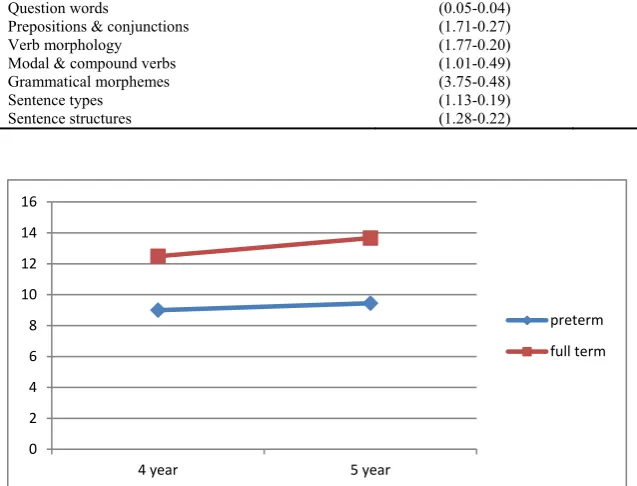
Descriptive information on the demographic features and PDSS scores of preterm children relative to full-term children is presented in Table 1. The first aim of this sur-vey was to investigate whether the preterm children showed delays in morphosyntax ability. Comparing the total scores of PDSS in preterm and full-term children with all grammatical subcategories, it was revealed that the preterm children had significantly lower scores than full-term children. Secondly, the effect of gestational age on the total PDSS scores was analyzed using the ANOVA test, indicating that there was no significant relationship between gestational age on the total PDSS scores (F=0.989, p=0.381). Thirdly, the correlations between genders on the total score of PDSS was determined. The results indicated no significant difference between girls and boys in the total score of PDSS (p>0.05) (Tables 1 & 2).
The stability of morphosyntactic impairments at ages 4 to 5 was examined, showing that these impairments were not resolved during development. The mean development total score of PDSS was 1.18 in full-term children and 0.45 in preterm children (Fig. 1).
Discussion
The main purpose of this study was to examine morpho-syntactic performance in 4-5-year-old preterm children born in Iran. According to the results, the Persian-speaking preterm children were outperformed by the con-trol group on all of the Persian DSS (PDSS) subscores as well as the total score. However, there are some studies with the opposite results (25-28). These contradictory re-sults might be due to language abilities being assessed in early years of development in most studies, while morpholosyntax abilities, as an advanced form of lan-guage, emerge after the age of 3 (19). Our findings are consistent with numerous surveys supporting the negative effect of early birth on language development, specifically grammatical development (29-38). One possible reason for these problems could be found in the neural and func-tional plasticity of the brain. The presence of language impairments, particularly complex language functions,
could be an indication for limitation of the plasticity of the developing brain born early and immature (13). Further-more, based on the Schafer et al findings, the left frontal and bilateral temporal white matter volumes are consider-ably decreased in preterm children and neural pathways develop differently in these children. In addition, cortex development and establishment of neuronal connections mainly occur after 25 weeks of gestation (6, 39). These differences may illustrate possible reasons for morphosyn-tactic difficulties in healthy preterms.
Two samples of preterm and full-term participants are as follow:
A 5-year-old preterm boy: /in mâšine/ = This is a car. A 5-year-old full-term boy: /bâbâ dâre bâ âčâr mâšinešo dorost mikone ke bere sare kâr/ = The father is fixing his car by a wrench to be able to go to work.
As illustrated in this example, the preterm boy predomi-nantly produced a shorter and less complicated utterance (one-verb sentence); however, the full-term boy produced Table 1.Demographic features of participants and PDSS scores
PT (N=43), FT (N=43)
PDSS
PT (M,SD) FT (M,SD) P Gender
Girl 46.5% N=20 N= 20 (9.24, 0.03) (13.31, 0.44) <0.0001 Boy 53.5% N=23 N= 23 (9.21, 0.03) (12.86, 0.44) <0.0001 Age (year)
4 50% N=21 N=22 (9.00, 0.891) (12.499, 1.431) <0.0001 5 50% N=22 N=21 (9.451, 1.038) (13.672, 1.704) <0.0001 GA group (week)
FT (>36) N=43 PT (<37) N=43
50% 50%
(13.072, 1.661) (9.231, 0.984) < 0.0001
LPT (34-36) N=4, 9.3% (9.51, 0.88) 0.381
MPT (32-33) N=14, 32.6% (9.47, 1.06)
VPT (<32) N=25, 58.1% (9.05, 0.951)
Late Preterm (LPT), Moderate Preterm (MPT), Very Preterm (VPT), Gestational Age (GA), Preterm (PT), Full-term (FT)
Table 2.Comparisons of grammatical subcategories scores for Full-term and Preterm groups
Grammatical subcategories Full-term (M-SD) Preterm (M-SD)
Pronouns Question words
Prepositions & conjunctions Verb morphology Modal & compound verbs Grammatical morphemes Sentence types Sentence structures
(1.33-0.35) (0.05-0.04) (1.71-0.27) (1.77-0.20) (1.01-0.49) (3.75-0.48) (1.13-0.19) (1.28-0.22)
(0.78-0.15) (0.01-0.01) (1.15-0.37) (1.42-0.18) (0.36-0.08) (2.29-0.52) (1-0.01) (1.09-0.05)
Fig. 1.Comparisons of morphosytax abilities from 4 to 5 years for preterm and full-term groups
0 2 4 6 8 10 12 14 16
4 year 5 year
preterm
full term
Morphosyntactic performance in preterms
http://mjiri.iums.ac.ir
4
more embedded clauses (two-verb sentence) at the age of 5.
Moreover, the relationship between the gestational age and the total score was examined, indicating no significant correlation between these 2 variables. Inconsistent with this finding, other surveys found a positive relationship between GA and language performance. Putnick et al sug-gested that very preterm children had poorer language performance than term-born and moderate-preterm chil-dren (37). Kern et al concluded that if the extremely term group were excluded from all preterm children, pre-term children do not fundamentally differ from full-pre-terms in their measures (40). One possible explanation is the focus on very preterm and moderate preterm groups and ignoring the late preterm children in many surveys. Cortex volume of a late preterm infant is 53% of that of a full-term infant, which means the last 6 weeks of gestation is very important for maturity of the brain (41-43), so the contradictory results of this study may be due to compar-ing 3 groups of preterm children. However, these results indicated that all preterm children, regardless of their ges-tational age, should be evaluated by a speech-language pathologist specialized in developmental language im-pairments.
The effect of gender on the morphosyntactic abilities of the participants was also analyzed. Although the PDSS total scores of girls were higher than boys in both groups of preterm and full-term children, this difference was not significant. However, girls were reported to have more advanced language abilities than boys in only 1 study (26).
An interesting by-product of our results was that there was no positive grammatical developmentin preterm chil-dren, while full-term children develop these skills increas-ingly from 4 to 5 years. Language impairment stability, also proposed by some studies, especially in very preterm children, is probably the result of general cognitive diffi-culties (37, 42,44). Some studies have indicated that pre-term children, similar to full-pre-term children, demonstrate a general increase in language development (11, 18, 19, 28). However, the rate of development is slower in preterm children because of their limited brain plasticity. It ap-pears that our findings have important theoretical and clin-ical implications and provide some new insights into the characteristics of morphosyntax development in preterm children. Therefore, it can be concluded that early detec-tion and intervendetec-tion of morphosyntactic difficulty in pre-term children is vital since they are not likely to be recov-ered during development.
This study had some limitations. First, only those pre-term children whose parents accepted to take part in the study were selected, and these parents might have had some prior concerns about their children’s language de-velopment. Second, this study was conducted only in 1 hospital in Tehran, Iran. Thus, the generalizability of the results was limited to preterm and term children born un-der similar conditions, which may present some selection bias.
Conclusion
In summary, this study suggested that morphosyntax performance was significantly lower in healthy preterms than in their full-term peers. Also, it was shown that all preterm children, regardless of their gestational age, should be assessed by a speech-language pathologist spe-cialized in developmental language impairments and re-ceive appropriate treatment for their morphosyntax defi-cits. In addition, it was found that the development of morphosyntax skill becomes stable in preterm children at ages 4 to 5.
Acknowledgments
First, I would like to thank children and parents for their participation in this research. Also, I must express my very profound gratitude to my family for providing me with unfailing support and continuous encouragement throughout my years of study and through the process of research and writing this thesis.
Conflict of Interests
The authors declare that they have no competing interests.
References
1. Kliegman RMMD, Behrman RE, Jenson HB, Stanton BF. Nelson Textbook of Pediatrics e-dition, 18th Ed Atlas of Pediatric Physical Diagnosis, 5th Ed. W B Saunders Co; 2007.
2. Miles J, Shevlin M. A time and a place for incremental fit indices. Pers Individ Dif. 2007;42:869-74.
3. Beck S, Wojdyla D, Say L, Bertran AP, Meraldi M, Requejo JH, et al. The worldwide incidence of preterm birth: a systematic review of ma-ternal mortality and morbidity. Bull World Health Organ 2010Jan;88(1):31–8.
4. Vakilian K, Ranjbaran M, Khorsandi M, Sharafkhani N, Khodadost M. Prevalence of preterm labor in Iran: A systematic review and meta-analysis. Int J Reprod Biomed (Yazd). 2015;13(12):743-748. 5. Amini L, Mahmoudi Z, Hosseini F, Mahmoudi A. The relationship
between the social structure and health and pregnancy outcomes: pre-term labor and rupture of water bag. J Sabzevar Uni Med Sci. 2013;20:109-16.
6. Karmiloff-Smith A. Nativism versus neuroconstructivism: Rethinking the study of developmental disorders. Dev Psychol. 2009;45(1):56–63. 7. Ajayi-Obe M, Saeed N, Cowan F, Rutherford M, Edwards A. Reduced development of cerebral cortex in extremely preterm infants. Lancet. 2000;356(9236):1162–3.
8. Counsell SJ. Magnetic resonance imaging of preterm brain injury. Archives of Disease in Childhood - Fetal and Neonatal Edition. 2003Jan;88(4).
9. Limperopoulos C. Late Gestation Cerebellar Growth Is Rapid and Impeded by Premature Birth. Pediatrics. 2005Jan;115(3):688–95. 10. Peterson BS, Vohr B, Staib LH, Cannistraci CJ, Dolberg A,
Schnei-der KC, et al. Regional brain volume abnormalities and long-term cognitive outcome in preterm infants. Jama-J Am Med Assoc. 2000;284:1939-47.
11. Barre N, Morgan A, Doyle LW, Anderson PJ. Language abilities in children who were very preterm and/or very low birth weight: a meta-analysis. J Pediatr. 2011;158:766–74.
12. Sansavini A, Guarini A, Caselli MC. Preterm Birth: Neuropsycho-logical Profiles and Atypical Developmental Pathways. Dev Disabil
Res Rev. 2011;17(2):102–13.
13. Noort-Van Der Spek, Franken M-CJP, Weisglas-Kuperus N. Lan-guage Functions in Preterm-Born Children: A Systematic Review and Meta-analysis. Pediatrics. 2012;129(4):745–54.
14. Saigal S, Doyle LW. An overview of mortality and sequelae of preterm birth from infancy to adulthood. Lancet. 2008;371(9608):261– 9.
15. Pritchard VE, Clark CA, Liberty K, Champion PR, Wilson K,
Woodward LJ. Early school-based learning difficulties in children born very preterm. Early Hum. Dev. 2009;85(4):215–24.
16. Aarnoudse-Moens CS, Weisglas-Kuperus N, van Goudoever JB, Oosterlaan J. Meta-analysis of neurobehavioral outcomes in very pre-term and⁄ or very low birth weight children. Pediatrics. 2009; 124:717– 28.
17. Guarini A, Sansavini A, Fabbri C, Savini S, Alessandroni R, Faldella G, et al. Long-term effects of preterm birth on language and literacy at eight years. J Child Lang. 2010; 37: 865–85.
18. Guarini A, Marini A, Savini S, Alessandroni R, Faldella G, Sansavini A. Linguistic features in children born very preterm at preschool age.
Dev Med Child Neurol 2016Jul;58(9):949–56.
19. Bates E, Bretherton I, Snyder L. From First Words to Grammar: Individual Differences and Dissociable Mechanisms. Cambridge: Cambridge University Press, 1988.
20. Hart B, Risley TR. Meaningful Differences in the Everyday Experi-ence of Young American Children. Baltimore, MD: Paul H. Brookes; 1995.
21. Johnson S, Hennessy EM, Smith RM, Trikic R, Wolke D, Marlow N. Academic attainment and special educational needs in extremely pre-term children at 11 years of age: The EPICure Study. Arch Dis Child Fetal Neonatal Ed. 2009;94:283–9.
22. Jalilevand N, Kamali M, Modarresi Y, Kazemi Y. The Persian de-velopmental sentence scoring as a clinical measureof morphosyntax in children. Med J Islam Repub Iran. 2016;30:435.
23. Vameghi R, Sajedi F, Mojembari AK, Habibollahi A, Lornezhad HR, Delavar B. Crosscultural adaptation, validation and standardization of Ages and Stages Questionnaire (ASQ) in Iranian Children. Iran J
Pub-lic Health. 2013;42(5):522–8.
24. Kazemi Y, Klee T, Stringer H. Diagnostic accuracy of language sample measures with Persian-speaking preschool children. Clin
Lin-guist Phonet. 2015;29(4):304–18.
25. Leroux S, Malcuit G, Pomerleau A. Étude comparative de nourrissons prématurés et nés à terme et des modes de stimulations qu’ils expérimentent au cours des six premiers mois. Can J Beh Sci.
1999;31:40–53.
26. Deltour JJ. Les problèmes de langage chez les prématurés. Paper presented at ULG Psychométrie et orientation scolaire, Chartres 1999. 27. Hediger ML, Overpeck, MD, Ruan WJ, Troendle JF. Birth weight
and gestational age effects on motor and social development. Paediatr
Perinat Epidemiol. 2002;16:33–46.
28. Lequin P, Delfosse MJ, Zaoui C, Duquennoy C, Vasseur C. Langage et prématurité. Étude à deux ans d’une population d’enfants nés pré-maturément à faible risque. Med Enfant. 1987;7:377–80.
29. Landry SH, Smith KE, Swank PR. Environmental effects on lan-guage development in normal and high-risk child populations. Semin Pediatr Neurol. 2002;9(3):192–200.
30. Normand M-TCACAL, Cohen H. The delayed emergence of lexical morphology in preterm children: the case of verbs. J Neurolinguis.
1999;12(3-4):235–46.
31. Woodward LJ, Moor S, Hood KM, Champion PR, Foster-Cohen S, Inder TE, et al. Very preterm children show impairments across multi-ple neurodevelopmental domains by age 4 years. ADC Fetal Neonatal. 2009;94(5):339–44.
32. Aram DM, Eisele JA. Plasticity and recovery of higher cognitive functions following early brain injury in Boller F, Grafman J. editors. Handbook of neuropsychology. Vol 6: Child neuropsychology. 1992; 73-114.
33. Hack M, Breslau N, Aram D, Weissman B, Klein N, Borowski-Clark E. The effect of very low birth weight and social risk on neurocogni-tive abilities at school-age J Dev Behav Pediatr. 1992;13: 412-20. 34. Korkman M, NEPSY- a proposed neuropsychological test battery for
young developmentally disabled children. Theory and evaluation. University of Helsinki, Helsinki, Finland. 1988.
35. Jansson-Verkasalo E, Valkama M, Vainionpaa L, Paakko E, Ilkko E, Lehtihalmes M. Language development in very low birthweight pre-term children: a follow up study. Folia Phoniatr Logop. 2004; 56:108– 19.
36. Sansavini A, Guarini A, Savini S, Alessandroni R, Faldella G. Rela-tions between phonological short-term memory and language at 3½ and 6 years in typically developing and preterm children. In N. B. Jo-hansen (ed.s). 2008; 241–65.
37. Putnick D, Bornstein M, Eryigit-Madzwamuse S, Wolke D. Long-Term Stability of Language Performance in Very Preterm, Moderate-Late Preterm, and Term Children. J Pediatr. 2017;09–006.
38. Susan H, Myron D, Patrica R, Lianne J. High Prevalence/Low Sever-ity Language Delay in Preschool Children Born Very Preterm. J Dev Behav Pediatr. 2010;31:658–67.
39. Schafer RJ, Lacadie C, Vohr B, Laura R. Alterations in functional connectivity for language in prematurely born adolescents. Brain. 2009;132:661–70.
40. Kern S, Gayraud F. Influence of preterm birth on early lexical and grammatical acquisition. First Lang. 2007;27:159.
41. Sansavini A, Guarini A, Alessandroni R, Faldella G, Giovanelli G, Salvioli G. Early relations between lexical and grammatical develop-ment in very immature Italian preterms. J Child Lang. 2006;33:199– 216
42. Ing, L. van Noort-van der Spek IL, Franken MC, Weisglas-Kuperus N. Languagefunctions in preterm-born children: a systematic review and meta-analysis.Pediatrics. 2012;129:745e54
43. Sansavini A, Guarini A, Fabbri C, Alessandroni R, Faldella G, Karmiloff-Smith A. Reconsidering the impact of preterm birth on lan-guage out come. Early Hum Dev. 2009;85:639–45.
44. Hu¨ppi PS, Schuknecht B, Boesch C, Bossi E, Felblinger J, Fusch C, et al. Structural and neurobehavioral delay in postnatal brain develop-ment of preterm infants. Pediatr Res. 1996;39:895–901.