Iranian Chemical Society
Anal. Bioanal. Chem. Res., Vol. 7, No. 2, 237-250, June 2020.
Optimization of Trace Metal Ion Binding Properties of a Novel Schiff Base Using
Response Surface Methodology
Felix Sunday Nworie* and Chinedu Nwali
Department of Industrial Chemistry, Ebonyi State University, Abakaliki, Nigeria (Received 27 July 2019 Accepted 28 November 2019)
In this study, solvent extraction technique combined with response surface methodology (RSM) applying Box-Behnken design was
applied to study the uptake of metal ions from aqueous solutions using bis(2,2I-methylylidenephenol)diaminoethane (H2BMPDE). The
extractions were monitored based on the process variables of time, temperature and concentration of hydrochloric acid, metal ions and
H2BMPDE. The extraction efficiencies of metal ions by H2BMPDE optimized using RSM models indicated the estimated extraction percentage of ˃99%. The predicted and experimental values under the same conditions showed less than 5% difference thereby making the
Box-Behnken design approach an efficient, effective and reliable method for the uptake of metal ions from aqueous solution with H2BMPDE by solvent extraction technique. The novel Schiff base (H2BMPDE) synthesized was characterized using common physicochemical techniques of UV-Vis, FT-IR, elemental analysis, GC-MS and NMR spectral data. The result obtained indicated that the
process could be applied in the removal of metal ions from environmental samples such as soil, industrial waste water and acid mine sites.
Keywords: Metal ions, Schiff base, RSM, Solvent extraction
INTRODUCTION
A Schiff base is a condensation product of aldehyde or ketone with an amine; Schiff bases are known to contain imine or azomethine (-C=N-) functional group. Many scientists are interested in research activities on this area because they can be tailored due to their structural flexibility and variability [1-3]. Bis(2,2I -methylylidene-phenol)diaminoethane (H2BMPDE), a Schiff base derived
from the condensation of primary amine(ethane-1,2-diamine) and a ketone (2-hydroxybenzaldehyde), is of much research interest due to the structural variability, flexibility, modification of substituent, ease of synthesis and myriads of applications [4]. The ligand is a chelating tetradentate molecule with N2O2 donor properties observed in several
studies to make metals in various oxidation states to achieve stability [5]. The reaction between H2BMPDE and a metal
*Corresponding author. E-mail: [email protected]
cation affords the formation of H2BMPDE-metal complex
usually coloured and are known to be important as models in many biological processes, in catalysis, in heavy metal removal, as photochromic and thermochromic agent, as antimicrobial agent and in the textile industries [3].
which predicts responses among variables through optimization of analytical technique, is applied [8-15]. Box- Behnken design (BBD) is more efficient and economical than other corresponding Central composite (CCD) and Doehlert designs and this informed the reason for its use in the optimization process.
Most optimization processes in chemistry using RSM
focused on extraction of valuable materials from plant sources not until recently when Zhang and Liu [16]
and Bilgin et al., [3] applied the RSM in optimizing process conditions for the synthesis of iron-polysaccharide complex and N,NI,NII,NIII-tetrasalicylidene-3,3I,4,4I -tetraaminodiphenyl ether, respectively. From available literature, there is no research so far on the optimization and metal ion binding properties of H2BMPDE Schiff base.
Interestingly, efforts to develop an improved high affinity modified by de novo design or re-modification of existing scaffold metal ion binding organic materials is at the forefront of research [17]. Consequently, binding sites of this kind affords opportunity for developing novel catalytic species, regulating biological processes, stabilizing metal ions and developing biosensors for trace metal ion determination [17].
In this study, H2BMPDE was synthesized by the
condensation of ethane-1,2-diamine and 2-hydroxy-benzaldehyde and characterized by elemental analysis, gas chromatography-mass spectrometry(GC-MS), Fourier transform infrared spectrophotometry(FT-IR), UV-Vis spectra and NMR data. The trace metal binding capacity of the Schiff base was studied in relation to the variables of time of extraction, temperature, metal ion, acid and H2BMPDE concentrations with extraction solvent as
trichloromethane. The study involving response surface methodology approach is a predictive simulation optimization process for getting optimum amounts of species sought for when the stated conditions are satisfied. Existing solvent extraction processes focused mainly on the specie extracted, the conditions of extraction and the mechanisms for extraction. As an extension of the existing work, the combinations of factors and prediction of favorable conditions for combination as well as the optimum conditions for maximum yield of the sought product was the major thrust of this work These parameters are very important for industrial designs.
EXPERIMENTAL
Ethane-1,2-diamine and 2-hydroxybenzaldehyde were supplied by Merck chemicals. H2BMPDE as described
elsewhere was prepared by modified Takeshima procedure [18]. Other reagents (hydrochloric acid, trichloromethane, tetrachloromethane and ethanol) were commercially obtained and used as received. Melting point, equilibration and shaking, elemental analysis, GC-MS, UV-Vis, FT-IR and NMR spectra of H2BMPDE were executed with
electrothermal digital melting point apparatus (Labtech model AV1), rotary shaker (RF-12 Remi equipment), vario-elemental microcube ELIII, GC-MSQ2010 Plus (Shimadzu, Japan) coupled with gas chromatograph,UV-Vis spectrophotometer (model Genesis 10S), Perkin-Elmer FTIR-8400S Fourier transform infrared spectrophotometer in the range of 4000-400cm-1 in KBr pellets, Bruker Avance II 400 MHz spectrometers with CDCl3 as solvent and
tetramethylsilane as internal reference. Optimization of the process conditions was performed using design expert software version 8.0.7.1 (Stat-ease Inc., USA, 2011). Stock solutions of iron(II), iron(III), Mn(II) and Cr(III) were made by dissolving Fe2(SO4)3 (p.a),
Mn(CH3COO)2.4H2O (p.a), Cr (NO3)3. 9H2O (p.a) and
(NH4)2Fe(SO4)2.6H2O (p.a) with distilled deionized water.
Synthesis
of
Bis(2,2
I-methylylidenephenol)
diaminoethane
(
H
2BMPDE)
H2BMPDE was synthesized according to the literature
procedure by the modified Takeshima procedure [18]. Ethane-1,2-diamine and 2-hydroxybenzaldehyde were mixed in the mole ratio of 1:2 (Scheme 1) in a 500 cm3 beaker and heated in a mantle. The crude product obtained after stirring for five minutes was recrystallized twice from carbon tetrachloride and dried [18]. Analytical yield: 64.45%, Melting point = 127 ± 1°C, electronic spectrum (DMF, nm, ε = Mol-1 dm3 cm-1): 260 (ε = 3.0 102), 285 (ε = 3.6 102), 335 (ε = 4.7 102). Analytical calculated for C16H16N2O2: C, 71.64%; H, 5.97%;
N=C(H); 6.5-7.11 (4H, ArH); 3.5 (4H, =NCH2CH2N=). 13C NMR (CDCl
3, ɗ, ppm): 221.44 (bonded to phenolic
oxygen); 152.65 (aromatic carbons); 48.69 (methylene carbon): GC-MS (m/z): calculated for [M+1]+ 268; found [M+1]+ 268.
Metal Extraction Procedure
Solvent extraction technique was applied to examine the extraction of H2BMPDE-metal complexes from the aqueous
media to the organic trichloromethane phase. The
experiment was done by preparing aqueous solution of the metal-H2BMPDE which was previously extracted into the
trichloromethane layer with the aqueous phase containing the H2BMPDE dissolved in ethanol. Pretest examination
revealed the optimum conditions for the preparation and extraction to thehydrochloric acid concentration of 10-4 M, H2BMPDE concentration of (1%) 1.86 10-2 M,
initial metal ion concentration of 2 mg l-1 and temperature of 25 °C.The experiment was done by equilibrating and
shaking in a mechanical shaker at 300 rpm with equal volumes of the organic trichloromethane and aqueous phases (made up of metal solution, acid solution and H2BMPDE) in stoppered extraction bottles for 15 min at
30 °C. The solution containing the aqueous and organic components was transferred to a separatory funnel allowed standing and the aqueous phase separated from the organic components. The amount of metal ion left in the aqueous
phase was determined spectrophotometrically as described elsewhere [19] while the mass balance result indicated the quantity of metal ion extracted into the organic phase. The amount (n) and extraction percentage (E%) of the metal ions extracted into the organic phase is calculated as shown in Eqs. (1) and (2), respectively;
L m W W n ( 0 e)
(1)
e e W W W efficiency
Extraction (%)100 0 (2)
where Wo, We, m and L represents initial metal ion concentration (mg l-1), equilibrium metal ion concentration (mg l-1), volume of metal ion solutions (cm3), and mass of
H2BMPDE (g).
Response Surface Methodology
The response surface technique applying Box-behnken design matrix was applied to study the interaction and effects among the factors and their level of contributions and significance in the synthesis and extraction of metal complexes of H2BMPDE. This method determines the
needed best working conditions in a shorter time and detailed conditions of processes are provided. This was achieved through a designed experimental design applying Box-Behnken design of 46 steps of experiment consisting five factors and three levels. The experiment was performed in two replicates using 10 cm3 of H2BMPDE solution,
10 cm3 of metal ion solution and 5 cm3 of HCl solution. The Box-Behnken design (BBD) following the design expert software version 8.0.7.1 (Stat-ease Inc., USA, 2011) was used to evaluate the effect of time, temperature, ligand, acid and metal concentrations on the synthesis and extraction of metal H2BMPDE complexes.
RESULTS AND DISCUSSION
Characteristics of H
2BMPDE
H2BMPDE was recrystallized in carbon tetrachloride to
[M+1]+ of the ligand as 268. In the ligand H2BMPDE, the
unavailability of amine proton signals is a confirmation of the condensation of the precursor compounds, ethane-1,2-diamine and 2-hydroxybenzaldehyde [3]. The ultraviolet visible spectra of H2BMPDE indicated absorptions at 260,
285 and 335 nm representing π → π*, n → π* and charge transfer transitions of the phenyl or imine ring, non-bonding electrons in the nitrogen and intraligand charge transfer transitions, respectively [20-21]. FT-IR of H2BMPDE
illustrated phenolic hydroxyl group with broad peak at 3401 cm-1 and C=N stretching frequency at 1615 cm-1 a confirmation that the ligand was actually made [3,22]. Absorption band at 1285 cm-1 was assigned to phenol C-O group and characteristic band assignable to C=O and NH2
present in the precursor compounds disappeared further, establishing that the ligand was actually synthesized [3,23-25]. The symmetrical nature of H2BMPDE was shown by
methyne proton, observed as a doublet at 3.5 ppm and azomethine proton as a quartet at 7.4 ppm [21]. The hydrogen of aromatic ring appeared at 7.11 ppm. The
13C NMR spectrum of H
2BMPDE shows phenolic carbon
atom at 221.44 ppm, aromatic carbons at 152.65 ppm and methylene carbon at 48.69 ppm.
Optimization Process
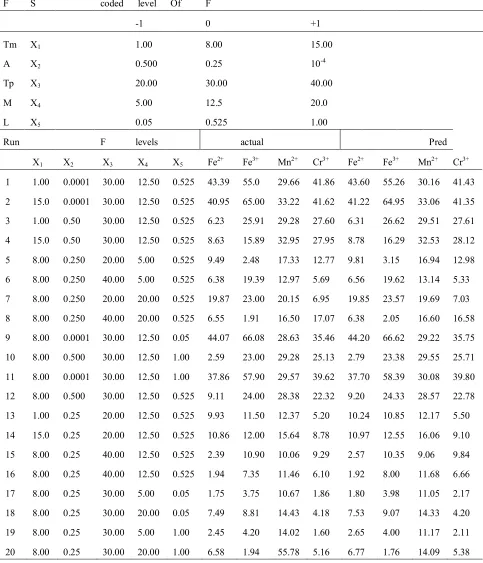
Solvent extraction technique where the mean results for 46 experiments providing different process conditions combination are illustrated in Table 1. Randomization of the process conditions order was done to avoid errors that may arise in the system. The experimental design showing the factor effects in relation with the response variables were evaluated using mathematical models showing their relevance and contributions to the entire process. Analysis of variance (ANOVA) was applied in the results of analysis and evaluation at 95% confidence level and is germane in process development and optimization of process conditions in analytical processes.
In ANOVA (Table 2), most of the main factors and combined interaction factors have p-values less than 0.05 indicating their significance at 95% confidence level. This means that they contribute to the model and are necessary for the formation and extraction of the compound whereas others with p-values greater than 0.05 are statistically insignificant, with no contribution, and should be excluded
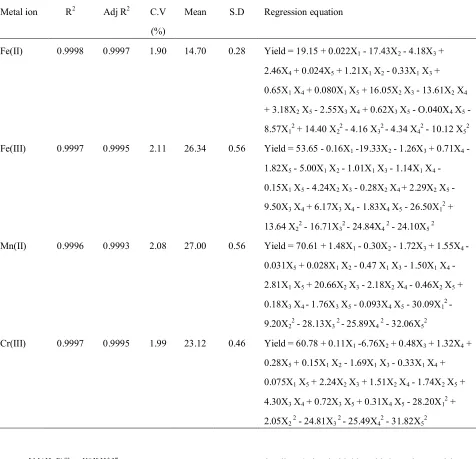
from the model. The F-value, a measure of the model significance, was high for all the interactions illustrating the significance. The most significant factor, as shown by the high F-value, is acid concentration. High acid concentration impedes complexation as the ligand is degraded or metal complex formed is demetallated [5]. Similarly, to access the relevance and significance of the models, any model with coefficient of determination (R2) above 90% is significant, excellent and shows goodness of fit. From Table 3, the R2 values, the standard deviation and coefficient of variation are presented. The R2 value for all the metal ions was over 99%. The precision and reliability of the experiment, tested using the coefficient of variation (C.V), indicated the relatively low values of 1.90, 2.11, 1.99 and 2.08% for Fe(II), Fe(III), Cr(III) and Mn(II), respectively, showing a better reliability and precision.
The complexation of the various metal ions as a function of initial metal ion concentration was investigated at 25 °C and acid concentration of 1.0 10-4 M. A monotonous increase was observed in metal ion uptake as concentration increased consequent upon the concentration gradient driving force. The metal uptake increased to a concentration point of 20 µg with ligand concentration of 1.0% for which above this, more ligand is unavailable to occupy the co-ordination sites and as such a decrease was obtained.
The RSM based on Box-Behnken design (BBD) optimization of process conditions for Fe(II), Fe(III), Mn(II) and Cr(III) optimum extraction percentage at initial metal ions concentration of 20 µg, ligand concentration of 1.0%, acid concentration of 1.0 10-4 M and temperature of 25°C was 81.75, 85.909, 70.612 and 69.615%, respectively. Higher uptake of Fe(II) and Fe(III) was observed for the Schiff base as a result of high complexing ability of the ligand H2BMPDE toward the metal cations [26-28]. The
presence of H+ is necessary for complexation and plays important role as without it there would be no complexation. At low concentration of acid (0.0001 M),
metal uptake was high, but at high concentration (0.1-0.01 M), complexation was hindered as the ligand was
Table 1. BBD Design Matrix and Experimental Results for Metal Ions-binding Properties of H2BMPDE
F S coded level Of F
-1 0 +1
Tm X1 1.00 8.00 15.00
A X2 0.500 0.25 10-4
Tp X3 20.00 30.00 40.00
M X4 5.00 12.5 20.0
L X5 0.05 0.525 1.00
Run F levels actual Pred
X1 X2 X3 X4 X5 Fe2+ Fe3+ Mn2+ Cr3+ Fe2+ Fe3+ Mn2+ Cr3+
1 1.00 0.0001 30.00 12.50 0.525 43.39 55.0 29.66 41.86 43.60 55.26 30.16 41.43
2 15.0 0.0001 30.00 12.50 0.525 40.95 65.00 33.22 41.62 41.22 64.95 33.06 41.35
3 1.00 0.50 30.00 12.50 0.525 6.23 25.91 29.28 27.60 6.31 26.62 29.51 27.61
4 15.0 0.50 30.00 12.50 0.525 8.63 15.89 32.95 27.95 8.78 16.29 32.53 28.12
5 8.00 0.250 20.00 5.00 0.525 9.49 2.48 17.33 12.77 9.81 3.15 16.94 12.98
6 8.00 0.250 40.00 5.00 0.525 6.38 19.39 12.97 5.69 6.56 19.62 13.14 5.33
7 8.00 0.250 20.00 20.00 0.525 19.87 23.00 20.15 6.95 19.85 23.57 19.69 7.03
8 8.00 0.250 40.00 20.00 0.525 6.55 1.91 16.50 17.07 6.38 2.05 16.60 16.58
9 8.00 0.0001 30.00 12.50 0.05 44.07 66.08 28.63 35.46 44.20 66.62 29.22 35.75
10 8.00 0.500 30.00 12.50 1.00 2.59 23.00 29.28 25.13 2.79 23.38 29.55 25.71
11 8.00 0.0001 30.00 12.50 1.00 37.86 57.90 29.57 39.62 37.70 58.39 30.08 39.80
12 8.00 0.500 30.00 12.50 0.525 9.11 24.00 28.38 22.32 9.20 24.33 28.57 22.78
13 1.00 0.25 20.00 12.50 0.525 9.93 11.50 12.37 5.20 10.24 10.85 12.17 5.50
14 15.0 0.25 20.00 12.50 0.525 10.86 12.00 15.64 8.78 10.97 12.55 16.06 9.10
15 8.00 0.25 40.00 12.50 0.525 2.39 10.90 10.06 9.29 2.57 10.35 9.06 9.84
16 8.00 0.25 40.00 12.50 0.525 1.94 7.35 11.46 6.10 1.92 8.00 11.68 6.66
17 8.00 0.25 30.00 5.00 0.05 1.75 3.75 10.67 1.86 1.80 3.98 11.05 2.17
18 8.00 0.25 30.00 20.00 0.05 7.49 8.81 14.43 4.18 7.53 9.07 14.33 4.20
19 8.00 0.25 30.00 5.00 1.00 2.45 4.20 14.02 1.60 2.65 4.00 11.17 2.11
Table 1. Continued
21 8.00 0.001 20.00 12.50 0.525 67.27 67.22 13.63 46.44 67.05 66.92 55.96 46.56
22 8.00 0.500 20.00 12.50 0.525 0.58 37.06 11.26 28.65 0.085 36.74 14.05 28.55
23 8.00 0.0001 40.00 12.50 0.525 26.50 73.16 51.75 42.99 26.59 72.88 11.19 43.03
24 8.00 0.500 40.00 12.50 0.525 24.01 26.04 9.61 34.16 23.82 25.74 51.90 33.98
25 1.00 0.25 30.00 5.00 0.525 4.66 0.37 15.53 4.99 4.41 0.62 10.09 5.33
26 15.0 0.25 30.00 5.00 0.525 3.76 3.00 15.63 6.11 3.14 2.57 16.05 6.19
27 1.00 0.25 30.00 20.00 0.525 7.82 3.81 15.67 8.55 8.03 4.32 16.20 8.63
28 15.0 0.25 30.00 20.00 0.525 9.53 1.89 15.58 8.36 9.38 1.72 16.15 8.19
29 8.00 0.25 30.00 12.50 0.05 9.61 22.70 10.24 4.45 9.65 22.09 10.42 4.12
30 8.00 0.25 30.00 12.50 0.05 0.04 7.53 10.43 3.56 0.048 7.23 10.50 3.63
31 8.00 0.25 20.00 12.50 1.00 8.50 6.00 14.03 3.83 8.46 6.11 13.88 3.24
32 8.00 0.25 40.00 12.50 1.00 1.41 15.51 7.16 5.82 1.34 15.93 6.91 5.63
33 1.00 0.25 30.00 12.50 0.05 0.88 5.02 4.89 0.95 0.50 4.87 4.20 0.44
34 15.0 0.25 30.00 12.50 0.05 0.27 5.22 13.47 0.93 0.38 4.86 12.78 0.51
35 1.00 0.25 30.00 12.50 1.00 0.73 1.92 10.21 1.20 0.38 1.54 9.76 0.86
36 15.0 0.25 30.00 12.50 1.00 0.44 1.50 7.55 1.48 0.59 0.91 7.10 1.22
37 8.00 0.0001 30.00 5.00 0.525 30.57 61.02 33.11 44.59 30.56 60.78 32.08 44.29
38 8.00 0.500 30.00 5.00 0.525 22.78 23.19 36.53 28.54 22.92 22.68 35.85 27.74
39 8.00 0.0001 30.00 20.00 0.525 62.83 63.18 40.07 43.54 62.71 62.75 39.54 43.92
40 8.00 0.500 30.00 20.00 0.525 0.59 24.24 34.77 33.54 0.62 23.55 34.59 33.41
41 8.00 0.250 30.00 12.50 0.525 19.09 53.73 70.55 60.90 0.62 53.65 70.61 60.78
42 8.00 0.250 30.00 12.50 0.525 19.00 54.00 71.00 61.00 19.15 53.65 70.61 60.78
43 8.00 0.250 30.00 12.50 0.525 19.50 53.00 70.00 60.20 19.15 53.65 70.61 60.78
44 8.00 0.250 30.00 12.50 0.525 19.08 53.71 71.56 60.70 19.15 53.65 70.61 60.78
45 8.00 0.250 30.00 12.50 0.525 19.10 53.73 71.00 60.70 19.15 53.65 70.61 60.78
46 8.00 0.250 30.00 12.50 0.525 19.10 53.70 70.55 61.00 19.15 53.65 70.61 60.78
uptake at high acid concentration could be attributed to the lower dissociation extent of the hydroxyl group with the protonation of the lone nitrogen pair on the imine molecule [28].
The extraction mechanism of the metal ions from aqueous acid solutions using the tetradentate Schiff base at the acid concentration of 10-1 to 10-4 M is suggested to
proceed by anion association route with the protonation of
the ligand at high acid concentration (10-4 M) which could ligate as neutral molecule with the metal cations as shown
in Eqs. (3)-(5) [28];
mH B nX M H B nX mH
M n
M kex
n
)
( 2
3 (3)
Table 2. The ANOVA for RSM Quadratic Model Ion Binding Properties Showing P and F Values
Model Fe(II) Fe(III) Mn(II) Cr(III)
F P F P F P F P
Model 7589.93 <0.0001 4127.49 <0.0001 3033.88 <0.0001 4620.48 <0.0001
X1 0.097 0.7582 1.35 0.2563 111.31 <0.0001 0.85 0.3662
X2 62226.46 <0.0001 19327.22 <0.0001 4.45 0.0450 3473.72 <0.0001
X3 3579.02 <0.0001 82.20 <0.0001 151.38 <0.0001 17.17 0.0003
X4 1242.94 <0.0001 26.17 <0.0001 122.50 <0.0001 133.28 <0.0001
X5 0.12 0.7368 171.64 <0.0001 0.048 0.8287 6.03 0.0213
X1 X2 74.95 <0.0001 324.04 <0.0001 0.00096 0.9226 0.41 0.5263
X1 X3 6.11 0.0206 13.25 0.0012 2.78 0.1077 54.37 <0.0001
X1 X4 21.79 <0.0001 16.78 0.0004 28.75 <0.0001 2.04 0.1660
X1 X5 0.33 0.5722 0.31 0.5822 100.57 <0.0001 0.11 0.7466
X2 X3 13187.00 <0.0001 232.55 <0.0001 5436.58 <0.0001 95.23 <0.0001
X2 X4 9485.75 <0.0001 1.00 0.3278 60.53 <0.0001 43.42 <0.0001
X2 X5 518.48 <0.0001 68.13 <0.0001 2.70 0.1132 57.63 <0.0001
X3 X4 333.52 <0.0001 1167.19 <0.0001 0.40 0.5322 350.93 <0.0001
X3 X5 19.68 0.0002 492.48 <0.0001 39.68 <0.0001 9.84 0.0043
X4 X5 8.29 0.0080 43.34 <0.0001 0.11 0.7441 1.82 0.1889
X12 8194.13 <0.0001 19818.52 <0.0001 25167.63 <0.0001 329940.58 <0.0001
X22 23151.46 <0.0001 5247.26 <0.0001 2352.44 <0.0001 173.85 <0.0001
X32 1928.53 <0.0001 7879.92 <0.0001 21984.36 <0.0001 25480.81 <0.0001
X42 2104.72 <0.0001 17415.63 <0.0001 18630.51 <0.0001 26912.78 <0.0001
n m n m n M X B H M H nX B H M kex ] [ ] [ ] [ ] ][ . ) ( [ 3 2
(4)
where
X = Cl-, ClO4-, NO3-, or HSO4-, M = metal cation and
D = Distribution ratio
logDMlog[H2B]nlog[X]mlogK1logkex (5)
The dissociation is highly acid dependent, and increase in acid concentration lowers dissociation while decrease in acid strength increases dissociation and then metal uptake [29-30]. Dissociation processes from thermodynamic point of view entails dissociation of binding sites of decreased affinity for metal ions. Thus, at low acid concentration, dissociation is slow and metal ions are strongly bound. This observation may not hold for all processes especially when an asymmetric ligand is involved. Extraction of metal ions
Table 3. Regression Models for Metal Ion Binding Properties of H2BMPDE (Performed at Coded Units)
Metal ion R2 Adj R2 C.V (%)
Mean S.D Regression equation
Fe(II) 0.9998 0.9997 1.90 14.70 0.28 Yield = 19.15 + 0.022X1 - 17.43X2 - 4.18X3 +
2.46X4 + 0.024X5 + 1.21X1 X2 - 0.33X1 X3 +
0.65X1 X4 + 0.080X1 X5 + 16.05X2 X3 - 13.61X2 X4
+ 3.18X2 X5 - 2.55X3 X4 + 0.62X3 X5 - O.040X4 X5 -
8.57X12 + 14.40 X22 - 4.16 X32 - 4.34 X42 - 10.12 X52
Fe(III) 0.9997 0.9995 2.11 26.34 0.56 Yield = 53.65 - 0.16X1 -19.33X2 - 1.26X3 + 0.71X4
-1.82X5 - 5.00X1 X2 - 1.01X1 X3 - 1.14X1 X4 -
0.15X1 X5 - 4.24X2 X3 - 0.28X2 X4 + 2.29X2 X5 -
9.50X3 X4 + 6.17X3 X4 - 1.83X4 X5 - 26.50X12 +
13.64 X22 - 16.71X32 - 24.84X4 2 - 24.10X5 2
Mn(II) 0.9996 0.9993 2.08 27.00 0.56 Yield = 70.61 + 1.48X1 - 0.30X2 - 1.72X3 + 1.55X4 -
0.031X5 + 0.028X1 X2 - 0.47 X1 X3 - 1.50X1 X4 -
2.81X1 X5 + 20.66X2 X3 - 2.18X2 X4 - 0.46X2 X5 +
0.18X3 X4 - 1.76X3 X5 - 0.093X4 X5 - 30.09X12 -
9.20X22 - 28.13X3 2 - 25.89X4 2 - 32.06X52
Cr(III) 0.9997 0.9995 1.99 23.12 0.46 Yield = 60.78 + 0.11X1 -6.76X2 + 0.48X3 + 1.32X4 +
0.28X5 + 0.15X1 X2 - 1.69X1 X3 - 0.33X1 X4 +
0.075X1 X5 + 2.24X2 X3 + 1.51X2 X4 - 1.74X2 X5 +
4.30X3 X4 + 0.72X3 X5 + 0.31X4 X5 - 28.20X12 +
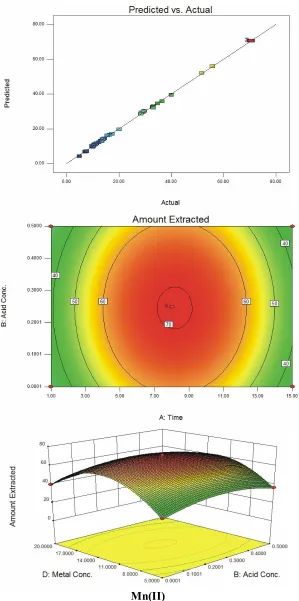
Mn(II)
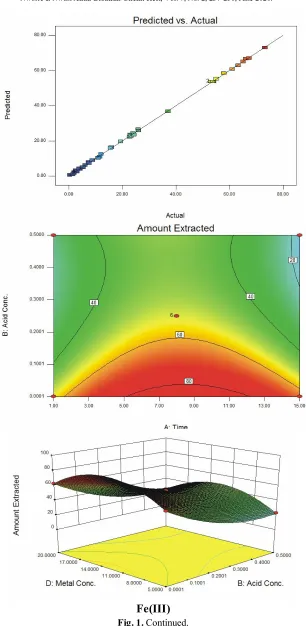
Fe(III)
Fe(II)
Cr(III)
with asymmetric ligands may lead to aggregation of ions at high acid concentration due to the presence of proton switchable ligand co-ordination sites [30]. Similarly, variation of solvents, possibly using tetrachloromethane in lieu of trichloromethane, has notable influence on metal ion extracted. The studies performed [30] have demonstrated that low solvent polarity and water solubility are likely responsible for small extent of metal ions partitioning in extraction of metal ions.
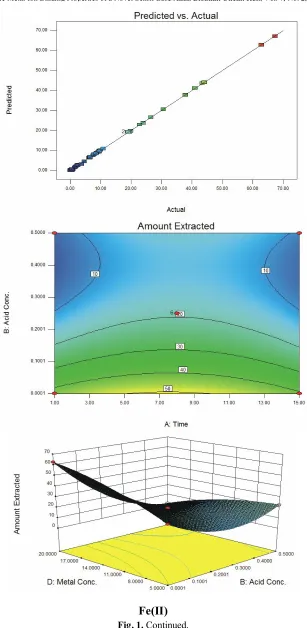
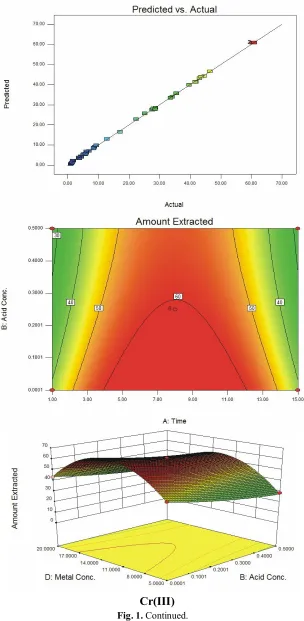
Comparison between the experimental values and the predicted results, shown in Table 1, gave results that were consistent at same conditions and difference less than 5%. The R2adj value, illustrating the agreement between the experimental values and the predicted results for Fe(II), Fe(III), Mn(II) and Cr(III) (Table 3, Fig. 1), was 99.97, 99.95, 99.93 and 99.95%, respectively, indicating that the BBD optimization process is an efficient, effective and suitable model for metal uptake through solvent extraction. Examples of response surface plots illustrating the five process conditions on the amount of H2BMPDE formed
which shows a clearer understanding of the interaction effects of the variables are shown in Fig. 1. Since the most significant factor is acid concentration, Fig. 1 shows the predicted and percentage extraction of the metal ions as a function of metal ions and acid concentration at 10-4 M. As expected, at high acid concentration, monotonous decrease was observed due to ligand degradation or demetallation [5]. The study showed that the novel Schiff base can effectively and efficiently uptake the metal ions under study in aqueous solution in the following decreasing order: Fe(III) (85.909%), Fe(II) (81.757%), Mn(II) (70.612%) and Cr(III) (69.615%). The values showed that Fe(III) was the best extracted metal cation indicating a more stable complex. An increased electronegativity difference between the ligand donor atom and metal atom imparts strong covalent character and increased complex compound stability [3,29-30] as hard donor acids form stronger and more stable inner sphere complexes with oxygen donors. The metal ions (Fe(III), Mn(II), Fe(II) and Cr(III)) are the hard acid donors except Fe(II) which is a borderline acid donor. The observed similarity between the binding capacity of Fe(III) and Fe(II) could be as a result of similar small ionic radius and polarizability of high spin 6-co-ordinated octahedral Fe(III) ion ( ionic radius = 78.5 pm)
and 6-co-ordinated octahedral Fe(II) ion (ionic radius = 75 pm) [30]. The little dismillarity observed in metal ions binding capacity of Fe(III) and Mn(II), and in Fe(III) and Cr(III), even though they belong to hard acid donors could be attributed to differences in macro ionic charge and also the extent of electrostatic attraction and co-ordination sites present. Thus, the co-ordination of metal ions to H2BMPDE
upon deprotonation at pH 4 suggests chelation of metal ions and predominance of inner sphere complexation. Even though the authors correlated not the extraction models with co-ordination number of metals, results indicate the formation of 6-co-ordinated inner sphere complexes.
CONCLUSIONS
The study presented the synthesis and characterization of H2BMPDE as a metal ion chelator or extractant. The
Schiff bis base was made by condensation reaction of ethane-1,2-diamine and 2-hydroxybenzaldehyde and characterized using UV-Vis, GC-MS, FT-IR and NMR. The optimum conditions for liquid-liquid extraction method for the variables of time, acid concentration, ligand concentration, temperature and metal concentration was determined using RSM approach. The extraction of the metal ions studied from trichloromethane increased in the order Cr(III) → Mn(II) → Fe(II) → Fe(III). Fe(III) was the best extracted metal cation and formed a stoichiometrically more stable complex than other cations. Acid concentrations (10-4 M) was the most effective medium for metal ion uptake as electrons are available at the N and O donor atoms of the ligand where co-ordination occurs. The predicted and experimental values from the model showed less than 5% difference thereby making the Box-Behnken design approach an efficient, effective and reliable method for the removal of metal ions from aqueous solution with H2BMPDE by solvent extraction technique.
REFERENCES
[1] R.D. Jones, D.A. Summerville, F. Basolo, Chem. Rev. 79 (1979) 139.
[2] K. Brodowska, E. Lodyga-Chruscinska, Chemik 68 (2014) 129.
Bingol, Separation Science and Technology 51 (2016) 2138.
[4] T. Katsuki, Chem Lett. 124 (2006) 1.
[5] C. Baleiza, H. Garcia, Chem. Rev. 106 (2006) 3987. [6] F.J. Alguacil, M. Alonso, Rev. Metal Madrid. 35
(1999) 190.
[7] C.R.T. Tarley, G. Silveria, W.N.L. Santos dos, G.D. Matos, E.G.P. da Silva, M.A. Bezerra, M. Miró, S.L.C. Ferreira, Microchem. J. 92 (2009) 58.
[8] M.A. Bezerra, R.E. Santelli, E.P. Oliveira, L.S. Villar, L.A. Escaleira, Talanta 76 (2008) 965.
[9] D. Bingöl, Fresenius Environ. Bull. 20 (2011) 2704. [10] D. Bingöl, M. Hercan, S. Elevli, E. Kilic, Bioresource
Technol.112 (2012) 111.
[11] S.L.C. Ferreira, M.G.A. Korn, H.S. Ferreira, E.G.P. da Silva, R.G.O. Araújo, A.S. Souza, S.M. Macedo, D.C. Lima, R.M. de Jesus, Appl. Spectroscopy Rev. 42 (2007) 475.
[12] D. Bingol, S. Karayunlu Bozbas, Spectroscopy Lett. 45 (2012) 324.
[13] D. Martínez-Fernandez, D. Bingol, M. Komarek, J. Hazard. Mater. 276 (2014) 271.
[14] N. Tekin, A. Safakli, D. Bingol, Desalination and Water Treatment 54 (2015) 2023.
[15] L. Trakal, D. Bingol, M. Pohorely, M. Hruska, M. Komarek, Bioresource Technology 171 (2014) 442. [16] Y.Y. Zhang, J.H. Liu, Chem. Biochem. Eng. Q. 25
(2011) 75.
[17] C.A. Di Tusa, K.A. McCall, T. Chritensen, M. Mahapatro, C. Fierke, E.J. Toone, Biochemistry 40 (2001) 5345.
[18] M. Ali, J. Chin. Chem. Soc. 55 (2008) 369.
[19] F.S. Nworie, F.I. Nwabue, J. John, Res. J. Chem. Sci. 5 (2015) 92.
[20] S. Yang, H. Kon, H. Wang, K. Chang, J. Wang, New. J. Chem. 34 (2010) 313.
[21] A.A.A. Emara, A.M. Ali, A.F. El-Asmy, E.M. Ragab, J. Saudi Chem. Soc. 18 (2011) 762.
[22] P. Gluvchinsky, G.M. Mocler, Spectrochim. Acta A 33 (1977) 1073.
[23] W. Al Zoubi, F. Kandil, M.K. Chebani, Arab. J. Chem. 48 (2013) 501.
[24] F. Kandil, W. Al Zoubi, M.K. Chebani, Separation Sci. Technol. 47 (2012) 1754.
[25] S. Samal, S. Acharya, R.K. Dey, A Ray, Talanta 57 (2002) 1075.
[26] K. Dev, G.N. Rao, Talanta 43 (1996) 451. [27] K. Dev, G.N. Rao, Analyst 120 (1995) 2509
[28] A.A. Atia, A.M. Donia, A.S. Abou-El-Enein, A.M. Yousif, Separation and Purification Technology 33 (2003) 295.
[29] F.A. Cotton, G. Wilkinson, C.A. Murillo, M. Bochmann, Advanced Inorganic Chemistry, 6th Ed., Wiley New York,1999, pp.200