Applications of graph operations
M.TAVAKOLI AND F.RAHBARNIA
Department of Mathematics, Ferdowsi University of Mashhad, P. O. Box 1159, Mashhad 91775, Iran
(ReceivedJanuary 5, 2013; Accepted February 22, 2013)
ABSTRACT
In this paper, some applications of our earlier results in working with chemical graphs are presented.
Keywords: Topological index, graph operation, hierarchical product, chemical graph.
1.
INTRODUCTION
Throughout this paper all graphs considered are finite, simple and connected. The distance
dG(u,v) between the vertices u and v of a graph G is equal to the length of a shortest path
that connects u and v. Suppose G is a graph with vertex and edge sets V = V(G) and E = E(G), respectively, and e = abE(G). The set of edges of G whose distance to the vertex u
is smaller than the distance to the vertex v is denoted by MuG(e). Then the edge PI index of
G, PIe(G), is defined as PIe(G) =
E(G) uv e
G v G
u (e) M (e)
M [1,2]. In a similar way,
(e)
NaG is defined as the set of vertices closer to the vertex a than to the vertex b. In other words, NaG(e)= {u V(G) | d(u, a) < d(u, b)}. The vertex PI index of G, PIv(G), is defined
as [|NuG(e)| + |NvG(e)|] over all edges of G [3,4]. The edges e = uv and f = xy of G are said to be equidistant if min{dG(u, x), dG(u, y)}=min{dG(v, x), dG(v, y)}. For e = uv G, the set
of equidistant vertices of e is denoted by N0G(e) and the set of equidistant edges of e is denoted by M0G(e). Thenthe above definitions are equivalent to
PIv(G) = |V(G)||E(G)| –
E(G) e
G 0 (e)
N ,
PIe(G) = |E(G)|2 –
E(G) e
G 0 (e)
M .
A graph G with a specified vertex subset U V(G) is denoted by G(U). Suppose G
and H are graphs and U V(G). The generalized hierarchical product, denoted by
G(U)H, is the graph with vertex set V(G) V(H) and two vertices (g, h) and (g′, h′) are adjacent if and only if g = g′ U and hh′ E(H) or, gg′ E(G) and h = h′. This graph operation has been introduced by Barriére et al. [5,6] and it has some applications in computer science. To generalize this graph operation to n graphs, assume that Gi = (Vi , Ei)
is a graph with vertex set Vi , 1 ≤ i ≤ N, having a distinguished or root vertex 0. The
hierarchical product H = GN …G2G1 is the graph with vertices the Ntuples xN …
x3x2x1, xi Vi , and edges defined by the following adjacencies:
xN…x3x2x1
0. 1 N x 2 x 1 x ) N E(G N y N x 1 x 2 x 3 x N y 0, 2 x 1 x ) 3 E(G 3 y 3 x 1 x 2 x 3 y N x 0, 1 x ) 2 E(G 2 y 2 x 1 x 2 y 3 x N x ), 1 E(G 1 y 1 x 1 y 2 x 3 x N x ... and if ... : : : and if ... and if ... if ...
We encourage the reader to consult [7] for the mathematical properties of the hierarchical product of graphs.
2.
MAIN RESULTS
Let G = (V, E) be a graph and U V. Following Pattabiraman and Paulraja [8], an u–v path through U in G(U) is an u–v path in G containing some vertex w U (not necessarily distinct from the vertices u and v). Let dG(U)(u,v) denote the length of a shortest u –v path
through U in G. Notice that, if one of the vertices u and v belong to U, then dG(U)(u,v) =
dG(u,v). A vertex xV(G(U)) is said to be equidistant from e = uvE(G(U)) through U in
G(U), if dG(U)(u, x) = dG(U)(v, x). For an edge e = ab in G(U), let N0G(U)(e) denote the set of
equidistant vertices of e through U in G(U) and NaG(U)(e) denote the set of vertices closer to a than to b through U in G. Then PIv(G(U)) and PIe(G(U)) can be computed by the
PIv(G(U)) =
E(G(U)) ab
e
G(U) b G(U)
a (e) N (e)
N
= |V(G(U))||E(G(U))| –
E(G(U)) eG(U) 0 (e)
N .
The edges e = uv and f = xy of G(U) are said to be equidistant edges through U in
G(U) if
min{dG(U)(u, x), dG(U)(u, y)}= min{dG(U)(v, x), dG(U)(v, y)}.
Let M0G(U)(e) denote the set of equidistant edges of e through U in G(U) and MaG(U)(e) denote the set of edges closer to a than to b through U in G. Then PIe(G(U)) is computed as
follows:
PIv(G(U)) =
E(G(U)) ab
e
G(U) b G(U)
a (e) M (e)
M
= |E(G(U))|2 –
E(G(U)) eG(U) 0 (e)
M .
Theorem 1. [9]. Let G and H be two connected graphs and let U be a nonempty subset of
V(G). Then PIv(G(U) H) =|V(H)| (|V(H)| – 1) PIv(G(U)) + |V(H)|PIv(G) +
|V(G)||U|PIv(H).
Theorem 2. [9]. Let G and H be two connected graphs and let U be a nonempty subset of
V(G). Then
PIe(G(U) H) = |V(H)|(|V(H)| – 1)PIe(G(U)) + |V(H)|PIe(G)
+ |V(H)||E(H)|
(
|U||E(G)| –
E(G(U)) g
g
G(U)
0 (gg) U
N
)
+ |E(G)||U|PIv(H) +|U|2PIe(H).
We are now ready to obtain the PI indices of some chemical graphs.
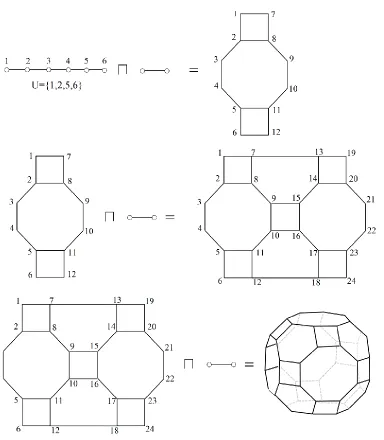
Example 3. Let H be the graph of truncated cuboctahedron (see Figure 1). Then H =
((P6(U1) P2)(U2) P2)(U3) P2, where U1 = {1, 2, 5, 6}, U2 = {7, 9, 10, 12} and U3 =
{1, 3, 4, 6, 19, 21, 22, 24}. One can see that PIe(P6(U1) P2) = 2 20 + 2 20 + 2
(4 5) + 5 4 2 = 160. Also PIe((P6(U1) P2)(U2) P2) = 2 176 + 2 160 + 2 4
14 + 14 4 2 = 896. Thus, by Theorem 1, we have
Figure 1. The Molecular Graph of Truncated Cuboctahedron.
Example 4. Octanitrocubane is the most powerful chemical explosive with formula
C8(NO2)8), part (a) of Fig. 2. Let H be the molecular graph of this molecule. Then obviously
H= P4(U)Q2, where U = {2, 3}. On the other hand, one can easily see that PIe(P4(U))=8
and PIe(P4) = 6 and so, by Theorem 1, we have
Figure 2. The Molecular Graph of Octanitrocubane.
Figure 3. The BridgeCycle Graph.
Example 5. Let
Gi id1 be a set of finite pairwise disjoint graphs with viV(Gi). Thebridgecycle graph BC(G1, G2, …, Gd) = BC(G1, G2, …, Gd; v1, v2, …, vd) of
Gi id1 withrespect to the vertices
vi di1 is the graph obtained from the graphs G1, …, Gd byconnecting the vertices vi and vi+1 by an edge for all i = 1, 2, …, d –1 and connecting the
BC(G1, G2, … , Gd) G(U) Cd, where |U|=|{r}|=1. On the other hand, It is not so
difficult to check that PIe(Cn)=
n | 2 2) n(n n | 2 1) n(n
and PIv(Cn)=
n | 2 n n | 2 1) n(n
2 . Therefore, if
2 | m, by Theorem 1, we have PIe(G(U)Cm) = m(m – 1)PIe(G(U)) + mPIe(G) +
m2(2|E(G)| – Nr(G)) + m(m – 2) and if 2 | m, then PIe(G(U)Cm) = m(m – 1)PIe(G(U)) +
mPIe(G) + m2(2|E(G)| – Nr(G)) – m|E(G)| + m(m – 1), where Nr(G)=|{uvE(G) |
dG(u,r)=dG(v,r)}|.
By replacing G with Pn (such that r is a pendant vertex of Pn) in the above relations,
we obtain PIe of Sunm, n–1, see [10], as follow:
PIe(Sunm, n–1)=
m | 2 m mn n m m | 2 m 2mn n m 2 2 2 2 .
In what follows, let j f 1
i i
and
j 0i fi for each i, j {0, 1, 2, …}, that i – j
= 1. Furthermore, let f j f 0
i i j
i i
for every i, j {0, 1, 2, …}, such that i – j > 1.Also, for a sequence of graphs, G1, G2, …, Gn, we set
j i
k k
j
i, V(G )
V and
j l k i, k k l ji, V(G )
V .
Theorem 6. [11]. Suppose G1, G2, …, Gn are connected rooted graphs with root vertices r1,
…, rn, respectively. Then
PIe(Gn …G2G1) = V PI (G ) V E(G )V PIv(Gi) -1 i 1 j 1 i 1, j j n 1 i n 1, i n 1 i i e n 1,
i
+
n 1 i n 1 i j j n 1, i ri) N )V ((V(G ) 1)
E(G ((
i
= E(G )V E(G ))) 1 j 1 k j 1 j 1, k k
,where Nr
uv E(Gi)|dG(u,ri) dG(v,ri)
i i
i .
Example 7. Let Γ be the graph of octanitrocubane, see part (b) of Figure 6. Then obviously
H= Q3 P2. On the other hand, one can easily see that PIe(Q3) = PIv(Q3) = 96 and PIe(P2)
REFERENCES
1. P. V. Khadikar, S. Karmarkar, A novel PI index and its applications to QSPR/QSAR studies, J. Chem. Inf. Comput. Sci.41 (2001) 934–949.
2. P.V. Khadikar, On a novel structural descriptor PI, Nat. Acad. Sci. Lett. 23 (2000) 113–118.
3. M. H. Khalifeh, H. YousefiAzari and A. R. Ashrafi, Vertex and edge PI indices of Cartesian product graphs, Discrete Appl. Math.156 (2008), 1780–1789.
4. M. H. Khalifeh, H. YousefiAzari, A. R. Ashrafi, A matrix method for computing Szeged and vertex PI indices of join and composition of graphs, Linear Algebra Appl.429 (2008) 2702–2709.
5. L. Barriére, F. Comellas, C. Daflo and M. A. Fiol, The hierarchical product of graphs, Discrete Appl. Math.157 (2009) 36–48.
6. L. Barriére, C. Dao, M. A. Fiol and M. Mitjana, The generalized hierarchical product of graphs, Discrete Math.309 (2009) 3871–3881.
7. M. Tavakoli, F. Rahbarnia and A. R. Ashrafi, Distribution of some graph invariants over hierarchical product of graphs, Appl. Math. Comput. 220 (2013) 405–413. 8. K. Pattabiraman, P. Paulraja, Vertex and edge PadmakarIvan indices of the
generalized hierarchical product of graphs. Discrete Appl. Math. 160 (2012) 1376– 1384.
9. M. Tavakoli, F. Rahbarnia, A. R. Ashrafi, Applications of Generalized Hierarchical Product of Graphs in Computing the Vertex and Edge PI Indices of Chemical Graphs, to appear in Ricerche di Matematica.
10.Y. N. Yeh and I. Gutman, On the sum of all distances in composite graphs, Discrete Math. 135 (1994) 359–365.