VOLUME 39, ARTICLE 40, PAGES 1065
,
1080
PUBLISHED 14 NOVEMBER 2018
https://www.demographic-research.org/Volumes/Vol39/40/ DOI: 10.4054/DemRes.2018.39.40
Descriptive Finding
Child poverty across immigrant generations in
the United States, 1993–2016: Evidence using the
official and supplemental poverty measures
Brian C. Thiede
Matthew M. Brooks
© 2018 Brian C. Thiede & Matthew M. Brooks.
This open-access work is published under the terms of the Creative Commons Attribution 3.0 Germany (CC BY 3.0 DE), which permits use, reproduction, and distribution in any medium, provided the original author(s) and source are given credit.
1 Introduction 1066
2 Data and methods 1067
3 Results 1068
4 Discussion 1075
5 Acknowledgements 1076
Child poverty across immigrant generations in the
United States, 1993–2016: Evidence using the official
and supplemental poverty measures
Brian C. Thiede1 Matthew M. Brooks2
Abstract
BACKGROUND
Recent increases in ethno-racial diversity in the United States are paralleled by growing representation of first- and second-generation immigrants, especially among children. Socioeconomic inequalities along the lines of immigrant generation, race, and ethnicity suggest such demographic changes may result in greater disparities among recent, more-diverse cohorts of children.
OBJECTIVE
Describe poverty rates among US children across five immigrant generation groups, using the US government’s official poverty measure (OPM) and a supplemental poverty measure (SPM), which accounts for government transfers and costs of living.
METHODS
Using data from the Current Population Survey and historical SPM estimates from 1993–2016, we describe trends in child poverty, stratified by immigrant generation. We compare estimates of inter-generational differences and temporal changes based on the OPM and SPM, and we conduct stratified analyses for Hispanic and Asian children.
RESULTS
We find persistent differences in poverty rates between immigrant generations. First-generation non-citizens and second-First-generation children with two foreign-born parents have consistently higher poverty rates than other generations, between which there are minimal disparities. Differences between OPM- and SPM-based estimates suggest public supports and costs of living have differential welfare effects across groups.
CONTRIBUTION
We provide a historical record of child poverty differentials across immigrant
generations, which have been understudied. Results demonstrate heterogeneity in the economic status of first- and second-generation children, which would be masked using other immigrant-generation typologies. Differences in OPM- and SPM-based measures raise questions about inter-generational disparities in public supports and costs of living, and stratified results highlight the intersection of race, ethnicity, and nativity as axes of inequality.
1. Introduction
Racial and ethnic diversity across the US population has increased markedly over recent decades, and this trend is expected to continue into the future (Alba and Foner 2015; Frey 2014; Lee et al. 2017; Lichter and Qian 2018). Shifts in ethno-racial composition have been particularly dramatic among recent cohorts of children. In 2016, for example, members of non-white minority groups comprised 50.4% of children ages 0–5 years, compared with 33.8% of adults ages 50–54 years and 19.1% of adults aged 85 or older (US Census Bureau 2017). The high degree of ethno-racial diversity at the bottom of the age distribution is driven by recent patterns of immigration and fertility, including high levels of fertility among first- and second-generation immigrant adults (Frank and Heuveline 2005; Johnson and Lichter 2016; Jonsson and Rendall 2004). One understudied implication is that new cohorts of children are not only characterized by growing diversity racially and ethnically, but also in terms of immigrant generation.
These new patterns of diversity are unfolding within a US context that has historically been characterized by socioeconomic inequalities along the axes of race, ethnicity, and immigrant generation (Glick and Yabiku 2016; Hamilton et al. 2011; Iceland et al. 2014; Lichter 2013). However, relatively little is known about whether and how inter-generational disparities among adults translate into patterns of advantage and disadvantage among children (National Academy of Sciences 2016). Existing evidence is focused mainly on broad differences between native- and foreign-born children and is largely based on data collected prior to the recent uptick in ethno-racial diversity among US children (Lichter, Qian, and Crowley 2005; Van Hook, Brown, and Kwenda 2004). Likewise, there has been little attention to historical changes in such socioeconomic gradients among children as diversity has increased.
immigration, and settlement within the United States, as well as differential access to the safety net. We expect these and related processes to produce distinct inter-generational patterns of poverty among children. We also examine historical dynamics in child poverty, which is merited given the possibility that inter-generational inequalities have changed over time with growing ethno-racial diversity, shifts in the socioeconomic characteristics and geographic distribution of immigration populations, and changes to the policy environment (Heinrich 2018; Lichter, Sanders, and Johnson 2015; Mattingly and Pedroza 2018). Finally, accounting for these patterns is important given their longer-term implications, as childhood exposure to poverty has negative effects over the life course (Duncan, Ziol-Guest, and Kalil 2010; Hayward and Gorman 2004). As an important 2016 report on immigrant integration in the United States argued, economic conditions among immigrant children “provide a window to the future” (National Academy of Sciences 2016: 289).
2. Data and methods
We analyze data from the Annual Social and Economic Supplement (ASEC) of the Current Population Survey (CPS). The CPS has the advantage of collecting data on parental place of birth – and thus children’s immigrant generation – regardless of whether the child and parent co-reside in a household. We use the Integrated Public Use Microdata Series (IPUMS) to extract data on immigrant generation and official poverty status among children ages 0 to 17 years for 1994 through 2017 (N = 1,254,895) (Flood et al. 2017). We begin in 1994 since it is the first year that detailed information on immigrant generation was collected in the CPS, and because the mid-1990s mark the beginning of a new era of increased immigration, dispersion to new immigrant destinations, and, we expect, changing economic patterns. Poverty status is defined for the prior calendar years (1993–2016), which we refer to when reporting findings.
to the Census SPM when it became available in the 2010 CPS. An implication is that historical SPM estimates may underestimate the welfare effects of new settlement patterns that emerged during the study period.
We stratify our child poverty estimates by immigrant generation, which is operationalized as a five-category typology. We distinguish between children who are (a) foreign-born and not US citizens; (b) foreign-born US citizens; (c) native-born to two foreign-born parents; (d) native-born to one foreign-born and one-native born parent; and (e) native-born to two native-born parents. Together, groups (a) and (b) comprise the first generation, groups (c) and (d) the second generation, and group (e) the third+ generation. We measure parental nativity rather than citizenship since we cannot identify the latter among non-resident parents using the CPS. If citizenship is a stronger correlate of poverty than nativity, our approach may understate within-second-generation disparities relative to a parental citizenship-based classification.
Our descriptive analyses are as follows. We estimate child poverty rates stratified by immigrant generation and over the 1993–2016 period. We pool the data into twelve two-year periods to increase the precision of estimates and throughout our study apply the ASEC person-level weights (Flood et al. 2017). We estimate poverty rates using both the OPM and SPM, and we compare inter-generational and temporal patterns to identify differences in the aggregate poverty-reducing (increasing) effect of the factors captured in the SPM. Finally, we produce generation-specific estimates of child poverty among Hispanic and Asian children, respectively, to compare two large but socioeconomically distinct immigrant populations.
3. Results
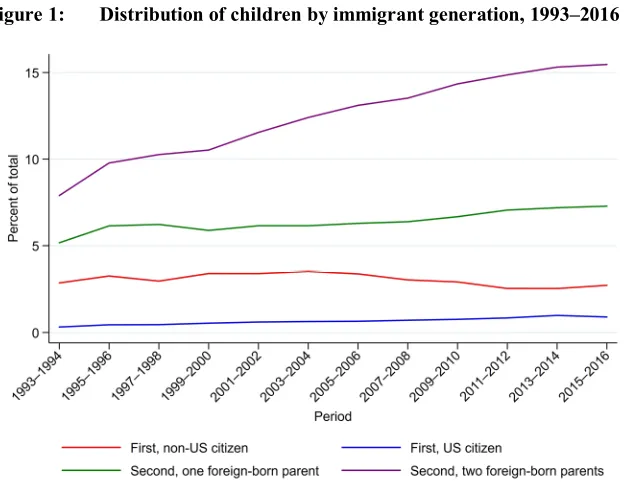
Figure 1: Distribution of children by immigrant generation, 1993–2016
Note: Figure excludes the third+ generation.
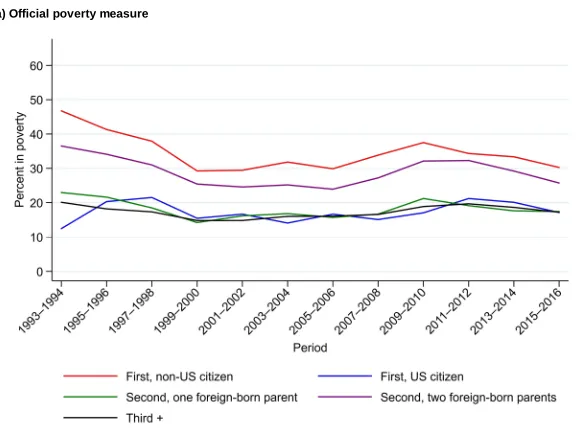
Figure 2: Child poverty estimates by immigrant generation, 1993–2016
a) Official poverty measure
Official poverty rates among the other three immigrant generations were all markedly lower, though still high in absolute terms. Averaged across all periods, poverty rates among these three groups – first-generation US citizens, second-generation children with one foreign-born parent, and the third+ second-generation – fell within a range of 17.3% to 18.1%. With few exceptions, child poverty rates among these three groups tracked closely together over time. Likewise, apart from an increase in poverty associated with the 2007–2009 recession, trendlines were relatively flat. For example, poverty among third+-generation children only declined from 20.1% to 17.2% from the start to the end of the study.
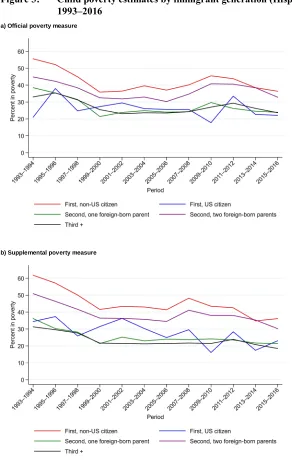
Figure 3: Child poverty estimates by immigrant generation (Hispanic only), 1993–2016
a) Official poverty measure
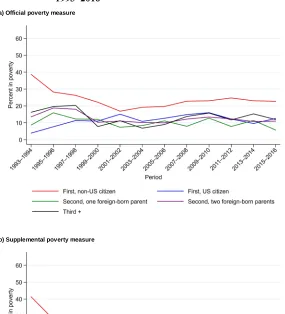
Since overall estimates of child poverty by immigrant generation may conceal variation in patterns across ethno-racial groups, we conduct a separate stratified analysis among the large but socioeconomically distinct Hispanic and Asian populations (Figures 3a–b and 4a–b). Indeed, we find stark differences in absolute poverty levels among Hispanic and Asian children. Hispanic children face disproportionately high levels of poverty, regardless of generation, while Asian children face below-average poverty rates. For example, 26.6% of third+-generation Hispanic children were officially poor across our study period, compared with 17.3% nationally and 13.4% of Asian children. Notably, the inter-generational poverty gradient observed nationally is also apparent among Hispanic but not Asian children. Hispanic first-generation non-citizens and second-generation children with two foreign-born parents face much higher poverty rates than their Hispanic peers throughout the study. In contrast, only first-generation non-citizen Asian children are distinctively worse-off vis-à-vis their same-race peers.
Figure 4: Child poverty estimates by immigrant generation (Asian only), 1993–2016
a) Official poverty measure
4. Discussion
Our analysis of child poverty across immigrant generations finds evidence of large differences according to child and parental nativity. First-generation US citizens and second-generation children with two foreign-born parents are at greater risk of poverty than the three other groups we consider, and this conclusion is supported using both the OPM and SPM. One implication of the inter-generational gradient that we document is that binary foreign- versus native-born comparisons, and those that compare aggregated first, second, and third+ generations, will mask substantively important heterogeneity in child poverty levels within the first and second generations. Future research should therefore employ detailed typologies to the extent that data permit.
The inter-generational child poverty gaps described above were relatively persistent, but we nonetheless observed some convergence between the highest- and lowest-poverty generations. For example, in 1993–1994, the differences in OPM- and SPM-based estimates between first-generation non-citizens and the third+ generation were 26.7 and 33.7 percentage points, respectively, but these gaps had decreased to 13.1 and 17.7 points in 2015–2016. While the OPM- and SPM-based estimates produce broadly similar conclusions with respect to the inter-generational gradient and temporal pattern in child poverty, the difference between these two measures varies across generations. The OPM yields higher estimates of poverty than the SPM among the third+ generation and second-generation children with one foreign-born parent, but it yields lower estimates among the remaining three generations in our typology. We speculate that these patterns are driven largely by inter-generational differences in safety net eligibility and use, which is often tied to parental citizenship and proxied here by parental nativity. Future research should work to decompose the precise sources of these differences.
Our analysis of the Hispanic and Asian populations revealed stark differences in poverty between these groups, with disproportionately high poverty rates among the former and below-average rates among the latter. Inter-generational gradients in Hispanic child poverty were broadly similar to national trends, but among Asians only first-generation non-citizen children were distinctively worse-off than same-race peers. Within both groups, we observed patterns of convergence between the most- and least-disadvantaged generations. Differences in OPM- and SPM-based poverty estimates also followed similar inter-generational patterns within both groups, which suggests that gradients in the aggregate welfare effects of the safety net and costs of living are consistent across ethno-racial groups.
diversity in the United States. In addition to the future research questions identified above, extensions of our work include comparing inter-generational gradients in child poverty across new and established destinations, studying the contribution of selective fertility and migration to child poverty patterns, and examining inter-generational differences in the frequency and duration of poverty spells.
5. Acknowledgements
References
Alba, R. and Foner, N. (2015).Strangers no more: Immigration and the challenges of
integration in North America and Western Europe. Princeton: Princeton
University Press.doi:10.1515/9781400865901.
De Jong, G.F., Graefe, D., Galvan, C., and Howe Hasanali, S. (2017). Unemployment and immigrant receptivity climate in established and newly emerging destination
areas. Population Research and Policy Review 36(2): 157–180. doi:10.1007/
s11113-016-9408-y.
De Trinidad Young, M., Leon-Perez, G., Wells, C.R., and Wallace, S.P. (2018). More inclusive states, less poverty among immigrants? An examination of poverty,
citizenship stratification, and state immigrant policies.Population Research and
Policy Review 37(2): 205–228.doi:10.1007/s11113-018-9459-3.
Duncan, G.J., Ziol-Guest, K.M., and Kalil, A. (2010). Early-childhood poverty and
adult attainment, behavior, and health. Child Development 81(1): 306–325.
doi:10.1111/j.1467-8624.2009.01396.x.
Flood, S., King, M., Ruggles, S., and Warren, J.R. (2017). Integrated public use microdata series: Current population survey: Version 5.0. [dataset]. Minneapolis:
University of Minnesota.https://www.ipums.org/doi/D030.V5.0.shtml.
Fox, L., Wimer, C., Garfinkel, I., Kaushal, N., and Waldfogel, J. (2015). Waging war on poverty: Poverty trends using a historical supplemental poverty measure. Journal of Policy Analysis and Management 34(3): 567–592. doi:10.1002/ pam.21833.
Frank, R. and Heuveline, P. (2005). A crossover in Mexican and Mexican-American
fertility rates: Evidence and explanations for an emerging paradox.Demographic
Research 12(4): 77–104.doi:10.4054/DemRes.2005.12.4.
Frey, W.H. (2014). Diversity explosion: How new racial demographics are remaking
America. Washington, D.C.: Brookings Institution Press.
Glick, J.E. and Yabiku, S.T. (2016). Migrant children and migrants’ children: Nativity
differences in school enrollment in Mexico and the United States.Demographic
Research 35(8): 201–228.doi:10.4054/DemRes.2016.35.8.
Hayward, M.D. and Gorman, B.K. (2004). The long arm of childhood: The influence of
early-life social conditions on men’s mortality. Demography 41(1): 87–107.
doi:10.1353/dem.2004.0005.
Heinrich, C.J. (2018). ‘A thousand petty fortresses’: Administrative burden in US
immigration policies and its consequences. Journal of Policy Analysis and
Management 37(2): 211–239.doi:10.1002/pam.22046.
Iceland, J. (2005). Measuring poverty: Theoretical and empirical considerations. Measurement: Interdisciplinary Research and Perspectives 3(4): 199–235.
doi:10.1207/s15366359mea0304_1.
Iceland, J., Weinberg, D., and Hughes, L. (2014). The residential segregation of detailed Hispanic and Asian groups in the United States: 1980–2010. Demographic Research 31(20): 593–624.doi:10.4054/DemRes.2014.31.20. Johnson, K.M. and Lichter, D.T. (2016). Diverging demography: Hispanic and
non-Hispanic contributions to US population redistribution and diversity.Population
Research and Policy Review 35(5): 705–725.doi:10.1007/s11113-016-9403-3. Jonsson, S.H. and Rendall, M.S. (2004). The fertility contribution of Mexican
immigration to the United States. Demography 41(1): 129–150. doi:10.1353/
dem.2004.0006.
Lee, B.A., Martin, M.J., Matthews, S.A., and Farrell, C.R. (2017). State-level changes
in US racial and ethnic diversity, 1980 to 2015: A universal trend?Demographic
Research 37(33): 1031–1048.doi:10.4054/DemRes.2017.37.33.
Lichter, D.T. (2013). Integration or fragmentation? Racial diversity and the American
future.Demography 50(2): 359–391.doi:10.1007/s13524-013-0197-1.
Lichter, D.T. and Qian, Z. (2018). Children at risk: Diversity, inequality, and the third
demographic transition. In: Poston, D.L. (ed.). Low fertility regimes and
demographic and societal change. Basel: Springer: 169–191. doi:10.1007/978-3-319-64061-7_10.
Lichter, D.T., Qian, Z., and Crowley, M.L. (2005). Child poverty among racial
minorities and immigrants: Explaining trends and differentials. Social Science
Quarterly 86(S1): 1037–1059.doi:10.1111/j.0038-4941.2005.00335.x.
Mattingly, M.J. and Pedroza, J.M. (2018). Convergence and disadvantage in poverty trends (1980–2010): What is driving the relative socioeconomic position of
Hispanics and Whites? Race and Social Problems 10(1): 53–66. doi:10.1007/
s12552-017-9221-1.
National Academies of Sciences (2016).The integration of immigrants into American
society. Washington, D.C.: National Academies Press.
Short, K. (2012). The research supplemental poverty measure: 2011. Suitland: US
Census Bureau.
US Census Bureau (2017). Annual estimates of the resident population by sex, age, race, and Hispanic origin for the United States and states: April 1, 2010 to July 1, 2016 [electronic resource]. Suitland: US Census Bureau, Population Division.
https://factfinder.census.gov/faces/tableservices/jsf/pages/productview.xhtml?src =bkmk.
Van Hook, J., Brown, S.I., and Kwenda, M.N. (2004). A decomposition of trends in
poverty among children of immigrants. Demography 41(4): 649–670.