ISSN(Online): 2320-9801
ISSN (Print) : 2320-9798
I
nternational
J
ournal of
I
nnovative
R
esearch in
C
omputer
and
C
ommunication
E
ngineering
(An ISO 3297: 2007 Certified Organization)
Vol. 3, Issue 9, September 2015
An Evaluation of a Novel Technique to
Suppress Corruptive Artifacts for
Example-Based Color Transfer Framework
Pooja M. Karale1, Prof. Mrudula S. Nimbarte 2, Prof. A. D. Gotmare3
M. Tech [CSE] Student, Dept. of Computer Engineering, Bapurao Deshmukh College of Engineering, Sevagram,
India1
Assistant Professor (Sr.Gr.), Dept. of Computer Engineering, Bapurao Deshmukh College of Engineering, Sevagram,
India2
Assistant Professor, Dept. of Computer Engineering, Bapurao Deshmukh College of Engineering, Sevagram, India3
ABSTRACT: Color manipulation is one of the most common tasks in image editing. How to transfer the colors of the given reference to the target effectively is a challenging problem and is significant in color transfer. Automatic color appearance adjustment is still of high demand, owing to the inherent difficulties to handle complex structures ubiquitous in natural images. The main purpose of the project is to develop a novel technique for Example-based color transfer framework which aims at copying the color appearance from a given “example” to a target image.
A novel technique to suppress corruptive artifacts for example based color transfer framework is proposed a technique which colorize the image, detect the corruptive artifact and suppress it. It also preserves edges. Time performance is improved in this system. In our system grain suppression, color fidelity and information loss are satisfied by reducing noise, increasing color fidelity and reducing information loss. We have presented a framework that allows a user to easily and quickly create a color transformed image and grain effect in the process of transfer, but also achieves the effect of detail preserving or enhancing.
.
KEYWORDS: Color Transfer, Suppression, Corruptive Artifacts, Example-based, Color fidelity, Noise.
I. INTRODUCTION
Color manipulation is one of the most common tasks in image editing. While artists resort to photo editing tools to manually adjust color appearance, automatic color appearance adjustment is still of high demand, owing to the inherent difficulties to handle complex structures ubiquitous in natural images. Arguably, example-based color transfer, which aims at copying the color appearance from a given “example” to a target grayscale or color image, is the most effective way to tackle the problem. Taking Fig. 1 as an example, due to the big difference in the intensity distribution between the reference and the target, an unsatisfactory transferred result was produced, with remarkable artifacts as follows[1].
Color distortion: Some disharmonious or unexpected colors appear which are not included in the reference image.
Grain effect: A phenomenon appears due to enhancing the noise level of the picture under the stretched mapping. Commonly, it looks like some noises or irregular blocks.
Loss of details: The fine-level details in the target image are missed after the color transfer. Ideally, color transfer between reference and target images should satisfy the following goals.
Color fidelity: The color distribution of the target should be close to that of the reference image.
Grain suppression: No visual artifacts (grain/blocky artifacts) should be generated in the target image.
ISSN(Online): 2320-9801
ISSN (Print) : 2320-9798
I
nternational
J
ournal of
I
nnovative
R
esearch in
C
omputer
and
C
ommunication
E
ngineering
(An ISO 3297: 2007 Certified Organization)
Vol. 3, Issue 9, September 2015
Fig..1Grain effect, color distortion and loss of details appear in the color transfer method
Color Transfer
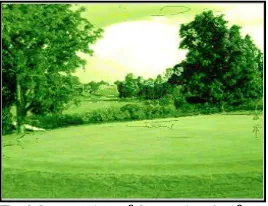
Color transfer is an image processing technique which can produce a new image combining one source image's contents with another image's color style. This article describes a method for a more general form of color correction that borrows one image’s color characteristics from another. We can imagine many methods for applying the colors of one image to another. Our goal is to do so with a simple algorithm, and our core strategy is to choose a suitable color space and then to apply simple operations there. When a typical three channel image is represented in any of the most well-known color spaces, there will be correlations between the different channels’ values. For example, in RGB space, most pixels will have large values for the red and green channel if the blue channel is large. This implies that if we want to change the appearance of a pixel’s color in a coherent way, we must modify all color channels in tandem. This complicates any color modification process. What we want is an orthogonal color space without correlations between the axes. Color can be added to greyscale images in order to increase the visual appeal of images such as old black and white photos, classic movies or scientific illustrations. Color transfer refers to the category of methods designed to change the color appearance of an image according to the color content of another image. The group of color transfer approaches contains two major categories of colorizing and recoloring. The Color transfer of the image is showon in the following figure. In this the reference color is transferred to the target image without changing the objects of target image.
Fig.2Color transfer Example
When we attempt to convert a greyscale source into a colored representation using the color information available in a reference image, the method is called colorizing. On the other hand, recoloring refers to the case where we wish to change the color appearance of a colored image to pretend another image’s color content [21]
II. RELATED WORK
ISSN(Online): 2320-9801
ISSN (Print) : 2320-9798
I
nternational
J
ournal of
I
nnovative
R
esearch in
C
omputer
and
C
ommunication
E
ngineering
(An ISO 3297: 2007 Certified Organization)
Vol. 3, Issue 9, September 2015
Rapid development has been witnessed in the last decade in the field of color transfer. Representative approaches include classical histogram matching, statistical transfer, N - dimensional probability density function transfer, gradient-preserving transfer non-rigid dense correspondence transfer , progressive transfer, to list a few. Although these approaches are effective in transferring the color information, they would occasionally produce visual artifacts, owing primarily to the contradictive roles of color distribution preservation and image content distribution. In 2001 Erik Reinhard et al[26] provided method for a more general form of color correction that borrows one image’s color characteristics from another. In 2002 Tomihisa Welsh et al.[25] has been introduced a general technique for “colorizing” grayscale images by transferring color between a source, color image and a destination, grayscale image . In 2004 G. Petschnigg et al.[24] introduced a Joint bilateral filter (JBF) which is the first guided edge-preserving smoothing approach. The JBF exploits the pixel intensity of the reference which is correlated to the target to improve the filtering effect. However, like the bilateral filter (BLF), JBF cannot avoid the halo artifact and gradient reversal problem. The grain effect can be treated as a special type of noises and it would be removed by linear smoothing. Although the linear smoothing can remove the grains, the over-blurring would destroy the original image details and lower the sharpness of edges. In 2007 Chang et al.[19] proposed a color category-based approach that categorized each pixel as one of the basic categories to prevent from the grain effect. Then a convex hull was generated in Lαβ color space for each category of the pixel set, and the color transformation was applied with each pair of convex hull of the same category. In 2007 for the color distortion Tai et al.[20] proposed a modified EM algorithm to segment probabilistically the input images and construct Gaussian Mixture Models (GMMs) for them, and the relationship was constructed by each Gaussian component pairs between the target and the reference under Reinhard’s approach. In 2010 Dong et al[14] proposed a dominant color idea for color transfer. When the amount of dominant colors of the target was consistent with that of the reference, the color of the reference would be transferred to obtain a satisfactory result. However, when the amount of dominant colors was not balanced, the unsatisfactory result would be produced. Dong’s proposed an improved approach distribution-aware conception to consider the spatial color distribution in the reference image. In 2011[11] Wang et al. developed the learning based color transfer methods to train out the proper color mapping relationship. Also tone and color adjustment rules as mappings has been defined, and proposed to approximate complicated spatially varying nonlinear mappings in a piecewise manner.
In 2012 Mrs. Smriti Kumar et.al[8] presented a general technique for “colorizing” grayscale images by transferring color between a source or color image and a destination or target or grayscale image by matching luminance and texture information between the images. This technique of the gray image coloring uses a very simple algorithm that chooses a decorrelated color space and then applies simple operations there. In 2013 Fuzhang Wu, et al.[6] presented a novel content-based method for transferring the color patterns between images. Unlike previous methods that rely on image color statistics, our method puts an emphasis on high-level scene content analysis. This method can also be used to re-color video clips with spatially-varied color effects . In 2013 Rashmi et. al.[4] presented different edge detection method. Different edge detection techniques as Prewitt, Robert, Sobel, Marr Hildrith and Canny operators. On comparing them conclusion is that canny edge detector performs better than all other edge detectors on various aspects such as it is adaptive in nature, performs better for noisy image, gives sharp edges , low probability of detecting false edges etc.
In 2014 Zhuo Su, et al[1] proposed a novel unified color transfer framework with corruptive artifacts suppression, which performs iterative probabilistic color mapping with self-learning filtering scheme and multiscale detail manipulation scheme in minimizing the normalized Kullback-Leibler distance.
III. PROPOSED ALGORITHM
A. Dataset Collection:
In this module dataset of various images would be found out for future evaluation. As it is example-based framework so we can consider any image. Standard dataset is not required.
B. Color Transfer and Detection of Corruptive Artifacts:
ISSN(Online): 2320-9801
ISSN (Print) : 2320-9798
I
nternational
J
ournal of
I
nnovative
R
esearch in
C
omputer
and
C
ommunication
E
ngineering
(An ISO 3297: 2007 Certified Organization)
Vol. 3, Issue 9, September 2015
C. Suppression of corruptive artifact and Modification of Example-based color transfer algorithm:
This module would consist of proper color transfer algorithm to suppress corruptive artifacts by using patch based method from the points where they are detected. And we have to achieve grain suppression, color fidelity and detail manipulation by providing novel technique. Time performance would be reduced. And also edge preservation is also find out.
D. Result Evaluation and Optimization:
In this module, result would be evaluated and optimized if required. Result would be in the form of delay, and accuracy of detection.
IV.IMPLEMENTATION
One of the most common tasks in image processing is to alter an image’s color. Grain suppression, color fidelity and information loss these are the important parameters to be satisfied. A novel technique has proposed to detect and suppress corruptive artifacts by improving time performance. The implemented methodology has to provide the color transformation and suppression of corruptive artifacts by improving Time performance. The project has gone through the following phases:
A. Colorization of Image
In the color transfer stage, Ycbcr technique is used to transfer the color. In the color transfer method the background effects of reference image transfer to the target image. For colorization purpose we convert our source image into a decorrelated color space and en find the minimum difference between pallet and gray image. After finding minimum difference we replace gray (x,y) with pallet (x,y). And after RGB conversion colorizing image is obtained. In the Gray image and Color image is given as a input.Colorization is shown in the fig.4.
Fig.3Input Gray Image and Color Image
Fig.4Colorized Image B. Detection Of Corruptive Artifacts
In the color transfer technique the color is transfered from reference image to the target image. Due to the big difference in the intensity distribution between the reference and the target, an unsatisfactory transferred result was produced, with remarkable artifacts. Artifacts are various types like grain suppression, color fidelity and detail preservation. So after colorization of image detection of artifacts is carried out by applying Laplacian of Gaussian and
canny edge detection. To satisfy these requirements Canny used the calculus of variations – a technique which finds the
function which optimizes a given functional. The optimal function in Canny's detector is described by the sum of four exponential terms, but it can be approximated by the first derivative of a Gaussian.
Laplacian of Gaussian
ISSN(Online): 2320-9801
ISSN (Print) : 2320-9798
I
nternational
J
ournal of
I
nnovative
R
esearch in
C
omputer
and
C
ommunication
E
ngineering
(An ISO 3297: 2007 Certified Organization)
Vol. 3, Issue 9, September 2015
To include a smoothing Gaussian filter, combine the Laplacian and Gaussian functions to obtain a single equation
( , ) =− [1- ]
where x is the distance from the origin in the horizontal axis, y is the distance from the origin in the vertical axis, and σ
is the standard deviation of the Gaussian distribution. Figure 5 shows the output for the detection of corruptive artifact.
Fig. 5Detection of Corruptive Artifact C. Suppression of corruptive artifacts
After the detection of artifacts from colorizing image in the form of edges suppression of artifact is carried out. Patch
Based method is used for the suppression of corruptive artifacts. Restoring damaged regions of an image and removing
undesired objects are termed as imageinpainting. The basic idea is to fill in the lost or broken parts of an image using the surrounding information in such a way that the final restored result appears to benatural to a not familiar observer These specified regions are called inpainting domain ortarget regions and the undamaged parts, in whichinformation is used to repair the target region, are called source regions. In the example-based algorithms, the unknown blocks of target region are inpainted by the most similar blocksextracted from the source region, using the availableinformation.
Fig.6 Suppression of Corruptive Artifacts
For the suppression patch based method is used. We divide the image into patches. Next we go to each patch and find the best matching other patch for replacement. Check if noise is present in the patch. Noise is present so find the next patch. Check if a noise free pixel is found and previous patch is noisy, so check the next patch. Next patch also has a noisy pixel in the same area, so we cannot use it. In this way suppression using patch based method is carried out. Suppression of corruptive arifact is shown in fig.6
D. Improvement of algorithm to apply on color image
A novel technique to suppress corruptive artifacts for example based color transfer framework is proposed a technique which colorize the image, detect the corruptive artifact and suppress it. It also preserves edges. Time performance is improved in this system. In our system grain suppression,color fidelity and information loss are satisfied by reducing noise, increasing color fidelity and reducing information loss. This modification is implemented.
V. RESULTS ANALYSIS
ISSN(Online): 2320-9801
ISSN (Print) : 2320-9798
I
nternational
J
ournal of
I
nnovative
R
esearch in
C
omputer
and
C
ommunication
E
ngineering
(An ISO 3297: 2007 Certified Organization)
Vol. 3, Issue 9, September 2015
Kullback-Leibler Distance Comparison
The Kullback-Leibler distance (K-L) can measure the similarity between two completely determined probability distributions.Here, we apply it to measure the difference betweenthe reference and transferred result in color transfer.
Fig.7 Graphical representation of KL distance
Here we have the comparison of KL distance for different method with our method. KL distance should be minimum as shown in figure 7.
Time Performance Comparison
We adopted the experimental runtime to measure our approach, and compared it with other approaches. We selected different sizes as the tested samples. Histogram matching and Reinhard’s approach had an efficient runtime response. However, as mentioned above, both of them were hard to obtain a satisfactory visual performance. Xiao’s gradient-preserving approach and Pitié’s N-dimensional PDF approach required too much time, because both of them needed to solve a large-scale optimization equation. Especially, if the size was over large, these two approaches would break down. By contrast, our approach had a sound time response and was better than previous approaches in usability. Time is calculated by taking difference of end time and start time.
Fig.8 Graphical representation of Time
Time performance of proposed methodology is minimum as compared to Traditional method as shown in fig. 8
VI.CONCLUSIONANDFUTUREWORK
Proposed method is applicable to images taken under a variety of conditions, is faster than our previous method. In our system a novel technique is used to colorize the image. During colorization whatever artifacts are produced that is detected and suppressed by using novel technique for example based color transfer framework. It gives the faster colorization of image than previous method by reducing grain suppression and improving color fidelity and detail preservation. In the future, we will extend our framework for video editing. . We also would like to develop a method to handle video with more clarity and faster.
0 5 10 15 20 25 30
Hist Reinhard GradPrev NPDF Multiscale
method
Novel technique
D
is
ta
n
c
e
Technique
KL(min)
KL(max)
0 5 10 15 20 25 30 35 40
Hist. Reinhard GradPrev. NPDF Multiscale Novel
technique
Ti
m
e
(s
e
c
)
Technique
T(max)
ISSN(Online): 2320-9801
ISSN (Print) : 2320-9798
I
nternational
J
ournal of
I
nnovative
R
esearch in
C
omputer
and
C
ommunication
E
ngineering
(An ISO 3297: 2007 Certified Organization)
Vol. 3, Issue 9, September 2015
REFERENCES
1. Zhuo Su, Student Member, IEEE, Kun Zeng, Li Liu, Bo Li, and XiaonanLuo.”Corruptive Artifacts Suppression for Example-Based Color Transfer” IEEE Transaction on multimedia, Vol. 16, no. 4, June 2014 .
2. ChetanBhele, Aslam Kazi(Electronics Department, AISSMS College of Engineering Pune, India)Image Inpainting Using Patch Sparsity IOSR Journal of Electronics and Communication Engineering (IOSR-JECE) e-ISSN: 2278-2834,p- ISSN: 2278-8735.Volume 9, Issue 2, Ver. VIII (Mar - Apr. 2014), PP 121-125www.iosrjournals.org
3. Christian Ledig,,Wenzhe Shi, Wenjia Bai, Daniel Rueckert Department of Computing, Imperial College London 180 Queen’s Gate, London SW7 2AZ, UK ”Patch-based Evaluation of Image Segmentation” IEEE trans. Visualiz. Comput. Graph.2014
4. Rashmi , Mukesh Kumar, and Rohini Saxena “Algorithm and Technique on various edge detection : A Survey” Signal & Image Processing : An International Journal (SIPIJ) Vol.4, No.3, June 2013
5. Mukesh Kumar, and Rohini Saxena Department of Electronics and Communication Engineering, SHIATS- Allahabad, UP.-India “ALGORITHM AND TECHNIQUE ON VARIOUSEDGE DETECTION: A SURVEY” Signal & Image Processing : An International Journal (SIPIJ) Vol.4, No.3, June 2013.
6. Fuzhang Wu, Weiming Dong, Yan Kong, Xing Mei, Jean-Claude Paul, Xiaopeng Zhang.”Content-Based Colour Transfer” Computer Graphics Forum , Wiley - Blackwell, 2013, 32 (1), pp. 190-203. <10.1111/cgf.12008>. <hal 00937188>
7. Pranali Dhabekar, Geeta Salunke “The Examplar-based Image Inpainting algorithm through Patch Propagation” International Journal of Recent Technology and Engineering (IJRTE) ISSN: 2277-3878, Volume-1, Issue-4, October 2012
8. Mrs. Smriti Kumar1, Mr. Deepak Singh(Department of Electronics and Telecommunication, ChhatrapatiShivaji Institute of Technology, India) “Colorization of Gray Scale Images in YCbCr Color Space Using Texture Extraction and Luminance Mapping” ISSN: 2278-0661 Volume 4, Issue 5 (Sep.-Oct. 2012), PP 27-32
9. Ping Zhou ,Wenjun Ye, Yaojie Xia, Qi Wang “An Improved Canny Algorit- hm for Edge Detection” Journal of Computational Information Systems 7:5 (2011) 1516-1523
10. S. Paris, S. W. Hasinoff, and J. Kautz, “Local Laplacian filters: Edge-aware image processing with a Laplacian pyramid,” ACM Trans. Graph.,
vol. 30, no. 4, pp. 1–12, 2011.
11. B. Wang, Y. Yu, and Y.-Q. Xu,“Example-based image color andtone style enhancement,” ACM Trans. Graph., vol. 30, no. 4, pp. 64:1–64:12, 2011.
12. T. Pouli and E. Reinhard, “Progressive color transfer for images of arbitrary dynamic range,” Comput. Graph., vol. 35, no. 1, pp. 67–80, 2011.
13. Z. Farbman, R. Fattal, and D. Lischinski, “Diffusion maps for edgeaware image editing,” ACM Trans. Graph. (Proc. ACM SIGGRAPH Asia 2010), vol. 29, no. 6, pp. 145:1– 145:10, 2010.
14. W. Dong, G. Bao, X. Zhang, and J.-C. Paul, “Fast local color transfer via dominant colors mapping,” ACM SIGGRAPH Asia 2010Sketches,pp. 46:1–46:2, 2010
15. X. Xiao and L. Ma,―Gradient-preserving color transfer,‖ Comput. Graph. Forum, vol. 28,no. 7, pp. 1879–1886, 2009.
16. Z. Farbman, R. Fattal, D. Lischinski, and R. Szeliski, ―Edge-preserving decompositions for multi-scale tone and detail manipulation,
ACMTrans. Graph., vol. 27, no. 3, pp. 67–76, 2008.
17. S. Paris, P. Kornprobst, J. Tumblin, and F. Durand,―”Bilateral filtering: Theory and application”, in Proc. Computer Graphics and Vision 2008.
18. R. C. Gonzalez and R. E. Woods, Digital Image Processing, 3rd ed. Upper Saddle River, NJ, USA: Prentice Hall, 2008.
19. Y. Chang, S. Saito, and M. Nakajima, “Example-based color transformation of image and video using basic color categories,” IEEE Trans.
Image Process., vol. 16, no. 2, pp. 329-336, 2007
20. Y. Tai, J. Jia, and C. Tang, “Soft color segmentation and its applications,” IEEE Trans. Pattern Anal. Mach. Intell., vol. 29, no. 9, pp. 1520– 1537, 2007
21. A. Abadpour and S. Kasaei, “An efficient PCA-based color transfer method,” J. Visual Commun. Image Represent., vol. 18, no. 1, pp. 15–34, 2007.
22. Konstantinos G. Derpanis “Outline of the relationship between the difference-of-Gaussian and Laplacian-of-Gaussian” September 19, 2006 23. F. Pitié, A. C. Kokaram, and R. Dahyot, “N-dimensional probablility density function transfer and its application to colour transfer,” in
Proc.10th IEEE Int. Conf. Computer Vision, 2005, vol. 2, pp. 1434–1439.
24. G. Petschnigg, R. Szeliski, M. Agrawala, M. Cohen, H. Hoppe, and K. Toyama, “Digital photography with flash and no-flash image pairs,”
ACM Trans. Graph. (Proc. ACM SIGGRAPH 2004), vol. 23, no. 3, pp. 664–672, 2004
25. T. Welsh, M. Ashikhmin, and K. Mueller, “Transferring color to grayscale images,” ACM Trans. Graph., vol. 21, no. 3, pp. 277–280, 2002. 26. E. Reinhard, M. Ashikhmin, B. Gooch, and P. Shirley, “Color transfer between images,” IEEE Comput. Graph. Applicat., vol. 21, no. 5, pp.