IJHR
Open Access
Abstract
Background and Objectives: Hospital is the largest and most costly operating unit of healthcare system. Provision of optimal care requires that hospital administrators identify hospital performance based on rel-evant indicators. This study used the Pabon Lasso analysis to assess the performance of hospitals and identify strategies towards an improved hospital performance.
Methods: This cross-sectional descriptive study involved all the eight general hospitals affiliated to Tehran University of Medical Sciences. Data on average length of stay, bed occupation and bed turnover rates were collected using questionnaire.
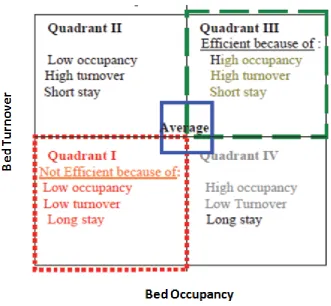
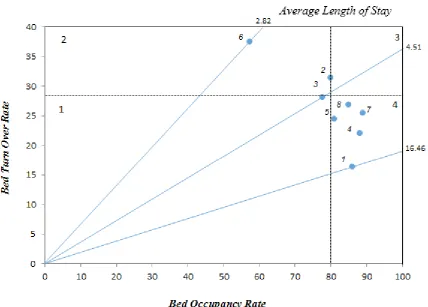
Findings: The overall average length of stay, bed occupation and bed turnover rates were 4.78 days, 79.95% and 28.36, respectively. One hospital demonstrated inefficiency and underutilization of resources by falling into Zone I, two hospitals located in Zone II, and five hospitals were placed in Zone IV. None of the hospitals were located in Zone III which represents a satisfactory level of efficiency.
Conclusions: The study showed the studied hospitals have generally low performance as indicated by Pabon Lasso analysis. The administrators should therefore seek a strategy for balancing average length of stay, bed occupation and bed turnover rates for an improved hospital performance.
Keywords: Hospital management; Performance assessment; Pabon Lasso Analysis; Average length of stay; Bed occupation rate;Bed turnover rate
*Corresponding author: Mohamad Hoseini Kasnaviyeh, Department of Emergency Care, School of Medicine, Iran University of Medical Sciences, Tehran, Iran, P.O.Box:…, Tel: +98 21 552 85 85, Email: [email protected]
Hospital Performance Based on Pabon
Lasso Model
Gholamreza Masoumi
1, Mohamad Hoseini Kasnaviyeh
1*, Alireza Tahrizadeh
2, Mohamad Panahi
3,
Ebrahim Najafi
41 Department of Emergency Care, School of medicine, Iran University of Medical Sciences, Tehran, Iran 2 Department of Health Care Management,
School of Management, Islamic Azad University, Science and Research Branch, Tehran, Iran 3 Department of Health Care Management, School of
Health, Tehran University of Medical sciences, Tehran, Iran 4 Department of Accounting , School of Accounting and Management, Allameh Tabatabee
University, Tehran, Iran
Background and Objectives
Patient satisfaction is an outcome of various factors in a hospital [1]. It can be considered as a condition in which patients feel comfortable in their stay in the hospital. While medical care plays a vital role in patient satisfac-tion, other situational factors are important as well [2]. Some authors consider patient satisfaction as a key to the success of the hospitals [3]. Moreover, this variable is of absolute importance in quality-assessment activities as its comprehensive analysis can highlight noble and prob-lematic aspects of each hospital.
In a study across 21 European countries, it was concluded that predictors of patient satisfaction with
the healthcare system were patient experience by
responsiveness domains, patient expectations, self-reported health status, type of care by provider type, personality, and vignette score, respectively [4]. High
levels of satisfaction suggest physical and psycho-logical improvement of the patients while low levels of satisfaction is predictive of agitation, anxiety, longer stay in hospital, and consequently, higher charges [5]. Patient satisfaction seems to be a continuous con-struct, resulting from emotional reactions and cogni-tive evaluations of the patient during his/her stay in the hospital. Nowadays, evaluation of the level of pa-tient satisfaction is recognized as an important index of the healthcare quality, and plans for its improve-ment have increased [6].
outcome of hospital services. Secondly, it can pre-dict future behavior of the patients. And thirdly, it is directly related to the quality of care, in interpersonal and organizational areas, as well as its technical do-mains [8].
Therefore, precise assessment of patient satisfac-tion is a valuable source of informasatisfac-tion for hospital managers in order to identify shortcomings and de-velop plans of action accordingly. Data from patient satisfaction assessment may also be used for qual-ity-improvement purposes in the medical settings. Recognizing and improving the problematic aspects of nursing and other factors should be considered by managers in the field [9].
In Iran, some hospitals and studies measure the level of patient satisfaction using non-validated instruments. Adopting haphazard measurement approaches runs the risk of yielding inaccurate data [10].
Assessment of patient satisfaction has gained much attention during the past few years in Iran. The Ministry of Health and Medical Education has im-posed obligations on the hospitals to measure patient satisfaction and make plans for its improvement [11].
In this respect, validated Farsi instruments are cur-rently lacking. Yet, translating the Western instru-ments appears to be inappropriate due to structural differences between the Western and Iranian health-care systems and cross-cultural disparities.
The present study aimed to develop and validate a preliminary version of Brief Inpatient Satisfaction Scale (BISS) via exploratory methods. The primary taxonomy of items consisted of four parts, namely
physician care, nursing care, living arrangements,
and communication.
Methods
Item generation
Considering the European models of patient satisfac-tion assessment, a primary item pool of 32 items was generated. In the process of item generation, the com-ments of two head nurses, two hospital managers, one physician, and one psychometrics expert were taken into account. Some items were translated and reword-ed from a French study [8]. Results from the interviews with ten patients were also considered. These 32 pri-mary items appeared to cover the factors presenting in the literature. The items were declarative statements using an eleven-point Likert type scale ranging from “Strongly agree” to “Strongly disagree”.
Item review
The item pool was reviewed by the authors, and com-ments from the patients led to minor rewordings due to poor comprehension. No additional items were proposed in this stage. The final item pool consisted of 32 items re-late to four dimensions; nursing care, physician care,
liv-ing arrangements, and communication were four desired
components of the BISS. Each part contained 8 items.
Item selection
The item pool was administered to 637 patients recruited from Moheb hospital (Tehran, Iran) in autumn 2013. Cri-teria for exclusion of items were then set: (1) proportion of missing values higher than 10%, (2) extreme deviation from the normal curve in response patterns using skew-ness and kurtosis indices, and (3) inappropriate loadings in Exploratory Factor Analysis (EFA).
Data transformation
Questionnaires with more than five missing values were excluded. Each item scored from 10 (Complete satisfac-tion) to 0 (Complete dissatisfacsatisfac-tion). No reverse scoring was required. Overall patient satisfaction score was cal-culated by summing all of the items’ scores.
Content validity
Content validity is evaluated in two terms. One is that the instrument appears valid to an expert in the field, the oth-er is that it covoth-ers all of the required facets of the concept being measured. The authors evaluated the content valid-ity of the instrument. Two existing instruments were used to evaluate if the instrument covers the required aspects.
Construct validity
of the instrument. The homogeneity of the factors was evaluated using item-total correlation.
Reliability
Cronbach’s alpha coefficient was used to assess the in-ternal consistency of subscales and total scale as a mea-sure of reliability. Value of 0.7 was considered minimum
acceptable value for the alpha coefficient.
Ethics
The verbal consent of all participants was obtained before administering the questionnaires. Moreover, all respondents were assured of the confidentiality of their responses.
Table 1 Hospital performance indicators in the studied hospitals
BOR BTO
ALS Hospital name
Hospital ID
85.83 16.46
6.62 Imam Khomeini
1
79.74 31.58
4.54 Baharlou
2
77.36 28.28
4.51 Hazrat Rasoul
3
87.84 22.19
6.69 Dr. Shariati
4
80.72 24.63
4.83 Sina
5
57.17 37.57
2.82 Ziaeian
6
88.68 25.64
6.14 Firouzgar
7
84.77 26.95
5.43 Vali -Asr
8
79.95 28.36
4.78 Mean
Statistical analysis
Data entry and analysis were performed in a blinded manner by the personnel who were not involved in the process of data collection. P < 0.05 was considered as statistical significance. Statistical analysis was performed using Statistical Package for the Social Sciences (SPSS) software (version 21.0; SPSS Inc, Chicago, Illinois).
Results
After meeting the exclusion criteria for participants, 637 valid questionnaires were entered into the soft-ware. Demographic characteristics of the patients are present in Table 1.
Item selection
Two items had more than 10% of missing values. The re-sponse pattern of one item deviated significantly from the normal curve and presented ceiling effect. A ceiling effect is said to occur when a high proportion of subjects in a study have maximum scores in an item. Consequently, three items were excluded in the first stage of item analysis.
Content validity
The authors examined the remaining items for content va-lidity. Four parts of the instrument were present and sig-nificantly correlated. The correlation coefficients between the subscales are present in Table 2.
Construct validity
EFA was performed on the remaining 29 items. The KMO measure of sampling adequacy was 0.941. Since, the minimum value of this measure for adequacy of data ma-trix for factorability is 0.6 [12], it can be cited that data matrix has the required assumptions for factor analysis. Bartlett’s test was also significant. These tests suggest the factorability of the instrument. Scree plot revealed that four factors could be extracted as predicted. The extract-ed factor’s structure was similar to the prextract-edictextract-ed parts of the scale. The four factors were named as physician care,
nursing care, living arrangements, and communication.
They explained 32.2%, 6.1%, 3.5%, and 2% of the total variance, respectively. Cumulatively, 43.8% of the total variance was explained by these four factors. The results of exploratory factor analysis are present in Table 3.
Reliability
The internal consistency coefficient was higher than 0.7 for four subscales and the total instrument. Considering all 26 remaining items, the total alpha coefficient was 0.91. Cronbach’s alpha coefficients of subscales and their corrected item-total correlation coefficients are presented in Table 4.
Discussion
The purpose of this study was to develop and vali-date the preliminary version of Brief Inpatient Satis-faction Scale. Since the most common technique for collecting data on patient satisfaction is surveying, this short instrument would aid hospital managers for action-planning.
Primarily, 32 items were generated in an eleven-point Likert scale. Item analysis suggested that 6-point Likert scale would benefit the results of the survey. Psychometric reasons support the fact that the higher 6-point Likert scale would be more satis-factory in the hospitals of this quality. Since, the lower 5 points on the Likert scale did not earn much at-tention, it can be concluded that similar hospitals do not need to utilize the whole continuum of the Lik-ert scale. In hospitals of different quality, symmetric 6-point Likert scale is suggested.
Two items were excluded for having more than 10% missing values. One item was excluded for ceiling ef-fect. Content validity was insured. Then exploratory factor analysis was performed to extract the final fac-tors. Four factors were, finally, identified as the prima-ry taxonomy of items predicted. Due to inappropriate loadings, three other items were discarded as shown in Table 3. The remaining items constituted four sub-scales, which were named physician care, nursing
care, living arrangements, and communication.
The items pertaining to physician care and
nurs-ing care were perfectly loaded as predicted by the
primary taxonomy. The items of the third and fourth factors were a little interfered. They need reconsid-eration and rewording in order to be loaded in a sat-isfactory manner.
This scale is called brief because of its short length. Some similar questionnaires such as Patient Judgment Hospital Questionnaire [13], Lutheran General Health System [14], and British Survey of Hospital Patients [15] consist of 42, 44, and 57 items, respectively.
Using the Western literature may be a reason for inappropriate cross-loadings in the two factors. Utiliz-ing qualitative methods to develop a scale is techni-cally more precise and would lead to more accurate
data; more importantly, developing an Iranian model based on qualitative methods would lead to an inte-grated theoretical framework. This methodology is strongly recommended for future studies.
It needs to be said that a U-shaped relationship be-tween the length of time after discharge and patient satisfaction has been described in previous studies [16]. For this reason, it appeared inappropriate to as-sess test-retest reliability because the time period had to be sufficiently long to allow the effects of memory to fade but not too long to allow complex phenome-non of maturation to occur in patient satisfaction [17]. Therefore, only Cronbach’s alpha coefficients were calculated to assess reliability. Alpha coefficients of two subscales were satisfactory, while two other co-efficients were marginally appropriate. Edition of the items related to these factors would increase the in-ternal consistency in the final version of BISS.
Finally, this scale may be used with caution to mea-sure inpatient satisfaction in hospitals because the psychometric properties were not strong enough. The preliminary version of BISS consists of 26 items mea-suring four distinct subscales. The items pertaining to living arrangements and communication need to be reworded or otherwise edited to yield satisfactory re-sults in the final version of the instrument.
Study Limitations
Since the sampling method of the current study was con-venience sampling method from one hospital, external validity of the instrument may not be adequate. Further research in various hospitals would insure the external validity of the scale in future. While preliminary results from this study are promising, it is important not to over-generalize the findings. It is recommended that future re-search investigate the properties of BISS using confirma-tory factor analysis (CFA).
Conclusions
The results of this study support the reliability and valid-ity of BISS. Factor structure supported the presence of four factors as predicted. More research is required for further development and validation of this instrument in other settings.
Abbreviations
Competing Interests
The authors declare no competing interests.
Authors’ Contributions
MA made substantial contribution to conception and design-ing of the reseach. SAZ provided some methodological sug-gestions and constributed to analysis of the results, MA was involved in interpretation of the results and drafting the manu-script, NN critically revised the manuscript. All authors read and approved the final manuscript.
References
1. Qureshi W, Nazir AK, Ajaz AN, et al. A case study on patient satisfaction in SMHS hospital, SRINGAR. J Hosp Today 2005; 12(3): 154-155.
2. Grogan S, Conner M, Willits D, Norman P. Development of a questionnaire to measure patients' satisfaction with gen-eral practitioners' services. Brit J Gen Pract 1995; 45(399): 525-529.
3. 3. Mosadegh Rad A M. The evaluation of the degree of sat-isfaction of patients from admission services in Razi Hospi-tal in Qazvin. Health INF Manage 2004; 1(1): 28-32. 4. World Health Survey. Geneva: World Health Organization;
2003. Available from: http://www.who.int/healthinfo/survey/ en/index.html.
5. Bahrami M, Nagy E. Patient satisfaction in attending to emergency services representative Medical Sciences Med-ical Center. Iranian J Nursing Midwifery Res 2001; 15(1): 45-40.
6. Bredart A, Coens C, Aaronson N, Chie WC, Efficace F, Con-roy T, et al. Determinants of patient satisfaction in oncology settings from European and Asian countries: Preliminary results based on the EORTC IN-PATSAT32 questionnaire. Euro J Cancer 2007; 43(2): 323-30.
7. Cleary P, McNeil B. Patient satisfaction as an indicator of quality of care. Inquiry 1988; 25(1): 25-36.
8. Labarere J, Francois P, Auquier P, Robert C, Fourny M. De-velopment of a French inpatient satisfaction questionnaire. Int J for Qual in Health Care 2001; 13(2): 99-108.
9. Gholjeh M, Ghaljaee F, Mazloom AR. Correlation between nurses' practice ability and patient satisfaction of nursing care. Pub Shahid Beheshti School of Nursing and Midwifery 2008; 18(63): 12-19.
10. DeVellis R. Scale Development: Theory and Applications (3rd Ed). California: Sage publications, 2012.
11. Jafari GA, Khalifegari S, Danaii k, Dolatshahi P, Ramezani M, Roohparvar R, Sabaghiyan PA. Hospital accreditation standards in Iran. Tehran: Sound Publication Center. 2010. 12. Tabachnick, B.G. & Fidell, L.S. Using Multivariate Statistics
(5th Ed.). New York: Allyn and Bacon, 2007.
13. Hays R, Nelson E, Rubin H, Ware J, Meterko M. Further evaluations of the PJHQ scales. Med Care 1990; 28: 29-38. 14. Carey R, Seibert J. A patient survey system to measure
quality improvement: Questionnaire reliability and validity.
Med Care 1993; 31: 834-845.
15. Bruster S, Jarman B, Bosanquet N et al. National survey of hospital patients. Brit Med J 1994; 309(1): 1542-1549. 16. Rubin H. Patient evaluations of hospital care: A review of
the literature. Med Care 1990; 28: 3-9.