Thinking Big about Mathematics, Science,
and Technology: Effective Teaching
STEMS from big ideas
Chris Hurst
Corresponding author: [email protected]
School of Education, Curtin University, Perth, WA, 6845, Australia
Keywords: big ideas, connected knowledge, curriculum development, common ideas
International Journal of Innovation in Science and Mathematics Education, 23(3), 11-21, 2015.
Abstract
Current discussion amongst mathematics and science educators seeks to clarify the nature of STEM education. This paper considers the benefits of an integrated view of STEM. Recent mathematics curricula, such as the Common Core State Standards for Mathematics (USA) and the Australian Curriculum: Mathematics, present content in a traditional linear and compartmentalised manner, rather than accentuate the connections between the “big ideas” of mathematics. Both curricula pay lip service to the “big process ideas” (or proficiencies) that should be the vehicles for exposing links between and within the “big content ideas”. To some extent, the same criticism could be levelled at the Australian Curriculum: Science although it at least embeds key process ideas in one of three strands: Science Inquiry Skills. As well, both the Australian Curriculum: Science and the Australian Curriculum: Technologies acknowledge that understandings do not develop within the confines of a single year. It is suggested here that it may be beneficial to re-think the nature of key content and to organise it for teaching based on the “big ideas” of mathematics, science, and technology, emphasising the connections within and between them. This paper suggests that in attempting to deal with widely perceived “crowded curriculum”, teachers could consider the similarities between the big ideas of mathematics, science, and technology, and make the connections explicit for children.
Introduction
In these days of high stakes testing and international scrutiny, teachers are under pressure to cover the content of curricula that are perceived by many to be increasingly crowded, a problem that has been noted in many quarters, particularly in Australia and USA. In the introduction to the Common Core State Standards for Mathematics, the National Governors’ Association Centre for Best Practices noted that “the standards must address the problem of a curriculum that is a mile wide and an inch deep” (NGA Center, 2010, p. 3). Similarly, Siemon, Bleckly, and Neal (2012, p. 20) recently supported that call in stating that “a focus on the big ideas is needed to ‘thin out’ the over-crowded curriculum”. Perhaps the traditional linear model for organising curriculum content is no longer adequate, and what is needed is for teachers to hold and teach mathematics, science, and technology content knowledge in a different way. It could be along the lines of the big ideas of mathematics, science, and technology, emphasising the links and connections within and between those ideas.
This paper makes two main assertions. First, teachers could benefit from undertaking an analysis of mathematics, science, and technology curricula with a view to identifying common content ideas within such documents and explicitly basing their teaching in those learning areas on common connected ideas. These are referred to here as the “big content ideas”. The premise being put here is that the big content ideas of mathematics underpin and inform much of the
content of the other curricula, and that they can also be developed through the contexts of the science and technologies curricula. Second, whilst there are common content ideas between the three learning areas, there is also mention made of how content can be developed. This is, however, presented in markedly different ways. It is completely embedded throughout the Australian Curriculum: Technologies, and in the Australian Curriculum: Science is contained in one of three content strands: Science Inquiry Skills. The Australian Curriculum: Mathematics describes a statement about Proficiencies that are “actions in which students can engage when learning and using the content” (ACARA, 2015a, p. 3) yet that statement is separate from the content strand statements. Such ideas are referred to here as “big process ideas”. The opportunity to make teaching more dynamic is clearly presented in the curriculum documents; it rests with teachers to interpret those documents in innovative ways, as suggested in this paper. It also rests with curriculum developers to encourage teachers to view curricula differently and to take, where possible, an integrated view of STEM education at least in the primary and middle years of schooling.
What do the “big content ideas” of mathematics and science look like?
The notion of “big ideas” is not new and can probably be traced back at least to the work of Bruner (1960) with regard to concept attainment and the spiral curriculum. Later, Clark cited Bruner’s work in describing the importance of concepts in this way:
My working definition of “concept” is a big idea that helps us makes sense of, or connect, lots of little ideas. Concepts are like cognitive file folders. They provide us with a framework or structure within which we can file an almost limitless amount of information. One of the unique features of these conceptual files is their capacity for cross-referencing (Clark, 1997, p. 94)
Clark described the power of linkages and the capacities of associations to promote sense- making and transfer of learning, and it is interesting how he equated the term “concepts” with “big ideas” and notes how they “provide the cognitive framework that makes it possible for us to construct our own understandings” (Clark, 1997, p. 98). Hiebert and Carpenter (1992) had also noted the importance of a “network of representations” for development of understanding whilst Askew, Brown, Rhodes, Wiliam, and Johnson (1997) found that the most effective teachers taught from a “connectionist” standpoint. The view taken here is that concepts can be equated to big ideas in that there are myriad connections between the component parts of each concept or big idea that enable a richer understanding to be developed.
The big ideas of mathematics
Big ideas of mathematics have been variously described. Charles (2005, p. 10) described big ideas as those which “link numerous mathematical ideas into a coherent whole”. He identified twenty-one such ideas including equivalence, the base ten number system, estimation, patterns, proportionality, and orientation and location. Siemon, Bleckly, and Neal (2012) concentrated on “big number ideas” and identified trusting the count, place value, multiplicative thinking, multiplicative partitioning, proportional reasoning, and generalising. Others (Hurst & Hurrell, 2014) have built on the work of Siemon et al. (2012) in identifying “micro content” or component parts that comprise big number ideas or concepts. Both Charles (2005) and Siemon et al. (2012) noted that it would be unlikely to gain agreement from mathematicians or teachers as to what exactly constituted the big idea’. In keeping with that, Clarke, Clarke, and Sullivan (2012) also discussed big ideas, noting that their value lies in stimulating teachers to deconstruct their own conceptual structures and to them thinking differently about their mathematical content knowledge, rather than gaining agreement about any set list of ideas. All
of this is preceded by the seminal work of Ma (1999) who did not use the term “big ideas” but described “knowledge packages” as being the way in which ideas are organised and developed. She also described “concept knots” that represent the vehicles for connecting and linking ideas that are related to one another (Ma, 1999). If teachers can view mathematics in a connected way and make connections within big ideas and with similar concepts in science and technology explicit for their students, it is possible to overcome the crowded and “mile wide-inch deep” view of curriculum.
The big ideas of science
While it has been suggested above that neither the Australian Curriculum: Mathematics (ACARA, 2015a) nor the Common Core Standards for Mathematics (NGA Centre, 2010) really address the notion of big content ideas and only pay a measure of lip service to the big process ideas, the Australian Curriculum: Science (AC: Science) (ACARA, 2015b) fares somewhat better. This section analyses the latter document (AC: Science) and links its contents to the big ideas of mathematics. The AC: Science contains a succinct rationale and statement of aims which is followed by the content structure of the curriculum based on three strands: Science Understanding, Science as Human Endeavour, and Science Inquiry Skills. There follows a short discussion of relationships between the strands which perhaps alerts teachers to the need to connect the content and process ideas but, due to its brevity, the statement can be easily passed over. The real strength of the AC: Science lies in the statement about Overarching Ideas. In this, there is a genuine attempt to highlight the big content ideas of science. Hence, the six overarching ideas will provide an analytical lens through which the many rich connections to be made to the big content ideas of mathematics can be viewed. Table 1 contains a summary of the connections between the big ideas of science and mathematics which is expanded in the discussion that follows.
Overarching Idea #1: Patterns, order and organisation
The AC: Science discusses the importance of classifying objects and events into groups based on characteristics and looking for patterns of similarity and difference (ACARA, 2015b). This is very similar to early and pre-number experiences in mathematics. Classification into groups based on features forms the basis of grouping and counting just as it underpins key science ideas. This link should be made explicit and constantly emphasised – the joint notions of comparing, classifying, patterns, ordering, matching form the basis of much mathematical and scientific knowledge that they warrant being highlighted as big content ideas throughout primary and elementary education.
Table 1
Linking big content ideas of science and mathematics
Big science ideas Big mathematics ideas
Patterns, order and organisation – Classification of objects and events into groups. Developing criteria for identifying patterns of similarity and difference. Role of scale in certain patterns.
Early number experiences – Pattern, classification, grouping, sorting. Factors and multiples, multiplicative patterns and relationships. Scale.
Form and function – Relationships between the make-up of an object and its uses.
Factors, multiples and primes. Divisibility rules. Tessellations and 2D shapes.
Observations of living things and materials to study link between form and function. Progress to large and small structures.
Multiplicative thinking, relative magnitude of numbers.
Stability and change – Relativeness of stability and change with different objects and situations. Competing and balanced forces.
Measurement principles, data collection, organisation and representation. Proportional reasoning
Scale and measurement – Quantification of time and spatial scale. Very large and very small numbers. Slow processes over time. Rates of change.
Multiplicative thinking, relative magnitude of numbers. Proportional reasoning Measurement concepts. Base ten number system.
Matter and energy – Observation of phenomena and materials in terms of flow of energy and/or matter. Role of energy and matter in the ways in which living things and objects change.
Conservation of number. Flexible partitioning of numbers. Division and equal sharing. Prime and composite numbers and remainders. Algebraic thinking – balance and equivalence.
Systems – Thinking in terms of systems to understand, explain and predict phenomena. Interdependent relationships between systems components. Balance and equilibrium. Inputs and outputs
Fraction, decimal and percentage. Ratio and proportional reasoning.
Algebraic thinking – balance and equivalence, function.
The AC: Science also describes that students should understand how “scale plays an important role in the observation of patterns [and that] some patterns may only be evident at certain time and spatial scales [such as] the pattern of day and night [which] is not evident over the time scale of an hour” (ACARA, 2015b, p. 8). There is an interesting parallel with mathematics here. Multiples of certain numbers will not be present or evident unless the number of which they are multiples is amongst the group (e.g., there are no multiples of 1000 in the numbers 1 to 999). As children learn more about the cyclical pattern that repeats in the naming and writing of numbers, they understand even more about how the pattern works. Children often have difficulty with the naming of numbers beyond 1000 and tend to call them “millions”. They need to see how the pattern of numbers (and naming them) beyond 1000 is the same for groups of ones: that is, the 100-10-1 pattern continues. In a similar way, children can see the day-night pattern and also know the smaller components: that is, they will know about seconds, minutes, and hours.
However, they may not connect with the relationship that exists. They can see relatively easily (because they can experience and feel it) how long it takes for 60 seconds to elapse, and less easily for 60 minutes to elapse. However, they may well have difficulty in sensing how long a day is because it cannot be represented easily, much in the same way that 10, 100 or even 1000 can be represented, but 10 000 is a different matter. Just as they may have trouble in making the leap from 1000 to 1 000 000 and think that the latter comes immediately after 1000, the situation with time is similar; the difficulty may be in understanding the relative magnitude of one day compared to one hour, just as it is difficult to see the relative magnitude of 1 000 000 compared to 1000. Teachers need to understand how similar these situations actually are; they are addressing similar ideas, and being aware of it can help teach the concepts better and use the same tools, activities, and ideas to help children connect the two concepts. It is likely that children develop their understanding of the mathematics concept/s simultaneously with the science concept/s, that is, at approximately at the same age, year level, or stage of learning. An
appreciation of that should benefit teachers in their understanding of children’s learning and subsequent planning for teaching.
Overarching Idea #2: Form and function
This idea even sounds like a mathematical idea; the algebraic concept of function where the output is determined by the input. The AC: Science describes this idea as being about “the relationships between form (the nature or make-up of an aspect of an object or organism) and function (the use of that aspect)” (ACARA, 2015b, p. 9). As well, students see that the functions of both living and non-living objects rely on their forms and this is based on observable behaviours and physical properties. Is there not a parallel here with mathematical ideas? When thinking about the make-up of numbers, the factors of a number could be the “form” aspect and the number relationship emanating from them could be the “function” aspect. That is, number relationships are determined by factors so that some numbers will not divide evenly into others. The form of a number determines what can be done with it in terms of operating so that a number like 71 cannot be split into groups other than containing 1 or 71 whereas 72 can be split in multiple ways without remainders (function). Similarly, the form of some shapes means that they tessellate (function) while others do not. Indeed some shapes can be rotated or reflected so that they tessellate. In a scientific sense, some animals behave in certain ways because of their make-up: for example, some have to hibernate (function) because of the way in which they are structured (form). The principle is the same and it seems logical to say that it could be of benefit for teachers to help children see parallels in this way. This is about a different way of thinking and children’s attention should be drawn to the connections that exist in the ways in which we look at and think about what happens with numbers, quantities, and scientific concepts.
Overarching Idea #3: Stability and change
The AC: Science notes that students recognise, describe, and predict stability and change through observations that some properties and phenomena appear to remain stable or constant over time, whereas others change. They see that these relationships may vary according to the particular time scale, and appreciate that stability can be the result of competing, but balanced forces. This seems to be closely linked to the algebraic idea of balance or equivalence. They are able to quantify change through measurement, describing patterns of change, and by representing and analysing data (ACARA, 2015b). There are obvious links to big content ideas in mathematics: measurement principles and the principles of data collection, sampling, representation, analysis and interpretation must be respected. Children need to understand that the two disciplines are inherently related in these ways. They may collect water samples and measure pH, conductivity, and turbidity, as well as count macro-invertebrate species to mount an argument about water quality, pollution, potential causes, and the effect on species based on their findings. What they are doing is highly scientific in nature but it also uses big content idea’ of mathematics, and children need to understand this. In considering stability and change, there is also a link to proportional reasoning. Understanding rate of change is akin to understanding the relative magnitudes of starting and finishing points: a population increase of 1000 is large when the original population was 2000 (50% increase) but small when the original population was 100 000 (1% increase). Other examples could include changes over time to global temperatures and the significance of this.
Overarching Idea #4: Scale and measurement
The fourth overarching idea of Scale and Measurement is inextricably connected to mathematical big content ideas of multiplicative thinking, the relative magnitude of numbers and proportional reasoning, and of course, measurement concepts. In the same way, there is an intrinsic connection between those mathematical ideas as an understanding of metric measurement units is underpinned by an understanding of the base ten number system and in turn, multiplicative and proportional reasoning. The connection between mathematics and science content is evident in the AC: Science statement that “Students often find it difficult to work with scales that are outside their everyday experience - these include the huge distances in space, the incredibly small size of atoms and the slow processes that occur over geological time” (ACARA, 2015b, p. 10). That statement is highly mathematical in nature!
Students’ initial learning about measurement is based around familiar experiences and quantities that they are able to physically measure. As they begin to understand multiplicative and proportional reasoning, they are in a position to understand large numbers and quantities that they cannot see and/or measure, as well as understand more difficult concepts such as the three-dimensional nature of volume and capacity; indeed, they can appreciate why it takes one million centimetre cubes to fill a cubic metre. If students do not develop an understanding of the multiplicative and proportional relationships in the number system, they are unlikely to understand such as ideas as the extremely small size of atoms, huge distances in space, or the immenseness of geological and prehistoric time periods. Teachers who are aware of the nature of such big ideas will recognise that children develop their understanding (or struggle to do so) of such mathematical and scientific ideas at the same time. By making the connections explicit to their students, and by using the context of one learning area to support the other, they can better assist their students to understand such important ideas.
Overarching Idea #5: Matter and energy
The fifth idea about Matter and Energy is underpinned by the principle of conservation in the same way as the notion of “conservation of number”. The flexible partitioning of numbers is a similar idea that relies on the notion of conservation: when a number is partitioned in multiple ways, the whole of the quantity represented is used. Also, when sharing a quantity, into equal parts, the whole amount must be used. Hence there is a conceptual connection with divisibility rules, and the idea of prime and composite numbers. As well, algebraic concepts of balance and equivalence are related to the idea of matter and energy. In mathematics, student learning can be supported in the early years through the use of manipulative objects and visualisations to reinforce the concept of the balancing nature of the equal sign (Van de Walle, Karp, & Bay-Williams, 2010). The concepts of equivalence and the conservation of energy and matter are very similar.
Overarching Idea #6: Systems
The final idea, Systems, is clearly linked to fraction understanding in that the size of the fraction is dependent on the size of the whole. That is, what constitutes the “whole” could be one animal, one animal family, one small animal community, one ecosystem in a local area, a regional population, a state population, a national population, a continental population or a global population. Again there are strong connections to proportional reasoning. In terms of the population size, one-tenth of a local population of endangered animals might amount to a single animal, but in a national or global sense, the same fraction could amount to 1000 or 10 000 animals. Similarly, if it is said that one percent of a town population contracts a disease, that could be a total of ten people (of a town of 1000), whereas across the whole of Australia, it
would be 22 000. Such contexts can be effectively used by astute teachers to help children understand the key mathematical ideas involved.
ACARA (2015b) describes how primary age children learn about relationships within simple systems and then interdependence of living and non-living systems. In terms of mathematical ideas, there are obvious connections. If we consider the topics such as natural food chains and also the impact of feral animals on native species, mathematics can be used to understand such concepts. For example, a native raptor such as a harrier might require a diet of approximately 90 coots per year in order to survive. To maintain the coot population, they must reproduce in certain proportions. In order to do so, the coots’ habitat of a certain area of swamp and open fresh water needs to be maintained. If a proportion of such habitat is drained or filled for housing, the effect is felt proportionately by the native species involved. Again, contextualisation can provide the conduit for children to understand what can be quite difficult mathematical concepts. There are countless such concepts in science (and indeed health and physical education). Consider ideas such as the rate of fertilizer run off into freshwater catchments, the changing ratio of atmospheric gases, or the point at which the proportion of a potentially harmful substance in the human body becomes dangerous or lethal, and so on.
‘Big ideas in technologies’ . . . Where do they fit?
The Australian Curriculum: Technologies (hereafter AC: Tech) (ACARA, 2015c) is structured somewhat differently to both the mathematics and science curricula (ACARA, 2015a; 2015b) in that achievement is considered in multiple year bands as opposed to single years. This aligns well with big idea thinking as it implies that the development of key concepts should not be tied to specific year levels but rather that conceptual understanding takes time to develop. The section of the curriculum titled Content Structure describes key ideas in the curriculum including Thinking in Technologies and provides brief elaborations of the components of Systems Thinking, Design Thinking, and Computational Thinking (ACARA, 2015c). It is here that some clear connections can be drawn between the technologies curriculum and the science and mathematics curricula, in terms of common big ideas.
Systems thinking
The description of Systems Thinking (AC: Tech) reveals much similarity with the statement about Systems in the AC: Science. There seems to be considerable scope for teachers to capitalise on that similarity and perhaps use the contexts provided by investigations in science and technologies to develop rich understanding of mathematics concepts with their students. Systems Thinking is described in the following way:
A holistic approach to the identification and solving of problems where the focal points are treated as components of a system, and their interactions and relationships are analysed individually to see how they influence the functioning of the entire system. . . . Students recognise the connectedness of and interactions between people, places, and events in the local and wider world contexts and consider the impact their designs and actions have in a connected world (ACARA, 2015c, p. 4)
This sits well with the AC: Science description of Systems which includes reference to understanding, explaining and predicting phenomena, studying relationships between interdependent systems components, and the consideration of certain actions (inputs) have certain effects (outputs). The associated mathematical notions of balance and equilibrium also come into play when considering issues such as balance in food chains, and relative stress on components of a structure such as a bridge.
Design thinking
Among other things, Design Thinking is described as underpinning learning in Design and Technologies where students identify needs, generate and plan solutions, and evaluate products and processes. With regard to Digital Technologies, there is considerable emphasis on the use of data to explore, analyse and develop ideas. Specifically, “When students design a solution to a problem, they consider how users will be presented with data, the degree of interaction with that data, and the various types of computational processing” (ACARA, 2015c, p. 4). There are some obvious connections with the entire statistics component of the Australian Curriculum: Mathematics: the big idea of data generation, organisation, representation, and interpretation. As well, it is implicit that measurement principles and concepts would be involved in the design process to some extent and this necessarily involves the multiplicative relationships in the number system. Again, the design process could provide a conduit for the development of these big content ideas of mathematics.
Computational thinking
By virtue of its title, Computational Thinking implies connections to mathematics. It is concerned with the development of algorithmic solutions to problems and involves organisation and interpretation of data, and interpreting patterns. It requires that “students must be able to take an abstract idea and break it down into defined, simple tasks that produce an outcome . . . [and] . . . this may include analysing trends in data . . . or predicting the outcome of a simulation” (ACARA, 2015c, p. 4). The ability to achieve such outcomes is dependent on a deep understanding of concepts such as the multiplicative relationships in the number system, an appreciation of the importance of patterns, and an understanding of the algebraic concept of function, all of which are big content ideas of mathematics. As well, there is the specified connection to the generation and interpretation of data. Computational Thinking is also conceptually linked to the overarching science idea of Systems in that the proportional relationships between components have an effect on any algorithms that may be developed.
Three different curricula . . . the same big process ideas
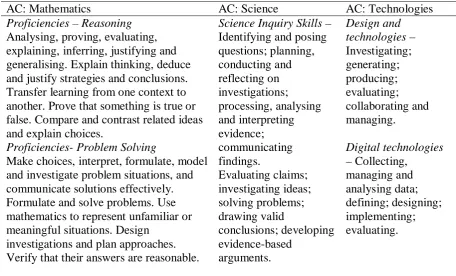
It is clear that there are many connections among the three curricula regarding big content ideas. However, it is the big process ideas common to all of them that provide the vehicle for the development of real conceptual understanding. A summary of these big process ideas is provided in Table 2. As already noted, the AC: Science and the AC: Tech have these ideas embedded with the content or knowledge components whereas the AC: Mathematics presents the Proficiencies as a separate entity. Unfortunately, this may give the impression that they are to be developed separately despite the presence of this well-meaning statement: “The proficiency strands describe the actions in which students can engage when learning and using the content . . . [and] . . . they indicate the breadth of mathematical actions that teachers can emphasise” (ACARA, 2015a, p. 5). Nonetheless, the proficiency statements contain some powerful ideas that sit well alongside the equivalent statements in the AC: Science and AC: Tech. Perhaps it would have been useful had the AC: Mathematics contained similar strong statements regarding the incorporation of the Proficiencies within specific content descriptors, as do the AC: Science and the AC: Tech.
Table 2
Big process ideas in the mathematics, science, and technologies curricula
AC: Mathematics AC: Science AC: Technologies
Proficiencies – Reasoning Analysing, proving, evaluating, explaining, inferring, justifying and generalising. Explain thinking, deduce and justify strategies and conclusions. Transfer learning from one context to another. Prove that something is true or false. Compare and contrast related ideas and explain choices.
Proficiencies- Problem Solving
Make choices, interpret, formulate, model and investigate problem situations, and communicate solutions effectively. Formulate and solve problems. Use mathematics to represent unfamiliar or meaningful situations. Design
investigations and plan approaches. Verify that their answers are reasonable.
Science Inquiry Skills – Identifying and posing questions; planning, conducting and reflecting on investigations; processing, analysing and interpreting evidence; communicating findings. Evaluating claims; investigating ideas; solving problems; drawing valid conclusions; developing evidence-based arguments. Design and technologies – Investigating; generating; producing; evaluating; collaborating and managing. Digital technologies – Collecting, managing and analysing data; defining; designing; implementing; evaluating.
Some strong descriptors from the AC: Science include “With guidance, plan appropriate investigation methods to answer questions or solve problems” and “Decide which variable should be changed and measured in fair tests and accurately observe, measure and record data, using digital technologies as appropriate” (Year Five) (ACARA, 2015b, p. 48). The Year Six statement is expanded to include “Pose questions to inform a scientific investigation, and predict what the findings might be” (ACARA, 2015b, p. 54). Similarly, the AC: Tech includes statements such as “Investigate how forces and the properties of materials affect the behaviour of a product or a system” (Year Three/Four) (ACARA, 2015d, p. 3) and “Generate, develop, communicate and document design ideas and processes for audiences using appropriate technical terms and graphical representation techniques” (Year Five/Six) (ACARA, 2015d, p. 5). It would be relatively straightforward to develop similar descriptors for the mathematics curriculum such as “Pose questions and make predictions to inform an investigation into the relative amounts of paper required to wrap a range of three dimensional objects”. The big process ideas in each of the three curricula discussed here are basically the same, and should serve as the vehicle for developing some of the key concepts in each of the learning areas. Jones (2003) described this as “teaching through problem solving” and making it the salient feature of most mathematical activity in a classroom. Once students become accustomed to working and learning in that way, it becomes second nature. Teacher planning and preparation time should be reduced, as would management of learning activities. Similarly, once students become accustomed to the idea of seeing commonalities between the big content ideas of different learning areas, and looking for connections, their learning becomes more meaningful and able to be applied to a range of different contexts.
Concluding comments
It has been suggested here that more dynamic and effective teaching can result from two factors. First, it could benefit from the utilisation of the similarities between the big content ideas of mathematics, science and technology curricula and the development of understanding of key mathematics concepts through science and technology contexts. Second, by making the common big process ideas the centrepiece of teaching and learning, the latter can become more meaningful, dynamic and effective.
However, the success of the ideas expressed in this paper is tied to the ability of teachers to develop a different mindset about the content they need to teach and the concepts they need to develop in their students. Equally so, it is about their ability or capacity to transmit this mindset to their students. It is about looking for connections and using ideas like “Where have I seen something that before?” and “What have I done previously that looks like this?” and “How is this similar to something that we did in Science . . . Maths . . . or even History or Geography?” It is about looking for the connections and using them in a way that builds concepts. Similarities and connections within the content knowledge have been shown to exist but there are also the processes of science, maths and technology that are abundantly similar. It is those big process ideas that hold the key for the development of concepts that are common across the three curriculum areas discussed here. In order to make explicit the connections between the big content ideas of the three curricula, effective questioning is critical. Such questions could include “What mathematics do we know about, or have seen/used, that can be used here to help us solve this problem or understand this situation?”
It is acknowledged that this paper has concentrated on the Australian curriculum documents for mathematics, science, and technologies. However, it is likely to be applicable to similar curricula in most countries. If teachers can make explicit the connections between the content areas of such curricula for their students, the task of covering the curriculum does not appear insurmountable and the “crowded curriculum” becomes much less of an issue. By whatever name the big process ideas are known – problem solving, investigating, scientific method, conducting experiments, design and appraise – the process are inherently similar whether students are “doing mathematics”, “doing science experiments” or “designing with technologies”. It is about having a clear purpose, devising a method, conducting the experiment/investigation rigorously, and carefully interpreting the results. It is also about teachers seeing connections between big content ideas that are in essence, very similar, but most importantly, making such connections explicit to their students. This may require teachers and their students to develop different mindsets but if they can do that, a richer and more connected world of understanding is likely to open for them.
References
Askew, M., Brown, M., Rhodes, V., Wiliam, D., & Johnson, D. (1997). Effective Teachers of Numeracy in Primary Schools: Teachers' Beliefs, Practices and Pupils' Learning. Paper presented at the British Educational Research Association Annual Conference, September 1997: University of York. Australian Curriculum Assessment and Reporting Authority (ACARA). (2015a). Australian curriculum:
Mathematics (v 7.5). Retrieved May 15, 2015, from: http://www.australiancurriculum.edu.au/
Australian Curriculum Assessment and Reporting Authority (ACARA). (2015b). Australian curriculum: Science (v 7.5). Retrieved May 15, 2105, from: http://www.australiancurriculum.edu.au/
Australian Curriculum Assessment and Reporting Authority (ACARA). (2015c). Australian curriculum: Technologies (v 7.5): Content structure. Retrieved May 15, 2015, from:
http://www.australiancurriculum.edu.au/
Australian Curriculum Assessment and Reporting Authority (ACARA). (2015d). Australian curriculum: Technologies (v 7.5): Design and technologies. Retrieved May 15, 2015, from:
http://www.australiancurriculum.edu.au/
Bruner, J. S. (1960). The Process of education. Cambridge, Mass.: Harvard University Press.
Charles, R. I. (2005). Big ideas and understandings as the foundation for early and middle school mathematics. NCSM Journal of Educational Leadership, 8(1), 9–24.
Clark, E. (1997). Designing and implementing an integrated curriculum: A student-centred approach. Brandon, Vermont: Holistic Education Press.
Clarke, D.M., Clarke, D.J., & Sullivan, P. (2012). Important ideas in mathematics: What are they and where do you get them? Australian Primary Mathematics Classroom, 17(3), 13-18.
Hiebert, J. & Carpenter, T.P. (1992). Learning and teaching with understanding. In D.A. Grouws (Ed.), Handbook of Research on Mathematics Teaching and Learning. New York: MacMillan.
Hurst, C., & Hurrell, D. (2014). Developing the big ideas of number. International Journal of Educational Studies in Mathematics, 1(2), 1-18. Retrieved from:
http://www.ijesim.com/arsiv/volume-1-issue-2-december-2014
Jones, L. (2003). The problem with problem solving. In I. Thompson (Ed.), Enhancing primary mathematics teaching (pp. 86-98).Maidenhead, UK: Open University Press.
Ma, L. (1999). Knowing and teaching elementary mathematics. Mahwah, NJ: Lawrence Erlbaum Associates. National Governors Association Centre for Best Practices, Council of Chief State School Officers (NGA
Centre). (2010). Common core state standards for mathematics. Retrieved from:
http://www.corestandards.org/the-standards
Siemon, D., Bleckly, J., & Neal, D. (2012). Working with the Big Ideas in Number and the Australian
Curriculum: Mathematics. In B. Atweh, M. Goos, R. Jorgensen & D. Siemon, (Eds.). (2012). Engaging the Australian National Curriculum: Mathematics – Perspectives from the Field. Online Publication:
Mathematics Education Research Group of Australasia pp. 19‐45
Van De Walle, J. A., Karp, K. S., & Bay-Williams, J. M. (2010). Elementary and middle school mathematics: Teaching developmentally. (7th Ed). Boston: Pearson.