COMPOSITIONALITY/COMPOSITIONALITY OF IDIOMS:
NON-NATIVE SPEAKERS’ CONSTRAINTS TO COMPREHENSION
Yvonne Pedria Velasco
Carlos Hilado Memorial State CollegeFirst received: 30 March 2016 Final proof received: 14 July 2016
Abstract
Representational Modularity (RM) Hypothesis which states that, similar to how people make sense of categories, they also systematically make sense of language. This study seeks to discover the way non-native speakers of English negotiate meaning when faced with idiomatic expressions that are modified either by a process of passivization or by a process of quantification; and whether idiom comprehension influence judgments of appropriateness of use of the modified expressions. Employing a researcher-made questionnaire that underwent content validity and reliability tests, the instrument was administered to four college freshman classes from four different higher education institutions. Findings reveal that a significant difference was found between group performance in the passivization and quantification tests through a one-sample test. However, an absence of a statistical relationship between the scores in the test and the participants’ judgment of appropriateness of use (spoken, written, spoken and written) was revealed by the statistical analysis.
Keywords: compositionality, passivization, quantification, idiomatic expression, non-native speakers
Native speakers of English easily understand idiomatic expressions. Their daily utterances are littered with many idiomatic expressions that would sound strange or even weird to non-native speakers. Idioms such as bring home the bacon, with flying colors, or steal the show are regarded as phrases whose meaning cannot be deduced from the literal meaning of their individual constituents. As a consequence, idioms do not generally follow the principle of compositionality which contends that the meaning of the constituent parts of a complex expression and the way they are syntactically combined determines the meaning of the expression (van der Linden, 1993, cited in Vegge, 2011). On the other hand, idioms are also said to be non-compositional in that, the meaning of the expression is not determined by the individual meanings of the constituent parts of the expression. Hence, non-native speakers whose language repertoire is constrained by the structure to which they are exposed to find themselves presented with rather puzzling constructions. For example, if a non-native speaker would not have any exposure at all to the use of the idiom bring home the bacon, the non-native speaker would likely understand this phrase on the literal level, obviously quite an unfortunate state of affairs.
However, several linguists argue that it would be a mistake to overgeneralize non-compositionality and apply it to the whole group of idioms and assume that per se all idioms are non-compositional in nature. As many psycholinguistic studies on idioms have shown, the presupposition of non-compositionality does not hold for all idioms (Gibbs
and Nayak, 1989; Gibbs, Nayak and Cutting, 1989; Gibbs, Nayak, Bolton and Keppel, 1989; Titone and Connine, 1994, cited in Liu, 2013). Hence, there is no one-size-fits-all definition for idiomatic expressions in relation to their meaning. Situated in the middle of this controversy, the study sought to determine idiom compositionality or non-compositionality from the perspective of non-native speakers of English.
Idiom category
From the classical theory point of view, it is difficult to define idioms as a category. Nonetheless, the existence of such a category is uncontroversial. The classical approach to categorization dictates that members of a category all share the same properties. This Aristotelian view lists two important characteristics (Riemer, 2010).
the conditions on their membership can be made explicit by specifying lists of necessary and sufficient conditions
their membership is determinate; whether or not something is a member of the category can easily be checked by seeing whether it fulfils the conditions
needed to appropriately describe idioms as a category. The Prototype Theory by Rosch (cited in Riemer, 2010) refutes the classical theory which suggests categories are independent and discrete. Through experiments on primary categories of color and various physical objects Rosch discovered that categories have members with variant properties and also members that are considered better examples than others. Prototypes are the best representatives of their category, e.g. in the category BIRD, a ‘robin’ is considered a prototype because it is more representative of the category as opposed to ‘penguin’ or ‘emu’ which is at the periphery. (Riemer, 2010). PT implies that not all members need to display all similar qualities or features. The features would help assign idiomatic membership. Besides conventionality, idioms are in general, considered to display one or more of the following properties: inflexibility in syntax, figuration, proverbiality, affect and informality (Nunberg, Sag, Wasow, 1994). The fact that not all members display all features indicates a blurry category membership. The often cited example of idioms that seems to be prototypical of its category is kick the bucket (Vegge, 2011). It is a multiword expression used frequently both in written and spoken discourse, thus its meaning is familiar to most native speakers of English. In this sense it is conventional. Also, it encodes figurative meaning which could be traced to its historical roots. Allegedly kick the bucket refers to how a person would kick the bucket used to stand on when committing suicide by hanging or the use of a bucket after slaughtering a pig (Ammer, 1997). Based on these characteristics, one could argue that kick the bucket is a prototypical member of the idiom category (Vegge, 2011). Idioms then, flowing from this discussion, could well form a category.
The non-compositionality of idioms
The property of idiomatic expressions that seems to have gained most attention is that they are non-compositional which means that they are expressions whose meaning cannot be deduced from its constituent parts. Among the linguists who follow this claim are Sweet (1899), Hockett (1958), Katz and Postal (1963), Healey (1968) Chafe (1968), Weinreich (1969), Fraser (1970), Makkai (1972), and Chomsky (1980) (cited in Kavka & Zybert, 2004).
Pawley (1983) advances the notion that fluent and idiomatic control of performance in a language results to a great extent, from the knowledge of a set of sentence stems which are institutionalised or lexicalised. They are to be understood as a ‘set’, as a unit, like a clause, or one of a longer stretch, whose form and lexical content are fixed. He introduced the notion of speech formula, yet, on closer look it seems to be a sort of cover term for idiomatic expressions. Thus, it could be inferred that in
Pawley’s view all genuine idioms are speech formulas. In psycholinguistic terms, idioms are such speech formulas that are semantically non-compositional and syntactically non-conforming (Pawley, 1983).
An argument for compositionality and other theories
Raymond W. Gibbs Jr. (1989) is an experimental psycholinguist and cognitive scientist focused on people’s use and comprehension of figurative language including metaphor, irony and idioms. He proposed the Direct Access Hypothesis, suggesting that only the non-literal meanings of idioms are activated first without reference to the literal meaning because of the strong conventionality feature of idioms. It is undeniable however, that the literal meanings would also be activated upon idiom comprehension in some cases. Thus, Gibbs et al. (1989) challenged the previously widely accepted idea of indecomposable (non-compositional) idioms by proposing the Decomposition Hypothesis. By this theory, he believes that the literal meanings of each component of idioms contribute to the real whole meaning. Also the literal meanings he admits, do contribute to the figurative meaning of idioms to some extent. According to Gibbs, all idioms fall into three categories. The first type is non-decomposable idioms whose real meanings cannot be directly comprehended via literal meanings of each word, like kick the bucket and spill the beans. The second type is normally decomposable idioms whose real meanings can be roughly grasped merely through literal meanings, like add fuel to the flames and zip your lips. The third type is abnormally decomposable idioms whose real meanings involve deep cognition and concepts systems like the use and comprehension of metonymy and metaphor. Idioms like carry a torch
activated by a specific concept related to the idiom. For example, the concept of dying may activate the superlemma kick the bucket, then further activate every lemma kick, the and bucket (Liu, 2013). This could be the reason why idiom production and comprehension may take longer time than simple words and phrases (Sprenger et al., 2006, cited in Liu, 2013). This theory involves not only idiom processing but also idiom production. The Graded Salience Hypothesis, on the other hand, focuses on the feature of saliency, avoiding the literal and non-literal division (Giora, 1999). It argues that the salient meanings rather than the literal or non-literal meanings are activated first regardless of the contextual constraints. More specifically, the salient meanings of idiomatic phrases refer to the highly conventionalized meanings stored in people’s mental lexicon, either literal or non-literal meanings. In other words, the salient meanings are those that first occur to people upon reading or hearing idioms, with marginal relations to contexts or component words. Salience here is not a question of either/or, rather a continuum graded by several factors like conventionality, familiarity, frequency and prototypicality. The comparatively more salient meanings would be accessed faster and retrieved earlier than the less salient ones. Only after the activation of the salient meanings, the contextual effects would take control. That is, if the salient meanings are not fitted into the contexts, the non-salient ones would then be activated by language users (Giora, 1999).
Rather than argue for the supremacy of one approach over the other, Titone & Connine (1994) argue for a hybrid model of idiom comprehension that characterizes idiomatic expressions both as a unitary word configurations and compositional word sequences, thereby incorporating both compositional and noncompositional aspects. According to this hybrid model, activation of idiomatic meanings, and the activation and use of literal meanings during comprehension, will be a function of the degree to which idioms are conventional and compositional (Nunberg et al.,1994). This model adopts the idiomatic classification scheme of Nunberg et al. (1994) in which idioms may be sorted as a function of their compositionality, transparency and conventionality (Titone and Connine, 1994). Accordingly, compositionality shall be considered, assuming that it is highly likely that the products of literal analysis of the idiom will contribute to the apprehension and interpretation of idiomatic meanings. Next, conventionality, which refers to the degree to which a particular configuration of words is highly likely to be idiomatically meaningful within a particular linguistic environment, shall also be considered. Titone and Connine (1994) propose that the disparity between literal and idiomatic meanings of nondecomposable (non-compositional) idioms should constitute a
hindrance in processing that does not exist for decomposable (compostitional) idioms, whose literal and idiomatic meanings are semantically related. They postulate that if the meanings of the idioms literal constituents and idiomatic sense figures into a discourse representation, then nondecomposable idioms should incur a processing cost that decomposable idioms do not.
Idiom modification
Given the two views of how idioms behave, impels one to conduct an empirical investigation to test whether idioms are still comprehended by non-native speakers when modification is applied to the idiomatic phrases. According to Nunberg et al. (1994), “Modification, quantification, topicalization, ellipsis, and anaphora provide powerful evidence that the pieces of many idioms have identifiable meanings which interact semantically with each other.” (p. 14). If indeed modification is possible, are non-native speakers of English able to comprehend and identify the meanings of the modified idioms when used in a sentence? This is a rather interesting point that motivated the researcher to undertake this study.
Modification by quantification
Wasow, Sag, and Nunberg (1980) demonstrate semantic compositionality of certain idioms by pointing to internal modification. According to him, idioms can be modified internally by means of adjectives (Wasow et al. 1980). An example for this is, they kept close tabs on John, the modifier close affects only one part of the idiom, tabs, implying that this part carry meaning. Here are other examples cited: call the political tune, scraping the bottom of every single barrel, bury the political
Wasow et al. (1980) claim however, that idioms are amenable to transformations because they appear in different syntactic structures. If a sentence is transformed and still carry the same meaning, then according to Wasow et al. they must be instances of the same idiom. If they are not, then there must be two different interpretations (Wasow, et al, 1980). Furthermore, it is their contention that the syntactic versatility of an idiom is a function of how the meanings of its parts are related to one another and to their literal meanings (Wasow et al. 1980)
Setting aside the linguists’ argument over compositionality and non-compositionality, it is interesting to note that NP-type constructions are generally likely to be extended and to take quantifiers. Thus, it is possible to have constructions like famous private eye, good old lady luck, real
lame duck, etc. and still have non-native speakers/learners understand them.
Modification by passivization
Passivization illustrates a change of voice from active to passive. The transformation of voice of a sentence from active to passive requires the main verb of the sentence to be transitive. The operation does not change the content of the sentence; it only offers two different ways to describe the interaction between the agent and the patient. In an active construction the agent is focused, while a passive construction gives prominence to the patient. However, the idiomatic meaning of kick the bucket
is the verb die. Since die isan intransitive verb it is reluctant to appear in the passive (Vegge, 2011). These are other examples where passivization took place, tabs were kept on John, answers were fished
from them, someone’s leg was pulled.
It would seem then that the semantic properties of idioms help explain why some idioms can be altered while others cannot. Their syntactic behavior relates to their semantic extensions. These extensions often have literal meanings which determine their syntactic behavior.
Although it seems likely that some type of modification applies to the meaning of the whole idiom, but it is quite premature to overgeneralize and say that modification is purely syntactic in all cases. The process of modifying idiom parts suggests that these parts are meaningful, thus they can be semantically modified internally, i.e. giant
leap of faith. Compositional idioms appear to have semantic internal structure that is amenable to various syntactic operations similarly to their literal counterparts.
Internal semantic structure is also a prerequisite for transformations of sentences (Vegge, 2011). To Vegge, the fact that operations such as passivization and quantification are applicable to some idioms provides evidence for the assumption that many idioms are compositional.
Further evidence comes from lexical substitution, i.e.
Operations such as modification by transformation and quantification when used and still leave the modified idioms to be readily understood by non-native speakers, this may serve to support the claim that many idioms have internal semantic structure that helps explain their syntactic behavior. Linguists however have yet to come up with a proper and universal definition for idioms and to agree whether these expressions are compositional or non-compositional. What this study is interested in is the possibility of non-native speakers to understand the idioms in modified form, and whether these non-native speakers are likely to understand modification of idioms by passivization or modification of idioms by quantification.
Non-native speakers
There are studies which advance that idiomatic expressions are challenging to non-native speakers. The studies further discussed how the L2 learner could benefit from the suggestions recommended on how to teach idioms better (Richards, 1996; Lennon, 1998; cited in Abel, 2003). Abel (2003) for instance piloted a study where non-native judgments on the decomposability (compositionality) of English idioms were investigated. The study, however, restricted itself to verbal idioms to control for the syntactic structure of the data and to keep the sorting task simple owing to the non-native sample. Thus, non-native comprehension of idiomatic expressions and their decomposability is a viable research area as supported by the studies conducted involving non-native samples.
This study does not intend to take sides with the issue on compositionality or non-compositionality of idiomatic expressions. The purpose of the study is to test whether the processes of idiom modification bears a relationship with how non-native speakers comprehend idiomatic expressions. By exploring non-native speakers of English idiom comprehension, this study aims to contribute to research in second language acquisition that demonstrate how idioms and speech formula as phrasal categories can possibly offer information on how non-native speakers of English comprehend idiomatic expressions, and further, on whether their comprehension of the phrasal categories may be influenced by processes such as passivization and quantification.
order for this to happen, speakers need to remember which items can be combined and how they can be combined (Jackendoff, 1997).
To further explain the theory, Jackendoff introduces conceptual structures as an integral part of lexical representation and also suggests that linguistic knowledge is separated into three different components in the mind. These are the lexical phonological structure (LPS), the lexical syntactic structure (LSS) and the lexical conceptual structure
(LCS). These are autonomous derivations that relate to each other through interfaces or correspondence rules. These rules provide information about how components interact. The three components provide information about phonological, syntactic and conceptual structures and make up the structure of sentence as a triple <PS, SS, CS> (Jackendoff, 1997). It is an important claim of RM that language is represented in the mind by these separate entities of information. These components of information are referred to as representation modules and they make use of the interface modules
for internal communication. Language production is thus dependent on the interaction of these modules. Jackendoff (1997) has averred that a lexical item is to be regarded as a correspondence rule and the lexicon as a whole to be regarded as part of the PS-SS and PS-SS-CS interface modules.
The study is conducted among college freshman students as they answer the English idioms test. In the Philippines, English is a second language and hence, the way Filipino learners as second language learners of English comprehend idiomatic expressions is the basis of the current study. In order to explore the way idiomatic expressions are understood when presented to non-native speakers of English, this study contributes to second language research by answering the following research questions.
1. Do non-native speakers comprehend idiomatic expressions when such expressions undergo a process of modification?
2. Which of the two kinds of idioms do non-native learners of English comprehend more: idioms modified by a process of quantification, or idioms modified by a process of passivization?
3. Does comprehension of the modified idioms influence judgments of appropriateness (whether spoken, written or spoken and written)?
In the section under Methodology, I outline my methods of analysis, particularly, the methods I used to obtain the sampling, the data collection methods and the data analysis. In the section under Results, I report on the outcomes of the analysis which answer the research questions posed and which were examined under the Discussion section. Finally, the
Conclusions and Implications of the study are discussed and presented.
METHOD Design
The study employed the quantitative method using a cross-sectional design involving four college freshman classes, coming from four different higher education institutions (HEIs). Of the four HEIs, two were privately-owned while the other two were state owned. The quantitative aspect of the study was realized with the use of a 10-item test on idioms which shall form the basis for interpretation.
Participants
Four college freshman classes consisting of 25 students per class from four different higher education institutions (HEIs) totalling 100 (n=100), are the participants of the study. The freshman students’ ages ranged from 17 to 21 with an average age of 18. According to preliminary interviews with faculty members of the respective schools sampled, an admission test and oral interview served as entrance placement for the students. Somehow, it can be said that the students in the four classes sampled possess almost the same English proficiency levels on the basis of the selection criteria for admission in the respective HEIs as reported by the faculty members. There were no native speakers of English in the sample. Non-native speaker is operationalized in this study to mean a second language learner studying in a higher education institution, whether privately-owned or state-owned. Thus, the 100 participants sampled are all non-native speakers/learners of English. The purposive sampling is the sampling method employed in the study. As defined by Kerlinger (1986), purposive sampling is a non-probability based sampling characterized by a deliberate effort to obtain representative samples through the inclusion of groups or typical areas in a sample. Hence, the present investigation that explored a cross section of both the public and private school higher education students requires a practical sampling technique in obtaining information from a very specific group of people which the purposive sampling addressed. The results of purposeful sampling are generally expected to be more representative of the population than those achieved with an alternative form of sampling technique.
Instrument
narrowed the number to 10. The inter-raters are graduate students taking doctorate studies who are themselves college instructors. All items are adjudged as grammatically sound by the three inter-raters.
Pilot testing
A pilot test was run to establish the validity and reliability of the instrument since the test was researcher made. Content validity was established by subjecting the test items to evaluation by three inter-raters who made the preliminary selection of test items to be included in the questionnaire. Reliability was established by piloting the 10-item test to one of the random freshman classes of one of the state-owned HEI sampled. By running the results using computer software, the instrument was found to have a reliability coefficient of 0.82, indicating that the instrument is reliable.
Data collection
Data collection took place in August of academic year 2014-15. After undergoing pilot testing, the instrument was administered by four faculty members of the respective HEIs to one of their freshman classes. The test lasted for a maximum of 15 minutes. The researcher retrieved the questionnaires, scored them and subjected them for statistical treatment.
Procedure
Prior to the administration of the idiom test to students, proper research conventions were observed. Permissions were sought from the administration of each of the four schools for the conduct of the test. The specific class schedules for the test was determined after permission was secured. Once the faculty members to conduct the test were identified, they were oriented as to how the test shall be administered. On the scheduled date of the test, the faculty members administered the 10-item test that lasted for 15 minutes; it included the giving of instructions to the students, the distribution and retrieval of the questionnaire. After the retrieval, the questionnaires were
submitted to the researcher for scoring, statistical treatment, and interpretation.
Scoring
Comprehension
The measure of comprehension is elicited by having the respondents choose from a set of two choices pertaining to the applicable meaning of the sentence containing the idiomatic expression. Of the two choices, one is the correct response which, if accurately chosen, shows that the respondent understands the meaning of the idiomatic expression couched in the sentence. The scores were designated descriptions so as to concretize the numerical scores. The descriptions for the scores are as follows:
9 -10 Excellent comprehension 7 - 8 Very good comprehension 5 - 6 Average comprehension 4 and below Below average comprehension
Data analysis
The idiom test administered to 100 participants was scored using an answer key. The first part of the questionnaire requires correct answers and hence, the questionnaires were subjected to checking for the correct answers. After the correction, the scores were computed to obtain the mean scores as descriptive measure. To find for correlations between categories, the Pearson r was used. To test for significant difference, the one sample t test was used. The one-sample t-test was used as a feasible tool for analysis since the sample comes from a particular cross-section of a population and not on full population information.
RESULTS AND DISCUSSION
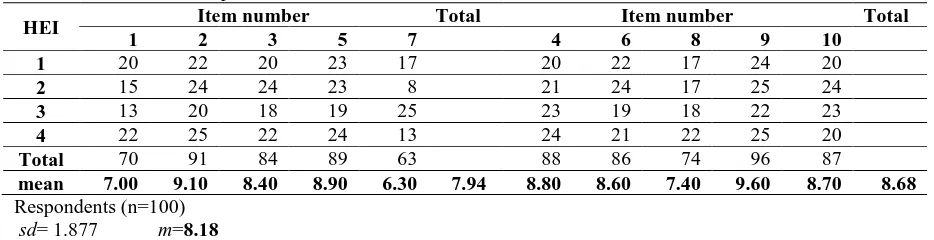
Level of idiom comprehension by the L2 learners The participants obtained a mean score of 8.18 in the 10-item test (m=8.18, n=100, sd= 1.877). This mean score is interpreted as Very Good on the scale designated in the analysis. Despite the modification, the non-native learners were able to discern the meanings of the idiomatic expressions. Table 1 below presents the obtained scores and the mean.
Table 1. Obtained Scores per Item in the Modified Idiom Test
HEI Item number Total Item number Total
1 2 3 5 7 4 6 8 9 10
1 20 22 20 23 17 20 22 17 24 20
2 15 24 24 23 8 21 24 17 25 24
3 13 20 18 19 25 23 19 18 22 23
4 22 25 22 24 13 24 21 22 25 20
Total 70 91 84 89 63 88 86 74 96 87
mean 7.00 9.10 8.40 8.90 6.30 7.94 8.80 8.60 7.40 9.60 8.70 8.68
Respondents (n=100)
The scores in Table 1 indicate the level of comprehension of the participants across the four HEI’s. It is to be noted that the idioms are already by themselves idiosyncratic prior to being modified. Yet, the participants were able to discern the meanings of the idiomatic expressions. The items for modification by quantification are 1, 2, 3, 5, 7. Of these four items, item 2 has the highest mean (m=9.10), which is represented by the sentence,
It was really sad that Joemarie let the very big cat out of the bag during the party which the participants inferred to mean ‘the secret was unfortunately revealed’ and rightly so. Only 9 of the 100 participants did not get this right. The idiom which underwent quantification and has the lowest mean (m=6.30), is item 7, represented by the sentence,
They would not leave any legal stone unturned just so they could reacquire their ancestral house.
The correct interpretation to this sentence would be ‘they would file a lawsuit if it would come to that’ which comes close to the other option which is ‘they would stop at nothing to get their house back’. It would seem that the options are somewhat similar but the clincher is with the word lawsuit, which would support the quantifier legal in the idiomatic expression ‘leave any stone unturned’.
Items 4,6,8,9 and 10 are sentences with idioms which underwent the process of passivization. Of the five, item 9 has the highest mean (m=9.60). The sentence for this item is,
Amanda is the juiciest apple of Adan’s eyes
which is understood by the participants to mean ‘Adan is attracted to Amanda’. The item which has the lowest mean in the passivization process is item 8, with the sentence,
I was not surprised when the beans were spilled by the couple.
The choices for this item are: ‘I knew that the couple were clumsy’ and the other is, ‘I knew that the couple were rumor-mongers’; curiously, it appears that the other participants had taken the sentence rather too literally for choosing the former interpretation.
Over-all, the participants performed remarkably well by obtaining a very good
comprehension level. This result answers the first research question and confirms that non-native speakers comprehend idiomatic expressions when such expressions undergo a process of modification. One thing that can be said about the test performance seems to support Jackendoff’s framework, which postulated that in the same way that one makes sense of categories, so does one systematically makes sense of language. Differently stated, individuals store lexicon and keep track of lexical information which is accessed in the production of an infinite number of sentences, it is then that
speakers need to remember which items can be combined and how they can be combined (Jackendoff, 1997). This is in fact what probably happened with the processing mechanism of the L2 learners sampled. There is a lexicon store where the participants seemingly keep all lexical information they have accumulated in the course of their learning the language. When they were faced with a peculiar word combination or strings, in this instance the modified idioms, they may have accessed their lexicon store and the peculiar word combination or string quite possibly triggered recognition which enabled them to correctly identify the meaning of the word string. One theory that the researcher advances is that, no matter how the words in the string are positioned, it is possible that the L2 learner is likely to accurately map the words such that the meaning is created, provided that the L2 learner has had the occasion to encounter such word string before.
This is in consonance with the Representational Modularity Hypothesis (Jackendoff, 1997) that relates to how people represent language in the mind, that language is built up into components of information, the so-called Representation Modules (RM’s). The L2 learners seemingly accessed these modules when they accurately gave the meanings of the idiom because the interface modules of these RM’s interact with each other internally and ultimately after logical mapping occurred, i.e., when the L2 realizes and recognizes meaning, language is produced. In this case, the meaning- making is equated with language production.
Performance levels in modified idiom test: quantification and passivization
To answer the question whether the non-native learners would perform significantly better in one type of idiom test over the other, the one sample test was run. This statistical treatment allows for a comparison of the performance of the participants in the two types of idiom modification processes (quantification and passivization).
combinations although the verb form is in the passive. When quantification occurs, a new concept is introduced which added to the cognitive load because it would somehow distort the stored strings or combinations of words in the lexicon which the non-native speaker would process as a new combination with the added confusion of the resulting literal interpretation which is also possible. In the test, the sentence,
I was not surprised when the beans were spilled by the couple.
can be taken to mean literally as it is, and it would still make sense. Therefore, it can be said that by transforming active to passive constructions (of idioms) which allow for this process, the chances of the non-native speaker to understand this modification process is higher than when the idiom undergoes modification by quantification.
Table 2. One Sample Test for Significance Test Value = 0
95% Confidence Interval of the Difference
t df Sig. (2-tailed) Mean Difference Lower
passivization 31.914 99 .000 3.920 3.68
quantification 34.931 99 .000 4.260 4.02
Judgments of modified idioms’ appropriateness of use (spoken, written, spoken and written)
Does comprehension of the modified idioms influence the judgment of appropriateness of use (of these idioms) by the participants? To answer this question, Pearson correlations were run on the
following combinations: test scores with judgment a (spoken); test scores with judgment b; (written) and, test scores with judgment c (spoken and written). The Tables 3, 4 and 5 presents the correlations.
Table 3. Test Scores Correlated with Judgment A (spoken)
The result showed no significant relationship between participants’ judgment of appropriateness of idiom use in spoken language and idiom comprehension (judgment a and test scores; r =
.069, n = 100, p >.05). With the level of significance set at p>.05, r is at .069, relationship is not significant.
Table 4. Test scores correlated with judgment b (written)
score judgment_b
score Pearson Correlation 1 -.134
Sig. (2-tailed) .184
N 100 100
judgment b Pearson Correlation -.134 1
Sig. (2-tailed) .184
N 100 100
As table 4 shows, there is no significant relationship between participants’ judgment of appropriateness of idiom use in written language and idiom comprehension (judgment b and test scores; r = .134, n = 100, p >.05). With the level of significance set at p>.05, r is at .134, relationship is not significant.
Table 5 shows that there is no significant relationship between participants’ judgment of appropriateness of idiom use in spoken and written language and idiom comprehension (judgment c and
test scores; r = .176, n = 100, p >.05). With the level of significance set at p>.05, r is at .176, relationship is not significant.
In the absence of statistical relationship between the scores and the participants’ judgment of appropriateness of use (spoken, written, spoken and written), one can say that the participants are likely to use the modified idioms rather arbitrarily, or without any pre-conceived notions with regards to rules.
judgment_a score
judgment_a Pearson Correlation 1 -.069
Sig. (2-tailed) .494
N 100 100
score Pearson Correlation -.069 1
Sig. (2-tailed) .494
Table 5. Test Scores Correlated with judgment c (spoken and written)
score judgment_c
score Pearson Correlation 1 .176
Sig. (2-tailed) .079
N 100 100
judgment c Pearson Correlation .176 1
Sig. (2-tailed) .079
N 100 100
The current study however admits some limitations on the basis of the study’s design. Since a purposive sampling was employed, it may not necessarily be a representative sample that the researcher is trying to reach. As such, since a small sample population is used, a small variation in the sample will cause deviance in the results and hence generalizability is proscribed.
CONCLUSION
The study investigated the non-native speakers’ idiom comprehension when the idioms underwent a process of either quantification or passivization. It was found that the non-native speakers have a very good level of comprehension in the modified idioms test, which supports the argument of linguists that argue for the compositionality of idiomatic expressions. Wasow et al. (1980) contended that it is possible for idioms to undergo modification and still retain meaning. To these linguists, an idiom’s versatility is a function of how the meanings of its parts are related to one another and to their literal meanings.
In the study, while there are test items that appeared to be confusing to the non-native learners on the basis of the low mean score on the item, over-all it can be said that college freshman students performed generally well in the modified idiom comprehension test. If non-native learners are able to infer the meaning despite the idiom undergoing modification, it is quite possible that there are categories of idioms that are highly flexible and allow for modification in the syntactical and lexical level subscribing to what Nunberg et al. (1994) have to say regarding the process of modification,
“Modification, quantification, topicalization, ellipsis,
and anaphora provide powerful evidence that the pieces of many idioms have identifiable meanings which interact semantically with each other”. (p.14)
However, in order for English language teachers to gauge whether students are in reality comprehending the meanings of idiomatic expressions that are not in their native language, it would be ideal practice to administer idiom tests that require students to exercise their judgment of appropriateness of use as a likely measure of comprehension. Moreover, this finding opens an area for research that is suitable for inquiry; it would be helpful to explore how non-native speakers arrive at judgments of appropriateness of idiom use
(modified) and to identify what factors have influenced their judgments. Future research would benefit from an investigation that focuses on how non-native speakers of English discriminate among various phrasal combinations and judge them as appropriately used.
As an implication of the study, expressions in the English language that are reputed to be rather highly rigid and non-decomposable, like idiomatic expressions and collocations, should be taught. Media and the world outside the formal educational venue, the classroom, are replete with these expressions that may appear to the non-native speaker or learner of English as weird and strange. When this linguistic feature skips teaching in the language curriculum, the non-native learners are bereft of the only chance that they could possibly integrate culture of the language to their own. What this means is that, although English is universally used and thus, allows for innovations that the many speakers of the world bring to it, still, a native speakers idiomaticity may need to be studied as well, so that not only culture of the native speaker is attached in the teaching of English, so too are the semantic and pragmatic value of such expressions that would prove to be problematic for a non-native speaker/learner whose comprehension of English may be constrained by the seemingly limited repertoire of these idiosyncratic expressions in the formal education curriculum.
REFERENCES
Abel, B. (2003). English idioms in the first language and second language lexicon: a dual
representation approach. Second Language Research19(4), 329-358.
Ammer, C. (1997). The American Heritage Dictionary of Idioms. Boston: Houghton Mifflin Company.
Chafe, W. L. (1968). Idiomaticity as an Anomaly in the Chomskyan Paradigm. Foundations of Language4(2), 109-127.
Gibbs, R. W., & Nayak, N. (1989). Psycholinguistic studies on the syntactic behaviour of idioms.
Cognitive Psychology, 21, 100-138.
Gibbs, R. W., Nayak, N., Bolton, J., & Keppel, M., (1989). Speaker’s assumptions about the lexical flexibility of idioms. Memory and Cognition, 17(1), 58-68.
Analyzability and idiom processing. Journal of Memory and Language 28, 576–593.
Giora, R. (1999). On the priority of salient meanings: studies of literal and figurative language. Journal of Pragmatics, 31, 919-929. Jackendoff, R. (1997). The architecture of the
language faculty. Cambridge, MA: MIT Press. Kavka, S., & Zybert, J. (2004). ‘Glimpses on the
history of idiomaticity issues’. In Štekauer, P. (ed.). Journal of the Theoretical Linguistics 1(1), 54-66.
Kerlinger, F.N. (1986). Foundations of behavioral research, 3rd ed. CBS Publishing, Japan. Liu, W. (2013). CiteSpace II: Idiom Studies
Development Trends. Journal of Arts and Humanities 2(2), 66-82.
Nayak, N.P., & Gibbs, R.W. (1990). Conceptual knowledge in the interpretation of idioms
Journal of Experimental Psychology: General, 119, 315–330.
Nicolas, T. (1995). ‘Semantics of idiom
modification’. In Everaert, M. Linden, E. van der, Schenk, A., Schreuder. R. (eds.). Idioms: Structural and psychological perspectives (pp. 233-252). New Jersey: Lawrence Erlbaum Associates.
Nunberg, G., Sag, I. A., & Wasow, T. (1994).
Idioms. Language, 3(70), 491-538. Pawley, A. (1983). ‘Two puzzles for linguistic
theory: nativelike selection and nativelike fluency’. In: J. C. Richards and R.W. Schmidt (eds.), Language and Communication (pp. 191-225). London: Longman.
Richards, J.C. (1996). Idiomatically speaking.
Zielsprache Englisch, 26, 32–33. Riemer, N. (2010). Introducing semantics.
Cambridge, UK: Cambridge University Press. Sprenger, S., Levelt, W., & Kempen, G. (2006).
Lexical access during the production of idiomatic phrases. Journal of Memory and Language, 54, 161-184.
Titone, D., & Connine, C. (1994). Descriptive norms for 171 idiomatic expressions: familiarity, compositionality, predictability, and literality. Metaphor and Symbolic Activity, 9, 247–270.
Vegge, T. (2011). An idiom paints a thousand words. Kristiansand: University of Agder. (unpublished paper).