Sharif University of Technology
Scientia IranicaTransactions D: Computer Science & Engineering and Electrical Engineering www.scientiairanica.com
Optimal design of grid-connected hybrid renewable
energy systems using multi-objective evolutionary
algorithm
Z.S. Shi, R. Wang
, X.Y. Zhang, Y. Zhang and T. Zhang
College of Systems Engineering, National University of Defense Technology, ChangSha, Hunan, P.R. China, 410073. Received 21 October 2015; received in revised form 17 October 2016; accepted 30 May 2017
KEYWORDS Grid-connected system;
Renewable energy; Hybrid system; Preference-inspired algorithm;
Coevolutionary; Multi-objective optimization.
Abstract. The optimal design of grid-connected Hybrid Renewable Energy Systems (HRESs) is studied by using multi-objective evolutionary algorithm in this paper. With the total system cost and fuel emissions to be minimized, a two-objective optimization model of the hybrid system is established. Then, a modied preference-inspired co-evolutionary algorithm is, for the rst time, applied to nd the optimal conguration of a grid-connected hybrid system. As an example, a grid-connected hybrid system, including PV panels, wind turbines, and diesel generators, has been designed and good results are obtained which show that the proposed method is eective.
© 2017 Sharif University of Technology. All rights reserved.
1. Introduction
The rising energy consumption, the depletion of limited fossil fuels, and the increasing concern for global warm-ing have enhanced the use of renewable energy sources, such as solar and wind energy. Renewable energy sources can decrease the dependence on conventional resources and reduce the greenhouse gas emissions, making them potential for electric power generation in the future. However, they are also unpredictable and intermittent, hindering their wide application in practice. A good solution to overcome the drawbacks of renewable sources is the appropriate design of a Hybrid Renewable Energy System (HRES), integrating various energy sources. Compared with single-source energy systems that include solar or wind energy alone, HRESs have many advantages, e.g. higher reliability, lower cost, and less fuel emissions.
*. Corresponding author. Tel.: +86 18874962006, E-mail address: [email protected] (R. Wang) doi: 10.24200/sci.2017.4578
An HRES can operate in either Grid-Connected (GC) or Stand-Alone (SA) mode according to the availability of utility grid [1]. Stand-alone systems can generate electricity without utility grid, so that is why they are said to be stand-alone and, hence, they are suitable for remote areas where the grid is not available. Along with the prevalence of HRESs, an increasing number of studies about optimal HRES design have been reported in the literature. The optimal design of an HRES is a Multi-objective Optimization Problem (MOP) [2] in most cases, which is too complex to solve eciently by traditional optimization methods. Hence, various evolutionary algorithms have been applied to optimally design the HRES with dierent objectives [3-9]. However, most of the present studies focus on stand-alone hybrid systems without considering the utility grid.
A grid-connected HRES is an independent power system connected to the electricity grid and the grid acts as a storage unit with unlimited capacity [1], so the battery storage device is unnecessary in this system. A grid-connected system is mainly used to cater to the local load demand, and surplus
genera-tion will be fed into the grid. Unlike the abundant number of literature reviews on stand-alone systems, there are only a few studies on grid-connected hybrid systems. Caballero et al. [10] proposed a method for the optimal business design of a small grid-connected hybrid PV-wind energy system aiming to minimize the life-cycle cost of the system under a certain level of reliability. In this method, the excess energy generated by the hybrid system is supplied to the grid at a xed sale price or through a Net Metering scheme. Dalton et al. [11] studied a large-scale grid-connected hotel by an analysis of the technical and nancial viability of dierent types of hybrid power supply congurations. They utilized the HOMER software to assess the net present cost, renewable fraction, and payback time of the system. Based on Particle Swarm Optimization (PSO), Pablo et al. [12] evaluated three Energy Management Systems (EMSs) of a grid-connected hybrid system for long-term optimization. The three EMSs try to seek the optimality of cost, eciency, and lifetime, respectively. Lashkar et al. [13] proposed a multi-objective optimization methodology to solve the reactive power-planning problem in power system. They combined the -constraint approach, mixed integer non-linear programming model, and implemented simulation experiments to simultaneously optimize the objectives of total fuel cost, power losses, and system loadability. Bernal and Dufo [14] conducted an economic and environmental research on PV solar energy installations in a grid-connected system.
As a matter of fact, the optimal design of a grid-connected HRES is similar to that of a stand-alone system. The optimization objectives needed to be considered include the economic and environmental indexes, i.e., the cost and fuel emissions. Note that the cost here consists of the initial investment cost
and the net cost of purchasing electricity which is equal to the total cost generated by purchasing the decient energy from the grid minus total benet from selling excess energy to the grid. In this paper, the total system cost and fuel emissions of one year as two objectives will be taken to establish a grid-connected hybrid system model including PV panels, wind turbines, and diesel generators. To nd the optimal conguration of the hybrid system which is a MOP, the modied preference-inspired co-evolutionary algorithm using goal vectors (PICEA-g [15]) is adopted to solve the problem. PICEA-g has better perfor-mance than other classical Multi-Objective Evolution-ary Algorithm (MOEA), such as NSGA-II [16] and MOEA/D [17]. Meanwhile, the modied PICEA-g has been testied to be eective, especially for bi-objective problems [18], and it is applied to size a grid-connected HRES for the rst time in this study.
The rest of the paper is organized as follows. Section 2 describes the problem under consideration. The model of the studied hybrid system is established in Section 3. Section 4 introduces the optimization al-gorithm, i.e. modied PICEA-g. Experimental study is presented in Section 5, and nally, Section 6 concludes this paper.
2. Problem description
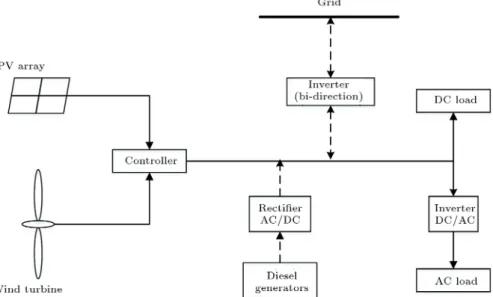
The considered grid-connected hybrid renewable en-ergy system includes PV panels, wind turbines, diesel generators, accessory devices, and utility grid which can act as a back-up system. A particular conguration of the employed system is shown in Figure 1. According to this gure, the system energy ow can be explained as follows. The available energy generated by PV panels and wind turbines is directly used to cater to
the load demand. When the power generation exceeds the power demand, the excess power will be fed into the utility grid; thus, it provides additional income for consumers by their surplus energy sales. On the contrary, when the energy from the renewable sources is not enough to satisfy the load demand, the diesel generators start to work. In case the diesel generators cannot meet the surplus load demand, the decient electricity will be drawn from the grid resulting in an increase of system cost of purchasing electricity.
A grid-connected system may be vulnerable con-fronted by system abnormalities and a good system design needs to be stable and reliable. In this study, the power balance of the system will always be maintained as the grid faults, disturbances blackouts, or other equipment failures, which are out of consideration.
3. Modeling of the hybrid system
The mathematical model of the hybrid system can be established based on the problem description. It is essential to analyze individual components before constructing the model of their combination. In this section, we rst analyze the main system components and establish their individual model including PV panels, wind turbines, and diesel generators, and then the optimization objectives and the system model are presented.
3.1. Mathematical models of system components
The utilization of solar energy includes primarily solar thermoelectric power generation and solar photovoltaic power generation. Although many studies have focused on solar thermoelectric power generation [19,20], pho-tovoltaic generation is becoming prevalent owing to its economic and environmental advantages. Therefore, solar photovoltaic generation is considered in this study. Generally, the output power of PV panels depends mainly on the eective solar radiation, the characteristics, and the slope angle of the PV panel. Mathematically, the output of PV panels at an instant time t, considering that the ambient temperature can be calculated by the following equations [21]:
TC(t) = TA(t) +NCOT 20800 Sp(t; ); (1)
ISC(t) = [ISC,STC+ KI(TC(t) 25)]Sp1000(t; ); (2)
VOC(t) = VOC,STC KV TC(t); (3)
PM(t; ) = NPV VOC(t) ISC; (t; ) F F (t); (4)
where TC(t) and TA(t) are the cell temperature and
ambient temperature at time t, respectively. NCOT is
the Nominal Cell Operating Temperature provided by the manufacturer, ISC,STCand VOC,STCare the module
short-circuit current and open-circuit voltage under Standard Test Conditions, and KI and KV are their
corresponding temperature coecients. PM(t) is the
power of a PV array consisting of NPVPV panels, and
FF(t) is the ll factor. is the slope angle of the panel, Sp is the eective solar radiation perpendicular to the
tilted panel and it is determined by the horizontal component of solar radiation (S) as follows [22].
Sp= sin hS sin(h + ); (5)
sin h = sin ' sin + cos ' cos cos ; (6) where h is solar elevation angle, ' is geography of the latitude, is hour angle, is solar declination related to earth's inclination to the plane of its orbit and the daily time [6].
The output power of a wind turbine can be expressed by the following equation:
PWT(; t) =
8 > > > < > > > :
0; < Vc 1
2CPAWT3; Vc < Vr
PWTR; Vr < Vf
0; Vf
(7)
where Cp is power coecient of the wind turbine,
is the air density, AWT is the rotor swept area, PWGR
is the rated power of the wind turbine, and is the wind velocity at hub elevation. Cut-in wind speed, Vc,
and cut-o Vfwind speed are set as 4 m/s and 20 m/s,
respectively. Vris the rated wind speed taken as 14 m/s
in this study [5].
Given wind speed r at reference height Hr and
the wind speed at the hub elevation of a wind turbine, Hwg can be calculated by the power law, which is
widely used by the researchers: = r
Hwg
Hr
; (8)
where is the wind speed power law coecient and its value is usually set to be one-seventh of relatively at surfaces.
The diesel generator acts as an emergency in case the power from renewable sources cannot meet the load demand. Its fuel consumption, Fcons, can be expressed
by a linear function of the power output as follows [5]: Fcons= AdgPr dg+ BdgPdg; (9)
where Pr-dg and Pdg are the generator's rated and
output powers, respectively, Adg and Bdg are the
coecients of fuel consumption curve, and their values can be 0.08145 l/kW h and 0.246 l/kW h in this paper according to the references.
3.2. System optimization model
Based on the individual model of each component men-tioned above, we can establish a bi-objective system optimization model. The objectives to be minimized in this paper are system total cost and fuel emissions. System total cost, Ctot, consists of two parts: the
annualized cost (ACS) and net cost of purchasing electricity Cgrid. ACS is the sum of annualized initial
investment cost, (Cainv), operation and maintenance
cost (Caom), and replacement cost (Carep) of each
component as follows [4]:
ACS =Cainv(comps)+Caom(comps)+Carep(comps);
(10) Ctot= ACS+Cgrid; (11)
where the components include PV panels, wind tur-bines, turbine towers, and diesel generators. These components usually have a long lifespan on the average; therefore, they need not to be replaced during the project lifetime of 25 years considered in this study.
As for the fuel emissions, the number of kg CO2
is utilized as a measure. Both the diesel generators and power generation forming the grid will produce CO2in
the system. The total fuel emissions are given by: Femission=
T
X
t=1
Fcons(t) Ef + Emissiongrid; (12)
where Ef is the emission factor depending on the
characteristic of the diesel generator and fuel used, and its value is generally 2.5 kg/lit. Emissiongrid is
the emissions produced by the power generation of the grid to supply the decient load demand, that is to say, the more electricity is supplied by the grid, the more emissions are produced by the system.
Decision variables are composed of the number of PV panels, Npv, the number of wind turbines, Nwg,
the number of diesel generators, Ndg, PV panel slope
angle, , and turbine tower height, Hwg. Considering
the constraints of decision variables and the objectives mentioned above, the multi-objective optimization problem, i.e. the system optimization model, can be expressed as follows:
Min Fobj= (Ctotal; Femission); (13)
subject to
(Npv; Nwg; Ndg) 0; (14)
Hlow Hwg Hhigh; (15)
0 90; (16)
where Hlow and Hhigh are the wind turbine towers of
lower and upper height limits (m). Additionally, the maximum values of Npv, Nwg, and Ndg in the
opti-mization process are set as 30, 20, and 10, respectively.
4. Optimization algorithm
The optimal design of a grid-connected hybrid system is a multi-objective constraint optimization problem, as shown in Eqs. (13)-(16). Traditional search and optimization approaches, such as Newton method, are no longer eective. Multi-Objective Evolution-ary Algorithms (MOEAs) are well-suited for solving MOPs owing to their population-based nature which can nd a set of trade-o solutions in a single run. Numerous MOEAs have been proposed over the past two decades and Preference-Inspired Co-Evolutionary Algorithm (PICEA) is one of them. According to the idea of PICEA, dierent preference sets might lead to dierent regions of a MOP's Pareto front. Therefore, a promising representative of the trade-o solutions (so-called Pareto front) can be achieved, if multiple specied sets of hypothetical preferences are evolved during the search process [15,23-25].
Preference-Inspired Co-Evolutionary Algorithms using goal vectors (PICEA-g) are instantiation of PICEA [15] and perform well on MOP benchmarks. Like most of evolutionary algorithms, PICEA-g con-sists of six steps: population initialization, population evaluation, tness assignment, selection-for-survive, so-lution reproduction, and selection-for-variation. How-ever, PICEA-g dierentiates itself from others by its coevolution features. Specically, two populations are evolved during the search, i.e. a population of preferences (goal vectors) and the usual population of candidate solutions. The preferences are mainly used to guide candidate solutions eectively towards the entire Pareto optimal front. Such an interac-tion is specically realized in the tness assignment procedure. A candidate solution gains tness by meeting several goal vectors in objective space, but the tness contribution has to be shared evenly with other solutions to satisfy the same goal vector. The goal vector will gain tness only by being satised by a candidate solution; therefore, the more it is satised, the lower its tness value is.
Although PICEA-g shows advantages over other evolutionary algorithms, the employed tness assign-ment method is only weakly Pareto dominance compli-ant [15]. Thus, Shi et al. [18] proposed an enhanced tness assignment method for PICEA-g. The new tness assignment method considers both the explicit tness value of goal vectors and the Pareto dominance rank of candidate solutions. This ensures that the dominated solutions will never have higher tness than non-dominated solutions. The modied PICEA-g with enhanced tness assignment method (termed as PICEA-ng) has been demonstrated eective and more details can be found in [18].
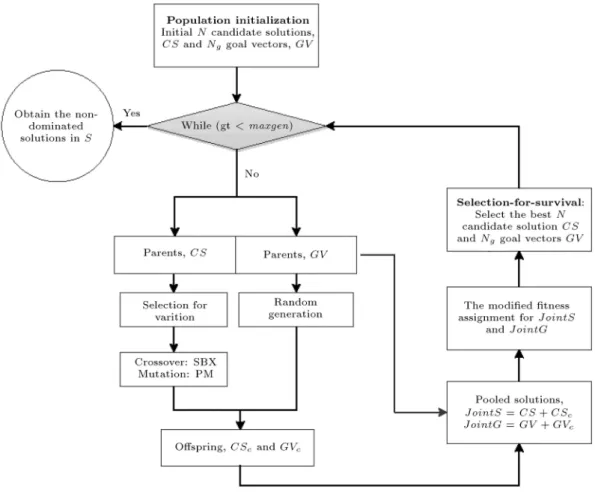
The PICEA-ng is implemented within a ( + ) elitist approach as shown in Figure 2. First, a
Figure 2. + elitist approach [13].
population of N candidate solutions, CS, and a set of Ngoal goal vectors, GV , are initialized. The two
populations are then co-evolved for maxGen genera-tions. In each generation, gt and parents CS(gt) will be paired up to produce N ospring, CSc(gt), by genetic
operators (specically, the simulated binary crossover (SBX) and Polynomial Mutation (PM) operators [16]). Meanwhile, Ng, new goal vectors, and GVc(gt) are
randomly re-generated according to the pre-dened bounds. Since, in the algorithm, all solutions are normalized within [0,1], the goal vector bounds can be set as [1.2,1.2,...,1.2]. Then, CS(gt) and CSc(gt) as
well as GV (gt) and GVc(gt) are pooled, respectively.
The combined population will be sorted based on their tness value, respectively. Finally, the same number of individuals with the parent population is selected by the truncation selection as the new parent populations [15].
PICEA-g algorithm is applied to address the MOP mentioned above. The chromosome of a candi-date solution is composed of ve genes in the form: [NpvjNwgjNdgjHwgj]. In the optimization process,
round operation is conducted to keep the number of system devices as integer ones. General parameter settings are given in Table 1, where pcis recombination
probability, pm is mutation probability, c and m
Table 1. General parameter settings. N Ng MaxGen pc
(SBX) c
(SBX) pm
(PM) m
(PM)
50 50 100 1 15 1/nvar 20
are distribution indices for SBX and PM operators, respectively. nvar is the number of decision variables. In this study, nvar = 5. The values of these parameters are set based on previous literature.
5. Experimental study
As an example of application, the optimal design of a grid-connected hybrid system to supply power for an area in Spain (latitude 41.65) is carried out in
this section. First, the input data are introduced to conduct the experiment. Then, experimental results and analyses are presented.
5.1. Input data
The input data set includes the hourly solar irradiation on horizontal surface, the hourly mean values of wind speed and ambient temperature, the hourly load de-mand during one year, and the specications of system
Figure 3. Monthly average load prole.
Figure 4. Hourly meteorological data.
components as shown in Figures 3 and 4 and Tables 2 and 3. The load (only DC load is considered here), solar radiation, and wind speed are assumed to be constant during the simulation time step of one hour [26].
The hourly mean values of solar irradiation and wind speed data at 10 meters height as well as the ambient temperature in Figure 4 are the average data of the last ten years [6]. The technical characteristics of system components are given in Tables 2 and 3, where initial investment cost, Cinv, and operation and
maintenance cost, Com, are used to calculate ACS. WT
tower stands for wind turbine tower.
Additionally, the limit of turbine tower height is between 5 and 30 meters, the rotor length is 2 meters, and the rated power is 8892 W. As for the diesel
Table 2. PV panels specications. Voc
(V)
Isc
(A)
Vmax
(V)
Imax
(A)
NCOT (C)
21 7.22 17 6.47 43
Table 3. The cost specications of system components. Item
Initial investment
cost Cinv
Maintenance cost Com
Lifetime (year)
PV panel 3000 $ 30 $ 25
Wind turbine 3013 $ 50 $ 25
WT tower 250 $/m 2.5 $/m 25
Diesel generator 1514 $ 0.17 $/h 25
generator, its rated power is 2 kW and its Comis related
to the operation time. In addition, the eciency of the inverter is set to be 90%. The nominal interest rate and annual ination rate considered are 3.75% and 1.5%, respectively. The fuel price used by the diesel generator is 1.2 $/lit [26]. The prices of selling electricity back to the grid and buying electricity from it are assumed to be equal and they are both 0.1/$kW h. The produced equivalent CO2 emissions are set as 0.5 kg per unit
power, when we purchase electricity from the grid in this study.
5.2. Results
With the input data, the PICEA-ng algorithm has been applied to address the optimization problem. The optimization result is shown in Figure 5, which is the representation of the last generation in objective space. As can be observed from the result, the total system cost and fuel emissions have a signicant
Table 4. Three typical optimal solutions.
Solution Npv Nwg Ndg Hwg Femission(kg) Ctot($)
1 30 10 0 26.10 47.29 2434.79 8051.49
2 3 7 0 19.83 57.63 3978.92 2835.72
3 0 1 0 25.53 56.10 5555.77 1675.14
negative relationship, i.e. a more cost-eective system will produce more fuel emissions.
Along with the obtained Pareto set, a decision-maker has to select a suitable solution by incorporating his/her a posteriori preference information. As an example, three typical solutions are selected from the Pareto set according to the fuel emissions objective (the minimal, medium, and maximum one) as shown in Table 4.
Compared with the previous work [26], this pa-per studied a grid-connected hybrid renewable energy system using the modied PICEA-g algorithm. In the grid-connected hybrid system, the utility grid serves as the storage device, so that the battery bank can be excluded. Although the system model and objectives are dierent, good results of the problems by means of the preference-inspired co-evolutionary approach are obtained. It is worthy to note that the number of diesel generators is zero in the grid-connected system congurations, i.e. there is no diesel generators in the optimal congurations. The reason may be that the cost of diesel generators is high, and they emit too many greenhouse gases compared with acquiring the same electricity from the grid.
6. Conclusions
The modied Preference-Inspired Co-Evolutionary Al-gorithm (PICEA-ng), which has high performance and simplicity compared with other evolutionary al-gorithms, has been used for the rst time to the optimal design of grid-connected hybrid renewable energy systems in this article. With simultaneous minimization of total system cost and fuel emissions, we established the grid-connected system model, which is a two-objective optimization problem. As a case study, a grid-connected hybrid system, including PV panels, wind turbines, and diesel generators, has been designed to nd the optimal conguration and good results are obtained by the proposed method.
It is worth mentioning that the optimization model is limited to a static environment, where some noisy parameters can be considered in the input data or objective functions to describe uncertain problems for future research. Moreover, various prices of selling the excess power back to the grid and buying the electricity from the grid might be considered to study their inuence on the optimal design of a grid-connected
hybrid system. Lastly, other advanced evolutionary algorithms, e.g. [27,28,29], can be employed to solve the optimal design of HRES. In another aspect, the problem itself can be formulated as a standard multi-objective problem to benchmark the performance of dierent multi-objective evolutionary algorithms.
Acknowledgment
The National Natural Science Foundation of China (No. 61403404, 71571187), the National University of Defense Technology (No. JC 14-05-01) and the Distinguished Natural Science Foundation of Hunan Province (No. 2017JJ1001) supported this work.
References
1. Kaundinya, D.P., Balachandra, P. and Ravindranath, N.H. \Grid-connected versus stand-alone energy sys-tems for decentralized power-A review of literature", Renew. Sust. Energ. Rev., 13(8), pp. 2041-2050 (2009). 2. Wang, R., Fleming, P.J. and Purshouse, R.C. \General framework for localised multi-objective evolutionary algorithms", Information sciences, 258(2), pp. 29-53, (2014).
3. Katsigiannis, Y.A., Georgilakis, P.S. and Karapidakis, E.S. \Multi objective genetic algorithm solution to the optimum economic and environmental performance problem of small autonomous hybrid power systems with renewable", IET Renew Power Gener., 4(5), pp. 404-419 (2010).
4. Yang, H., Zhou, W., Lu, L. and Fang, Z. \Optimal siz-ing method for stand-alone hybrid solar-wind system with LPSP technology by using genetic algorithm", Sol. Energy, 82, pp. 354-367 (2008).
5. Dufo-Lopez, R. and Bernal-Agustin, J.L. \Multi-objective design of PV-wind-diesel-hydrogen-battery systems", Renew Energ., 33(12), pp. 2559-2572 (2008). 6. Shara, M. and ELMekkawy, T.Y. \Multi-objective optimal design of hybrid renewable energy systems using PSO-simulation based approach", Renew Energ., 68, pp. 67-79 (2014).
7. Wang, R. and Zhang, T. \Multi-objective optimal design of hybrid renewable energy systems using MOEA/D", International Conference on Renewable Energy Research and Applications, IEEE, Milwaukee, USA, pp. 161-167 (2014).
8. Giannakoudis, G., Papadopoulos, A.I., Seferlis, P. and Voutetakis, S. \Optimum design and operation under
uncertainty of power systems using renewable energy sources and hydrogen storage", Int. J. Hydrogen En-ergy, 35(3), pp. 872-891 (2010).
9. Jahromi, A.E. and Rad, Z.B. \Optimal topological design of power communication networks using genetic algorithm", Sci. Iranica, Trans. E: Ind. Eng., 20(3), pp. 945-957 (2013).
10. Caballero, F., Sauma, E. and Yanine, F. \Busi-ness optimal design of a grid-connected hybrid PV (photovoltaic)-wind energy system without energy storage for an Easter Island's block", Energ., 61, pp. 248-261 (2013).
11. Dalton, G.J., Lockington, D.A. and Baldock, T.E. \Feasibility analysis of renewable energy supply op-tions for a grid-connected large hotel", Renew Energ., 34(4), pp. 955-964 (2009).
12. Pablo, G.T., Francisco, L.I., Carlos, A.G.V., Antonio, J.L.M., Luis, M.F.R. and Francisco, J. \Long-term optimization based on PSO of a grid-connected renew-able energy/battery/hydrogen hybrid system", Int. J. Hydrogen Energy, 39(21), pp. 10805-10816 (2014). 13. Lashkar Ara, A., Kazemi, A., Gahramani, S. and
Behshad, M. \Optimal reactive power ow using multi-objective mathematical programming", Sci. Iranica, Trans. D: Comput. Sci. Eng. Electr. Eng., 19(6), pp. 1829-1836 (2012).
14. Bernal-Agustin, J.L. and Dufo-Lopez, R. \Economical and environmental analysis of grid connected photo-voltaic systems in Spain", Renew. Energ., 31(8), pp. 1107-1128 (2006).
15. Wang, R., Purshouse, R.C. and Fleming, P.J. \Preference-Inspired Coevolutionary Algorithms for Many-Objective Optimization", IEEE Trans. Evol. Comput., 17(4), pp. 474-494 (2013).
16. Deb, K., Pratap, A., Agarwal, S. and Meyarivan, T. \A fast and elitist multiobjective genetic algorithm: NSGA-II", IEEE Trans. Evol. Comput. 6(2), pp. 182-197 (2002).
17. Zhang, Q. and Li, H. \MOEA/D: A Multiobjec-tive Evolutionary Algorithm Based on Decomposi-tion", IEEE Trans. Evol. Comput., 11(6), pp. 712-731 (2007).
18. Shi, Z.C., Wang, R. and Zhang, T. \PICEA-g using an enhanced tness assignment method", 2014 IEEE Symposium on Computational Intelligence in Multi-Criteria Decision-Making (MCDM), IEEE, Orlando, USA, pp. 72-77 (2014).
19. Muthu, G., Shanmugam, S. and Veerappan, A.R. \Numerical modeling of year-round performance of a solar parabolic dish thermoelectric generator", J. Electronic Materials, 44(8), pp. 2631-2637 (2015). 20. Baranowski, L.L., Warren, E.L. and Toberer, E.S.
\High-temperature high-eciency solar thermoelectric generators", J. Electronic Materials, 43(6), pp. 2348-2355 (2014).
21. Koutroulis, E., Kolokotsa, D., Potirakis, A. and Kalaitzakis, K. \Methodology for optimal sizing of stand-alone photovoltaic/wind-generator systems us-ing genetic algorithms", Sol. Energy, 80(9), pp. 1072-1088 (2006).
22. Abedi, S., Alimardani, A., Gharehpetian, G.B., Riahy, G.H. and Hosseinian, S.H. \A comprehensive method for optimal power management and design of hybrid RES-based autonomous energy systems", Renew. Sust. Energ. Rev., 16(3), pp. 1577-1587 (2012).
23. Wang, R., Purshouse, R.C. and Fleming, P.J.\ Preference-inspired co-evolutionary algorithms using weights for many objective optimisation ", European Journal of Operations Research, 243(2), pp. 423-441 (2015).
24. Wang, R., Purshouse, R.C., Giagkiozis, I. and Flem-ing, P.J., \The iPICEA-g a new hybrid evolution-ary multi-criteria decision making approach using the brushing technique", European Journal of Operations Research, 243(2), pp. 442-453 (2015).
25. Wang, R., Maszatul, M. Mansor, Purshouse, R.C. and Fleming, P.J. \An analysis of parameter sensitivities of preference-inspired co-evolutionary algorithms", Inter-national Journal of Systems Science, 46, pp. 423-441 (2015).
26. Shi, Z.C., Wang, R. and Zhang, T. \Multi-objective optimal design of hybrid renewable energy systems using preference-inspired coevolutionary approach", Sol. Energy, 118, pp. 96-116 (2015).
27. Wang, R. Zhang, Q.F. and Zhang, T. \Decomposition based algorithms using Pareto adaptive scalarizing methods", IEEE Trans. Evol. Comput., 20, pp. 821-837 (2016).
28. Li, M., Yang, S., Zheng, J., and Liu, X. \ETEA: A Euclidean minimum spanning tree-based evolutionary algorithm for multiobjective optimization", Evolution-ary Computation, 22(2), pp. 189-230 (2014).
29. Li, M., Yang, S., Zheng, J., and Liu, X. \Pareto or non-Pareto: Bi-criterion evolution in multi-objective optimization", IEEE Trans. Evol. Comput., 20(5), pp. 645-665 (2016).
Biographies
Zhichao Shi received his BSc degree from the Nankai University in 2013 and MSc degree from the National University of Defense Technology in 2015, both in P.R. China. He is currently pursuing his PhD degree in the Department of Electrical and Computer Engineering, University of Alberta, Canada. His main research interests include renewable energy system planning, optimization methods, and computational intelligence. Rui Wang received his BSc degree from the National University of Defense Technology (NUDT), P.R. China, in 2008 and his PhD degree from the University of Sheeld, U.K, in 2013. He is currently a Lecturer at
the NUDT. His main research areas are evolutionary computation, multi-objective optimization, machine learning, and optimization methods on energy internet network. He won the Operational Research Society PhD prize Runners-up for the best PhD dissertation in 2016.
Xiaoyu Zhang is currently pursuing the PhD degree at the College of Information System and Management, National University of Defense Technology. Her main research interests include machine learning and opti-mization.
Yan Zhang received his BSc from the Sichuan Uni-versity (SCU), P.R. China, in 2010. He received his MSc and PhD degrees from the National University
of Defense Technology (NUDT), P.R. China, in 2012 and 2016, respectively. He is currently a Research Assistant at the Science and Technology University on ship integrated power system technology laboratory, the Naval University of Engineer. His main research areas are optimal scheduling and model predictive control of micro-grids.
Tao Zhang received his BSc, MSc, and PhD degrees from the National University of Defense Technology (NUDT), P.R. China, in 1998, 2001, and 2004, respec-tively. He is currently a Professor at the College of Information System and Management, the NUDT. His main research areas are multi-criteria decision-making, optimal scheduling, data mining, and optimization methods on energy internet network.