Issues
ISSN: 2146-4138
available at http: www.econjournals.com
International Journal of Economics and Financial Issues, 2017, 7(2), 94-102.
The Risk-sensitivity of Bank Capital Requirements: The
Moderating Effects of Capital Regulation and Supervisory Power
Mohamed Albaity
1*, Mohammadmahdi Toobaee
21Department of Finance and Economics, College of Business Administration, University of Sharjah, Sharjah, 27272,
UAE, 2Department of Banking and Finance, Faculty of Business and Accountancy, University of Malaya, Kuala Lumpur, 50603,
Malaysia. *Email: [email protected]
ABSTRACT
This study examines the moderating effects of capital regulation and supervisory power on the risk-sensitivity of bank capital requirements. Using two-step system generalized method of moments (GMM) estimator, we work on the international sample of 222 banks charted in 30 countries. The finding suggests that asset volatility is a critical variable in explaining the risk-sensitivity of banks. The results indicate that stricter capital regulatory
regimes and higher supervisory power enhance the risk sensitivity of capital requirements. Moreover, the capital regulation was found to moderate the relationship between asset volatility and risk-sensitivity while supervisory power was found not to exert any impact on the level of risk of the banks. Another interesting result is that governments with a higher debt to gross domestic product ratio tend to overregulate the other banks’ investments
compared to government bonds. This is the first study that investigates the moderating effects of capital regulation and power of supervision on the risk sensitivity of capital requirements. The results of this study show that the efficiency of risk-based capital requirements depends on the stringency
of capital regulation in different countries.
Keywords: Bank Capital Requirements, Risk-weighted Assets, Capital Regulation, Supervisory Power, System Generalized Method of Moments, Government Debt to Gross Domestic Product
JEL Classifications: G21, G34, G33, G28
1. INTRODUCTION
The amount of capital that banks should hold has been one of the most controversial subjects in the history of the banking industry. The main reason for setting standards for minimum capital is that
banks are the hearts of financial systems; if banks fail, the stability of the whole financial system could be in danger.
Recent financial crisis shows that despite the refinements on
capital regulations (Basel I and II) which occurred during last two decades, regulatory capital requirements were not in line with the riskiness of the bank asset portfolios (Vallascas and Hagendorff,
2013). Some financial experts believe that one of the significant
reasons why banks held inadequate capital when the crisis commenced was because regulatory capital requirements were not
sufficiently attuned to the riskiness of bank activities (Acharya et al., 2009; Vallascas and Hagendorff, 2013). The main question
here is to what extent those mentioned defects are related to the
execution of the minimum capital regulation guidelines across countries, not the nature of those regulations. For example, the calculation of risk-weighted assets, which is the key part of the minimum capital regulation ratios, could cause many variations because of differences in regulatory frameworks, supervisory frameworks, accounting frameworks, legal frameworks, economic cycles, business models, and lending, valuation and provisioning
practices (Avramova and Le Lesle, 2012). As a consequence of
those differences, Basel II has never been implemented uniformly
(Moosa, 2010). As an instance, despite the fact that the Basel II is mandatory only for large banks with more than $250 million in
total assets in the United States, the European Union implements Basel II via credit requirement directive for all credit institutions
and investment firms (Moosa, 2010). Emerging economies, also, may have some difficulties regarding Basel II implementation
as it involves a major cultural shift in regulation and massive
across different jurisdictions are neglected, investigating the risk-sensitivity of capital requirement approaches could be biassed.
The inherent concern of this study is to clarify whether or not the stringent capital regulation and powerful supervision can enhance the risk sensitivity of capital regulations. In other words, this study examines the risk sensitivity of capital requirements, while the effects of variations in executing the regulations in different jurisdictions are taken into account. Although Vallascas
and Hagendorff (2013) conducted a comprehensive analysis of
the relationship between risk-weighted asset and asset volatility of banks, the moderating effects of country-level variables on the risk sensitivity of bank capital have not been investigated. Thus, the main purpose of this study is to close this gap. The result of this study may help regulators to realise that current bank capital regulations are not enough to prevent banks from high-risk investments, as the so-called risk-based capital regulations (including Basel 1 and 2) are not strongly associated with the market perception of banks portfolio risk. Also, the role of governments practices in moderating the relationship between regulatory assessment of risk and market perception of risk should be recognised, as we showed that the risk sensitivity of capital regulation is higher in highly regulated countries.
The first objective of this study is to investigate how effective
the capital regulation and supervisory power are in capturing the bank portfolio risk. The second objective is to examine the moderating effect of capital regulation and supervisory control on the relationship between regulatory assessment of risk and the economic risk. As the regulatory practices and supervisory powers are not equal across countries, they may encourage bankers to
undertake regulatory capital arbitrage (Ledo, 2011; Vallascas and Hagendorff, 2013). Thus, the moderating effects of stringency
of capital requirements, and the power of supervision to enforce those regulations should be investigated.
The second section of this study is devoted to the literature review. In section three, after discussing the methodology of the study, we explain the sampling process. In the fourth chapter,
the results are reported and discussed. Chapter five is devoted
to the conclusion.
2. REVIEW OF LITERATURE
When it comes to studying capital regulations and its different
aspects, the first question that comes to mind is why a bank’s
capital should be regulated. Calem and Rob (1999) argued that the main aims of capital regulation are discouraging bank risk-taking (when the government deposit-guarantee allows banks to make riskier loans without having to pay more interest rates on deposits, the excessive risk-taking problem may occur), preventing bank failures, and ensuring continued solvency of the deposit insurance fund. The potential social cost of this risk-taking would be high because a major bank failure could impose external costs on
financial markets (Berger et al., 1995). Kim and Santomero (1988), also, argued that since the amount of capital influences
the probability of bank insolvency and thus the healthiness of the entire banking system, the regulators, ceteris paribus, prefer more capital to less. Thus, in a nutshell, we can say that the safety
and healthiness of banks are the main reasons for designing and
developing capital regulations (Vallascas and Hagendorff, 2013).
The theoretical foundation of capital regulation is that banks need to hold enough capital to absorb losses. Owing to the fact that bank shareholders tend to take on high portfolio risk to maximise the value of deposit insurance, capital regulation may offset incentives for bank shareholders to shift risk (Vallascas and Hagendorff,
2013). This happens when the required amount of capital that
banks should hold is linked to the risk of bank portfolio (Calem
and Rob, 1999; Furlong and Keeley, 1989; Sharpe, 1978). In other
words, when bank shareholders are forced to absorb the losses in association with bank risk-taking, capital regulation can prevent them from excessive risk-taking behaviours.
However, a number of researchers investigated the discrepancies between the regulatory assessment and the economic risks of banks, which encourage larger banks to use capital arbitrage. Merton (1995) indicated that risk-weight international capital rules, which are regulated by the Basel Committee, incentivise
banks to engage in capital arbitrage. Jones (2000) and Hellwig (2010) also argued that the risk-weighted approach encourages
bankers to use regulatory capital arbitrage that distorts regulatory capital ratio measures. After examining the several aspects of the
recent financial crisis, Acharya et al. (2009) concluded that the
current regulatory focus is on just one performance metric of the bank, which is capital to risk-weight assets. According to the Basel Committee reports, discrepancies between regulatory assessment of risk and economic risk were among the main reasons why
banks held inadequate capital when the recent global financial crisis began (Basel Committee, 2009; 2011). Acharya et al. (2013) showed that before the recent global financial crisis, securitisation
allowed banks to reduce regulatory capital. Thus, to retain risks on their balance sheets and receive a reduction in regulatory capital, banks widely used securitisation methods.
In response to those critics about the inefficiencies of risk-weight
capital regulation approaches, many studies have investigated the relationship between capital ratios and economic risks. Shrieves and Dahl (1992), Jacques and Nigro (1997), Calem and Rob
(1999), and Flannery and Rangan (2007) tried to clarify the
risk-sensitivity of capital ratios during past decades. However, the studies that directly examine the relationship between the regulatory assessment of risk and the market assessment of bank
portfolio risk are scarce. Vallascas and Hagendorff (2013) worked on an international of large banks between 2000 and 2010 and
evaluated the risk-sensitivity of minimum capital requirements.
In contrast with the previous studies (Calem and Rob, 1999; Flannery and Rangan, 2007; Jacques and Nigro, 1997; Shrieves
and Dahl, 1992) that study the relationship between the bank
capital and the risk, Vallascas and Hagendorff (2013) investigated
the relationship between the density of risk-weighted asset (risk-weighted assets over total assets) as the regulatory assessment of risk, and bank asset volatility as the market assessment of
risk. They found a positive and significant association between
small increase in capital requirements. They, besides, studying the moderating effect of internal-rating-based (IRB) approach on the risk-sensitivity of capital, the IRB approach has enhanced the risk-sensitivity of regulatory capital requirements, although if the IRB approach increases portfolio risk and has minimal impact on capital requirements.
Despite the fact that the effectiveness of the risk-based capital regulation and its evolution during last three decades has been
studied in different ways, the role of country-specific variables
in improving the risk-sensitivity of risk-based capital regulation has not been adequately evaluated. There are many variations in the calculation of risk-weighted assets, which is the keystone of risk-based capital regulation, across countries. According
to Avramova and Le Lesle (2012), regulatory framework,
supervisory framework, accounting framework, legal framework, economic cycle, business cycle, and lending, valuation and provisional practices are the main differences in risk-weighted
asset densities across countries. Moosa (2010) argued that
because of the variations in the execution of Basel agreements in different countries, risk-based capital regulations have never been completely implemented. Some commentators, moreover,
argued that emerging economies, also, may have some difficulties
regarding Basel II implementation as it involves a major cultural shift in regulation, even a massive re-engineering in regulating
body (Davies, 2005; Fischer, 2002). Thus, the efficiency of
risk-based capital regulation in enhancing the risk sensitivity of capital requirements should be judged only when the differences of execution in different jurisdictions are taken into account. In
addition, recently Delis and Karaviasb (2015) investigated the
optimal level of credit risk which is linked to maximum bank
profit and found that the optimal level follows the business
cycle whereby it increases in stable periods and decreases when the economy is in recession. On the other hand, Mariathasan
and Merrouche (2014) using panel data sample of 21 countries
examined the relationship between approval of Basel II IRB and risk-sensitivity and found that risk-sensitivity decreased once approval was granted. Using different variables, Barakova and
Palvia (2014) evaluated the impact of advanced internal ratings
based risk on portfolio risk and found that advanced internal ratings found risk to be highly correlated with portfolio risk.
3. RESEARCH METHODOLOGY
3.1. Sample
In this study, we use the sampling design of Vallascas and
Hagendorff (2013). We built a cross-country sample of large listed banking organisations. We started with 650 largest (by total assets)
banks listed on Bureau van Dijk’s Bankscope database on a yearly
basis between 2000 and 2010. The sample period was selected due to data availability and structural break consideration. We first filtered out pure investment banks that are not subject to the Basel
accord. Then cooperative banks, government-owned institutions, long-term credit banks, and Islamic banks are excluded because the shareholder value considerations do not drive the risk choices and capital management decisions at these institutions. Also, we excluded the regional banks in Japan because capital adequacy rules for regional banks in Japan are not based on the Basel
accord. In the next step, we omitted banks that are subsidiaries of
other banking firms since some capital management decisions are
likely to be made at the level of holding company rather than at subsidiary level. The sample size reduces to 2,272 observations when applying these criteria. Excluding observation with missing
values for country-specific variables, the sample size shrinks to
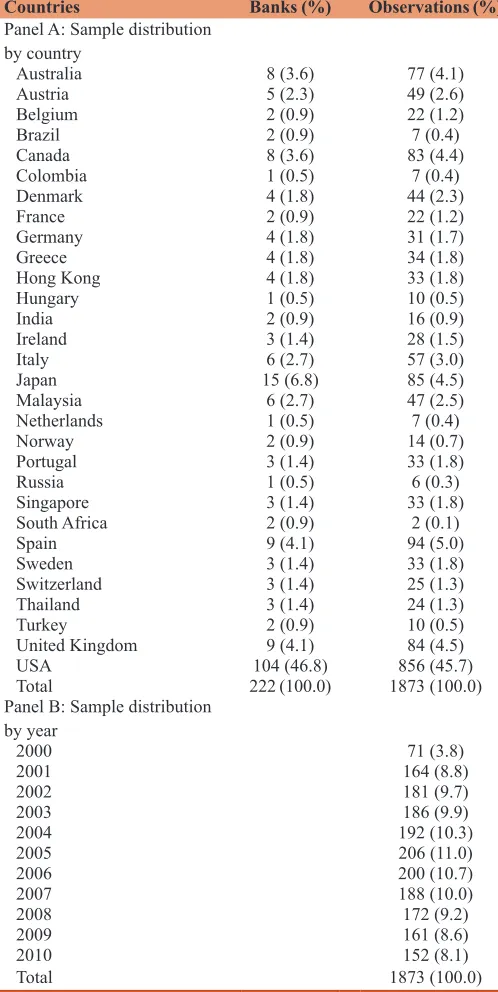
1,873 observations for 222 banks charted in 30 countries. The distribution of the final sample by country and year is reported
in Table 1.
3.2. Regulatory and Market Assessment of Bank Portfolio Risk
The dependent variable in this study is the density of risk-weighted asset as a proxy for the regulatory assessment of the bank portfolio
Table 1: Sample distribution by country and year
Countries Banks (%) Observations (%)
Panel A: Sample distribution by country
Australia 8 (3.6) 77 (4.1) Austria 5 (2.3) 49 (2.6) Belgium 2 (0.9) 22 (1.2) Brazil 2 (0.9) 7 (0.4)
Canada 8 (3.6) 83 (4.4) Colombia 1 (0.5) 7 (0.4)
Denmark 4 (1.8) 44 (2.3) France 2 (0.9) 22 (1.2) Germany 4 (1.8) 31 (1.7) Greece 4 (1.8) 34 (1.8) Hong Kong 4 (1.8) 33 (1.8) Hungary 1 (0.5) 10 (0.5)
India 2 (0.9) 16 (0.9)
Ireland 3 (1.4) 28 (1.5) Italy 6 (2.7) 57 (3.0)
Japan 15 (6.8) 85 (4.5) Malaysia 6 (2.7) 47 (2.5) Netherlands 1 (0.5) 7 (0.4)
Norway 2 (0.9) 14 (0.7)
Portugal 3 (1.4) 33 (1.8) Russia 1 (0.5) 6 (0.3)
Singapore 3 (1.4) 33 (1.8) South Africa 2 (0.9) 2 (0.1)
Spain 9 (4.1) 94 (5.0)
Sweden 3 (1.4) 33 (1.8) Switzerland 3 (1.4) 25 (1.3) Thailand 3 (1.4) 24 (1.3) Turkey 2 (0.9) 10 (0.5)
United Kingdom 9 (4.1) 84 (4.5) USA 104 (46.8) 856 (45.7) Total 222 (100.0) 1873 (100.0)
Panel B: Sample distribution by year
2000 71 (3.8)
2001 164 (8.8)
2002 181 (9.7)
2003 186 (9.9)
2004 192 (10.3)
2005 206 (11.0)
2006 200 (10.7)
2007 188 (10.0)
2008 172 (9.2)
2009 161 (8.6)
2010 152 (8.1)
risk. Following Avery and Berger (1991), Shrieves and Dahl
(1992), Berger (1995), and Vallascas and Hagendorff (2013) the
density of risk-weighted asset is computed as the proportion of risk-weighted assets over total assets. For banks that are regulated
based on Basel I, the ratio is defined as:
RWATA=
RWA +12.5×C
TA
=RWA +RWA TA
CR RWAMR CR MR (1)
Where, RWACR is the amount of risk-weighted assets, which is related to a bank’s credit risk, C–RWAMR is the amount of capital required for market risk exposure, RWAMR is the amount of risk-weighted assets that is related to marker risk, and TA is the total asset. Basel II, however, gives the banks the opportunity to opt either for the standardised approach or for the IRB approach, for assigning the risk-weights to assets. Besides, Basel II includes the operational risk in calculating the risk-weighted asset. Thus, we can calculate the density of risk-weighted assets under Basel II as:
RWATA=RWA +12.5×(C_RWA +C_RWA )
TA
=RWA +RWA +R
CR_SD(IRB) MR OR
CR MR WWA
TA
OR
(2)
Where, RWACR_SD(IRB) is the amount of risk-weighted assets that is related to the credit risk and is calculated (either under the standard or the IRB approach), C_RWAMR is the amount of capital required for market risk exposure, and C_RWAOR is the amount of capital required for the operational risk exposure.
The main independent variable in this study is the bank’s asset volatility that is a proxy for the market perception of bank’s
asset portfolio risk. We follow Flannery and Rangan (2007) for
estimating the total risk exposure from its equity volatility as:
σ =
A(
σ
EE
A
)×
(3)Where, σE is the standard deviation of bank’s daily equity returns over a year, E is the market value of bank’s equity at the end of the year, and A is the quasi-market value of bank asset (The market value of equity plus the book value of debt) at the end
of the year. Then, the resulting measure of σA is annualised, by multiplying the year’s daily standard deviation by the square root
of 250 (the approximate number of trading days in a year). This σA incorporates all risks, including asset returns, liability returns,
changes in the off-balance-sheet book, and operating efficiencies (Flannery and Rangan, 2007).
3.3. Econometric Model
The econometric model that is used in this study is:
RWATAi,t = β0 + β1 × RWATAi,t−1 + β2 × asset volatilityi,t
+ β3 × bank specific controls + β4 × country specific controls + β5 × capital regulationk,t × asset volatilityi,t
+ β6 × supervisory powerk,t
× asset volatilityi,t + β7 × yeart + εi,t (4)
Where, RWATA is the risk-weighted asset divided by total assets, asset volatility is the volatility of bank portfolio asset.
Bank-specific controls is a vector of bank-Bank-specific variables including
size (natural logarithm of total assets), return on assets (ROA), capital buffer (the difference between bank’s regulatory capital ratio and the regulatory minimum), deposits (total deposits over total liabilities), loans (net customer loans over total assets), noninterest income (noninterest income over total operating income), Basel II (dummy variable equals 1 if the bank has adopted Basel II in a given year and zero otherwise), IRB (dummy variable equals 1 if the bank has adopted IRB approach in a given year and zero otherwise), and standardised (dummy variable equals 1 if the bank has adopted standard approach in a given year and zero
otherwise). Country-specific controls is a vector of country-level
variables including capital regulation (a variable that measures the regulatory approach to assessing and verifying the degree of
capital at risk in banks from Barth et al. (2004) with updated values
from the World Bank website) supervisory power (a variable
that measures the extent to which official supervisory authorities have the authority to take specific actions to prevent and correct problem, from Barth et al. (2004) with updated values from the
World Bank website)1, government debt to gross domestic product
(GDP), and GDP growth. Year is a vector of time dummies,
and ε is the idiosyncratic error term. As the ultimate purpose of this study is to find the moderating effects of country-specific
variables on the relationship between the regulatory assessment of risk (RWATA) and the economic risk, the interaction terms between asset volatility and capital regulation, and supervisory power, are introduced and added into the model, one by one, to observe their moderating effect on the risk-sensitivity of capital regulation. Inasmuch as the banks that operate in countries with stringent capital regulatory and powerful supervision environment are less likely to engage in capital arbitrage activities, we expect capital regulation and supervisory power variables to enhance the risk-sensitivity of capital regulation. It means that a positive relationship between risk-weighted asset and asset volatility combined with capital regulation, and between asset volatility combined with supervisory power should be expected. However,
we expect the coefficients to be smaller than the direct impact of
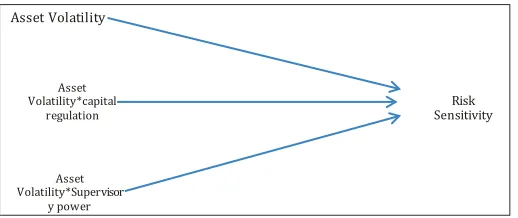
asset volatility on risk. Figure 1 summarises the direct and indirect relationship between asset volatility and risk-sensitivity.
Larger banks have more ability to engage in capital arbitrage and might be under more severe regulatory scrutiny (Vallascas and
Hagendorff, 2013). Therefore, we hold no expectation regarding the effect of bank size on RWATA. Since more profitable banks
seem to have fewer incentives to engage in capital arbitrage, we expect to see a positive association between RWATA and ROA. By the same token, we expect to see a positive relationship between deposits and RWATA, as banks with higher deposits are less likely to engage in capital arbitrage. On the other hand, we expect to see a negative relationship between RWATA and capital buffer as the regulatory scrutiny might be lower for highly capitalised banks (Calem and Rob, 1999). Regarding the relationship between loans and RWATA, we expect to see a positive relationship, as risk-weights assigned to customer loans are higher than weights
assigned to other forms of lending. Also, we expect to see a negative association between RWATA and noninterest income, as banks with a higher portion of noninterest income are expected to engage in more non-lending activities (lower risk-weights).
According to the Basel Committee (2006), for a given level of
portfolio risk, the minimum capital requirements decreased for banks that adopted Basel II relative to Basel I. Thus, we expect
to find a negative relationship between RWATA and the Basel
II adoption. Also, some researchers argued that since low-risk lending is better treated under the IRB method, the banks with low-risk loans in their asset portfolio are more likely to adopt the
IRB approach (Hakenes and Schnabel, 2011; Repullo and Suarez, 2004). Then, we expect to find a negative relationship between
RWATA and IRB adoption.
Regarding country-specific variables, we expect to find a positive
association between the capital regulation and supervisory power with RWATA, as a stricter regulatory capital regime and more powerful supervision in a country provide banks with fewer opportunities to engage in capital arbitrage. Several studies investigate the procyclical impacts of risk-based capital regulations
under Basel II. Following Vallascas and Hagendorff (2013) and
many others, we use the real GDP growth as a proxy for the business cycle and expect a higher regulatory measure of risk i.e., RWATA during the economic downturn. Thus, we expect to
find a negative relationship between GDP growth and RWATA.
Moreover, a government that simultaneously regulates the bank capital and borrows from it may have the motivation to increase
risk-weights for risky loans to ease its debt financing (Schliephake, 2013). Therefore, we expect to find a positive relationship between
government debt to GDP and RWATA.
As the ultimate purpose of this study is to find the moderating effects of country-specific variables on the relationship between
the regulatory assessment of risk (RWATA) and the economic risk, we introduce the interaction terms between asset volatility with capital regulation and supervisory power, and add them to the model to observe their moderating effect on the risk-sensitivity of capital regulation. We mean-centred asset volatility before adding it to the regression to prevent multicollinearity. In addition, we ran the VIF test to check the problem of multicollinearity and found the variables do not suffer from this problem. Since the banks that operate in countries with stringent capital regulatory and powerful supervision environment are less likely to engage
in capital arbitrage activities; we expect capital regulation and
supervisory power variables to enhance the risk sensitivity of capital regulation. It means that a positive relationship between
RWATA and the interaction terms between asset volatility and capital regulation, and the interaction term between asset volatility and supervisory power should be expected.
3.4. Endogeneity Problem
Some researchers argued that regulatory assessment of a bank’s portfolio risk (the proxy of which is RWATA in this study) might partly determine the market assessment of the risk of bank’s portfolio asset. Increasing the amount of RWATA, for example, could be a sign for investors upwardly to adjust their expectations
of bank’s portfolio risk (Vallascas and Hagendorff, 2013). This
reverse causality could cause the asset volatility to be correlated with the error term, which is called endogeneity. Some other endogeneity issues, moreover, can be considered explanatory variables. For instance, Shrieves and Dahl (1992) and Rime
(2001) argued that banks adjust capital buffer and risk-weighted
asset simultaneously. Thus, putting capital buffer as a
bank-specific variable into the model may cause endogeneity issues. We follow Vallascas and Hagendorff (2013) treating all bank-specific
variables as endogenous variables, and all country characteristic measures as strictly exogenous variables.
3.5. Data Analysis Technique
The system generalized method of moments (GMM) proposed by Blundell and Bond (1998) is an estimator designed for situations with few time periods and many individuals, not strictly exogenous
independent variables, fixed effects, and heteroscedasticity and autocorrelation within individuals (Roodman, 2006). As the maximum number of time periods in this study is 11 (2000-2010),
and there are 222 banks, obviously N>>T. Besides, asset volatility
and bank-specific control variables are considered endogenous
variables. Therefore, system GMM seems to be the best estimators
for this study. Also, Blundell and Bond (1998) is more efficient
than other estimators such as differenced GMM.
To comply with the system GMM identification, we use the first
lag difference of bank characteristics as instruments in the level equation and the second and the third lags of bank characteristics
as instrument in the difference equation. Equally, the first lag
difference of asset volatility, and the second and the third lags of asset volatility are used as instruments for the level and the difference equations respectively. We, also, use the level (difference) of the yearly volatility of domestic stock markets as another instrument for the level (difference) equation, which
is correlated with asset volatility (r = 0.18) but not with RWATA (r = −0.08). Using this instrument can capture the external
economic conditions that shape the market perception of bank
portfolio risk (Flannery and Rangan, 2007). Since the two-step
system GMM estimator tends to bias the estimated standard errors
downward, we use the Windmeijer (2005) procedure to correct the
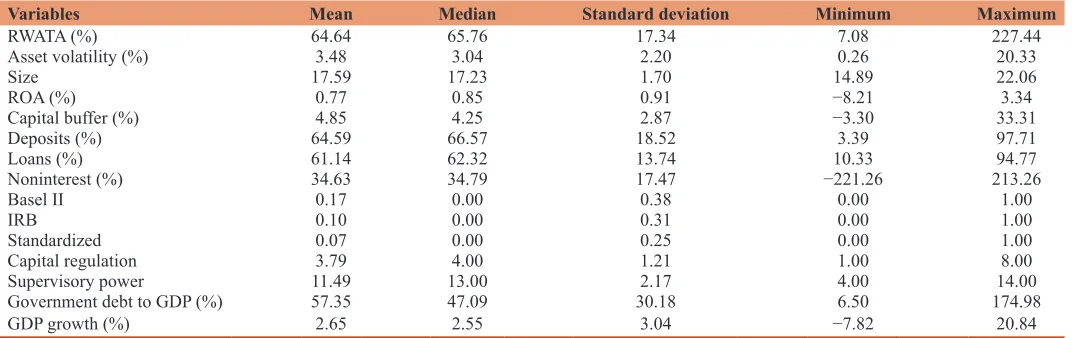
standard errors and reduce the bias. Table 2 offers the descriptive statistics of variables.
Table 2 shows the descriptive statistics of the variables in this study. As evident, the capital regulation index and supervisory power index vary between 1-8 and 4-14 respectively for different countries and different years. However, the average and median of supervisory power index are 11.5 and 13 respectively which
shows that the power of supervision is rather high for the majority of countries in this study. There are some missing values for the government debt to GDP ratio and GDP growth.
4. TWO-STEP SYSTEM GMM REGRESSION
RESULTS
This section reports the regression results. We run four different
specifications for both the full sample and pre-crisis periods.
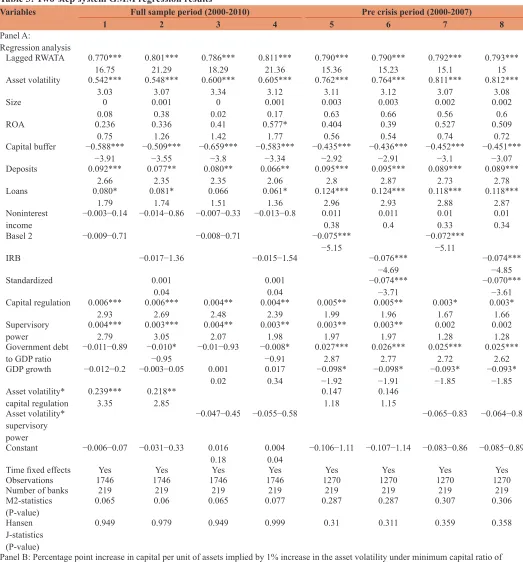
Models 1 and 3 include all the variables except the IRB standardised approach of capital regulation. Models 2 and 4 include all the variables except Basel 2. In addition, Models 1 and 2 include the moderating effect of asset volatility and capital regulation and exclude the interaction effect of asset volatility and supervisory power which is included in Models 3 and 4. The same technique is used for Models 5-8 which use the pre-crisis period. The regression results are presented in Table 3. We run the regression
for both the full sample period (2000-2010) and pre-crisis period (2000-2007) as the effects of the recent financial crisis especially
on the macroeconomic variables should not be ignored. As is
evident, the coefficient of the asset volatility in all specifications is positive and significant (at the 1% level), which indicates a positive and significant association between RWATA and asset volatility. Although the magnitude of the coefficients of the asset volatility for the pre-crisis period specifications is higher than coefficients of the same specification for the full sample period, the relationship
between RWATA and the asset volatility should be examined in economic terms. We calculate the increase in capital per unit of
assets when the asset volatility increases 1%, under the minimum capital ratio of 8%. Panel B of Table 3 shows that a 1% point
increase in the asset volatility leads to additional capital holdings
between 0.043% and 0.048% points on full sample period, and 0.061% and 0.065% points on pre-crisis period. Therefore, the
relationship between RWATA and asset volatility is very weak in economic terms. These results clearly show that bank capital regulations under Basel agreements are not effective in capturing the market perception of bank portfolio risk.
Capital regulation and supervisory power are found to be positive
and significant implying that these two variables are important
in explaining the bank risk. To examine the moderating effects of capital regulation and supervisory power, we should look at
the coefficients of the interactions terms. Table 3 shows that the
coefficient of the interaction term between the asset volatility and capital regulation is positive and significant (at 1% and 5% level of confidence) in the full sample period. This indicates that
higher values of asset volatility accompanied by high capital regulation (stringent capital regulation regime) lead to high-risk-sensitivity. In other words, in countries with stricter regulatory regimes, the regulatory assessment of bank portfolio risk is more attuned to the market perception of risk. However, when we compare the impact of asset volatility on risk-sensitivity with the moderating effect of capital regulation, we can observe that the indirect relationship is weakened. In other words, the moderating impact of capital regulation reduces the impact of asset volatility
by more than half from 0.542 to 0.239 and from 0.548 to 0.218
in Models 1 and 2 respectively. Therefore, the higher the capital regulation, the weaker the impact of asset volatility on the
level of risk. On the other hand, the results show no significant
impact of the moderating variable power of supervision on the relationship between asset volatility and risk-sensitivity. However, the interaction effect is negative although individually both asset
volatility and supervisory power are significant. The negative
impact indicates that supervisory power weakens the impact of asset volatility on risk. Therefore, it is clear that supervisory power does not moderate the relationship between asset volatility and risk.
Regarding the control variables, our results show a negative and
significant relationship between RWATA and capital buffer and confirm our expectation that the regulatory scrutiny might be
lower for highly capitalised banks. Vallascas and Hagendorff
(2013) argued that the negative coefficient of capital buffer indicates deficiencies in regulatory risk assessment permit banks
to boost capital by letting them underreport their portfolio risk when they hold a buffer. On the other hands, the results show a
positive and significant (at 1% and 5% level) relationship between
RWATA and deposits, which is in line with our expectation that banks with a higher amount of deposits are less likely to engage in capital arbitrage activities. Our results show that there is a
positive relationship between RWATA and loans, which confirm Table 2: Descriptive statistics of variables
Variables Mean Median Standard deviation Minimum Maximum
RWATA (%) 64.64 65.76 17.34 7.08 227.44
Asset volatility (%) 3.48 3.04 2.20 0.26 20.33
Size 17.59 17.23 1.70 14.89 22.06
ROA (%) 0.77 0.85 0.91 −8.21 3.34
Capital buffer (%) 4.85 4.25 2.87 −3.30 33.31
Deposits (%) 64.59 66.57 18.52 3.39 97.71
Loans (%) 61.14 62.32 13.74 10.33 94.77
Noninterest (%) 34.63 34.79 17.47 −221.26 213.26
Basel II 0.17 0.00 0.38 0.00 1.00
IRB 0.10 0.00 0.31 0.00 1.00
Standardized 0.07 0.00 0.25 0.00 1.00
Capital regulation 3.79 4.00 1.21 1.00 8.00
Supervisory power 11.49 13.00 2.17 4.00 14.00 Government debt to GDP (%) 57.35 47.09 30.18 6.50 174.98
GDP growth (%) 2.65 2.55 3.04 −7.82 20.84
our expectation as under Basel guidelines, the risk weights assigned to customer loans are higher than those applied to other
forms of lending. The results also show a negative and significant
association between RWATA and adopting Basel 2 guidelines for
the pre-crisis period. These findings confirm that the minimum
capital requirements for banks that have adopted Basel 2 have decreased relative to the banks that have adopted Basel 1 for a given level of portfolio risk for the pre-crisis period. Besides, the
Table 3: Two-step system GMM regression results
Variables Full sample period (2000-2010) Pre crisis period (2000-2007)
1 2 3 4 5 6 7 8
Panel A:
Regression analysis
Lagged RWATA 0.770***
16.75 0.801***21.29 0.786***18.29 0.811***21.36 0.790***15.36 0.790***15.23 0.792***15.1 0.793***15 Asset volatility 0.542***
3.03 0.548***3.07 0.600***3.34 0.605***3.12 0.762***3.11 0.764***3.12 0.811***3.07 0.812***3.08
Size 0
0.08 0.0010.38 0.020 0.0010.17 0.0030.63 0.0030.66 0.0020.56 0.0020.6
ROA 0.236
0.75 0.3361.26 0.411.42 0.577*1.77 0.4040.56 0.390.54 0.5270.74 0.5090.72
Capital buffer −0.588***
−3.91 −0.509***−3.55 −0.659***−3.8 −0.583***−3.34 −0.435***−2.92 −0.436***−2.91 −0.452***−3.1 −0.451***−3.07
Deposits 0.092***
2.66 0.077**2.35 0.080**2.35 0.066**2.06 0.095***2.8 0.095***2.87 0.089***2.73 0.089***2.78 Loans 0.080*
1.79 0.081*1.74 0.0661.51 0.061*1.36 0.124***2.96 0.124***2.93 0.118***2.88 0.118***2.87 Noninterest
income −0.003−0.14 −0.014−0.86 −0.007−0.33 −0.013−0.8 0.0110.38 0.0110.4 0.010.33 0.010.34
Basel 2 −0.009−0.71 −0.008−0.71 −0.075***
−5.15 −0.072***−5.11
IRB −0.017−1.36 −0.015−1.54 −0.076***
−4.69 −0.074***−4.85
Standardized 0.001
0.04 0.0010.04 −0.074***−3.71 −0.070***−3.61
Capital regulation 0.006***
2.93 0.006***2.69 0.004**2.48 0.004**2.39 0.005**1.99 0.005**1.96 0.003*1.67 0.003*1.66 Supervisory
power 0.004***2.79 0.003***3.05 0.004**2.07 0.003**1.98 0.003**1.97 0.003**1.97 0.0021.28 0.0021.28 Government debt
to GDP ratio −0.011−0.89 −0.010*−0.95 −0.01−0.93 −0.008*−0.91 0.027***2.87 0.026***2.77 0.025***2.72 0.025***2.62 GDP growth −0.012−0.2 −0.003−0.05 0.001
0.02 0.0170.34 −0.098*−1.92 −0.098*−1.91 −0.093*−1.85 −0.093*−1.85
Asset volatility*
capital regulation 0.239***3.35 0.218**2.85 0.1471.18 0.1461.15 Asset volatility*
supervisory power
−0.047−0.45 −0.055−0.58 −0.065−0.83 −0.064−0.8
Constant −0.006−0.07 −0.031−0.33 0.016
0.18 0.0040.04 −0.106−1.11 −0.107−1.14 −0.083−0.86 −0.085−0.89 Time fixed effects Yes Yes Yes Yes Yes Yes Yes Yes Observations 1746 1746 1746 1746 1270 1270 1270 1270
Number of banks 219 219 219 219 219 219 219 219 M2-statistics
(P-value) 0.065 0.06 0.065 0.077 0.287 0.287 0.307 0.306 Hansen
J-statistics (P-value)
0.949 0.979 0.949 0.999 0.31 0.311 0.359 0.358
Panel B: Percentage point increase in capital per unit of assets implied by 1% increase in the asset volatility under minimum capital ratio of 8% (capital regulation=supervisory power=0) computed as the estimated coefficient of the asset volatility *0.01*0.08*100
1% increase
in the asset volatility
0.043 0.044 0.048 0.048 0.061 0.061 0.065 0.065
***indicates significance at the 1% level, **indicates significance at the 5% level, *indicates significance at the 10% level, ROA: Return on assets, GDP: Gross domestic product,
negative coefficient of IRB confirms Repullo and Suarez (2004) and Hakenes and Schnabel (2011) who argued that low-risk
lending is treated more advantageous under the IRB approach.
Finally, we found that bank size, the level of profitability (ROA) and noninterest income were not significant in explaining bank
risk.
Regarding country-specific variables, the positive coefficients of
capital regulation and supervisory power indicate that banks that are working in countries with stringent capital regulatory regime and more powerful supervisory power are less likely to engage
in capital arbitrage activities. Moreover, the positive coefficient of government debt to GDP confirms Schliephake (2013) that
argued a government that regulates the banks and borrows from them at the same time, may have the incentive to overregulate risky investments compared to government bonds. Although the increase in government debts leads to increase in government default risk, governments may have the incentives to neglect that risk, and keep the risk-weights for government bonds in bank asset portfolio at zero level, which means to treat government
bonds as a risk-free investment. Also, the negative coefficient of
GDP growth indicates the procyclical effects of risk-based capital
regulation emphasised by several papers (Feess and Hege, 2012; Repullo and Suarez, 2004). They argued that regulatory measures
of credit risk increase during an economic downturn.
Finally, the coefficient of lagged RWATA is positive and significant (at 1% level) in all specifications. Besides, Hansen J-statistics is not significant (at any customary level of confidence) in any specification, which confirms our instruments are valid. Moreover, M2-statistics is not significant (at any customary level for pre-crisis period, and at 1% and 5% for the full sample period) which confirm
there is no serious second-order serial correlation.
5. CONCLUSION
In this paper, we examined the moderating effects of capital regulation and supervisory power on the risk sensitivity of capital requirements. We work on the international sample of 222 banks charted in 30 countries.
The results of our study reveal that although the risk-sensitivity of capital regulation is higher in countries with stricter capital regulatory regimes, the relationship between regulatory assessment of risk and risk is still very weak in economic terms, even in countries that have the most stringent capital regulatory regimes. This is important to central banks to enforce more regulation on the banks since the relationship between capital regulation and bank risk is small while capital buffer seems to have a higher impact
than capital regulation. It is clear that capital buffer coefficient has increased during the financial crisis. This is because, under
Basel capital regulations, banks that hold regulatory capital above minimum requirements underreport their portfolio risk. Therefore, central banks need to use stricter regulation to avoid insolvency of
banks, especially during a crisis. We did not find any evidence of
the moderating role of supervisory power on the risk sensitivity of
capital requirements. This result confirms Avramova and Le Lesle (2012) that country-specific variables could affect the density of
risk-weighted asset calculation, and the risk sensitivity of capital requirements as a consequence.
Besides, our results show that there is a positive association between regulatory assessment of risk and government debt to GDP ratio in the pre-crisis period, which indicates governments with higher debts have a tendency to overregulate other banks’ investments compare to government bonds.
Asset volatility could be calculated based on the Black-Scholes-Merton pricing model which may be more precise than the method we used for calculating asset volatility based on equity volatility, as Black-Scholes-Merton’s pricing model uses an iteration
process. Moreover, some other country-specific variables and their
moderating effects could be included in the model.
The result of this study may help regulators realise that current bank capital regulations are not enough to prevent banks from high-risk investments, as the so-called risk-based capital regulations are not strongly associated with the market perception of banks portfolio risk. Also, the role of governments practices in moderating the relationship between regulatory assessment of risk and market perception of risk should be recognised, as we showed risk-sensitivity of capital regulation is higher in highly regulated countries.
REFERENCES
Acharya, V., Philippon, T., Richardson, M., Roubini, N. (2009), The financial crisis of 2007-2009: Causes and remedies. Financial
Markets, Institutions and Instruments, 18(2), 89-137.
Acharya, V., Schnabl, P., Suarez, G. (2013), Securitization without risk transfer. Journal of Financial Economics, 107(3), 515-536.
Avery, R.B., Berger, A.N. (1991), Risk-based capital and deposit insurance reform. Journal of Banking and Finance, 15(4), 847-874.
Avramova, S., Le Leslé, V. (2012), Revisiting Risk-Weighted Assets. IMF Working Papers No. 12/90. p1-11.
Barakova, I., Palvia, A. (2014), Do banks’ internal Basel risk estimates reflect risk? Journal of Financial Stability, 13(1), 167-179. Barth, J.R., Caprio, G., Levine, R. (2004), Bank regulation and
supervision: What works best? Journal of Financial Intermediation, 13(2), 205-248.
Basel Committee. (2006), Results of the Fifth Quantitative Impact Study (QIS 5). Basel: Basel Committee on Banking Supervision. Basel Committee. (2009), Strengthening the Resilience of the Banking
Sector. Consultative Document. December, 2009. Basel: BIS. Basel Committee.( 2011), Global Systemically Important Banks:
Assessment Methodology and the Additional Loss Absorbency Requirement. Basel: Basel Committee on Banking Supervision. Berger, A.N. (1995), The relationship between capital and earnings in
banking. Journal of Money, Credit and Banking, 27(2), 432. Berger, A.N., Herring, R.J., Szegö, G.P. (1995), The role of capital in
financial institutions. Journal of Banking and Finance, 19(3-4), 393-430.
Blundell, R., Bond, S. (1998), Initial conditions and moment restrictions in dynamic panel data models. Journal of Econometrics, 87(1), 115-143. Calem, P., Rob, R. (1999), The impact of capital-based regulation on
bank risk-taking. Journal of Financial Intermediation, 8(4), 317-352.
Davies, H. (2005), A review of the review. Financial Markets Institutions
and Instruments, 14(5), 247-252.
and monetary policy. Journal of Financial Stability, 16(1), 13-30. Feess, E., Hege, U. (2011), The Basel accord and the value of bank
differentiation. Review of Finance, 16(4), 1043-1092.
Fischer, S. (2002), Basel II: Risk management and implications for
banking in emerging market countries. In: William Taylor Memorial Lecture at the International Conference of Banking Supervisors,
September 19, 2002, Cape Town, South Africa.
Flannery, M.J., Rangan, K.P. (2007), What caused the bank capital build-up of the 1990s? Review of Finance, 12(2), 391-429.
Furlong, F.T., Keeley, M.C. (1989), Capital regulation and bank risk-taking: A note. Journal of Banking and Finance, 13(6), 883-891.
Hakenes, H., Schnabel, I. (2011), Bank size and risk-taking under Basel
II. Journal of Banking and Finance, 35(6), 1436-1449.
Hellwig, M. (2010), Capital regulation after the crisis: Business as usual? CESifo DICE Report, 8, 40-46.
Jacques, K., Nigro, P. (1997), Risk-based capital, portfolio risk, and bank capital: A simultaneous equations approach. Journal of Economics and Business, 49(6), 533-547.
Jones, D. (2000), Emerging problems with the Basel capital accord:
Regulatory capital arbitrage and related issues. Journal of Banking and Finance, 24(1), 35-58.
Kim, D., Santomero, A.M. (1988), Risk in banking and capital regulation. The Journal of Finance, 43(5), 1219-1233.
Laeven, L., Levine, R. (2009), Bank governance, regulation and risk
taking. Journal of Financial Economics, 93(2), 259-275.
Ledo, M. (2011), Towards more consistent, albeit diverse, risk-weighted
assets across banks. Rivista de Estabilidad Financiera, 21, 41-61.
Mariathasan, M., Merrouche, O. (2014), The manipulation of Basel risk-weights. Journal of Financial Intermediation, 23(3), 300-321.
Merton, R.C. (1995), Financial innovation and the management and
regulation of financial institutions. Journal of Banking and Finance,
19(3), 461-481.
Moosa, I.A. (2010), Basel II as a casualty of the global financial crisis.
Journal of Bank Regulation, 11(2), 95-114.
Repullo, R., Suarez, J. (2004), Loan pricing under Basel capital
requirements. Journal of Financial Intermediation, 13(4), 496-521.
Rime, B. (2001), Capital requirements and bank behavior: Empirical
evidence for Switzerland. Journal of Banking and Finance, 25(4),
789-805.
Roodman, D. (2006), How to do Xtabond2: An Introduction to
“Difference” and “System” GMM in Stata. Center for Global
Development Working Paper, No. 103.
Schliephake, E. (2013), Risk Weighted Capital Regulation and Government Debt (No. 130011). Otto-von-Guericke University
Magdeburg, Faculty of Economics and Management.
Sharpe, W.F. (1978), Bank capital adequacy, deposit insurance and
security values. The Journal of Financial and Quantitative Analysis, 13(4), 701.
Shrieves, R.E., Dahl, D. (1992), The relationship between risk and capital in commercial banks. Journal of Banking and Finance, 16(2), 439-457.
Vallascas, F., Hagendorff, J. (2013), The risk sensitivity of capital
requirements: Evidence from an international sample of large banks. Review of Finance, 17(6), 1947-1988.
Windmeijer, F. (2005), A finite sample correction for the variance of linear efficient two-step GMM estimators. Journal of Econometrics,
126(1), 25-51.
APPENDIX
Capital Regulation and Supervisory Power
Following Laeven and Levine (2009) and Vallascas and Hagendorff (2013), we construct two variables based on the database that designed by Barth et al. (2004) to capture the stringency of capital requirements and the power of supervision to enforce those guidelines. The first variable, which is capital regulation, measures the regulatory approach to assessing and verifying the degree of capital at risk in banks of a country. The variable is constructed based on these questions (Yes = 1, No = 0): Is the minimum capital asset ratio requirement risk-weighted in line with the Basel guidelines? Does the minimum ratio vary as a function of market risk? Are market values of loan losses not realised in accounting books deducted from capital? Are unrealised losses in securities portfolios deducted? Are unrealised foreign exchange losses deducted? What fraction of revaluation gains is allowed as part of capital? Are the sources of funds to be used as capital verified by the regulatory or supervisory authorities? Can the initial disbursement or subsequent injections of capital be done with assets other than cash or government securities? Can initial disbursement of capital be done with borrowed funds? We construct the variable using the updated values from the World Bank website2.
The second variable, which is supervisory power, measures the extent to which official supervisory authorities have the authority to take specific actions to prevent and correct problem. We construct this variable based on Barth et al. (2004) using updated values from the World Bank website. The measure is created based on Yes/No answers to these questions (Yes = 1, No = 0): Does the supervisory agency have the right to meet with external auditors to discuss their report without the approval of the bank? Are auditors required by law
to communicate directly to the supervisory agency any presumed involvement of bank directors or senior managers in elicit activities,
fraud, or insider abuse? Can supervisors take legal action against external auditors for negligence? Can the supervisory authority force a bank to change its internal organisational structure? Are off-balance sheet items disclosed to supervisors? Can the supervisory agency order the bank’s directors or management to constitute provisions to cover actual or potential losses? Can the supervisory agency suspend the directors’ decision to distribute: Dividends? Bonuses? Management fees? Can the supervisory agency legally declare—such that this declaration supersedes the rights of bank shareholders—that a bank is insolvent? Does the Banking Law give authority to the supervisory agency to intervene—that is, suspend some or all ownership rights—a problem bank? Regarding bank restructuring and reorganisation, can the supervisory agency or any other government agency do the following: Supersede shareholder rights? Remove and replace management? Remove and replace directors?