University of New Orleans
University of New Orleans
ScholarWorks@UNO
ScholarWorks@UNO
University of New Orleans Theses and
Dissertations
Dissertations and Theses
Fall 12-20-2018
Subculture and Queer Subjectivity
Subculture and Queer Subjectivity
Natalie Woodlock
University of New Orleans, [email protected]
Follow this and additional works at: https://scholarworks.uno.edu/td
Part of the Fine Arts Commons
Recommended Citation
Recommended Citation
Woodlock, Natalie, "Subculture and Queer Subjectivity" (2018). University of New Orleans Theses and Dissertations. 2531.
https://scholarworks.uno.edu/td/2531
This Thesis is protected by copyright and/or related rights. It has been brought to you by ScholarWorks@UNO with permission from the rights-holder(s). You are free to use this Thesis in any way that is permitted by the copyright and related rights legislation that applies to your use. For other uses you need to obtain permission from the rights-holder(s) directly, unless additional rights are indicated by a Creative Commons license in the record and/or on the work itself.
Subculture and Queer Subjectivity
A Thesis
Submitted to the Graduate Faculty of the University of New Orleans
in partial fulfillment of the requirements for the degree of
Master of Fine Arts in
Fine Arts
by
Natalie Woodlock
B.F.A. Victorian College of the Arts, 2003
Table of Contents
List of Illustrations ... iii
Abstract ... iv
Chapter One – Girls and Romance... 1
Introduction ... 1
Archetypes of Femininity, Fans and Idols ... 1
Love Letters ... 9
Chapter Two – Baby Doll ... 12
Chapter Three – Secret Society ... 15
Chapter Four – Brokeback Mountain ... 26
Conclusion ... 30
References ... 31
List of Illustrations
Figure 1. Natalie Woodlock, Untitled, 2016 ... 2
Figure 2. Rineke Dijkstra, Hilton Head Island, S. C., USA, June 24, 1992, 1992 ... 4
Figure 3. Candice Breitz, King (A Portrait of Michael Jackson) (composite), 2005 ... 5
Figure 4 .Karlheinz Weinberger, Zurich, circa 1962 ... 6
Figure 5. Kate Murphy, Britney Love, 2000 ... 7
Figure 6. Natalie Woodlock, Carrie, 2016 ... 10
Figure 7. Ruth Owens and Natalie Woodlock, Baby Doll, 2016 ... 12
Figure 8. Natalie Woodlock, Lupe (detail), 2018 ... 16
Figure 9. Alvin Baltrop, Untitled, 1975-86 ... 18
Figure 10. Malick Sidibé, Nuit de Noël (Christmas Eve), 1963 ... 19
Figure 11. Nan Goldin ,The Ballad of Sexual Dependency ,on view at Il Museo di Fotografia Contemporanea, Milan, 2017 ... 22
Figure 12. Natalie Woodlock, Jee, 2018 ... 23
Figure 13. Dario Robleto, There's an Old Flame Burning in Your Eyes, or, Why Honky Tonk Love is the Saddest Kind of Love, 1998 ... 27
Abstract
My work explores subculture as a form of cultural resistance to the dominant ideology. I'm concerned with the ambiguous relationship we occupy as subjects to the material produced by popular culture, and how this is digested and understood by female viewers and cultural outsiders. The specific temporality of the queer subject is a key theme in my work.
Girls and Romance
Introduction
Subculture for many teens and young people is a way out. It is a means of disidentifying with the toxicity of the dominant culture. The relationships formed within subculture, especially in many queer
subcultures, can replicate and, in some cases, replace familial bonds. In opposition to the parent culture, subcultures build worlds of shared identity. Before I discovered subculture I gorged on the trash of mass culture. As an artist I began to be interested in the kind of material I had consumed as an adolescent, in particular in relation to my subject position as a female working class reader. Growing up in a pre-internet era of limited media, which was further compounded by cultural and geographic isolation, I collected what scraps I could from popular culture, infusing these with my own meanings.
Archetypes of Femininity ,Fans and Idols
My work is concerned with the distance between the lived experiences of young girls and mass culture's representations of femininity, at a time of adolescence; a time of becoming. I'm interested in the relationships we form as viewers to the narratives produced by popular culture. Teen girls (along with other viewing groups, such as female viewers of soap operas) are often mistakenly understood as passive consumers. Far from being the case, the relationship female viewers create to the codes and conventions of femininity produced by popular culture is active and nuanced. While representations of women and girls can be archetypal and one-dimensional, there is a definite pleasure associated with consuming the versions of femininity presented by mass culture.
Coming of age in the age in the early-mid 1990s, I was an avid consumer of teen romance novels. I particularly favored the American serialized romances Sweet Valley High and Sweet Dreams. Living as I did on the outskirts of an Australian town known for its status as a cultural backwater, these books I borrowed from the library were treasured gifts that permitted me an escape into an unfamiliar world. The lives of the girls in these books did not resemble mine, and this was part of the pleasure I derived from reading them. Like the teens of 1980s-era Hollywood films, these girls were overwhelmingly white and wealthy. Visually, their class difference was symbolized to me in their four-poster canopy beds, window seats, in their pony clubs and their wealth of fashionable clothes and accessories.
I use the form of a tunnel book (see figure 1) to explore the range of archetypes and idols produced by mass culture. Tunnel books, also known as peepshows, were a common pre-cinema entertainment. Scholar Richard Balzer traces their origins to Fifteenth Century Europe. Beginning as a Renaissance-era tool used by artists to understand perspective and vision, they were later used to depict theatrical sets and became popular as souvenirs to commemorate civic achievements.1 Many tunnel
books were produced and sold to mark the opening of the Thames Tunnel in London in 1843. Postcard-sized, panels that depicted the tunnel were connected by concertina folds, that when opened out, created an illusion of depth and perspective. Tunnel books were also produced as parlor games and novelties, alongside other standards of pre-cinema entertainment such as the zoetrope, stereoscope and kaleidoscope. Many of these tunnel books were constructed not out of paper but out of wood. Their panels were removable in order to view different scenes or narratives. It is this latter form that I have based my own tunnel book on, screen-printing my imagery directly on wooden panels.
1 "Curator's favorite: a Tunnel Book by Any Other Name...," The Library Company of Philadelphia,
. Figure 1. Natalie Woodlock, Untitled (detail), 2016.
My work depicts twelve teen girls that appear to be in one room or scene. Drawn from cover illustrations of Young Adult (YA) and teen romance novels, coming-of-age films and magazine
advertisements targeting young women, this imagery is bricolaged together to form a coherent scene. Part of the appeal of drawing from these sources, apart from my own personal connection to them, is their ubiquity and cultural dominance during the era that I grew up in. Scholar Linda K. Christian-Smith notes that although teen romance novels in the US can be traced back to the 1940s and 1950s, the contemporary wave of teen romance fiction began in 1980, developed through market research conducted by Scholastic.2 Many of these novels were formulaic, written to adhere to proscriptive tip
sheets. Christian-Smith links the rise of these new teen romances, with their emphasis on
heterosexuality, girls' passivity and their virtual ban on genital sex, to the conservative agendas and purity campaigns that dominated the Reagan era.3
In these books, "like Sleeping Beauty, heroines' sexuality is awakened by boys.”4 Not just a girls'
sexuality but her very identity is shaped and defined by her love for the right boy. Christian-Smith
observes that desire is expressed in psychological, not physiological, terms. She cites a passage from P.S. I Love You (a romance I read as a teen), "I felt the warmth of his hand .... The touch had created a tiny
2 Linda K. Christian-Smith, “Young Women and Their Dream Lovers: Sexuality in Adolescent Fiction,” in Sexual Cultures and the Construction of Adolescent Identities, ed. Janice M. Irvine (Philadelphia: Temple University Press, 1994), 207.
tingle of electricity that reached the insides of my heart.”5 Here, physical desire is conveyed solely in
romantic terms. Although these novels can be understood as conservative in terms of their regressive gender roles, especially in the wake of the achievements of the social movements of the 1970s, readers create a range of meanings from their pages. Conducting field research with a group of high school romance readers in the Midwest, Christian-Smith found that girls read romance novels to escape, deriving pleasure from imagining themselves as the heroines of the stories they read. The teen girls in the study were aware of the differences between their lives and the heroines', and many wished their boyfriends would behave more like the boys in the books.6 In other words, readers were aware that these books
were works of fantasy. And while these novels provide no instruction for how to deal with real-life situations, they afford female readers the pleasure of imagining a world where girls are loved and cherished by boys.
This element of fantasy and wishful-thinking is part of what rescues this material for me. Becoming a woman through romance (to borrow Christian-Smith's phrase) was a very real part of my own experience as a teen. There was a great emphasis within my working-class family on marriage and love. And though the material of teen romances is conservative in many ways, for female readers, who live in a world where they must adhere to strict gender codes and double standards, coveting the respect of boys can be understood as a radical desire.
Adolescence is a state of becoming, a time where identity is pliable and in flux. It is a period of emulation, of mimicry, of trying things out. In this identity-forming period, the consumption of mass media can be particularly influential. The heightened influence of popular culture on the adolescent subject is demonstrated in Rineke Dijkstra's series of beach portraits, and, tellingly, it is most evident in her portraits of American girls. In Hilton Head Island, S.C., USA, June 24, 1992 (see figure 2), a girl in an orange bikini poses for the camera. Reminiscent of Sandro Botticelli's painting The Birth of Venus, she appears to be caught in the process of emulating her magazine idols.7 Though the mimicry is
picture-perfect, her delicately formed pose has an aura of uncertainty. The assumed identity appears fragile, and in many of the photographs in this series, awkward and ill-fitting. The vulnerability of each subject is heightened by the casual and revealing attire of their bathing suits.
It is this element of the ill-fitting identity that I am interested in. For while the girls of books and movies seamlessly project a coherent feminine identity, this is an impossible task for a real-life
adolescent. In the process of becoming, we try many things, have a great many influences and
experiment with different identities. One identity can be easily shed and replaced with another. My work speaks to the awkwardness of this process. Adolescents select elements from popular culture and mass media, creating emulations that are inevitably fragile, uncertain, distorted or exaggerated.
Talking about Rineke Dijkstra's beach portraits, Carol Ehlers states, "Adolescents in America tend to travel in packs, often preferring the company and emotional support of their peers, and are frequently treated as a tribe apart from society.”8 This sense of isolation is heightened by Dijkstra's treatment of
light in the beach portraits. Each photograph is taken using a strobe light, that has the effect of
underexposing the background. Each subject is crisply outlined, separating them from their surroundings,
5 Linda K. Christian-Smith, “Young Women and Their Dream Lovers: Sexuality in Adolescent Fiction,” in Sexual Cultures and the Construction of Adolescent Identities, ed. Janice M. Irvine (Philadelphia: Temple University Press, 1994), 213.
6 Christian-Smith, "Dream Lovers," 218-221.
and every flaw of the skin, every fold in apparel is exposed. This consistent treatment of light has the effect of making the beaches of Poland and South Carolina appear equally overcast and dark, lending a uniformity to each photograph in the series. Ehlers sates, "Because the subjects are alone and
unsupported before a universal backdrop of earth, sky, and water, the fact of their mere presence appears heroic.”9
Figure 2. Rineke Dijkstra, Hilton Head Island, S. C., USA, June 24, 1992, 1992.
In Candice Breitz's work we are witness to the redemptive potential of mass culture. In her work
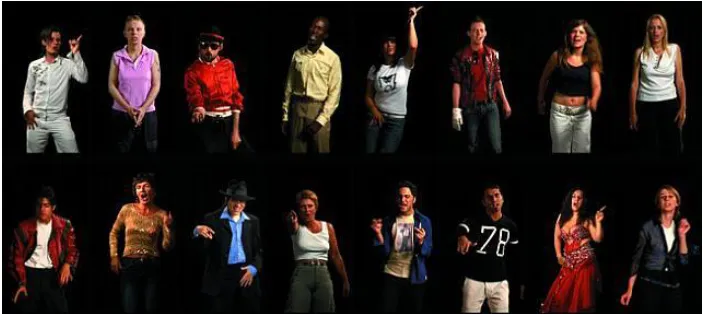
Queen (A Portrait of Madonna) thirty Madonna fans sing the Immaculate Collection album from start to finish in a single take. Presented on a grid of monitors, Queen positions the fan not as a mindless consumer but as a subject who creates personal connections to the icons of pop culture. In Queen and its' twin work King (A Portrait of Michael Jackson) (see figure 3) we are witness to mass culture's ability to provide a vehicle for undirected expression.10 As Breitz states, the lack of "an overtly iconic
representation of the pop star is a way to suggest that the star is, on some level, a mirror in which the collective desires and fantasies of her fans are reflected, rather than some kind of fixed, unchanging entity. Madonna and Michael Jackson are therefore portrayed in their absence, as composite of the elaborate projections of the fans who buy their albums, who hero worship them, and who made them
9 Rineke Dijkstra, Beach Portraits (Chicago: LaSalle Bank, 2002), 58.
10 Christy Lange, "Crazy for You: Candice Breitz on Pop Idols & Portraiture," Modern Painters (September
stars in the first place.”11King and Queen are mediations on the relationship between mass culture and
subject formation. In both works, we are given insights about the subjects in lieu of the celebrities they adore. This relationship between fan and idol speaks to a collective pleasure and joy in mass culture that is often underestimated and overlooked.
Figure 3. Candice Breitz, King (A Portrait of Michael Jackson) (composite), 2005.
In both King and Queen the participants are sourced from European countries (in the case of
Queen ,Italy, and King, Berlin). Unlike American consumers, global audiences are at a double remove from the cultural context the material was made in. While this distance can be an impediment to
understanding certain nuances, it can also enable a great freedom of interpretation. Worshipping from a distance creates interesting dissonances. This can be seen in Photographer Karlheinz Weinberger's documentation of Swiss youth subculture in the 1960s. Weinberger photographed youth in Zurich who were known as the Halbstark, or Half-Strong. This subculture styled itself after American rock and roll idols and iconography. While the Halbstark used the imagery of mass culture (see figure 4), their
handmade presentation of the material transformed the relationship to global icons such as Elvis into one of oblique and intimate connection. Combining known iconography with benign, ready-made items (many of these sourced from the hardware store), the Halbstark transformed the established meanings of well-known cultural symbols, making their meanings oblique to outsiders. The Halbstark prefigured punk's practice of combining ordinary haberdashery alongside symbolic imagery to create confounding critiques of the parent culture.
This cultural remove is something I'm interested in, particularly as an avid teen consumer of American mass culture. The unfamiliarity of the cultural surroundings in many of the novels I read disguised their true strangeness, which came more from class than cultural difference. For poor and working-class girls, class aspirations are often hidden within a desire for the kind of femininity presented within popular culture. As Roberta Seelinger Trites points out in her analysis of teen romances,
"performing certain types of femininity requires middle-class conditions.”12 For working-class girls, the
fantasy of the teen romance is also a fantasy of escaping class difference. In my tunnel book, I have used the decorative tropes I associate with such Hollywood teen movies such as Heathers and Sixteen
11 Christy Lange, "Crazy for You: Candice Breitz on Pop Idols & Portraiture," Modern Painters (September
2005): 72.
12 Roberta Seelinger Trites, Twenty-First-Century Feminisms in Children's and Adolescent Literature
Candles. The world I have created stands in for a femininity that cannot be acquired without a certain amount of wealth.
Figure 4 .Karlheinz Weinberger, Zurich, circa 1962.
Australian artist Kate Murphy's video installation Britney Love )2000(is about our relationship to our idols, in the space of pre-adolescence. She films an ordinary eleven year old girl, Brittaney Love, performing a Britney Spears dance routine. Her mimicry of the routine is amateur, but performed with the enthusiasm of a true fan, who relishes the brief and unusual pleasure of being in the limelight. In this piece, Murphy combines the "private daydream space of early adolescence with that of the public and highly sexualized role model.”13 This work specifically touches on the relationship between teen or tween
girls and their pop culture icons. Murphy, like Candice Breitz, collapses the boundaries between fan and idol. The clumsy, amateur dance moves of Brittaney Love are slightly off-kilter, a little off-register. They illuminate the gap between our realities and the fantasies that we aspire to. The emulation highlights the discord between image and reality, and between reality and desire. This elusive gap is here presented ambiguously - we can never live up to the glossy, highly-constructed images proscribed to us by mass culture, and while this discord can be painful, it can also produce a space in which something new is created.
While my work in part shares this celebratory relationship to mass culture, the isolation and unhappiness of many of the figures in my tunnel book highlight the limits of consuming en masse the
narratives produced for us by popular culture. Each girl, though pictured with others, is isolated, trapped in the interiority of her own activity. These are often solo, indoor activities - doing a puzzle, talking on the phone, reading a book or writing a letter. These activities speak to a general lack of freedom granted to adolescent girls, especially in regard to their male counterparts.
Cultural theorist Angela McRobbie writes about the all-girl teeny-bopper subculture of England in the 1970s. She writes,
Membership carries relatively few personal risks. For girls of their age real boys remain a threatening and unknown quantity. Sexual experience is something most girls of all social classes want to hold off for some time in the future. They know, however, that going out with boys inevitably carries the possibility of being expected to kiss, or 'pet'. The fantasy boys of pop make no such demands. They 'love' their fans without asking anything in return. The pictures which adorn bedroom walls invite these girls to look, and even stare at length, at male images .... These pin-ups offer one of the few opportunities to stare at boys and to get to know what they look like.14
Figure 5. Kate Murphy, Britney Love, 2000.
McRobbie posits that this pre-adolescent teeny-bopper subculture is a site of active feminine identity.15 She argues that while girls' subculture might seem at first glance to be passive and purely
consumptive, that in fact girls are actively engaged with the material of mass culture. Girls create their own meanings and build their own narratives from the material they consume. Often faced with limited personal freedoms, especially in comparison to adolescent boys, girls are often confined to the private space of the bedroom. This space is transformed into a site of fantasy and a place of active identity-creation, that is often enacted through play with other girls.
McRobbie writes about how the working-class girls of Mill Lane, a hamlet south of London, subverted the official ideology of their high school with their own informal ideology of gossip, romance, pop, fashion, beauty and boys.16 This was not a culture of outright rebellion, but one of subtle
subversions. McRobbie notes that while these girls were very much focused on boys and the male heartthrobs of popular culture, the girls deliberately set themselves apart from the boys, moving in a world dominated by the bonds of female friendship. McRobbie, using Richard Hoggart's description, calls this a period of "the brief flowering of working class girls.17 The girls' daily lives revolve for a brief
moment around relationships with other girls and women. All too soon, their own identity becomes subsumed by the collective identity of the family, as they succumb to their almost inevitable fate of becoming and wives and mothers.
It is this period within a girl's life that my tunnel book is concerned with. For while much about femininity is derived from mass culture, much of what girls learn comes from their peers, friends and family members. Idols can come from magazine pages, but perhaps more influential are the girls of real life that one copies, emulates, tries to be like. I have crowded the panels of my tunnel book with figures, alluding to the importance of this period of all-female friendship that McRobbie writes about. And while the romance novel, so attractive to me when I was a young teen, is an influence, this work also speaks to the writing of authors like Judy Bloom, who in her YA novels privileges the feminist, peer-structured learning that girls do from each other.
While the girls of the tunnel book are mostly peers, their ages do vary slightly. There are three girls gathered in a cluster in the back, dressed in lingerie and holding the heart-shaped balloons that are repeated throughout the tunnel book and are used as a motif on the outside of the box. These are drawn from a series of Victoria's Secret magazine advertisements published in 1979. This ad campaign featured young women in the excessively decorous lingerie popular at the time, posing in Victorian-era sets, complete with stuffed furniture, velvet drapes and textured wallpaper hung with gilded picture frames. The girls in the back function as the older sisters and role models of this world. They also speak to the allure of the archetype of the bad girl, so popular in soap operas and teen movies.
Much has been written about the pleasure viewers find in narrative forms like soap operas and romance novels. Louise Spencer, analyzing female viewers of soap operas, cites that fantasy and everyday life are not oppositional but are instead dialectical dualities.18 Spencer writes that pleasure is
extracted from the unreality of soap operas, even as they are simultaneously critiqued by viewers for not being close enough to real life. Soap operas can be traced back to early incantations of the melodramatic form. Melodrama is a shape-shifter, that has served different classes and audiences since its' inception. It became the preferred medium of the emerging bourgeoisie in the latter half of the Eighteenth Century, as they sought to distinguish themselves from the aristocrats. Jackie Byars writes that the bourgeoisie
16 Angela McRobbie, Feminism and Youth Culture (New York: Routledge, 2000), 58. 17 McRobbie, Feminism and Youth Culture, 64.
18 Louise Spencer, "'They killed off Marlena but she's in another show now': Fantasy, reality and pleasure
"appropriated classical forms, altering the forms to suit their needs, and one of these needs was for a dramatic form peopled not by the aristocrats, as was tragedy, but by the bourgeoisie. The tragic hero - indicative, in Greek tragedy, of a social group - became the melodramatic hero, capable of individual error ... the social, in melodrama, came to be expressed as the personal.”19 Melodrama focused on
individual and personal challenges within the society, sourcing its material from the drama of everyday life. Byars credits the ongoing popularity of the medium through its various formats - novels, theatre and, later, television - to its flexibility and willingness to incorporate the everyday into its' narratives. By the end of the Nineteenth Century, a distinction had been made between respectable and popular
entertainment, and melodrama, relegated to the latter category, became associated with working-class audiences. This fragmentation of the audience continued into the Twentieth Century, with the invention of the daytime soap opera, which resulted in melodrama becoming associated primarily with women.
Scholar Bell Hooks in her essay on Jennie Livingston's film Paris is Burning speaks of the place of fantasy-making within the queer black lives pictured onscreen. She sees the role of fantasy as at times redemptive, transforming impoverished black queer lives through the power of imagination, and at other times reductive, an escapist response to the reality of living in a racialized society, that does not serve its subjects well or offer solutions to problems born of both race and class.20
For many mods, a largely working class subculture that emerged in the late 1950s in London, modeled in part on the stylized perfections of the gangsters of Hollywood noir, the gap between the idealized image and the reality was great. Theorist Dick Hebdige writes, "Every mod was existing in a ghost world of gangsterism, luxurious clubs, and beautiful women even if reality only amounted to a draughty Parker anorak, a beaten up vespa, and fish and chips out of a greasy bag.”21 This same
disparity between fantasy and reality can be seen in the lives of the ball participants in Paris is Burning
and in the female identification with romance novels. In my tunnel book I am interested in fantasy as a redemptive, though limited, activity.
Love Letters
In my work I'm interested in collections and archives. An archive of many of one thing exposes patterns, social codes and cultural conventions that may otherwise go unnoticed. Presenting an archive or collection becomes by default a group portrait. This is the case in Harrell Fletcher and Miranda July’s web-based archive Learning to Love You More (2002 – 2009). LTLYM collated participants’ responses to a set of assignments written by the artists. Collectively, these responses (many numbering in the hundreds) point to a sense of shared history, community and identity. Assignments such as#18Recreate a poster you had as a teenager and#32Draw a scene from a movie that made you cry speak to a collective identity that is created through identification with mass culture. Like Candice Breitz's work, LTLYM
portrays mass culture in a celebratory way. It is also depicted as something that helps shape communities, a vehicle for sparking connections and creating moments for social interaction.
19 Jackie Byars, All That Hollywood Allows: Re-Reading Gender in 1950s Melodrama (London: Routledge,
2005), 10.
20 Bell Hooks, "Is Paris Burning?" in Black Looks: Race and Representation (Boston, MA: South End Press,
1992), 155.
21 Dick Hebdige, "The Style of the Mods," Sub and Popular Culture Series, no. 20 (Birmingham: Centre
Figure 6. Natalie Woodlock, Carrie, 2016.
In my zine zine Carrie (see figure 6), I self-published a collection of thirty-four letters by a teen girl to her high school boyfriend. The letters were given to me by a friend, who found them abandoned in the tool shed of a rental property in middle Tennessee. The letters and notes, many of them written in class, contain poems, Aerosmith lyrics and oft-repeated declarations of love and affection. There is an idealism and hope in the letters, that is most often relegated to expressions of love made by the very young. From certain details contained within the material, I have surmised that these were penned somewhere between 1991 and 1999.
Carrie speaks to the centrality of romance within a young girls' life. Each page of the zine is silk-screened on lined notebook paper that matches the paper used in the original letters. Drawings of hearts, smiley faces and highlighted declarations of love are all faithfully reproduced. Details of school and home life dot the pages of the letters, but the central concern is romantic. One of the love letters is a poem which reads:
Holdin' hands, walking by the creek, Don't matter what we do,
as long as I'm with you. Goin' to the park or for a Sunday drive,
honey, when we're together, I love it all
Baby Doll
The masking tradition of the New Orleans Baby Dolls is said to have come out of black Storyville, an officially sanctioned red-light district located just outside the French Quarter. It is an African American cultural tradition that has been traced back to a group of sex workers who crowned themselves 'The Million Dollar Baby Dolls' on Mardi Gras day in 1912. Starting in Storyville, this practice soon spread to the adjacent neighborhoods of the Tremé and the Seventh Ward. This tradition was practiced by many groups of women from the time of its' inception until a wane in popularity in the 1960s and 70s. Over the last decade and a half, groups of women in the city have been involved in an effort to revive the
tradition. Ruth Owens are I collaborated with one of these groups, The Gold Digger Baby Dolls, to make our video piece Baby Doll (see figure 7).
Figure 7. Ruth Owens and Natalie Woodlock, Baby Doll, 2016.
This carnival masking tradition of grown women dressing up in the clothes of infant girls and parading through the streets began as a rivalry between the black sex workers of uptown and downtown
Storyville. In 1912, at the height of Jim Crow segregation, two Storyville's existed; one for white patrons and one for black. Though each catered to a different clientele, black women worked in both districts. Historian Kim Marie Vaz calls this act of rivalry a ritual of recognition.22 Allegedly, hearing rumors that the
women of downtown Storyville were planning to mask in the upcoming Carnival, Beatrice Hill and Leola Tate gathered a group of uptown women together. Their plan was to mask as a group, to show up the downtown women. Vaz states that, according to interviews with Beatrice Hill conducted in the 1930s by Robert McKinney, a woman at the meeting, Althea Brown, reportedly said "Let's be ourselves, let's be baby dolls, that's what the pimps call us.”23 They called themselves The Million Dollar Baby Dolls, a name
that proudly centered their financial success. Each Baby Doll had to have at least $50 in her garter the
22 Kim Marie Vaz, The 'Baby Dolls': Breaking the Race and Gender Barriers of the New Orleans Mardi Gras Tradition (Louisiana State University Press, 2013), 27.
day of the parade - "money was key to the costume to show their economic prowess.”24 With this
established, the women planned to parade to downtown Storyville, for the express purpose of showing up the downtown women.
Though competition was central to this act, the fact that a group of fellow black sex workers were the intended audience for these Baby Dolls indicates that solidarity underpinned this act. Vaz writes, "with each other these black women could experience the pleasure of mutual recognition.”25 The Million
Dollar Baby Dolls sought the pleasure of being seen by the other who is also the same. Vaz continues, "the baby dolls masking tradition served as a form of play that built relational bonds among similarly situated black women. In the safety of play, the uptown women knew that the downtown women would recognize and respond to their statement.”26
Today, it is mostly older women who mask, many of whom remember their mothers and grandmothers masking. Fellow grad student Ruth Owens asked me to collaborate on a video piece with her, for a show at Xavier College's Chapel Gallery. Through Owen's position as an African American woman who had built a relationship with an existing Baby Doll group, I was given privileged access to the culture that as a white outsider I most likely would otherwise not have been granted. Owens and I filmed The Gold Digger Baby Dolls on several occasions, and also conducted interviews with the women about the tradition.
The Gold Digger Baby Dolls were re-established by sisters Janice and Merline Kimble, whose family members masked using the same name as early as the 1930s. They are two older African American women who have paraded in order to bring the tradition back to their community. The Gold Digger Baby Dolls wear the short satin dresses, bobby socks, bonnets and bloomers that have become associated with the tradition. Around their necks they carry pacifiers and baby bottles, that are filled not with milk but liquor, as tradition dictates. The contrasting attire and the age of the participants creates a spectacle that subverts normative gender codes. In our piece, we wanted to centralize the experience of black resilience and invention that this cultural tradition exemplifies. The voices of the Kimble sisters, who recount their experiences of being Baby Dolls, can be heard in the soundtrack. The use of interviews within the work speaks to the centrality of oral histories within communities that have been historically denied cultural, political and economic power by a repressive state.
Laid out in a grid, the six individual video portraits coalesce to create a group portrait. This sense of a group or collective identity is highlighted by the matching costumes and the uniform background that each Baby Doll performs in front of. The dance-off, another aspect of the culture, is highlighted here by the gridded layout. Similar to other black masking traditions, Baby Dolls seek to outshine each other, through dress, dance and performance. The element of mutual recognition, disguised as competition, remains a central component of this tradition.
This work positions the performance tradition of the Baby Dolls as a rebel act. This is reinforced in the audio, when we hear Merline Kimble, talking of her mother and grandmother masking, say, “these women were rebels, true rebels.” Fantasy here is redemptive; it is an act of defiance that celebrates a
24 Kim Marie Vaz, The 'Baby Dolls': Breaking the Race and Gender Barriers of the New Orleans Mardi Gras Tradition (Louisiana State University Press, 2013), 25.
Secret Society
Secret Society documents an American queer subculture that has its roots in punk, radical social movements and the hedonism of gay party culture. In this series, I have created eight portraits of queer subjects, drawn from a community that I am a part of. These subjects are outsiders of sorts. This outsider status is not solely conferred by way of their queer subjectivity, but by a sensibility, by taste, by acts of sexual deviance (such as sex work, cruising and BDSM), as well as by other identifying factors including race and class. This queer underground subculture has emerged out of the era of sexual freedoms and deviant sexual practices of bathhouses and leather bars and is equally influenced by the militancy that came out of the melancholia produced by the AIDS crisis. It is marked by an oppositional aesthetic that is in debt to punk, camp, drag and the bad-taste cinema of John Waters, among others. Analogous to the work of subjective documentary photographers Alvin Baltrop, Nan Goldin, Malick Sidibé and Karlheinz Weinberger, I see this series as a documentation of a community at a specific moment in time.
Using the form of the satin banner, each portrait becomes a commemorative object, celebrating both the individual subject and the broader community / subculture they are a part of. Each portrait communicates belonging to the others through shared formal devices such as line and value, as well as through gesture, adornment and pose.
Nan Goldin's work The Ballad of Sexual Dependency, utilizing the slide show as a medium, restages the elusive and fleeting nature of social histories and communities. The Ballad is made up of hundreds of photographs, many of them candid, taken between 1979 and 1986. Natalie King writes that the slide shows "had the more ephemeral purpose of documenting and dissolving. They had the
sensibility of fleetingness and the mimetic qualities of mortality.”27 The giving way of one image to the
other lends to The Ballad a haunting quality, emphasizing the continual movement of time, and the way in which we move within it.
Goldin claims to take photographs as a way of never losing the memory of a loved one. The Ballad can be read as a memorial that defies death, guarding against the loss of memory and refusing to submit to the chronological ordering of history. The medium of photography, with its ability to freeze a moment in time, has long been associated with death and mortality. The photographs in The Ballad
speak of loss, intimately chronicling the lives of a set of cultural outsiders in the era of the AIDS epidemic.
In discussing AIDS activism Douglas Crimp refers to the Freudian differentiation between mourning and melancholia, citing melancholy as a pathological form of mourning. Whereas "mourning is achieved by severing attachments to the lost object and moving on, in melancholia there is a form of attachment to loss ... attachment to the object, the lost loved one.”28 This attachment, he argues, can be
politicizing in the context of the silence experienced by those living through the early years of the AIDS epidemic. He argues that melancholy can act as a psychological refusal of the healing of the wound, that in the context of the governmental response to the AIDS crisis becomes a political act bent on
remembrance in the face of erasure and indifference.
27 Natalie King, Up Close: Carol Jerrems with Larry Clark, Nan Goldin and William Yang (Melbourne: Heide
Museum of Modern Art, 2010), 199.
Although her snapshot aesthetic coupled with a lack of formal concerns shift the work into the realm of the highly subjective,The Ballad of Sexual Dependency can also be read as a social document. Like other artists working in this era, Goldin's work acts to preserve the memory of a specific community. The pairing of queer subjects in the era of the monumental losses caused by the AIDS epidemic position this work at a moment of historic specificity. Sarah Ruddy writes that "her images could only have come out of a period of crisis, when the need to show how historical space alters and is altered by what happens to those within it is most urgent.”29 Ruddy positions Goldin's subjects - drag queens, addicts,
club kids, battered women - as the "waste products of the society imagined by official history", and as such, subject to disappearance by official historical discourse.30 The photographs that make up The Ballad struggle against the ordinary disappearance of people from personal memory, but also against a broader, political erasure of a specific community. Understood as a social document, The Ballad can be read as an act of collective remembrance.
Figure 8. Natalie Woodlock, Lupe (detail), 2018.
The format of The Ballad as a slideshow set to music adds to the emotional resonance of the piece. Goldin began showing the work in this format in the 1970s. It was shown in clubs and bars, rather than galleries, which allowed for a more intimate exchange between the audience and the work. Each presentation in this time period was announced with the immediacy of a hastily put together xeroxed flier. If the audience and Goldin's subjects were not always the same people, they were from the same world. The audience and her subjects became interchangeable, creating a viewing atmosphere where
29 Sarah Ruddy, "A Radiant Eye Yearns From Me: Figuring Documentary in the Art of Nan Goldin," Feminist Studies 358 (2009): 358.
"everyone is a witness to everyone else.”31 This format and approach allowed for a collaborative
exchange between artist and subject.
In its earliest iterations, the photographs, music and sequencing of The Ballad would constantly change. Goldin expressed an initial hesitancy to fix the images and their sequencing in time, by, for example, releasing The Ballad in book form. This reluctance to present an audience with a finalized piece is indicative of a prioritizing of the artists' own subjectivity in relation to her subjects. Sequencing would sentence the relation between artist and subject to a fixed position; to a chronological ordering of time. Continually reorganizing the slideshow is a way for the past to continue to act as a force upon the present - for the times spent with those who have passed to be continually seen anew, to be reinterpreted, lending new meanings to the present and to the future. It prohibits narrative closure, privileging a psychic, temporal organization of time, where one may travel backwards as well as forwards.
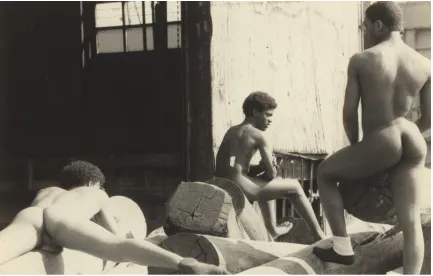
Alvin Baltrop photographed the New York City piers, a public space heavily utilized by both artists and gay men that was eventually demolished, succumbing to the ebb and flow of the marketplace. Baltrop photographed the men who cruised Manhattan's West Side piers, at a time when it was possible for the public spaces of the city to be put to a variety of uses. Valerie Cassel Oliver writes that "the piers became the catalyst that imploded the social and economic hierarchies of the time. They represented the ultimate democratization of sexual desire, and Baltrop knew that this moment was extraordinary, yet ephemeral.”32 Baltrop documented a specific moment in history - post-Stonewall and pre-AIDS - where a
gay male subculture of sexual expression, desire and freedom flourished. He treasured this specific moment, carefully archiving his work and conducting interviews with the men who frequented the piers after they were demolished.
Though his work is highly voyeuristic and demonstrates strong formal concerns, his photographs of men cruising the piers share Goldin's interest in the temporal. Shaped by the decade of loss and erosion of community by both encroaching economic interests and the AIDS crisis, both artists demonstrate an interest in documenting in order to preserve the ephemeral. The social and sexual communities that sprung up at the piers and in the adult cinemas of nearby Times Square were highly susceptible to the economic forces that shaped the development of real estate in Manhattan. This prioritization of commercial interests over social uses of public space as well as the moral panic induced by the AIDS crisis made the communities Goldin and Baltrop photographed especially fragile to the forces of history.
The squalid surroundings that Goldin and Baltrop's subjects inhabit, in addition to the hedonistic indulgences and graphic displays of sexual intimacy, signify acts that negate polite, bourgeois society. Dick Hebdige's understanding of style as an act of refusal of the parent culture is instructive here. Hebdige describes Jean Genet as conflating crime and art. In addition to Genet's legally punishable crimes, he also broke social and moral codes.33 Writing on punk, Hebdige interprets the carefully
cultivated malnourished physical presentation of the punk body as a symbol of refusal. Goldin and
Baltrop's subjects are positioned as both bound to and refusing the dominant social codes of the era. Like Hebdige's punks, Goldin and Baltrop's subjects seem to live in a nowhere-elsewhere, that is presented as both dystopic and romantic.
31 Greil Marcus, "Songs Left Out of Nan Goldin's Ballad of Sexual Dependency," Aperture,no. 197 (2009):
79.
32 Valerie Cassel Oliver, Alvin Baltrop:Dreams into Glass (Houston: Contemporary Arts Museum, 2012),
14.
Figure 9. Alvin Baltrop, Untitled, 1975-86.
The dystopic produces a distinct kind of romanticism, whose inflection is evident within contemporary queer and punk North American subcultures. Having refused the parent culture's aspirations, desires and aesthetics, queer subculture has made itself over in its own image. It relishes "the drag queen in the dive waterfront coffee shop turning towards a stranger and giving a coy seductive smile that reveals a mouth of rotted teeth.”34 The queer underground renounces the values of polite
bourgeois society, privileging desire and social connection over the values of heterosexual social
productivity. For the racially or economically marginalized subject, these values may not be undesirable, but they are certainly unattainable. It is this fact that is heartbreakingly illustrated in Paris is Burning
when we hear a ball participant say, "I never felt comfortable being poor, I just don't. Or even middle-class doesn't suit me, seeing the riches, seeing the way people on Dynasty lived, these huge houses ... I always felt cheated out of things like that. Why was it that they could have it and I couldn't?”35
There is an undeniable power in seeing yourself or your community represented. This is true a thousand-fold if the pleasure of seeing yourself reflected within culture has been historically denied. Part of the power of Goldin and Baltrop's work is their focus on historically marginalized subjects, positioned within culture at a time of heightened loss. Exhibiting the work in bars, Goldin especially made the exchange with the audience an important part of the work. The subjects reception of and joy in seeing themselves represented is an important part of my work. It is especially evident at opening receptions, and this was true of both the Baby Doll work and the series of banners that make up Secret Society.
Malick Sidibé is another photographer who made an exchange with his subjects a central
concern. Sidibé opened his own portrait studio in Bamako, Mali, in 1957 (see figure 10). As well as taking studio portraits, Sidibé also documented the expansive youth culture of his day. He soon became an
34 David Wojnarowicz, Close to the Knives: A Memoir of Disintegration (New York: Vintage, 1991), 10. 35 Paris Is Burning, directed by Jennie Livingston (1991; Burbank, CA, Miramax Home Entertainment,
integral fixture of social life in Bamako, documenting the fashion and dance crazes of young people, many of whom followed the yéyé culture, which fused local fashion and identity with global trends in music. Sidibé was invited to house parties for the express purpose of documenting the night. Partly as a way to generate business, Sidibé would print the photographs from the parties of the week before, and place them outside his studio. According to Manthia Diqwara, a filmmaker who lived streets away from Sidibé's studio, he captured the "euphoria of African independence.”36 It was his involvement as a
participant in this important historical moment that set his work apart, gifting the viewer with an intimate portrait of youth culture in Bamako, in the years following independence.
Figure 10. Malick Sidibé, Nuit de Noël (Christmas Eve), 1963.
It is this aspect of a highly sensitive and intimate collaboration between subject and artist that I am interested in. Goldin herself and The Ballad in particular occupy a privileged position within the subculture that I am part of. Her subjects are ancestors of sorts, they are one part of the social history of our world. Drawn to a desire to document, I have fused a participatory approach with a highly subjective style, in order to depict my community. For the series of portraits in Secret Society, I asked friends to pose for me naked in the studio. This process involved a mutual trust and respect, and the success of each portrait relies in part upon this collaborative exchange. It is the nature of this exchange as well as the importance of photography as a process to this series that links my work to a history of subjective documentary photography.
While I have used codes associated with Western portraiture and the nude, these poses are also influenced by early photographers and artists producing what was understood as pornographic work. Photographer Wilhelm Von Gloeden and artist Tom of Finland were working in the context of a
repressive, pre-Stonewall era. Their work, created by necessity in secrecy, was sometimes seized by the authorities. They were, however, for the most successful in producing and disseminating homoerotic imagery. Many of the queer subjects I photographed are bringing to the studio with them a history of these images, that have become embedded in the archives of queer culture.
Theorist Sara Ahmed interprets the pursuit of pleasure in queer lives as a threat to the dominant ideology of heterosexuality. Pleasure, within this discourse, is understood as a reward for socially
sanctioned behavior. The homosexual subject presents a deficiency in this regard, failing to orient their particular body towards the appropriate body. The queer subject becomes a threat to reproduction, to life itself.37 In queer life, pleasure is a pursuit in and of itself. Douglas Crimp, writing on gay male culture in
the era of disco states, "Pleasure was its own reward; it didn't require redemption through 'love' or 'commitment' or even an exchange of phone numbers.”38 This celebratory relationship to pleasure is
reflected in the poses of my subjects, who break the mold of compulsory heterosexuality, orienting their bodies to other queer subjects. Within the portraits a joy in physical pleasure and a celebration of desire can be discerned.
Secret Society explores the subjectivity and multiple temporalities that the queer subject occupies. Tim Dean writes that the condition of possessing multiple temporalities is a condition of modernity. He states, "Ever since the French Revolution interrupted time to stop the flow of history understood as a chronological succession of events, the temporality of any number of unfinished pasts; rather than a singular progression, time thus has become multiple, heterogeneous, and subject to intervention.”39 He argues that as subjects we do not experience time as chronological or linear. The
"homogeneous, empty time" of progressivist narratives of historical development defined by Walter Benjamin40 does not belong to the psyche.
Dean speaks instead of a continual circular relationship between our past, future and present, using Bloch's notion of the Nachtraiglichtreit. Bloch argues that psychic temporality can flow in any direction. The present not only sheds light on the past but can actively change it. Dean states that, "the human organism moves through time chronologically while the psyche follows a different temporal
37 Sara Ahmed, "Queer Feelings," in The Routledge Queer Studies Reader, ed. by Donald E. Hall,
Annamarie Jagose, Susan Evangelista, and Andrea Bebell (London: Routledge, 2013): 422-423.
38 Douglas Crimp, "Diss-Co (A Fragment): From Before Pictures, a Memoir of 1970s New York," Criticism 50, no. 1 (Winter 2008): 15.
39 Tim Dean, "Bareback Time," in Queer Times, Queer Becomings, ed. E.L. Callum and Mikko Tuhkanen
(Albany: State University of New York Press, 2011), 79.
logic.”41 He cites Judith Halberstrom, who writes, "queer time, even as it emerges from the AIDS crisis, is
not only about compression and annihilation; it is also about the potentiality of a life unscripted by the conventions of family, inheritance, and child-rearing.”42 If marriage is a "temporal resolution ... a form of
narrative closure akin to death,”43 the queer underground is occupied by subjects living in a period of
extended adolescence. This specific temporality can be identified within historic and contemporary queer subcultures.
In Love Saves the Day, Author Tim Lawrence describes the rise and influence of disco in New York City. David Mancuso was an early key player, who threw invite-only house parties, loosely modelled on the Harlem rent parties of the 1920s. His parties were not advertised, and functioned by way of an invite-only system, that though exclusive was not elite. Using his own living space, dubbed The Loft, Mancuso decorated his dark, womb-like space with balloons, creating a space of psychological regression, that prioritized connection and play.44
Small-town gay bars allude to this extended adolescence. The names of these bars, located predominantly in the South - Rumors, Second Chances, TABU, Crossroads - playfully reject stigma, whilst acknowledging the outsider status of the queer subject, something that is especially pronounced in rural areas. A similar sensibility can be seen in the popularity of queer communities throwing prom-themed dance parties. Restaging the site of original rejection, the prom theme suggests both a celebration of difference and signals the importance of community and belonging.
The banners of Secret Society are linked to a vernacular aesthetic. Satin is a material associated with the everyday, rather than elite, special occasion. It is a material, like glitter and animal print, that is associated with low culture, with an excess of bad taste. The gaudy, tacky and flamboyant have a long-standing association with camp and the practice of drag. Animal print and neon (in Australia) have long been signifiers of queer identity. As can be seen in the cinema of John Waters, there is an inclination within queer culture to celebrate trash. Inherent in this celebration is a rejection of the bourgeois
definitions of 'good taste'. The choice to use satin and fringe as the materials for my banners underscores the relationship between queer subjectivity and a vernacular, lowbrow aesthetic. At the same time, this material provides a luminous surface for each portrait.
The presentation of the banners in the gallery reinforce their link to a vernacular, rather than fine art, tradition. This mode of presentation references the intimate tropes of the home altar, or the regalia of marching bands or early protest banners, emphasizing the fact that underground queer culture is not officially sanctioned. I have deliberately used a form of presentation associated with the display of information and objects that is more commonly seen in places such as Veteran League Federation (VLF) and Royal Servicemen League (RSL) halls. These associations commemorate their heroes, who, though treated with reverence within their halls, are unknown to the rest of the world. Using fringe and ornate
41 Tim Dean, "Bareback Time," in Queer Times, Queer Becomings, ed. E.L. Callum and Mikko Tuhkanen
(Albany: State University of New York Press, 2011), 84.
42 Tim Dean, "An Impossible Embrace: Queerness, Futurity and the Death Drive," in A Time for the Humanities: Futurity and the Limits of Autonomy,ed. by James J. Bono, Tim Dean and Ewa Plonowska Ziarek (New York: Fordham University Press, 2008), 123.
43 Tim Dean, "Bareback Time," in Queer Times, Queer Becomings, ed. E.L. Callum and Mikko Tuhkanen
(Albany: State University of New York Press, 2011), 83.
44 Tim Lawrence, Love Saves the Day: a History of American Dance Music Culture, 1970-1979(Durham:
piping as forms of embellishment also links the work to a vernacular tradition of street parades and protest movements.
Figure 11. Nan Goldin, The Ballad of Sexual Dependency, on view at Il Museo di Fotografia Contemporanea, Milan 2017.
Like other subcultures, queerness appropriates from mainstream culture, taking ordinary, benign objects and subverting their meanings. Both mod and punk subcultures are instructive in this regard. Mod style emerged in London around 1958. In its' first incarnation, it was a small, exclusive subculture
primarily centered around fashion and music. The early mods were dandies, dedicated followers of fashion, that according to cultural theorist George Melly were "interested in creating works of art – themselves.”45 As the subculture spread through London and to other parts of the country, mod fashion
became influenced in equal parts by the street style of the Jamaican hustler and the Italian gangsters of Hollywood noir. Mods listened to ska and R & B, and were known for their fondness for amphetamines and dancing. The preferred mode of transport was the Italian scooter, the popularity of which Stephen Glynn associates with Federico Fellini's 1959 film La Dolce Vita.46
Writing on the mods' appropriation of objects such as the suit and the vespa, Hebdige writes, "In order to project style it became necessary first to appropriate the commodity, then to redefine its use and value and finally to relocate its meaning within a rearrangement of those components of the objective world which the mod style required.”47 The safety pin of punk and the scooter of the mods became
symbols invested with menace to outsiders, but that functioned as symbols of belonging to the members
45 Stephen Glynn, Quadrophenia (Columbia University Press, 2014), 13. 46 Glynn, Quadrophenia, 9.
47 Dick Hebdige, "The Style of the Mods," Sub and Popular Culture Series, no. 20. (Birmingham: Centre
of each subculture. Hebdige asserts that it was this creative appropriation for private use that guarded against the passivity of ordinary consumption. For the mods, the scooter, an object of formerly
respectable use, became a weapon of speed and a symbol of identification and solidarity. Hebdige elaborates, "the mod dealt his blows by inverting and distorting the images (of neatness, of short hair) so cherished by his employers and parents, to create a style, which while being overtly close to the straight world was nonetheless incomprehensible to it.”48
Figure 12. Natalie Woodlock, Jee, 2018.
48 Dick Hebdige, "The Style of the Mods," Sub and Popular Culture Series, no. 20. (Birmingham: Centre
Stripped of the signifiers of style such as fashion and environment, my subjects signify belonging through pose, gesture, expression and a shared sensibility that can be seen in the specificity of their tattoos. These appear as a confusing code to outsiders. Many of the tattoos are stick-and-pokes, that betray their punk procurement. They have the look of a collection of urgent moments, where skill has been eschewed for immediacy. Similar imagery, style and subject matter can be traced across the tattoos of multiple subjects in my series, that viewed together have the intimate feel of a journal or diary. The palm tree is a symbol that can be glimpsed on multiple subjects (see figure 8), that within queer subculture has come to stand in for the imagining of a queer utopia. It speaks to the extended adolescence of the queer subject and to the hedonistic pursuit of pleasure and beauty.
In my banner Jee (see figure 12), the appearance of a limp wrist draped across the body marks the subject as queer. The limp wrist is an appropriation and exaggeration of a gesture, that has come to symbolize camp and queerness. Juan Muñoz writes that mimicry is "the representation of a difference that is itself a process of disavowal.”49 Mimicry can be a powerful tool when in the hands of cultural
outsiders. Muñoz writes, "mimicry is the sign of the double articulation; a complex strategy of reform, regulation, and discipline which 'appropriates' the other as it visualizes power.”50 In this one gesture ,we
can trace the history of the queer subject through time, from the dandy of the Nineteenth Century, to the drag queen, to the queer punk, to a contemporary transgender identity. Subculture is about gesture, about how the body moves and what it communicates. Dana Laing states that, "the mods looked alright but there was something in the way they moved that adults couldn't make out.”51 Like Hebdige
chronicles, the signifiers of punk are also generated in the movements and gestures of the body. While the mods' appropriations and critiques of straight culture were more oblique, many of queer culture's exaggerations and appropriations are overt and highly visible.
From its beginning, punk eschewed the dominant ideology of the parent culture, which included heterosexuality and romance. Love and partnership were excluded from punk's sensibility, relegated to the domain of what the early English punks labeled their parent's generation, BOFs (boring old farts). It is the negation in punk that makes it similar to the lack of future imagined by queer theorist Lee Edelman. Hebdige's states that while many subcultures imagined another place, for example, a nostalgic return to the past as was the case with the early skinheads, punk's future was a nowhere. Black communities and subcultures had an imagined, utopic elsewhere in Africa or the West Indies. In contrast, for most white post-war English subcultures, there was only the gritty present. Hebdige states, "The punks turned to the world a dead white face which was there and yet not 'there'. Like the myths of Roland Barthes, these 'murdered victims' - emptied and inert - also had an alibi, an elsewhere, literally 'made up' out of vaseline and cosmetics, hairdye and mascara. But paradoxically, in the case of the punks, this 'elsewhere' was also a nowhere - a twilight zone - a zone constituted out of negativity.”52
Hebdige examines predominantly white, post-war English youth subcultures, analyzing both their relationship to the parent culture and their relationship to black youth culture and communities. He understands early skinheads as presenting a decidedly working-class viewpoint, one that necessarily fused elements of black and white culture and style. This necessity arose out of an identification with traditional, working-class values at a time when they were disappearing, eroded by relative affluence and changes to the physical environment. The skinheads re-discovered these values in Black West Indian
49 José Esteban Muñoz, Disidentifications: Queers of Color and the Performance of Politics (Minneapolis:
University of Minnesota Press, 2015), 78.
50 Muñoz, Disidentifications, 78.
51 Dick Hebdige, "The Style of the Mods," Sub and Popular Culture Series, no. 20. (Birmingham: Centre
for Contemporary Cultural Studies, University of Birmingham, 1974): 11.
communities, fusing the sharp style of the Jamaican hustler with the imaginary white slum of a past working-class era, which "reconstituted each in terms of the other.”53
At the margins of the parent culture's structures, those that cannot have or do not want a part of the dominant ideology create their own worlds. And while queer subculture shares with punk a disavowal of dominant cultural codes, ideology and aesthetics, the queer subject can hardly afford to eschew romance, love and desire. In this respect, queer subculture deviates from punk. For while punk is content to nihilistically dwell in the ruins of the dystopic present, queer culture seeks to create a kind of paradise, if only for a night. Queer underground parties often transform their wasted surroundings through cheap but elaborately constructed decorations, dissociative drugs and music. This temporary world, made for pleasure, creates a space for social connection between friends and potential lovers. Like the mods, who extended the time of the weekend with their amphetamines that were aptly named 'midnight runners', the queer subject expands and re-centers the utopic space of the party as a dominant force. In the highly dystopic present, queer cultural practices carve out spaces that privilege pleasure and connection,
countering the values of the parent culture.
Brokeback Mountain
I came of age as the AIDS crisis subsided. As a political teen, I clipped ACT UP and Gran Fury posters from the pages of the left-wing newspapers I read. I was particularly enamored with Gran Fury's
Kissing Doesn't Kill: Greed and Indifference Do, originally designed as an ad for the sides of buses. As a high school student, I attended demonstrations to demand that the act of sodomy be removed from Tasmania's criminal code. Carrying a maximum sentence of twenty-one years imprisonment, in the 1990s this penalty was the harshest in the Western world for private homosexual acts between consenting adults. Underage, I snuck into La Cage, the only gay bar in town. Far from finding a community there, the bar seemed to be frequented by the lonely men and women that were such a feature of gay
literature in the pre-Stonewall era. The atmosphere of Hobart’s only gay bar was in stark contrast to the vibrant queer world promised by Kissing Doesn't Kill, with its beautiful young people, its promise of shared values, its political idealism, its aura of celebration. I knew that this kind of queer
contemporaneity existed even though I could not see it anywhere around me. VHS tapes from the small gay and lesbian section in the video store assured me that it did. These tapes were revelatory; having borrowed them from Blockbuster with my predominantly straight roommates, the next day I would impatiently wait for them to leave the house so that I could re-watch these films, basking in the full revelation of their promise alone.
What I didn't understand about La Cage at the time was the atmosphere of hostility that had enveloped Tasmania in regards to homosexuality and the pernicious influence this had on the
development of local queer culture. In 1997, the anti-sodomy laws were finally overturned by a ruling of the United Nations Human Rights Committee. Support for LGBTQI rights in Tasmania has quickly
gathered momentum since this time, and the state now leads the nation in some areas of LGBTQI rights. However, in the late 1980s, sanctioned by parliamentary and public opinion, police and state harassment was a regular feature of queer life. The lonely and desperate atmosphere that seemed to pervade the bar spoke to the fact that this small town was afflicted like so many others by the specter of loss, through the exodus of many of its would-be members to the safe haven of the big city. This well-worn path is
anthologized in Bronski Beat's 1984 hit Smalltown Boy, a track Nan Goldin also included in The Ballad of Sexual Dependency.
Dario Robleto's work is a meditation on intimacy and social histories, that involves a direct form of engagement from the viewer. In his work There's an Old Flame Burning in Your Eyes, or, Why Honky Tonk Love is the Saddest Kind of Love (see figure 13) , Robleto coated the tips of matches with the ground up powder of Patsy Cline, Tammy Wynette and Hank Williams records, and "then planted them in bars where unsuspecting customers would strike them and inhale the essence of doomed love affairs - a subtle olfactory warning about honky tonky romance.”54 An exchange is central to Robleto's project, both
between objects that are either created or altered, and between viewer and object. In It Sounds like they Still Love Each Other to me (1998), Robleto made a set of earplugs, constructed from resin and melted vinyl records. The left ear plug was made from the melted vinyl of Nirvana's album The Muddy Banks of the Wishkah River while the right contained the ground up vinyl of Hole's Live Through This. This piece involves a dialogue between the two objects, and invested as they are through this process of alchemy, it also involves an exchange with the viewer.
Dunbar uses literary historian Mary Louise Kate's term 'sentimental collaboration' to describe Robleto's work.
Rooted in mid-nineteenth-century American sentimental novels, poetry, and craft objects,
sentimental collaboration refers to a voluntary communal exchange and circulation of sympathy and support through various forms of creative production. Traditional
examples of sentimental collaboration include poetic verse, quilts, needlework, and other personalized craft items that friends and family members created for one another as tributes or memorials, consolatory offerings, and gestures of spiritual connectedness. Fundamental to sentimental collaboration - and Robleto's work - is a belief in establishing and maintaining connections with others, especially in the face of loss, than can then transform grief and pain into something restorative and optimistic.55
Figure 13. Dario Robleto, There's an Old Flame Burning in Your Eyes, or, Why Honky Tonk Love is the Saddest Kind of Love, 1998.
The restorative function of this kind of exchange can be seen on a grand scale in the AIDS Memorial Quilt. The Quilt, a public art project commemorating the hundreds of thousands of lives lost during the AIDS epidemic, was created by thousands of anonymous individuals. Each square
memorializes a friend or family member who died of AIDS-related causes. The quilt is a site of communal exchange. The restorative aspect of the collaboration comes not only from the ritual of honoring the dead, but from its mass scale, that enables individual grief to be understood in the broader context of a political and public health crisis .
Dunbar cites Felix Gonzalez-Torres as an early influence on Robleto, stating, "a generous spirit, open emotionalism, and interactive, performative nature of the art”56 as concerns the two artists share.
In Gonzales-Torres’ work Untitled (Portrait of Ross in L.A.) (1991),a pile of candy in a corner stands in for the body of Gonzalez-Torres' HIV+ lover Ross. The amount of candy corresponds exactly to Ross' body weight, at the time he was severely afflicted with AIDS. This work is one of many of Gonzalez Torres' where he uses the gift aesthetic: viewers are encouraged to take a piece of the art home with them from the gallery. Éric Troncy writes that many pieces by Gonzalez-Torres “make their own disappearance their working principle.”57 In this work, it is a piece of candy, in others, a poster. At the
end of each day, the candy is refilled by the gallery, to weigh in again at 175lbs. The act of inviting the viewer to take a piece of the artwork turns the gallery into a site of social exchange, breaking the code
55 Elizabeth Dunbar, Alloy of Love: Dario Robleto (Seattle: University of Washington Press, 2008),
212-213.
56 Dunbar, Alloy of Love, 231.