www.ijper.org DOI: 10.5530/ijper.53.3.76
Correspondence: Mr. Sudheer Babu Kolla, Department of Chemis-try, Vignan’s Foundation for Science, Technology and Research University, Vadlamudi, Guntur, Andhra Pradesh- 522213, INDIA. Phone: +91 9949894569 E-mail: [email protected] Submission Date: 08-09-2018; Revision Date: 28-12-2018; Accepted Date: 21-03-2019 ABSTRACT
Aim: The study involved design of experiment guided discriminatory dissolution method development for poorly soluble, ezetimibe tablets. Objective: In the current scope of study, ezetimibe tablets are selected as a suitable drug product candidate to evaluate the application of design of experiments in discriminatory dissolution method development for poorly soluble drug. Ezetimibe is practically insoluble in all the aqueous buffers. Methodology: 2-Level factorial design is selected as suitable model to build the experimental setup. Different factors like pH of dissolution media, sodium lauryl sulphate concentration, dissolution media volume and agitation speed (RPM) are selected for the study and dissolution % release at 5, 10, 15, 20, 45 min and % RSD of dissolution values at 20 min were selected as responses based on prior experience. The responses
are evaluated for statistical significance and for adequacy of the built design with the
help of different tools like ANOVA and diagnostic graphs. Results: It is observed that pH of dissolution media, surfactant concentration are having minimal positive effect on all of the responses. Whereas agitation speed and dissolution media volume were having
significant positive effect on all responses, except for % RSD at 20 min and is inversely
proportional to agitation speed. Conclusion: With the current scope of study design of experiments as an effective tool for discriminatory dissolution method development is employed to prove adequacy. Selected solutions from predictions were executed for experimental results and were compared against predictions to validate model.
Key words: DoE, Discriminatory dissolution method, Ezetimibe tablets, DoE aided dissolution method development.
Design of Experiments Approach to Discriminatory
Dissolution Method Development of Poorly Soluble
Drug in Immediate Release Dosage Form
Sudheer Babu Kolla1,2,*, Madhusudhan Rao Vallabhaneni1, Srinivasa Babu Puttagunta3, Maharshi
Sudulagunta Venkata2
1Department of Chemistry, Vignan’s Foundation for Science, Technology and Research University, Vadlamudi, Guntur, Andhra Pradesh,
INDIA.
2Department of Analytical Research and Development, Formulations, GVK Bio Sciences Pvt. Ltd, JP Nagar, Bangalore, Karnataka,
INDIA.
3Department of Pharmacy, Vignan College of Pharmacy, Vadlamudi, Jawaharlal Nehru Technological University, Kakinada, Andhra
Pradesh, INDIA.
INTRODUCTION
To predict the similarity of test product to that of reference product of a pharmaceuti-cal generic tablet dosage form, a dissolution
profile comparison is performed under iden -tical conditions for the product before and after the change(s) is recommended.
Dissolu-tion profiles are considered similar by virtue of overall profile similarity and similarity at every
dissolution sample time point.1 Dissolution as
a tool for evaluation of in-vitro performance
and equivalence of the test product to refer
-ence product, is a widely used tool in pharmaceutical industry for product
development.2,3 To compare any two
different formulations performance in terms of dissolution characteristics, it is
essential to first develop a dissolution
method.4 Discriminatory dissolution
method is very essential to compare
any two formulations performance in terms of dissolution characteristics5
selection of parameters for dissolution testing like
media volume, agitation speed (RPM), buffer pH and
concentration of buffer (Dissolution media) along with
the concentration of additives like surfactants in case of
poorly soluble molecules.6
Discrimination power of the dissolution method is described as the ability of the dissolution test method to differentiate the performance of two different for-mulations with the release pattern.7 The dissolution test
method shall be able to identify the minor
formula-tion differences and shall reflect the same in terms of changes in dissolution profile.7,8 Different approaches
are available in literature in order to achieve discrimina -tory dissolution method and most of them recommend
the use of specified and limiting dissolution conditions like (1) Dissolution media volume, (2) Dissolution media pH, (3) Agitation rate of apparatus, (4) Concentration
of surfactants if any.7 The target is to achieve a slow
release in the initial 15 min which gradual increase by
30 min of dissolution testing and achieves a complete
release at about 45 to 60 min.5 In order to achieve this
criteria, the selected dissolution media and volume shall be sufficient enough to facility complete release and
addition of surfactant is desired at certain concentra-tion to facilitate solubility of poorly soluble molecules.7
Increase in SLS concentration alone may cause sud-den burst of drug release and discrimination cannot be
achieved. In order to arrive at the optimum concentra
-tion of SLS and media volume with right combina-tion of agitation speed (RPM) and pH of dissolution media, all the selected variables are to be optimized in com -bination to yield a discriminatory dissolution method.
Bioequivalence (BE) studies are required to be carried out to prove the formulation equivalence of test prod -uct with that of the reference listed drug prod-uct and
in-vitro dissolution profile matching will further enhance the success rate of BE studies.9
The current research work is aimed at studying the
appli-cations of DoE (Design of experiments) in developing
a discriminatory dissolution method for poorly soluble
Ezetimibe tablets. Not many studies were reported in literature on the methodologies of application of DoE in dissolution method development for poorly soluble molecules. Available literature references majorly focus on QbD implementation in dissolution method devel -opment,10-12 DoE for extended release profile13 and DoE
in dissolution method optimization of modified release
tablets.14,15 For this study ezetimibe tablet which is in a
class of lipid-lowering compound was selected, as the molecule is practically insoluble in water.16 Ezetimibe is
available as a tablet for oral administration containing 10 mg of ezetimibe and the following inactive ingredients: croscarmellose sodium NF, lactose monohydrate NF,
magnesium stearate NF, microcrystalline cellulose NF, povidone USP and sodium lauryl sulfate NF.16 Available
literature methods for Ezetimibe tablets are for con
-ventional QC release purpose and not enough discrimi -nating for prediction of in-vitro equivalence of test and
reference product.17,18 Other literature reported
disso-lution methods were targeted for platform technology
formulations but not for conventional IR formulations
and without use of surfactants.19 A ‘2-level factorial
design’ studies all the factors at high and low of the combinations and uses statistics to identify the critical
factors and their influence on the responses being stud -ies.20 Thus with less number of runs/ experiments more
information about influence on each factor can be pre -dicted. Factorial design are simple to use and has been widely used in pharmaceutical analytical processes.21-23
MATERIALS AND METHODS Chemicals and Reagents
Pure ezetimibe was supplied by Inogent Laboratories Private Limited (A GVK BIO Company-Hyderabad, INDIA). Ezetimibe tablets were supplied by GVK BIO, Formulations. Hydrochloric acid (HCl), Sodium dodecyl sulphate (SLS), sodium hydroxide pellets, gla
-cial acetic acid, HPLC grade Acetonitrile (ACN) and methanol were procured from Merck Life Sciences Pvt. Ltd. (Mumbai, India). Buffer salts (Sodium acetate anhy -drous, potassium chloride and monobasic potassium
phosphate) and all other chemicals were of Emplura grade. Ultra-pure water was obtained from SG water purification system (Hyderabad, India).
Apparatus and Equipment
Dissolution apparatus were used for discriminatory
0.45µm Polyvinylidene Fluoride (PVDF) filters (Merck, Bangalore, India) were used for the filtration of sample solutions. Design-Expert 10 software was used during DoE studies so as to generate experimental designs and to analyze the obtained responses.
Procedure and Details of Test Product
Dissolution studies were performed with paddle appa-ratus by maintaining bath temperature at 37ºC. All the
dissolution media were prepared as directed in USP general chapters. Standard solution of ezetimibe is pre
-pared by dissolving 20 mg of substance in 100 ml of
methanol and further diluting the solution with
respec-tive dissolution media to attain a final concentration of 0.02 mg/ml of ezetimibe. Dissolution sample solutions at predefined intervals were withdrawn and filtered
through 0.45 µ PVDF membrane filter. Test samples were obtained from GVK BIO, formulations, INDIA. All the solutions were analyzed by HPLC technique to
estimate % amount of drug release on label claim at each
interval. The experiments by HPLC were performed on Zodiac C18 Column (150 mm x 4.6 mm, 5µ), with a flow rate of 1.0 ml/min, UV detection wavelength of 233 nm. Mobile phase for HPLC analysis was prepared by mixing phosphate buffer solution (0.01 Molar) and ace
-tonitrile in the ratio of 60:40 v/v.
Solubility Studies and Dissolution Studies with OFAT Approach
Ezetimibe API is reported to be practically insoluble in
water.16 The prescribed daily dose of ezetimibe tablets
is 10 mg/day.16 Solubility studies contribute a vital infor
-mation on selection of dissolution media. Solubility studies were performed in different media across
physi-ological pH range also by adding SLS at concentration of 0.2% and 0.5%. Preliminary dissolution studies were conducted in different dissolution media at pH 1.2, pH 4.5 and pH 6.8 in plain media also with 0.45% of SLS as additive to predict the behavior of ezetimibe tablets
to form a basis of selection of dissolution media and
method conditions. Considering maximum dissolution media volume of 900 ml, an approximate solubility of 0.01 mg/ ml is required to solubilize ezetimibe tablets. Further based on knowledge gained from OFAT experi
-mental trials, to achieve a discriminatory and complete dissolution of ezetimibe tablets, different combination of pH of dissolution media, SLS concentration, agita
-tion speed and media volume were experimented by DoE.
Application of DoE During Discriminatory Dissolution Method Development
Design of experiments considers multiple factors to be experimented in a single experiment and all the factors
were varied in each of the set of experiments as per
predetermined statistical modelling.24 A simple 2-level
factorial design was used to develop discriminatory dis
-solution method to achieve desired dis-solution profile with high and low levels of each selected factor/ vari -able. In order to gain more information, the design was
enabled with “center points” option to include mid val
-ues of each factor in the experimental design to check for lack of fit and curvature. Thus a total of 22 runs were arrived for experimentation including 6 center
points.
Ezetimibe tablets were subjected to different combina
-tion of dissolu-tion condi-tions by varying the method parameters such as pH of dissolution media (pH 1.2 to pH 4.5; considered as categorical variable), SLS con
-centration (0.2 % to 0.75%), dissolution media volume (250 ml to 900 ml) and agitation speed (RPM, 25 to 75). Paddle apparatus was selected for dissolution studies as
the dosage form is tablet.25,26 DoE was applied to dis
-solution method parameters and dis-solution profile at 5, 10, 15, 20 and 45 min along with % RSD at 20 min was
obtained on tablet dissolution.
Design Evaluation for Adequacy and Statistical Significance
To evaluate effectiveness of the experimental design, 2-level factorial design was assessed through a statisti
-cal measure of power, lack of fit and pure error. These
3 statistical parameters determine the adequacy of the
design model created. Additional graphical evaluation
was performed through fractional design space (FDS)
graph. Statistical evaluation tools like Power lack of fit, pure error and VIF value are evaluated to ensure ade -quacy of the design.27 Obtained results for lack of fit,
pure error and power for all variables individually and in combination indicate that the experimental design is significant. As design was proven to be adequate, all the experimental runs were executed and results of each response were evaluated for statistical significance by ANOVA tool. ANOVA includes Model F–value, adjusted R-square, predicted R-square and adequate
precision as statistical measures.27
Design Prediction and Validation
As the design model was proven to be statistically significant, further results were navigated for effects of variables on responses with the help of perturba -tion graph, contour graph and 3 D surface graphs to
understand which variable is having significant effect on the responses. Next step of DoE involves prediction of solutions as per the desired outcome and validating the suggested solutions against experimental data. DoE design was aided with desired dissolution profile values
solu-tions were predicted. Out of the suggested solusolu-tions,
selected solutions were methodically evaluated with numerical optimization and overlay graph to understand the method operable design region (MODR) of experi -mental design.28-30 Dissolution profile was established
with suggested method conditions and the experimental results were compared against the DoE predicted values to validate the model.
RESULTS AND DISCUSSION
Solubility and Dissolution Studies as Preliminary Screening
Saturation solubility studies and dissolution profiles in different media at standard conditions were executed to establish a scientific basis of selection of variables and ranges for the DoE study. Solubility studies, at satura
-tion level, of ezetimibe across physiological pH range in different pH buffer solutions with SLS as additive were
conducted. SLS was considered as anionic surfactant
additive to enhance solubility, as the molecule is practi
-cally insoluble in aqueous media. The observed solubil
-ity was giving sufficient saturation solubil-ity at 0.5% of
SLS concentration. The results of solubility studies are listed in Table 1.
As was evident from the solubility studies, ezetimibe is having very poor solubility in plain aqueous media across the physiological pH range. But it was observed
that with increase in SLS concentration the solubility is
increasing and at about 0.5% of SLS, sufficient solubil
-ity to achieve complete dissolution of dosage strength
was attained. Dissolution studies were performed in
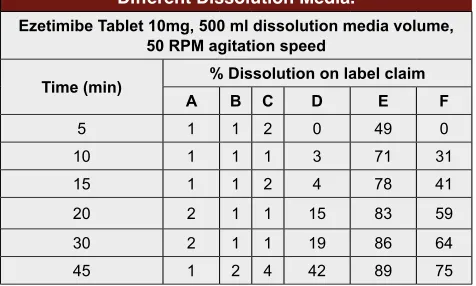
different buffer solution across physiological pH range, with and without 0.45% SLS. The observed dissolution profile in plain buffer solutions was less than 5% and in 0.45% SLS in 0.05 molar pH 4.5 acetate buffer sudden burst release was observed in 10 min as well complete release was not observed. In other media with SLS, the release was slow and not complete. Results of dissolu
-tion studies with OFAT approach in different dissolu -tion media are presented in Table 2.
Design Adequacy and ANOVA
The design was evaluated for adequacy with statistical parameters. Observed degrees of freedom values for lack of fit and pure error were 3 and 4 respectively which indicate model adequacy. Power values were calculated for each variable and combination of different Variables
which indicate the capability to detect signal to noise for
each variable experiment. The observed power values were above 90% for all combinations of variable. All
the statistical parameters were well within the desired limits signifying that the model built was statistically
valid. Results of design adequacy evaluation are pre
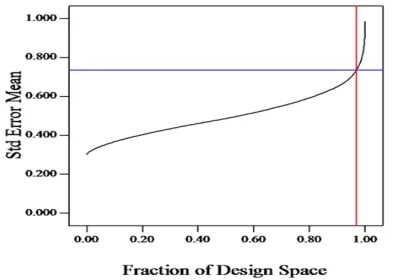
-sented in Table 3. Additionally graphical evaluation tool of FDS graph was also evaluated. The recommended FDS score of at least 0.8 or 80% for exploration and optimization is desirable to yield better statistical mod
-elling. Observed FDS score was 0.98 hence the design
was adequate to create meaningful results. FDS graph
of the executed DoE is shown in Figure 1.
Results of all the 22 experimental runs were fed to
DoE software and were evaluated statistically for any anomalies. Experimental set along with ranges of vari
-ables and arrived responses for each run are presented
in Table 4. Selected desired statistical model and evalu
-ated the ANOVA parameters; Model F value, Lack of fit F-value, degree of freedom for pure error, R-squared
values, adjusted R-square, predicted R-square and
ade-quate precision. Model F-value for all the responses in
found less than 5% for all responses which indicates that there are only about 5% or less chances that the
model may fail due to noise. Lack of fit, F-Values were found to be more than the desired value of 3 for all the responses. The “Predicted R-squared” was not as close to the “Adjusted R-squared” and the difference was more than 0.2. “Adequate Precision” measures the signal to noise ratio. A ratio greater than 4 is desirable.
Table 2: Dissolution Studies with OFAT Approach in Different Dissolution Media.
Ezetimibe Tablet 10mg, 500 ml dissolution media volume, 50 RPM agitation speed
Time (min) % Dissolution on label claim
A B C D E F
5 1 1 2 0 49 0
10 1 1 1 3 71 31
15 1 1 2 4 78 41
20 2 1 1 15 83 59
30 2 1 1 19 86 64
45 1 2 4 42 89 75
A, pH 1.2 Hydrochloric acid; B, pH 4.5 Acetate buffer; C, pH 6.8 Phosphate buffer; D, 0.45% Sodium lauryl sulphate (SLS) in pH 1.2 Hydrochloric acid; E, 0.45% Sodium lauryl sulphate (SLS) in 0.05 M, pH 4.5 Acetate buffer; F, 0.45% Sodium lauryl sulphate (SLS) in pH 6.8 Phosphate buffer.
Table 1: Solubility of Ezetimibe in Buffer Solutions Across Physiological pH Range (mg/ml).
SLS Conc. (% w/v) Different pH buffers
A B C
0 0.001 0.003 0.002
0.1 0.002 0.001 0.003
0.2 0.003 0.004 0.006
0.5 0.007 0.012 0.017
Table 3: Design Evaluation Parameters for Adequacy.
Term Std. Err VIF Power at 5 % alpha
A 0.21 1.00 97.1
B 0.25 1.00 91.2
C 0.25 1.00 91.2
D 0.25 1.00 91.2
AB 0.25 1.00 91.2
AC 0.25 1.00 91.2
AD 0.25 1.00 91.2
BC 0.25 1.00 91.2
BD 0.25 1.00 91.2
CD 0.25 1.00 91.2
ABC 0.25 1.00 91.2
ABD 0.25 1.00 91.2
ACD 0.25 1.00 91.2
BCD 0.25 1.00 91.2
ABCD 0.25 1.00 91.2
Lack of Fit 3 Pure Error 4
A, pH of dissolution media; B, Sodium lauryl sulphate concentration (%w/v); C, Dissolution media volume (ml); D, Agitation speed (RPM).
Figure 1: FDS Graph for Evaluation of Adequacy of the Model.
ure 2 (a) depicts the relation of variables to response 1
and dissolution media volume was having more positive
effect as increase in agitation speed will effect in tablet bursting effect thus aiding more release at initial time
point. Figure 2 (b) shows the relation of variables to response 2 (% dissolution at 10 min) and all the variables were having positive effect. Agitation speed was having more positive effect on the release rate at 10 min which need to be optimized to have discriminatory release at initial time points. SLS concentration was having mar
-ginal positive effect on response 3 and 4 (% dissolution at 15 and 20 min) whereas dissolution media volume and agitation speed were having significant impact on release rate. Effect of variable on response 3 and 4 are depicted in Figure 2 (c), (d). Extent of release, i.e., % dissolution at 45 min was influenced to significant extent by dissolution media volume and agitation speed whereas SLS concentration was having nominal positive effect. Figure 2 (e) shows the relation of variables to response 5. Figure 2 (f) shows the relation of variables to response 6, where SLS concentration was having pos
-itive impact and all other variables were having negative impact. In order to achieve minimum possible % RSD at 20 min; target is to have lower value, it was desirable to have optimum values for dissolution media volume
and agitation speed.
Further evaluation of responses with respect to vari -ables was made with 3D Surface. 3 D surface plot
allows to evaluate a combination selected 2 variables at time and evaluate the effect of variation on responses. Figure 3 shows the relation of selected variable (Dis
-solution media volume and SLS Concentration) on each response. It was observed that SLS concentration and dissolution media volume were having moderate posi
-tive effect on response 1 to 5 whereas agitation speed was having a high positive effect. As the objective was to achieve slow and steady dissolution profile, it was desir
-able to play with vari-able B and vari-able C.
Design Constraints for Solution Predictions and Optimization of Discriminatory Dissolution Method
In order to predict the solutions the software was given
constraints which were target acceptance ranges or anticipated results for each of the response. For this
purpose each of the factor was given with the targeted range to operate and then each of response was given
with the constraint of desired result outcome. Table
6 illustrates the ranges of each of the variable and response. Response 1 was given a target of 10 to 35 % of dissolution release to prevent release dumping at initial time point. Response 2 was given a target of 20 Observed ratio for all responses were above 4. ANOVA
results evaluation table for statistical significance of model is presented in Table 5.
Evaluation of Responses (Perturbation Plots, Contour Plots, 3 D Plots)
All the responses were evaluated through different graphs to understand the effect and relation of variables on each response. Perturbation plot helps to compare
the effects of all the factors at a particular point in the
Fig-Figure 2: Perturbation Plots. (a) Perturbation plot for re-sponse-1: %D @ 5 min, (b) Perturbation plot for response-2: % D @ 10 min, (c) Perturbation plot for response-3: % D @ 15 min, (d) perturbation plot for response-4: % D @ 20 min, (e) Perturbation plot for response-5: % D @ 45 min, (f) Perturba-tion plot for response-6: % RSD @ 20 min.
Table 4: Experimental Setup by DoE for Discriminatory Dissolution Method Development.
Runs Variables Responsesa
A B C D R1 R2 R3 R4 R5 R6b
1 4.5 0.75 250 75 35 53 59 62 70 8.8
2 4.5 0.75 900 25 51 64 69 69 74 23.3
3 1.2 0.475 575 50 44 63 70 74 80 8.5
4 1.2 0.2 900 75 46 58 67 73 87 3.6
5 1.2 0.75 900 25 22 34 37 39 42 32.5
6 1.2 0.75 900 75 72 89 93 96 99 1.8
7 4.5 0.2 900 75 37 55 73 79 91 3.9
8 4.5 0.475 575 50 55 71 79 79 84 8.9
9 1.2 0.2 250 25 1 2 3 4 6 20.4
10 4.5 0.75 900 75 63 93 98 100 102 1.4
11 1.2 0.475 575 50 57 72 80 86 92 3.3
12 4.5 0.2 250 25 1 2 4 5 7 12.8
13 4.5 0.475 575 50 41 64 72 76 81 9
14 1.2 0.75 250 75 28 40 45 51 64 12.2
15 1.2 0.75 250 25 2 3 4 5 9 31.6
16 4.5 0.475 575 50 55 71 79 79 84 8.9
17 1.2 0.2 250 75 15 23 29 32 42 28.3
18 1.2 0.2 900 25 9 14 17 19 23 6.7
19 4.5 0.2 900 25 19 31 43 48 59 18.1
20 4.5 0.2 250 75 20 34 41 45 57 17
21 1.2 0.475 575 50 57 72 80 86 92 3.3
22 4.5 0.75 250 25 2 3 4 5 8 0
A, pH of dissolution media; B, sodium lauryl sulphate concentration (%w/v); C, dissolution media volume (ml); D, agitation speed (RPM); R1, % dissolution @ 5 min; R2, % dissolution @ 10 min; R3, % dissolution @ 15 min; R4,% dissolution @ 20 min; R5, % dissolution @ 45 min; R6, % RSD for dissolution values at 20 min.
a % dissolution on label claim of dosage form.
b % RSD of replicate measurement of dissolution values.
Table 5: ANOVA Results Evaluation Table for Statisti-cal Significance of Model.
Responses Statistical parameters
A B C D E F G
Figure 3: 3D Surface Plots. (a) 3D Surface plot for response-1: % dissolution @ 5 Min, (b) 3D surface plot for response-2: % dissolution @ 10 min, (c) 3D surface plot for response-3: % dissolution @ 15 min, (d) 3D surface plot for response-4: % dissolution @ 20 min, (e) 3D surface plot for response-5: % dissolution @ 45 min, (f) 3D surface plot for response-6: % RSD of dissolution values @ 20 min.
Figure 4: Contour Plots for ‘Solution 1’ (a) Contour plot for response-1: % dissolution @ 5 min, (b) Contour plot for response-2: % dissolution @ 10 min, (c) Contour plot for response-3: % dissolution @ 15 min, (d) Contour plot for response-4: % dissolution @ 20 min, (e) Contour plot for response-5: % dissolution @ 45 min, (f) Contour plot for response-6: % RSD of dissolution values @ 20 min.
by software. As it was observed that pH of the dissolu
-tion media was having a very minimal effect and was negligible in terms of its influence on the observed results, pH 4.5 was selected as target pH as the same was relevant from physiological transit of the dosage form
based on Tmax values. Out of the suggested solutions to arrive at discriminatory dissolution method, ‘solution 1’ and ‘solution 13’ were selected for further evaluation and design validation. Figure 4 illustrates contour plots
for all responses of solution 1, explaining the impact of selected variables. Response 1, 2, 3 and 4 were hav
-ing moderate positive effect with increase in dissolution media volume and SLS concentration; Figure 4 (a) (b) (c) (d). Response 5 was having significant positive effect with increase in dissolution media volume which sug
-gests that to achieve extent of release media volume shall be kept to the maximum possible; Figure 4 (e). Response 6 was not having any impact with the selected variables and was inversely proportional to agitation speed; Figure 4 (f). Contour plots of ‘solution 13’ are presented in Figure 5. Impact of selected variables on all responses were similar to that of ‘solution 1’.
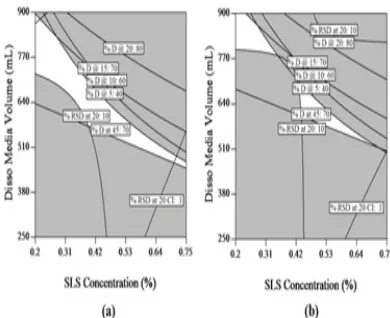
Graphical Optimization Criteria was used to produce an overlay graph. It was comprised of the contour
plots from each response laid on top of each other.
The numerical optimization criteria was carried over and automatically fills the Graphical Optimization cri
-teria. Overlay plot of ‘solution 1’ is depicted in Figure
6 (a), white color defines the acceptable factor settings. Another color (Grey by default) defines the unaccept -able factor settings. The color represented in white is
termed as MODR, where all responses will meet the desired criteria by varying the factors in the allowable ranges. Overlay graph for ‘solution 13’ is depicted in
to 70 to ensure that there is notable increase in release
from 5 min to 10 min time point. Response 3 was given
a target of 30 to 80 % of dissolution release to ensure
that around 50% of the drug was released. Response 4 was given a target of 50 to 100 % of release to ensure that at least 50%. Response 5 was given a target of 75 % and above dissolution release to ensure that complete drug release was monitored. Response 6 was given a tar
-get less than 10% and objective to minimize.
Design Validation with Predicted and Selected Solutions
With the given target ranges and constraints for each of
the responses, the software was able to suggest about
16 different solutions with a combination variable fac -tors. Table 7 illustrates different solutions as proposed
Figure 6: Overlay Plots showing the observed desirable space with input method parameters: concentration of SLS, dissolu-tion medium volume, variable pH and variable speed. Here in % D at 5, 10,15,20,45 and % RSD at 20 were target responses for optimization. White colour field of chart defines the accept-able factor settings. Grey by default defines the unacceptaccept-able factor settings. The colour represented in white is termed as design space, where all responses will meet the desired crite-ria by varying the factors in the allowable ranges.
Table 6: Constraints for Optimisation and Solutions Prediction.
Name Goala Lower
Limitb Upper Limitb Importance
A is in range 4.5 4.5 3
B is in range 0.2 0.75 3
C is in range 750 900 3
D is in range 25 75 3
R1 minimize 10 35 3
R2 minimize 20 70 3
R3 minimize 30 80 3
R4 maximize 50 100 3
R5 maximize 75 110 3
R6 minimize 1 10 3
A, pH of dissolution media; B, sodium lauryl sulphate concentration (%w/v); C, dissolution media volume (ml); D, agitation speed (RPM); R1, response-1:% dissolution @ 5; R2, response-2:% dissolution @ 10; R3, response-3:% dissolution @ 15; R4, response-4:% dissolution @ 20; R5, response-5: % dissolution @ 45; R6, Response-6: % RSD of dissolution values at 20.
a given criteria for variables and responses;
b lower and higher limits for variables and responses.
Table 7: Numerical Solutions Table as Derived from DoE.
Number Variables Responsesa
A B C D R1 R2 R3 R4 R5 R6b
1 4.5 0.200 750 58 35 50 62 67 77 9.7 Selected
2 4.5 0.200 753 58 35 50 63 67 77 9.7
3 4.5 0.200 759 57 35 50 63 67 77 9.7
4 4.5 0.200 765 57 35 50 63 67 78 9.7
5 4.5 0.203 750 58 35 50 62 67 77 9.7
6 4.5 0.200 771 57 35 50 63 67 78 9.7
7 4.5 0.200 774 56 35 50 63 67 78 9.8
8 4.5 0.204 750 58 35 50 62 67 77 9.8
9 4.5 0.200 778 56 35 50 63 67 78 9.8
10 4.5 0.200 790 55 35 51 63 68 78 9.8
11 4.5 0.211 750 57 35 50 62 67 77 9.8
12 4.5 0.214 750 57 35 51 62 67 77 9.8
13 4.5 0.200 802 54 35 51 63 68 78 9.9 Selected
14 4.5 0.200 807 54 35 51 63 68 78 9.9
15 4.5 0.200 814 54 35 51 63 68 79 10.0
16 4.5 0.200 821 53 35 51 64 68 79 10.0
A, pH of media; B, sodium lauryl sulphate concentration( %w/v); C, dissolution media volume(ml); D, agitation speed (RPM); R1, response-1: % dissolution @ 5 min; R2, response-2: % dissolution @ 10 min; R3, response-3: % dissolution @ 15 min; R4, response-4: % dissolution @ 20 min; R5, response-5: % dissolution @ 45 min; R6, response-6: % RSD of dissolution values at 20 min.
a percentage(%) label claim.
Figure 6 (b) and has two design spaces to achieve the desired dissolution profile.
As predicted by the model, ‘solution-1’ and ‘solution-13’
were selected out of the 16 solutions suggested. These
two solutions were executed in the lab with suggested combination of variables and dissolution profile was established. The established dissolution profile was compared against the DOE suggested solutions; Table 8. It was observed that the DOE suggested dissolution profiles were closely matching with the experimental results. Hence it is affirmed that the DOE model is vali
-dated and any of the two selected solutions can be final
-ized as suitable discriminatory dissolution method.
CONCLUSION
Discriminatory dissolution methods have a critical role in pharmaceutical tablet dosage form development. In
generic formulations of solid oral dosage forms the suc-cess rate of in-vivo bioequivalence studies depends on
the adequacy of discriminatory dissolution employed to
study sameness of test and reference product. Poorly soluble molecules pose a great developmental challenge for dissolution method development. Developing a dis
-criminatory dissolution method involves multiple vari -able that were interrelated, which makes the method
development process cumbersome. DoE is the tried
and tested approach in pharmaceutical industry and
rec-ommended by regulatory agencies for better scientific understanding of product and processes. DoE in disso
-lution method development can help accelerate the dis
-solution method development process to arrive at better discriminatory method with minimum runs. Poorly sol
-uble molecule, ezetimibe was selected to demonstrate applications of DoE in dissolution method develop
-ment. A simple 2-level factorial design was employed
Table 8: DoE Model Validation Table for Selected Solution.
Time (min) A B C D
5 34 34 35 36
10 50 61 51 60
15 62 74 63 71
20 67 85 67 79
45 77 93 78 88
A, ‘Solution 1’ prediction (pH 4.5, 0.2% SLS) 750ml, 60 RPM; B, ezetimibe tablets actual dissolution data from lab experiment (pH 4.5 acetate buffer 0.2% SLS) 750ml, 60 RPM; C, ‘Solution 13’ prediction (pH 4.5 acetate buffer, 0.2% SLS) 800ml, 55 RPM; D, Ezetimibe tablets actual dissolution data from lab experiment (pH 4.5 acetate buffer, 0.2% SLS) 800ml, 55 RPM.
with 4 variables with center points and 6 responses, by analyzing dissolution profile at different time intervals. Model was evaluated for adequacy and statistical sig
-nificance and solutions for discriminatory dissolution
method were predicted with input criteria and
numeri-cal optimization criteria. Graphinumeri-cal evaluation tools like
perturbation plots, contour plots, 3D surface plots and
overlay plots help in better understanding of effects of variables on responses. Selected dissolution method conditions were experimented in lab with test product to establish dissolution profile values, which were com
-pared against DoE predicted solutions. Experimen -tal results were in agreement with predicted solutions
which confirms design validation and achieved dissolu
-tion profile has discriminatory power with slow initial release profile and complete release of drug at 45 min (90%). By extending these concepts to pharmaceutical solid oral dosage forms one can develop discriminatory dissolution methods with minimal experimental runs,
for poorly soluble molecules, which will further enhance
the success rate of BE studies for generic products.
ACKNOWLEDGEMENT
Authors are thankful to GVK Biosciences Pvt. Ltd, for
-mulation division for providing research lab facilities.
CONFLICT OF INTEREST
Authors declare no conflict of interest.
ABBREVIATIONS
DOE: Design of Experiments; SLS: Sodium
Lau-ryl Sulphate; RPM: Revolutions Per Minute; HPLC:
High Performance Liquid Chromatography; ANOVA:
Analysis of Variance; FDS: Fraction of Design Space;
MODR: Method Operable Design Region.
REFERENCES
1. USFDA, Guidance for industry, Immediate Release Solid Oral Dosage Forms, Scale-up and Post approval Changes: Chemistry, Manufacturing and Controls, in vitro Dissolution Testing and in vivo Bioequivalence Documentation, Center for Drug Evaluation and Research (CDER). CMC. 1995;5.
2. Phil JB, Marion JC, Ivana D, Patrick J. Design and analysis of method equivalence studies. Analytical Chemistry. 2009;81(24):9849-57.
3. Marion JC, Phil JB. Acceptance criteria for method equivalency assessments. Analytical Chemistry. 2009;81(24):9841-8.
4. USFDA, Guidance for industry, Bioavailability and Bioequivalence Studies Submitted in NDAs or INDs, U.S. Department of Health and Human Services, Food and Drug Administration, Center for Drug Evaluation and Research (CDER). Bio Pharmaceutics. 2014.
Administration, Center for Drug Evaluation and Research (CDER). BP. 1997;1.
6. USFDA, Bioavailability and Bioequivalence Studies for Orally Administered Drug Products- General Considerations, U.S. Department of Health and Human Services, Food and Drug Administration, Center for Drug Evaluation and Research (CDER). 2003.
7. USP 40- NF 35, General Chapter, The Dissolution procedure: Development and Validation <1092>, The United States Pharmacopeial Convention. 1296-316.
8. USP 40- NF 35, General Chapter, Dissolution <711>, the United States Pharmacopeial Convention. 588-98.
9. USFDA, Guidance for industry, Bio equivalence recommendations of Ezetimibe tablets, U.S. Department of Health and Human Services, Food and Drug Administration, Office of Generic Drugs. 2008.
10. Dickinson PA, Lee WW, Stott PW, Townsend AI, Smart JP, Ghahramani P,
et al. Clinical relevance of dissolution testing in quality by design. The AAPS Journal. 2008;10(2):280-90.
11. Phil JB, Marion JC, Phil N, Duncan T, Keith T. The application of quality by design to analytical methods. Pharmaceutical Technology. 2007;31(10):142-52.
12. Mark S, Matthias P, Hanna-Brown M, Phil N, Phil JB, Gordon H, et al. Implications and opportunities of applying QbD principles to analytical measurements. Pharmaceutical Technology. 2010;34(2):52-9.
13. Limin Z, John F, Hui Z, Harshad P, Scott J. Dissolution Method Development for Fixed-Dose Combination Drug Products – Challenges and Strategies. American Pharmaceutical review. 2015.
14. Kincl M, Turk S, Vrecer F. Application of experimental design methodology in development and optimization of drug release method. International Journal of Pharmceutics. 2005;291(1-2):39-49.
15. Vayeda CM, Devendra SY, Hitesh AJ. Quality by design based dissolution test development of Omeprazole extended release formulation. Asian Journal of Pharmaceutical and Clinical Research. 2014;7(5):150-4.
16. ZETIA (EZETIMIBE) tablets, Patient information leaflet (PIL), Merck/Schering-Plough pharmaceuticals, 29480958T, REV 14.
17. USFDA, Dissolution methods database, Ezetimibe tablets, U.S. Department of Health and Human Services, Office of generic drugs, Center for Drug Evaluation and Research (CDER). 2008.
18. USP 40- NF 35, Official monograph, Ezetimibe Tablets, the United States pharmacopeial convention. 8289-90.
19. Deepthi KN, Abbaraju PL, Ajay BK, Narandra JR. Formulation and in-vitro
evaluation of conventional tablets of Ezetimibe by using solid dispersion.
International Journal of Pharmacy and Pharmaceutical Sciences. 2013;5(2):331-5.
20. Lalit K, Sreenivasa MR, Renuka SM, Girish KP. Full factorial design for optimization, development and validation of HPLC method to determine valsartan in nanoparticles. Saudi Pharmaceutical Journal. 2015;23(5):549-55.
21. Moolchand K, Sanjay K, Bhupinder S, Saranjit S. Implementation of design of experiments for optimization of forced degradation conditions and development of a stability-indicating method for furosemide. Journal of Pharmaceutical and Biomedical Analysis. 2014;96:135-43.
22. Alice MFL, Jean CW, Eckers C, Borman PJ, Chatfield MJ. Investigation into the factors affecting accuracy of mass measurements on a time-of-flight mass spectrometer using Design of Experiment. Rapid Communications in Mass Spectrometry. 2007;21(4):529-35.
23. George O, Alice L, Patrick J, Phil B, Marion C. Reduced-method robustness testing of analytical methods driven by a risk-based approach. Pharmaceutical Technology. 2010;22(4):72-86.
24. Dennis A, Mikael N, Susanne O, Jörgen S, Olof S, Silke K, et al. A quality control method enhancement concept-continual improvement of regulatory approved QC methods. Journal of Pharmaceutical and Biomedical Analysis. 2016;129:273-81.
25. ICH, Specifications: Test procedures and acceptance criteria for new drug substances and new drug products: Chemical substances (Q6A), International Conference on Harmonization of technical requirements for Registration of Pharmaceuticals for human use. 1999.
26. Kose OC, Esim O, Kurbanoglu S, Savaser A, Ozkan S, Ozkan Y. Development of a suitable dissolution method for the combined tablet formulation of Atorvastatin and Ezetimibe by RP-LC Method. Current Drug Delivery. 2016;13(3):1-9.
27. USFDA, Quality by design for ANDAs: An example for immediate-release dosage forms, Example QbD IR Tablet, Module 3 Quality, 3.2.P.2 Pharmaceutical Development, Office of Generic drugs. 2012.
28. Shengyun D, Bing X, Gan L, Jianyu L, Zhong X, Xinyuan S, et al. Application of design of experiment and design space (DOE-DS) methodology for the HPLC Separation of Panax Notoginseng Saponins. The Open Chemical Engineering Journal. 2015;9:47-52.
29. Phil JB, John R, Chris J, Hann-Brown M, Roman S, Simon B. The development phase of an LC method using QbD principles. Journal of Separation Science. 2010;2:2-8.
30. EMA-FDA pilot program for parallel assessment of Quality-by-Design applications: lessons learnt and Q and A resulting from the first parallel assessment. EMA/430501/2013. 2013.
• Discriminatory dissolution method for poorly
soluble Ezetimibe tablets is developed with the help of 2-Level factorial design. Design of Experi -ments software is used make simulations of
differ-ent variables. With the help of statistical software’s desired dissolution method conditions to achieve discriminatory profiles was predicted. Arrived dis
-solution method is validated against experimental runs to confirm DoE predictions.
Cite this article: Kolla SB, Vallabhaneni MR, Puttagunta SB, Venkata MS. Design of Experiments Approach to Discriminatory Dissolution Method Development of Poorly Soluble Drug in Immediate Release Dosage Form. Indian J of Pharmaceutical Education and Research. 2019;53(3):435-45.
ABOUT AUTHORS
Mr. Sudheer Babu Kolla: Is a graduate in pharmaceutical technology and working in renowned
pharmaceutical organizations in the field of analytical research and development. Expertise areas include analytical method development, validation, method transfer, quality control and quality assurance of finished pharmaceutical dosage forms. Current research interests are in applica