Lib. Sc. 20; 1983; Paper B.
PHASE
RELATIONS ASSOCIATED WITH
MATHEMATICAL SCIENCES:
A
Case
Study
M
A
GOPINATHAND
A LAKSHMANAMOORTHY,*Documentation Research and Training Centre, Indian Statistical Institute,
31 Church Street, Bangalore 560 001.
An analysis of quantitative data on the incidence of phase relations associated with mathematical sciences is presented. It has been found that application and bias phase relations have high percentage of incidence. Physical sciences show a greater tendency for phase relations wittr mathematics. It is also observed that intra-subject
phase relations with mathematics is fairly frequent.
I
0 introduction
Complex subjekts have been identified as one of the important
features in the structure and development of universe of subjects. They arise out of the mode of 'loose assemblage" (3). The resulting relation is called "Phase Relation (5). In phase relation, two or more
subjects arc combined by a variety of relations such as Bias, Application, Influence and also Comparison, Difference and General (5). Detqiled deftnitions of this typology has been presented in Colon Classification (-- CC) and also in same papers (1,2,4). However to get data on the frequency of inadence of phase relations in different subject fields, we have to identity a large collection of documents, principally in a library. In this paper, we have attempted to find out the types of phase relations incident in documents collected in a large scientific library. We have further restricted our study to the phase relations of subjects associated with Mathematical Sciences.
* Student of DRTC Course (1982-84)
PHASE RELATIONS WITH hWTHEMATICAL SCIENCES B2
1 The nature of Mathematical Sciences
Mathematical Sciences is .a field which generates a kind of absmct logic. It attempts to find patterns from empirical situations and generalize them into a principle or a function Such generalisa- tions are helpfbl for applications to solve problems in different contexts. In a sense, specialists express difficult concepts and
multivariate
relational complexities with the help of mathematical Language. The field of mathematics is an ancient one. It has developed from Arithmetics, Algebra and Geometry to the current developments of Statistical analysis, Operations Research and Topology. In fact, it is said that mathematics is a discipline whose structure is ever changing and developing. Mathematics has been used as a general input discipline to the study of the relations and critical factors in these relations in various subject fields. Such studies aid prediction and improve the rigour of the field of study for hrther development.In order to get a feel of the ramifications of the use of mathematics in different fields, we have attempted to get a sample set
of documents from a large library for analysis. 2 Methodology by collecting the samples
To get an empirical sample of documents which embody complex subjects associated with mathematics, we selected a large science library in Bangalore, namely the Indian Institute of Science Library. This library has a collection of books which range 1,15,000. Amidst these documents mathematics has around 7000 documents. Of these documents, 3000 documents are those published during 1960 to 1980. From this collection, we selected a sample of subjects which have phase relations with Mathematical Sciences. The procedure of the selection of the documents for the purpose of study is as follows:
1) The alphabetical part of the catalogue, containing subject entries were scanned. The entry term normally used was mathematics or any of its associated fields such as Algebra, Geometry, Statistics, Calculus etc. From this part call numbers for various documents indicating phase relations were selected.
2) Using the call numbers selected, the classified pan was
searched for the specific main entries representing documents having complex subjects. In this process, the entire classified part was
searched. Fields in Natural Sciences and Social Sciences were looked into for c o ~ e c t i o n s with nmathematical sciences.
3) For each main entry selected as a sample for the study of phase relations, the following items of information were collected:
a) DDC call number of the docbk'nen~
b) Title of the document;
c) Edition andlor the year of publication of the document;
d) - Subject headmgs wherever they were provided.
4) The collected samples totalled to 576. Of these 223 were published chning 1960's (1 960-1 969) and 293 were published during
1970's (1970-198 1).
T1
ey were analysed as follows:a) The actual documents on the shelf were also consulted for determining the specific subject embodied in it;
b) Each of these specific subjects was analysed using postulational approach to classification.
c) The type of phase relations involved was identified and noted on each slip;
d) The component subjects involved in the phase relations were also noted. For this purpose, the classification schemes such as the Dewey Decimal Classification (DDC), C.C. and the Broad System of Ordering (BSO) were used, for recognising the subjects.
e) The total data collected from the samples was consolidated in the following manner:
i) By types of phase relations namely General, Bias, Application and Influence;
ii) By subjects involved in phase relation;
iii) By the date of publication of documents. For this purpose, we selected documents which were published after 1960 upto 1980's.
PHASE RELATIONS WITH MA'l'l I li.\M11CAL SCIENCES B3
3 Subjects involved in the phwe relations
From the samples collected, it was found that a fairly wide spec- of subjects have phase relations involving Mathematid
Sciences. This spectrum ranges from Physical Sciences, Natural
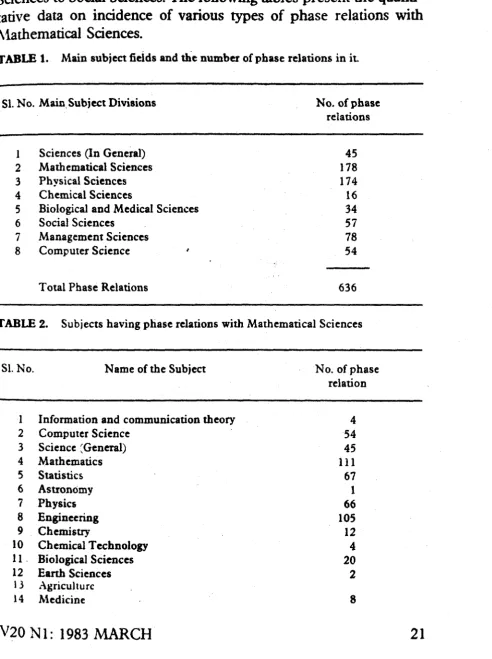
Sciences to Social Saences. The following tables present the quanti- tative data on inadence of various types of phase relations with
lathema ma tical
Sciences.TABLE 1. Main subject fields and the number of phase relations in it.
-
S1. No. Main, Subject Divisions No. of phase relations
Sciences (In General) Mathematical Sciences Physical Sciences Chemical Sciences
Biological and Medical Sciences Social Sciences
Management Sciences
Computer Science *
Total Phase Relations 636
TABLE 2. Subjects having phase relations with Mathematical Sciences
S1. No. Name of the Subject No. of phase relation
Information and communication theory Computer Science
Science (General) Mathematics Statistics
Astronomy
Physics Engineering Chemistry
Chemical Technology
Biological Sciences
Earth Sciences Agriculture
hledicine
B2 GOI'INATH AND LNCSHMANAMOORTHY
S1. No. - Name of Subject
- - -- - - - - - - Behavioural Sciences Philosophy
Psychology Social Sciences Education Political Science Economics
Management Science Commerce/Busincss
No. of Phase relation
Total
Note for the Tabks::It is important here to note that a single document having more than one complex subject has been counted seprately, hence resulting 636 phase relations out of the sample contaning 5 16 entries.
Annotation:
It is evident from the above two tables that the complex subjects going with mathematical sciences has a fairly high incidence, namely 178 instances out of 636 relations.This indicates that interrelations in mathematics have a high internal incidence, that is a subfield in Mathematics is used for the study of another subfield. Physical sciences have ranked second in phase relations with Mathematics (it has 174 phase relations). Here again, it is found that Engineering has the highest incidence (105). The third field which uses mathematics is Management Science. Social sciences rank fourth in having interrelations with mathematical sciences. Ranked in discending sequence of their interrelations, we can list the following subjects namely, Computer Science, Sciences in general, Biological and Medical Science and Chemical Sciences. It is obvious that the Physical and Natural Science sector uses mathematics more than Social Sciences Sector. It may be cautioned that the data is collected
h m
a predominantly Science and Technology library and hencethere is slant in the incidence of phase relations. 4 Analysis of data by phore reladons
The phase relations incident in the sample subject chosen for
PHASE RELhnONS WITH .MATHWfATiCAL SCIENCES EM1
incidence of comparison and difTerence phase relations in the sample. Further it can be stated that the dominant phase relations were bias
phase relations and application phase relations. The succeding sec- tions discuss the details of the various phase relations.
41 ' General Phase Rehation
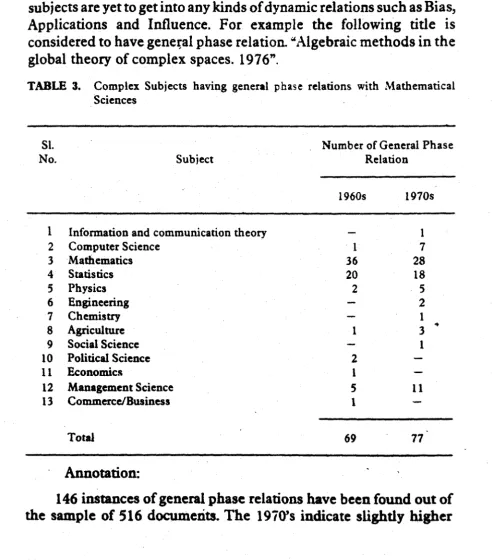
The following table presents details about the incidence of general phase relation of the complex subjects associated with mathematical sciences. By genetal relation it is meant that the two subjects are yet to get into any kinds of dynamic relations such as Bias, Applications and Influence. For example the following title is considered to have general phase relation 'Algebraic methods in the global theory of complex spaces. 1976".
TABLE 3. Complex Subjects having general phase relations with Mathematical Sciences
S1. Number of General Phase
No. Subject Relation
Information and communication theory Computer Science
Mathematics Statistics Physics Engineering Chemistry Agriculture Social Science Politic& Science Economics
Management Science Cornmerce/Busintss
Total
Annotation:
146 instances of general phase relations have been found out of the sample of 516 documents. The 1970's indicate slightly higher
f341 GO131NATH AND LAKSHMANAMOORTHY
r incidence than &at
in the
1960s. The mathematics itself has a f&lyhigh incidence of g e n e d phase relation with rm&cmaticat scienccs. Apart
ftam
Wsthe
field of statisticshs
o high incidence of generalphase relations. The social sciences appcar to have very low incidence of general phase relation
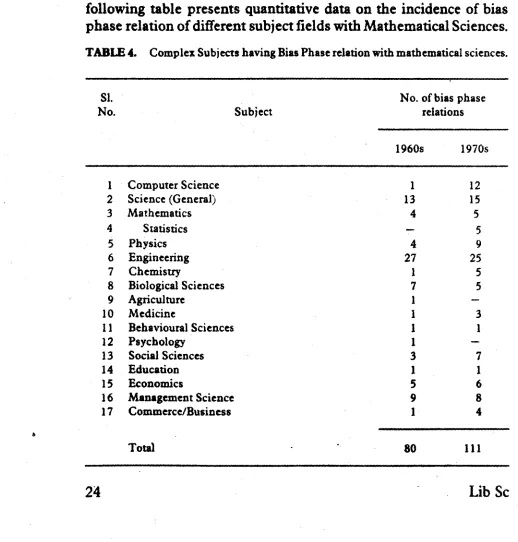
Bias phase relation appears to be one of the commonest incidences of phase relations. In this relations the subject appearing in the first phase is oriented to the needs of the subjects appearing in the second phase. For example %he following subject is said to have bias phase relation.
"Numerical Methods for Engineers and Scientists. 1977." The following table presents quantitative data on the incidence of bias phase relation of difTerent subject fields with Mathematical Sciences. TABLE 4. Complex Subjtcts having Bias Phase relation with mathematical sciences.
si.
No. Sub j tct
No. of bias phase
relations
Computer Science Science (General) Mathematics
Statistics Physics Engineering Chemistry
Biological Sciences Agriculture
Medicine
Behavioural Sciences
Psychology
Social Sciences Education Economics
Management Science Commerce/Business
PHASE RELATIONS WITH MAW E.'\1A'I'lCAL SCIENCES
Bias phase relation has a fairly large incidence in the complex subjects studied in the sample. There arc about 191 instances of bias phase relations out of 5 1 6 documents. The 1970's indicates a slight increase of bias phase relations. Engineering fields appear to have fairly high percentage of incidence of bias phase relation Sciences (General) comes next in order. Social sciences have a sprinkling of bias phase with economics having a large share in this. It can also be observed that computer sciences have a large incidence of bias phase relations in 1970s.
43 Application Phase Relcuiun
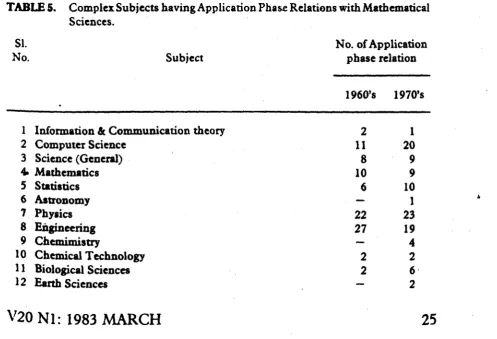
Mathematics is an important field for the study of many disciplines. This is well borne out in the sample chosea Almost all the fields of knowledge have fairly good incidence of application phase relation with mathematical sciences. For example, the following document illustrates the nature of applied phase relation with krthematics. "Group theory and its applications to Physical Problems". 8
The following table presents the quantitative data of the complex subjects associated with mathematics.
TABLE 5. Complex Subjects having Application Phase Relations with Mathematical Sciences.
S1.
No. Subject
No. of Application phase relation
1 Information 8t Communication theorg 2 Computer Science
3 Science (General) 4 Mathematics 5 Statitstics 6 Astronomy 7 Physics
8 &gineering
9 Chcmimistrg
10 Chemical Technology
1 1 Biologicd Sciences 12 Earth Sciences
B42 GOPINATH AND LAKSHMANAA"00RTHY
SL No.
No. of Application phase relation
- ---
13 Agriculture 1
-
14 Medicine 1 3
15 Behaviowal Sciences 1
16 Philosophy 1
-
17 Psychology 2
-
18 Social Sciences
-
319 Education 2 2
20 Political Science 1
-
21 Economics 3 6
22 Management Science 5 17
23 Commerce/Business 3 6
Total 110 144
Annotation:
Application phase relation has the highest incidence
-
that is above 250 instance out i f 516 documents chosen as sample. The 1970's show slight increase in the percentage of applicatibn phase relation of complex subjects with mathetical sciences. Engineering and Physics apqears to have high incidence of application phase relation Social sciences also have good incidence of the phase relation. Apart from this the computer sciences appear to have a good share of this phase relationwith
mathematics. Further the 1970's indicate larger incidence with computer science.# 1-e Phase Relation
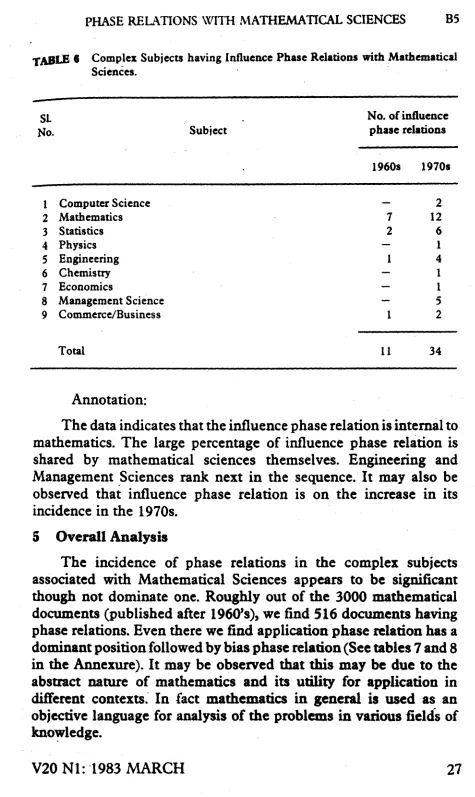
Influence phase relation is a relation in which the subject field in the hrst phase is influenced by the structure and development of the subject in the second phase. For example, 'Selecting and Ordering of Population: Influence of Statistical Methods. 1976".
The followhg table presents data on the incidences of influence phase relation in the cornpiex subjects associated with mathematical
PHASE RELATIONS \YrlTH MATHEtMATICAL SCIENCES B5
TABLE 6 Complex Subjects having Influence Phase Relations with Mathematical Sciences.
- SL
No. Subject
No. of influence phase relations
Computcr Science Mathematics Statistics Physics Engineering Chemistry Economics
Management Science Commerce/Business
Total 11 34
Annotation:
The data indicates that the influence phase relation is internal to mathematics. The large percentage of influence phase relation is shared by mathematical sciences themselves. Engineering and Management Sciences rank next in the sequence. It may also be observed that influence phase relation is on the increase in its incidence in the 1970s.
5 Overall Analysis
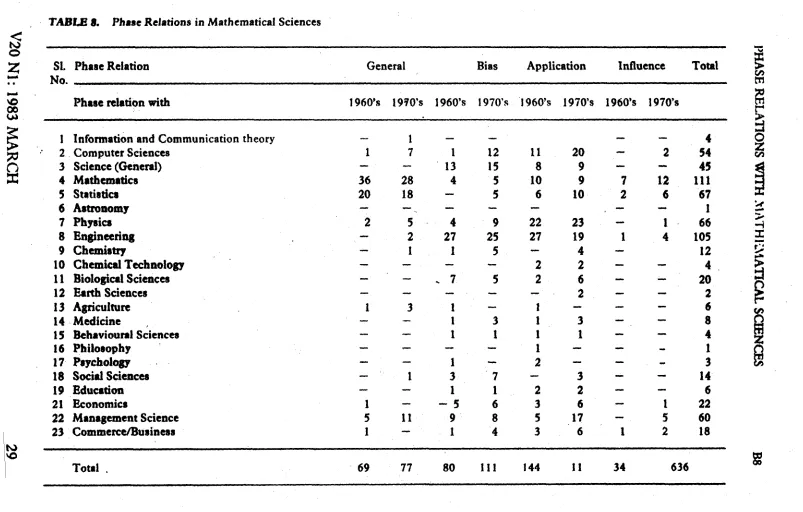
The incidence of phase relations in the complex subjects associated with Mathematical Sciences appears to be significant though not dominate one. Roughly out of the 3000 mathematical documents (published after 196(Ys), we find 516 documents having phase relations. Even there we find application phase relation has a dominant position followed by bias phase relation (See tables 7 and 8 in the Annexwe). It may be observed &at this may be due to the abstract nature of mathematics and its utility for application in different contexts. In fact mpthematics in general
is
used as an objective language for analysis of the problems in various fields ofknowledge.
This paper presents a case study to analyse empirically the
ioddence o f . d o ~ e n t s with phase relations
in
the
collecdm of libraries. It is obviaus that we annot gencnlise the infmnces on thebuis
ofthe
sample data providedin
this paper. But it is an attempt to apply a methodology ro find the d c a t i o n sin
the incidences of complex subjects and the type of phase relations. It may be helpful tocoilcct data from the coliections of other large libraries oriented to science and technology as well as social sciences. Such dam collection may help us to develop a quantitative pattern ofincidence ofcomplex subjects in the universe of subjects. -
7 Bit,liographic References
1 JAYARAJAN (P) and GOPI'NATW (MA). Ussification of complex subjects in CC and UDC. (DRTC Annual Semmnar. 2; 197 1; Paper CCj.
2 N N E W G H A N (A; and GOPINATH (M A). Subjects presenting relanons
between two subjecss with particular reference to phase retation: Case Stud.. (DRTC Annual Seminar 7; 1969; Paper BB).
4 lUNGANI4THAN (S R). Kinds of bonds between w a subjects including f v s c t ~ ~ bond. (DRTC Annual Seminar 5; 1967; Paper B).
5 W G A N A ' l ' H A K (S R). Phase and inaa-facet relation. (In his Colon Classification. Ed. 6. 1960. Chapter 6:.
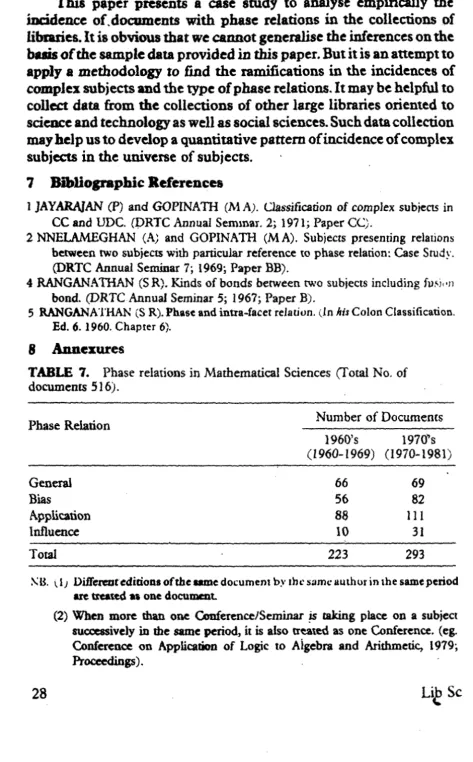
TABLE 7. Phase relations in Mathematical Sciences (Total No. of documents 5 1 6).
Phase Relation Number of Documents
Geaersl
Bias
Application influence
XU. I ) DitTcntrccditions ofthc wme document by rhc same author in rhe same period
8rc ac8d as one docummt.
(2) When mort thao one GonferencelSeminar caking place on a subject suaasively in the same period, it is also treated as one Conference. (eg.
Confkrcnce on Applicafan of Logic to Aigebn md Arirhmetic, 1979;
TABLE 8. Phase Relations in Mathematical Sciences
S1. Phase Relation General Bias Application Influence Total
No.
Phase relation with 1960's 1970's 1960's 1970's 1960's 1970's 1960's 1970's
1 Information and Communication theory 2 Computer Sciences
3 Science (Gtncml) 4 Mathematic8 5 Strtisdcs
6 Aattonomy
7 Physics 8 Engineering
9 Chemistry
10 Chemical Ttcbnology
1 1 Biological Sciences 12 Earth Sciences
1 3 Agriculture 14 Medicine ,
15 Behrviounl Sciencea 16 Philorophy
17 Paychololty 18 Socid Scicnceb 19 Education 21 Economics
22 Management Science 23 Comme~:e/Business
GOPNATH AND LAKSHMANAMOORTHY
93 Types of Phase Relations with Mathematics
Totar
v
Total
General Bias Application Influence