C O M M E N T A R Y
Open Access
Environmental stress and epigenetic
transgenerational inheritance
Michael K Skinner
Abstract
Previous studies have shown a wide variety of environmental toxicants and abnormal nutrition can promote the epigenetic transgenerational inheritance of disease. More recently a number of studies have indicated environmental stress can also promote epigenetic alterations that are transmitted to subsequent generations to induce pathologies. A recent study by Yao and colleagues demonstrated gestational exposure to restraint stress and forced swimming promoted preterm birth risk and adverse newborn outcomes generationally. This ancestral stress promoted the epigenetic transgenerational inheritance of abnormalities in the great-grand offspring of the exposed gestating female. Several studies now support the role of environmental stress in promoting the epigenetic transgenerational inheritance of disease. Observations suggest ancestral environmental stress may be a component of disease etiology in the current population.
Please see related article: http://www.biomedcentral.com/content/pdf/s12916-014-0121-6.pdf.
Keywords:Epigenetic, Non-genetic inheritance, Stress, Transgenerational
Background
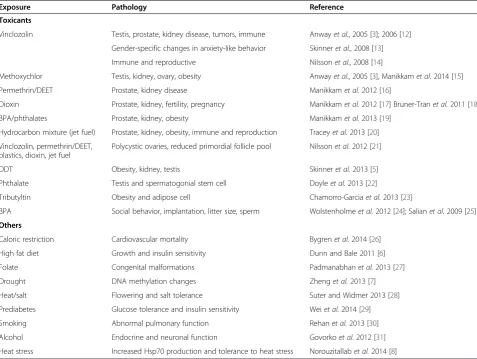
The ability of environmental factors, such as stress [1], to promote the epigenetic transgenerational inheritance of disease and phenotypic variation has now been estab-lished in a number of organisms ranging from plants to humans, with a variety of environmental exposures [2]. One of the first studies found that environmental toxi-cants such as fungicides and pesticides promoted epigen-etic transgenerational inheritance of reproductive disease [3]. Subsequently a large number of different types of toxicants (plastics, hydrocarbons, dioxin, biocides, dichlo-rodiphenyltrichloroethane (DDT)) have been shown to promote the transgenerational inheritance of disease [4] from obesity to cancer [5] (Table 1). Other critical en-vironmental factors found to promote transgenerational disease are nutritional abnormalities such as caloric res-triction or high fat diets [6]. In species such as insects and plants both drought and temperature have also been shown to be critical environmental factors [7,8] (Table 1). Therefore, a large number of environmental factors have been shown to promote the epigenetic transgenerational
inheritance of disease or phenotypic variation in a variety of different species, including humans [9]. This environ-mentally induced form of non-genetic inheritance will have a significant impact on disease etiology [2,10] and areas of biology such as evolution [11].
Epigenetic transgenerational inheritance is defined as ‘the germline (egg or sperm) transmission of epigenetic information between generations in the absence of any
environmental exposure’ [10]. Direct environmental
ex-posure does not involve a generational phenotype, only direct toxicity or physiological effects of the individual exposed [2]. As previously described [2,32], the exposure of an individual any time during development (F0 ge-neration) results in the exposure of that individual and the germline (sperm or egg) that will generate the next generation (F1 generation) (Figure 1). The exposure of a gestating female exposed the F0 generation female, F1 generation fetus and germline that will generate the F2 generation (Figure 1). The ability of an exposure to act on multiple generations is termed a multigenerational ex-posure [32]. Where direct exex-posure is involved, no trans-generational effects are observed. Unfortunately, many
Correspondence:[email protected]
Center for Reproductive Biology, School of Biological Sciences, Washington State University, Pullman, WA 99164-4236, USA
studies have misused the term transgenerational to refer to multigenerational exposure effects. By contrast, if stu-dies are extending to generations with no direct environ-mental exposure then observed effects can be considered transgenerational because the germline is the only cell
type able to transmit epigenetic information generationally (Figure 1).
Epigenetics is defined as ‘molecular factors/processes around DNA that regulates genome activity independent of DNA, and that are mitotically stable’[10]. The types Table 1 Examples of transgenerational inheritance studies
Exposure Pathology Reference
Toxicants
Vinclozolin Testis, prostate, kidney disease, tumors, immune Anwayet al., 2005 [3]; 2006 [12]
Gender-specific changes in anxiety-like behavior Skinneret al., 2008 [13]
Immune and reproductive Nilssonet al., 2008 [14]
Methoxychlor Testis, kidney, ovary, obesity Anwayet al., 2005 [3], Manikkamet al.2014 [15]
Permethrin/DEET Prostate, kidney disease Manikkamet al.2012 [16]
Dioxin Prostate, kidney, fertility, pregnancy Manikkamet al.2012 [17] Bruner-Tranet al.2011 [18]
BPA/phthalates Prostate, kidney, obesity Manikkamet al.2013 [19]
Hydrocarbon mixture (jet fuel) Prostate, kidney, obesity, immune and reproduction Traceyet al.2013 [20] Vinclozolin, permethrin/DEET,
plastics, dioxin, jet fuel
Polycystic ovaries, reduced primordial follicle pool Nilssonet al.2012 [21]
DDT Obesity, kidney, testis Skinneret al.2013 [5]
Phthalate Testis and spermatogonial stem cell Doyleet al.2013 [22]
Tributyltin Obesity and adipose cell Chamorro-Garciaet al.2013 [23]
BPA Social behavior, implantation, litter size, sperm Wolstenholmeet al.2012 [24]; Salianet al.2009 [25]
Others
Caloric restriction Cardiovascular mortality Bygrenet al.2014 [26]
High fat diet Growth and insulin sensitivity Dunn and Bale 2011 [6]
Folate Congenital malformations Padmanabhanet al.2013 [27]
Drought DNA methylation changes Zhenget al.2013 [7]
Heat/salt Flowering and salt tolerance Suter and Widmer 2013 [28]
Prediabetes Glucose tolerance and insulin sensitivity Weiet al.2014 [29]
Smoking Abnormal pulmonary function Rehanet al.2013 [30]
Alcohol Endocrine and neuronal function Govorkoet al.2012 [31]
Heat stress Increased Hsp70 production and tolerance to heat stress Norouzitallabet al.2014 [8]
BPA, Bisphenol A; DEET, N,N-diethyl-m-toluamide.
of molecular processes involved are DNA methylation, histone modifications, chromatin structure, and non-coding RNA (ncRNA). The best characterized epigenetic factor to be involved in germline transmission of epi-genetic information is DNA methylation. An example is imprinted genes that mediate paternal or maternal allelic transmission of specific DNA methylation patterns [33]. A number of studies have shown that environmentally induced epigenetic transgenerational inheritance involves altered germline DNA methylation [4,34]. More recently ncRNA has been suggested as an additional mechanism in germline transmission of epigenetic information [35]. His-tone modifications have also been suggested in a variety of organisms [36]. Although DNA methylation has a critical role in fetal germline development and early embryonic development [37], all the epigenetic processes will likely be involved and have unique functions in regulating devel-opment [10]. Further studies regarding the role of all epi-genetic processes in environmentally induced epiepi-genetic transgenerational inheritance are required.
Environmental stress and transgenerational phenotypes
A number of studies have shown multigenerational ef-fects of stress [38]. One of the best initial examples was the work of Suderman and colleagues [39] showing the generational effects of maternal care on early postnatal life. Optimal early postnatal maternal care promoted epi-genetic programming of the brain that created an adult female with good maternal care characteristics, which then passed on to subsequent generations. By contrast, bad early postnatal maternal care (environmental stress) promoted bad maternal characteristics later in life and altered epigenetic programming of the brain to pro-pagate bad maternal care generationally [39]. This is a good example of an environmental exposure at each ge-neration promoting epigenetic programming that leads to a specific phenotype in the individual, that is, a multi-generational exposure [32]. Other examples of multigen-erational exposures influenced by stress have also been described [40-42]. Environmentally altered epigenetics is the critical molecular mechanism for these multigener-ational exposures [32]. Somatic cell epigenetic effects will be the most predominant environmental impacts on an individual’s phenotype and disease. If these effects do not involve the germline, they will not be transmitted to subsequent generations.
One of the initial studies to demonstrate environ-mental stress promoting the epigenetic transgenerational inheritance of disease was a three-generation study in-volving maternal separation and maternal restraint stress [43]. Social abilities and brain function showed transge-nerational alteration in the F2 and F3 generations. A re-cent study investigated the ability of a paternal olfactory
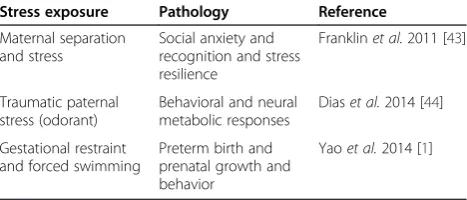
stress experience to promote the transgenerational in-heritance of an olfactory stress response in F2 generation progeny [44]. Correlations with DNA methylation pat-terns in the olfactory receptor system were documented in the transgenerational offspring. Although a limited number of transgenerational stress-induced pathologies have been observed (Table 2), there have been reviews on the topic [38,45].
In addition to the ability of ancestral stress to induce the epigenetic transgenerational inheritance of disease, a previous study demonstrated altered stress responses in transgenerational individuals [46]. Toxicant (vinclozolin) lineage transgenerational (F3 generation) rats were found to have altered stress responses (adolescence restraint stress) later in life. These stress responses were sex specific and gene expression networks in brain regions were found to correlate with these transgenerational stress responses [47]. Therefore, stress can induce the transgenerational in-heritance of disease, and ancestral exposures to a variety of factors can alter stress response transgenerationally.
Ancestral stress exposure promotes preterm birth and newborn abnormalities
Yao and colleagues [1] designed a study to investigate the ability of environmental stress to promote the epi-genetic transgenerational inheritance of disease. The ex-perimental design exposed a gestating female to restraint stress and forced swimming in the later stages of fetal development. The offspring (F1 generation) were bred to generate F2 and F3 generations. A non-stress control lineage, stress lineage (only F0 generation female stress) and chronic stress lineage (all generations stressed) were examined for preterm birth and newborn abnormalities. The F3 generation stress lineage animals had decreased pup weights and altered developmental behaviors. The gestational length progressively declined with each ge-neration leading to a higher preterm birth risk. The F2 generation brain and uterus expression of ncRNA for selected miRNA were altered. Therefore, the study de-monstrated that gestational stress promoted the epige-netic transgenerational inheritance of preterm birth risk
Table 2 Stress-induced transgenerational inheritance of pathologies
Stress exposure Pathology Reference
Maternal separation and stress
Social anxiety and recognition and stress resilience
Franklinet al.2011 [43]
Traumatic paternal stress (odorant)
Behavioral and neural metabolic responses
Diaset al.2014 [44] Gestational restraint
and forced swimming
Preterm birth and prenatal growth and behavior
and decreased brain development of early postnatal offspring.
This is the first study to suggest ancestral stress can influence transgenerational preterm birth risk. Preterm birth in humans is linked to a number of postnatal ab-normalities [48]. There has been a dramatic increase in preterm birth rates in recent years. Although there have been a number of proposed factors for this rise in pre-term births, the current study of Yao and colleagues [1] suggests ancestral gestational stress may be a component in the pathology. Although further research is needed, the concept that ancestral gestational stress may have a role in promoting transgenerational preterm birth risk is a novel component of the disease etiology to consider. Similar considerations can be proposed for early postna-tal neurodevelopmenpostna-tal abnormalities.
Conclusions
The study of Yao and colleagues [1] supports a role of ancestral stress in the epigenetic transgenerational in-heritance of disease. Although direct stress exposure of adults can influence pathologies in the individual and offspring, the multigenerational versus transgenerational inheritance characteristics of the pathology need to be considered. A direct exposure generally affects somatic tissues that will be critical for the individual’s disease, but a transgenerational effect requires a transmission of epigenetic information by the germline. Often, as shown in the current study [1], the transgenerational disease and pathology is distinct and/or has greater frequency than the direct exposure pathology [5]. The ability of stress to promote the epigenetic transgenerational in-heritance of disease has now been shown in several dif-ferent laboratories and animal model systems (Table 2).
A variety of environmental factors promote the epi-genetic transgenerational inheritance of disease (Table 1). The observation that environmental stress can also pro-mote transgenerational pathologies suggests ancestral stress conditions may be a significant factor in our own disease and what we pass down to our grandchildren. Several studies have considered the multigenerational impacts of stress on future generations, including World War 2 holocaust survivors’ offspring [49] and traumatic stress generational effects in several African countries [50,51]. The concept that ancestral stress, particularly dur-ing gestation, may influence disease etiology for gene-rations to come is an important aspect to consider in regards to our environment and society. This is a novel concept that will need to be seriously considered in our future health management and therapy.
Competing interests
The author declares he has no competing interests.
Author information
MKS is an Eastlick Distinguished Professor in the School of Biological Sciences and founding Director of the Center for Reproductive Biology at Washington State University, Pullman Washington, USA. His research is in the area of environmental epigenetics and reproduction (see www.skinner.wsu.edu for more information).
Acknowledgements
I thank Dr. Eric Nilsson for critical review of the manuscript and Ms. Heather Johnson for assistance in preparation of the manuscript. This research was supported by National Institutes of Health grants to MKS.
Received: 31 July 2014 Accepted: 12 August 2014
References
1. Yao Y, Robinson AM, Zucchi FCR, Robbins JC, Babenko O, Kovalchuk O, Kovalchuk I, Olson DM, Metz GAS:Ancestral exposure to stress epigenetically programs preterm birth risk and averse maternal and newborn outcomes.BMC Medicine2014,12:121.
2. Skinner MK, Manikkam M, Guerrero-Bosagna C:Epigenetic transgenerational actions of environmental factors in disease etiology.Trends Endocrinol Metab
2010,21:214–222.
3. Anway MD, Cupp AS, Uzumcu M, Skinner MK:Epigenetic transgenerational actions of endocrine disruptors and male fertility.Science2005, 308:1466–1469.
4. Manikkam M, Guerrero-Bosagna C, Tracey R, Haque MM, Skinner MK: Transgenerational actions of environmental compounds on reproductive disease and epigenetic biomarkers of ancestral exposures.PLoS One
2012,7:e31901.
5. Skinner MK, Manikkam M, Tracey R, Nilsson E, Haque MM, Guerrero-Bosagna C: Ancestral DDT exposures promote epigenetic transgenerational inheritance of obesity.BMC Medicine2013,11:228.
6. Dunn GA, Bale TL:Maternal high-fat diet effects on third-generation female body size via the paternal lineage.Endocrinology2011,152:2228–2236. 7. Zheng X, Chen L, Li M, Lou Q, Xia H, Wang P, Li T, Liu H, Luo L:
Transgenerational variations in DNA methylation induced by drought stress in two rice varieties with distinguished difference to drought resistance.PLoS One2013,8:e80253.
8. Norouzitallab P, Baruah K, Vandegehuchte M, Van Stappen G, Catania F, Vanden Bussche J, Vanhaecke L, Sorgeloos P, Bossier P:Environmental heat stress induces epigenetic transgenerational inheritance of robustness in parthenogenetic Artemia model.FASEB J2014,28:3552–3563.
9. Pembrey M, Saffery R, Bygren LO:Human transgenerational responses to early-life experience: potential impact on development, health and biomedical research.J Med Genet2014,51:563–572.
10. Skinner MK:Environmental epigenetic transgenerational inheritance and somatic epigenetic mitotic stability.Epigenetics2011,6:838–842. 11. Skinner MK, Guerrero-Bosagna C, Haque MM, Koop JAH, Knutie SA, Clayton
DH:Role of epigenetics in the speciation and evolution of Darwin’s finches.Genome Biol Evol2014,6:1972–1989.
12. Anway MD, Leathers C, Skinner MK:Endocrine disruptor vinclozolin induced epigenetic transgenerational adult-onset disease.Endocrinology
2006,147:5515–5523.
13. Skinner MK, Anway MD, Savenkova MI, Gore AC, Crews D:
Transgenerational epigenetic programming of the brain transcriptome and anxiety behavior.PLoS One2008,3:e3745.
14. Nilsson EE, Anway MD, Stanfield J, Skinner MK:Transgenerational epigenetic effects of the endocrine disruptor vinclozolin on pregnancies and female adult onset disease.Reproduction2008,135:713–721. 15. Manikkam M, Haque MM, Guerrero-Bosagna C, Nilsson E, Skinner M:
Pesticide methoxychlor promotes the epigenetic transgenerational inheritance of adult onset disease through the female germline. PLoS One2014,9:e102091.
16. Manikkam M, Tracey R, Guerrero-Bosagna C, Skinner M:Pesticide and insect repellent mixture (permethrin and DEET) induces epigenetic transgenerational inheritance of disease and sperm epimutations. Reprod Toxicol2012,34:708–719.
18. Bruner-Tran KL, Osteen KG:Developmental exposure to TCDD reduces fertility and negatively affects pregnancy outcomes across multiple generations.Reprod Toxicol2011,31:344–350.
19. Manikkam M, Tracey R, Guerrero-Bosagna C, Skinner M:Plastics derived endocrine disruptors (BPA, DEHP and DBP) induce epigenetic transgenerational inheritance of adult-onset disease and sperm epimutations.PLoS One2013,8:e55387.
20. Tracey R, Manikkam M, Guerrero-Bosagna C, Skinner M:Hydrocarbon (jet fuel JP-8) induces epigenetic transgenerational inheritance of adult-onset disease and sperm epimutations.Reprod Toxicol2013,36:104–116. 21. Nilsson E, Larsen G, Manikkam M, Guerrero-Bosagna C, Savenkova M, Skinner
M:Environmentally induced epigenetic transgenerational inheritance of ovarian disease.PLoS One2012,7:e36129.
22. Doyle TJ, Bowman JL, Windell VL, McLean DJ, Kim KH:Transgenerational effects of di-(2-ethylhexyl) phthalate on testicular germ cell associations and spermatogonial stem cells in mice.Biol Reprod2013,88:112. 23. Chamorro-Garcia R, Sahu M, Abbey RJ, Laude J, Pham N, Blumberg B:
Transgenerational inheritance of increased fat depot size, stem cell reprogramming, and hepatic steatosis elicited by prenatal exposure to the obesogen tributyltin in mice.Environ Health Perspect2013, 121:359–366.
24. Wolstenholme JT, Edwards M, Shetty SR, Gatewood JD, Taylor JA, Rissman EF, Connelly JJ:Gestational exposure to bisphenol A produces transgenerational changes in behaviors and gene expression. Endocrinology2012,153:3828–3838.
25. Salian S, Doshi T, Vanage G:Perinatal exposure of rats to bisphenol A affects the fertility of male offspring.Life Sci2009,85:742–752. 26. Bygren LO, Tinghog P, Carstensen J, Edvinsson S, Kaati G, Pembrey ME,
Sjostrom M:Change in paternal grandmothers’early food supply influenced cardiovascular mortality of the female grandchildren.BMC Genet2014,15:12.
27. Padmanabhan N, Watson ED:Lessons from the one-carbon metabolism: passing it along to the next generation.Reprod Biomed Online2013, 27:637–643.
28. Suter L, Widmer A:Environmental heat and salt stress induce transgenerational phenotypic changes inArabidopsis thaliana.PLoS One
2013,8:e60364.
29. Wei Y, Yang CR, Wei YP, Zhao ZA, Hou Y, Schatten H, Sun QY:Paternally induced transgenerational inheritance of susceptibility to diabetes in mammals.Proc Natl Acad Sci U S A2014,111:1873–1878.
30. Rehan VK, Liu J, Sakurai R, Torday JS:Perinatal nicotine-induced transgenerational asthma.Am J Physiol Lung Cell Mol Physiol2013, 305:L501–L507.
31. Govorko D, Bekdash RA, Zhang C, Sarkar DK:Male germline transmits fetal alcohol adverse effect on hypothalamic proopiomelanocortin gene across generations.Biol Psychiatry2012,72:378–388.
32. Skinner MK:What is an epigenetic transgenerational phenotype? F3 or F2.Reprod Toxicol2008,25:2–6.
33. Kaneda M:Genomic imprinting in mammals-epigenetic parental memories.Differentiation2011,82:51–56.
34. Guerrero-Bosagna C, Settles M, Lucker B, Skinner M:Epigenetic transgenerational actions of vinclozolin on promoter regions of the sperm epigenome.PLoS One2010,5:e13100.
35. Gapp K, Jawaid A, Sarkies P, Bohacek J, Pelczar P, Prados J, Farinelli L, Miska E, Mansuy IM:Implication of sperm RNAs in transgenerational inheritance of the effects of early trauma in mice.Nat Neurosci2014,17:667–669. 36. Kelly WG:Transgenerational epigenetics in the germline cycle of
Caenorhabditis elegans.Epigenetics Chromatin2014,7:6. 37. Seisenberger S, Peat JR, Hore TA, Santos F, Dean W, Reik W:
Reprogramming DNA methylation in the mammalian life cycle: building and breaking epigenetic barriers.Philos Trans R Soc Lond B Biol Sci2013, 368:20110330.
38. Gapp K, von Ziegler L, Tweedie-Cullen RY, Mansuy IM:Early life epigenetic programming and transmission of stress-induced traits in mammals: how and when can environmental factors influence traits and their transgenerational inheritance?Bioessays2014,36:491–502.
39. Suderman M, McGowan PO, Sasaki A, Huang TC, Hallett MT, Meaney MJ, Turecki G, Szyf M:Conserved epigenetic sensitivity to early life experience in the rat and human hippocampus.Proc Natl Acad Sci U S A2012, 109:17266–17272.
40. Dietz DM, Laplant Q, Watts EL, Hodes GE, Russo SJ, Feng J, Oosting RS, Vialou V, Nestler EJ:Paternal transmission of stress-induced pathologies. Biol Psychiatry2011,70:408–414.
41. Morgan CP, Bale TL:Early prenatal stress epigenetically programs dysmasculinization in second-generation offspring via the paternal lineage.J Neurosci2011,31:11748–11755.
42. Ward ID, Zucchi FC, Robbins JC, Falkenberg EA, Olson DM, Benzies K, Metz GA:Transgenerational programming of maternal behaviour by prenatal stress.BMC Pregnancy Childbirth2013,13:S9.
43. Franklin TB, Linder N, Russig H, Thony B, Mansuy IM:Influence of early stress on social abilities and serotonergic functions across generations in mice.PLoS One2011,6:e21842.
44. Dias BG, Ressler KJ:Parental olfactory experience influences behavior and neural structure in subsequent generations.Nat Neurosci2014,17:89–96. 45. Matthews SG, Phillips DI:Transgenerational inheritance of stress
pathology.Exp Neurol2012,233:95–101.
46. Crews D, Gillette R, Scarpino SV, Manikkam M, Savenkova MI, Skinner MK: Epigenetic transgenerational inheritance of altered stress responses. Proc Natl Acad Sci U S A2012,109:9143–9148.
47. Gillette R, Miller-Crews I, Nilsson EE, Skinner MK, Gore AC, Crews D:Sexually dimorphic effects of ancestral exposure to vinclozolin on stress reactivity in rats.Endocrinology2014, [Epub ahead of print].
48. Iams JD, Donovan EF:Spontaneous late preterm births: what can be done to improve outcomes?Semin Perinatol2011,35:309–313. 49. Dekel S, Mandl C, Solomon Z:Is the Holocaust implicated in
posttraumatic growth in second-generation Holocaust survivors? A prospective study.J Trauma Stress2013,26:530–533.
50. Saile R, Ertl V, Neuner F, Catani C:Does war contribute to family violence against children? Findings from a two-generational multi-informant study in Northern Uganda.Child Abuse Negl2014,38:135–146.
51. Roth M, Neuner F, Elbert T:Transgenerational consequences of PTSD: risk factors for the mental health of children whose mothers have been exposed to the Rwandan genocide.Int J Ment Health Syst2014,8:12.
doi:10.1186/s12916-014-0153-y
Cite this article as:Skinner:Environmental stress and epigenetic transgenerational inheritance.BMC Medicine201412:153.
Submit your next manuscript to BioMed Central and take full advantage of:
• Convenient online submission
• Thorough peer review
• No space constraints or color figure charges
• Immediate publication on acceptance
• Inclusion in PubMed, CAS, Scopus and Google Scholar
• Research which is freely available for redistribution