Geschke Center
Doctor of Nursing Practice (DNP) Projects Theses, Dissertations, Capstones and Projects
Fall 12-13-2013
Transforming the Journey for Newly Licensed
Registered Nurses: A Community Based
Transition-to-Practice Program in Ambulatory
Care Settings
Cathryn A. Halford DNP
University of San Francisco, [email protected]
Follow this and additional works at:https://repository.usfca.edu/dnp
Part of theNursing Commons
This Project is brought to you for free and open access by the Theses, Dissertations, Capstones and Projects at USF Scholarship: a digital repository @ Gleeson Library | Geschke Center. It has been accepted for inclusion in Doctor of Nursing Practice (DNP) Projects by an authorized administrator of USF Scholarship: a digital repository @ Gleeson Library | Geschke Center. For more information, please [email protected].
Recommended Citation
Halford, Cathryn A. DNP, "Transforming the Journey for Newly Licensed Registered Nurses: A Community Based Transition-to-Practice Program in Ambulatory Care Settings" (2013).Doctor of Nursing Practice (DNP) Projects. 71.
Transforming the Journey for Newly Licensed Registered Nurses: A Community Based Transition-To-Practice Program in Ambulatory Care Settings
Cathryn Halford MSN, RN, CNS, CNL, DNP(c) University of San Francisco
School of Nursing and Health Professions
Submitted in partial fulfillment of the requirements for the degree of DOCTOR OF NURSING PRACTICE
Health Care Systems Leadership December 2013
Approved as to style and content by:
Table of Contents
I. Abstract………4
II. Introduction………..5
Background Knowledge………...6
Local Problem………..8
Intended Improvement/Purpose of Change………..9
Review of Evidence………10
Systematic Review………..15
Discussion………...21
Conceptual/Theoretical Framework………24
III. Methods………...27
Ethical Issues………...27
Setting………..28
Planning the Intervention……….30
Implementation……….33
Planning the Study of the Intervention……….35
Methods of Evaluation………..37
Analysis………39
IV. Results………..44
Program Evaluation/Outcomes………44
V. Discussion………46
Relation to Other Evidence………48
Barriers to Implementation/Limitations……….49
Interpretation………..51
Conclusions………52
References………..54
VI. Appendices……….59
Appendix A: Strobe Guidelines……….59
Appendix B: Strobe Study Evaluation………...64
Appendix C: USF New Nurse Resident Application……….65
Appendix D: Casey-Fink Graduate Nurse Experience Survey (revised)………...67
Appendix E: Brief QSEN Evaluation……….75
Abstract
In response to the job shortage for newly licensed registered nurses (RNs), transition to practice and residency programs have been established in many areas of the country including the San Francisco Bay Area. The programs were designed as demonstration projects to assist new graduates by increasing their competence, confidence, and skills, and their employability. Evidence from new graduate programs suggests that the programs provide an important bridge that is necessary for the critical transition from classroom to clinical practice and from newly licensed RN to qualified nursing professional. The University of San Francisco (USF) Transition-To-Practice (nurse residency) program in ambulatory care described in this manuscript was developed and implemented as an innovative and alternative approach to
traditional residency programs that has proven successful in increasing the employability of new RN graduates. The program provides a strategy that will enhance newly licensed nurses
transition from the academic environment to the professional environment.
A Community Based Transition to Practice Program in Ambulatory Care Settings Today’s complex health care environment is challenging for nurses and especially those who are new to the profession (Anderson, Hair, Todero, 2012; Holland & Modderman, 2012; Spector & Echternacht, 2010;Welding, 2011). While newly licensed registered nurses (RNs) are now the largest population of RNs available for recruitment in the nation, they face difficult psychological and intellectual challenges as they adapt to their new profession (Welding, 2011). The transition from student nurse to newly licensed registered nurse can be a daunting process, full of unfamiliar experiences and anxiety provoking situations. Despite hours of clinical
experience in a variety of settings and classroom education, new graduates often find themselves unprepared for their first job (Rush, Adamack, Gordon, Lilly, & Janke, 2012).
Upon entering the work force, new graduates’ feelings of excitement and anticipation can quickly changes to feelings of stress. Newly licensed RNs have demonstrated competency to practice by meeting legal and professional requirements at a minimal level; however they will likely experience anxiety, role conflict, and a lack of confidence when making clinical judgments (Duscher, 2008; Fink, Krugman, Casey & Goode, 2008; Spector & Echternacht, 2010).
Until 1994 new RN graduates entered practice as “graduate nurses.” This classification included temporary permission to practice in a restricted role under supervision while awaiting the opportunity to take the State Board exam now known as the National Council Licensure Examination for Registered Nurses (NCLEX-RN). Since State Board exams were administered to blocks of students within each State, newly graduated RNs remained in the graduate nurse role for 3 to 4 months. An unintended consequence of computerized adapted testing (CAT)
eliminated this transition period (National Council of State Boards of Nursing, 2006 Annual Report).
There are many factors that affect the new nurse’s ability to provide safe, appropriate, and effective patient care. Factors include increased patient acuity, the complexity of patients with chronic illnesses and co-morbidities, and the exponential growth of technology that reflects the changing face of nursing (Spector & Echternacht, 2010). Coupled with their lack of experience and their lack of site-specific knowledge, newly licensed RNs are not adequately prepared for their first job. As advanced beginners they are focused on patient care as a set of tasks that must be accomplished within an environment of undifferentiated priorities. The process of applying the evidence to individual patients may prove baffling to new RNs due to their limited
experiential knowledge and clinical judgment (Ferguson & Day, 2007).
There are many issues that new nurse encounter as they enter the workforce. Nursing schools cannot adequately prepare students for practice in all different settings; each practice site
requires that nurses learn a significant amount of specific knowledge. Transition to practice programs that acknowledge the career development issues that new nurses experience upon entry to practice will advance knowledge, expand competencies, and bridge the gap from student to professional nurse.
Background
inquiry, teamwork, patient-centered care, informatics and professionalism (Spector & Echternacht, 2010).
Currently the National Council of State Boards of Nursing (NCSBN) is conducting a randomized control study of residency and transition to practice programs in the hope that the nursing community will embrace an evidence-based standardized model that could be federally funded (Spector & Echternacht, 2010). Benner, Sutphen, Leonard, and Day (2009) called for a radical transformation of the education of the nation’s nurses and identified clinical residencies for all new graduates as part of their key recommendations. They further recommended that all newly licensed RNs be required to complete a one-year residency so that they are able to develop in-depth knowledge in one specialized area of clinical practice (Benner et al., 2009). While there are many successful transition-to-practice programs available now, transition experiences are also variable across levels of education and across settings. A standardized model that can be tailored to individual practice settings would assume that newly licensed RNs are not expected to “hit the ground running” (Spector, 2010).
critical elements of new nurse transition to practice programs so that creative strategies can be developed to support newly licensed RNs as they move into the role of a professional nurse (Marshburn, Keener, Engelke, & Swanson, 2009). The Institute of Medicine (IOM) 2010 report, The Future of Nursing: Leading Change and Advancing Health also notes the importance of transition-to-practice (residency) programs in improving retention of nurses, expanding competencies, and improving patient outcomes.
Local Problem
An interesting complication in California is that while there is no actual shortage of nursing positions in hospitals, there is a shortage of hospitals hiring RNs. According to the California Institute for Nursing and Healthcare (CINHC), 37% of California hospitals have 5462 unfilled RN positions but are only actively recruiting to fill less than half of them (California Institute for Nursing and Healthcare, 2011). The San Francisco Bay Area has been distinctly affected by this reduction in employment opportunities for newly licensed RNs, and it has become exceedingly clear that the most promising employment opportunities are outside of the inpatient setting (California Institute for Nursing and Health Care, 2011).
An opportunity exists because in the near future nursing care will be provided less in the traditional hospital setting and will instead occur more in community based ambulatory care settings. This transformation will include innovative nursing led services such as wellness
centers and health promotion and disease prevention services. Preparation for this transformation includes determining the feasibility of transition to practice programs for newly licensed RNs in community based settings.
(USF) transition-to-practice program in ambulatory care was envisioned as an expansion of transition programs for newly licensed RNs throughout California that began in response to the newly licensed RN hiring crisis. The CINHC was instrumental in securing funds and re-granting funds to establish new graduate RN Transition Programs in the San Francisco Bay Area. These programs were both hospital and community-based.
Along with specific curriculum development for ambulatory care settings, an application was submitted for a waiver of practice requirements from the California Department of Public Health (CHPH) for home health participants. CHPH requires that RNs employed in licensed home health agencies have one-year previous professional nursing experience. California is one of a few states with this requirement. However a flexible waiver was granted that allows each home health agency to apply if they wish to hire a graduate RN at the end of the 4 month transition program with the stipulation that the agency will continue to mentor the newly licensed RN for a year to ensure safe and effective care. In 2010, approximately 43 percent of new graduates in California were unable to find jobs leaving California’s newly licensed RNs with fewer
opportunities to gain experience and successfully transition into nursing practice. This temporary decline in job openings reflects the current economic situation and does not signal the end to a nursing shortage (California Institute for Nursing and Health Care, 2011).
Intended Improvement/Purpose of Change
expectations and clinical opportunities. For newly licensed RNs this transition program will bridge the gap from student nurse to graduate nurse with professional practice skills. The mission of the program is to promote professional role development of the newly licensed nurse to work as an advanced beginner RN in ambulatory care settings. Expected outcomes include improved patient safety that is achieved through an intensive transition to specific ambulatory care settings. This present project will examine the importance and sustainability of transition to practice programs for newly licensed RNs in diverse ambulatory care settings. It will identify challenges and potential solutions for planning and implementing a transition to practice program in
ambulatory care settings.
Review of the Evidence
Nurse residency and transition to practice programs are implemented to support the transition of newly licensed RNs into the reality of professional practice. There are many factors that have heightened awareness for these programs, and there is also growing evidence that there is a need for a standardized Transition to Practice model foremost because of the changes in health care over the past 2 decades. It is imperative that transition programs are implemented for all newly licensed RNs (Spector & Echternacht, 2010).
The changing health care demands of diverse patient populations and national emphasis on patient safety brought forth by the IOM: To Err is Human (1999) and further works of the IOM have heightened awareness related to needed changes in professional education, the development of transition-to-practice ( nurse residency) programs, and quality improvements related to
implications for patient care and safety and is also marked by high turnover rates during the first year of employment (Spector & Echternacht, 2010).
Health system leaders report that new graduate RNs are not ready to practice. Recent reports from the National Council of State Boards of Nursing (NCSBN) demonstrate that less than 50% of employers replied, “Yes definitely,” when surveyed on new graduates ability to provide safe, effective care (National Council of State Boards of Nursing, 2004). The New Graduate Nurse Performance Survey (2007) illustrated the preparation-practice gap and provided further evidence that academic and health care leaders need to work collaboratively to resolve it. The survey also suggested transition-to-practice (nurse residency) programs as an important strategy to improve new graduate nurse performance. This was particularly evident in the bottom third of competencies that included “management of responsibilities.” Competencies in this subset
reflected items that were more applied in nature such as taking initiative, delegating, and tracking multiple responsibilities. These skills may be more easily assimilated in an experiential learning environment (Berkow, Virkstis, Stewart &Conway, 2008).
Moreover new RNs may be lost to the profession further contributing to the impending nursing shortage. Further there is a prediction of an expertise gap in nursing that will occur as the overall level of nursing experience declines; older expert nurses will retire and the number of new graduates will increase. Implications for quality and safety of patients and an extension of the nursing shortage might be predicted. Orsolini-Hain and Malone (2007) describe this as a perfect storm to expand the nursing shortage, as predicted retirements will decrease the number of mentors available for new nurses. They pose that yearlong state mandated
transition-to-practice programs may provide part of the solution when novice nurses are paired with mentors who are in the proficient stage of skill development (Orsolini-Hain & Malone, 2007; Spector & Echternacht, 2010).
Evidence suggests that these trends have been modified related to national recruitment initiatives, growth in two-year associate degree programs, and innovative baccalaureate programs. Numbers of younger working RNs have increased. Following a decade of low entry rates of younger cohorts, the number of young RNs (ages 23-26) has continued to rise since 2002 (Bureau of Labor Statistics, 2010). The rising numbers of younger nurses into the profession is a positive sign but does not answer the question whether this interest in nursing careers will continue its growth into the future particularly without an effective means to incorporate novice nurses into a complex health care environment.
A complicating factor of the surge of RNs who are entering the workforce is the current economy that has made it more difficult for newly licensed RNs to find jobs. Beginning in 2008 the economic downturn produced changes that created a perfect storm to reduce the number of jobs available for newly graduated RNs. The results were a decrease in hospital admissions, fewer elective surgeries, change in insurance coverage, and experienced nurses working
increased hours or not retiring (Jones & West, 2010). Prior to the recession about 73,000 nurses left the profession each year but with financial uncertainty fewer have chosen to leave work. Though this helped to ease the immediate nursing shortage, most of these nurses are still in the workforce, as they do not see a convincing economic recovery yet. They are clogging the market and making it more difficult for newly licensed RNs to find jobs.
RNs entering the profession provide the key to long-term growth. Even if the nursing workforce continues to grow, it has become unclear if this workforce is ideally suited for the needs of the population. The 2010 IOM report: The Future of Nursing: “Leading Change, Advancing Health” serves as a roadmap for preparing the nation’s nurses for the critical role they are expected to play in an era of healthcare reform.
One of the eight recommendations in this landmark report to accomplish is the following: #3: Implement nurse residency programs. This recommendation states: State boards of nursing accrediting bodies, the federal government, and health care organizations should take actions to support nurses’ completion of a transition-to-practice program (nurse residency) after they have completed a pre-licensure or advanced practice degree or when they are transitioning into new clinical practice areas (Institute of Medicine, 2010). Along with this, it is predicted that a greater percentage of nursing care will be provided in the community to help meet the increasing needs of a burgeoning population of adults over the age of 65 years.
Systematic Review
A systematic review of the literature was undertaken to learn more about the effectiveness of transition-to-practice (nurse residency) programs in supporting newly licensed RNs during their critical entry period and progression into practice. Transition-to-practice (nurse residency) programs were included. Nursing represents the largest sector of health professionals with more than 3 million nurses in the United States. For the first time the recent IOM report (2010) on the future of nursing recognized that nurses should be part of the health care policy discussion regarding the future care of patients (Institute of Medicine, 2010).
Along with this transition to practice programs are recommended for new graduate nurses. The IOM report, The Future of Nursing: Leading Change and Advancing Health recommended that all newly licensed nurses should have a residency program to serve as a bridge from nursing student to professional nurse. The aim of this systematic review was to identify evidence that transition to practice programs are an effective strategy to increase newly licensed nurses competence, confidence, and skills that will also increase their employability.
Methods
Inclusion Criteria
Exclusion Criteria
Publications that were editorials, narrative reviews, or letters to the editor were excluded. Studies using only qualitative data were also excluded. Studies were excluded if they were not in the English language.
Outcomes
Transitions to practice programs were examined as an effective strategy for
consolidating knowledge and skills that are required for professional nursing practice. Other outcomes included participant satisfaction, critical thinking, level of confidence, retention, cost-benefit analysis, and skill performance that was examined by objective clinical examinations and questionnaires.
Literature Search Strategy
The following databases were searched from 2006 onward: CINAHL Plus, USF library online, AHRQ, EBSCO, Cochrane, and Joanna Briggs. The following key words that were used included: new nurse graduate, new RN, transition to practice, residency, orientation, and intern. A large number of potential studies were identified. Reviews were excluded for this systematic review but were searched for other potential studies.
Study Selection
of the studies in this review are based on hospital transition-to-practice (nurse residency) programs they remain relevant for the present project. No studies that examined
transition-to-practice (nurse residency) programs in ambulatory care settings were found.
Study Evaluation
Studies were evaluated using the STROBE checklist (von Elm et al., 2007). The STROBE checklist was chosen as the best method of evaluation as the majority of these studies were observational in nature, and this checklist was developed specifically to assist with evaluation of observational studies (see Appendix A for STROBE guidelines and Appendix B for evaluation of studies using the STROBE checklist).
Results
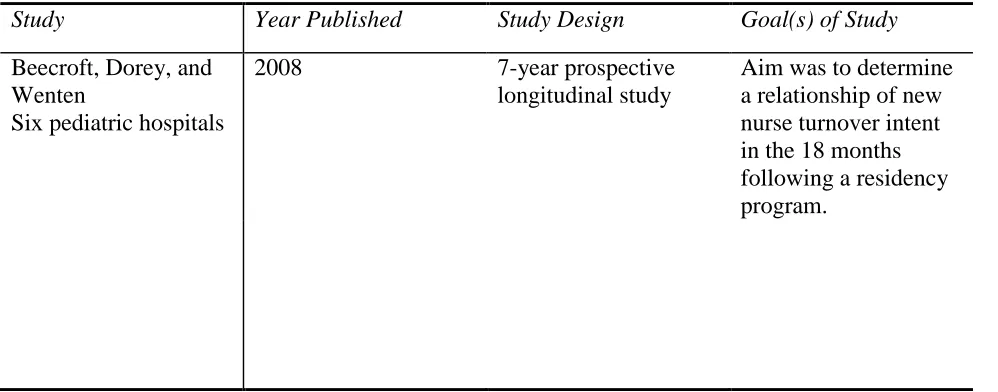
Of approximately 253 citations identified in the initial search, eight were selected for full retrieval. All eight of the studies that were selected evaluated the effectiveness of transition to practice programs for newly licensed RNs (Table 1).
Table 1
Description of Studies Included in the Systematic Review
Study Year Published Study Design Goal(s) of Study
Beecroft, Dorey, and Wenten
Six pediatric hospitals
2008 7-year prospective longitudinal study
Goode, Lynn, and McElroy University Health System Consortium/American Association of
Colleges of Nursing.
2013 Descriptive case study Year long hospital residency; post-baccalaureate. Residents demonstrated
improvement in skills and competencies. Improved comfort with intra and inter-professional care team members. Stress scores decreased. Turnover rates decreased. Kowalski & Cross 2010 Descriptive Case
Study
Report preliminary findings on new nurse graduates participating in a year-long
residency program at 2 hospitals in Las
Vegas, NV Trepanier, Early,
Ulrich, and Cherry Multi-site health care corporation in the southwest United States. Study conducted in 15 community based hospitals.
2012 Descriptive case study A new graduate residency program was associated with a decrease in the 12-month turnover rate from 36.8% pre-residency to 6.41% post-residency. Evaluation also demonstrated a decrease in contract labor usage
Ulrich et al.
Versant RN Residency Program
2010 10 year longitudinal study
Demonstrated an accelerated increase in competence,
Marshburn, Engelke, and Swanson
775-bed tertiary care academic medical center
2009 Descriptive
correlational design
Compared new nurses performance based measurements to their perceptions of clinical competence. Provides information that suggests transition programs may be important to fill gaps in new nurses’ perception and actual performance that could lead to patient safety issues.
Williams, Goode, Kresk, Bednash, and Lynn
1-year outcomes of hospital residency program jointly developed by the University Health-System Consortium and the American Colleges of Nursing (AACN). 12 sites across the U.S.
2007 Longitudinal, descriptive study
This study showed a V shaped pattern of high scores at entry to the program, a decline at 6 months, and return to higher scores at 12 months that may depict the reality shock described by Kramer (1974).
Kowalski & Cross, 2 hospitals in Las Vegas, NV
2010 Descriptive Case Study
Study showed improved clinical competencies throughout the
yearlong program with improved leadership skills. The first year retention rate was 78% Roth & Johnson,
Acute care hospitals in North Carolina, Phase I
2011 Longitudinal design Study found that the quality of the
preceptor-new graduate nurse relationship was key in increasing the new nurse’s self-reported competence. Higher self-reported
The primary outcomes of studies are presented in Table 2. Table 2
Primary Outcomes of Studies
Study Primary Outcomes
Williams Descriptive data from this study suggests that the dynamics of what occurs over time within a residency program is complex. Reports a V pattern of residents’
perception via survey that show high scores at entry to the program, a decline at 6 months and return to higher scores at 12 months that may depict the reality shock described by Kramer (1974).
Beecroft When new graduate RNs were satisfied with their jobs and felt committed to the organization, their retention was high.
Goode Year-long hospital postbaccalaureate program. Residents demonstrated improvements in skills and competencies.
Marshburn Compared new nurses performance based on measurements to their perceptions of clinical competence. Suggests that transition programs may be important to fill gaps in new nurses’ perceptions and actual performance that could lead to
improvement in patient safety issues.
Kowalski Findings indicate improved clinical competency throughout the program and an increase in leadership and communication skills. This year-long residency
program’s retention rate was 78% for the first cohort.
Ulrich Demonstrated an accelerated increase in competence, confidence, and leadership. Study reported a significant decrease in turnover rates.
Roth Findings showed that the quality of preceptor-new graduate nurse relationship was key in increasing the new nurse’s self-reported competence. Higher
self-reported competence scores correlated with fewer practice errors at 4 and 6 months respectively.
Trepanier A new graduate residency program was associated with a decrease in the 12-month turnover rate from 36.8% pre-residency to 6.41% post-residency. This study also demonstrated a decrease in contract labor usage.
Discussion
All of the studies in this review used convenience samples and examined slightly different concepts within transition to practice (residency) programs. The purpose of all of these programs is to bridge the student to professional gap. The programs described in these studies included classroom days with additional clinical support in the form of preceptorships. Most of the
programs in this review were hospital based and varied in length from 18 weeks to 12 months so that they are not generalizable to transition to practice programs in ambulatory care settings that reflect academic practice partnerships and a shorter transition program length.
Of the eight studies reviewed (Marshburn, 2009; Trepanier, 2012; Beecroft, 2007; Goode, 2009; Ulrich, 2010; Williams, 2007; Kowalski & Cross, 2010; Roth, 2011) critical thinking, skill acquisition, increased knowledge, confidence and resident satisfaction are all discussed as
development of competent and confident new graduate nurses as a major challenge and reports on a previously failed new graduate internship at the Children’s Hospital in 1999. From this the Versant RN residency was born. Ulrich et al. (2010) analyzed the Versant and found a positive effect on nursing competencies, job satisfaction, self-confidence, inter-professional relationships and turnover rates. Beecroft et al. (2008) also found that higher scores on work environment and organizational satisfaction decreased the likelihood that new nursing graduates would be in the group that signified intended turnover. Ulrich (2010) also found that lower turnover rate was associated with organizations that had experience in running transition programs.
Williams et al. (2007) used the Casey-Fink Graduate Nurse Experience Survey (CFGNES) as a measure to assess the residents’ experience in a postbaccalaureate residency program. Findings in this study were expected increases in the ability to organize and prioritize care,
communication, leadership, professional satisfaction and support. Results from the CFGNES stress scale demonstrated a significant reduction in stress from the beginning to the end of the program. Marshburn, Engelke, & Swanson (2009) examined the relationship between new nursing graduates’ perceptions of clinical performance and actual performance-based measurements. The CFGNES was used in this study to measure clinical competence. Study results showed a significant relationship between previous experience and problem management. Nurses who had previous experience as nursing assistants, licensed practical nurses, nurse
give further credence to the importance of implementing and evaluating transition to practice programs in all settings.
Six of the eight studies reviewed found that having a transition program resulted in a cost-benefit for the hospital due to decreased turnover of nursing staff. Trepanier et al. (2012) described increased organizational commitment that is reflected in a 12-month turnover rate across 15 hospitals that improved from a mean of 36.8% pre-residency program to a mean of 6.41% post residency. The findings of this study also show that the costs for contract labor declined following a residency program. Kowalski & Cross (2010) also found that year-long nurse residency programs were instrumental in decreasing costs associated with nursing turnover in new graduates. They also found improved clinical competency throughout the year-long program, decreased stress levels, and improved communication and leadership skills.
Goode et al. (2013) examined outcomes from 10 years of research on a post-baccalaureate nurse residency program. Participating hospitals reported improved retention rates for new nurse graduates in residency programs. The study also confirmed residents’ improved perception of
their ability to organize and prioritize their work, communicate, and provide clinical leadership. Many of the studies revealed a trend for residents to start their programs with relatively high
self-perceptions with a significant dip at 6 months in residents’ self perceptions of support and professional satisfaction followed by a significant increase between the mid point and the end of the program.
and 6 months. According to Roth and Johnson (2011) preceptor support for new nurse graduates will promote safe patient care and also help to address nursing staff turnover rates.
The results of this systematic review are consistent with evidence that suggests that transition-to-practice (nurse residency) programs should be implemented in all health care settings for newly licensed RNs. This project will provide information about a
transition-to-practice (nurse residency) practice program that is focused on ambulatory care settings that will arm new RNs with the necessary knowledge and skills to provide safe, effective, and appropriate patient care within the community. Development of
transition-to-practice (nurse residency) programs in diverse ambulatory care settings within the community is an important strategy for redesigning practice environments to improve patient outcomes.
Conceptual/Theoretical Framework
The Dreyfus Model of Skill Acquisition is an applicable conceptual model in the examination of transition to practice programs for newly licensed RNs in ambulatory care setting because this framework acknowledges a perspective that describes skill acquisition and articulation of knowledge embedded in expert nursing practice (Benner, 2004). The Dreyfus model describes how students acquire skills through formal instruction. It was developed by Stuart E. Dreyfus and Hubert L. Dreyfus a mathematician, and a systems analyst respectively and is based on the study of ways that students acquire skills through formal instruction and practice.
The original study Dreyfus (1980) looked at highly skilled practitioners including commercial airline pilots and world-renowned chess masters to investigate the nature of
simulation model of instruction could produce highly skilled emergency response behavior because experience gained in this way most effectively led to knowledge acquisition (Benner, 1984, Dreyfus, 1979) This research demonstrated changes in response that occur as knowledge is gained.
More skills are not just gained; rather fundamental differences are experienced in how the world is perceived. External factors that either help performance or hinder it change as well. The Dreyfus model describes how and why abilities, attitudes, and perspectives change according to skill level. According to the model it is important to consider that learners are neither novice nor expert at all things; rather they are at one of these stages in some particular skill domain. The original model proposes that a learner passes through five distinct stages of skill acquisition as follows: novice, advanced beginner, competent, proficient, and expert (Dreyfus & Dreyfus, 1980).
The Dreyfus model has illustrated ongoing research on skill acquisition and articulation of knowledge that is embedded in expert practice in nursing. It is a unique tool that Benner (1982) applied to nursing to interpret practice and to develop guidelines for knowledge and career development in clinical nursing practice (Benner, 1984).
situations to note the recurrent, meaningful situational components that are aspects of a specific situation. However they are still unable to differentiate importance of actions (Benner, 1982) In the second stage a newly licensed RN is usually struck by the fact that he or she now has full legal and professional responsibility for patients. Advanced beginners are still governed by the rules that they have learned and are only able to take in a little of the situation at hand. The third stage is reflected by a nurse who has two or three years of experience and is able to view his or her actions in terms of long range goals utilizing more analytical and abstract ways of thinking. The fourth stage is proficient and at this stage the nurse perceives the situation as a whole rather than just in terms of aspects. Experience has taught the proficient nurse what to expect in a given situation and how to modify plans in response to events that occur. The last stage is that of expert who has an extensive background of experience with an intuitive grasp of the situation. This level of proficiency is characterized by knowing what is possible in a given clinical situation and is very useful in expanding the scope of practice of nurses who are less proficient. Experience as it is understood in this context does not just reflect the passage of time as a nurse; it is the
refinement of theory and preconception through encountering unique patient situations that add nuances to the theory (Benner, 1982).
improving their competencies. Skill acquisition and individual practices are integral to Benner’s model and its broad perspective serves as an appropriate framework for this project.
Methods
Ethical Issues
It is not anticipated that there will be any risk to patients associated with this project. This project represents an effort to increase the skills and competencies of newly licensed RNs that will lead to improved patient outcomes. New RN graduates in this project are transitioning into practice in ambulatory care settings within the community. Kramer (1974) provided the most significant research on the experience of transition to practice that described large discrepancies between what new graduates understand about nursing from their education and what they experience in actual health settings. This reflects an important ethical issue that the nursing profession has a responsibility to provide support to newly licensed RNs as they transition into professional practice (Mariani, 2012, Duscher, 2008, Hoffart, 2011). Despite many years of effort to ease the transition for new nurses there is still no standardized model to address this need. Moreover there is a need to establish best practices to ensure increased quality of care (Spector& Echternacht, 2010).
in the community with patients and families in situations that are often undetermined, and changing (Benner et al. 2010).
Justice is the ethical principle that relates to fair, equitable, and appropriate treatment (Burkhardt & Nathaniel, 2013). Following Kramer (1974) there have been only a few studies reporting on the new graduate nurse employment experience beyond the initial orientation period (Mariani, 2012). It is important to understand the experiences of the new RN graduate so that effective strategies can be developed to provide a consistent transition from newly licensed RN to qualified nursing professional. Nursing care is predicted to occur less in traditional hospital settings in the near future; therefore it is important to expand transition to practice programs outside of acute care settings. Community-based programs will prepare new nurses for
successful practice in ambulatory care who will then be ready for the expected transformation of nursing care into the community.
Setting
The setting for the USF RN transition-to-practice program is the USF School of Nursing and Health Sciences and various ambulatory care sites. The program is offered in conjunction with academic practice partners within the community. Academic practice partnerships provide an effective way to strengthen nursing practice in order to lead change and advance health. There is a continued effort within the partnership to address the IOM recommendations for the future of nursing as well as a commitment to work together to provide an evidence based transition to practice program that is both sustainable and cost-effective (Beal et al., 2012).
home health, hospice, and ambulatory care clinics, school nursing, transitional care programs, public health programs, and pediatric clinics. Program participants are selected by application and must be licensed RNs who are either unemployed or under-employed who have graduated from an accredited nursing program within the past two years. Participants all have less than 12 months of practice experience.
Newly Licensed RNs Learning Needs and Transition Experiences
The USF program promotes the professional development of the newly licensed RN and strives to meet their learning needs to enhance their transition experience. The program has also provided support and healing to the new RNs who are experiencing symptoms of anxiety, low self esteem, sadness, and grief related to high unemployment rates. When asked to share their experiences as newly licensed RNs, the participants reported feeling both confident and fearful. Recognition of all that they had learned in their nursing programs along with fear of the
unknown in patient situations comprised these conflicting emotions. Nurses in transition-to-practice (nurse residency) programs express commitment to successfully transitioning into practice (Dyess & Sherman, 2009). The most important evidence for the implementation of transition-to-practice (nurse residency) programs for newly licensed RNs comes from their own statements. One new graduate said: “I am frightened for my patient and for my license” (Spector & Echternacht, 2010). Others have reported panic and dread, are overwhelmed by the number of tasks required to care for an acutely ill patient and fear that they may harm the patient (Dracup & Morris, 2007).
for specific patient experiences. This recommendation for a longer length of support is consistent with the theoretical stage of acquiring clinical competence and acknowledges that novice nurses or advanced beginners do not have a clear understanding of the brand-new situations in which they are expected to perform (Benner, 1984; Dyess & Sherman, 2009).
Institutional Review
This project has been found to meet the guidelines for an Evidence-Based Change in Practice Project and is exempt from Institutional Review Board review (see appendix C).
Planning the Intervention
The present USF transition-to-practice (nurse residency) program in ambulatory care settings was envisioned as an expansion of residency programs for new graduate RNs throughout
California. It was also expanded from the initial USF program that included school nursing and clinic consortium placements. The mission of the program is to promote professional role development of newly licensed RNs to work as advanced beginners in diverse ambulatory care settings. Prior to the inception of the program a detailed proposal was created to provide direction for the program. As part of the appraisal process this plan contained program details and explored the financial feasibility of the program.
Options
Option #2 included the creation of a transition to practice program in ambulatory care settings that was comprised of diverse settings as previously described. The benefits of this option
include the creation of a younger work force of RNs that will fill the impending gap in community health settings.
Option #3 included developing a more intensive program for preceptor training and further expansion of the program as a post-baccalaureate course.
Cost-Benefit analysis
Continuous declines in cost reimbursement have created financial instability in today’s healthcare environment. This has contributed to the decrease in new RN graduate hiring and orientation during the onboarding period. Conversely this has occurred at a time when there is increased patient acuity and complex technology. For newly licensed RNs who make up approximately 10% of the workforce in acute care settings this extra burden suggests the need for residency programs that will successfully transition them into the RN role (Trepanier, Early, Ulrich, & Cherry, 2010). While there is scant literature on the cost benefit of transition-to-practice (nurse residency) programs, a recent study found a positive economic outcome in 15 community hospitals across the nation (Trepanier et al., 2010). Findings from this study demonstrated a decrease in a 12-month turnover rate from 36.08% to 6.41% and a significant reduction in contract labor usage (Trepanier et al., 2010).
experience in community settings that will benefit patients and also provide a bridge for new graduates to more effectively transition into ambulatory care settings. To date this program has been funded by grants. Due to the generosity of grantors, participants are eligible to receive a small stipend of $500.00 following successful completion of the program. This is an important incentive for attaining the required clinical hours. Partner agencies also receive an honorarium for participation to help defray some of the agency costs.
Market and competition analysis
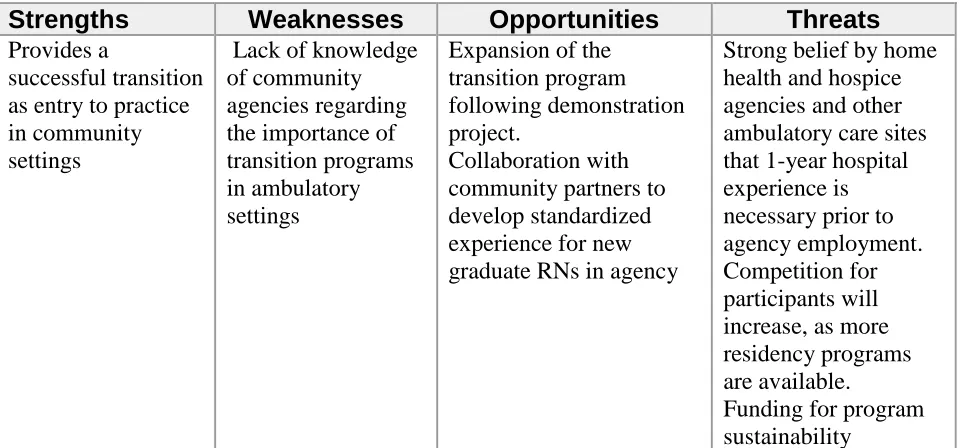
As part of the strategic plan a thorough analysis of the strengths, weaknesses, opportunities, and threats (SWOT analysis) associated with the project was conducted. Identification of SWOTs was essential to identify both internal and external aspects that will either positively or negatively affect the project (Harris, Roussel, Walters, & Dearman, 2011). SWOT is also an important planning strategy for achievement of selected objectives may be derived from SWOT.
Table 3
SWOT Analysis
Strengths Weaknesses Opportunities Threats
Provides a
successful transition as entry to practice in community settings
Lack of knowledge of community agencies regarding the importance of transition programs in ambulatory settings
Expansion of the transition program following demonstration project.
Collaboration with community partners to develop standardized experience for new graduate RNs in agency
Strong belief by home health and hospice agencies and other ambulatory care sites that 1-year hospital experience is necessary prior to agency employment. Competition for participants will increase, as more residency programs are available.
Strengths Weaknesses Opportunities Threats
Program will fill a gap as newly graduated RNs currently have fewer job opportunities No standardized preceptor experience for participants. Decreased productivity of preceptor in agency during transition program
Process for completion of waiver is streamlined for participating home health agencies
Inability to obtain waiver from
Department of Public Health for 1-year experience for home health placements
Program assists in the prevention of a potential nursing shortage.
Ongoing funding for the program is uncertain.
Obtain grant funding to continue program that will allow for increase in stipend received by participants. Program will become
post-baccalaureate and newly licensed RNs may earn MSN credit for
completing a graduate level project.
Worldview of community partners reflects lack of understanding of potential nursing shortage.
Participants’ ability to sustain themselves financially over course of program.
Prepares new graduates for home health nurse as entry to practice
Lack of formalized preceptor training
Formalization and standardization of preceptor training program
Lack of nurses who are willing to precept new grads
Program is in line with IOM recommendations that nursing residency programs should be implemented
As a result of the economy,
employers are not budgeting for transition programs
Return on investment (ROI) will reflect a younger work force that can meet the health care needs of the population in community setting
ROI will not be realized
Implementation/Program Design
didactic segments are supported by web-based assignments and group work. Two cohorts of participants completed the program in 2012. A third cohort began in August 2013. The
conceptual framework of the program was designed to reflect the unique domain of ambulatory care nursing and the scope and standards of practice for professional ambulatory care (Baker-Laughlin, 2013). It is also focused on competencies that include patient safety and outcomes. The curriculum is structured to enhance the new graduate’s knowledge of quality and safety competencies as outlined by QSEN. Other core competencies include patient care and inter-professional collaboration, inter-professional role development, management of patient care, ethics, and end-of-life care. An important curriculum assignment includes a requirement to complete a Quality Improvement project individually or as part of a team at the participants’ respective clinical sites. This evidence-based project provides a way to get staff involved in evidence-based practice and can serve as a catalyst for transforming clinical practice areas. Faculty from USF teach the didactic and simulation portions of the course while each newly licensed RN is assigned a preceptor at their respective community agency for the clinical portion of their experience. The following reflects the planning schedule for the USF Transition-to-Practice Program for newly licensed RNs and for the present DNP project.
Table 4
Timeline
November 2011 Contact and secure community partners for program. Complete curriculum design with input from Advisory committee.
conclusion of the program.
January 2012 Meet with California Department of Public Health to develop protocol for waiver for 1-year hospital experience requirement for home health
agencies. Accept applications for the program.
February 2012 Review applications and in conjunction with community partners conduct applicant interviews. Secure program faculty to include DNP students.
March 2012 Notify applicants of acceptance into program.
April 2012 Transition program begins.
August 2012 Complete program evaluation for 1st cohort.
Planning the Study of the Intervention
The success of previous transition programs as measured by the participant’s self-assessment
and preceptor evaluation, suggests that new graduate programs in ambulatory care settings have a valuable and important place in the transition from classroom to clinical practice and from novice nurse to qualified nursing professional. Evaluation data used to demonstrate the success that USF’s Transition-to-Practice Program in Ambulatory Care Settings for newly licensed RNs will show the intended goals of increasing new graduates’ skills, clinical competence, and confidence thus improving their employability and optimizing patient outcomes. Data from the Quality and Safety Education for Nurses competency assessment tool and from the Casey-Fink Graduate Nurse Experience Surveywill be compared within groups and between groups in order to evaluate the program.
Participants
The present project is comprised of newly licensed RNs enrolled in the USF
transition-to-practice program in two cohorts during 2012. The application process for the USF RN Transition-to-Practice program requires that each applicant (a) submit a copy of their resume (including GPA for nursing major), along with a completed application that includes nursing positions that they have held since graduation, and any healthcare related volunteer experiences; (b) describe what ambulatory care nursing means to them in the following settings: home health, clinic, or school nursing and how working in any of these areas will contribute to their
professional development; (c) delineate at lease one learning outcome that will be achieved from working in an ambulatory care clinical setting; (d) discuss any restrictions for participation to include work/schedule conflicts, transportation, lack of health insurance etc. and; (e) submit a copy of their RN license CPR card, and if applicable Public Health Nurse Certificate (PHN). Applicants are also required to describe their efforts to obtain employment since graduation and to list any other degrees outside of nursing. There were at least three qualified applicants for each program slot.
Following acceptance into the USF RN Transition-to-Practice program, applicants are required to submit the following:
Pre-clinical requirements as outlined by individual clinical agency to include proof of malpractice insurance (provided through USF program)
$100 non-refundable processing fee to USF.
Applications are sorted into a spreadsheet to facilitate review by specific clinical agencies, and then interviews are conducted by the clinical agencies for participant selection. No tuition is charged for participation in the program, and clinical placements within the program are not paid positions. A $500 stipend is awarded at the end of the program to all participants who complete the required 320 clinical hours. (see Appendix C for USF RN resident program in ambulatory care settings application form).
Methods of Evaluation
Data for program evaluation is comprised of the following metrics:
Quality and Safety Education for Nurses (QSEN)
Casey-Fink Graduate Nurse Experience Survey (CFGNES)
First Employer Survey
Employment Tracking
The QSEN Competency Assessment Tool evaluates the development of the participants’ competencies in the following areas both pre and post program: patient-centered care, communication, safety, informatics, evidence-based practice, teamwork and collaboration, professionalism and quality. Specific measures in each of these categories are measured throughout the program in the clinical and classrooms setting.
The CFGNES measures participant confidence pre and post program. Data are collected online at the beginning and upon completion of the program
Employment Tracking is utilized to measure new graduate RN employment attainment and turnover rates. A follow-up survey is sent to employers after one year of employment of the transition RN. As shown in the table below the evaluation tools utilized in the program are aligned with the goals of the program.
Table 4
Standard Evaluation Goals and Tool
Program Goal Tool for Measurement
Build confidence Casey-Fink Graduate Nurse Experience Survey Build competence Brief Competency Assessment Tool (QSEN)
based
Effective transition to the workforce RN Transition Program Survey to 1st
employers of program graduates
Decrease new graduate RN turnover Follow-up survey with 1st employers of program graduates after 1 year of employment
The present project used data collected from survey tools that were identified based on recommendations from a California RN Transition Advisory Board Committee lead by the CINHC and representing nursing leaders and Transition Program coordinators. These
4-point balanced response format, or “yes” or “no” answers to a series of stressors. The non-stress items address the newly licensed RNs professional comfort, expectations and level of support. The items in section three relate to satisfaction with their clinical site, and the items in section four and five are demographic and also include open-ended questions that allow the transition RN to express their impressions of their experiences (Casey, Fink, Krugman, & Propst, 2004). Permission was obtained to use the Casey-Fink Graduate Nurse Experience Survey. Competence of the program participants is measured using the New Graduate RN Transition Program Competency assessment tool that was created by the RN Transition Program Advisory Board (see Appendix E). This competency tool is based on the six Quality and Safety Education for Nurses (QSEN) competencies: patient-centered care, teamwork and collaboration, evidence based practice, quality improvement, safety, and informatics. The Lasater Clinical Judgment Rubric was used as a model for scoring the QSEN based competency assessment tool to rate the transition RN as beginning, developing, or accomplished (see Appendix F). The evaluation scale was tabulated as following Beginning competence = 1; developing competence = 2;
accomplished competence = 3, and not applicable was coded as a 0. The long form of the QSEN evaluation is also provided to preceptors to use as a reference when completing the brief form for their transition RN. Employment tracking is also used as a measure to evaluate the success of the program and will be discussed for the two cohorts in 2012.
Analysis
RNs felt uncomfortable performing the highest percentage were blood draws (venipuncture) at 38.9%, electrocardiogram (EKG, ECG) monitoring and interpretation at 27.9% and intravenous (IV) starts at 33.3%. Sixty percent of the newly licensed RNs indicated that they were
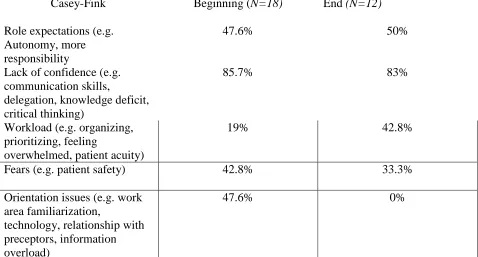
experiencing stress in their personal lives with 90% reporting that the personal stress was caused by finances. The following table shows role transition difficulties that were experienced by the respondents.
Table 5
Role Transition Spring Cohort 2012
Casey-Fink Beginning (N=15) End (N=10)
Role expectations (e.g. Autonomy, more responsibility)
28.6% 42.8%
Lack of confidence (e.g. communication skills,
delegation, knowledge deficit, critical thinking)
71.4% 57.1%
Workload (e.g. organizing, prioritizing, feeling
overwhelmed, patient acuity)
21.4% 14.3%
Fears (e.g. patient safety) 35.7% 28.6% Orientation issues (e.g. work
area familiarization,
technology, relationship with preceptors, information overload)
Table 6
Role Transition Fall Cohort 2012
Casey-Fink Beginning (N=18) End (N=12)
Role expectations (e.g. Autonomy, more responsibility
47.6% 50%
Lack of confidence (e.g. communication skills,
delegation, knowledge deficit, critical thinking)
85.7% 83%
Workload (e.g. organizing, prioritizing, feeling
overwhelmed, patient acuity)
19% 42.8%
Fears (e.g. patient safety) 42.8% 33.3% Orientation issues (e.g. work
area familiarization,
technology, relationship with preceptors, information overload)
47.6% 0%
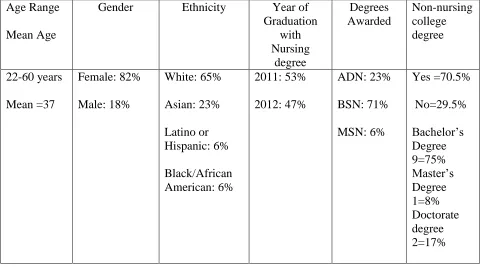
Table 7
Demographic Data for Casey-Fink New Graduate Nurse Experience Survey: Spring (N =15)
Age Range Mean Age
Gender Ethnicity Year of Graduation with Nursing degree Degrees Awarded Non-nursing college degree 25-54 years Mean=39 Female: 93% Male: 7%
White: 66% Asian: 20% Latino or Hispanic: 7% 2009: 6% 2010: 42% 2011: 52% ADN: 40% BSN: 45% MSN: 15% Yes 12=80% No 3=20% Bachelor’s Degree 10=83% Associate Arts Degree 2=17% Table 8
Demographic Data for Casey-Fink Nurse Experience Survey: Fall (N=17)
Age Range Mean Age
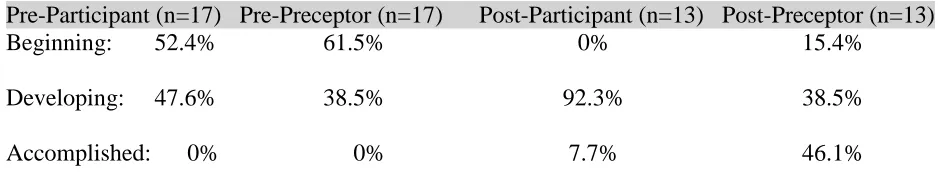
The pre and post overall competence results from the QSEN participant and preceptor surveys are shown below for the two 2012 cohorts.
Table 9
Overall Clinical Competence: Spring 2012
Pre-participant (n=15) Pre-Preceptor (n=9) Post-participant (n=9) Post-preceptor (n=8) Beginning: 0% 0% Beginning: 0% 0%
Developing: 0% 0% Developing: 83.4% 75% Accomplished:0% 0% Accomplished: 16.6% 25% Pre-program clinical competence is not measured for the Spring 2012 cohort as neither participants nor preceptors completed the portion of the QSEN related to overall competence. Post program clinical competence levels however are reflected in Table 9.
Table 10
Overall Clinical Competence Fall 2012
Pre-Participant (n=17) Pre-Preceptor (n=17) Post-Participant (n=13) Post-Preceptor (n=13) Beginning: 52.4% 61.5% 0% 15.4%
Developing: 47.6% 38.5% 92.3% 38.5% Accomplished: 0% 0% 7.7% 46.1%
findings from the 2012 cohorts showed increased confidence and competencies in the participants.
Results
Program Evaluation/Outcomes
Evaluation data reflects that the program is making a difference in how newly licensed RNs are transitioned into practice as follows:
Employment results
An employment-tracking log is maintained by the program director to collect
information from RN participants as they accept jobs. This tool allows for employment tracking and also provides retention data in order to follow the transition RNs employment over a period of two years. As of November 2012, 14 out of 15 (93%) of the participants in the spring cohort had gained employment; nine of the 13 had secured full-time employment and five were
employed part-time. Each of the part-time positions was greater than 20 hours per week. Five of the participants were hired by their clinical agency while the others obtained crossover
employment as a result of the program. Eighty percent of the respondents reported that the USF Transition-to-Practice program was a factor in their ability to obtain employment. They reported an increased level of confidence with the interview process as well as feeling supported and immersed in the role of a nurse. The second cohort also demonstrated successful employment results with 15 out of 17 (88%) becoming employed within 3 months of the end of the program. All but two of these transition RNs obtained full-time employment. Five (29%) of the
Confidence results
Overall the results of the CFGNES survey for both cohorts showed an increase in participant confidence. From the beginning of the program to the end, new graduate RNs reported that they felt more confident as shown by their accord with the following:
Confidence communicating with physicians
Comfortable knowing what to do for a dying patient
Comfortable delegating tasks to support staff
I feel at ease asking for help from other RNs in my work area
I feel staff is available to me during new situations and procedures
I have opportunities to practice skills and procedures more than once
I am able to complete my patient care assignment on time
I feel the expectations of me in this job are realistic
I feel prepared to complete my job responsibilities
My preceptor is helping me to develop confidence in my practice
Participant agreement with the following statements decreased from the beginning to the end of the program:
I am having difficulty prioritizing patient care needs
I feel overwhelmed by my patient care responsibilities and workload
Competence results
those skills from “beginner” to “developing.” The progression of these competencies is in line with Benner’s model from novice to expert.
The goal of the USF RN Transition-to-Practice program is to retain new graduates in the nursing workforce so that they are able to fill current and future positions when the demand increases. A significant aim of the program is to keep new graduates engaged in nursing practice while improving their skills and competencies that will also improve patient care. Program evaluation and data gathering also provide a means to demonstrate that transition to practice (residency) programs should become a part of nursing education that is ongoing. Collaboration with academic practice partners and other programs will also allow for the development of best practices.
Providing an effective transition to practice for newly licensed RNs in unique ambulatory care settings will also assist in dispelling the myth that new grads must have 1-year acute care
experience prior to working in an ambulatory care setting. At a very fundamental level nursing is broader than the hospital. Transition to practice (residency) programs are designed to provide improvement in nursing education that provides experiential learning that is necessary to prepare new nursing graduates to meet emerging health care needs in community settings (Spector & Echternacht, 2010).
Discussion
Summary
they have a broader view of the professional role of a nurse outside of the hospital. Many also report that community based nursing is a good fit for them. Opportunities for new nursing graduates in community settings can influence evolution of nursing practice in a positive way. Traditionally newly licensed RNs have spent at least a year in the acute care environment; the USF program is transforming that practice model for newly licensed RNs in a way that also addresses the needs of patients in the community. Organizational transformation is also seen in clinical settings as staff becomes more engaged in research, evidence based practice and quality improvement while guiding the new graduate RN through new learning experiences to meet the program objectives.
Comprehensive transition programs are also associated with improved retention rates among new graduate nurses. While the literature reports turnover rates of 35% to 60% during the first year of practice, these statistics may be skewed as they include turnover rates within an
institution and generally only reflect acute care settings. However it is likely that these statistics are also representative of high turnover rates for new graduates in all settings (Pine & Tart, 2007; Halfer, Graf & Sullivan, 2008; Williams et al., 2007; Spector & Echternacht, 2010). Retention rates also have implications for patient safety related to lack of familiarity with the patient population and with the clinical site itself. These two issues are cited as reasons for near misses by newly licensed RNs (Spector & Echternacht, 2010).
settings that can assist in the development of new care delivery models that are necessary for the evolution of nursing practice.
Relation to Other Evidence
The importance of having an adequate supply of RNs in the U.S. workforce is critical to ensuring a safe, effective health care system (Budden, Zhong, Moulton, & Cimiotti, 2013). Currently there is no standardized transition into practice for newly licensed nurses. This has several implications that include the current job shortage that is occurring in some areas of the country, high turnover rates for new graduates, and patient safety issues (Spector & Echternacht, 2010). There has been much written about the need for ongoing support for new RNs during their first year of practice. New nursing graduates are expected to become adept at a wide range of skills while learning to understand the world of professional nursing. They must learn to function within a team of other health care providers while also utilizing evidence based practice to care for patients (Goode et al., 2009; Pine & Tart, 2007; Spector & Echternacht, 2010).
While 60% of all RNs in the U.S. currently practice in hospital settings (Health Resources and Services Administration, 2010), that percentage is likely to decrease related to healthcare reform, technological innovations, and the need for community based care that is both innovative and cost effective. The fastest growing sector will be in ambulatory care settings. With the growing numbers of older adults with co-morbidities, patient acuity is also likely to increase. To meet the needs of this growing population there is a need to prepare and inspire nurses to practice in nontraditional work environments.
Health care reform is also significantly altering the landscape of practice that is also creating a need to keep patients out of the acute care setting while managing their health within the
settings is no longer a current model and inhibits emerging community based models that are the future of healthcare. There is also a need for nursing education to respond to the changes in health care delivery.
Evidence suggests that new graduate transition programs result in improved levels of
retention and increased competency in new graduate nurses (Spector & Echternacht, 2010; Rush et al., 2012). The USF program was designed as an academic practice partnership that fosters immersion into the RN role, lifelong learning, and ongoing support by a preceptor. These
partnerships are also essential to transforming health care and advancing nursing education (Beal et al., 2012). Through achievement of its goals the USF transition-to-practice program has highlighted the relevance of community opportunities and potential career trajectories for new graduate RNs.
Barriers to Implementation/Limitations
The initial USF program was launched as an evaluation project. As the program has expanded a structured plan for data collection is needed to optimize dissemination of information from the program. Data collection has proven difficult at some points. An issue that has persisted through the 2012 cohorts is the willingness of the transition RNs to participate in data collection. At the beginning of each cohort 100% completed both the Casey-Fink and QSEN surveys. This
structured plan for data collection and analysis to optimize information gained and to minimize data loss.
Regulatory issues
The CDPH requires that RNs employed in licensed home health agencies (HHAs) have one-year previous professional nursing experience. Initially this was a barrier for the program as home health agencies were reluctant to participate for fear that they would not be able to hire a transition RN upon completion of the program as the new graduate would not meet the1-year requirement. USF and the CINHC obtained a flexible waiver plan from the CDPH that allows for hire as long as certain requirements are met. Home health agencies are required to document: (a) individuals’ previous nursing experience or participation in a new RN transition program, (b) documentation of the HHAs orientation, (c) documentation of competency evaluations and training/skill assessments, (d) documentation of the monitoring plan for the new RN, and (e) documentation regarding the quality assurance and assessment review process (California Department of Public Health, 2012). The USF program coordinator assisted practice sites with the process in order to assure that all of the requirements had been met. Thus this limitation to the program was eliminated.
Time Line/funding
The USF program is completing its last cohort that will end in January 2014. The goal is to continue this program and expand access to the program. However the approximate cost of the program is $3000 - $4500 per participant that to date has been generously funded by
Interpretation/Nursing Implications
Providing support for newly licensed nurses is recognized as a necessity in today’s fast paced
health care world (Dyess & Parker, 2012; Spector & Echternacht, 2010). Successful transition programs can contribute to a return on investment through cost savings that are achieved with retention, and improved reimbursements based on patient safety measures and quality care (Dyess & Parker, 2012). Moreover getting nurses employed during this current economic climate also contributes to cost savings while keeping new RNs engaged in the profession.
A lack of sufficient support to transition newly licensed RNs into practice will impact the patient safety and outcomes in all healthcare settings. The program described in the present project will add to the body of nursing knowledge regarding the importance of transition to practice programs that are focused on ambulatory care. It also strengthens the understanding that there is a need for innovative programs that will support new graduate RNs as they transition into professional practice that will meet the needs of our changing health care world. A significant aim of the program is to keep new graduates engaged in nursing practice while improving their skills and competencies that will also improve patient care. Program evaluation and data analysis also provide a means to demonstrate that transition to practice (residency) programs should become a part of nursing education that is ongoing. Collaboration with academic practice partners and other programs will also allow for the development of best practices.