RESEARCH ARTICLE
Open Access Full Text Article
Efficient use of acetone extractive of
Oroxylum indicum
for
the improvement of quality of silk in silkworm Bombyx mori
(L.) (Race: PM x CSR2)
Vitthalrao B. Khyade, Abhilasha C. Bhunje
Agriculture Development Trust, Shardanagar, Malegaon (Baramati) Dist. Pune – 413115, India.
*For correspondence: [email protected]
Article Info: Received 11 Nov 2015; Revised: 24 Dec 2015; Accepted 28 Dec 2015.
ABSTRACT
The present study was undertaken to study the influence of acetone extractive of bark of Oroxylum indicum
on the cocoon characters; silk filament characters and esterase enzyme activity of silk worm Bombyx mori
(L.) (Race: PM x CSR2). The soxhletation was followed for the obtaining acetone extractive of bark of
Oroxylum indicum (L). Three concentrations (5ppm; 10ppm and 20ppm) of extractive were prepared. The fifth instar larvae were utilized for the experimentation. Soon after the fourth moult, the fifth instar larvae were grouped into five groups (each with hundred individuals) ( Untreated control; Acetone treated control;
5ppm extractive; 10ppm extractive and 20ppm extractive). Ten microliters of each concentration of extractives were topically applied to respective group to the individual larva at 48 hours after the fourth moult. The larvae were maintained through standard schedule. Ten larvae from each group were utilized for analysis of electrophoretic esterase pattern on fifth day. The silk worms were sacrificed, haemolymph and silk gland samples were isolated and analyzed by using 7.5% of native gel electrophoresis. Acetone extractives of
O.indicum at 5 ppm, 10 ppm and 20 ppm concentrations recorded maximum cocoon weight (1.95,1.84,1.76
gm), shell weight (0.40, 0.35, 0.33gm), pupal weight (1.55, 1.49,1.43). All concentrations of the bark extract of
O.indicum recorded higher cocoon, shell, and pupal weight than the control (untreated and acetone treated).
There was a gradual increase in the silk yield with an increase in the concentrations of bark extracts O.
indicum from 5 ppm, 10 ppm and 20 ppm concentration of Oroxylum indicum (L). Efficient use of acetone
extractives of Oroxylum indicum (L) may open a new avenue in the silk yield.
Keywords: Bombyx mori, Esterases, Native gel electrophoresis, Oroxylum indicum and Silk yield.
1.
INTRODUCTION
The Indian subcontinent is considered to be a rich emporium of medicinal plants in the world. Nature has provided an impressive number of drugs which -
has been isolated from the medicinal plants. Many of the medicinal plants are known to possess a wide range of medicinal properties such as antibacterial, antimicrobial, analgesic, antioxidant, anti-cancerous, anti-arthritic, antipyretic etc., due to the presence of
Malaya
Journal of
Biosciences
biologically active compounds otherwise called secondary metabolites. One among such plants possessing a number of medicinal properties is
Oroxylum indicum (Bignoniaceae). Isolation of
secondary metabolites from the bark extract of O.
indicum showed that it possessed antimicrobial,
analgesic, antifungal [1,2] antibacterial activity [3] and it is being widely employed in the famous tonic formulation Chyawanaprasha. Oroxylum indicum is one among widely used ayurvedic preparations and is one of the ingredients of Dasamoolam, Sidhartha
Kadhiagadam, Misraka sneha, Amrotharishta and
Mashataila considered to be antiarthritic, anti-fungal and antibacterial [4]. (Warrier et al., 1995).
The mulberry silkworm Bombyx mori L. is a lepidopteron belonging to family Bombycidae. It is a domesticated phytophagous insect feeding on the leaves of mulberry plant and reared indoors. Enriching mulberry leaves by nutrient supplementation is one of the ways to improve growth rate in Bombyx mori L. [5]. It is of great economic importance as a foreign exchange earner for many silkproducing countries of the world [6]. Taking this into consideration, some enzymological work was undertaken with special reference to esterases. Esterases are a group of hydrolytic enzymes occurring in multiple forms with broad substrate specificity. Esterases comprise a diverse group of enzymes catalyzing the hydrolysis of organic esters. Esterases (EST, 3.1.1.1) are ubiquitous in living organisms. Several esterases have been isolated from various tissues of microbes, plants and animals and investigated for their biochemical properties [7,8]. Heterogeneity of esterase’s from several species of insects has been demonstrated employing electrophoretic techniques and they are shown to be tissue specific [9]. Esterase polymorphism in haemolymph, silk gland, fat bodies, mid gut, eggs and integuments with differential relative mobility through gel electrophoresis has been evidenced in B. mori [10,11].
Recent studies on esterases from several species implicate them to be involved in the regulation of juvenile hormone titre in the haemolymph [12]. Recent investigations on biologically active secondary metabolites from the stem bark of O.
indicum showed that the stem has a more
antimicrobial effect than the root [13]. So far no work has been done on the effect of the bark extract of O. indicum on the esterase activity of silk gland and haemolymph and silk yield of silkworm Bombyx mori. Hence the present investigation has been taken up to study the effect of bark extract of O. indicum on
silk yield and esterase intensity in order to understand their possible role.
2. MATERIALS AND METHODS
The experimentation was divided into the parts like: Preparation of plant extractive; Rearing of silkworm larvae; Topical application of plant extractive to the fifth instar larvae; Bioassay of esterase activity and Analysis of economic parameters.
2.1.Preparation of plant extractive
The stem bark of Oroxylum indicum (Bignoniaceae) was collected from trees growing in Malegaon Sheti farm of Agriculture Development Trust, Baramati (India). The collected plant material were washed thoroughly with distilled water to remove the surface contaminants. the stem bark were shade dried. It was finely powdered using an electric blender and stored in airtight containers until required. 25gm of the dried stem bark powder was subjected for soxhletation using acetone as solvent, for twenty four hours. The soxhelet extract was filtered through a muslin cloth and filtrates were centrifuged at 3000 rpm for 15 min. The supernatants were maintained as a stock solution (100%). Three concentrations (5ppm; 10ppm and 20ppm) of extractive were prepared.
2.2. Rearing of silkworm larvae
The disease free layings of multivoltine crossbreed race ( PM x CSR2 ) of silkworm, Bombyx mori (L) were procured from the “Dr. APIS” Laboratories and processed for black boxing, rearing of early instars, rearing of late age instars, provision of mountage for spinning the cocoon and cocoon harvesting through the standard methods of Krishnaswami, et al (1992).
2.3. Topical application of plant extractive to the fifth instar larvae
2.4.Analysis of electrophoretic esterase pattern
Ten larvae (each for haemolymph and silk glands) from each group were utilized for analysis of electrophoretic esterase pattern on fifth day. The silk worms were sacrificed, haemolymph and silk gland samples were isolated and analyzed by using 7.5% of native gel electrophoresis.
Silkworm larvae were dissected, haemolymph and the silk gland were isolated and collected into prechilled eppendorf tubes containing 0.025% Phenyl thiourea. The silk gland were homogenized in (10%) 0.01 M Tris-HCl buffer (pH7.4) containing 0.9% NaCl. The homogenate was centrifuged. The supernatants and haemolumph were diluted separately, 1:1 with 20% sucrose containing bromo phenol blue ass tracking dye. Aliquot of 0.1ml of these solutions was loaded directly onto the separating gel. Esterase pattern was separated on thin layer (1.5mm thick). Native Poly acryl amide gels (7.5%). The gel mixture was prepared according to the procedures of Clarke (1964) [14]. Gelling was allowed for 45 min. After loading on to gel, the samples were overlaid with electrode buffer and gel plates were connected to the Electrophoretic tank. Tris (0.05M), Glycine (0.38M) buffer (PH 8.3) was used as electrode buffer. A constant current of 50 volts for the first 15 minutes followed by 150 volts for the rest of the run was supplied during electrophoresis.
Esterases were visualized on the gels by adopting the staining procedures of Holmes and Master (1967) [15] and described by Reddy and Laxmipathi (1988) [16]. Electrophoretic bands of esterases resulted from stained gel with α-naphthyl acetate. The relative mobility of the individual subunits was calculated using the following formula. The reading of Distance travelled by the esterase was divided by the Distance travelled by tracking dye from the origin. The quotient thus obtained was considered as relative mobility of individual subunits.
2.5.Analysis of economic parameters
The cocoons from the mountage were harvested on fifth day after mounting for spinning. Twenty cocoons from each group were selected randomly, deflossed and used for recording the weight of entire cocoon. Each cocoon was cut vertically using the blade. Weight of shell of cocoon and pupa were noted. Through the use of readings of weight of entire cocoon and weight of pupa, the shell ratio was calculated. The experimentation was repeated for
three times for consistency in the results. The collected data was subjected for statistical analysis.
3. RESULTS AND DISCUSSION
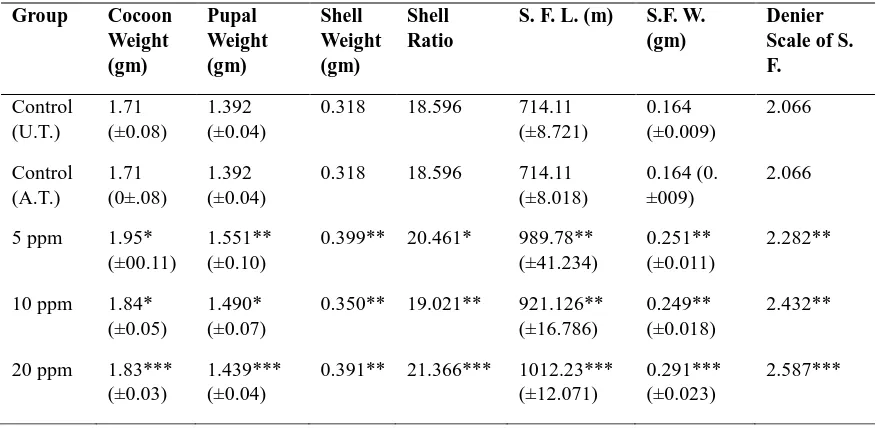
The results on the topical application of acetone extractive of Oroxylum indicum (L) to the fifth instar larvae of silkworm, Bombyx mori (L) are presented tables (1 and 2). Acetone extractives of O.indicum at 5 ppm, 10 ppm and 20 ppm concentrations recorded maximum cocoon weight (1.95; 1.84; 1.76 gm), shell weight (0.40; 0.35; 0.33 gm), pupal weight (1.55; 1.49;1.43 gm). All concentrations of the bark extract of O.indicum recorded higher cocoon, shell, and pupal weight than the untreated control and acetone treated control groups of larvae. There was a gradual increase in the silk yield with an increase in the concentrations of bark extracts O. indicum from 5 ppm, 10 ppm and 20 ppm concentration of Oroxylum indicum (L).
The serial two fold dilution of the samples followed by the visibility of the zone in electrophoresis was used to score activity intensity of the zone. Relative mobility indicates (Table-1) that the Rm value is 57.142 in the middle region. 1-naphthyl acetate was used as a substrate to score the activity of esterases on gels. The esterase patterns obtained indicate that the silk gland in control and in the treated (5 ppm, 10 ppm and 20 ppm) group of larvae showed a single hyper active band in 5 ppm and 10 ppm concentrations of bark extract which leave heavy deposition of 1-naphthol on the cathodal side of the bands after staining and that the relative mobility (Rm value) is 57.142 (Table-1) in the middle region.
Table 1. Influence of topical application of acetone extractives of bark of Oroxylum indicum (L) on the parameters of cocoon and silk filament in silkworm, Bombyx mori (L) (Race: PM x CSR2).
Group Cocoon Weight (gm)
Pupal Weight (gm)
Shell Weight (gm)
Shell Ratio
S. F. L. (m) S.F. W. (gm)
Denier Scale of S. F.
Control (U.T.)
1.71 (±0.08)
1.392 (±0.04)
0.318 18.596 714.11 (±8.721)
0.164 (±0.009)
2.066
Control (A.T.)
1.71 (0±.08)
1.392 (±0.04)
0.318 18.596 714.11 (±8.018)
0.164 (0. ±009)
2.066
5 ppm 1.95* (±00.11)
1.551** (±0.10)
0.399** 20.461* 989.78** (±41.234)
0.251** (±0.011)
2.282**
10 ppm 1.84* (±0.05)
1.490* (±0.07)
0.350** 19.021** 921.126** (±16.786)
0.249** (±0.018)
2.432**
20 ppm 1.83*** (±0.03)
1.439*** (±0.04)
0.391** 21.366*** 1012.23*** (±12.071)
0.291*** (±0.023)
2.587***
Each figure is the mean of the three replications. Figure with ± sign in the bracket is standard deviation.
Figure below the standard deviation is the increase for calculated parameter and percent increase for the others over the control. * P < 0.05, ** P < 0.005, ***P < 0.01
Esterase isozymes exhibited higher levels of polymorphism in vertebrates and invertebrates [21, 22]. Gillespie and Kojima (1968) [23] reported a relationship between the level of polymorphism and metabolic enzymes such as esterases. The differences in fractions of esterase may be due to the degree of genetic heterogeneity. Raju et al. (2013) [24], reported that the elctrophoretic patterns of esterases in Bombyx mori (L.) and in eri silkworm Samia cynthia ricini [25] The Heterogeneity of esterases from several species of insects has been demonstrated employing electrophoretic techniques and they are shown to be tissue specific [9]. Recent studies on esterases from several species implicate them to be involved in the regulation of juvenile hormone titer in the haemolymph [12]. The stem bark extract O. indicum showed the influence on the enhancement of silk production. Samatha et al. (2013) [28] reported that the plant secondary metabolites can be used not only to control diseases of silkworm, but also to increase the commercial characters ofsilkworm. The effectiveness of the plant was not only due to main active constituents but also due to combine action of other chemical compounds such as alkaloids,
flavonoids, triterpenoids, and other compounds of phenolic nature which are classified as antimicrobial compounds [26,27] The present results clearly indicate that the isolation of bioactive compounds is being done to discover new compounds for pharmaceutical and agricultural applications. Plant extracts have tendency to increase biological characters such as larval, cocoon, pupal and shell weight, shell ratio percentage and length of silk filament [28] which is evidenced in the present investigation on the effect of O. indicum bark extract which influenced the esterase intensity and hence there is an increase in the silk yield. Hence, it can be used as a nutrient supplement to improve silk yield in B. mori. The in vivo functions of esterases are not clear in Bombyx mori, this needs further investigation. Efficient use of acetone extractives of Oroxylum indicum (L) may open a new avenue in the silk yield.
Conflict of Interest
References
1. Rasadah, M.A., Houghton, P.J., Amala, R., Hoult, J.R.S. 1998. Antimicrobial and anti-inflammatory activity of extracts and constituents of Oroxylum indicum Vent. Phytomedica., 5: 375 - 381.
2. Vasanth, S., Natarajan, M., Sundarsan, R., Rao, R.B. and Kundu, A.B .1991. Ellagic acid Oroxylum indicum Vent. Indian drugs, 28 (11): 507.
3. Samatha Talari., Sampath, A., Sujatha, K. and Rama Swamy Nanna. 2013. Antibacterial Activity of Stem Bark Extracts
of Oroxylum indicum an Endangered
Ethnomedicinal Forest Tree. IOSRJournal of Pharmacy and Biological Sciences, 7(2): 24 - 28.
4. Warrier, P.K, Nambiar, V.P.K. and Raman kutty.1995. Oroxylum indicum. In a compendium of 500 species Indian medicinal plants. Madras. Orient longman, IV: 186-190.
5. Umadevi, P. Venu Gopal Reddy, B. and Anitha, M. 2012. Synthesis And Evaluation Of Diamino Substituted 1, 3,4 Thiadiazole As Possible Bombyx Mori Growth Enhancer, Int. J. Pharm. Bio. Sci., 3(4): 604 – 611. 6. Krishnaswami, S., Narashimanna,
Suyananrayana, S. K. and Kumararaj, S. 1992. Sericulture Manual 2: Silkworm Rearing, Oxford and IBH, New Delhi. 7. Thomas, C.T., Szekas, A., Hammock, D.B.,
Wilson W.B. and Mc Namee G.M. 1993. Affinity chromatography of neuropathy target esterase. Chem. Biol. Interaction., 87: 347 - 360.
8. Shahjahan, R.M., Afroza, K., Begum, R.A., Alam, M.S. and Begum A. 2008. Tissue specific esterase isozyme banding pattern in Nile Tilapia (Oreochromis niloticus). Univ. J. Zool. Rajasahi Univ., 27: 01- 05.
9. Markert, C. L. and Hunter, R. L. 1959. The distribution of esterases in mouse tissue. J. Histochem. Cytochem., 7: 42 - 49.
10. He, J. 1995. Studies on the inheritance of deletion type of the blood esterase isoenzymes in the silkworm, Bombyx mori L. Sericologia., 35:17 - 24.
11. Stoykova, T., Popov, P. and Dimitrov, B. 2003. Electrophoretic analysis of nonspecific haemolymph esterases during silkworm (Bombyx mori L.) ontogenesis. Sericologia., 43: 153-162.
12. Hammock, Β.D. and Quistad G.B. 1976. In the Juvenile Hormones, ed. L. I. Gilbert (New York, Plenum Press), pp. 374 – 393. 13. Akunyili, D.N. Houghton, P.J. and Raman
A.R. 1991. Antimicrobial activities of the stem bark of Kigelia pinnata, Journal of Ethnopharmacology., 35: 173 - 177.
14. Clarke, C.T. 1964. Simplified "Disc" (Polyacrylamide Gel) Electrophoresis. Ann. NY. Acad. Sci., 28: 121: 428 - 436.
15. Holmes R.S and Masters C.J. 1968. A comparative study of the multiplicity of mammalian esterases Biochimica et
Biophysica Acta (BBA) Enzymology,
151:147–158.
16. Reddy, T.M. and Laxmipathi, V. 1988. Esterases in Amolypharyngodon mola. Current Science. 57 (1): 24-27.
17. Eguchi, M. and Iwamoto, A. 1975. Changes in protease, esterase and phosphatases in the alimentary canal of the silkworm during meta- morphosis. Insect. Biochemistry, 5: 495-507.
18. Eguchi, M. and Sugimoto, T. 1965. Changes in esterase zymograms in the silkworm, Bombyx mori L., during development. J. Ins. Physiol., 11: 1145 - 1149.
19. Egorova, T.L. Vasilleva,T. Sankina, Y. Nasirillaev and Y. Phillippovich. 1977. Enzymatic activity of soluble proteins in different silkworm races (B.mori L.). J. Gen. Biol., 3 : 447- 463.
20. Eremina, O. 1985. Studies on the effect of permethrine upon the esterase spectrum of some insects. Insect Biochemistry, 83 - 86. 21. Selander, R.K. 1976. Genetic variation in
natural populations. Molecular Evolution. Ed. Ayala. Sinaue Associates, Inc., Suderland, Massachusetts, 277.
22. Singh, R.S. 1976. Substrate-specific enzyme variation in natural populations of Drosophila pseudo obscura. Genetics. 82(3): 507 - 526.
23. Gillespie, J.H. and Kojima, K. 1968. The degree of polymorphisms in enzymes involved in energy production compared to that in nonspecific enzymes in two Drosophila ananassae populations. Proceedings of National. Academy of Sciences, USA. 61(2): 582–585
24. Raju, N. Prasanna, D. Bhargavi G.Y. and Venkaiah, Y. 2013. Electrophoretic Patterns of Esterases in Eri silkworm Samia cynthia
ricinii. IOSR Journal of Pharmacy and
25. Raju, N., Sampath, A., Sujatha, K. and Venkaiah, Y. 2013. Electrophoretic Patterns of Esterases in Bombyx mori. L. Indo
American Journal of Pharmaceutical
Research, 3(8): 6336 - 6340.
26. Roja, P., Mermandez, L. and Pereda, 1992. Screening for antimicrobial activity of crude drug extracts and pure natural products Mexican medicinal plants. Journal of Ethnopharmacology, 35: 275 - 283.
27. Radhika, L.G., Meena, C.V., Peter, S., Rajesh, K.S. and Rosamma M.P. 2011. Phytochemical and antimicrobial study of Oroxyum indicum. Ancient. Science of Life, 30: 114 - 120.
28. Samatha Talari., Sampath, A., Sujatha, K. and Rama Swamy Nanna. 2014. Effect of stem bark extracts of Oroxylum indicum an ethno medicinal forest tree on silk production of Bombyx mori. International
journal of Pharmaceutical Sciences and