Security Risk Minimization for Desktop and Mobile
Software Systems. An In-Depth Analysis
Florina Camelia PUICAN, Cezar Liviu CERVINSCHI, Manole VELICANU
Abstract–In an extremely rapid growing industry such as the information technology nowadays, continuous and efficient workflows need to be established within any integrated enterprise or consumer software system. Taking into consideration the actual trend of data and information migrating to mobile devices, which have became more than just simple gadgets, the security threats and vulnerabilities of software products have created a new playground for attackers, especially when the system offers cross-platform (desktop and mobile) functionalities and applicability. In this context, the paper proposes an in depth analysis over some of the weaknesses software systems present, providing also a set of solutions for minimizing and mitigating the risks of any solution, be it mobile or desktop. Subsequently, even though consumer and enterprise systems have fundamentally different structures and architectures (due to the different needs of the end user), data loss or information leakage may and will affect any type of machine if proper securization of the systems is not taken into consideration, therefore risk minimization through an in-depth analysis of any integrated software system becomes mandatory and needs extensive care.
Keywords–Software Threat, Information Security, Mobile Software, Data Management, Mobile Database Vulnerability.
I. I
NTRODUCTIONOver the last few years, technology has experienced massive changes in all of its areas. Discussing about concepts that a few decades ago were considered pure theory, at this moment we are witnessing a transformation that has changed our entire perception in terms of machinery, technologies, engineering or telecommunications, a moment where innovation is the main keyword and the perfect driver for any product that would satisfy our need for information, for knowledge or for technology itself, all of these assets running towards us in ultra-high speed.
Following a bottom-up arrangement of elements, we now benefit of enormous storage farms, huge amounts of disk storage (cloud), extremely sophisticated and advanced databases, reliable operating systems, state of the art technologies or complex, ergonomic user interfaces that allow us to gain the perfect experience in terms of informational flows. In the same idea, with data services becoming more and more powerful and accessible for anyone, internet penetration has grown so big that anyone can now access the internet from almost anywhere–either from personal computers, laptops, notebooks, tablets or smartphones, using broadband, wireless or mobile data connections. Following this trend, telecommunication operators have launched services that come into meeting
their customers’ expectations [1], allowing them to change
their perspective over what internet means nowadays and to proactively offer them high speed mobile data
connections and, subsequently, moving their focus from classic desktop internet usage onto their mobile gadgets.
The reverse of this situation is represented by malicious software running free over any of these data connection points. Each and every day, attackers find new and improved methods of abusing any security breach in order to retrieve personal information from vulnerable software systems. Sensitive data (for example, credit card details) need extensive protection when running over the internet through any online channel (identity software systems, banking systems, online shops, a.s.o.) and this is why, before starting the development or the deployment of any type of this systems, and in depth security analysis must be performed [2] and clear precautions must be taken into consideration before launching such a product on the market. Moreover, since migrating from desktop devices to mobile ones, these risks have significantly increased and any type of classic vulnerability has now replicated into mobile, putting information security under even more pressure in this regards.
The context of this paper has been chosen due to the high degree of malicious software attacks and their typologies. Since the online environment is now accessible from almost anywhere and due to the fact that mobile platforms, systems or applications have not yet reached their maturity in terms of securization or protection against cybernetic attacks, it has become very clearly that the newest playground for malicious software has itself migrated towards mobile devices.
Whereas integrated software systems offer protection only at the network level, the application layer is the one being exposed and, most often, the one being attacked in the first place. The paper will present a detailed overview over the types of exploits that OWASP (Open Web Application Security Project) [3] has found to be the mostly used by attackers, creating a chart with the trends for each of them over the last few years. In parallel, the paper will propose solutions to overcome these threats as well as a case study over a secured channel for an online e-commerce platform. The case study will focus on the most sensitive points of the integration, providing solutions for minimizing the risks and for safely deliver the input data from the source to the destination system, in order to successfully close the transaction.
Copyright © 2014 IJECCE, All right reserved Furthermore, since most of the downloaded applications
require access to the device’s internal storage and personal
data (for example, to activate the push-notification system on a particular device), these risks are even bigger and must be taken into consideration by more than the user itself. These details will be presented further on in the paper.
The proposed approach will present both theoretically and practically the problem of information security on integrated software solutions, progressing from desktop systems to mobile implementations, integrations or stand-alone applications.
II. S
ECURITYT
HREADS INI
NTEGRATEDS
OFTWARES
YSTEMSBecause an integrated software system represents more than just a simple application server and a common user interface [18, 19], but often consists of several interconnected systems that allow the proper functionality of the entire mechanism (this being, actually, a wide definition for this type of software systems), security vulnerabilities might appear anywhere and might have an extremely wide range of causes.
Discussing the matter of systems integration, the issue must be addressed through a drill-down approach, meaning that a high level security analysis must be performed for the entire block of systems and afterwards, each of the impacted systems must be further analyzed, taking into consideration the integration points (some of the most vulnerable parts of an integrated software system), the machines where the application servers run on, the transport protocols which are in use, the handshakes that are made in order to close the data flows or the custom developed code.
Because an attacker will try to exploit any vulnerability or security flaw that presents a possible breach in the system, the architectural solution of the integration must take into consideration such possible scenarios and find viable solutions into mitigating these risks on both macro and micro level of the systems, as stated before. A successful attack could compromise and destabilize the entire integration but, even worse (and this is what attackers are usually after), could allow software pirates to access sensitive data, perform session hijacks or run transactions impersonating themselves as other users. This becomes an extremely problematic topic when discussing about online banking systems or data flows involving money transfers, for example.
In this idea, OWASP (The Open Web Application Security Project) delivered a ranking featuring the top ten of the most commonly used software attacks. The two versions of this ranking have been issued in 2010 and 2013 and are presented in Table I:
Table I:OWASP 2010 and 2013 vulnerabilities’ ranking
[5, 6]
# 2010 Ranking 2013 Ranking
1 Injection Injection
2 Cross Site Scripting Broken Authentication and Session Management
3 Broken Authentication and Session Management
Cross Site Scripting
4 Insecure Direct Object References
Insecure Direct Object References
5 Cross Site Request Forgery
Security Misconfiguration
6 Security Misconfiguration Sensitive Data Exposure 7 Insecure Cryptographic
Storage
Missing Function Level Access Control 8 Failure to Restrict URL
Access
Cross Site Request Forgery
9 Insifficent Transport Layer Protection
Using Components with Known Vulnerabilities 10 Unvalidated Redirects and
Forwards
Unvalidated Redirects and Forwards
Analyzing Table I, we can see that the top 3 most exploited vulnerabilities has not changed but just shifted positions. New entries in this ranking would be, for 2013, sensitive data exposure (ranked 6th), missing function level access control (#7) and using components with known vulnerabilities (#9). Each one of these sixteen, overall, vulnerabilities has its own specific and should be avoided using distinct approaches. However, some of these vulnerabilities cannot be found manually, therefore using a tool that discovers security leaks by performing an in-depth analysis (which, sometimes, could last for days) and trying to intrude even the most hidden parts of the system is essential for every integrated software system that manipulates sensitive data or transacts important values.
(a) Injection
Due to the specific of this exploit, anyone that could send untrusted data to the system could be considered a potential attacker (external or internal users, administrators, automated robots). Depending on the type of injection that is made and the part of the system it targets, this attack uses the specific syntax of the interpreter to intrude malicious data through the data flows. Some of the most commonly attacked interpreters are SQL or LDAP queries, OS commands, XML parsers, HTTP or SMTP headers. The results of such injections are often catastrophic and may lead to complete system takeover, resulting into serious reputation damage if such an attack would harm any well known brand worldwide [7].
Our experimental research, as well as the industry’s best
practices demostrates that overcoming this type of attack implies a clear separation between external data and commands or queries by using safe APIs and escaping special characters used by the interpreter. Code analysis [8] and manual testing are also important assets into overcoming this type of risk.
(b) Cross Site Scripting
–
XSS
represented by session hijacking inside a web browser, causing data to be altered or even allowing malware software inside the systems.
Mitigating XSS risks can be done through exhaustive input data escaping or by using auto-sanitization libraries. Nonetheless, code analysis and manual (positive and negative) testing must be done exhaustively [8, 9]. Experimental research has proven us that applying this rather small set of recommendations, protection against this type of attack increases significanlty.
(c) Broken Authentication and Session Management
Session management represents a sensitive area when discussing about any type software systems, but especially online. Due to the multiple scenarios or states a user could be in, session or authentication manipulation becomes challenging and implies more than just a set of credentials. A brute-force attack would impersonate another user’s
identity and try all the possible combinations of digits and
letters in order to match it with that specific account’s
password. Due to weak authentication protection, attackers often manage to retrieve the desired result from the systems.
As experience demonstrates us through the performed research, the most efficient way a software system can be protected by such attacks is an enhanced and strong authentication and session management control mechanism, of course, doubled by exhaustive (positive and negative) testing and code analysis [8, 9].
Even though the paper will limit the presentation only to this top three of the mostly used exploits, it is clear that all the other types of attacks can cause several damage to information systems, therefore each and every one of them must be addressed and taken care of during the analysis, development and testing phases of any project implementation or integration. Nonetheless,
automatic testing will ensure a proper load on the impacted systems and will be able to point out any type of vulnerability the system could have, thus assuring a high degree of security over the integrated system and all of its dependencies. Table II presents the top 10 mostly used
type of exploits, but this doesn’t necessary mean that other
types of attacks are out of our analysis. What we propose besides the industry best practices, are extended security levels through either custom-developed cryptographic mechanism (where applicable), either through network level protection using firewalls, demilitarized (DMZ) zones, access control and restrictive permissions for incoming IPs.
III. M
OBILED
EVICES’
E
XPOSURE TOR
ISKFrom mobile perspective, nowadays, there is a growing market of security software that evolved in order to protect consumers from malicious software expansion. The end users need to be aware of the impact security has on their mobile devices usage. Due to the emergent factors such as cloud computing features, mobile communication or remote authentication, threats are evolving into complex assets and data security is becoming more and more challenging to be achieved. Solutions for data security
imply surveillance of confidential data and of the points where it is exposed, discipline of the end user regarding data protection and remedial of critical data losses.
The traffic generated by the mobile networks worldwide is for more than 50 Exabytes on annual basis [10]. The SNS Research [11] estimates that mobile device and network security investments will account for nearly $9 Billion in 2013.
A pattern for threats handling in mobile environments
considers the diversity of mobile applications, the devices’
security weaknesses, remote web services and mobile
platforms’ integrations.
In Table II we presented some of the most common areas of risk and their weaknesses in mobile environments.
Table II. Mobile environments threats [10]
Overcoming mobile threats implies data protection, achieved by cleaning information in order to become
inaccessible for others, controlling applications’
accessibility to user’s personal data, avoiding phishing
attacks and blocking malware sites. It is important to procure beforehand the intelligence, the engineering and the progressive threat management to defend mobile devices and theirs exposures to vulnerabilities. This is how a secure pattern for mobile device usage at a larger scale could be set in place. The security patterns are handled distinctly by the mobile operating systems.
The encryption of hardware for mobile operating systems is the groundwork of shield, which provides a worthy stratum of fort for information. In order to be
effective, the mobile device users’ need to keep their
devices locked.
For iOS mobile operating system. starting with version 4 further after, applications can duty the information rampart impute to annex a degree of safety to their on-disk material. iOS mobile devices insures gauzy security and attributes customizable or not. The device encryption is one of the features which cannot be configured. There are actually several levels of security. The hardware security prevents malware; whereas the mobile operating system protects the access to personal data and unauthorized assault.
Mobile Risk Area Weakness Description Insecure
Client - Server Communication
In most of the mobile applications, information is transferred using a client server mechanism, over an insecure network or protocol.
Client Injection External and insecure data can be inserted in the mobile systems or devices. Injection, such as SQL injection (through SQLite), cross site scripting (XSS – done through JavaScript) or file injection are just a few examples.
Copyright © 2014 IJECCE, All right reserved Data defense manipulates the built-in encryption
hardware from the mobile devices to hoard registers in an encrypted style on disk. Having the mobile device locked, the secured data is remote square to the application that designed it. The application might have access to the secure files only if the user unlocks the device by entering the security key.
Data security is obtainable on most iOS inventions and further is liable to the audience needs. The older versions of mobile devices, do not nurture the data protection and the end user has to boot the disk and recover some capacity from a substitute. To obtain data security, users hold an encryption key of the device. Mobile devices with iOS are built up with an AES 256 encryption engine. The unique device identifier (UID) is hidden in the mobile
device’s processor during the manufacturing process. The
data encryption is unique for each iOS device. Certain steps must be followed in order to create a passcode. Afterwards, the user will need to check whether the data security feature is enabled. There is also the option to setup the data erase after ten wrong endeavors. The information abides on the disk and there are no ways to decrypt it.
Regarding the file system’s protection, certain attributes
are scheduled to the files in order to point to the claimed degree of security. These attributes are adjoined using NSData or NSFileManager classes. NSFileManager class is a simple class used for the files creation and management and NSData class supplies the storage space, where the input of a file is read or from where the dynamic cached data can be written to a file. The development framework of iOS is based on these two out of three essential classes, the third one being the NSFileHandleClass, which scope is to perform basic file operations [12].
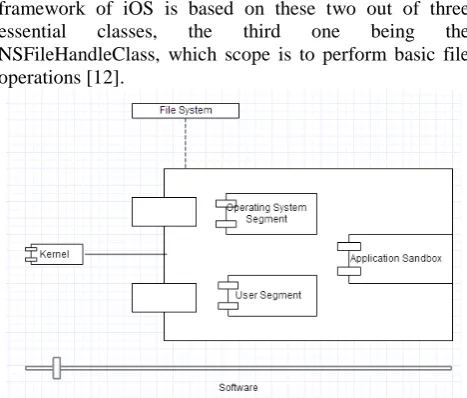
Fig.1. Security architecture for iOS Mobile devices Figure 1 exposes the security architecture for iOS devices. The iOS security model ensures that applications are retrieved from a reliable source and they do not imperil the other existing ones from the system or the system
itself. The applications from other sources are “Sandbox”
applications, meaning that they are restrained to admission other files from the other applications or to alter them. Any tentative of amending files of other applications is conceivable through application programming interfaces
(APIs). The system’s files and its resorts are hidden from
the end user, the operating system’s segment being read -only.
For further protection, data storage on iOS mobile devices can also be achieved at network level. Several protocols, such as Secure Socket Layer (SSL v3), DTLS (Datagram Transport Layer Security), Transport Layer Security (TLS) are supported but also virtual private network servers (VPS) with particular protocols and certified authentication, such as Cisco and Check Point [12].
A comparison of Android mobile operating system with iOS reveals that the account manager of Android resemblance with the one of iOS, nevertheless, Android meets its particular security issues. An operating system such as Android ought to function on a ridge security program that also offers manageability to the end user.
The basics of the Android’s security model were
consolidated after a period of observing the behavior and challenges encountered with security threats, by other server platforms, mobile devices and desktops. The security model for Android contains open-source elements
that are regularly reviewed by the Android’s security team
and any other users willing to bring contributions. Actually, there is put in place an entire Android community that helps in on time security issues mitigation. From the architecture perspective, Android endows its architecture with essential security aspects, such as, a solid security at the mobile operating system level,
obtained through Linux kernel, application’s “Sandbox”
which narrows all the code beyond the Linux Kernel, the security monopoly over the communication (IPC – Inter-Process Communication features which ensures the security for the communication among applications that function in various processes) and the end user and application authorization [13].
Being based on Linux kernel, the security model for Android holds several features in order to secure one user resorts from one another. In Linux, one user cannot read another user files or use another memory or devices, like GPS, Bluetooth. The user safeguard obtained through Linux supposes the recognition and separation of
application’s resorts. Android has a unique user identifier
(UID) to each application and functions with each of it in different processes [14].
There are also several user security features such as file system encryption, password protection and device administration. Android created application programming interfaces (APIs) that ensure the permission to the end
user’s data in the branch of secured APIs. Taking into consideration that the devices that hold Android will be also storing data from the third-party applications, the applications can use the Android operating system to verify the information from those third-party applications [15].
release of these operating systems. In the following table, there are outline some of these vulnerabilities.
Table III: Comparison between iOS and Android Weaknesses
iOS Weaknesses Android Weaknesses
Data security is available starting with Iphone version 4 further. A third party application is able to figure out an end user passcode, even with the end user feature “Erase data”
There is claimed that the authorizations that the Android’s end user should understand are too many and it results in ignorance of some important security warnings.
Any user holding an older version than 4 of the iOS is
highly expose to
vulnerabilities
There are still many mobile devices with older version of Android operating system, that cannot be updated to the newer secure versions
Apple still does not allow several mobile devices to upgrade and the number of the end users exposed to vulnerabilities is pretty high.
Google Play is an open marketplace, compared to the Apple store, which claims to be a closed one; hence the security of the available applications is doubtful. The telephony functionality
might interfere with insecure applications. Avoiding the maintained APIs, sandboxed applications might solicitate inquiries right to a system deamon, inspecting the telephone functionality.
The devices released by any bearer can be altered by them, since Google Android allows this. The end consumers are not always thrilled by the alterations brought to the user interface or software.
Since malware has gone mobile, as conclusions after the above analysis, there should be stated that avoiding malware infections sometimes simply implies to always keep up to speed with the latest mobile operating systems releases, not to expose private information on insecure wireless networks and, as much as possible, to make use of available security software. The third party applications should be installed with precautious and the easiest method to keep mobile devices protected is to have a phone password. Nowadays, mobile platforms compete with their PC counterparts and from the security point of view there might be much secure.
IV. P
ROPOSING AS
ECUREDE-P
AYMENTO
NLINEC
HANNELFor the presented research, the paper proposes an IPN-based online e-payment solution that provides internet users a safe and secured transaction environment, applicable for both desktop and mobile devices. Having a wide area of applicability, from simple e-commerce websites to complex banking systems, the mechanism has been developed and integrated in full compliancy with the industry standards, in order to minimize each of the up-mentioned security threads.
The concept of Instant Payment Notification (IPN) [16] is based on a request-response model, similar to server-side scripting: a client system (usually, an online retailer) sends a payment request to a secured machine (the payment server) which processes the request, analyzes its
parameters and responds to the client accordingly, sending
the order’s IPN. The proposed solution wraps the response IPN in three layers of securization, protecting the request and response parameters, the application server as well as securing the transaction channel through network-level protection.
Developing a secured e-payment channel for online systems has always proven to be quite a challenging task, since, as shown in sections II and III, any vulnerability represents a great opportunity for cybernetic pirates to prove their capabilities and take advantage of any security leak that might occur in the systems. The solution presented in this paper is, obviously, exposed to such a risk, mainly due to the fact that there are two systems involved in the data exchange and because of the integration point in-between them, therefore, the main concern during the analysis phase and, afterwards, during development, was to assure a secured channel for the
entire data flow, focusing, besides the “how?” (mechanism’s capabilities), mostly on the “why?” (scope
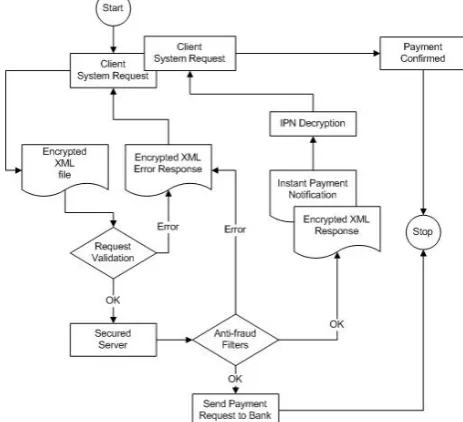
of the integration). Figure 2 presents the approached solution, in terms of data flows:
Fig.2. Proposed technical solution for a secured
e-payment channel (author’s research)
After the client system generates a request in XML format (identified through a unique signature), a validation is performed in order to determine whether that particular signature is assigned to that certain partner system. If the signature is not valid, the request dispatcher would respond with an error code that would be interpreted by the client application. Otherwise, the XML request goes
further into the secured server’s processing mechanism
Copyright © 2014 IJECCE, All right reserved the order identifiers between the IPN and the initially
generated request and confirm the payment, thus closing the functional flow.
The proposed IPN-based online e-payment solution, applicable also for mobile devices is able to deal with mobile databases, ensuring data protection through the described security model. The mobile payments solutions find success with factors such as security, privacy and ease of use and they became desirable services. Nowadays, the enhanced features of mobile databases allow big amount of data processing, with a fast and efficient data management, data storage and database engine that handle imminent situations, such as network disruptions and not at last, numerous concurrent users accessing information [17].
The approached solution, as mentioned above, benefits of a three-layered security level, meaning that data is encrypted with a custom developed Base64-like algorithm, it runs over a secured https protocol channel and uses an asymmetric encryption algorithm. The integration has been extensively tested with automated security tools, in order to find all the possible breaches that could occur in and in-between the two systems, but the three layers of protection proved to assure a constant pace over the security level, none of the exploit attempts being successfully finalized.
V. C
ONCLUSIONS ANDF
UTUREW
ORKTaking into consideration the up-mentioned aspects presented in the paper, with security needs becoming more and more challenging and demanding, it has become clear that data protection is mandatory in any integrated
software system’s architecture, be it on a small, medium or
enterprise complexity. In-depth analysis must be performed on all the impacted systems and, even more important, on the integration points that exist inside the overall achitecture and data flows. This will assure compliancy with the industry standards and, most important, will protect the system from data flaws, vulnerabilities or data leakages.
Since security threads are widely spread and cover an extremely large impact area, they must be handled separately, depending on the system, on the scope of the integration and, of course, on the impacted systems capabilities. Regarding online and mobile environments, several layers of securization must be put in place, starting with the network equipments, going further on the transport layer, securing the transfer protocol, securing the physical machine and the operating system running on it, architecture compliancy, database extensive protection, application and web server securization and, least but not last, code compliancy. Each of these layers protects its area but, extensively, assures the overall integrated software system.
The proposed solution follows the industry standards in terms of online data flow securization, but, of course, it could benefit from an additional securization layer and future work is planned to add this level on the TLS section, assuring proper communication within the
systems, taking the data securization a step forward. Future research will aim into enhancing and upgrading the solution in order to overcome any threats that may affect mobile devices.
REFERENCES
[1] “Mathematical and Computer Modelling”, Special Issue On: Telecommunications Software Engineering: Emerging Methods, Models and Tools no. 53, pp. 403–404, 2011
[2] Andrew Austin, Casper Holmgreen, Laurie Williams, “A comparison of the efficiency and effectiveness of vulnerability discovery techniques”, Information and Software Technology, no, 55, pp. 1279–1288, 2013
[3] https://www.owasp.org/index.php/Main_Page
[4] http://en.wikipedia.org/wiki/Free_and_open-source_software [5] https://www.owasp.org/index.php/Category:OWASP_Top_Ten_
Project#tab=OWASP_Top_10_for_2010
[6] https://www.owasp.org/index.php/Category:OWASP_Top_Ten_ Project#tab=OWASP_Top_10_for_2013
[7] Lwin Khin Shar, Hee Beng Kuan Tan, “Predicting SQL injection and cross site scripting vulnerabilities through mining input sanitization patterns”, Information and Software Technology, 2013 (accepted for publication)
[8] Gabriel Díaz, Juan Ramón Bermejo, “Static analysis of source code security: Assessment of tools against SAMATE tests”, Information and Software Technology, no. 55, pp. 1462–1476, 2013
[9] Ruoyu Zhanga, Shiqiu Huanga, Zhengwei Qi, Haibing Guanb, “Static program analysis assisted dynamic taint tracking for software vulnerability discovery”, Computers and Mathematics with Applications, no. 63, pp. 469–480, 2012
[10] The Mobile Device & Network Security Bible: 2013–2020 [11]
http://www.reportsnreports.com/reports/267722-the-mobile-device-network-security-bible-2013-2020.html [12] http://support.apple.com/
[13] http://source.android.com [14] https://developer.android.com
[15] https://developer.android.com/guide/practices/security.html [16] https://www.paypalobjects.com/webstatic/en_US/developer/docs
/pdf/ipnguide.pdf
[17] Florina Camelia Puican, Adrian Munteanu, Elena-Geanina Ularu, “Mobile Data Management for Business Intelligence In Distributed Environment”, 19th International Economic Conference, IECS 2012, 6/15/2012, Sibiu, România, issued in the Proceedings of the 19th International Economic Conference, pg. 45-50, ISSN 1235-7654
[18] Cezar Liviu Cervinschi, Diana Butucea, “Incentives and enhancements for using online tools. Case study for an online assessment platform”, 19th International Economic Conference, IECS 2012, 6/15/2012, Sibiu, România, issued in the Proceedings of the 19th International Economic Conference, ISSN 1235-7654
[19] Cezar Liviu Cervinschi, Diana Butucea, “Impact of web technologies in functionality and aesthetics of web applications”, Revista Economică, no. 5 (57), pp. 12 –17, 2011
A
UTHOR’
SP
ROFILEFlorina Camelia Puican
Cezar Liviu CERVINSCHI
graduated from the Faculty of Automatics and Applied Informatics of the Transilvania University of Brasov in 2009. With a masters degree in Information Technology, his interest in web technologies, web development, integrated software systems and database administration brought the motivation for advanced research in this field of science, since his main target is building robust, reliable and complex software solutions. At present, he is a PhD candidate at the Academy of Economic Studies in Bucharest at the Economic Informatics department studying web technologies, databases, online security, e-business and e-marketing.