A Three-Party Password-based Authenticated Key Exchange Protocol
for Wireless Communications
Yanrong Lu
1,2, Lixiang Li
1,2, Haipeng Peng
1,2, Yixian Yang
1,21 Information Security Center, State Key Laboratory of Networking and Switching Technology, Beijing University of Posts and Telecommunications, China
2 National Engineering Laboratory for Disaster Backup and Recovery, Beijing University of Posts and Telecommunications,China
e-mail: [email protected]
http://dx.doi.org/10.5755/j01.itc.44.4.9729
Abstract. A three-party password-based authenticated key exchange (3PAKE) protocol is an important cryptographic primitive which allows two entities to establish a session key with the help of a trusted server through an insecure channel. Recently, Farash and Attari (Information Technology and Control 43(2), 143-150, 2014) presented an improved 3PAKE protocol to erase the security flaws found in Tallapally’s 3PAKE protocol (Information Technology and Control 41(1), 15-22, 2012). They claimed that their improved protocol could withstand many security attacks. However, we identified that Farash and Attari’s protocol was still sensitive to the off-line password guessing attack which directly resulted in defencelessness to the impersonation attack. In order to cope with the loopholes of Farash and Attari’s protocol, we proposed a modified 3PAKE protocol without using smart cards for wireless communications. We demonstrate that the proposed protocol can mitigate all the problems of the protocol of Farash and Attari and possess more security properties. In addition, we make a comparison among the proposed protocol and the other related protocols regarding the performance and security properties.
Keywords: three-party; password-based; authenticated key exchange; wireless communications.
1. Introduction
With the rapid development of wireless communication, various portable devices (mobile phone, Laptop, USB thumb drives and PDAs.) have dramatically increased to provide a more convenient life to people. People can roam freely and use mobile services almost everywhere. However, open access to wireless services for wireless environment has raised a number of security concerns. Authenticated key exchange (AKE) protocols were proposed to authenticate the identities of entities involved in the open communication. Password-based authenticated key exchange (PAKE) protocol is a type of AKE protocols. It is where two or more parties, based only on their knowledge of a password, establish a session key by messages exchange, thus preventing an unauthorized entity from participating in the protocol. Hitherto, PAKE is widely applied because of its simplicity, convenience, adaptability, mobility, and less hardware requirement [1].
Bellovin and Merritt [2] proposed the first two-party authenticated key exchange (2PAKE) protocol which is employed to establish a session key between two communication parties. After that, numerous
In this paper, we focus on the protocol provided by Farash andAttari. We found that the protocol was still insecure against off-line password guessing attack which directly resulted in defencelessness to the impersonation attack. In order to cope with the loopholes of Farash and Attari’s protocol, we proposed a modified 3PAKE protocol without using smart cards for wireless communications. We demonstrate that the proposed protocol can mitigate all the problems of the scheme of Farash andAttari’s protocol and possess more security properties. In addition, we make a comparison between the proposed protocol and the other related protocols regarding the performance and security properties.
The remainder of this paper is organized as follows. Section 2 and Section 3 review and analyze Farash and Attari’s protocol. Section 4 presents our proposed protocol. Section 5 analyzes the proposed protocol. The performance and security properties comparison among the proposed protocol and other related schemes are shown in Section 6. Section 7 is a brief conclusion.
2. Review of Farash and Attari’s protocol
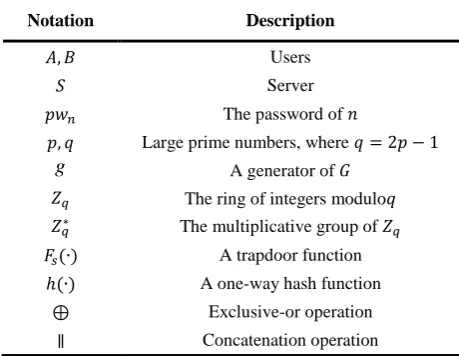
In this section, we briefly review Farash and Attari’s 3PAKE protocol. First, in Table 1, we introduce some notations used in this paper.
Table 1. Notations
Notation Description
𝐴, 𝐵 Users
𝑆 Server
𝑝𝑤𝑛 The password of 𝑛
𝑝, 𝑞 Large prime numbers, where 𝑞 = 2𝑝 − 1
g A generator of 𝐺
𝑍𝑞 The ring of integers modulo𝑞
𝑍𝑞∗ The multiplicative group of 𝑍𝑞
𝐹𝑠(∙) A trapdoor function
ℎ(∙) A one-way hash function
⊕ Exclusive-or operation
∥ Concatenation operation
1) 𝐴 randomly selects 𝑥, *
p a Z
r , and computes
q B A pw h
gx a
a ( , , )mod
R .Then, he sends the
message
A,B,Ra
to 𝑆 . Similarly, 𝐵 alsogenerates two random numbers
y
, *p b Z r , and
computes g h pwb AB q
y
b ( , , )mod
R . 𝐵 sends
A,B,Rb
to 𝑆.2) Upon receiving the messages, 𝑆 first computes q
B pw A h R
Ra' a ( || a|| )mod , and q
B pw A h R
Rb' b ( || b|| )mod . After that, 𝑆 selects a random number *
p
Z
z and computes,
q R
K z
a sa ( ) mod
'
, K R z q
b sb ( ) mod
'
,
) || 0 || || || ||
(pw A K B S
h
Za a sa , T g q
z
s mod ,
) || || || || 0 ||
(pw K B A S
h
Zb b sb . Finally, 𝑆 sends
back the message
Za,Ts
and
Zb,Ts
to 𝐴 and𝐵,respectively.
3) After receiving the message, 𝐴 computes,
q T
K x
s
as( ) mod and checks whether Za Za
? ' . If
holds, 𝐴computes Vah(A||B||Kas||pwa||0||Ts
)
||S and sends Va to 𝑆. Simultaneously, once
receiving the message, 𝐵 also computes q
N
Kbs ( s)ymod and verifies whether
) 0 || || || || ( ?
B K A pw h
Zb b sb . If it is correct, 𝑆 is
authenticated. Then, 𝐵 computes Vbh(A||B||Kbs )
|| || 0 ||
||pwb Ts S and sends Vb to 𝑆.
4) When receiving the messages, 𝑆 checks whether ( || || || ||0|| || )
?
S T pw K B A h
Va as a s and
) || || 0 || || || || ( ?
S T pw K B A h
Vb bs b s . If hold, 𝑆
computes XaKsbh(1||A||B||S||Ksa||pwa)
andXbKsah(1||A||B||S||Ksb||pwb). Then, 𝑆 sends Xa and Xb to 𝐴 and 𝐵, respectively.
5) When receiving the message, 𝐴 computes Ksb Xah(A||B||Kas||pwa||S||1),
q K
K x
sb
ab( ) mod , Sah(Kab||A) and sends
a
S to 𝐵 . Simultaneously, 𝐵 computes
) 1 || || || || || (
X h A B K pw S
Ksa b bs b ,
q K
K y
sa
ba ( ) mod , Sbh(Kba||B) and sends
b
S to
A
.6) Finally, 𝐴 and 𝐵 check the correctness of Sb and
a
S and respectively compute the session key
) || || || || ||
(A B S Kas Kab Kbs h
sk .
3. Security analysis of Farash and Attari’s
protocol
In this section, we analyze the protocol proposed by Farash andAttari. The following attacks are based on the assumption that a malicious adversary has totally supervised the communication channel andhas the capacity to intercept, insert, delete, refresh or update any information delivered in the public channel [23].
3.1. Off-line password guessing attack
Assume𝐴 is a malicious user. He can obtain the password of the real user 𝐴 by performing the following process.
1) 𝐴 guesses a password '
a
pw and computes
) , , (pw' AB h
g
R x a
number of 𝐴. Finally, 𝐴 submits
A,B,Ra
and
B,A,Rb
to 𝑆.2) When receiving the messages, 𝑆 computes )
, , ( '
B A pw h R
Ra a a , R' R h(pw,A,B)
b b
b .
After that, 𝑆 generates a random number *
q
Z z
and computes the values z s g
T , Ksa
Raz' ,
z bsb R
K ' , Zah(0,A,B,S,pwa,Ksa) and )
, , , , , 0
( b sb
b h ABS pw K
Z . Then, 𝑆 sends back
Ts,Za
and
Ts,Zb
to 𝐴 and 𝐵, respectively.3) When
A
receives the message, he computes
xs as T
K at first. 𝐴 then checks whether
a as
a
K
Z
pw
S
B
A
h
? '
)
,
,
,
,
,
0
(
. If the equation istrue,
A
has guessed the correct password; Otherwise, he continues to guess a candidate password and repeat 1)-3) until he succeeds.3.2. Impersonation attack
As described in the previous subsection, when an adversary got the password of one of the entities, he could easily impersonate as the legal user to cheat the server. The details will follow.
1) Assume 𝐴’s password is leaked. The adversary 𝐴
generates a random number '
x
, computes) , , (
'
B A pw h g
R x a
a , and sends
A,B,Ra
and
B,A,Rb
to 𝑆.2) After receiving the message, 𝑆 performs the original protocol in their scheme without detecting
𝐴 who is actually a disguiser. Finally, 𝑆
respectively delivers
Ts,Za
and
Ts,Zb
to 𝐴 and𝐵.
3) When receiving the message, the adversary first checks the correctness of Za . If it holds, he
computes Va h(A,B,S,pwa,Kas,Ts), and sends
a
V and Vb to 𝑆.
4) After receiving the message, 𝑆surely verifies the correctness of
V
a since all the values indeed come from 𝐴 . Then, 𝑆 computes XaKsbh(1,A,) , , ,Ksa S pwa
B , XbKsah(1,A,B,Ksb,S,pwb)
and sends Xa and Xb to 𝐴 and 𝐵, respectively.
5) When receiving the message, 𝐴 computes
) , , , , , 1 (
'
as a
sb h ABS pw K
K , Sah(Kab,A) ,
xyz x sb
ab K g
K ( ' ) , Sbh(Kab,B) and the
session key skh(A,B,S,Kas,Ksb,Kab). That is, 𝐴 successfully has been authenticated by the server.
4. The proposed protocol
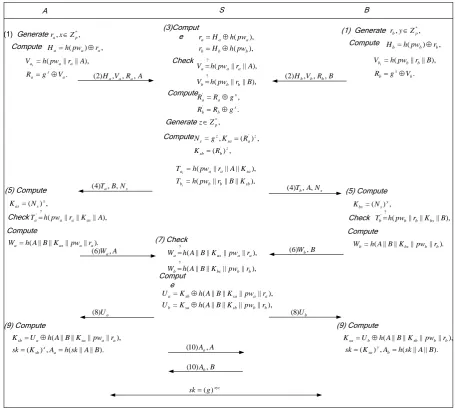
In this section, we introduce our enhanced protocol which inherits the merits and remedies the weaknesses of Farash andAttari’s protocol. The proposed protocol is shown in Fig. 1.
1)
A
chooses two random numbers 𝑥, *p a Z r and
computes
H
a
h
(
pw
a)
r
s,V
a
h
(
pw
a||
r
a||
A
)
,andR gx Va q
a mod .𝐴 sends
Ha,Va,Ra,A
to𝑆. Similarly, 𝐵 also generates two random numbers
𝑦 , *
p b Z
r and calculates the values
b b
b
h
pw
r
H
(
)
,V
b
h
(
pw
b||
r
b||
B
)
andq V g R y b
b mod . 𝐵 sends
Hb,Vb,Rb,B
to 𝑆.2) When receiving the messages, 𝑆 first derives the two random numbers ra andrb using the known
passwords pwa and pwb . Then, 𝑆 verifies
whether h(A||pwa||ra) and h(B|| pwb||rb) are
equal to the received Va and Vb, respectively. If
hold, 𝑆 computes ' ( || || )
a a a
a R h A pw r
R , and
) || || ( '
b b b
b R h A pw r
R . After that, 𝑆 selects a
random number *
p
Z
z and computes
q g
Ns zmod , Ksa (Ra')zmodq , q
R
K z
b sb ( ) mod
'
, Tah(pwa||ra||Ksa||A) , )
|| || ||
(pw r K B
h
Tb b b sb . Finally, 𝑆 sends back
the messages
Ta,B,Ns
and
Tb,Ns,A
to 𝐴 and𝐵, respectively.
3) Upon receiving the message, 𝐴 computes q
N
K x
s
as( ) mod and verifies whether
) || || || (
?
A K r pw h
Ta a a as . If the equation is true, 𝐴
computes Wah(A||B||Kas||pwa||ra) and sends
A,Wa
to 𝑆. Simultaneously, when receiving the message, 𝐵 also computes Kbs(Ns)ymodq andchecks whether ( || || || ) ?
B K r pw h
Tb b b bs . If the equation is true, 𝐵 computes Wbh(A||B||
) || || b b bs pw r
K and sends
B,Wb
to 𝑆.4) Once receiving the messages, 𝑆 checks whether
) || || || || ( ?
a a as
a h A B K pw r
W and
) || || || || ( ?
b b bs
b h A B K pw r
W . If hold, 𝑆 computes
) || || || ||
( sb b b
sa
b K h A B K pw r
U . Finally, 𝑆
sends Ua and respectively Ub to 𝐴 and 𝐵.
5) After receiving the message, 𝐴 computes
) || || || ||
( sa a a
a
sb U h A B K pw r
K ,
q K
(7) Check , ) || || || || ( , ) || || || || ( ? ? b b bs b a a as a r pw K B A h W r pw K B A h W Comput e ), || || || || ( = ), || || || || ( = b b sb sa b a a sa sb a r pw K B A h K U r pw K B A h K U
A S B
Check Compute
(1) Generate , *,
p a x Z
r
, ) ( = a a a hpw r
H . ), || || ( = a x a a a a V g R A r pw h V i (3)Comput e ), ( ), ( b b b a a a pw h H r pw h H r ), || || ( ), || || ( ? ? B r pw h V A r pw h V b b b a a a Compute . , ' ' x b b x a a g R R g R R Compute Generate *,
p Z z , ) ( , ) ( , = ' ' z b sb z a sa z s R K R K g N ), || || || ( = ), || || || ( = sb b b b sa a a a K B r pw h T K A r pw h T i i s a B N
T, , ) 4 ( Compute (5) Compute . ) || || || || (
= bs b b b hA B K pw r
W , ) ( = y s bs N K ), || || || ( ? ' B K r pw h
Tb b b bs
Check Compute
(1) Generate , *,
p b y Z
r
, ) ( = b b b h pw r
H . ), || || ( = b x b b b b V g R B r pw h V i B R V Hb, b, b,
) 2 (
B Wb,
) 6 (
s b AN
T, , ) 4 ( b U ) 8 ( a U ) 8 ( Compute (5) Compute . ) || || || || (
= as a a a hA B K pw r
W , ) ( = x s as N K ), || || || ( ? ' A K r pw h
Ta a a as
Check (9) Compute ), || || || || (
= a sa a a sb U hA B K pw r
K ). || || ( , )
(K A hsk A B
sk a x sb A R V Ha, a, a,
) 2 (
A Wa,
) 6 ( (9) Compute ), || || || || (
= b sb b b sa U hA B K pw r
K ). || || ( , )
(K A hsk A B
sk b
y sa
A Aa,
) 10 (
B Ab,
) 10 (
xyz
g sk( )
Figure 1. The proposed protocol
Then, 𝐴 sends
A
a to 𝐵. Upon receiving the message, 𝐵 retrieves Ksa by computing) || || || ||
( sb b b
b h A B K pw r
U and then computes
y sa
K
sk( ) ,Abh(sk||A||B).
Finally, 𝐵 sends
A
a to 𝐴.6) After receiving the message, 𝐴 and 𝐵 verify the correctness of
A
b and respectivelyA
a. If they respectively hold, 𝐴 and 𝐵 successfully agree on the session key xyzg
sk( ) with the help of the
server.
5. Security analysis
This section will present a cryptanalysis of the proposed protocol. The following attacks are based on the assumption that a malicious adversary has totally supervised the communication channel and has the
capacity to intercept, insert, delete, refresh or update any information delivered in the public channel [23].
5.1. Off-line password guessing attack
Without loss of generality, we assume the adversary has intercepted the message
Ha,Va,Ra,A,Ta,B,Ns,Wa,Ua
transmitted from 𝐴 to𝑆. However, the adversary cannot guess correctly of the password even if he knows the transmitted message. In the proposed protocol, 𝐴’s password pwa
is mingled with the random number ra, which is
5.2. On-line password guessing attack
Without loss of generality, an adversary may eavesdrop
Ha,Va,Ra,A,Ta,B,Ns,Wa,Ua
and plan topretend to be a legal user
A
. But the adversary cannot send a new valid message
Ha,Va,Ra,A,Ta,B,Ns,Wa,Ua
to the trusted server unless he has guessed the correct password. And all the values
Ha,Va,Ra,A,Ta,B,Ns,Wa,Ua
are hiddenfrom the one-way hash functions, the adversary cannot get them because of the security of hash function. Therefore, our protocol can resist the un- detectable online password guessing attack.
5.3. Mutual authentication
In the proposed protocol, 𝑆 authenticates 𝐴 by computing Va and Wa. Furthermore, 𝑆 authenticates B
by computing Vb and Wb. 𝑆 is verified through the correctness of Ta and Tb. Therefore, mutual
authenti-cation is achieved in the proposed protocol.
5.4. Impersonation attack
Assume that the adversary wants to impersonate 𝐴
to cheat 𝑆 via intercepting the messages transmitted in the public channel. However, he cannot succeed until he can get the password of 𝐴. As described in the previous subsection, the adversary is not possible to launch an off-line password guessing attack. That is, the proposed protocol is immune to the impersonation attack.
5.5. The session key perfect forward secrecy Suppose 𝐴 has compromised all the passwords of the communication entities. In order to get the session
key xyz
g
sk( ) , he needs to know the random numbers
x,y,z
. Nevertheless, he will face the DLP if he tries to get
x,y,z
from
Kas,Kbs,Ns
. Therefore, theproposed protocol can ensure the perfect forward secrecy.
5.6. Replay attack
In our protocol, we use numerous random numbers for each session to resist replay attack. If the adversary intends to resend the old messages, the corresponding receiver will immediately detect the attack from the sender. Therefore, it seems to be impossible to perform the replay attack to our protocol.
6. Performance and security properties
comparison
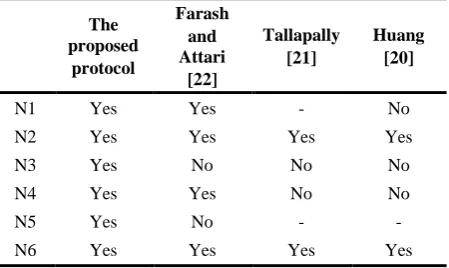
In this section, we compare the performance and security properties of our protocol with other related protocols [20-22] in Fig. 2 and Table 2.
In Fig. 2, our proposed protocol has a similar efficiency with Farash andAttari’s protocol even if the costs of our protocol are slightly higher than Tallapaly and Huang’s protocol. However, Tallapaly and Huang’s protocol is vulnerable to the on-line password guessing and off-line password guessing attacks and Huang’s protocol cannot provide mutual authentication. As shown in Table 2, none of the other protocols can resist the off-line password guessing attack. Therefore, our protocol is efficient and secure compared with other related protocols.
Figure 2. Performance comparison
No.of T: the number of trapdoor functions; No.of H: the number of hashing operations; No.of E: the number of exponentiation operations.
Table 2. Comparison of security properties
The proposed
protocol
Farash and Attari
[22]
Tallapally [21]
Huang [20]
N1 Yes Yes - No
N2 Yes Yes Yes Yes
N3 Yes No No No
N4 Yes Yes No No
N5 Yes No - -
N6 Yes Yes Yes Yes
N1: Provide mutual authentication;
N2: Provide the session key perfect forward secrecy;
N3: Withstanding off-line password guessing attack;
N4: Withstanding on-line password guessing attack;
N5: Withstanding impersonation attack;
N6: Withstanding replay attack.
7. Conclusion
the proposed protocol could withstand various kinds of attacks including attacks found in Farash and Attari’s protocol. In addition, we compared the proposed protocol with other related protocols regarding the performance and security features. The results showed that the proposed protocol was more secure than Farash and Attari’s protocol without increasing the computation cost. All in all, the proposed protocol is suitable for the wireless environments.
Acknowledgments
The authors are grateful to the anonymous referees for their valuable comments and suggestions to improve the presentation of this paper. This paper is supported by the National Natural Science Foundation of China (Grant Nos. 61472045, 61573067), the BUPT Excellent Ph.D. Students Foundation (Grant No. CX2015310), the Asia Foresight Program under NSFC Grant (Grant No. 61411146001) and the Beijing Natural Science Foundation (Grant No. 4142016).
References
[1] J. Yang, T. Cao. Provably secure three-party password authenticated key exchange protocol in the standard model. Journal of Systems and Software, 2012, Vol. 85, No. 2, 340-350.
[2] S. M. Bellovin, M. Merritt. Encrypted key exchange: password-based protocols secure against dictionary attacks. In: Proceedings of the 1992 IEEE symposium on research in security and privacy, 1992, pp. 72-84. [3] C.-T. Li, C.-C. Lee. A robust remote user
authentica-tion scheme using smart card. Information Technology and Control, 2011, Vol. 40, No. 3, 236-245.
[4] M. K. Khan, J. S. Zhang. Improving the security of ‘a flexible biometrics remote user authentication scheme’. Computer Standards & Interfaces, 2007, Vol. 29, No.1, 82-85.
[5] H. Sun, Q. Wen, H. Zhang, Z. Jin. A strongly secure pairing-free certificate less authenticated key agreement protocol for low-power devices. Information Technology and Control, 2013, Vol. 42, No. 2, 113-123.
[6] Y.-M. Tseng, C.-H. Yu, T.-Y. Wu. Towards scalable key management for secure multicast communication. Information Technology and Control, 2012, Vol. 41, No. 2, 173-182.
[7] B.-L. Chen, W.-C. Kuo, L.-C. Wuu. A secure password- based remote user authentication scheme without smart cards. Information Technology and Control. 2012, Vol. 41, No. 1, pp. 53-59.
[8] Q. Jiang, J. Ma, G. Li, Z. Ma. An improved password-based remote user authentication protocol without smart cards. Information Technology and Control. 2013, Vol. 42, No. 2, pp. 150-158.
[9] Y. Lu, L. Li, Y. Yang. Robust and efficient authentication scheme for session initiation protocol. Mathematical Problems in Engineering, 2015, Article ID 894549.
[10] Y. Lu, L. Li, H. Peng, X. Yang, Y. Yang. A light-weight ID based authentication and key agreement protocol for multi-server architecture. International Journal of Distributed Sensor Networks, 2015, Article ID 635890.
[11] Y. Lu, L. Li, H. Peng, Y. Yang. An enhanced biometric-based authentication scheme for telecare medicine information systems using elliptic curve cryptosystem. Journal of Medical Systems. 2015, Vol.39, No.3, 1-8.
[12] Q. Xie, N. Dong, X. Tan, D.-S. Wong, G. Wang.
Improvement of a three-party password-based key exchange protocol with formal verification.
Information Technology and Control, 2013, Vol. 42, No. 3, 231-237.
[13] T.-F. Lee, J.-L. Liu, M.-J. Sung, S.-B. Yang, C.-M. Chen. Communication-efficient three-party protocols for authentication and key agreement. Computers & Mathematics with Applications, 2009, Vol. 58, No. 4, 641-648.
[14] J. Nam, J. Paik, H.-K. Kang, U.-M. Kim, D. Won.
An offline dictionary attack on a simple three-party key exchange protocol. IEEE Communications Letters, 2009, Vol. 13, No. 3, 205-207.
[15] D. Zhao, H. Peng, L. Li, Y. Yang. A secure and effective anonymous authentication scheme for roaming service in global mobility networks. Wireless Personal Communications, 2014, Vol. 78, No. 1, 247-269.
[16] T.-F. Lee. Verifier-based three-party authentication schemes using extended chaotic maps for data exchange in telecare medicine information systems. Computer Methods and Programs in Biomedicine, 2014, Vol. 117, No. 3, 464-472.
[17] J. Zhao, D. Gu. Provably secure three-party password- based authenticated key exchange protocol. Information Sciences, 2012, Vol. 184, 310-323. [18] H. Yang, Y. Zhang, Y. Zhou, X. Fu, H. Liu, A.
Vasilakos. Provably secure three-party authenticated keyagreement protocol using smart cards. Computer Networks, 2014, Vol. 58, 29-38.
[19] H.-F. Huang. A simple three-party password-based key exchange protocol. International Journal of Communication Systems, 2009, Vol. 22, No. 7, 857-862.
[20] S. Tallapally. Security enhancement on simple three- party PAKE protocol. Information Technology and Control, 2012, Vol. 41, No. 1, 15-22.
[21] M. S. Farash, M. A. Attari. An enhanced and secure thee-party password-based authenticated key exchange protocol without using server’s public-keys and symmetric crypto-systems. Information Technology and Control, 2014, Vol. 43, No. 2, 143-150.
[22] L. Lamport. Password authentication with insecure communication. Communications of the ACM, 1981, Vol. 24, No. 11, 770-772.