Linear Data-Model Based
Adaptive ILC for Freeway
Ramp Metering Without
Identical Conditions
on Initial States and
Reference Trajectory
ITC 2/48Journal of Information Technology and Control
Vol. 48 / No. 2 / 2019 pp. 268-277
DOI 10.5755/j01.itc.48.2.20406
Linear Data-Model Based Adaptive ILC for Freeway Ramp Metering Without Identical Conditions on Initial States and
Reference Trajectory
Received 2018/03/22 Accepted after revision 2019/05/15
http://dx.doi.org/10.5755/j01.itc.48.2.20406
Corresponding author: [email protected]
Hao Liang
Engineering Institute, Yantai Nanshan University, No 12, University road, East Sea tourism resort, Longkou, Yantai, China
Na Lin
School of Automation & Electronic Engineering, Qingdao University of Science & Technology, No 99, Songling Road, Qingdao, China
Ronghu Chi
Engineering Institute, Yantai Nanshan University, No 12, University road, East Sea tourism resort, Longkou, Yantai, China;
School of Automation & Electronic Engineering, Qingdao University of Science & Technology, No 99, Songling Road, Qingdao, China
Yumei Sun
269
Information Technology and Control 2019/2/48
Although freeway traffic system is conducted with a repeatable pattern day-to-day, the initial volume/or speed and the desired density of the traffic flow may vary with days due to the external disturbances. In this paper, a new linear data-model based adaptive iterative learning control (LDM-AILC) is proposed to address ramp metering in a macroscopic level freeway environment. A linear data-model is developed for the nonlinear macroscopic traffic flow model by introducing an equivalent dynamical linearization approach in the time domain. Then the LDM-AILC is designed with a feedback control law and a parameter updating law. The proposed scheme is data-driven intrinsically, where only the input and output data are required for the controller design and analysis. The convergence is shown by rigorous analysis without any identical conditions exposed on both the initial state and the reference trajectory. Extensive simulation results are provided to verify the effectiveness of the proposed LDM-AILC.
KEYWORDS: Adaptive ILC, Linear data-model, Traffic control, Ramp metering, Random initial conditions, Iteration-varying target trajectory.
1. Introduction
Freeway traffic control [1, 20, 28] is an important area in the field of traffic engineering and intelligent trans-portation systems. Frequent congestions on freeway during rush hours deteriorate traffic conditions. The most common reasons causing freeway congestion include traffic demand being greater than capacity, as well as traffic accidents, road works and weather [28]. For better utilization of freeway capacity, ramp metering [1, 13, 15, 17, 27] is a commonly implemented strategy. The purpose of ramp metering is to regulate the amount of traffic entering a given freeway at its entry ramps to maximize throughput by maintaining a desired (or optimal) occupancy on the downstream mainline freeway. Ramp metering is implemented by means of traffic lights in practice, which is used to meter the number of entering vehicles.
Based on the model extracted from these data, local and coordinated feedback (ALINEA) ramp metering strategy has been implemented [1]. It has been shown to be a remarkably simple, highly efficient and easily implemented ramp metering application. However it is difficult to calibrate the key model parameters crit-ical to the performance, because model parameters vary with geometry of freeway road conditions and en-vironmental factors, e.g. rain and frog. In addition, the freeway traffic flow system is of strong nonlinearities, coupling, and uncertain and thus its accurate model is hardly available in practice. Therefore, the common model-based control approaches [13, 15, 26-27] will encounter many unexpected difficulties when applied to freeway traffic control problems.
On the other hand, the macroscopic traffic flow pat-terns are in general repeated every day [11]. For
in-stance, the traffic flow will start from a very low lev-el at midnight, and increase gradually up to the first peak of morning rush hour, which is often from 7-9 AM, and the second one from 5-7 PM. Congestions typically start at the same location every day. Note that iterative learning control (ILC) [8, 10-12, 16, 25] is very suitable for a repetitive process. Based on this observation, some ILC based ramp metering strate-gies have been proposed for the freeway density con-trol [10-12, 25, 28] in daily or weekly basis. In [11], only basic ILC based ramp metering and speed control are discussed. In [10], the learning mechanism com-bined with a pure error feedback in a complementa-ry manner is studied and the simulation results have shown its superiority to the ILC based only. In [12], the input saturation was explored by using ILC based ramp metering strategy and the complementary ramp metering combining ILC and ALINEA, respectively. In [25, 28], the effectiveness of the ramp metering based on ILC was further evaluated.
Note that all the above ILC approaches [10-12, 25, 28] for ramp metering are based on the contraction map-ping and fixed-point theory to design linear iterative learning algorithm, which causes two major limitations when used in practice. The first one is that the tran-sient performance of the system output along the iter-ation axis becomes poor sometimes because the con-vergence property of tracking error is achieved in the sense of
λ
norm. The second one is that the identical conditions of initial states and target references must be matched to achieve a perfect tracking.practical that the initial values of traffic density and average speed of the vehicles, as well as the tracking target are varying day-to-day due to the variations of freeway road conditions and environmental factors, e.g. rain and frog. Therefore, it is certain interesting to explore the ILC approach for the freeway traffic system without a strictly repeatable pattern with random initial conditions and iteration-varying de-sired density trajectory.
Adaptive iterative learning control (AILC) scheme [4, 6-7, 18, 23-24] was widely studied with many successful applications. In general, the most attrac-tive advantage of the AILC is its capability of dealing with the problems of iteration-varying reference tra-jectories, bounded but possibly large random initial resetting error and disturbance. However, most of the existing AILCs [4, 6-7, 23-25] depend on the fact that the unknown parameters are linearly parameterized with known nonlinear functions, thus cannot been utilized to the freeway traffic control problems due to the strong nonlinearity of the macroscopic traffic flow model.
Recently, neural networks or fuzzy systems have been applied to AILC in many works to deal with the prob-lem that the plant nonlinearities cannot be linearly parameterizable such as those in [2, 3, 5, 19, 21-22]. However, it is often difficult to determine the fuzzy rule base and membership functions and to train the neural network with massive operation data. More recently, a data-driven model-free adaptive ILC [6, 14] was proposed for a class of nonlinear discrete-time systems by introducing a dynamical lineariza-tion approach in the iteralineariza-tion domain. It achieves a perfect tracking under random initial conditions without requiring any external testing signals or any training process. But, the tracking target trajectory must be repeatable strictly.
Motivated by the above discussion, an equivalent dynamical linearization approach is proposed for freeway traffic system by introduce a new concept of pseudo partial derivative (PPD) [9]. Then, a new linear data-model based adaptive ILC (LDM-AILC) is proposed for the freeway density control via ramp metering. Both theoretical analysis and simulations results confirm the effectiveness of the proposed approach.
The main contributions of the proposed LDM-AILC are that: (a) it is capable of dealing with nonlinear
systems without known linear parametric structures and thus it is a data-driven control approach where the controller design and analysis just depends on the I/O data. (b) It can deal with the iteration-vary-ing uncertainties, such as random initial states and iteration-varying tracking targets and achieves a perfect tracking performance. In a sum, the proposed LDM-AILC is suitable in practice for a complicated freeway traffic system with higher orders and strong nonlinearities and non-repetitive changes.
The rest of this paper is organized as follows. Sec-tion 2 shows a linear data-model of the macroscopic traffic flow model. Section 3 presents the LDM-AILC approach with rigorous analysis. Section 4 provides the simulation results to verify the effectiveness of the proposed approach. Section 5 concludes this work.
2. Problem Formulation
2.1.
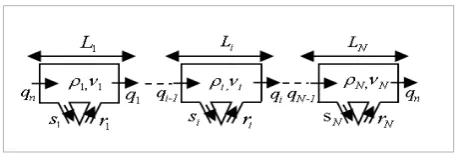
Nonlinear Macroscopic Traffic Flow ModelAs shown in Fig.1, a single freeway is considered with one on-ramp and one off-ramp on each section. Its spatially discretized traffic flow model is expressed mathematically by the following equations [17].
[
( ) ( ) () ()]
, )( ) 1
(t t Lh qi 1 t qi t ri t si t i
i
i + =ρ + − − + −
ρ (1)
(2)
[
]
[
]
[
[
]
]
,) (
) ( ) ( )
( ) ( ) (
) ( )) ( ( ) ( ) 1 (
1
1 τυ ρ ρ ρκ
ρ τ
+ − −
− +
− +
= +
+
− t
t t L
h t v t v t v L
h
t v t V h t v t v
i i i
i i
i i i
i i i
i
(3)
Figure1
Sections on a freeway with on/off ramp
3
the iteration-varying uncertainties, such as random initial states and iteration-varying tracking targets and achieves a perfect tracking performance. In a sum, the proposed LDM-AILC is suitable in prac-tice for a complicated freeway traffic system with higher orders and strong nonlinearities and non-repetitive changes.
The rest of this paper is organized as follows. Sec-tion 2 shows a linear data-model of the
macroscop-ic traffmacroscop-ic flow model. Section 3 presents the LDM-AILC approach with rigorous analysis. Section 4 provides the simulation results to verify the effec-tiveness of the proposed approach. Section 5 con-cludes this work.
2. Problem Formulation
2.1. Nonlinear Macroscopic Traffic Flow Model
As shown in Fig.1, a single freeway is considered with one on-ramp and one off-ramp on each section. Its spatially discretized traffic flow model is ex-pressed mathematically by the following equations [17].
Figure1
Sections on a freeway with on/off ramp
[
() () () ( )],
)( ) 1
(t t Lh qi1 t qi t ri t si t i
i
i + =ρ + − − + −
ρ (1) ),
( ) ( )
(t t v t
qi =ρi i (2)
[
]
[
]
[
[
]
]
,) (
) ( ) ( )
( ) ( ) (
) ( )) ( ( ) ( ) 1 (
1
1 ρ κ
ρ ρ
τ υ ρ
τ
+ − −
− +
− +
= +
+
− t
t t L
h t v t v t v L
h
t v t V h t v t v
i i i
i i
i i i
i i i
i
(3)
, ) ( 1 ))
( (
m l jam i free
i
t v
t V
− =
ρ ρ
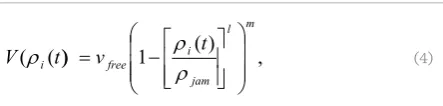
ρ (4) where h is the sample time interval; t denotes the
t-th time instant; i∈{1,,IN} is the i-th section of a freeway; IN is the total section number;
m l, , , ,υ κ
τ are constant parameters reflecting par-ticular characteristics of a given traffic system. The other model parameter variables are listed in Table 1.
Table 1
Model Parameters
Traffic density ρi(t) (veh/lane/km)
Mean speed vi(t)(km/h) Traffic flow qi(t)(veh/h) Traffic volume On-ramp ri(t)(veh/h) Traffic volume Off-ramp si(t)(veh/h)
Length Li(km)
Free speed Vfree
Maximum density ρjam
Assume the freeway traffic system is repetitive over a finite running time interval t=
{
0,1,,T}
. The control objective is to design an adaptive ILC without knowing the exact traffic model and dis-turbances. The adaptive ILC will make use of the historical freeway traffic data to generate a se-quence of control inputs that drives traffic density to converge to the desired one over the entire inter-val t={
0,1,,T}
.2.2. General Nonlinear Formulation and Some Assumptions
According to (1) – (4), we can also express the traf-fic dynamics in a general nonlinear form [17] as
)], ( ), ( ), ( [ ) 1
(t f y t r t d t
y + = (5) where the state vector y(t)∈Rn comprises all
traf-fic densities and mean speeds, as well as all ramp queues; the control vector r(t)∈Rn comprises all controllable ramp volumes; the disturbance vector
p R t)∈ (
d comprises all on-ramp demands and turning rates; f()∈Rn is a vector valued func-tion.
271
Information Technology and Control 2019/2/48
, ) ( 1 ))
( (
m l
jam i free i
t v
t V
− =
ρ ρ
ρ (4)
where h is the sample time interval; t denotes the t-th time instant; i∈{,1,IN} is the i-th section of a freeway; IN is the total section number; τ,υ,κ,l,m
are constant parameters reflecting particular char-acteristics of a given traffic system. The other model parameter variables are listed in Table 1.
Table 1
Model Parameters
Traffic density ρi(t) (veh/lane/km) Mean speed vi(t)(km/h) Traffic flow qi(t)(veh/h)
Traffic volume On-ramp ri(t)(veh/h) Traffic volume Off-ramp si(t)(veh/h)
Length Li(km)
Free speed Vfree
Maximum density ρjam
Assume the freeway traffic system is repetitive over a finite running time interval t=
{
0,,1,T}
. Thecontrol objective is to design an adaptive ILC with-out knowing the exact traffic model and disturbanc-es. The adaptive ILC will make use of the historical freeway traffic data to generate a sequence of control inputs that drives traffic density to converge to the de-sired one over the entire interval t=
{
0,,1,T}
.2.2. General Nonlinear Formulation and Some Assumptions
According to (1) – (4), we can also express the traffic dynamics in a general nonlinear form [17] as
(5)
where the state vector y(t)∈Rn comprises all traffic densities and mean speeds, as well as all ramp queues; the control vector r(t)∈Rn comprises all controllable ramp volumes; the disturbance vector d(t)∈Rp comprises all on-ramp demands and turning rates;
n
R
∈ ) (
f is a vector valued function.
Assumption 1: The partial derivatives of f() with respect to control inputs r(t) are continuous.
Assumption 2: System (5) is generalized Lip-schitz, that is, ∆y(t+1) ≤bΦ ∆r(t) for each fixed t and ∆r(t) ≠0, where ∆y(t+1)= y(t+1)−y(t),
) 1 ( ) ( )
( = − −
∆r t r t r t , and bΦ is a positive constant.
Remark 1: Assumption 1 is a typical condition of con-trol system design for general nonlinear systems. It is obvious that the partial derivatives of all the non-lin-ear functions in (1) – (4) with respect to its arguments exist and are continuous. Therefore, Assumption 1 is satisfied for the considered freeway traffic system. Remark 2: Assumption 2 limits the rates of chang-es of the system outputs driven by the changchang-es of the control inputs. For a real freeway traffic system, it is evident that the finite change of one traffic vari-able does not cause an infinite variation of the other variables. Furthermore, we just need the existence of such a constant bΦ without requiring the exact value. 2.3. Dynamical Linearization
The equivalent dynamical linearization is summa-rized as the following theorem [9].
Theorem 1: For nonlinear system (5), satisfying Assumptions 1 and 2 with ∆r(t) ≠0 for each fixed t, there must exist a parameter Φ(t), called the PPD matrix, such that nonlinear system (5) can be trans-formed into the following equivalent dynamical linearization data model
) ( ) ( ) 1
(t Φ t r t
y + = ∆
∆ , (6)
where Ö(t)∈Rn×n
and .
Proof.See Appendix A.
Remark 2: The linear data-model (6) is an equivalent and exact description of system (5), which is quite different from other linearization forms such as Taylor’s linearization, where the high-order terms are omitted. The dynamical linearization is a data-driven approach and it is achieved only based on the I/O data of the plant. Further, the linear data-model is simple without requiring any fuzzy rules as in fuzzy control, or any external testing signals and any training process as in neural network control.
Another assumption is exposed on the PPD parameter. Assumption 3:.The PPD matrix parameter Φ(t) is