This is an open access journal, and articles are distributed under the terms of the Creative Commons Attribution-Non Commercial-ShareAlike 4.0 License, which allows others to remix, tweak, and build upon the work non-commercially, as long as appropriate credit is given and the new creations are licensed under the identical terms.
© 2019 Journal of Advanced Pharmacy Education & Research | Published by SPER Publication
46
Respiratory training efficacy on quality of life and functional
capacity in patients with Leukemia
Nesreen G.El-Nahas, Heba A Abdeen*
Assistant Professor of Cardiovascular/respiratory disorder and geriatrics, Faculty of Physical Therapy. Cairo University, Egypt.
Correspondence:Heba A Abdeen, Assistant Professor of Cardiovascular/respiratory disorder and geriatrics, Faculty of Physical Therapy. Cairo University, Egypt.
ABSTRACT
Background: Leukemia, as a type of cancer that is treated with chemotherapy often encounters functional status limitations with pulmonary toxicity and decreased inspiratory muscle strength in the 3 phases of its treatment. Aim of the study: To assess the efficacy of respiratory training on functional capacity and quality of life in patients with leukemia .Material and methods: Forty men patients with leukemia, in the age range of 37.1 ± 4.89, underwent chemotherapy for at least one cycle. The patients, chosen from National Cancer Institute, Cairo (inpatient ward), were arbitrarily allocated into two groups. Study Group included 30 patients who received respiratory muscles training for 4 successive weeks, 5 sessions/week; and Control Group included 10 patients who acted as a control group on chemotherapy only. Data obtained from both groups regarding forced Maximum voluntary ventilation(MVV), 2 min walk test, Quality of life questionnaire (FACT-G) were statistically analyzed and compared. Results: After 4 weeks of training, the results of the study group showed that there was a significant increase in the MVV, 2min walk test distance, and FACT-G by 23.59%, 17.29% and 18.86%; respectively. While for the control group, the results showed significant decrease in the previous parameters assessed by 12.93%, 15.48% and 8.27%; respectively. Conclusion: It was concluded that respiratory muscle training can be performed in an attempt to minimize the consequent effects of respiratory muscle weakness, and preserve the functional capacity, and improve the quality of life in patients with leukemia receiving chemotherapy.
Keywords:Leukemia, chemotherapy, functional capacity, quality of life, respiratory training.
Introduction
Cancer is a type of disease which includes uncontrolled growth and expansion of abnormal cells. It has been estimated that about 1.7 million new cancer cases to be diagnosed in 2018. Also, the death rates and progress of cancer cases and their incidence would be increased. Adding to these, the risks leading cancer would also be increased that would provide socio-economical burden [1].
Leukemia is a fatal disease which is mostly found among people aged from 0 to 18 years old, including 25-35% of all tumors in this population. Based on cytology, immunohistochemistry and
cytogenetics, Leukemia has been categorized as acute lymphoblastic leukemia (ALL) and acute myeloid leukemia (AML) [2]. ALL includes 70-80% of the cases, and AML includes
almost 15% of the cases [3].
Although Acute myeloid leukemia (AML) is the most widespread kind of leukemia in adults, its survival rate is the lowest among all leukemias. While, the survival rate has considerably improved in the younger age group, the prognosis in older patients is still very weak [4, 5].
Patients with AML often show various non-specific (generalized) symptoms. The symptoms can be weight loss, fatigue, fever, night sweats, and loss of appetite. In fact, these are not just the symptoms of AML, and mostly are resulted from some reasons other than leukemia [6].
Treating leukemia, like the other kinds of cancer, is a complex process. In most of the cases, in the standard procedure of the treatment, chemotherapy followed by a bone marrow transplant is applied [7].
Although CT is given to kill cancer cells, it damages normal cells, and cause significant side effects. The side effects vary depending on the particular CT drug, dosage, rout of
Access this article online
Website: www.japer.in E-ISSN: 2249-3379
How to cite this article: Nesreen G.El-Nahas, Heba A Abdeen.
Respiratory training efficacy on quality of life and functional capacity in patients with Leukemia. J Adv Pharm Edu Res 2019;9(2):46-52.
administration and patient characteristics; while some people may experience very few side effects, others may experience more. Some CT side effects can be too severe which may require hospitalization [8].
In all types of cancer treated with chemotherapy, the group of side effects includes the ability of the patient to function at pre-cancer levels. In most of the cases, when the overall physiological and psychological functioning is decreased, further administration of treatment is stopped or slowed down, and this can result in low treatment outcomes. Among the common side effects of chemotherapy conducted on leukemia patients, it can be mentioned to debilitating fatigue, nausea, loss of body mass (development of cancer cachexia), anemia, and depression [7].
Patients with AML often suffer from poor health-related quality of life; symptoms like fatigue and Pulmonary Functions at baseline have been recognized as independent prognostic factors for overall survival that in several studies, there has been shown an improvement in both domains through treatment [9].
Patients suffering from cancer also encounter the risk of complications including pulmonary dysfunction. Pulmonary toxicity due to the chemotherapy or associated with radiotherapy may also cause interstitial lung injury during the initial stage until several months after the treatment and, in the late stage, the most widespread problem is lung fibrosis that has been associated with reduced lung volumes and capacities reflected on functional capacity of the patients [10].
In an attempt to seek alternatives to minimize the effects on weakness and/or respiratory muscle fatigue, in 1976, the first study was conducted to evaluate the effects of inspiratory muscle training in healthy individuals. Since then, the number of studies regarding inspiratory muscle training (IMT) has increased. As it proves to be effective in strength gain and respiratory muscle strength, leading to the reduction in dyspnea, improves the performance of activities of daily living (ADL) and reduces postoperative pulmonary complications [11].
Inspiratory muscle training (IMT) improves the strength and endurance of inspiratory muscles, functional exercise capacity, dyspnea and quality of life. It was found that in patients with inspiratory muscle weakness, adding IMT to a general exercise training program improved the maximum inspiratory pressure (MIP), and tended to improve the exercise performance [12].
Methods
Forty leukemic men patients with the age range of 37.1 ± 4.89, underwent chemotherapy for at least one cycle. The patients were chosen from National Cancer Institute, Cairo (inpatient ward). The patients were randomly allocated into two groups. Randomization was done by opening an opaque envelope which was prepared by an independent individual in which there were random numbers. 30 patients who were included in the study group received inspiratory muscles training for 4 successive weeks, 5 sessions/week; and 10 patients who formed the control group, just received chemotherapy.
The patients included in this study followed the criteria of: Leukemic men patients with the age range of 30 to 50 years. They were hemodynamically stable, and have been on chemotherapy at least one cycle as a treatment of malignant tumor. While the exclusion criteria included the patients who suffered from the metastasis of lung, ribs, mediastinal structure, Pulmonary pathology (e.g. acute respiratory distress syndrome or exacerbation of Chronic Obstructive pulmonary disease), Ruptured eardrum or any other condition of the ear, and the patients with marked elevated left ventricular end-diastolic volume and pressure, heart failure signs and symptoms, and the bed- ridden patients.
Ethical consideration included the patients’ rights to know benefits, procedures and potential risks that were explained thoroughly to all the patients prior to signing an informed consent with explaining that the confidentiality was assured. The study was approved by the ethical committee of Faculty of Physical Therapy no. P.T.REC/012/001806 and the Institution Review Board of the National Cancer Institute no.201617032.4.
This study was registered in
ClinicalTrials.gov Identifier: NCT03876834
Outcome measures: Both groups underwent an identical battery of tests: baseline (before training) after 4 weeks of exercise training program (after training). The evaluated parameters included (MVV) that was performed by spirometry maneuver, 2 min walk test distance as to assess the functional capacity of each patient enrolled in the study [13], and the Quality of life
questionnaire (FACT-G).
The training program by using Threshold Inspiratory Muscle Training that was performed by the study group as follows, lasted for 20 minutes: The patients started breathing at a resistance equal to 30% of their maximal inspiratory pressure (MIP), measured at baseline [14].
The resistance was increased incrementally, based on the rate of perceived exertion (RPE) scored by the patient on the modified Borg Scale. If the RPE was less than 5, the resistance of the inspiratory threshold trainer was increased incrementally by 2cm H2O. The resistance did not change if the level of perceived exertion was rated from 6 to 8, and the resistance was decreased by 1 to 2 cm H2O if the level of perceived exertion was rated 9 or 10 [15].
Then, the load was increased rapidly over the first 7 days up to 60–80% of the baseline MIP. The patients were allowed to take breaks during the training session in order to cough or to rest for a while when they felt fatigue. But the duration of these breaks was minimized in order to maintain the training stimulus [16].
Statistical analysis:
Results
Table 1 shows the demographic data of the patients.
Table 1 : Demographic data of the patients enrolled in the study:
Study Group
Control Group
MD value t- value p- Sig
Χ± SD
(SE) Χ(SE) ± SD Age
(years) 4.89 (0.9)37.1 ± 5.05 (1.6)37.8 ± -0.7 -0.38 0.7 NS
Weight (kg)
74.06 ± 8.08 (1.47)
72.2 ±
8.96 (2.83) 1.86 0.61 0.54 NS
Height
(cm) 5.36 (0.97)171.8 ± 5.36 (1.69)173.1 ± -1.3 -0.66 0.51 NS
BMI (kg/m²)
25.2 ± 3.47 (0.63)
24.13 ±
3.16 (1) 1.07 0.85 0.39 NS
: Mean, SD: Standard Deviation, SE: Standard error, MD: Mean difference, value: Unpaired t value, p value: Probability value, NS: Non significant
Results of Maximum Voluntary
Ventilation:
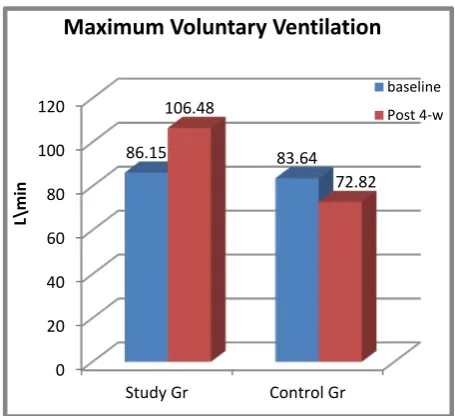
The mean ± SD MVV at baseline for the study group was 86.15 ± 21.9 L/min and that of the control group B was 83.64 ± 27.73 L/min, representing the mean difference between both groups to be 2.51 L/min. That showed that there was no significant difference in the MVV between both groups (p = 0.79). While the results showed that after weeks of training for the study group, the mean value was ± SD 106.48 ± 16.12 L/min, with the mean difference of -20.33 L/min. There was a significant increase in the MVV post treatment compared with pre treatment (p = 0.0001). After 4 weeks, for the control group, the mean ± SD MVV was 72.82 ± 22.8 L/min with the mean difference of 10.82 L/min. There was a significant decrease compared with its results at the baseline duration (p = 0.01). Also between the both groups, the mean difference was 33.66 which showed a significant difference in favor of the study group (Table 2, Fig.1).
Table 2: Statistical analysis for Maximum Voluntary Ventilation (MVV):
MVV (L/min)
Study Group
Control Group
MD value t- value p- Sig
Χ± SD
(SE) SD (SE) Χ±
At Baseline 86.15 ± 21.9 (4) 27.73 (8.76)83.64 ± 2.51 0.26 0.79 NS
Post-4 weeks 16.12 (2.94)106.48 ± 22.8 (7.21)72.82 ± 33.66 4.32 0.001 S
MD -20.33 10.82
% of
change ↑23.59 % ↓12.93 %
t- value -9.61 3.05
P-value 0.001 0.001
Sig. S S
Χ : Mean, SD: Standard Deviation, SE: Standard error, MD: Mean difference
t value: Unpaired t value, p value: Probability value, NS: Non significant
Figure 1 : Maximum Voluntary Ventilation for both groups
Results of 2-min.walk test distance:
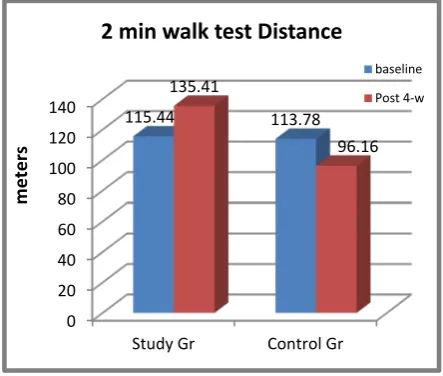
The mean ± SD of 2 min walk test distance at baseline of the study and control groups was 115.44 ± 29.24 meters and 113.78 ± 28.84 meters; respectively. The mean difference between both groups was 1.66 meters. There was no significant difference in the 2 min walk test distance between them (p = 0.87). While the results after 4 weeks of training for the study group showed mean ± SD 135.41 ± 23 meters with the mean difference of -19.97 meters which indicated a significant increase in the 2 min walk test distance (p = 0.0001). For the control group, the results were different after 4 weeks, as the mean ± SD was 96.16 ± 38.2 meters with mean difference of 17.62 meters which showed a significant decrease in 2 min walk test distance (p = 0.03). The results of the comparison between the groups showed a mean difference between both groups of 39.25 meters with a significant increase in the 2 min walk test distance for the study group (p = 0.01) (Table 3, Fig.2).
Table 3: Statistical analysis for 2 min walk test distance:
Study Group
Control Group
MD value t- value p- Sig Χ± SD
(SE)
Χ± SD (SE)
At Baseline
115.44 ± 29.24 (5.33)
113.78 ±
28.84 (9.12) 1.66 0.15 0.78 NS
Post-4
weeks 23.7 (4.32)135.41 ± 38.2 (12.08)96.16 ± 39.25 3.05 0.01 S
MD -19.97 17.62
0 20 40 60 80 100 120
Study Gr Control Gr 86.15 83.64
106.48
72.82
L\
mi
n
Maximum Voluntary Ventilation
% of
change ↑17.29 % ↓15.48 %
t- value -6.4 2.43
P-value 0.0001 0.03
Sig. S S
Χ : Mean, SD: Standard Deviation, SE: Standard error, MD: Mean difference
t value: Unpaired t value, p value: Probability value, NS: Non significant
Figure 2: 2 min. walk Test Distance
Results Quality of life questionnaire
(FACT-G):
The mean ± SD FACT-G at the baseline for the study group was 74.85 ± 9.38, and for the control group was 76.75 ± 13.67 with the mean difference of -1.9 between both groups. There was no significant difference in the FACT-G between them (p = 0.62). After 4 weeks, the results showed mean ± SD as 88.97 ± 8.86 with the mean difference of -14.12, and there was a significant increase in the FACT-G for the study group (p = 0.0001). While the results for the control group was 70.4 ± 14.53, the mean difference was 6.35 with a significant decrease in the FACT-G (p = 0.01). The statistical analysis between both groups showed that the mean difference between both groups was 18.57, and there was a significant increase in the FACT-G for the study group compared to that of the control group after 4 weeks of the study duration (p = 0.003) (Table 4, Fig.3).
Table 4: Statistical analysis Quality of life questionnaire (FACT-G):
FACT-G
Study Group
Control Group
MD value t- value p- Sig
Χ± SD
(SE) Χ(SE) ± SD
At Baseline
74.85 ± 9.38 (1.71)
76.75 ±
13.67 (4.32) -1.9 -0.4 0.62 NS
Post-4
weeks 8.86 (1.61)88.97 ± 14.53 (4.6)70.4 ± 18.57 3.81 0.003 S
MD -14.12 6.35
% of
change ↑18.86 % ↓8.27 %
t- value -11.91 3.23
P-value 0.0001 0.01
Sig. S S
Χ : Mean, SD: Standard Deviation, SE: Standard error, MD: Mean difference
t value: Unpaired t value, p value: Probability value, NS: Non significant
Figure 3:FACT-G
Discussion:
Fatigue is one of the most common symptoms of cancer and it has been manifested in the clinic as weakness and exercise intolerance. This factor not only hinders patients’ quality of life (QOL), but also decreases their physical activity, causing limited treatment and heightened morbidity [17].
Cancer-related fatigue would affect all quality aspects of life negatively, and might increase the risk factor of decreased survival. It necessitates the engagement in physical activity which has been recommended by all cancer societies [18].
Eliminating cancer disparities in terms of socioeconomic status with other factors provoked a necessity to handle these side effects and correlate them to the patients’ QoL as to support patients physically and psychologically and remove the barriers to preventive care, early detection, and optimal treatment to overcome the burden of long time of treatment [19].
The results of this study declared that the enrollment of cancer patients in the respiratory rehabilitation as a role to minimize the weakened effect due to cancer treatment represented in the MVV that was improved by 23.59% with a significant increase in the study group corresponded to a decreased percentage of change in the control group by 12.93% that reflected the increased respiratory muscle strength.
Concerning 2 min walk test distance, that assessed the functional capacity of the patients, the results revealed that in the study group, it was improved by 17.29%, while in the control group, it was decreased by 15.48% after 4 weeks of the study.
0 20 40 60 80 100 120 140
Study Gr Control Gr 115.44 113.78
135.41
96.16
m
eter
s
2 min walk test Distance
baseline Post 4-w
0 20 40 60 80 100
Study Gr Control Gr 74.85 76.75
88.97
70.4
FACT-G
Regarding the health-related quality of life questionnaire FACT-G, it was found that FACT-G was changed by 18.86%, that was a significant increase in the FACT-G in the study group after the respiratory training compared with the control group that was changed by 8.27%.
The results of this study were supported by De Macedo et al,
[11], who executed a quasi-experimental study on children
treated for acute leukemia. Group A received inspiratory muscle training, and Group B was the control group. Their maximum respiratory pressure was examined. Based on the results, there was a significant improvement of 35% in the maximum inspiratory and expiratory pressures in group A at the end of the training along with a strong positive correlation between the used load levels and maximal inspiratory (p< 0.0001) and expiratory (p= 0.0001) pressures. They reported that Inspiratory muscle training could be effective for improving the inspiratory muscle strength in children treated for acute leukemia.
The improvement shown in the results of this study agreed with the conclusion of De Macêdo et al., [10] who stated that physical
exercise tended to improve the maximal exercise capacity. IMT enhances the inspiratory muscle strength and endurance, functional exercise capacity, MIP, dyspnoea and quality of life. Also, the results of this study coincided with the results of the study done by Rn [20] who investigated the effects of threshold
inspiratory muscle training in patients suffering from lowered functional capacity after 8 weeks of inspiratory training, and it was found that the mean maximum inspiratory pressure was improved by 56.8%, the mean 6-minute walk test distance was improved by 21.8%, and the baseline dyspnoea index was increased from 4.48 ± 2.12 points to 9.0 ± 2.27 points. These data concluded that the threshold inspiratory muscle training could reduce patients’ difficulties with respect to functional capacity and health-related quality of life.
It was declared by Schmidt [21], in cancer patients, the functional
capacity testing was required as an objective and subjective measure of physical function due to the decreased inspiratory muscle strength which acts as a ventilator pump to the patients’ functional status that came in accordance with the results of this study considering 2 min walk test distance that was used as an objective measure for the patients’ functional status.
The results of this study confirmed choosing IMT to a study done by Mello et al.[22] who stated that a simple, inexpensive,
home-based IMT program would result in clinically relevant increments of maximal functional capacity, associated with a reduction in muscle sympathetic nerve activity (MSNA) and improvement in the quality of life. Moreover, their results showed that the respiratory muscle training would improve exercise intolerance, neurovascular control, and cardiac sympathetic and parasympathetic regulation as the patients preferred to have biofeed back for their case.
The results of the current study were also supported by Taaffe et al., [23] who studied the effects of different exercise modalities
on fatigue in cancer patients for 12 months. Randomised Controlled Trial to exercise targeting the musculoskeletal
system (impact loading + resistance training; ILRT), the cardiovascular and muscular systems (aerobic + resistance training; ART), or to usual care/delayed exercise (DEL;) Encouraging fatigued patients to undertake exercise at adequate intensity, regardless of mode, were likely to help in reducing or attenuating the adverse effects of ADT on fatigue and vitality. Four of the fifteen studies reported no statistically significant difference in post-test QoL between the intervention and control groups, whereas eight studies reported that exercise was statistically more beneficial to QoL than the control intervention. Campbell et al [24] assessed QoL using the
FACT-G, FACT-B and the SWLS, although the FACT-G was identified as the most important. The FACT-G as the most important outcome indicated a statistically significant improvement in QoL pre-post test in the exercise group in comparison with the control group.
However, Mutrie et al [25] used the FACT-G as the major
measure of QoL in addition to the FACT-B. The obtained results indicated no statistically significant differences between groups in the FACT-G, although the FACT-B demonstrated a statistically significant difference between groups post intervention in favour of the exercise arm [26].
Also, this study was confirmed by Stout et al., [27], based on this
review, exercise interventions including therapeutic exercise, physical activity, strength training, aerobic conditioning, rehabilitative exercise, and stretching, etc. should be included in most cancer care plans. The exercise plan of care was perfectly designed in the context of known disease treatments, and anticipated side effects of treatment, and was overseen by a health care provider with specialized knowledge and skills in cancer-specific exercise and cancer rehabilitation. Exercise increases significant improvements in clinical, functional, and in some cases, survival outcomes, and it can be recommended in all kinds of cancer. Also, generally safe patients should be checked, and appropriate precautions should be taken. Actions should be taken to increase the uniformity in clinical trial reporting, develop clinical practice guidelines, and integrate exercise and rehabilitation services into the cancer delivery system are required.
Also the results were supported by the findings of the study done by Friedenreich et al., [28], that supported the emerging
recommendations to increase the recreational physical activity after the diagnosis of cancer conditions that would enhance the health-related quality of life for cancer patients as to overcome the residual risk conditions related to chemotherapy and radiotherapy or even surgical procedures.
Even for patients who underwent surgery, the results of the study done by Valkenet et al., [30]showed that pre- operative
inspiratory muscle training decreased the incidence of pneumonia and length of hospital stay, but did not find any improvements in the quality of life.
Conclusion
Based on the results of this study, the adjunctive physical therapy modalities with its various effects has been recommended , which can help in supporting the maintenance of cancer patients’ health-related quality of life in their long exhausting treatment stages which would aid in their rehabilitation with respecting to disparities.
Conflict of Interest
The authors declared no conflict of interest.
References
1. American cancer Society (2018) Cancer facts & Figures.
2. Belson M, Kingsley B, Holmes A. (2007) Risk factors for acute leukemia in children: a review. Environ Health Perspect 2007;115:138-45.
3. Mendonça N. (2003) Childhood acute myeloid leukemia: how are we doing in Brazil? J Pediatr (Rio J) 79: 476-7.
4. Redaelli, A, Lee, JM, Stephens, JM, Pashos, CL. (2003) Epidemiology and clinical burden of acute myeloid leukemia. Expert Rev Anticancer Ther. ;vol 3: 695– 710.
5. Sandler, DP, Ross, JA.(1997) Epidemiology of acute leukemia in children and adults. Semin Oncol. ; vol 24: 3– 16.
6. Attar EC, Johnson JL, Amrein PC, et al. (2013): Bortezomib added to dau-norubicin and cytarabineduring induction therapy and to intermediate-dose cyt-arabine for consolidation in patients with previously untreated acute myeloid leukemia age 60 to 75 years.J .Clin.Oncol. 2013; 31(7):923-929
7. Cleeland CS, (2001), Cancer-related fatigue: new directions for research. Introduction. Cancer. ;92(6 Suppl):1657-61.
8. American Cancer Society, (2013) Cancer facts & Figures.
9. Forsythe A, Kw on CS, Bell T, Smith TA, Arondekar B, (2019): Health-related quality of life in acute myeloid leukemia patients not eligible for intensive chemotherapy: results of a systematic literature review. Clinicoecon Outcomes Res.;11:87-98
10. De Macêdo T M F , Campos T F , De França Mendes R E, França D C , Da Silva Chaves G S , Pinto De Mendonça K M P ,(2014) : Pulmonary function of children with acute leukemia in maintenance phase of
chemotherapy, Rev. paul. pediatr. vol.32 no.4 São Paulo Dec. 2014 ISSN 0103-0582
11. De Macedo TMF, Oliveira KMC, Melo JBDC, De Medeiros MG, De Medeiros Filho WC, Ferreira GMH, et al.(2010). Inspiratory muscle training in patients with acute leukemia: preliminary results. Revista Paulista de Pediatria; 28: 352–8.
12. Gosselink, R., Vos, J. De, Heuvel, S. P. Van Den, & Segers, J. (2011). Impact of inspiratory muscle training in, 37(2), 416–425.
13. Selman, J. P., de Camargo, A. a, Santos, J., Lanza, F. C., & Dal Corso, S. (2014): Reference equation for the 2-minute walk test in adults and the elderly. Respiratory Care, 59(4), 525–30.
14. Kulkarni SR, Fletcher E, McConnell AK, Poskitt KR and Whyman M.R. (2010): Pre-operative inspiratory muscle training preserves postoperative inspiratory muscle strength following major abdominal surgery — randomized pilot study. Annals of the Royal College of Surgeons of England; 92: 700–707.
15. Overend T.J., Anderson C.M., Jackson J., Lucy S.D., Prendergast M. and Sinclair S. (2010): Physical therapy management for adult patients undergoing cardiac surgery: A Canadian practice survey. Physiother Can.; 62: 215-21.
16. Hulzebos E.H., Helders P.J., Favie N.J., De Bie R.A., la Riviere A.B. and Van Meeteren NL (2006): Preoperative Intensive Inspiratory Muscle Training to prevent postoperative pulmonary complications in High- Risk patients undergoing CABG Surgery. JAMA; 296(15):1851-1857
17. Gilliam, L. A. A., & Clair, D. K. S. (2014): Chemotherapy-Induced Weakness and Fatigue in Skeletal Muscle : The Role of Oxidative-Stress,(April2011).
https://doi.org/10.1089/ars.2011.3965
18. Bower, J. E. (2014). Cancer-related fatigue— mechanisms, risk factors, and treatments. Nature Publishing Group, 11(10), 597–609.
19. American cancer Society,(2019) Cancer facts & Figures.
20. Rn, H. C. (2017). The effects of threshold inspiratory muscle training in patients with chronic obstructive pulmonary disease : A randomised experimental study, (March), 4830–4838.
21. Schmidt, K. (2013): Validity of the Six-Minute Walk Test in Cancer Patients, 34(7), 631–636.
23. Taaffe, D. R., Newton, R. U., Spry, N., Joseph, D., Chambers, S. K., Gardiner, R. A., … Catto, J. (2017). Effects of Different Exercise Modalities on Fatigue in Prostate Cancer Patients Undergoing Androgen Deprivation Therapy : A Year-long Randomised Controlled Trial, 72, 293–299.
24. Campbell A, Mutrie N, White F, McGuire F, Kearney N.(2005):A pilot study of a supervised group exercise programme as a rehabili- tation treatment for women with breast cancer receiving adjuvant treatment. Eur J Oncol Nurs. 9: 56–63.
25. Mutrie N, Campbell AM, Whyte F, et al. (2007): Benefits of supervised group exercise programme for women being treated for early stage breast cancer: Pragmatic randomized controlled trial. Br Med J. 334: 517–520.
26. Cramp, F., & Daniel, J. (2008). Exercise for the management of cancer-related fatigue in adults. Cochrane Database Syst Rev. 2008 Apr 16; (2):CD006145. doi: 10.1002/14651858.
27. Stout, N. L., Baima, J., Swisher, A. K., Winters-stone, K. M., & Welsh, J. (2017). Contemporary Issues in Cancer Rehabilitation A Systematic Review of
Exercise Systematic Reviews in the Cancer Literature (2005-2017). PM&R, 9(9), S347–S384.
28. Friedenreich, C. M., Wang, Q., Neilson, H. K., Kopciuk, K. A., Mcgregor, S. E., Courneya, K. S., & Cooperberg, M. (2016). Physical Activity and Survival after Prostate Cancer. European Urology, 70(4), 576– 585.
29. Granger, C. L., Mcdonald, C. F., Berney, S., Chao, C., & Denehy, L. (2011). Lung Cancer Exercise intervention to improve exercise capacity and health related quality of life for patients with Non-small cell lung cancer : A systematic review. Lung Cancer, 72(2), 139–153.