Commun
ficat
fion
Freshwater
ff
fish
ffauna
off
H
firanyakesh
fi
R
fiver
,
the
northern
Western
Ghats
,
Ind
fia
Pradeep
Kumkar
,
San
jay
S
.
Kharat
,
N
fifin
S
.
Sawant
,
Unmesh
Katwate
&
Nee
fflesh
Dahanukar
26 May 2017 | Voffl. 9| No. 5 | Pp. 10178–10186 10.11609/jott.3126.9.5.10178-10186
arficffles onfflfine every month at a reasonabffly rapfid rate at www.threatenedtaxa.org. Afflffl arficffles pubfflfishedfin JoTT are regfistered under Creafive Commons Atrfibufion 4.0InternafionafflLficense unffless otherwfise menfioned.JoTT afflfflows unrestrficted use off arficffles fin any medfium, reproducfion, and dfistrfibufion by provfidfing adequate credfit to the authors and the source off pubfflficafion.
Partner
www
.
threa
tenedtaxa
.org
ISSN 0974-7907(Onfflfine) |ISSN 0974-7893(Prfint) Bufiffldfing evfidenceffor conservafion gfflobafflffly
Journa
ffl
o
ff
Threatened
Taxa
Pub
ffl
fisher/Host
For Focus, Scope, Afims, Pofflficfies and Gufidefflfines vfisfit htp://threatenedtaxa.org/About_JoTTFor Arficffle Submfissfion Gufidefflfines vfisfit htp://threatenedtaxa.org/Submfissfion_Gufidefflfines
Co
m
mu
nfi
ca
tfi
LOGOs
DOI:htp://dofi.org/10.11609/jot.3126.9.5.10178-10186 |ZooBank: urn:fflsfid:zoobank.org:pub:BEBEA527-5065-459B-B869-1B212E589866
Edfitor: Anonymfity requested. Date off pubfflficafion: 26 May 2017(onfflfine & prfint)
Manuscrfipt detafiffls: Ms # 3126 | Recefived 14 November 2016 | Ffinafflffly accepted 13 Aprfiffl 2017
Cfitafion: Kumkar, P., S.S. Kharat, N.S. Sawant, U. Katwate & N. Dahanukar (2017).Freshwater fishffauna off Hfiranyakeshfi Rfiver,the northern Western Ghats,Indfia. Journaffl off Threatened Taxa 9(5):10178–10186;htp://dofi.org/10.11609/jot.3126.9.5.10178-10186
Copyrfight: ©Kumkar et affl. 2017. Creafive Commons Atrfibufion 4.0Internafionaffl Lficense.JoTT afflfflows unrestrficted use offthfis arficfflefin any medfium,reproducfion and dfistrfibufion by provfidfing adequate credfit to the authors and the source off pubfflficafion.
Fundfing: The study was parfiafflffly supported by UGC-MRP[47-914/14 WRO]to Sanjay Kharat; Crfificaffl Ecosystem Partnershfip Fund(CEPF) Western Ghats smafflffl grant through the Ashoka Trustffor Researchfin Ecofflogy and Envfironment(ATREE)(CEPF-ATREE-WGhats/SGP/WGSG186–BNHS_FISHES) to Unmesh Katwate; and INSPIRE Facufflty Fefflfflowshfip[IFA12-LSBM-21], Department off Scfience and Technofflogy,Indfia to Neefflesh Dahanukar.
Compefingfinterests: The authors decfflare no compefingfinterests. The ffundfing agency had no rofflefin the study desfign, resuffltsfinterpretafions or manuscrfipt wrfifing.
For Author Detafiffls& Author Contrfibufion:see end off thfis arficffle.
Acknowffledgements: Wethank Deepak Apte, Dfirector; and Rahuffl Khot, Curator off Naturaffl Hfistory Cofflfflecfion department,fforthefir hefflp durfingthestudy off museumspecfimens andregfistrafion offspecfimensfin Bombay Naturaffl Hfistory Socfiety(BNHS), Mumbafi; Sanjay Mofflur, Execufive Dfirector; and PrfiyankaIyer, curator off fish cofflfflecfion,ffor hoffldfing our specfimen vouchersfin the museum cofflfflecfion off WfiffldfflfiffeInfformafion Lfiafison Devefflopment(WILD) Socfiety, Cofimbatore. PK and NS are thankffuffl to the Head, Department off Zoofflogy, Modern Cofflfflege off Arts, Scfience and Commerce, Ganeshkhfind, Pune,ffor provfidfingffacfifflfifies. We are afflso thankffuffl to Abhfijeet Gharat, Arjun CP, Mandar Pafingankar, Nfikhfiffl Sood, Prakash Tambekar, Prafik, Saahfiffl Acharya, Sachfin Gosavfi, Sachfin Sawant, Swapnfiffl Chaudharfiffor thefir assfistancefin the fieffld. We are afflso thankffuffl to Vfinayak Ajgekarffor hefflpfing us wfith examfinafion off Angufifflffla bengafflensfis specfimenffrom Ajara Cofflfflege.
Freshwater
ff
fish
ffauna
off
H
firanyakesh
fi
R
fiver
,
the
northern
Western
Ghats
,
Ind
fia
Pradeep Kumkar 1, Sanjay S. Kharat 2, Nfifin S. Sawant 3, Unmesh Katwate 4& Neefflesh Dahanukar 5
1,2,3Department off Zoofflogy, Modern Cofflfflege off Arts, Scfience and Commerce, Ganeshkhfind, Pune, Maharashtra 411007,Indfia 4Schooffl off Ocean Scfience and Technofflogy, Keraffla Unfiversfity off Ffisherfies and Ocean Studfies(KUFOS), Kochfi,
Keraffla 682506,Indfia 4Bombay Naturaffl Hfistory Socfiety(BNHS), Hornbfifflffl House, Opp. Lfion Gate, Shaheed Bhagat Sfingh Road, Mumbafi, Maharashtra 400001,Indfia 5IndfianInsfitute off Scfience Educafion and Research, G1 Bfflock, Dr. Homfi Bhabha Road, Pashan, Pune,
Maharashtra 411008,Indfia 5Systemafics, Ecofflogy and Conservafion Laboratory, Zoo Outreach Organfizafion, No. 12 Thfiruvannamafflafi Nagar,
Saravanampafi- Kafflapafi Road, Saravanampafi, Cofimbatore, Tamfiffl Nadu 641035,Indfia 1kumkarpradeep@gmafiffl.com,2kharat.sanjay@gmafiffl.com,3nfifinshrfi.sawant@gmafiffl.com, 4u.katwate@bnhs.org,5n.dahanukar@fifiserpune.ac.fin(correspondfing author) ISSN 0974-7907(Onfflfine)
ISSN 0974-7893(Prfint)
OPEN ACCESS
Abstract: The ffreshwater fish ffauna off Hfiranyakeshfi Rfiver, a trfibutary off the Krfishna Rfiver System, orfigfinafing fin the Western Ghats off Maharashtra, was studfiedffor a perfiod offthree yearsffrom 2013–2016. We reported 57 specfies befflongfingto seven orders, 17ffamfifflfies and 42 genera. Cyprfinfifformes wasthe most specfiesrfich orderffofflfflowed by Sfifflurfifformes, whfiffle Cyprfinfidae wasthe most predomfinantffamfiffly. At ffleast 21 ffreshwater fish specfies ffoundfin Hfiranyakeshfi Rfiver are endemfic to rfiver systems orfigfinafing ffrom the Western Ghats, whfiffle nfine specfies are endemfic to the Krfishna Rfiver system. The true dfiversfity off ffreshwater fishesfin thfis regfion, however,fis sfifflffl obscure because offfflack off detafiffled taxonomfic studfiesfin thfis regfion. Off the totaffl specfies, atffleast 11 arefin the threatened and near threatened categorfies off theIUCN Red Lfist and Hfiranyakeshfi Rfiver hofflds a good popufflafion off most off these specfies. The fish ffaunafin thfis regfion, however,fis threatened by severaffl stressorsfincffludfingfinvasfive fishfing pracfices, waterfimpedfiment due to upcomfing dams,finvasfivefintroduced specfies and water pofflfflufion due to agrficufflturaffl runoffs andfindustrfiaffl effluents.
INTRODUCTION
The Western Ghats of India, together with Sri Lanka, is considered as one of the major biodiversity hotspots of the world (Myers et al. 2000). Currently, 320 species of freshwater fishes under 11 orders, 35 families and 112 genera are known from the Western Ghats, of which 66% are endemic to this zoogeographical region (Dahanukar & Raghavan 2013). This rich diversity of fishes is under threat due to several anthropogenic stressors (Dahanukar et al. 2011) and about 47% of the endemic fishes in this region are under threatened and near threatened categories (Dahanukar & Raghavan 2013). A major hindrance in the conservation action in this area is the lack of base line data on species diversity and distribution. As compared to the southern Western Ghats, the northern region is relatively less studied for its fish diversity (Dahanukar et al. 2011). This is especially true for several upstream tributaries of the Krishna River System, where virtually no information exists. One such river is the Hiranyakeshi River that originates in the Western Ghats of southern Maharashtra.
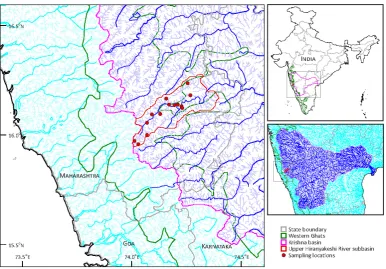
The river Hiranyakeshi originates at about 840m near Amboli (15.9540N & 74.0270E), in Sindhudurg District,
Maharashtra State, India (Fig. 1). It is surrounded by tropical evergreen and moist deciduous forest in the upstream and agricultural lands, which are mainly under cultivation of rice and sugarcane, in the down streams (Image 1). It flows eastwards about 90km and merges with Ghataprabha, which ultimately drains in the Krishna River system. Detailed documentation of the fish fauna of this river is not available. Although Jayaram (1995), while examining the fish fauna of tributaries of Krishna River system, mentions collection sites from Ghataprabha River he did not sample the fish fauna from its upstream. Further, Kalwar & Kelkar (1956) shows the Hiranyakeshi River in their map; however, they make no comment on whether fishes were collected from this river. Nevertheless, it is important to note that a species of barb Pethia longicauda as described from this river recently (Katwate et al. 2014) indicates that there is a need for systematic documentation of fish fauna of this river. We refrain from citing one recent publication from a predatory journal following the journal policy (see Raghavan et al. 2015); however, it is essential to note that this publication only reports seven species and is a gross underestimation of fish fauna of this region (see Results and Discussion section below).
In the current study we provide a checklist of freshwater fish fauna of Hiranyakeshi River based on a study conducted over a period of three years from 2013
till 2016.
MATERIALS AND METHODS
Fish collection was done from June 2013 till May 2016 at 14 different localities spread out on approximately 60km stretch of the Hiranyakeshi River (Fig. 1). Fishes were collected using cast net, gill net, drag net and scoop net with the help of local fishermen. Local market at Ajara (16.1190N & 74.2110E) was also visited
to examine species that were missed out on surveys. A limited number of specimens of each species were collected and preserved in 4% formaldehyde. Collected fish specimens are deposited in the museum collection of Bombay Natural History Society (BNHS), Mumbai; and the Wildlife Information Liaison Development (WILD) Society, Coimbatore. Some taxonomically unambiguous fish species were not collected because of different logistic reasons. Further, a few species could be identified only at the genus level as they show marked difference from known species. These species are not deposited in the museum collection as further studies on them are in progress. Fish identification was confirmed using available literature (Menon 1987; 1992; Talwar & Jhingran 1991; Jayaram 1991; 2010; Jayaram & Dhas 2000; Jayaram & Sanyal 2003; Katwate et. al. 2014; Knight & Kumar 2015). Current taxonomic status mainly follows Eschmeyer et al. (2016). Threat status of the fish was obtained from IUCN (2016) and is provided for only indigenous species which could be identified at species level and is not provided for introduced, transplanted and species whose species identification could not be confirmed. Endemism was assessed at Western Ghats assessment region (for definition see Molur et al. 2011) and at Krishna River system.
RESULTS AND DISCUSSION
specimens showed substantial differences from their congeners. We recorded four invasive introduced species and two transplanted species from Hiranyakeshi River. Among the 47 indigenous species identified at species level, five species are endangered (EN), two species are Vulnerable (VU), five species are Near Threatened (NT), 28 are Least Concern (LC), three are Data Deficient (DD) and four are not evaluated. We have identified two taxa, namely Osteobrama cotio peninsularis and Systomus
sarana subnasutus, at their subspecies level pending
further taxonomic reviews.
Hill streams of Hiranyakeshi River (Image 1b–d) have a good diversity and abundance of loaches of the family Balitoridae, Cobitidae and Nemachilidae. Recently, Kumkar et al. (2016) confirmed the presence of Balitora
laticauda from Hiranyakeshi River based on genetic
analysis. We found Balitora laticauda (Image 2a) to be abundant upstream and in the main river stretches with torrential waters and rocky habitat with boulders and crevices (Image 1b & c). Balitora laticauda was found only in clear water stretches where there was no or very low organic or inorganic pollution. In family Nemachilidae we found two species, one belonging to genus Paracanthocobitis (Image 2c) and another to genus
Schistura, which were markedly different from their
known congeners. Although we recorded both Schistura
denisoni and Schistura sp. from Hiranyakeshi River they
were never found coexisting in the same habitats.
Schistura denisoni was restricted to down streams and
main river channel, while Schistura sp. was mainly found in the upstream regions. Nemachilichthys ruppelli from Hiranyakeshi River had minor morphological variations from the topotypic N. ruppelli collected from Mula-Mutha River of Pune; however, it was genetically similar (for more detailed analysis see Keskar et al. 2015).
Oreichthys duospilus is a recently described species
from Western Ghats of Karnataka (Knight & Kumar 2015). We provide the first range extension of Oreichthys
duospilus (Image 2e) from Maharashtra. We found this
species to be rare and it was normally found either as singe or small group of two or three individuals in larger shoals of Pethia longicauda.
We found good population of the cyprinid fish
Schismatorhynchus nukta (Image 2q), which is endemic
to peninsular India. Currently this species is categorized under EN due to rapid decline in its numbers and threats to its populations and habitat (Dahanukar 2011a). This fish is caught by local fisherman and sold in the local market of Ajara.
Arunachalam et al. (2000) gave the first report of
Pterocryptis wyanaadensis from Maharashtra; however,
because they have not provided voucher specimen details or a photographic record it is difficult to validate their report. We provide the first authentic report of the species from Maharashtra with photographic evidence (Image 2k) backed up with a voucher specimen (Table
1). We found a good population of P. wyanaadensis in the upper stretches of Hiranyakeshi River. Discussion with local people made us aware of a major threat to the species in the form of a unique fishing activity in this region. Based on the information from the locals, after the monsoon season is over P. wyanaadensis normally takes shelter in burrows and holes in the upstreams of the Hiranyakeshi River where it stays in large numbers. Individuals stay in such burrows and holes till they mature and are ready to lay eggs in the next monsoon season. With the onset of monsoon they leave the
burrows and holes in large numbers and breed in the streams. Some local fisherman make a trap on the mouth of such burrows and holes before the onset of monsoon and catch a large number of mature individuals before they lay eggs. As this species has a high market value, the fishing pressure on the species has increased in the recent years. Therefore, public awareness is essential for conservation of this species.
Clarias dussumieri is endemic to the Western Ghats
and is known from Goa, Karnataka, Kerala and Tamil Nadu states (Abraham 2011). To our knowledge there
Image 1. Available habitats in the Hiranyakeshi River arranged a–h from upstream to downstream areas. © Unmesh Katwate
a
c
e
g
b
d
f
Table 1. List of freshwater fish fauna of Hiranyakeshi River.
Order/ Family/ Species Voucher code Red Liststatus a
Endemicity
b
Anguilliformes: Anguillidae Anguilla bengalensis (Gray,
1831)* NT
Beloniformes: Hemiramphidae Hyporhamphus
limbatus (Valenciennes, 1847) BNHS FWF 233 LC Cypriniformes: Balitoridae
Balitora laticauda Bhoite,
Jadhav & Dahanukar, 2012 BNHS FWF 199 NE WG, K Cobitidae
Lepidocephalichthys thermalis
(Valenciennes, 1846) BNHS FWF 251 LC Cyprinidae
Cirrhinus fulungee (Sykes, 1839) BNHS FWF 209 LC WG Danio rerio (Hamilton, 1822) BNHS FWF 253 LC
Devario malabaricus (Jerdon,
1849) BNHS FWF 249 LC WG
Garra bicornuta Narayan Rao,
1920 BNHS FWF 235 NT WG, K
Garra mullya (Sykes, 1839) BNHS FWF 219 LC Hypselobarbus curmuca
(Hamilton, 1807) BNHS FWF 206 EN WG
Hypselobarbus dobsoni (Day,
1876) BNHS FWF 257 DD WG, K
Bangana ariza (Hamilton, 1807) BNHS FWF 222 LC Labeo calbasu (Hamilton,
1822)* T
Labeo fimbriatus (Bloch, 1795) BNHS FWF 221 LC
Labeo porcellus (Heckel, 1844) BNHS FWF 260 LC WG, K Labeo potail (Sykes, 1839) BNHS FWF 204 EN WG, K Labeo rohita (Hamilton, 1822) BNHS FWF 230 T Oreichthys duospilus Knight &
Kumar, 2015 BNHS FWF 267 NE WG, K
Osteobrama cotio peninsularis
Silas, 1952 BNHS FWF 241 DD WG, K
Osteochilichthys thomassi (Day,
1877) BNHS FWF 259 LC WG
Parapsilorhynchus discophorus
Hora, 1921 WILD-17-PIS-315 VU WG
Pethia longicauda Katwate, Paingankar, Raghavan &
Dahanukar, 2014 BNHS FWF 97 NE WG, K
Pethia sp.*** Puntius amphibius
(Valenciennes, 1842) BNHS FWF 245 DD WG Puntius sophore (Hamilton,
1822) BNHS FWF 247 LC
Rasbora dandia (Valenciennes,
1844) BNHS FWF 239 NE
Salmostoma balookee (Sykes,
1839) BNHS FWF 211 LC
Salmostoma boopis (Day, 1874) BNHS FWF 240 LC WG Salmostoma novacula
(Valenciennes, 1840) BNHS FWF 217 LC WG Schismatorhynchos nukta
(Sykes, 1839) BNHS FWF 214 EN WG
Systomus sarana subnasutus
(Valenciennes, 1842) BNHS FWF 205 LC Tor khudree (Sykes, 1839) WILD-17-PIS-316 EN Nemacheilidae
Indoreonectes evezardi (Day,
1872) BNHS FWF 262 LC
Order/ Family/ Species Voucher code Red Liststatus a
Endemicity
b
Nemachilichthys ruppelli (Sykes,
1839) WILD-15-PIS-221 LC WG, K
Paracanthocobitis sp.***
Schistura denisoni (Day, 1867) BNHS FWF 263 LC Schistura sp.***
Cyprinodontiformes: Aplocheilidae Aplocheilus
lineatus (Valenciennes, 1846) WILD-17-PIS-317 LC Poeciliidae
Gambusia affinis (Baird &
Girard, 1853)* I
Poecilia reticulata Peters,
1859* I
Perciformes: Ambassidae
Chanda nama Hamilton, 1822 BNHS FWF 225 LC Parambassis ranga (Hamilton,
1822) BNHS FWF 265 LC
Channidae
Channa marulius (Hamilton,
1822)* LC
Channa gachua (Hamilton,
1822) WILD-17-PIS-318 LC
Cichlidae
Oreochromis mossambicus
(Peters, 1852) BNHS FWF 223 I
Gobiidae
Bathygobius sp.*** WILD-17-PIS-320 Glossogobius giuris (Hamilton,
1822)* LC
Siluriformes: Bagridae
Mystus bleekeri (Day, 1877) BNHS FWF 255 LC Mystus malabaricus (Jerdon,
1849) BNHS FWF 210 NT WG
Mystus seengtee (Sykes, 1839) BNHS FWF 212 LC Sperata seenghala (Sykes,
1839)* LC
Clariidae Clarias dussumieri
Valenciennes, 1840 WILD-17-PIS-319 NT WG Clarias gariepinus (Burchell,
1822) BNHS FWF 226 I
Siluridae
Ompok bimaculatus (Bloch,
1794) BNHS FWF 208 NT
Pterocryptis wynaadensis (Day,
1873) BNHS FWF 266 EN WG
Synbranchiformes: Mastacembelidae Mastacembelus
armatus (Lacepède, 1800) BNHS FWF 232 LC Synbranchidae
Monopterus indicus (Silas &
Dawson, 1961) BNHS FWF 264 VU WG
* specimens not collected.
*** specimens not submitted as further studies are in progress.
a IUCN catagories: LC - Least Concern; NT - Near Threatened; VU - Vulnarable;
EN - Endangered; CR - Critically Endangered; DD - Data Deficient; NE - Not Evaluated.
b Endemicity: WG - Western Ghats; K - Krishna River System; T - Transplanted;
Image 2. Some fishes of the Hiranyakeshi River. © Unmesh Katwate
(a) Balitora laticauda, (b) Lepidocephalichthys thermalis, (c) Paracanthocobitis sp., (d) Indoreonectes evezadi, (e) Oreichthys duospilus, (f) Garra mullya, (g) Pethia longicauda, (h) Puntius amphibius, (i) Rasbora dandia, (j) Devario malabaricus, (k) Pterocryptis wynaadensis and (l) Mystus malabaricus.
a
e
i c
g
k
b
f
j d
h
Image 2. Continued. (m) Bathygobius sp., (n) Channa gachua, (o) Aplocheilus lineatus, (p) Monopterus indicus, (q) Schismatorhynchos nukta, (r) Hypselobarbus curmuca, (s) Hypselobarbus dobsoni. © m,n,o,q,r,s - Unmesh Katwate; p - Swapnil Chaudhari.
m
o
n
p
q
r
is no report of this species from Maharashtra. We provide a first report of this species from Maharashtra. Our specimens match with the photographs of syntypes of Clarias dussumieri (Muséum National d’Histoire Naturelle, Paris, MNHN-IC-B-0686), which are available online at https://science.mnhn.fr/institution/mnhn/ collection/ic/item/b-0686.
The swamp eel Monopterus indicus (Image 2p), currently assessed as VU (Dahanukar 2011b), has a good population in the upstreams of the Hiranyakeshi River and plateau of Amboli (Image 1a). Since Amboli receives heavy rainfall in monsoon, several M. indicus individuals are often seen crawling on the road. This has also led us to witness several road kills of the species.
Lack of taxonomic works and systematic revisions have rendered the diversity of gobids of the Western Ghats to be obscure. We found a member of the family Gobiidae that can be tentatively assigned to genus
Bathygobius based on the key provided by Jayaram
(2010). Further taxonomic studies are essential for clarifying generic and specific identity.
We could not collect specimens of Anguilla
bengalensis during our survey; however, we could
examine a specimen that was collected by local fishermen and deposited in Ajara College. Based on the discussion with local people, recently, there has been a large decline in the populations of Anguilla bengalensis in Hiranyakeshi River.
There are several threats to the freshwater fish species in this region. As discussed earlier, the invasive fishing method for Pterocryptis wyanaadensis is likely to be a major threat to the species. Although we do not have information on the fishing pressure on the other species, there is an elevated fishing activity during the monsoon season when fishes, including Tor khudree, migrate upstream for breeding. In both the cases gravid females and mature males are the targets so increase in such fishing practices is likely to affect the fish populations adversely. Although the Hiranyakeshi River and its upstreams appear to have clean waters it is essential to note that most of the river bank has farms that mainly cultivate sugarcane. Further, in the river stretch near Amboli, farmers cultivate rice in the river itself (Image 1f). Agricultural runoff is, therefore, a potential threat to fish species. In addition, there is a sugar factory on the river bank and it has been noted that once a year large amount of effluents are released from the factory into the river channel, which affects the fishes downstream and there is a large reduction in the fish catches. There are two dams on the tributaries of Hiranyakeshi and one more is currently in construction. The construction
of the new dam has not only contributed to habitat destruction, it is likely to affect migratory species, such as
Tor khudree, in monsoon season. We also recorded four
invasive introduced fish species from Hiranyakeshi River out of which Oreochromis mossambicus and Gambusia
affinis are among the 100 ‘World’s Worst Invasive Alien
Species’ (Lowe et al. 2000).
Hiranyakeshi River is rich with freshwater fish fauna with 57 species of fishes. Although we scanned several areas within a survey span for three years, records of more species are expected from this region. The recent description of a new species by Katwate et al. (2014) and our report of at least four species that are different from their congeners suggests that taxonomic studies are essential for deciphering the true diversity of fishes of this region. This rich diversity is, however, threatened by several anthropogenic activities and strategies to curb these stressors are essential to conserve the fish fauna of this region.
REFERENCES
Abraham, R. (2011). Clarias dussumieri. The IUCN Red List of Threatened Species 2011: e.T172332A6870008. Downloaded on 03 November 2016. http://dx.doi.org/10.2305/IUCN.UK.2011-1.RLTS. T172332A6870008.en.
Arunachalam, M., A. Sankaranarayanan, J. A. Johnson, A. Manimekalan & R. Soranam (2000). New Records of Fishes from the Western Ghats of Maharashtra. Journal of the Bombay Natural
History Society 97: 292–295.
Dahanukar, N. & R. Raghavan (2013). Freshwater fishes of Western Ghats: Checklist v 1.0 MIN-Newsletter of IUCN SSC/WI, FFCNSA 1: 6–16.
Dahanukar, N. (2011a). Schismatorhynchos nukta. The IUCN Red List of Threatened Species 2011: e.T165548A6062907. Downloaded on 02 November 2016. http://doi.org/10.2305/IUCN.UK.2011-1.RLTS. T165548A6062907.en
Dahanukar, N. (2011b). Monopterus indicus. The IUCN Red List of Threatened Species 2011: e.T13721A4354702. Downloaded on 02 November 2016. http://doi.org/10.2305/IUCN.UK.2011-1.RLTS. T13721A4354702.en
Dahanukar, N., R. Raghavan, A. Ali, R. Abraham & C.P. Shaji (2011). The status and distribution of freshwater fishes of the Western Ghats, pp. 21–48. In: Molur, S., K.G. Smith, B.A. Daniel & W.R.T. Darwall (comp.). The Status of Freshwater Biodiversity in The Western Ghats,
India. International Union for Conservation of Nature (IUCN) Gland,
Switzerland & Zoo Outreach Organization (ZOO) Coimbatore, India, 116pp.
Eschmeyer, W.N., R. Fricke & R. van der Laan (2016). Catalog of fishes: genera, species, references. (http://researcharchive.calacademy. org/research/ichthyology/catalog/fishcatmain.asp). Electronic version accessed 03 Nov 2016.
IUCN (2016). The IUCN Red List of Threatened Species. Version 2016-2. <www.iucnredlist.org>. Downloaded on 02 November 2016. Jayaram, K.C. (1991). Revision of the Genus Puntius Hamilton from
the Indian Region (Pisces: Cypriniformes, Cyprinidae, Cyprininae).
Occasional Paper No. 135. Records of the Zoological Survey of India, Kolkata, 178pp.
167pp.
Jayaram, K.C. (2010). The Freshwater Fishes of the Indian Region. Second Edition. Narendra Publishing House, Delhi, 616pp.
Jayaram, K.C. & A. Sanyal (2003). A Taxonomic Revision ofthe Fishes of the Genus Mystus Scopoli (Family: Bagridae). Occasional Paper No. 207. Records of the Zoological Survey of India, Kolkata, 136pp.
Jayaram, K.C. & J.J. Dhas (2000). Revision of the Genus Labeo from Indian Region with A Discussion on
its Phylogeny and Zoogeography. Occasional Paper No. 183. Records of the Zoological Survey of India,
Kolkata, 143pp.
Kalawar, A.G. & C.N. Kelkar (1956). Fishes of Kolhapur. Journal of the Bombay Natural History Society 53(4): 669–679.
Raghavan, R., N. Dahanukar & S. Molur (2015). Curbing academic predators: JoTT’s policy regarding citation of publications from predatory journals. Journal of Threatened Taxa 7(10): 7609–7611; http:// doi.org/10.11609/JoTT.o4388.7609-11
Katwate, U., M. S. Paingankar, R. Raghavan & N. Dahanukar (2014). Pethia longicauda, a new species of barb (Teleostei: Cyprinidae) from the northern Western Ghats, India. Zootaxa 3846(2): 235–248; http:// doi.org/10.11646/zootaxa.3846.2.4
Keskar, A., P. Kumkar, U. Katwate, A. Ali, R. Raghavan & N. Dahanukar (2015). Redescription of
Nemachilichthys rueppelli, a senior synonym of N. shimogensis (Teleostei: Nemacheilidae). Zootaxa 4059
(3): 555–568; http://doi.org/10.11646/zootaxa.4059.3.7
Knight, J.D.M. & R.G. Kumar (2015). A review of the species of Oreichthys (Teleostei: Cyprinidae) in the Western Ghats, India. Zootaxa 3914(2): 157–167; http://doi.org/10.11646/zootaxa.3914.2.5
Kumkar, P., U. Katwate, R. Raghavan & N. Dahanukar (2016). Balitora chipkali, a new species of stone loach (Teleostei: Balitoridae) from the orthern Western Ghats of India, with a note on the distribution of B.
laticauda. Zootaxa 4138(1): 155–170; http://doi.org/10.11646/zootaxa.4138.1.7
Lowe S., M. Browne, S. Boudjelas & M. de Poorter (2000). 100 of the World’s Worst Invasive Alien Species:
A selection from the Global Invasive Species Database. Published by The Invasive Species Specialist Group
(ISSG) a specialist group of the Species Survival Commission (SSC) of the World Conservation Union (IUCN), 12pp. Updated and reprinted version: November 2004.
Menon, A.G.K. (1987). The Fauna of India and Adjacent Countries, Pisces, Vol - 4, Teleostei-Cobitoidea, Part
- 1, Homalopteridae. Zoological Survey of India, Kolkata, 259pp.
Menon, A.G.K. (1992). The Fauna of India and Adjacent Countries, Pisces, Vol - 4, Teleostei-Cobitoidea, Part
- 2 Cobitidae. Zoological Survey of India, Kolkata, 113pp.
Molur, S., K.G. Smith, B.A. Daniel & W.R.T. Darwall (2011). The Status of Freshwater Biodiversity in The
Western Ghats, India. International Union for Conservation of Nature (IUCN) Gland, Switzerland & Zoo
Outreach Organization (ZOO) Coimbatore, India, 116pp.
Myers, N., R.A. Mittermeier, C.G. Mittermeier, G.A. da Fonseca & J. Kent (2000). Biodiversity hotspots for conservation priorities. Nature 403: 853–858; http://doi.org/10.1038/35002501
Talwar, P.K. & A.G. Jhingran (1991). Inland Fishes of India and Adjacent Countries. Oxford-IBH Publishing Co. Pvt. Ltd., New Delhi, 1158pp.
Author Details: Pradeep Kumkar is working on diversity, distribution, ecology and evolution of freshwater fishes. Sanjay Kharat is working on diversity and distribution of freshwater fishes in the northern Wsestern Ghats of India. Nitin Sawant is working on diversity, distributin and ecology of Scorpions and also interested in freshwater fish diversity. Unmesh Katwate is a PhD student, conducting his doctoral study in Kerala University of Fisheries and Ocean Studies (KUFOS) and currently working as Scientist-A in Bombay Natural History Society (BNHS). He works on systematics, ecology and conservation aspects of freshwater fishes and amphibians of the Western Ghats. Neelesh Dahanukar works in ecology and evolution with an emphasis on mathematical and statistical analysis. He is also interested in taxonomy, distribution patterns and molecular phylogeny of freshwater fishes.
Author Contribution: PK, SSK, NSS, UK and ND preformed field surveys; PK, UK and ND did taxonomic studies; PK and ND wrote the manuscript with inputs from SSK, NSS and UK.
peer-reviewed articles online every month at a reasonably rapid rate at www.threatenedtaxa.org. All articles
published in JoTT are registered under Creative Commons Attribution 4.0 International License unless
otherwise mentioned. JoTT allows unrestricted use of articles in any medium, reproduction, and distribution by providing adequate credit to the authors and the source of publication.
May 2017 | Vol. 9 | No. 5 | Pages: 10141–10248
Date of Publication: 26 May 2017 (Online & Print)
DOI: 10.11609/jott.2017.9.5.10141-10248
www.threatenedtaxa.org
ISSN 0974-7907 (Online); ISSN 0974-7893 (Print)
Article
Dna barcoding, population genetics, and phylogenetics of the illegally hunted Philippine Duck Anas luzonica (Aves: Anseriformes: Anatidae)
-- Ardea Mingoa Licuanan, Mariano Roy Martin Duya, Perry Sim Ong & Ian Kendrich Carandang Fontanilla, Pp. 10141–10150
Communications
Population dynamics of medium and large mammals in a West African gallery forest area and the potential effects of poaching
-- Emmanuel M. Hema, Yaya Ouattara, Mamadou Karama, Fabio Petrozzi, Massimiliano Di Vittorio, Wendengoudi Guenda & Luca Luiselli, Pp. 10151–10157
A comparative study of avian diversity in Teknaf Wildlife Sanctuary, Inani Reserve Forest and Chittagong University campus in Bangladesh
-- M. Farid Ahsan & Ibrahim Khalil Al Haidar, Pp. 10158–10170
On two little-known terrestrial South Asian geckoes Hemidactylus reticulatus and Hemidactylus scabriceps (Reptilia: Gekkonidae)
-- S.R. Ganesh, M. Rameshwaran, Naveen A. Joseph &
Ahamed M. Jerith, Pp. 10171–10177
Freshwater fish fauna of Hiranyakeshi River, the northern Western Ghats, India
-- Pradeep Kumkar, Sanjay S. Kharat, Nitin S. Sawant, Unmesh Katwate & Neelesh Dahanukar, Pp. 10178–10186
Short Communications
A new species of sea squirt Rhopalaea bilobata (Ascidiacea: Diazonidae) from the Andaman Islands, India
-- Jhimli Mondal, C. Raghunathan & Tamal Mondal, Pp. 10187– 10193
Observations on the association of Scaphula deltae Blanford (Mollusca: Bivalvia) in Garanga Wetland of Pobitora Wildlife Sanctuary, Assam, India
-- Girindra Kalita, Pp. 10194–10197
Butterfly fauna of Baghmundi, Purulia, West Bengal, India: a preliminary checklist
-- Supriya Samanta, Dipanwita Das & Sudipta Mandal, Pp. 10198– 10207
Butterflies of the Kole Wetlands, a Ramsar Site in Kerala, India -- S. Sarath, E.R. Sreekumar & P.O. Nameer, Pp. 10208–10215
A first record of three hitherto unreported species of bats from Kerala, India with a note on Myotis peytoni (Mammalia: Chiroptera: Vespertilionidae)
-- Bhargavi Srinivasulu & Chelmala Srinivasulu, Pp. 10216–10222
Notes
New distribution records of some wild crop relatives from India
-- K. Pradheep, R.S. Rathi, K. Joseph John, S.M. Sultan, B. Abraham, Anjula Pandey, E. Roshini Nayar, S.P. Ahlawat & Rita Gupta,
Pp. 10223–10228
Ixora polyantha Wight (Rubiaceae) a new record for northeastern India
-- Deiji Narah, Nazir Ahmad Bhat & Yogendra Kumar, Pp. 10229– 10232
Euphorbia royleana Boiss., (Euphorbiaceae) a new record for the Eastern Ghats, India
-- N. Sarojinidevi & Rudraraju Reddi Venkataraju, Pp. 10233–10235
Notes on the extended distribution of two threatened species of Strobilanthes Blume (Acanthaceae) in Kerala, India
-- E.J. Josekutty, P. Biju & Jomy Augustine, Pp. 10236–10239
A first report of the Broad-Tail Royal Creon cleobis Godart, 1824 (Insecta: Lepidoptera: Lycaenidae) and its host plant from Agasthyamalai Biosphere Reserve of the southern Western Ghats, India
-- Raveendran Lekshmi, Pp. 10240–10241
A photographic record of the Rusty-spotted Cat Prionailurus rubiginosus (Mammalia: Carnivora: Felidae) in a forest plantation on the east coast of Tamil Nadu, India
-- M. Bubesh Guptha & M. Eric Ramanujam, Pp. 10242–10245
Stomach contents of the Indian Pangolin Manis crassicaudata (Mammalia: Pholidota: Manidae) in tropical forests of southern India
-- Mohanarangan Ashokkumar, Dipika Valsarajan, M. Arjun Suresh,