http: // www.ijrtsm.com© International Journal of Recent Technology Science & Management 17
IJRTSM
INTERNATIONAL JOURNAL OF RECENT TECHNOLOGY SCIENCE & MANAGEMENT
“
OPTIMIZATION OF LEAF SPRING USING COMPOSITE MATERIAL
”
Manish Parwani
1, Vaibhav Jain
2, Vikas Sharma
31M. Tech Scholar, Mechanical Engineering, Malwa Institute of Technology Indore
2Asst. Prof. Mechanical Engineering Department, Malwa Institute of Technology Indore
3Asst. Prof. Mechanical Engineering Department, Malwa Institute of Technology Indore
ABSTRACT
In the present scenario the utilization of fuel energy, weight reduction became one of the important factors for automobile industry. Weight reduction can be obtained by the introduction of composite material in the place of conventional material. The introduction of composite material was made it possible to reduce the weight of leaf spring without losing its load carrying capacity and stiffness. The composite material have more strain energy, strong capacity, excellent corrosion resistance, high strength weight ratio with compared to conventional leaf spring and it is lesser in weight with compared to conventional leaf spring. The use of composite material for leaf spring reduces the weight of conventional leaf spring by nearly 80%.
KEYWORDS: composite material, leaf spring, weight reduce.
I.
I
NTRODUCTIONhttp: // www.ijrtsm.com© International Journal of Recent Technology Science & Management 18
analysis between steel leaf spring and composite leaf spring. The composite leaf spring is found to have lesser weight, lesser cost, lesser stresses.
II.
M
ETHODOLOGYThe following procedure has been adopted to achieve the objectives of the present study
A collection of data for the multi-leaf spring for a light commercial vehicle locally manufactured.
Theoretical analysis of the conventional leaf spring.
Development of CAD models as per the specifications and drawing shared by the manufacturer
Selection of suitable composite materials which could be used in place of conventional steel material.
Identification of properties of the selected composite materials from the literature survey and development of CAD models for the laminated spring made from composite material keeping the geometry same as the conventional leaf spring.
Structural analysis of the conventional and composite material leaf spring CAD models using finite element method.
Comparison of the results obtained from the analytical calculation and the numerical simulation for conventional steel leaf spring for benchmarking of the software results.
Comparison of the results of static analysis using an FEA tool for with the objective of identifying the suitable materials which give better performance.
Design of leaf spring:
The leaf spring analyzed in the present study is made up of spring steel graded as SUP9. The composition of material is 0.50-0.060 %C, 0.15-0.35 %Si, 0.035 %S&P, and 0.65-0.95 %Cr. Following are the specification for the spring steel SUP9. The specifications of existing leaf spring are listed in the table no. 1 given below:
Table No.1 Specification of existing leaf spring [6] Sr.
No. Specification Value
1 Length of leaves (mm) 965
2 Number of full length leaves 01
3 Width of all leaves (mm) 45
4 Thickness of all leaves (mm) 30
5 Inner radius of the eye(mm) 23
6 Outer radius of the eye(mm) 50
7 Camber (mm) 125
9 Young‟s Modulus (MPa)
10 Poisson‟s Ratio 0.3
http: // www.ijrtsm.com© International Journal of Recent Technology Science & Management 19
Materials for Composite Leaf Spring
Based on the specific energy of steel spring and some composite materials, and Hybrid (Jute/E-glass/Epoxy) are selected as the spring material. The specifications for the composite leaf spring material are listed in table 2.
Table No.2 Isentropic Properties of composite material [ 7]
Validation of Design Data
For evaluating the design of leaf spring it is considered as cantilever beam as shown in fig.4.1
12 Yield Tensile Strength (MPa) 1100
13 Density (kg/mm3) 0.00000785
14 Coefficient of thermal expansion(/0 C)
15 Behavior Isotropic
16 Weight 13 Kg
Sr. No. Specification
Hybrid (Jute/E-glass/Epoxy)
1 Density(kg/mm3
) (ρ) 1460
2 Poisson‟s Ratioμ 0.22
3 Tensile Strength(MPa) 185
http: // www.ijrtsm.com© International Journal of Recent Technology Science & Management 20
Where,
W= Load applied (N)
t = Thickness of the plate (mm) b= Width of the plate (mm) L= Length of the plate (mm)
Form the fig. it is seen that the maximum bending moment „M‟ occurring at the end A and given by Eq. 1.1a, And section modulus „Z‟ eq. 1.1b,
Therefore, Bending stress „ ‟ in such a spring given by eq. 1.1c ,
For „n‟ number of leaves, the above expression can be written as,
MPa
Now it is also seen that the maximum deflection occurs in the cantilever beam with concentrated load given by Eq. 1.1d [17],
, ( )
,
Analytical Calculation
Table No.3 Analytical stress calculation of steel by using formula
S.NO Applied Load (Newton) Theoretical Stresses (Mpa)
1 1000 71.48
2 1500 107.22
3 2000 142.96
4 2500 178.70
http: // www.ijrtsm.com© International Journal of Recent Technology Science & Management 21
III.
S
OFTWARE METHODCAD Modeling
http: // www.ijrtsm.com© International Journal of Recent Technology Science & Management 22
IV.
STRESS
ANALYSIS
OF
STEEL
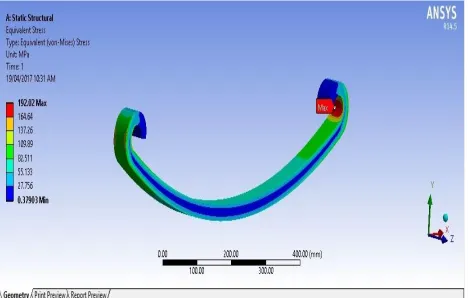
On the maximum load 3000 N
Table No.4 FEA Maximum Stresses in the Mono Leaf Spring Model
S.NO Applied Load (Newton) FEA Stresses (Mpa)
1 1000 64.00
2 1500 96.01
3 2000 128.01
4 2500 160.02
http: // www.ijrtsm.com© International Journal of Recent Technology Science & Management 23
FEA stress analysis of Composite Material:
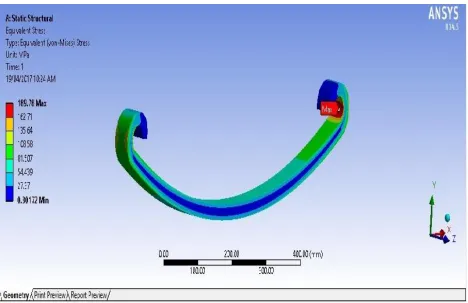
On the maximum load of 3000 N
Table No.5 FEA Maximum Stresses of Composite material in the Mono Leaf Spring Model
S.NO Applied Load (Newton) FEA Stresses (Mpa)
1 1000 63.26
2 1500 94.89
3 2000 126.52
4 2500 158.15
http: // www.ijrtsm.com© International Journal of Recent Technology Science & Management 24
V.
R
ESULT AND DISCUSSIONResult :
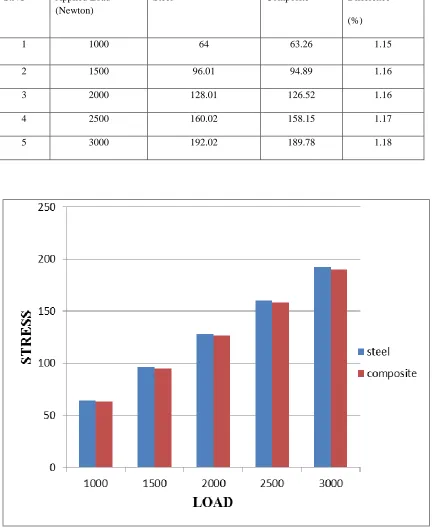
Table No .6 Comparison of stress analysis result in the steel and composite material
S.NO Applied Load
(Newton)
Steel Composite Difference
(%)
1 1000 64 63.26 1.15
2 1500 96.01 94.89 1.16
3 2000 128.01 126.52 1.16
4 2500 160.02 158.15 1.17
http: // www.ijrtsm.com© International Journal of Recent Technology Science & Management 25
Discussion:
As we see the above result the stresses induced in composite material is lesser than the comparison of steel . To reduce more stress we increase the quantity of composite material with this composite material. The overall the main aim of this project is reduce the weight of the automobile vehicle without compromise its strength and capacity. By using this composite material weight of the leaf spring is reduce up to 80%. The composite material is suitable for best alternative of the conventional steel leaf spring.
VI
F
UTURE SCOPE1. A prototype of Hybrid composite leaf spring can be prepared and after performing the test it can be compared with the analytical results.
2. Measurement of strain and stresses induced in the leaves can be done by using strain gauges and the experimental results could be used to optimally design the leaf spring using composite materials.
3. Modal analysis of the conventional steel and composite leaf spring using simulation or FEA can be done.
4. Effect of variable leaf thickness in the leaves can be studied in terms of maximum stress and deflection.
5. The effect of initial pre-stressing particularly of master leaf due to variation in the curvature (nipping) can also be studied using FEA.
6. The effect of added stresses from transverse forces and from twisting load (which is not considered in the present work) can also be studied by variation in the design of leaf spring such as selecting the master leaf of a superior material than, the rest of the spring.
7. The effect on material saving by reducing the factor of safety (which was taken as 2) can also be studied easily using FEA.
8. The effect of reduction in strength and endurance limit due to the center bolt hole can be studied during the simulation to achieve the results which closely match the experimental testing conditions.
REFERENCES
[1] Gulur Siddaramanna, Shiva Shankar, Sambagam Vijayarangan, “Mono Composite Leaf Spring for Light Weight Vehicle –
Design, End Joint Analysis and Testing” MATERIALS SCIENCE (MEDŽIAGOTYRA), Vol. 12, No. 3., (2006), ISSN 1392–
1320 .
[2] K. Nagendra Babu, P.Sudheer Kumar, “ Design and Analysis of Jute/E-glass/Epoxy Composite Mono Leaf Spring of
Varying Cross-section Area using Catia V5 and Ansys 14.5” International Journal of Innovations in Engineering and Technology(IJIET), Vol.07. Issue 01 June 2016, pp 244-254.
[3] M Senthil Kumar, S Vijayarangan, “Static analysis and fatigue life prediction of steel and composite leaf spring for light passenger vehicles”, Journal of Scientific & Industrial Research, Vol.66, 2007, pp 128-134.
[4] Daugherty.R.L,” Composite leaf springs in heavy truck applications ”, International conference on composite material procedings of japan US conference, Tokyo 1981:pp 529-538
[5]M. Raghavedra, Syed Altaf Hussain, V. Pandurangadu, K. PalaniKumar “Modeling and Analysis of Laminated Composite Leaf Spring under the Static Load Condition by using FEA” International Journal of Modern Engineering Research (IJMER) Vol.2, Issue.4, pp-1875-1879 ISSN: 2249-6645 , July-Aug. 2012
http: // www.ijrtsm.com© International Journal of Recent Technology Science & Management 26
[7]Makarand B. Shirke, Prof. V.D Wakchaure, “Performance Association of Static and Fatigue Behaviour of steel and Glass
Epoxy Composite Leaf Spring of Light Motor Vehicle”, International Journal of Advanced Research in Science, Engineering
![Table No.1 Specification of existing leaf spring [6]](https://thumb-us.123doks.com/thumbv2/123dok_us/8784177.1763201/2.612.119.497.421.704/table-specification-existing-leaf-spring.webp)
![Table No.2 Isentropic Properties of composite material [ 7]](https://thumb-us.123doks.com/thumbv2/123dok_us/8784177.1763201/3.612.165.390.543.667/table-isentropic-properties-composite-material.webp)