The Journal of Threatened Taxa (JoTT) is dedicated to building evidence for conservation globally by publishing peer-reviewed articles online every month at a reasonably rapid rate at www.threatenedtaxa.org. All articles published in JoTT are registered under Creative Commons Attribution 4.0 International License unless otherwise mentioned. JoTT allows allows unrestricted use, reproduction, and distribution of articles in any medium by providing adequate credit to the author(s) and the source of publication.
www.threatenedtaxa.org
ISSN 0974-7907 (Online) | ISSN 0974-7893 (Print)
Building evidence for conservation globally
Journal of Threatened Taxa
For Focus, Scope, Aims, Policies, and Guidelines visit https://threatenedtaxa.org/index.php/JoTT/about/editorialPolicies#custom-0 For Article Submission Guidelines, visit https://threatenedtaxa.org/index.php/JoTT/about/submissions#onlineSubmissions For Policies against Scientific Misconduct, visit https://threatenedtaxa.org/index.php/JoTT/about/editorialPolicies#custom-2 For reprints, contact <[email protected]>
Short Communication
First photographic evidence of Fishing Cat
Prionailurus viverrinus Bennett, 1833 and
Clouded Leopard Neofelis nebulosa Griffith, 1821
(Carnivora: Felidae) in Parsa National Park, Nepal
Shashank Poudel, Babu Ram Lamichhane, Santosh Bhattarai, Dipendra Adhikari, Chiranjibi Prasad Pokheral, Tek Raj Bhatt, Sailendra Raj Giri, Saneer Lamichhane, Amir Sadaula, Ashish Gurung, Laxman Prasad Poudyal, Uba Raj Regmi &
Naresh Subedi
12 March 2019 | Vol. 11 | No. 4 | Pages: 13497–13501 DOI: 10.11609/jott.4549.11.4.13497-13501
Partner
Member
Threatened Taxa
Publisher & Host
PLATINUMOPEN ACCESS
The opinions expressed by the authors do not reflect the views of the Journal of Threatened Taxa, Wildlife Information Liaison Development Society, Zoo Outreach Organization, or any of the partners. The journal, the publisher, the host, and the part-ners are not responsible for the accuracy of the political boundaries shown in the maps by the authors.
13497
Shor
t C
ommunica
tion
DOI: https://doi.org/10.11609/jott.4549.11.4.13497-13501 | ZooBank: urn:lsid:zoobank.org:pub:DDF127AC-3B59-49F4-A4E4-D91EFE3A1387
Editor: Angie Appel, Wild Cat Network, Germany. Date of publication: 12 March 2019 (online & print)
Manuscript details: #4549 | Received 11 November 2018 | Final received 02 March 2019 | Finally accepted 09 March 2019
Citation: Poudel, S., B.R. Lamichhane, S. Bhattarai, D. Adhikari, C.P. Pokheral, T.R. Bhatt, S.R. Giri, S. Lamichhane, A. Sadaula, A. Gurung, L.P. Poudyal, U.R. Regmi & N. Subedi (2019). First photographic evidence of Fishing Cat Prionailurus viverrinus Bennett, 1833 and Clouded Leopard Neofelis nebulosa Griffith, 1821 (Carnivora: Felidae) in Parsa National Park, Nepal. Journal of Threatened Taxa 11(4): 13497–13501; https://doi.org/10.11609/jott.4549.11.4.13497-13501
Copyright: © Poudel et al. 2019. Creative Commons Attribution 4.0 International License. JoTT allows unrestricted use, reproduction, and distribution of this article in any medium by adequate credit to the author(s) and the source of publication.
Funding: Funding for this work was provided by Zoological Society of London (ZSL) Nepal Office and Panthera.
Competing interests: The authors declare no competing interests.
Acknowledgements: We would like to thank the Department of National Parks and Wildlife Conservation and Parsa National Park office for coordinating the survey and allowing us to study in the protected area. We are obliged for the support extended by all the field technicians of the National Trust for Nature Conservation. In addition, we would also like to extend our gratitude towards the Nepal office of the Zoological Society of London and Panthera for supporting the camera trap survey in Parsa National Park.
First photographic evidence of Fishing Cat
Prionailurus viverrinus Bennett, 1833 and
Clouded Leopard Neofelis nebulosa Griffith, 1821
(Carnivora: Felidae) in Parsa National Park, Nepal
Shashank Poudel 1 , Babu Ram Lamichhane 2 , Santosh Bhattarai 3 , Dipendra Adhikari 4 ,
Chiranjibi Prasad Pokheral 5 , Tek Raj Bhatt 6 , Sailendra Raj Giri 7 , Saneer Lamichhane 8 ,
Amir Sadaula 9 , Ashish Gurung 10 , Laxman Prasad Poudyal 11 , Uba Raj Regmi 12 &
Naresh Subedi 13
1–3,5,8–10,13 National Trust for Nature Conservation, P.O. Box 3712, Khumaltar, Lalitpur, 44600, Nepal. 4,6,7 Zoological Society of London, Nepal Office, Bhatbhateni, Kathmandu, Nepal.
11,12 Department of National Parks and Wildlife Conservation, Government of Nepal, Babarmahal, Kathmandu, Nepal. 1[email protected] (corresponding author), 2[email protected], 3[email protected],
4 [email protected], 5[email protected], 6[email protected], 7[email protected], 8[email protected], 9[email protected], 10[email protected], 11 [email protected], 12[email protected], 13[email protected]
Journal of Threatened Taxa | www.threatenedtaxa.org | 12 March 2019 | 11(4): 13497–13501
Abstract: Twelve cat species were recorded in Nepal including the
largest, Tiger Panthera tigris, and the smallest, Rusty-spotted Cat Prionailurus rubiginosus. There is more research on the Panthera
species than on small wild cats; consequently, the conservation status, distribution, and ecology of small cat species are poorly known. In this article, we report on the first photographic evidence of Clouded Leopard Neofelis nebulosa and Fishing Cat Prionailurus viverrinus in
Parsa National Park in southern central Nepal during a camera trap survey targeted at the tiger between 2014 and 2016. There were only single detections of each species; this does not give enough information to establish distribution or conservation status of either of the species in Parsa National Park. Further targeted surveys are needed to establish the significance of this protected area for the conservation of these two species.
Keywords: Camera trapping survey, small wild cats, southern central
Nepal, Terai.
ISSN 0974-7907 (Online) ISSN 0974-7893 (Print)
PLATINUM OPEN ACCESS
Nepal is home to 12 cat species including both the largest, Tiger Panthera tigris, and the smallest, Rusty-spotted Cat Prionailurus rubiginosus, of the world (Lamichhane et al. 2016; Lama et al. 2019). Distribution and ecology of large charismatic cats like Tiger, Snow Leopard Panthera uncia, and Leopard Panthera pardus
Journal of Threatened Taxa | www.threatenedtaxa.org | 12 March 2019 | 11(4): 13497–13501 Fishing Cat and Clouded Leopard in Parsa NP Poudel et al.
13498
records, and sign surveys carried out in protected areas for large felids (Lamichhane et al. 2016; Taylor et al. 2016). These efforts detected common and large felids but may have missed rare and elusive smaller felids (Tempa et al. 2013). Increased use of camera trapping in recent years aided in the discovery of rare species like Clouded Leopard
Neofelis nebulosa and Fishing Cat Prionailurus viverrinus in
new areas and provided verifiable records (see Appel et al. 2012; Lamichhane et al. 2016; Taylor et al. 2016; Ghimirey & Acharya 2018; Yadav et al. 2018; Lama et al. 2019). The latest addition is the discovery of Marbled Cat Pardofelis
marmorata in the eastern Himalayas of Nepal (Lama et al.
2019).
Among the cat species, Clouded Leopard receives less attention from the conservation community in Nepal and is threatened by illegal wildlife trade and degrading habitat (Ghimirey & Acharya 2018). Though Hodgson (1853) reported its presence in Nepal already in the mid-18th
Century, it was recorded in different parts of the country only since the late 1980s (Dinerstein & Mehta 1989), such as in Dhanusa, Nawalparasi, and Kaski districts (Dinerstein & Mehta 1989), Annapurna Conservation Area (Appel et al. 2012; Ghimire et al. 2019), Shivapuri Nagarjun NP (Pandey 2012), and Chitwan NP (Ghimirey et al. 2014; Lamichhane et al. 2014). In recent years, Fishing Cat was recorded in Chitwan NP (Dahal & Dahal 2011; Mishra et al. 2018), Koshi Tappu Wildlife Reserve (Taylor et al. 2016), Bardia NP (Yadav et al. 2018), Shuklaphanta NP (NTNC survey records, unpublished), and Jagadishpur Reservoir in Kapilvastu area of southwestern Nepal (Dahal 2016).
We report Clouded Leopard and Fishing Cat recorded for the first time in Parsa NP in southern central Nepal during a monitoring survey targeting tiger. These are the first confirmed records for the presence of both species in Parsa NP.
Study area
Parsa NP is located in southern central Nepal (27.3060N
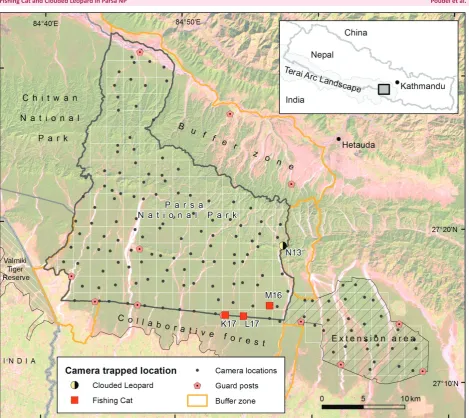
& 84.7810E) (Fig. 1), covering an area of 627km2 (Thapa et
al. 2014; Lamichhane et al. 2018). It is contiguous with Chitwan NP in the west and is a critical region in the Chitwan-Parsa-Valmiki trans-boundary forest complex in the Terai Arc landscape (Chanchani et al 2014). The park is dominated by subtropical dry deciduous forest with colonizing Saccharum spontaneum and Imperata
cylindrica on the dry riverbeds and floodplains to a climax
Sal Shorea robusta forest on Bhabhar and hillsides (Thapa
et al. 2014). The streams running off the Churia Hills permeates the porous sediment and flows underground, reappearing south of the park and restricting water availability in more than 70% of its area throughout the
dry months (Lamichhane et al. 2017). The protected area supports diverse mammalian fauna including Tiger, Leopard, Dhole Cuon alpinus, Striped Hyena Hyaena
hyaena, Golden Jackal Canis aureus, Bengal Fox Vulpes
bengalensis,and Honey Badger Mellivora capensis (Thapa et al. 2014). The major prey species are Spotted Deer Axis axis, Barking Deer Muntiacus muntjak, Gaur Bos gaurus, Nilgai Bosephalus tragocamelus, Wild Boar Sus scrofa, and Sambar Rusa unicolor. The combined ungulate density was estimated to be 25.33 (SE±3.9) ungulates/km2 in 2013
(Dhakal et al. 2014).
Materials and Methods
The study was primarily designed for tiger monitoring, deploying camera traps in continuous cells of 2kmx2km during the cool and dry seasons of November 2014 to January 2015 and February to April 2016, covering the core area of Parsa NP during the first survey period and the new extension area during the 2016 survey period (Fig. 1). A pair of camera traps (model: Panthera V5) was placed in each cell. All the camera traps were active for 24 hours for a minimum of 21 days during both survey periods. Following completion of the field survey, images were checked manually for the species recorded.
Results
Camera traps were deployed in 130 and 167 locations during the first and second survey period, with a total survey effort of 7,230 trap nights, including 3,549 and 3,681 trap nights, respectively. We obtained a single image of Clouded Leopard and four images of a Fishing Cat.
Clouded Leopard
A single Clouded Leopard was photographed on 30 November 2014 at 00.26h at 27.312°N & 84.961°E (Fig. 1) on the eastern edge of Parsa NP. The species was identified by comparing the pelt pattern with the image of a Clouded Leopard provided in the IUCN Red List (Grassman et al. 2016). The age and sex of the individual, however, could not be determined. The Clouded Leopard was camera trapped in Sal-dominated mixed forests (Image 1).
Fishing Cat
Fishing Cat and Clouded Leopard in Parsa NP Poudel et al.
Journal of Threatened Taxa | www.threatenedtaxa.org | 12 March 2019 | 11(4): 13497–13501 13499
forest (Image 2).
Discussion
Our records confirm that both Clouded Leopard and Fishing Cat occur in Parsa NP. Thus, both species were documented in all three protected areas within the Chitwan-Parsa-Valmiki trans-boundary forest complex (Clouded Leopard: Ghimirey et al. 2014; Lamichhane et al. 2014; Kamlesh Maurya pers. comm. 2017; Fishing Cat: Dahal & Dahal 2011; Mishra 2016; Mukherjee et al. 2016).
Borah et al. (2014) reported frequent captures of the Clouded Leopard by camera traps set up on paths and animal trails in Manas NP. Also, Lamichhane et al. (2014) reported records of the species on the forest floor in Chitwan NP. The camera locations in Parsa NP were selected after an intensive search for signs such as scratch marks to maximize the probability of capturing the tiger.
Our protocol of checking camera traps every alternate day may have impacted encounter rates of shy and elusive small wild cats.
Large intact and interconnected forest patches of this complex (ca. 3,000km2) might have provided an
opportunity for the dispersal of the Clouded Leopard. Such interconnected forest habitats are important for sustaining viable populations of large carnivores such as Tiger, Leopard, and Clouded Leopard, which in turn also protect the functionality of the ecosystem (Borah et al. 2014; Chanchani et al. 2014). To maintain its ecological integrity, the Chitwan-Parsa-Valmiki protected area complex should also be kept intact by avoiding the construction of linear infrastructure such as roads and railways that fragment the forests, or by establishing wildlife-friendly corridors.
Journal of Threatened Taxa | www.threatenedtaxa.org | 12 March 2019 | 11(4): 13497–13501 Fishing Cat and Clouded Leopard in Parsa NP Poudel et al.
13500
and streams, marsh areas, reed beds, tidal creeks, and mangrove forests (Mukherjee et al. 2016). Parsa NP is a relatively dry area with limited water sources, especially during the dry rainless season between October and April. Perennial water sources here are confined to small streams coming from the Churia Hills and flowing partly underneath the surface, which limits the availability of water in the park (Israil et al. 2006; Thapa et al. 2014).
The location where the Fishing Cat was recorded is a dry forest road in Bhabar Forest, which contrasts with records in wetlands across southern and southeastern Asia (e.g., Cutter & Cutter 2009 in Thailand; Mukherjee et al. 2012 in West Bengal, India; Islam et al 2015 in Pakistan; Taylor et al. 2016 in eastern Nepal; Palei et al. 2018 in Odisha, India; Thaung et al. 2018 in coastal Cambodia). A targeted survey for Fishing Cat by Sharma (2016) did not record the species in Parsa NP. This survey covered only a small area (~20km2), targeting two sites close to rivers
and streams. Our record is at a distance of ~20km from the survey area of Sharma (2016) and well away from wetland sites or water sources (>5km). Looking at the linear movement and the single record of the species, we assume that the individual might have arrived incidentally at the location or been passing through it while migrating to another habitat.
While the global ranges of Fishing Cat and Clouded Leopard are declining due to various anthropogenic factors (Grassman et al. 2016; Mukherjee et al. 2016), the current records in an additional protected area would help in their conservation.
These records, however, also indicate that more in-depth surveys on their distribution, abundance, and habitat use are necessary and warranted. In addition, such targeted surveys will also contribute to understanding the dynamics between larger carnivores, like tiger and leopard, and small wild cats. Hence, we recommend a targeted survey covering the current capture locations to ascertain whether these individuals were transiting or are resident.
Table 1. Details of Clouded Leopard and Fishing Cat capture events in Parsa National Park, Nepal.
Particulars Fishing Cat Clouded Leopard
Grid ID (GPS Locations)
K17
(27.2350N & 84.8920E),
L17
(27.2340N & 84.9140E),
M16
(27.2460N & 84.9460E)
N13
(27.3120N & 84.9610E)
Elevation 201–255 m 458m
Number of
detections 3 1
Date of capture 8.iii.2016 30.xi.2014
Time of capture 04.48h (K17), 05.37h (L17) & 19.43h (M16) 00.26h
Flank image Both Right
Forest road Riverbed Habitat surrounding
the location Sal forest Sal forest Distance to nearest
settlement 4.5–5.6 km 5.7km Distance to nearest
perennial water
source 4.2–5.7 km 0.5km
Image 1. Clouded Leopard Neofelis nebulosa in a dry riverbed in Parsa National Park, Nepal. © Department of National Parks and Wildlife Conservation, National Trust for Nature Conservation, Zoological Society of London, 16 November 2014.
Fishing Cat and Clouded Leopard in Parsa NP Poudel et al.
Journal of Threatened Taxa | www.threatenedtaxa.org | 12 March 2019 | 11(4): 13497–13501 13501
References
Appel, A., Y. Ghimirey & R. Acharya (2012). Status Assessment of Wild
Felids with a Special Focus on Clouded Leopard and Asian Golden Cat in the Hugu-Kori Forest, Annapurna Conservation Area, Nepal. Friends of Nature, Kathmandu, Nepal, 24pp.
Borah, J., T. Sharma, D. Das, N. Rabha, N. Kakati, A. Basumatary & J. Vattakaven (2014). Abundance and density estimates for common
Leopard Panthera pardus and Clouded Leopard Neofelis nebulosa in
Manas National Park, Assam, India. Oryx 48(1): 149–155; https://doi. org/10.1017/S0030605312000373
Chanchani, P., B.R. Lamichhane, S. Malla, K. Maurya, A. Bista, R. Warrier, S. Nair, M. Almeida, R. Ravi, R. Sharma, M. Dhakal, S.P. Yadav, M. Thapa, S.R. Jnawali, N.M.B. Pradhan, N. Subedi, G.J. Thapa, H. Yadav, Y.V. Jhala, Q. Qureshi, J. Vattakaven & J. Borah (2014). Tigers
of the Transboundary Terai Arc Landscape: Status, Distribution and Movement in the Terai of India and Nepal. National Tiger Conservation Authority, Government of India, and Department of National Park and Wildlife Conservation, Government of Nepal, 98pp.
Cutter, P. & P. Cutter (2009). Recent sightings of Fishing Cats in Thailand.
Cat News 51: 12–13.
Dahal, S. (2016). Fishing Cats outside protected areas in Nepal Terai,
pp27–28. In: Appel, A. & J.W. Duckworth (eds.). Proceedings of the First International Fishing Cat Conservation Symposium, 25–29 November 2015, Nepal. Fishing Cat Working Group, Bad Marienberg, Germany and Saltford, Bristol, United Kingdom, 75pp.
Dahal, S. & D.R. Dahal (2011). Trapping of Fishing Cat in Chitwan National
Park, Nepal. Cat News 55: 10–11.
Dhakal, M., M. Karki, S.R. Jnawali, N. Subedi, N.M.B. Paradhan, S. Malla, B.R. Lamichhane, C.P. Pokheral, G.J. Thapa, J. Oglethorpe, S.A. Subba, P.R. Bajracharya & H. Yadav (2014). Status of Tigers and Prey in Nepal. Department of National Parks and Wildlife Conservation, Kathmandu, Nepal, 74pp.
Dinerstein, E. & J.N. Mehta (1989). The Clouded Leopard
in Nepal. Oryx 23(4): 199–201; https://doi.org/10.1017/ S0030605300023024
Ghimirey, Y. & R. Acharya (2018). The Vulnerable Clouded Leopard
Neofelis nebulosa in Nepal: an update. Oryx 52(1): 166–170; https:// doi.org/10.1017/S0030605316000582
Ghimirey, Y., K. Yadav, J. Rai, R. Baral & R. Acharya (2019). Clouded
Leopard in Sikles-Bhujung landscape, Annapurna Conservation Area, Nepal. Cat News 61: 13–15.
Ghimirey, Y., R. Acharya & S. Dahal (2014). An undocumented record
of a Clouded Leopard captured in Chitwan District, Nepal. Cat News 60: 27–28.
Grassman, L., A. Lynam, S. Mohamad, J.W. Duckworth, J. Borah, D. Willcox, Y. Ghimirey, A. Reza & H. Rahman (2016). Neofelis nebulosa.
In: The IUCN Red List of Threatened Species: e.T14519A97215090. Accessed on 15 August 2018; https://doi.org/10.2305/IUCN.UK.2016-1.RLTS.T14519A97215090.en
Hodgson, B.H. (1853).Felis macrosceloides. Proceedings of the Zoological
Society of London 21: Plate XXXVIII.
Islam, S., R. Nawaz & M. Moazzam (2015). A survey of Smooth-coated
Otter (Lutrogale perspicillata sindica) and Fishing Cat (Prionailurus viverrinus) in Chotiari Reservoir, Sanghar, Pakistan, using camera traps.
International Journal of Biology and Biotechnology 12(4): 579–584.
Israil, M., M. Al-hadithi & D.C. Singhal (2006). Application of a resistivity
survey and geographical information system (GIS) analysis for hydrogeological zoning of a piedmont area, Himalayan foothill region, India. Hydrogeology Journal 14(5): 753–759.
Jackson, R.M. (1996). Home range, movements and habitat use of Snow
Leopard (Uncia uncia) in Nepal. PhD Thesis. University of London, United Kingdom, 233pp.
Karki, J.B., B. Pandav, S.R. Jnawali, R. Shrestha, N.M.B. Pradhan, B.R. Lamichane, P. Khanal, N. Subedi & Y.V. Jhala (2015). Estimating the
abundance of Nepal’s largest population of tigers Panthera tigris.Oryx 49(1): 150–160; https://doi.org/10.1017/S0030605313000471
Lama, S.T., J.G. Ross, D. Bista, A.P. Sherpa, G.R. Regmi, M.K. Suwal, P. Sherpa, J. Weerman, S.S. Lama, M. Thapa, L.P. Poudyal &
A.M. Paterson (2019). First photographic record of Marbled Cat
Pardofelis marmorata Martin, 1837 (Mammalia, Carnivora, Felidae) in Nepal. Nature Conservation 32: 19–34; https://doi.org/10.3897/ natureconservation.32.29740
Lamichhane, B.R., C.P. Pokheral, S. Poudel, D. Adhikari, S.R. Giri, S. Bhattarai, T.R. Bhatta, R. Pickles, R. Amin, K.P. Acharya, M. Dhakal, U.R. Regmi, A.K. Ram & N. Subedi (2018). Rapid recovery of tigers Panthera tigris in Parsa Wildlife Reserve, Nepal. Oryx 52(1): 16–24;
https://doi.org/10.1017/S0030605317000886
Lamichhane, B.R., M. Dhakal, N. Subedi & C.P. Pokheral (2014). Clouded
Leopard co-exist with other five felids in Chitwan National Park, Nepal.Cat News 61: 30–32.
Lamichhane, B.R., R. Kadariya, N. Subedi, B.K. Dhakal, M. Dhakal, K. Thapa & K.P. Acharya (2016). Rusty-spotted Cat: 12th cat species
discovered in western Terai of Nepal. Cat News 64: 30–33.
Mishra, R., K. Basnet, R. Amin & B.R. Lamichhane (2018). Fishing Cat
Prionailurus viverrinus Bennett, 1833 (Carnivora: Felidae) distribution and habitat characteristics in Chitwan National Park, Nepal. Journal of Threatened Taxa 10(11): 12451–12458; https://doi.org/10.11609/ jott.3426.10.11.12451-12458
Mukherjee, S., A. Appel, J.W. Duckworth, J. Sanderson, S. Dahal, D.H.A. Willcox, V. Herranz Muñoz, G. Malla, A. Ratnayaka, M. Kantimahanti, A. Thudugala, R. Thaung & H. Rahman (2016).Prionailurus viverrinus.
In: The IUCN Red List of Threatened Species: e.T18150A50662615. Accessed on 15 August 2018; https://doi.org/10.2305/IUCN.UK.2016- 2.RLTS.T18150A50662615.en
Mukherjee, S., T. Adhya, P. Thatte & U. Ramakrishnan (2012). Survey
of the Fishing Cat Prionailurus viverrinus Bennett, 1833 (Carnivora: Felidae) and some aspects impacting its conservation in India. Journal of Threatened Taxa 4(14): 3355–3361; https://doi.org/10.11609/JoTT.
o3199.3355-61
Palei, H.S., U.P. Das & S. Debata (2018). The Vulnerable Fishing Cat
Prionailurus viverrinus in Odisha, eastern India: status and conservation implications. Zoology and Ecology 28(2): 69–74; https://doi.org/10.10 80/21658005.2018.1468646
Pandey, B.P. (2012). Clouded Leopard in Shivapuri Nagarjun National
Park, Nepal. Cat News 57: 24–25.
Sharma, B. (2016). Status of Fishing Cat in Parsa Wildlife Reserve, central
Nepal, pp. 61–63. In: Appel, A. & J.W. Duckworth (eds.). Proceedings of the First International Fishing Cat Conservation Symposium, 25–29 November 2015, Nepal. Fishing Cat Working Group, Bad Marienberg, Germany and Saltford, Bristol, United Kingdom, 75pp.
Smith, J.L.D., S.C. Ahearn & C. McDougal (1998). Landscape analysis of
Tiger distribution and habitat quality in Nepal. Conservation Biology
12(6): 1338–1346.
Taylor, I.R., H.S. Baral, P. Pandey & P. Kaspal (2016). The conservation
status of the Fishing Cat Prionailurus viverrinus Bennett, 1833 (Carnivora: Felidae) in Koshi Tappu Wildlife Reserve, Nepal. Journal of Threatened Taxa 8(1): 8323–8332; https://doi.org/10.11609/ jott.2034.8.1.8323-8332
Tempa, T., M. Hebblewhite, L.S. Mills, T.R. Wangchuk, N. Norbu, T. Wangchuk, T. Nidup, P. Dendup, D. Wangchuk, Y. Wangdi & T. Dorji (2013). Royal Manas National Park, Bhutan: a hot spot
for wild felids. Oryx 47(2): 207–210; https://doi.org/10.1017/
S0030605312001317
Thapa, K., R. Shrestha, J. Karki, G.J. Thapa, N. Subedi, N.M.B. Pradhan & M.J. Kelly (2014). Leopard Panthera pardus fusca density in the seasonally dry, subtropical forest in the Bhabhar of Terai Arc, Nepal. Advances in Ecology 2014(286949): 1–12; https://doi. org/10.1155/2014/286949
Thaung, R., V.H. Muñoz, J. Holden, D. Willcox & N.J. Souter (2018).
The Vulnerable Fishing Cat Prionailurus viverrinus and other globally threatened species in Cambodia’s coastal mangroves. Oryx 52(4): 636– 640;https://doi.org/10.1017/S0030605317001491
Yadav, S.K., B.R. Lamichhane, N. Subedi, M. Dhakal, R.K. Thapa, L. Poudyal & B.R. Dahal (2018). Fishing Cat camera trapped in Babai
Valley of Bardia National Park, Nepal. Cat News 67: 31–33.
ISSN 0974-7907 (Online) | ISSN 0974-7893 (Print)
March 2019 | Vol. 11 | No. 4 | Pages: 13419–13510 Date of Publication: 12 March 2019 (Online & Print)
DOI: 10.11609/jott.2019.11.4.13419-13510
www.threatenedtaxa.org
The Journal of Threatened Taxa (JoTT) is dedicated to building evidence for conservation globally by publishing peer-reviewed articles online every month at a reasonably rapid rate at www.threatenedtaxa.org. All articles published in JoTT are registered under Creative Commons Attribution 4.0 International License
unless otherwise mentioned. JoTT allows allows unrestricted use, reproduction, and distribution of articles in any medium by providing adequate credit to the author(s) and the source of publication.
Editorial
Foreword to the small wild cats special issue
– Angie Appel & Shomita Mukherjee, 13419–13420
Articles
Using camera traps to study the elusive European Wildcat Felis silvestris silvestris Schreber, 1777 (Carnivora: Felidae) in central Germany: what makes a good camera trapping site?
– Harald Wening, Lynne Werner, Matthias Waltert & Markus Port, Pp. 13421–13431
Activity patterns of the small and medium felid (Mammalia: Carnivora: Felidae) guild in northeastern India
– Shomita Mukherjee, Priya Singh, André Pinto Silva, Chandan Ri, Kashmira Kakati, Binod Borah, Tana Tapi, Sandesh Kadur, Prafull Choudhary, Shikha Srikant, Surabhi Nadig, R. Navya, Mats Björklund & Uma Ramakrishnan, Pp. 13432–13447
Estimating Leopard Cat Prionailurus bengalensis Kerr, 1792
(Carnivora: Felidae) density in a degraded tropical forest fragment in northeastern Thailand
– Wyatt Joseph Petersen, Tommaso Savini, Robert Steinmetz & Dusit Ngoprasert, Pp. 13448–13458
An update on the status of Fishing Cat Prionailurus viverrinus Bennett, 1833 (Carnivora: Felidae) in Thailand
– Wanlop Chutipong, Anucha Kamjing, Worata Klinsawat, Dusit Ngoprasert, Kitipat Phosri, Niti Sukumal, Pongnapa Wongtung & Naruemon Tantipisanuh, Pp. 13459–13469
Communications
The Caracal Caracal caracal Schreber, 1776 (Mammalia: Carnivora: Felidae) in Uzbekistan
– Mariya Alexeevna Gritsina, Pp. 13470–13477
Small cat surveys: 10 years of data from Central Kalimantan, Indonesian Borneo
– Karen Anne Jeffers, Adul & Susan Mary Cheyne, Pp. 13478–13491
Short Communications
Insights into the feeding ecology of and threats to Sand Cat Felis margarita Loche, 1858 (Mammalia: Carnivora: Felidae) in the Kyzylkum Desert, Uzbekistan
– Alex Leigh Brighten & Robert John Burnside, Pp. 13492–13496
First photographic evidence of Fishing Cat Prionailurus viverrinus Bennett, 1833 and Clouded Leopard Neofelis nebulosa Griffith, 1821 (Carnivora: Felidae) in Parsa National Park, Nepal
– Shashank Poudel, Babu Ram Lamichhane, Santosh Bhattarai, Dipendra Adhikari, Chiranjibi Prasad Pokheral, Tek Raj Bhatt, Sailendra Raj Giri, Saneer Lamichhane, Amir Sadaula, Ashish Gurung, Laxman Prasad Poudyal, Uba Raj Regmi & Naresh Subedi, Pp. 13497– 13501
First photographic evidence of polymorphic Asiatic Golden Cat Catopuma temminckii Vigors & Horsfield, 1827 (Mammalia: Carnivora: Felidae) in Buxa Tiger Reserve, West Bengal, India
– Mayukh Ghose, Deepak Sharma & Nandavaram Subbarao Murali, Pp. 13502–13505
First photographic record of the Rusty-spotted Cat Prionailurus rubiginosus (I. Geoffroy Saint-Hilaire, 1831) (Mammalia: Carnivora: Felidae) in Horton Plains National Park, Sri Lanka
– Thilina Sudarshana Nimalrathna, Yan Ru Choo, Enoka P.
Kudavidanage, Thakshila Ravindra Amarasinghe, Udamulle Gedara Sumith Indika Bandara, Wanninayaka Aarahchilage Charitha Lakmali Wanninayaka, Piyal Ravindrakumar, Marcus Aik Hwee Chua & Edward L. Webb, Pp. 13506–13510
Partner
Member
Threatened Taxa
Publisher & Host
PLATINUM OPEN ACCESS