A STUDY OF CONTENT BASED METHODS FOR AUTHOR PROFILING IN
MULTIPLE GENRES
Muhammad Waqas Anjum Ch1and Waqas Arshad Cheema2
Department of Computer Science & Information Technologies, Superior University Lahore
Abstract—Author profiling is the task of automated prediction of one or more author traits from his/her text. Author profiling is grouping of written document based on their similarity, content, topic and semantic tags of their author. Further than the identification and verification of a specific person whose writing style is examined, when we talk about author profiling that means how a specific person interact in a social circle and how they share their language so that group them according to their writing style[1]. Automatically detecting an author's profile from text has potential applications in marketing, forensic analysis and detecting harassment cases. To develop and analyze automatic techniques for author profiling, we need a benchmark corpora. In recent years, standard evaluation resources have been developed for different genres including tweets, blogs, hotel reviews, social media etc.
KEYWORDS
INTRODUCTION
Author profiling is the process of identification of a person's gender, age, native language, personality traits and other demographic in order from his/her written TEXT[1]. We are living in this era where knowledge is
growing so quickly arising many difficult problems for researchers one of the problems is author profiling. Now most of the text is online. People write and share their opinions ideas behind the certain limit of secrecy. The problem of author profiling has become an important problem in the fields like linguistic forensics, marketing and security. The work of author profiling is to classify one or more author traits and an author profile compose of the resulting a set of calculating traits. Automatic finding of an author’s profile from
his/her text has become an emerging and popular research area in now days. Automatically calculating the characteristics of the authors from their texts has a number of potential applications. Such as forensics analysis (Corney et al., 2002; Abbasi and Chen, 2005), advertising intelligence (Glance et al., 2005) and sentiment analysis. We aim to apply content-based approach on a variety of corpora, which are on different genres including social media, hotel review, twitter and blogs. The content may stand up other than material, how author is feeling while writing it, it may reflect distinctive behavioral examples of its author. The information possessed BY THE CONTENT CAN BE UTILIZED by distinctive machine learning methodologies/algorithms to consequently perceive identity sorts. Author profiling is the matter of interest for many different areas such as psychology, linguistics and natural language processing. 21st century is surely the century of science and technology. In previous times, electronic medium was not so much sophisticated that there was no requirement for its analysis. With the passage of time the advancement in technology the use of internet has change the lives of people. Computer mediated communication (CMC) which includes emails, blogging, chat rooms, conversation boards and social media has presented the huge channels for online communication. So the use of (CMC) like emails, blogs, websites and Social Media has
increased, that’s why the amount of text is incremented so the need to identify “who is who” has also become important and it’s a field of grow up attention these days. Internet and web technology has
shortened the distances and open new pathways for learning and sharing information worldwide mainly inform of electronic text and videos. As a result of this advancement in social media, we observe a lot of unlabeled content as well, which means though there are heaps of contents available, but we lack information about generator of the content. In this respect, the author profiling is trying to conclude the age, mother tongue, education, work or behavior of the authors by discover their available texts. In today's world, the society medium has a great impact on the lives of people across the world. It provides collective networking sites, which can help people to connect with their friend’s family and acquaintances. This
accounts do not belong to real profiles [2].It is important in many cases to know that who is the author of a given profile is. Author profiling can be useful in such cases. For example from Forensic perspective, the
purpose of the multilingual person of a man’s profile who composed a "doubtful content" can give helpful
information about the suspect. The reviews of unknown people about products can help the companies to know about the personality behavior and choices of their customers. From a security perspective, linguistic assessment may profile possible criminals.
RELATEDWORK
The majority of the existing work in author profiling has been done mostly based on the bases of a small number of author traits, for example gender and age [3], gender [4], extraversion and neuroticism [5], extraversion, geniality, neuroticism, and conscientiousness [6], extraversion, agreeableness,
conscientiousness, neuroticism, and openness. The author describes a testing in judgment the author’s
gender in email with machine learner model, namely Support Vector Machine (SVM). Overall, their approach differentiates the male and female authors satisfactorily. The main result of that functional word the most important evidences for the differentiating the gender. They tried to differentiate extraversion from introversion and high neuroticism from low neuroticism in familiar texts. The four sets of features (modality, conjunctive phrases, lexical features, and appraisal) and Support Vector Machine for the classification. The authors tried to predict age and gender in the blog data. Due to the very big in number of authors in the corpus that is greater in the number (18,000), a traditional regular simple classification techniques that was not more feasible. Because researchers agreed to for an information retrieval approach using various expression frequency-inverse, document frequency weights, with the combination of this for resemblance. The technique was not able to predict the author correctly in approximately70percentage of the attempted predictions. The authorship profiling problem is growing importance day by day specially in the few years .There are many author profiling applications such as in security ,commercially and in forensics. In the police department, the author profiling play a key role to avoid crime. In market point of view or the large companies the author profiling technique knowing about the like or dislike the product of that company. This survey is based on the online reviews or blogs [5]. Stylistic based features and content-based features are the two most basic types of features. There are many other features are also included in the textual type of style like lexical, vocabulary complexity and syntactic, based features whereas in some special case there are also following features are also used such as grammatical, morphological, and orthogonal errors in the simple text.[5]
documents is also distributed from this. Content based profiling on simple usual text analysis method is
“bag of words and when the uses the other naïve bayes method have more difficult rather than the bag of
words. In the author identification for the purpose of the e-mail forensics has limitations due the bad categorization presentation approach because of the large amount of data has to be needed for the particular author or not used the good decision to distinguish the other author [4]. The major aim of author profiling is to discover the most relevant information of the person by his/her written text [7]. There are the following categories that analysis strictly how to identifying the author’s age, gender, language, education and his/ her
behavior in social and economically. Many features can calculate the text of the author but the absolute length of the text find out the simple features that are given below:
Number of Words
Number of Characters
Number of Sentences
In author profiling, automatically calculating from the written text has many applications [8]. For example in the marketing intelligence point of view, the author profiling plays a vital role to sale out the company products by the use of their survey [8]. In author profiling the text preprocessing consist of two parts first is segmentation and other is punctuation study [8]. The e-mail firstly split into paragraph and then paragraph further split into tokens and sentences.
trained model on one genre of the twitter and then evaluated with the different genre of the twitter. There were 22 participants has to identifying the age and gender cross genre in the English, Dutch, and Spanish languages. This paper the author takes out the corpus from the written text from British National corpus. Corpus consists of blogs, tweets in the form of text. Corpus is a collection of the written texts specially the entire work of the particular author.With the continues development in the social media, the attention shifted to other kind of writings, more informal, less organized and structured, just like blogs. The datasets, on which different experiments were made, contains 566 documents from British National Corpus.There are three most popular author profilingtechniques were used in the most recent previous work but we also used the Content based technique.
Table1Summary table to compare existing techniques
DATA SETS AND METHODOLOGY
This section represents the experimental setup (corpus used for experimentation), author profiling techniques applied on the corpus, evaluation measures used to evaluate the performance and methodology used for identifying author personality. The PAN 2013 dataset consists of total 236596 files. The PAN 2013 contains only the blogs data in different age groups (10s, 20s, and 30s) with gender male and female.Blogs, social media, twitter and hotel reviews are the four different genres used in PAN14.The PAN 2014 dataset consists of total 12053 files in three different categories Hotel reviews, Blogs and Social media. The PAN 2014 Hotel reviews corpus is 4160 files, PAN 2014 corpus for Blogs is 147 files and PAN 2014 corpus for Social Media corpus is 4476 files of total datasets. In PAN 2015, the English corpus for author profiling task consists of 152 files. The PAN 2015 Dutch corpus for author profiling task consists of 34 files. In PAN 2015 Italian corpus for author profiling task consists of 38 files and PAN 2015 Spanish corpus for author profiling task consists of 100 files.Content-based features were used to select to specific gender according to age group and calculated the frequencies of some selected unigrams used by participants in author profiles. The approach used for author identification is “content based”, for this simply convert given text into word
tokens and count the number of their occurrences.
To convert text into words use the “string to word vector” filter available in WEKA toolkit, then customized this filter and compared the results by setting different attributes and applying on a corpus to find best modification for this filter, and then select the best settings for testing on rest of data. There are different content-based features like Chi square, information gain, gain ratio are used.
CONTENT BASED STYLOMETRY BASED TOPIC BASED
It considers content of the text.
It considers writing style of the text.
It chooses words from text and analyses topic of the text. Each word is a feature. It has around 64 unique feature
based on writing style.
All key words consider as features.
It becomes ambiguous when all authors are writing on same topic.
It becomes ambiguous while comparing current writing and writing of 10 year back of same author.
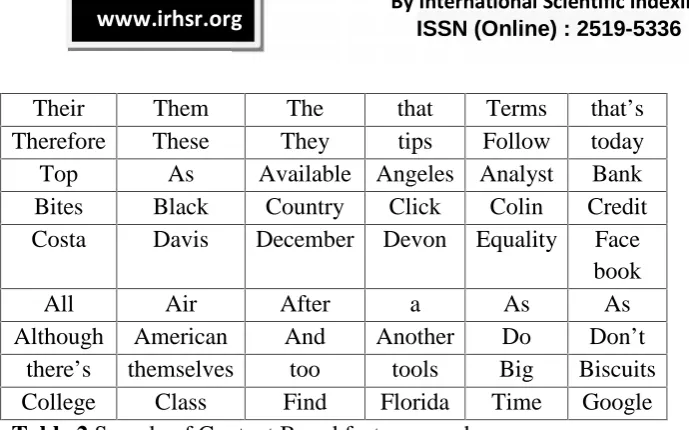
Their Them The that Terms that’s
Therefore These They tips Follow today Top As Available Angeles Analyst Bank Bites Black Country Click Colin Credit Costa Davis December Devon Equality Face
book
All Air After a As As
Although American And Another Do Don’t there’s themselves too tools Big Biscuits College Class Find Florida Time Google
Table 2 Sample of Content Based features used
WEKA is software that provides built in algorithms to select attributes;in WEKA just to select the attribute evaluator and then apply search method that want to use.In this research, work used the WEKA toolkit. WEKA is the software for the popular machine learning approach that is written in Java language, which contains a visualization collection tools and data analysis algorithms and predictive modeling with graphical user interfaces for easy access to this feature.
RESULT AND ANALYSIS
This section will report and analyze the results that we have achieved in this section, for our experiments using the content-based techniques and the comparison of the PAN author-profiling task.For content-based features, we applied the five classifiers; naming J48, Naïve Byes, Random Forest, SMO, ID3and the results are reported in the table. Overall, the results for content-based features are very good and encouraging. The
second approach used for author identification is “content based”, for this we simply convert given text into word tokens and count the number of their occurrences.
To convert text into words we use “string to word vector” filter available in WEKA toolkit, we customized
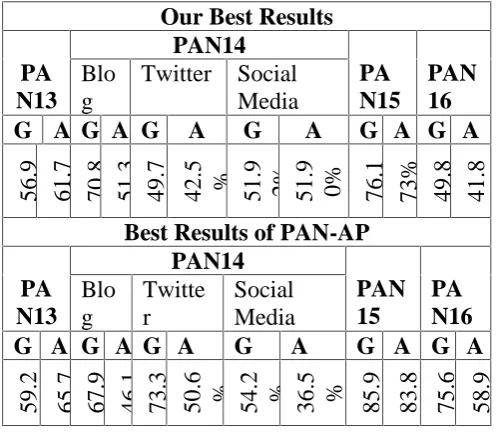
this filter and compared the results by setting different attributes and applying on a small corpus to find best customization for this filter, and then select the best settings for testing on rest of data.With respect of the Englishlanguage task, the results of the PAN-AP13 and our accuracy rate is below in gender than the teams who are participate in the task of author profiling. The difference between our results with the other author profiling participants is just only 3%. The technique, which we used to obtain the result, is content-based technique. Our results are better from the 16 teams out of the 22 participants of the PAN. The results are
better from more than 72% of the participant’s team. The highest accuracy rate of the PAN-AP teams is 59.2% and our result is 56.7%, which seems not to the bad results. We are closer to those results. We were obtaining 72% accuracy for the gender identification. The accuracy rate of the age identification is 61.7% and the accuracy rate of the participant’s team is 65.72% as shown in table. The difference of the results is
participant’s teams. The classifier that we used SMO performs well in gender identification 56.9% and the classifier Random Forest performs well in the age identification 61.75 in our research. All datasets of the content-based techniques are applied for age and gender prediction. The approach used for author
identification is “content based”, for this we simply convert given text into word tokens and count the number of their occurrences. In the PAN-AP14 there are four different sub corpora namely blogs, social media, twitter, and hotel reviews.
Our Best Results
PA N13
PAN14
PA N15
PAN 16
Blo g
Twitter Social Media
G A G A G A G A G A G A
56.9 %61.7 %70.8 %51.3 %49.7 % 42.5 % 51.9 2% 51.9 0% 76.1 %73% 49.8 %41.8 %
Best Results of PAN-AP
PA N13
PAN14
PAN 15
PA N16
Blo g
Twitte r
Social Media
G A G A G A G A G A G A
59.2 % 65.7 %67.9 %46.1 73.3% %50.6 % 54.2 % 36.5 % 85.9 % 83.8 % 75.6 % 58.9 %
Table 3 Comparison with the PAN Datasets
Our results are better from all the participants of the PAN. The result of the twitter in terms of the English task performs very badly. Our techniques perform very badly in age and gender identification. The result of gender is 49.7% and the teams of author profiling results are 73.38%, which is much greater accuracy. The result of age is 42.5% and the teams of author profiling shows good results with the accuracy rate of the 50.65%. Only 50% results of the age identification will be improved. Our results of the PAN-AP14 twitter in terms of accuracy on ENGLISH gender are from the last out of the 10 participants of the PAN and our results in terms of accuracy on ENGLISH age are on fifth out of 10 teams of the PAN-AP14.
The table 3 describes the results of the participant’s team of the author profiling PAN-AP15 and compare with our results that are shown above. The table shows the results of applying classifiers that are used to for the experiment of Content based approach. The results of the PAN-AP15 are not much good. The techniques, which we performed, perform badly. Both the age and gender identification result are not matched with the team results of the PAN-AP15. Only 59% results in gender identification and 63% results in age identification. Our results are better from the 16 teams out of the 22 participants of the PAN as shown in table. The accuracy rate of the gender identification is 76.1% and the accuracy rate of the participant’s
team is 85.92%. Our results are better from the 13 teams out of 22 participants of the PAN. The accuracy
rate of the age identification is 73.6% and the accuracy rate of the participant’s team is 83.80%.
The table describes the results of the participant’s team of the author profiling PAN-AP16 and compare with our results that are shown above. The table shows the results of applying classifiers that used to for the experiment of Content based approach. The results of the PAN-AP16 are not much good. The techniques performed the datasets of the PAN-AP16 perform badly. Both the age and gender identification result are not matched with the team results of the PAN-AP16. The result of gender is 49.8% and the teams of author profiling results are 75.64%, which is much greater accuracy. The result of age is 41.8% and the teams of author profiling shows good results with the accuracy rate of the 58.97%. Only 10% results will be improved in gender identification and 50% results will improved in age identification. Over all achieved the 60% accuracy from the team participates in the PAN competition.
CONCLUSION
BIBLIOGRAPHY
Mooney, R. J., & Roy, L. (2000, June). Content-based book recommending using learning for text categorization. In Proceedings of the fifth ACM conference on Digital libraries (pp. 195-204). ACM.
Schler, J., Koppel, M., Argamon, S., &Pennebaker, J. W. (2006, March). Effects of Age and Gender on Blogging. In AAAI spring symposium: Computational approaches to analyzing weblogs (Vol. 6, pp. 199-205).
De Vel, O., Anderson, A., Corney, M., &Mohay, G. (2001). Mining e-mail content for author identification forensics. ACM Sigmod Record, 30(4), 55-64.
Argamon, S., Koppel, M., Pennebaker, J. W., &Schler, J. (2009). Automatically profiling the author of an anonymous text. Communications of the ACM, 52(2), 119-123.
Santosh, K., Bansal, R., Shekhar, M., & Varma, V. (2013). Author profiling: predicting age and gender from blogs—Notebook for PAN at CLEF 2013. In In Forneret.
Weren, E. R., Kauer, A. U., Mizusaki, L., Moreira, V. P., de Oliveira, J. P. M., & Wives, L. K. (2014). Examining Multiple Features for Author Profiling. JIDM, 5(3), 266-279.
Estival, D., Gaustad, T., Pham, S. B., Radford, W., & Hutchinson, B. (2007). Author profiling for English emails. In Proceedings of the 10th Conference of the Pacific Association for Computational
Linguistics (PACLING’07) (pp. 263-272).
Posadas-Durán, J., Markov, I., Gómez-Adorno, H., Sidorov, G., Batyrshin, I., Gelbukh, A., &Pichardo-Lagunas, O. (2015). Syntactic n-grams as features for the author profiling task. Working Notes Papers of the CLEF.
Rangel, F., Rosso, P., Verhoeven, B., Daelemans, W., Potthast, M., & Stein, B. (2016). Overview of the 4th author profiling task at PAN 2016: cross-genre evaluations. Working Notes Papers of the CLEF.
López-Monroy, A. P., y Gómez, M. M., Jair-Escalante, H., & nor Pineda, L. V. (2014). Using intra-profile information for author profiling—Notebook for PAN at CLEF 2014. Cappellato et al.[6].
Patra, B. G., Banerjee, S., Das, D., Saikh, T., &Bandyopadhyay, S. (2013). Automatic Author Profiling Based on Linguistic and Stylistic Features Notebook for PAN at CLEF 2013.
Koppel, M., Argamon, S., &Shimoni, A. R. (2002). Automatically categorizing written texts by author gender. Literary and Linguistic Computing, 17(4), 401-412.
Rangel, F., Rosso, P., Potthast, M., Trenkmann, M., Stein, B., Verhoeven, B., &Daeleman, W. (2014). Overview of the 2nd author profiling task at pan 2014. In CEUR Workshop Proceedings (Vol. 1180, pp. 898-927). CEUR Workshop Proceedings.
Rangel, F., Rosso, P., Potthast, M., Stein, B., &Daelemans, W. (2015, September). Overview of the 3rd Author Profiling Task at PAN 2015. In CLEF. sn.
http://pan.webis.de/ Last visit 02-04-2017
J. Marquardt, G. Farnadi, G. Vasudevan, S. Davalos, A. Teredesai, and M. De Cock, “Age and Gender Identification in Social Media,” in CEUR Workshop, 2014.
Yatam, S. S., & Reddy, T. R. (2014, December). Author profiling: Predicting gender and age from blogs, reviews & social media. In International Journal of Engineering Research and Technology (Vol. 3, No. 12 (December-2014)). IJERT.
Najib, F., Cheema, W. A., &Nawab, R. M. A. (2015). Author's Traits Prediction on Twitter Data using Content Based Approach. In CLEF (Working Notes).
Ashraf, S., Iqbal, H. R., &Nawab, R. M. A. Cross-genre author profile prediction using stylometry-based approach. Balog et al.[5].
Rangel, F., Rosso, F. C. P., Potthast, M., Stein, B., &Daelemans, W. Daelemans, W.: Overview of the 3rd author profiling task at pan 2015. In CLEF 2015 Labs and Workshops, Notebook Papers. CEUR Workshop Proceedings, CEUR-WS. org (Sep 2015), http://www. clef-initiative. eu/publication/working-notes.
Pennacchiotti, M., &Popescu, A. M. (2011). A Machine Learning Approach to Twitter User Classification. Icwsm, 11(1), 281-288.
Juola, P., &Stamatatos, E. (2013, September). Overview of the Author Identification Task at PAN 2013. In CLEF (Working Notes).