Monograph
Leaping frogs (Anura: Ranixalidae) of the Western Ghats of
India: An integrated taxonomic review
Neelesh Dahanukar, Nikhil Modak, Keerthi Krutha, P.O. Nameer, Anand D. Padhye & Sanjay Molur
15 September 2016 | Vol. 8 | No. 10 | Pp. 9221–9288
10.11609/jott.2532.8.10.9221-9288
tional License unless otherwise mentioned. JoTT allows unrestricted use of articles in any medium, reproduction and distribution by providing adequate credit to the authors and the source of publication.
Partner
www.threatenedtaxa.org
ISSN 0974-7907 (Online) | ISSN 0974-7893 (Print)
The international journal of conservation and taxonomy
Journal of Threatened Taxa
Publisher/Host
For Focus, Scope, Aims, Policies and Guidelines visit http://threatenedtaxa.org/About_JoTT.aspFor Article Submission Guidelines visit http://threatenedtaxa.org/Submission_Guidelines.asp
For Policies against Scientific Misconduct visit http://threatenedtaxa.org/JoTT_Policy_against_Scientific_Misconduct.asp
Monogr
aph
LOGOs
DOI: http://dx.doi.org/10.11609/jott.2532.8.10.9221-9288 | ZooBank: urn:lsid:zoobank.org:pub:0AD3BF63-ECF2-433F-A47F-5F96B15D3725
Editor: Anonymity requested. Date of publication: 15 September 2016 (online & print)
Manuscript details: Ms # 2532 | Received 09 February 2016 | Final received 15 August 2016 | Finally accepted 10 September 2016
Citation: Dahanukar, N., N. Modak, K. Krutha, P.O. Nameer, A.D. Padhye & S. Molur (2016). Leaping frogs (Anura: Ranixalidae) of the Western Ghats of India: An
integrated taxonomic review. Journal of Threatened Taxa 8(10): 9221–9288; http://dx.doi.org/10.11609/jott.2532.8.10.9221-9288
Copyright: © Dahanukar et al. 2016. Creative Commons Attribution 4.0 International License. JoTT allows unrestricted use of this article in any medium, reproduc-tion and distribureproduc-tion by providing adequate credit to the authors and the source of publicareproduc-tion.
Funding: This paper is an outcome of the work conducted by the ‘amphibian chytrid project’ partially funded by the U.S. Fish and Wildlife Service ‘Amphibians in Decline’ Fund no. F11AP00334 to Sanjay Molur and Mohammed bin Zayed Species Conservation Fund (Grant nos. 12254621, 14254361) to Keerthi Krutha. Neelesh Dahanukar is supported by DST-INSPIRE Research Grant [IFA12-LSBM-21]. Nikhil Modak is supported by DST-INSPIRE Student Fellowship [IF 120398]. Nikhil Modak was supported by Ernst Mayr Travel Grant, MCZ, Harvard University, US, for examination of specimens at NHM, London and MNHN, Paris. P.O. Nameer’s biodiversity monitoring projects are funded by the Kerala Agricultural University.
Conflict of Interest: The authors declare no competing interests. Funding sources had no role in study design, data collection, results interpretation and manuscript writing.
For Author Details, Author Contribution and Acknowledgements see end of this article.
Leaping frogs (Anura: Ranixalidae) of the Western Ghats of
India: An integrated taxonomic review
Neelesh Dahanukar 1,*, Nikhil Modak 2,*, Keerthi Krutha 3, P.O. Nameer 4, Anand D. Padhye 5&
Sanjay Molur 6
*Joint first authors
1 Indian Institute of Science Education and Research (IISER), G1 Block, Dr. Homi Bhabha Road, Pashan, Pune, Maharashtra 411008, India
1,6 Systematics, Ecology and Conservation Laboratory, Zoo Outreach Organization (ZOO), 96 Kumudham Nagar, Vilankurichi Road, Coimbatore, Tamil Nadu 641035, India
2 Department of Biodiversity, MES Abasaheb Garware College, Karve Road, Pune, Maharashtra 411004, India 3,6 Wildlife Information Liaison Development (WILD) Society, 96 Kumudham Nagar, Vilankurichi Road, Coimbatore, Tamil Nadu 641035, India
4 Centre for Wildlife Studies, College of Forestry, Kerala Agricultural University, Thrissur, Kerala 680656, India 5 Department of Zoology, MES Abasaheb Garware College, Karve Road, Pune, Maharashtra 411004, India 5 Institute of Natural History Education and Research (INHER), B1/602 Kumar Parisar, Kothrud, Pune, Maharashtra 411038, India
1 [email protected] (corresponding author), 2 [email protected], 3 [email protected], 4 [email protected], 5 [email protected], 6 [email protected]
ISSN 0974-7907 (Online) ISSN 0974-7893 (Print)
OPEN ACCESS
Abstract: Leaping frogs of the family Ranixalidae are endemic to the Western Ghats of India and are currently placed in a single genus, Indirana. Based on specimens collected from their entire range and a comprehensive study of type material defining all known species, we propose a revised taxonomy for the leaping frogs using an integrative approach including an analysis of the mitochondrial 16S rRNA and nuclear rhodopsin genes, as well as multivariate morphometrics. Both genetic and morphological analyses suggest that the genus Indirana is paraphyletic and a distinct monophyletic group, Walkerana gen. nov., is described herein. The new genus is separated from Indirana sensu stricto by an apomorphic character state of reduced webbing, with one phalange free on the first and second toe (vs. no free phalanges), two phalanges free on the third and fifth toe (vs. one free phalange), and three phalanges free on the fourth toe (vs. 2–2½ phalanges free). This review includes (i) identification of lectotypes and redescription of three species of the genus Walkerana; (ii) identification of lectotypes for Indirana beddomii and I. semipalmata and their redescription; (iii) redescription of I. brachytarsus and I. gundia; and (iv) descriptions of four new species, namely, I. duboisi and I. tysoni from north of the Palghat gap, and I. yadera and I. sarojamma from south of the Palghat gap; and (iv) a key to the genera and species in the family Ranixalidae.
Keywords: Discriminant analysis, genetic gap analysis, Indirana, molecular phylogeny, new combinations, new genus, new species,
INTRODUCTION
The taxonomic history of anurans currently
grouped into the genus Indirana, in the monotypic
family Ranixalidae, dates back to Günther (1876),
who described four species, Polypedates beddomii, P.
brachytarsus, P. brevipalmatus and Ixalus diplostictus from the Malabar Coast of southwestern India. Boulenger (1882) transferred these species to the
genus Rana; however, as the name brevipalmata was
preoccupied by R. brevipalmata Peters, 1871, Boulenger
(1882) provided a replacement name R. leptodactyla for
P. brevipalmatus. Boulenger (1882) also synonymized P. brachytarsus with R. beddomii and described two other
related species, R. phrynoderma and R. semipalmata.
Subsequently, Boulenger (1888) described another
member of the same group, R. leithii from Matheran in
the northern Western Ghats. The combination of these species into a single group was a result of Boulenger’s
(1920) monograph on Rana, in which he defined the
subgenus Discodeles by using characters including “toes,
often also fingers, dilated at the end, the dilation, or disc, bearing a crescentic or horseshoe-shaped horizontal groove, outer metatarsals united or separated only in the distal third; omosternum forked at the base”. Although Boulenger (1920) included three other species from the Solomon Islands, Oceania, in the same subgenus, he specifically considered a distinct ‘Ranae beddomianae’
group to consolidate the six species, namely, R.
(Discodeles) beddomii, R. (D.) diplosticta, R. (D.) leithii,
R. (D.) leptodactyla, R. (D.) phrynoderma, and R. (D.)
semipalmata. Rao (1937) later added R. (D.) tenuilingua
from Kemphole Forest, Karnataka, India to the same group, elevating the number of species to seven.
Laurent (1986) erected the genus Indirana and
transferred the seven species to it, but he was apparently unaware that Inger et al. (1984) had already
resurrected R. brachytarsus from the synonymy with R.
beddomii. During the same year, Dubois (1986) erected
a new genus, Ranixalus, in his description of Ranixalus
gundia. Dubois (1987a) subsequently transferred the six
‘Ranae beddomianae’ group members, R. tenuilingua,
as well as Rana brachytarsus, to Ranixalus, making the
total number of species under Ranixalus nine. Dubois
(1987b), based on the priority in publication date,
synonymized Ranixalus with Indirana. In their review
of the frog genus Philautus, Bossuyt & Dubois (2001)
transferred P. longicrus Rao, 1937 to genus Indirana,
elevating the number of species under Indirana to 10.
With recent description of two species (Padhye et al.
2014; Modak et al. 2015), the genus Indirana currently
comprises 12 species, including: I. beddomii (Günther,
1876), I. brachytarsus (Günther, 1876), I. chiravasi
Padhye et al., 2014, I. diplosticta (Günther, 1876), I.
gundia (Dubois, 1986), I. leithii (Boulenger, 1888), I. leptodactyla (Boulenger, 1882), I. longicrus (Rao, 1937),
I. phrynoderma (Boulenger, 1882), I. salelkari Modak
et al., 2015, I. semipalmata (Boulenger, 1882), and I.
tenuilingua (Rao, 1937).
Dubois (1987a) proposed the tribe Ranixalini, later treated as the subfamily Ranixalinae by Dubois (1992),
with the type genus Ranixalus (now a synonym of
Indirana) and included two other genera, Nannophrys
and Nyctibatrachus, based on the presence of femoral glands in males. On the basis of priority, the subfamily Indiraninae Blommers-Schlösser, 1993, is a junior synonym of Ranixalinae Dubois, 1987. Van Bocxlaer et al. (2006) in their taxonomic analysis using three nuclear and one mitochondrial genetic markers elevated the
taxon to the family Ranixalidae with the genus Indirana
as its sole member.
More recent molecular studies (Nair et al. 2012a; Modak et al. 2014) have revealed that several species
in the genus Indirana are undescribed. Although some
studies have been published that attempt to resolve these issues by the study of topotypic material to assist in delineating geographic distribution boundaries of species (e.g., Modak et al. 2014), and by defining new species using an integrated taxonomic approach (Padhye et al. 2014; Modak et al. 2015), a detailed taxonomic review of leaping frogs is still pending.
In the current study, using type material of known species, and with freshly collected material from throughout the Western Ghats, emphasizing type localities of known species, we present genetic barcodes
for species of Indirana and provide species delimitation
based on genetic gap analysis. We describe a new genus, redescribe the known species in the family, and describe
four new species of Indirana.
MATERIALS AND METHODS
Study site and specimen collection
Specimens of the family Ranixalidae were studied from the Western Ghats mountain ranges in the Indian states of Kerala, Tamil Nadu, Karnataka, Goa, Maharashtra, and Gujarat (Fig. 1). Specimens were collected with permissions from the respective state forest departments (permit nos. WL12-7972/2010;
WL10-3548/2012; WL10-3548/2013; PS/PCCF/
1-566-WL&ET/12-13/1034; 2/21/GEN/WL&ET(S)/ 2012-13/4; No.2-WL-Perm/NP-2009-12-FD/ 2195; Desk-9/Trg./ Survey & Coll./C.R.No.14(11-12)/66/13-14;
D-4(WL)/Research/2263/2013-14; Wl5 (A)/9699/2013
Permit No. 8/2-14; Roc.No. WL/2048/2013). Specimens were collected during the day as well as night through opportunistic surveys in a variety of habitats including grasslands, forest floors, stream banks, paddy fields, caves, cliff faces, and rock crevices near streams and waterfalls. Collected specimens were euthanized using buffered tricaine methanesulfonate. Tissue samples were taken from the thigh muscle and preserved in 100% ethanol for molecular analysis. Whole specimens
were preserved in either absolute ethanol or 4% formaldehyde and later transferred to 70% ethanol for long-term storage.
Museum details
Specimens studied in this paper have been deposited in the museums of (i) the Bombay Natural History Society, Mumbai (BNHS); (ii) the Wildlife Information Liaison Development Society, Coimbatore (WILD); (iii) the Zoological Survey of India, Western Regional Center, Pune (ZSI-WRC); and (iv) the Zoology Research Laboratory at Abasaheb Garware College, Pune (AGCZRL) in India. Type specimens from the Natural History Museum, London (BMNH), and the Muséum National d’histoire Naturelle, Paris (MNHN), were also studied.
Morphometry
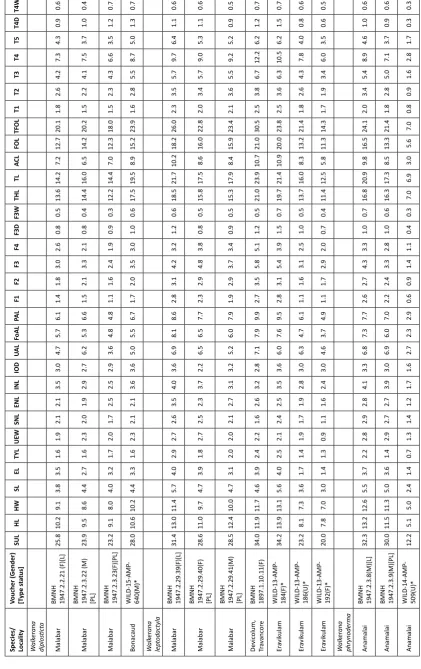
Measurements were completed using digital calipers (Ocean Premium Measuring Instruments) to the nearest 0.1mm. A total of 32 characters were measured, which included characters used by Padhye et al. (2014), Modak et al. (2015), and additional five characters. Abbreviations and definitions of morphometric characters are as follows: snout–urostyle length (SUL; length of specimen from snout to the visible tip of urostyle); head length (HL; measured from the posterior border of the tympanum to the tip of the snout); head width (HW; width of head between the posterior borders of the tympanum); snout length (SL; from the anterior edge of the orbit to the tip of the snout); eye length (EL; horizontal length of the eye); maximum tympanum length (TYL); upper eyelid width (UEW); snout–nostril distance (SNL); eye–nostril distance (ENL); internarial distance (INL); interorbital distance (IOD; minimum distance between the eyelids); upper arm length (UAL); forearm length (FoAL); palmar length (PAL, proximal edge of outermost palmar tubercle to tip of third finger); length of fingers 1–4 (F1–F4; measured from the base of the most proximal subarticular tubercle); finger 3 disc width (F3D); finger 3 width at the base of the disc (F3W); thigh length (THL; measured from hip joint to joint between thigh and shank); tibia/shank length (TL; measured from joint between thigh and shank to joint between shank and tibiotarsal articulation); astragalo-calcaneal length (ACL; measured from joint between shank and tibiotarsal articulation to the base of the inner metatarsal tubercle); foot length (FOL; measured from the base of the inner metatarsal tubercle to the tip of the fourth toe); total foot length (TFOL; from the tibio-tarsal articulation to the tip of fourth toe); length of toes 1–5 (T1–T5; measured from the base of the most proximal
# # # # # # # # # # # # # ### # # # # # # # # ## # # # # # # # # # # # # # # # # # ### # # ## ## # # # # # # # # # # # # # # # # # # # # # # # # # # # # # # # # # # ## # # # # # # ## # # # # # # # # # # # Goa gap Palghat gap MAHARASHTRA KARNATAKA GOA KERALA
TAMILNADU
ARABIAN EAS
# # # # # ### # # ## # ### ### # # ### # # ###### # # # ### # ### ## # # # # # # # # # # ### ####### # # ## # # #### # # # # ## # ## # ## ## ### # ## ## # # # INDIA #
9 NO
10 NO
11 NO
12 NO
13 NO
14 NO
15 NO
16 NO
17 NO
18 NO
19 NO
20 NO
21 NO
72 EO
73 EO
74 EO
75 EO
76 EO
77 EO
78 EO #
#
Shencottah gap
subarticular tubercle); toe 4 disc width (T4D); and toe 4 width at the base of the disc (T4W). Webbing formulae were determined following the method of Savage & Heyer (1967), as modified by Myers & Duellman (1982). Characters related to the roof of buccal cavity were studied following Modak et al. (2015).
Statistical analysis of morphometry
Since all the characters showed positive linear relationship with SUL, statistical analysis of the morphometric data was performed on size-adjusted measurements by taking all measurements as percent of SUL to remove body size variation bias. Discriminant analysis (DA) was performed to understand whether related species form significantly different clusters (Huberty & Olejnik 2006). Mahalanobis distances (see Harris 2001) between pair of individuals were calculated and used for computing Fisher’s distances (distance between the centroids of the clusters, divided by the sum of their standard deviations) between two clusters to check if the clusters were significantly different. Only in the case of comparison between species of the new genus (because there were more characters than number of specimens) we performed principle component analysis (PCA) of size-adjusted characters with correlation matrix between characters, and maximizing the variation between groups. Statistical analysis was performed in PAST 3.09 (Hammer et al. 2001).
Molecular analysis
Thigh muscles of 70 specimens (Table 1) were used for extracting DNA and conducting molecular analyses. Genomic DNA extraction, polymerase chain reaction (PCR) for the mitochondrial 16S rRNA and nuclear rhodopsin partial genes, PCR product purification, and sequencing were performed following the protocols detailed in Padhye et al. (2014). Sequences were checked using the BLAST tool (Altschul et al. 1990) to identify the nearest congeners. Sequences are deposited in GenBank under the accession numbers KX641759–KX641828 for 16S rRNA and KX641829–KX641886 for rhodopsin genes. Additional sequences of related species from the study by Modak et al. (2014, 2015) and Padhye et al. (2014) and five outgroups, namely Nyctibatrachus
aliciae, N. major, Micrixalus fuscus, M. kottigeharensis and Nasikabatrachus sahyadrensis, were retrieved from the NCBI GenBank (http://www.ncbi.nlm.nih.gov/). GenBank accession numbers of the sequences used for the analysis are provided in Table 1. Gene sequences were aligned separately for 16S rRNA and rhodopsin
using MUSCLE (Edgar 2004) implemented in MEGA 6 (Tamura et al. 2013). Genes were concatenated to make a super gene alignment with 922 bases using DAMBE (Xia 2013). Alignment was partitioned into four charsets corresponding to 16s rRNA gene and three codon positions of rhodopsin gene to create a full partition. We used a greedy strategy (Lanfear et al. 2012) implemented in IQ-TREE (Nguyen et al. 2015) to find the best partition scheme for the data using minimum Bayesian information criterion (BIC) value (Schwarz 1978; Nei & Kumar 2000). The best fit partition scheme was used to perform maximum likelihood analysis using IQ-TREE (Nguyen et al. 2015). Reliability of the phylogenetic tree was estimated using ultrafast bootstrap values run for 1000 iterations (Minh et al. 2013). The phylogenetic tree was edited in FigTree v1.4.2 (Rambaut 2009). This tree was also used to understand the phylogeographic
distribution of Indirana in the Western Ghats using
GenGIS 2.5 (Parks et al. 2013). Digital elevation map for phylogeography analysis was downloaded from Spatial Data Access Tool (http://webmap.ornl.gov/wcsdown/).
Since 16S rRNA gene has been suggested as a better barcoding region (Vences et al. 2005), we used this marker for analysis. Raw (p) distances between pairs of 16S rRNA sequences were calculated in MEGA 6 (Tamura et al. 2013). The frequency distributions of genetic distances was plotted to understand whether the distribution of the distances followed a bimodal distribution with a natural gap separating the two peaks. Such a gap is an indication of separation of intra- and interspecies genetic distances, which can be used to identify a gap in genetic distances that can be reliably used to separate two closely related species (Meyer & Paulay 2005; Meier et al. 2008). Intra- and interspecific distances were plotted as the mean, with minimum and maximum value indicated as error bars, to identify genetic gaps for delineating species. To substantiate our genetic gap analysis we also analyzed the 16S rRNA sequences using Automatic Barcode Gap Discovery (ABGD) software with simple distances (Puillandre et al. 2012) so as to understand species delimitation.
Further, we identified taxonomically important sites (defined below) within the 16S rRNA gene sequence
for delineating and diagnosing eight species of Indirana
that are morphologically similar. All available sequences for the given species were aligned with the complete
16S rRNA gene of Fejervarya cancrivora (Gravenhorst)
extracted from whole mitochondrial genome sequence EU652694. Character (nucleotide) numbers were considered relative to the alignment with the complete
Genus/Species Locality Latitude Longitude Altitude (m) Specimen no. 16S rRNA rho Reference
Indirana
I. beddomii Peruvannamuzhi 11.535 75.880 63 WILD-14-AMP-420 KX641761 KX641831 This study
I. beddomii Kunthipuzha 11.049 76.440 95 WILD-14-AMP-421 KX641762 KX641832 This study
I. beddomii Sairandhri 11.093 76.464 1001 WILD-14-AMP-409 KX641764 KX641834 This study
I. beddomii Aralam 11.946 75.878 546 WILD-13-AMP-138 KX641763 KX641833 This study
I. beddomii Kakkayam 11.548 75.889 60 WILD-14-AMP-413 KX641765 KX641835 This study
I. beddomii Peruvannamuzhi 11.599 75.819 38 WILD-14-AMP-411 KX641759 KX641829 This study
I. beddomii Peruvannamuzhi 11.599 75.819 38 WILD-14-AMP-414 KX641760 KX641830 This study
I. brachytarsus Neyyar 8.534 77.232 109 WILD-13-AMP-234 KX641766 KX641836 This study
I. brachytarsus Neyyar 8.559 77.159 104 WILD-13-AMP-247 KX641775 KX641844 This study
I. brachytarsus Ponmudi 8.737 77.145 903 WILD-13-AMP-301 KX641767 KX641837 This study
I. brachytarsus Ponmudi 8.967 77.052 91 WILD-13-AMP-241 KX641774 KX641843 This study
I. brachytarsus Ponmudi 8.735 77.140 837 WILD-13-AMP-293 KX641777 KX641845 This study
I. brachytarsus Chimmony 10.447 76.395 48 WILD-14-AMP-475 KX641770 KX641839 This study
I. brachytarsus Peechi-Vazhani 10.426 76.466 61 WILD-14-AMP-478 KX641772 KX641841 This study
I. brachytarsus Ponmudi 8.563 77.165 138 WILD-13-AMP-285 KX641776 - This study
I. brachytarsus Painavu 9.844 76.959 743 WILD-14-AMP-358 KX641768 KX641838 This study
I. brachytarsus Vellakkamaly 9.843 76.979 704 WILD-14-AMP-437 KX641769 - This study
I. brachytarsus Chimmony 10.447 76.395 48 WILD-14-AMP-477 KX641771 KX641840 This study
I. brachytarsus Painavu 9.844 76.959 743 WILD-14-AMP-359 KX641778 KX641846 This study
I. brachytarsus Vellakkamaly 9.843 76.979 704 WILD-14-AMP-442 KX641779 KX641847 This study
I. brachytarsus Topslip 10.471 76.842 748 WILD-15-AMP-609 KX641773 KX641842 This study
I. chiravasi Koyna 17.392 73.678 862 WILD-15-AMP-530 KX641780 KX641848 This study
I. chiravasi Kitawade 16.001 74.018 722 WILD-15-AMP-612 KX641782 - This study
I. chiravasi Chandoli 17.210 73.811 920 WILD-15-AMP-535 KX641781 KX641849 This study
I. chiravasi Amboli 15.956 73.997 744 WILD-14-AMP-489 KM386530 KM386538 Padhye et al. (2014)
I. chiravasi Amboli 15.956 73.997 744 BNHS 5890 KM386531 KM386539 Padhye et al. (2014)
I. duboisi Mookambika 13.917 74.913 634 WILD-15-AMP-630 KX641815 KX641875 This study
I. duboisi Mookambika 13.894 74.831 498 WILD-15-AMP-631 KX641816 KX641876 This study
I. duboisi Muduba 13.322 75.146 724 BNHS 5980 KX641817 - This study
I. gundia Aralam 11.933 75.838 162 WILD-13-AMP-139 KX641783 KX641850 This study
I. gundia Coorg 12.005 75.890 817 WILD-13-AMP-210 KX641784 KX641851 This study
I. gundia Kutta 12.027 75.932 812 WILD-13-AMP-211 KX641785 KX641852 This study
I. gundia Ranipuram 12.414 75.353 785 WILD-15-AMP-614 KX641787 - This study
I. gundia Gundia 12.825 75.569 128 WILD-14-AMP-499 KM386532 KM386540 Padhye et al. (2014)
I. gundia Gundia 12.829 75.607 224 WILD-14-AMP-500 KM386533 KM386541 Padhye et al. (2014)
I. gundia Subramanya Sullya 12.651 75.573 98 WILD-16-AMP-649 KX641790 KX641856 This study
I. gundia Aralam 11.931 75.836 180 WILD-13-AMP-136 KX641786 KX641853 This study
I. gundia Ranipuram 12.419 75.358 757 WILD-15-AMP-616 KX641788 KX641854 This study
I. gundia Ranipuram 12.416 75.364 794 WILD-15-AMP-618 KX641789 KX641855 This study
I. leithii Karnala 18.878 73.110 25 WILD-15-AMP-525 KX641791 KX641857 This study
Genus/Species Locality Latitude Longitude Altitude (m) Specimen no. 16S rRNA rho Reference
I. leithii Ahwa Dang 20.764 73.676 395 AGCZRL-Amphibia-552 KX641794 - This study
I. leithii Achala fort 20.432 73.814 1106 AGCZRL-Amphibia-548 KX641793 - This study
I. leithii Ahwa Dang 20.764 73.676 395 AGCZRL-Amphibia-555 KX641795 - This study
I. leithii Matheran 18.989 73.268 801 BNHS 5591 KF590638 KF590648 Modak et al. (2014)
I. leithii Ratangad 19.500 73.700 1094 AGCZRL-Amphibia-113 KF590646 KF590656 Modak et al. (2014)
I. leithii Gaganbawda 16.550 73.831 600 AGCZRL-Amphibia-195 KJ442877 KJ442881 Modak et al. (2014)
I. leithii Ratangad 19.500 73.700 1094 AGCZRL-Amphibia-112 KF590645 KF590655 Modak et al. (2014)
I. leithii Visapur 18.720 73.490 1035 WILD-013-AMP-178 KF590644 KF590654 Modak et al. (2014)
I. leithii Koynanagar 17.410 73.740 839 WILD-013-AMP-177 KF590643 KF590653 Modak et al. (2014)
I. leithii Tamhini 18.480 73.410 579 WILD-013-AMP-175 KF590641 KF590651 Modak et al. (2014)
I. leithii Harishchandragad 19.390 73.780 1329 WILD-013-AMP-174 KF590640 KF590650 Modak et al. (2014)
I. leithii Harishchandragad 19.390 73.780 1329 WILD-013-AMP-173 KF590639 KF590649 Modak et al. (2014)
I. leithii Tamhini 18.480 73.410 579 WILD-013-AMP-176 KF590642 KF590652 Modak et al. (2014)
I. leithii Anuskura ghat 16.761 73.795 603 AGCZRL-Amphibia-193 KJ442876 KJ442880 Modak et al. (2014)
I. leithii Anjaneri 19.925 73.579 888 AGCZRL-Amphibia-199 KJ442874 KJ442878 Modak et al. (2014)
I. leithii Amba ghat 16.982 73.781 630 AGCZRL-Amphibia-192 KJ442875 KJ442879 Modak et al. (2014)
I. leithii Matheran 18.989 73.268 801 BNHS 5590 KF590637 KF590647 Modak et al. (2014)
I. sarojamma Ponmudi 8.967 77.052 91 BNHS 5981 KX641796 KX641858 This study
I. salelkari Netravali 15.095 74.211 78 BNHS 5931 KP826824 KP826827 Modak et al. (2015)
I. salelkari Netravali 15.095 74.211 78 WILD-15-AMP-551 KP826825 KP826828 Modak et al. (2015)
I. salelkari Netravali 15.095 74.211 78 AGCZRL-Amphibia-210 KP826826 KP826829 Modak et al. (2015)
I. semipalmata Sholayar 10.308 76.742 722 WILD-15-AMP-610 KX641797 KX641859 This study
I. semipalmata Chimmony 10.447 76.462 61 WILD-14-AMP-471 KX641808 KX641870 This study
I. semipalmata Chimmony 10.447 76.462 61 WILD-14-AMP-473 KX641810 KX641872 This study
I. semipalmata Kunthipuzha 11.049 76.440 95 WILD-14-AMP-419 KX641799 KX641861 This study
I. semipalmata Chimmony 10.447 76.462 61 WILD-14-AMP-474 KX641811 KX641873 This study
I. semipalmata Peechi-Vazhani 10.532 76.366 96 WILD-14-AMP-470 KX641807 KX641869 This study
I. semipalmata Sholayar 10.308 76.742 722 WILD-15-AMP-611 KX641798 KX641860 This study
I. semipalmata Parambikulam 10.418 76.793 661 WILD-14-AMP-503 KX641812 KX641874 This study
I. semipalmata Idukki 9.874 77.076 797 WILD-14-AMP-440 KX641814 - This study
I. semipalmata Silent Valley 11.072 76.535 556 WILD-14-AMP-416 KX641806 KX641868 This study
I. semipalmata Peechi-Vazhani 10.532 76.366 96 WILD-14-AMP-472 KX641809 KX641871 This study
I. semipalmata Kizhukanam 9.874 77.076 797 WILD-14-AMP-438 KX641800 KX641862 This study
I. semipalmata Painavu 9.849 76.949 803 WILD-14-AMP-354 KX641813 - This study
I. semipalmata Shendurney 8.916 77.110 174 WILD-13-AMP-269 KX641801 KX641863 This study
I. semipalmata Shendurney 8.910 77.119 230 WILD-13-AMP-270 KX641802 KX641864 This study
I. semipalmata Shendurney 8.909 77.119 281 WILD-13-AMP-271 KX641803 KX641865 This study
Genus/Species Locality Latitude Longitude Altitude (m) Specimen no. 16S rRNA rho Reference
I. semipalmata Idukki 9.874 77.076 797 WILD-14-AMP-351 KX641805 KX641867 This study
I. tysoni Ranipuram 12.419 75.353 932 BNHS 5979 KX641818 KX641877 This study
I. tysoni Ranipuram 12.419 75.353 932 WILD-15-AMP-615 KX641819 KX641878 This study
I. tysoni Wattakole 12.380 75.822 1051 WILD-16-AMP-650 KX641820 KX641879 This study
I. yadera Neyyar 8.563 77.165 138 WILD-13-AMP-338 KX641821 KX641880 This study
I. yadera Vagamalai 9.874 77.076 797 BNHS 5982 KX641822 KX641881 This study
I. yadera Chimmony 10.445 76.460 55 WILD-14-AMP-479 KX641823 KX641882 This study
Walkerana
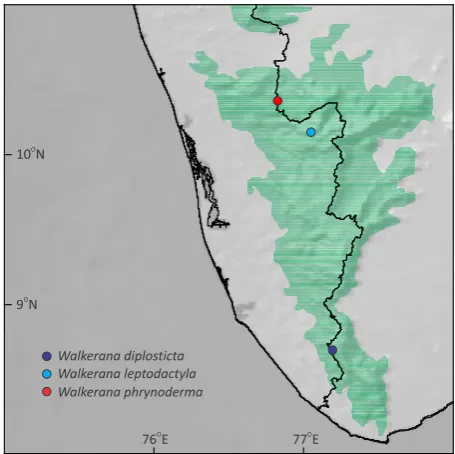
W. diplosticta Bonacaud 8.686 77.183 877 WILD-15-AMP-640 KX641828 KX641886 This study
W. leptodactyla Eravikulam 10.144 77.037 1899 WILD-13-AMP-192 KX641825 KX641884 This study
W. leptodactyla Eravikulam 10.145 77.038 1940 WILD-13-AMP-186 KX641826 - This study
W. leptodactyla Eravikulam 10.145 77.038 1940 WILD-13-AMP-184 KX641827 KX641885 This study
W. phrynoderma Anamalai 10.354 76.815 928 WILD-14-AMP-509 KX641824 KX641883 This study Outgroup
Micrixalus fuscus - - - GU136106 AF249120 GenBank
Micrixalus
kottigeharensis - - - AF249041 AF249121 GenBank
Nyctibatrachus aliciae - - - - - AF249063 AF249114 GenBank
Nyctibatrachus major - - - - - AF249052 AF249113 GenBank
Nasikabatrachus
sahyadrensis - - - AY364381 AY364381 GenBank
were identical within a species but showed variation between the species, alone or in combination, were considered taxonomically informative sites and used as diagnostic for the given species.
RESULTS
Identification of topotypes, putative topotypes, and
their barcodes for known species
Günther (1876) did not provide an exact type
locality for Indirana beddomii, and the syntypes of this
species came from Malabar, Travancore, Anamallays (=Anamalai), and Sevagherry (=Sivagiri). In fact, the
syntypes of I. beddomii represent a species complex,
which necessitates the designation of a lectotype from among the syntypes (see Taxonomy section below). The original illustration provided by Günther (1876: Plate LXIII B) depicts specimen BMNH 1947.2.27.72, originating in Malabar, and we hereby designate this
specimen as the lectotype of I. beddomii. This specimen
closely resembles the population we studied at
Peruvannamuzhi, Malabar Wildlife Sanctuary (11.5990N
& 75.8190E, elevation 38m), located north of the
Palghat gap. Because Malabar is not a precise locality (see Biju 2001), being the first revisers we designate
Peruvannamuzhi, Malabar Wildlife Sanctuary, Kerala,
India as the putative type locality of I. beddomii. This is
pertinent, given that our specimen (WILD-14-AMP-414) from this locality closely resembles the lectotype, based on the following key characters: (i) one phalange free of webbing on the inner side of the third toe; (ii) heels just overlap when thighs are held at right angles to body axis, loreal region more oblique; and (iii) structure and placement of vomerine teeth. Further, Peruvannamuzhi also falls into the larger Malabar region of the British era. Therefore, the 16S rRNA gene sequence KX641760 is topotypic and can be considered as a barcode to allow
genetic identification of I. beddomii.
In the original description of Indirana brachytarsus,
Günther (1876) suggested that the species hailed from Anamalai and Sivagiri, both south of the Palghat gap. From among the syntypes, Inger et al. (1984) designated the specimen originating from Anamalai (BMNH 1947.2.27.92) as lectotype of the species. Specimen WILD-15-AMP-609 from our collection, originating from
Topslip of Anamalai in Tamil Nadu (10.4710N & 76.8420E,
and (iv) structure and placement of vomerine teeth and choanae in buccal cavity. We therefore consider this specimen as a putative topotype and its 16S rRNA gene
sequence KX641773 as a genetic barcode to identify I.
brachytarsus.
Padhye et al. (2014) provided genetic data for
paratypes of Indirana chiravasi. As these paratypes
were from the same locality as that of the holotype, they are also isotypes and therefore the 16S rRNA gene sequences KM386530 and KM386531 represent
topotypic material of I. chiravasi and are therefore
genetic barcodes for identifying I. chiravasi.
Günther (1876) did not provide exact type locality for Indirana diplosticta, and the syntypes came from Malabar. Because three syntypes are available, designation of a lectotype is essential to stabilize taxonomy. We could not decipher which of the three specimens was used in the original illustration (Günther 1876: Plate LXIII C), however, BMNH 1947.2.2.21 is most similar to the illustration. We therefore designate BMNH 1947.2.2.21 as lectotype for the species (see Taxonomy section below). This specimen closely resembles
the population we studied at Bonacaud (8.6860N &
77.1830E, elevation 877m), Peppara Wildlife Sanctuary.
Since Malabar is not a precise locality, as first revisers we designate Bonacaud, Peppara Wildlife Sanctuary, Kerala, India, as the putative type locality of I. diplosticta. This is pertinent, given that our specimen (WILD-15-AMP-640) from this locality closely resembles the lectotype. Therefore, the 16S rRNA gene sequence KX641828 is topotypic and can be considered as a genetic barcode to allow genetic identification of I. diplosticta.
Padhye et al. (2014) provided genetic information of Indirana gundia from the type locality Gundia, Karnataka, India. We can therefore consider sequences KM386532 and KM386533 as 16S rRNA gene barcodes
for identifying I. gundia.
Modak et al. (2014) provided the 16S rRNA gene
sequence KF590637 for Indirana leithii from its type
locality in Matheran, Maharashtra, India, and considered this as topotypic sequence. We follow these authors and
consider this sequence as a genetic barcode for I. leithii.
In the discussion of his replacement name Rana
leptodactyla for Günther’s (1876) Polypedatus brevipalmatus, Boulenger (1882) suggested that several types of Günther’s species came from Anamalai and Malabar. We could not locate any syntypes originating from Anamalai in the collection of BMNH. However, three syntypes, from Malabar (BMNH 1947.2.29.39, BMNH 1947.2.29.40 and BMNH 1947.2.29.41) were studied. Although we also examined several other
specimens collected by Col. R.C. Beddome (BMNH 1874.4.28.503–509) and Jerdon (BMNH 1874.4.28.503– 509), the type status of these specimens are uncertain (see Taxonomic section below). Because three syntypes are available, designation of a lectotype is essential to stabilize taxonomy. We therefore designate BMNH 1947.2.29.39 as lectotype for the species (see Taxonomy section below), based on the priority in voucher number as no illustration or specific comments on any one of the syntypes is available in the original description. This specimen closely resembles the population we studied
at Eravikulam National Park (10.1450N & 77.0380E,
elevation 1940m), and because Malabar is not a precise locality, as first revisers we designate Eravikulam National Park, Kerala, India, as the putative type locality of I. leptodactyla. This is pertinent, given that our specimen (WILD-13-AMP-184) from this locality closely resembles lectotype. Therefore, the 16S rRNA gene sequence KX641827 is topotypic and can be considered
as a genetic barcode to allow genetic identification of I.
leptodactyla.
Boulenger (1882) described Rana phrynoderma from
Anamalai based on two syntypes (BMNH 1947.2.3.8 and 1947.2.3.9). To stabilize taxonomy, we designate
BMNH 1947.2.3.8 as the lectotype for I. phrynoderma
(see Taxonomy section below), based on the priority in voucher number as no illustration or specific comments on any one of the syntypes is available in the original description. Our specimen WILD-14-AMP-509 from
Parambikulam Tiger Reserve (10.3540N & 76.8150E,
elevation 928m) in Anamalai of Kerala is conspecific
with the syntypes of I. phrynoderma and therefore we
consider the sequence KX641824 as a genetic barcode that can serve in identifying the species.
Modak et al. (2015) provided the 16S rRNA gene sequence KP826824 of the holotype while describing
Indirana salelkari, which is the genetic barcode for identifying the species.
In his description of Indirana semipalmata,
Boulenger (1882) mentioned Malabar as the type locality. Because two syntypes (BMNH 1947.2.29.50 and 1947.2.29.51) are available, designation of a lectotype is essential to stabilize taxonomy. We could not decipher which of the two specimens was used in the original illustration (Boulenger 1882: Plate IV Fig. 3); however, BMNH 1947.2.29.50 is most similar to the illustration and therefore we designate BMNH 1947.2.29.50 as the lectotype for the species (see Taxonomy section below). This specimen closely resembles the population we
studied at Painavu, Idukki Wildlife Sanctuary (9.8490N
precise locality, as first revisers we designate Painavu, Idukki Wildlife Sanctuary, Kerala, India, as the putative
type locality of I. semipalmata. This is pertinent, given
that our specimen (WILD-14-AMP-354) from this locality closely resembles the lectotype, based on the following key characters: (i) reduced webbing with at least ½
phalange free on 3rd and 5th toe and 2¼ phalanges free
on 4th toe; and (ii) tympanum diameter more than
50% of eye diameter. Therefore, the 16S rRNA gene sequence KX641813 is topotypic and can be considered
as a genetic barcode to allow genetic identification of I.
semipalmata.
Genetic barcodes for I. longicrus and I. tenuilingua
cannot be assigned because of taxonomic ambiguity as explained under the Taxonomy section.
Phylogenetic analysis
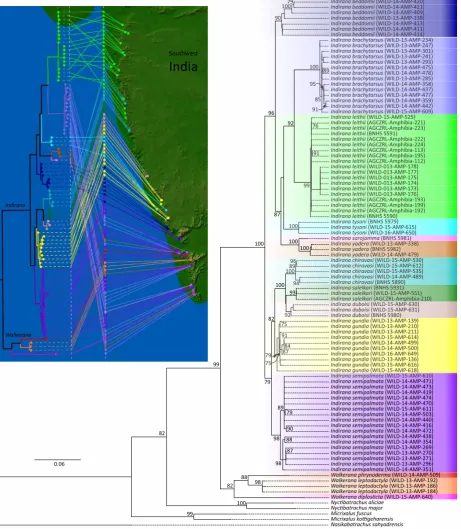
Analysis of best partition scheme for mitochondrial 16S rRNA gene and three codon positions of nuclear rhodopsin gene implied transition model with rate heterogeinity (TIM2+R3, BIC = 11498.60, lnL=-5186.11, df=165) as the best nucleotide substitution model for all partitions. In the maximum likelihood tree (Fig. 2), a deep branching clade separates species with highly
reduced webbing (I. phrynoderma, I. leptodactyla, I.
diplosticta) from other species of Indirana. We identify
this clade as a distinct genus and erect Walkerana
gen. nov. (see Taxonomy section below) within the family Ranixalidae. Intra- and interspecific genetic raw
uncorrected p distances in 16S rRNA gene for species
of Indirana are provided in Table 2, for Walkerana gen.
nov. in Table 3, and between species of Indirana and
Walkerana gen. nov. in Table 4. In the genus Indirana, maximum intraspecific genetic distance in 16S rRNA
gene is 1.9% in I. semipalmata, while the minimum
interspecific distance is 2.4% between I. duboisi sp. nov.
and I. salelkari. The gap between the two is marked as a genetic gap for species delimitation in Fig. 3. This gap is also evident in a frequency distribution of pairwise
distances for all samples of Indirana (Fig. 3 inset). This
genetic gap revealed presence of 11 species in genus
Indirana, which included three proposed new species. Analysis using Automatic Barcode Gap Discovery (ABGD) software also revealed same grouping into 11 species with partition having prior maximal distance P = 0.00596. We had limited samples of species in
Walkerana gen. nov., as most of the species occur within protected areas with limited access and permission to collect only a few individuals. Nevertheless, we find that
the maximum intraspecific genetic distance is 0.4% in W.
leptodactyla comb. nov., and the minimum interspecific Species
(1) (2) (3) (4) (5) (6) (7) (8) (9) (10) (11) I. beddomii (1) 1.0 (0.0–1.7) I. brach yt arsus (2) 5.8 (5.2–6.7) 0.5 (0.0–1.2) I. chiravasi (3) 7.4 (7.1–7.9) 8.0 (7.5–9.0) 0 I. duboisi (4) 7.0 (6.5–7.9) 7.8 (7.3–8.5) 3.0 (2.7–3.1) 0.3 (0.0–0.4) I. gundia (5) 4.8 (4.2–5.5) 7.0 (6.4–7.9) 3.7 (3.6–3.8) 3.1 (2.7–3.3) 0.1 (0.0–0.4) I. leithii (6) 4.6 (3.3–5.9) 6 .0(5.1–7.4) 9.2 (8.4–10.3) 8.2 (7.6–9.2) 7.2 (6.3–8.4) 0.6 (0.0–1.6) I. salelk ari (7) 7.8 (7.6–8.2) 8.9 (8.5–9.2) 3.4 (3.4–3.4) 2.4 (2.4–2.5) 4.0 (4.0–4.0) 9.0 (8.5–9.9) 0 I. sarojamma (8) 4.9 (4.8–5.4) 7.2 (7.0–8.2) 7.9 (7.9–7.9) 7.6 (7.5–7.8) 6.2 (6.2–6.4) 6.0 (5.3–7.0) 8.5 (8.5–8.5) 0 I. semipalmat a (9) 5.5 (4.6–5.9) 6.3 (5.6–7.7) 4.9 (4.6–5.6) 4.5 (4.2–5.0) 3.1 (2.6–3.3) 7.0 (6.0–8.8) 5.5 (5.2–6.0) 8.0 (7.5–8.3) 0.9 (0.0–1.9) I. tysoni (10) 4.6 (4.0–5.2) 6.0 (5.6–6.3) 6.9 (6.9–6.9) 7.3 (7.1–7.6) 5.8 (5.5–5.9) 5.8 (5.1–6.9) 8.2 (8.2–8.2) 5.6 (5.6–5.6) 6.3 (5.9–6.9) 0 I. yadera (11) 5.5 (5.2–5.8) 8.0 (7.5–9.0) 8.6 (8.5–8.7) 8.2 (7.9–8.5) 7.1 (6.8–7.3) 6.7 (6.0–7.8) 9.4 (9.3–9.5) 3.4 (3.3–3.5) 7.7 (7.1–8.5) 5.7 (5.6–5.8) 0.1 (0.0–0.2)
Table 2. Raw (p) uncorrected genetic distances (%) in 16S rRNA g
ene between species of
Indirana
expressed as mean (minimum–maximum). Diagonal values in bold a
Figure 2. Maximum likelihood tree for concatenated mitochondrial 16S rRNA and nuclear rhodopsin partial gene sequences. Species of
Nyctibatrachus, Micrixalus and Nasikabatrachus were used as outgroups with Nasikabatrachus sahyadrensis as a root. Values along the
nodes are percent boostraps for 1000 iterations. Phylogeographic analysis using GenGIS is shown in the inset. Color codes for sequences used in phylogeography analysis are shown in the main tree with same color boxes.
0.06
Indirana brachytarsus(WILD-13-AMP-234)
Indirana leithii(WILD-013-AMP-175)
Indirana yadera(BNHS 5982)
Indirana semipalmata(WILD-13-AMP-271) Indirana chiravasi(WILD-15-AMP-535)
Walkerana leptodactyla(WILD-13-AMP-186) Indirana brachytarsus(WILD-14-AMP-358)
Indirana chiravasi(BNHS 5890)
Indirana gundia(WILD-16-AMP-649)
Indirana gundia(WILD-13-AMP-211)
Walkerana diploscta(WILD-15-AMP-640) Indirana leithii(BNHS 5590)
Indirana gundia(WILD-14-AMP-500)
Indirana duboisi(WILD-15-AMP-630)
Indirana tysoni(BNHS 5979)
Indirana yadera(WILD-14-AMP-479)
Indirana gundia(WILD-15-AMP-616)
Indirana brachytarsus(WILD-13-AMP-293)
Indirana chiravasi(WILD-14-AMP-489)
Indirana semipalmata(WILD-15-AMP-610)
Indirana leithii(AGCZRL-Amphibia-112)
Indirana chiravasi(WILD-15-AMP-612)
Indirana gundia(WILD-15-AMP-618)
Indirana brachytarsus(WILD-14-AMP-442)
Indirana brachytarsus(WILD-14-AMP-478)
Indirana beddomii(WILD-14-AMP-414)
Indirana brachytarsus(WILD-13-AMP-285)
Indirana semipalmata(WILD-14-AMP-419) Indirana tysoni(WILD-16-AMP-650)
Indirana brachytarsus(WILD-14-AMP-359)
Indirana leithii(AGCZRL-Amphibia-223)
Indirana brachytarsus(WILD-13-AMP-241)
Indirana brachytarsus(WILD-14-AMP-475)
Indirana leithii(AGCZRL-Amphibia-199)
Indirana gundia(WILD-13-AMP-139)
Indirana yadera(WILD-13-AMP-338)
Walkerana leptodactyla(WILD-13-AMP-192) Indirana semipalmata(WILD-14-AMP-472) Indirana leithii(WILD-013-AMP-173)
Indirana duboisi(WILD-15-AMP-631)
Indirana brachytarsus(WILD-13-AMP-247)
Indirana semipalmata(WILD-14-AMP-473) Indirana leithii(AGCZRL-Amphibia-113)
Indirana semipalmata(WILD-13-AMP-270)
Indirana semipalmata(WILD-14-AMP-351) Indirana salelkari(WILD-15-AMP-551)
Nycbatrachus aliciae
Indirana leithii(WILD-013-AMP-176)
Indirana leithii(BNHS 5591)
Indirana gundia(WILD-14-AMP-499)
Indirana gundia(WILD-15-AMP-614)
Indirana semipalmata(WILD-14-AMP-354)
Nycbatrachus major Indirana sarojamma(BNHS 5981)
Indirana beddomii(WILD-14-AMP-409)
Indirana tysoni(WILD-15-AMP-615)
Indirana leithii(WILD-013-AMP-177)
Indirana brachytarsus(WILD-14-AMP-437)
Indirana salelkari(BNHS 5931)
Indirana beddomii(WILD-14-AMP-411)
Nasikabatrachus sahyadrensis Indirana semipalmata(WILD-14-AMP-474) Indirana beddomii(WILD-14-AMP-420)
Indirana salelkari(AGCZRL-Amphibia-210)
Indirana brachytarsus(WILD-15-AMP-609)
Micrixalus fuscus
Indirana brachytarsus(WILD-14-AMP-477)
Indirana duboisi(BNHS 5980)
Indirana leithii(AGCZRL-Amphibia-192)
Indirana leithii(AGCZRL-Amphibia-193)
Indirana semipalmata(WILD-14-AMP-470) Indirana beddomii(WILD-14-AMP-413)
Indirana semipalmata(WILD-14-AMP-503)
Indirana semipalmata(WILD-13-AMP-269) Indirana gundia(WILD-13-AMP-210)
Indirana leithii(AGCZRL-Amphibia-222)
Indirana beddomii(WILD-14-AMP-421)
Indirana chiravasi(WILD-15-AMP-530)
Walkerana leptodactyla(WILD-13-AMP-184) Indirana semipalmata(WILD-13-AMP-296) Indirana leithii(WILD-013-AMP-178)
Indirana semipalmata(WILD-14-AMP-471) Indirana leithii(WILD-15-AMP-525)
Indirana semipalmata(WILD-14-AMP-438) Indirana leithii(WILD-013-AMP-174)
Indirana semipalmata(WILD-14-AMP-440)
Micrixalus ko geharensis
Indirana semipalmata(WILD-15-AMP-611)
Walkerana phrynoderma(WILD-14-AMP-509) Indirana leithii(AGCZRL-Amphibia-195)
Indirana leithii(AGCZRL-Amphibia-224)
Indirana gundia(WILD-13-AMP-136)
Indirana leithii(AGCZRL-Amphibia-221)
Indirana semipalmata(WILD-14-AMP-416) Indirana beddomii(WILD-13-AMP-138)
0 2 4 6 8 10 12
Indirana beddomii Indirana brachytarsus Indirana chiravasi Indirana gundia Indirana leithii Indirana salelkari Indirana sarojamma Indirana semipalmata Indirana duboisi Indirana tysoni Indirana yadera Indirana beddomii X Indirana brachytarsus Indirana beddomii X Indirana chiravasi Indirana beddomii X Indirana gundia Indirana beddomii X Indirana leithii Indirana beddomii X Indirana salelkari Indirana beddomii X Indirana sarojamma Indirana beddomii X Indirana semipalmata Indirana beddomii X Indirana duboisi Indirana beddomii X Indirana tysoni Indirana beddomii X Indirana yadera Indirana brachytarsus X Indirana chiravasi Indirana brachytarsus X Indirana gundia Indirana brachytarsus X Indirana leithii Indirana brachytarsus X Indirana salelkari Indirana brachytarsus X Indirana sarojamma Indirana brachytarsus X Indirana semipalmata Indirana brachytarsus X Indirana duboisi Indirana brachytarsus X Indirana tysoni Indirana brachytarsus X Indirana yadera Indirana chiravasi X Indirana gundia Indirana chiravasi X Indirana leithii Indirana chiravasi X Indirana salelkari Indirana chiravasi X Indirana sarojamma Indirana chiravasi X Indirana semipalmata Indirana chiravasi X Indirana duboisi Indirana chiravasi X Indirana tysoni Indirana chiravasi X Indirana yadera Indirana gundia X Indirana leithii Indirana gundia X Indirana salelkari Indirana gundia X Indirana sarojamma Indirana gundia X Indirana semipalmata Indirana gundia X Indirana duboisi Indirana gundia X Indirana tysoni Indirana gundia X Indirana yadera Indirana leithii X Indirana salelkari Indirana leithii X Indirana sarojamma Indirana leithii X Indirana semipalmata Indirana leithii X Indirana duboisi Indirana leithii X Indirana tysoni Indirana leithii X Indirana yadera Indirana salelkari X Indirana sarojamma Indirana salelkari X Indirana semipalmata Indirana salelkari X Indirana duboisi Indirana salelkari X Indirana tysoni Indirana salelkari X Indirana yadera Indirana sarojamma X Indirana semipalmata Indirana sarojamma X Indirana duboisi Indirana sarojamma X Indirana tysoni Indirana sarojamma X Indirana yadera Indirana semipalmata X Indirana duboisi Indirana semipalmata X Indirana tysoni Indirana semipalmata X Indirana yadera Indirana duboisi X Indirana tysoni Indirana duboisi X Indirana yadera Indirana tysoni X Indirana yadera
raw (p) distances (%)
0 2 4 6 8 10 12
raw (p) distance (%)
0.0 1.2 2.4 3.6 4.8 6.0 7.2 8.4 9.6 10.8 12.0 13.2 14.4 15.6
per
cen
t
Figure 3. Genetic gap analysis for species of Indirana. Mean raw uncorrected p distance values of intra and inter species divergence are
genetic distance is 6.4% between W. leptodactyla comb.
nov. and W. phrynoderma comb. nov. with a clear gap
between the two values (Fig. 4). Interspecific distances
between the species of Indirana and Walkerana gen.
nov. are >11.0% in all cases.
Morphometric analysis
Fisher’s distances between clusters were significantly different after sequential Bonferroni correction at
two-tailed level, except in two cases, Indirana beddomii
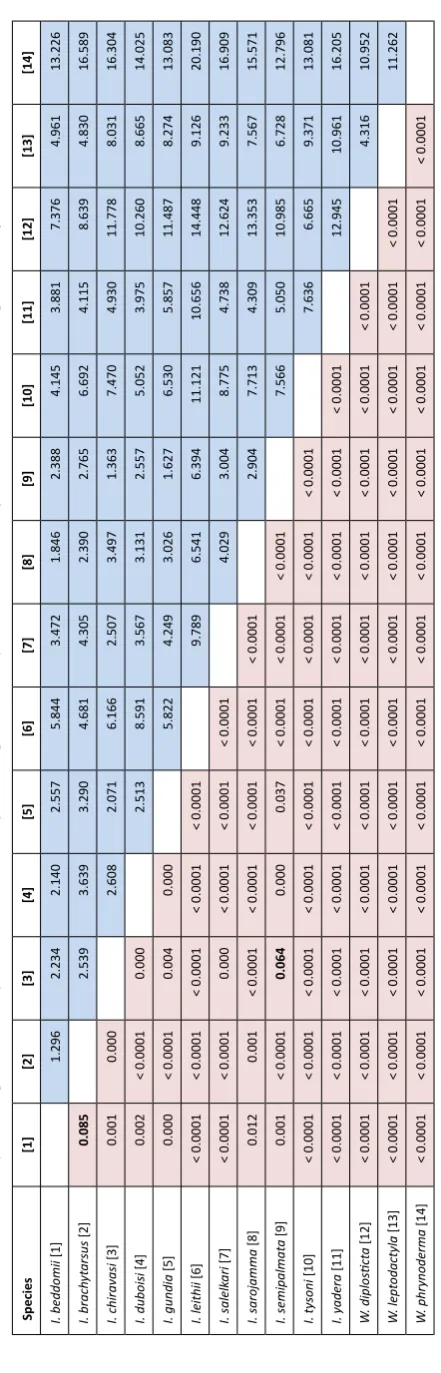
vs. I. brachytarsus and I. semipalmata and I. chiravasi, which were only marginally significant at one-tailed level (Table 5). Nevertheless, both these pairs of species had different extent of webbing (see Taxonomy section below). Discriminant analysis of all species of Ranixalidae extracted 13 factors (Fig. 5, inset). Species of Walkerana gen. nov. are morphometrically distinct
from species of Indirana along the first two; and fourth
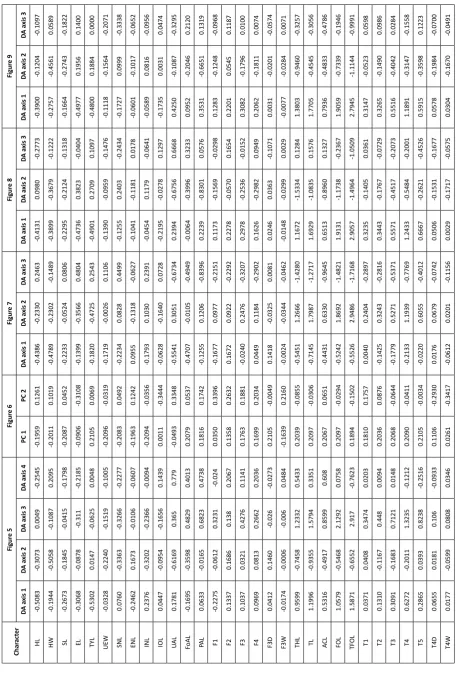
discriminant axes (Fig. 5). This separation occurs largely because of smaller TYL and ENL and longer THL, FOL,
TL and TFOL in species of Walkerana gen. nov., when
all the lengths are corrected for size (Table 6). Species
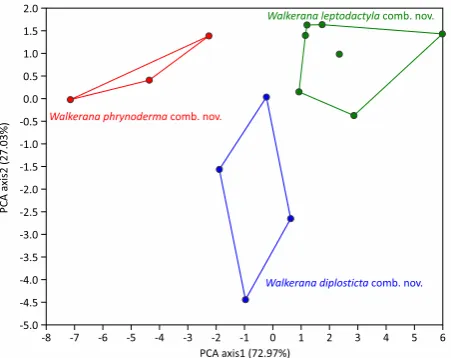
under Walkerana gen. nov. form distinct clusters in first
two dimensions of PCA (Fig. 6). Walkerana diplosticta comb. nov. separated based on higher EL, IOL and T4W;
W. leptodactyla comb. nov. separated based on higher
TYL, F3D, FOL and T5; and W. phrynoderma comb. nov.
separated based on higher SL, UEW, SNL and INL (Table
6). Discriminant analysis of Indirana species extracted
10 factors, of which the first three factors explain 74.45%
of the total variation in the data (Fig. 7, inset). Indirana
leithii forms a distinct cluster in the first two dimensions
(Fig. 7a, b), while I. tysoni sp. nov. forms a distinct cluster
in the third dimension (Fig. 7c). Indirana leithii forms
a distinct cluster from all other species under Indirana
(Fig. 7a, b) based on comparatively higher values of
ENL, F2 and F3D (Table 6); while I. tysoni sp. nov. forms
a distinct cluster from other species of Indirana based
on relatively higher values of characters such as SNL, INL
and F3D (Table 6). The remaining species of Indirana
(Fig. 8) and members of ‘beddomii group’ (Fig. 9) (see
Taxonomy section for details) form distinct clusters in DA only in higher dimensions. Factor loading for the first three dimensions in Figs. 8 and 9 are provided in Table 6.
Taxonomy
Order: Anura Fischer von Waldheim, 1813
Incertae sedis: Philautus longicrus Rao, 1937 (= P.
crnri Dutta, 1985).
Species (1) (2) (3)
W. diplosticta (1) 0
W. leptodactyla (2) 11.5 (11.2–12.1) 0.3 (0.0–0.4)
W. phrynoderma (3) 13.1 (13.1–13.1) 6.7 (6.4–7.3) 0 Table 3. Raw (p) uncorrected genetic distances (%) in 16S rRNA
gene between species of Walkerana gen. nov. expressed as mean
(minimum–maximum). Diagonal values in bold are intra specific distances.
0 2 4 6 8 10 12 14
raw (p) distances (%)
Walkerana diplosticta Walkerana leptodactyla Walkerana phrynoderma Walkerana leptodactyla X Walkerana diplosticta Walkerana phrynoderma X Walkerana diplosticta Walkerana phrynoderma X Walkerana leptodactyla
Figure 4. Genetic gap analysis for species of Walkerana gen. nov.. Mean raw uncorrected p distance values of intra and inter species
divergence are plotted with minimum and maximum value as error bars. Green bar shows genetic gap between 0.4 to 6.4% genetic divergence.
Species W. diplosticta W. leptodactyla W. phrynoderma
I. beddomii 13.2 (13.0–13.7) 11.0 (10.6–11.8) 13.9 (13.3–14.2)
I. brachytarsus 14.1 (13.9–14.4) 12.7 (11.8–15.0) 15.1 (14.6–15.9)
I. chiravasi 14.5 (14.5–14.5) 11.8 (11.4–12.5) 13.9 (13.9–13.9)
I. duboisi 14.1 (14.0–14.3) 11.6 (10.8–13.0) 13.4 (13.1–13.8)
I. gundia 14.7 (14.7–14.7) 11.0 (10.5–12.2) 13.4 (13.0–13.7)
I. leithii 13.6 (13.1–14.5) 13.4 (12.3–15.6) 15.1 (14.3–16.2)
I. salelkari 14.1 (14.1–14.1) 12.4 (12.0–13.1) 13.9 (13.9–13.9)
I. sarojamma 15.0 (15.0–15.0) 12.9 (12.6–13.4) 14.6 (14.6–14.6)
I. semipalmata 14.1 (13.9–14.3) 11.2 (10.8–12.0) 13.3 (13.1–13.5)
I. tysoni 14.5 (14.5–14.5) 11.8 (11.4–12.5) 13.8 (13.8–13.8)
I. yadera 14.9 (14.8–15.0) 11.5 (11.2–12.1) 14.4 (14.3–14.5) Table 4. Raw (p) uncorrected genetic distances (%) in 16S rRNA gene
between species of Walkerana gen. nov. and Indirana expressed as
Philautus longicrus Rao, 1937 (= P. crnri Dutta, 1985,
a replacement name to avoid homonymy with Ixalus
longicrus Boulenger, 1894, a species now part of the
genus Philautus) was transfered to Indirana based on
the arguments put forth by Bossuyt & Dubois (2001), who suggested that Rao’s (1937) mention of absence
of vomerine teeth and a lingual papilla in P. crnri were
‘defects of observations’. We disagree with Bossuyt & Dubois (2001) that Rao (1937) made a mistake listing
these characters as absent in P. crnri, because his
descriptions of other species based on these characters are correct. Since we have been unable to identify any
species of Indirana from the type locality of P. crnri that
matches the original description, and since the holotype is now lost and the species description and illustration are not adequate to reliably determine whether the species belong to the families Rhacophoridae, Micrixalidae or Ranixalidae (members of the first two families lack
vomerine teeth), we treat Philautus longicrus Rao, 1937
-5 -4 -3 -2 -1 0 1 2 3 4 5 6
D aA xis 1 -6 -5 -4 -3 -2 -1 0 1 2 3 4 5 D a A xis 4
-5 -4 -3 -2 -1 0 1 2 3 4 5 6
D aA xis 1 -4 -3 -2 -1 0 1 2 3 4 5 6 7 D a A xis 2
Species ofIndirana
Species ofWalkerana
0.0 0.5 1.0 1.5 2.0 2.5 3.0
1 3 5 7 9 11 13 DA axis 0 20 40 60 80 100 Cumula v e v ariability e xplained (% ) Eigen v alue a b
Figure 5. Discriminant analysis of species under the family Ranixalidae. (a) Scatterplot in the first and second axes and (b) scatterplot in first and fourth axes. Scree plot explaining percent vairiation explained by each asis is provided in the inset. Species
under Walkerana gen. nov. are morphometrically different from
species under Indirana.
Species [1] [2] [3] [4] [5] [6] [7] [8] [9] [10] [11] [12] [13] [14] I. beddomii [1] 1.296 2.234 2.140 2.557 5.844 3.472 1.846 2.388 4.145 3.881 7.376 4.961 13.226 I. brach yt arsus [2] 0.085 2.539 3.639 3.290 4.681 4.305 2.390 2.765 6.692 4.115 8.639 4.830 16.589 I. chiravasi [3] 0.001 0.000 2.608 2.071 6.166 2.507 3.497 1.363 7.470 4.930 11.778 8.031 16.304 I. duboisi [4] 0.002 < 0.0001 0.000 2.513 8.591 3.567 3.131 2.557 5.052 3.975 10.260 8.665 14.025 I. gundia [5] 0.000 < 0.0001 0.004 0.000 5.822 4.249 3.026 1.627 6.530 5.857 11.487 8.274 13.083 I. leithii [6] < 0.0001 < 0.0001 < 0.0001 < 0.0001 < 0.0001 9.789 6.541 6.394 11.121 10.656 14.448 9.126 20.190 I. salelk ari [7] < 0.0001 < 0.0001 0.000 < 0.0001 < 0.0001 < 0.0001 4.029 3.004 8.775 4.738 12.624 9.233 16.909 I. sarojamma [8] 0.012 0.001 < 0.0001 < 0.0001 < 0.0001 < 0.0001 < 0.0001 2.904 7.713 4.309 13.353 7.567 15.571 I. semipalmat a [9] 0.001 < 0.0001 0.064 0.000 0.037 < 0.0001 < 0.0001 < 0.0001 7.566 5.050 10.985 6.728 12.796 I. tysoni [10] < 0.0001 < 0.0001 < 0.0001 < 0.0001 < 0.0001 < 0.0001 < 0.0001 < 0.0001 < 0.0001 7.636 6.665 9.371 13.081 I. yadera [11] < 0.0001 < 0.0001 < 0.0001 < 0.0001 < 0.0001 < 0.0001 < 0.0001 < 0.0001 < 0.0001 < 0.0001 12.945 10.961 16.205 W . diplos tict a [12] < 0.0001 < 0.0001 < 0.0001 < 0.0001 < 0.0001 < 0.0001 < 0.0001 < 0.0001 < 0.0001 < 0.0001 < 0.0001 4.316 10.952 W . lep todactyla [13] < 0.0001 < 0.0001 < 0.0001 < 0.0001 < 0.0001 < 0.0001 < 0.0001 < 0.0001 < 0.0001 < 0.0001 < 0.0001 < 0.0001 11.262 W . phr ynoderma [14] < 0.0001 < 0.0001 < 0.0001 < 0.0001 < 0.0001 < 0.0001 < 0.0001 < 0.0001 < 0.0001 < 0.0001 < 0.0001 < 0.0001 < 0.0001
Table 5. Fisher’s distances (above diagonal blue cells) and ass
ociated P values (below diagonal red cells) between clusters of
species.
P v
alues in bold ar
e signific
an
t only a
t one t
ailed le
(= Philautus crnri Dutta, 1985) as incertae sedis within the Order Anura until further information becomes available.
Family: Ranixalidae Dubois, 1987
Type genus: Indirana Laurent, 1986
Diagnosis of the family: Y shaped terminal phalanges, digital discs, femoral glands, and semi-terrestrial tadpoles with 3-5/3-4 rows of labial teeth, elongated bodies and low tail fins, with an ability to make long jumps on the ground to escape predators (Dubois 2003).
Included genera: Indirana and Walkerana gen. nov.
Walkerana gen. nov.
urn:lsid:zoobank.org:act:1A088397-8F05-4339-8696-A50093E88CD5
Type species:Ixalus diplostictus Günther, 1876
Diagnosis: Walkerana gen. nov. represents a
genetically distant clade within the family Ranixalidae
and differs from its sister taxon Indirana in having
extremely reduced webbing with one phalange free on first and second toes (vs. nil), and three phalanges free
on the fourth toe (vs. 2–2½). Further, Walkerana differs
from Indirana in consistently having the first finger
shorter than second (vs. equal to or longer than second, except in I. leithii).
Etymology:The genus is named after Ms. Sally Walker
in recognition of her selfless service to the improvement of zoos in South Asia, as well as her contributions to in situ conservation of neglected and non-charismatic wild fauna and flora through the work of Zoo Outreach
-8 -7 -6 -5 -4 -3 -2 -1 0 1 2 3 4 5 6
PCA axis1 (72.97%) -5.0 -4.5 -4.0 -3.5 -3.0 -2.5 -2.0 -1.5 -1.0 -0.5 0.0 0.5 1.0 1.5 2.0
Walkerana phrynodermacomb. nov.
Walkerana leptodactylacomb. nov.
Walkerana diplostictacomb. nov.
PCA axis2 (27.03%)
Figure 6. Principle component analysis of species under Walkerana
gen. nov. showing distinct clusers. Values in parentheses are percent of total variation explained by the axis.
-4 -3 -2 -1 0 1 2 3 4 5 6 7
D aA xis 1 -4 -3 -2 -1 0 1 2 3 4 5 D a A xis 2
-4 -3 -2 -1 0 1 2 3 4 5 6 7
D aA xis 1 -4 -3 -2 -1 0 1 2 3 4 5 6 D a A xis 3
-4 -3 -2 -1 0 1 2 3 4 5
D aA xis 2 -4 -3 -2 -1 0 1 2 3 4 5 6 D a A xis 3 Indirana beddomii Indirana brachytarsus Indirana chiravasi Indirana duboisi Indirana gundia Indirana leithii Indirana salelkari Indirana sarojamma Indirana semipalmata Indirana tysoni Indirana yadera 0.0 0.5 1.0 1.5 2.0 2.5
1 2 3 4 5 6 7 8 9 10 DA axis 0 20 40 60 80 100 C u m u la ve variability e x p la in e d ( %) Eige n v a lu e a b c
Figure 7. Discriminant analysis of species under the genus Indirana
in the first three dimensions. Scree plot is provided in the inset.
Indirana leithii formed a distinct cluster from other Indirana species
in the first dimension (a, b), while I. tysoni sp. nov. formed a distinct
Key to genera
Extensive webbing with no phalange free on first and second toes, one phalange free on third and fifth toes, and 2–2½ phalanges free on fourth toe ... Indirana
Reduced webbing with one phalange free on first and second toes, two phalanges free on third and fifth toes, and three phalanges free on fourth toe ... ... Walkerana gen. nov.
Key to species
1a Canthus rostralis indistinct, skin warty ... Walkerana phrynoderma comb. nov. 1b Canthus rostralis distinct, skin smooth ... 2
2a Dorsal glandular folds absent, distinct black patch on the loin ...Walkerana diplosticta comb. nov. 2b Dorsal glandular folds present, black patch on loin absent...Walkerana leptodactyla comb. nov.
Indirana beddomii Indirana brachytarsus Indirana chiravasi Indirana duboisi Indirana gundia Indirana salelkari Indirana sarojamma Indirana semipalmata Indirana yadera -6 -4 -2 0 2 4 6 -2 0 2 4
-1.5 -1.0 -0.5 0.0 0.5 1.0 1.5 -6
-4 -2 0 2 4 6 -4 -3 -2 -1 0 1 2 3 4 -1.5 -1.0 -0.5 0.0 0.5 1.0 DA axis 1
DA axis 2
D A axis 3 D A axis 3
DA axis 2
D A a xi s 1 0.0 0.2 0.4 0.6 0.8 1.0 1.2 1.4 1.6
1 2 3 4 5 6 7 8 DA axis 0 20 40 60 80 100 C u m u la ve variability e xplained (% ) E ig e n v a lue
Figure 8. Two projections for discriminant analysis of species under the genus Indirana excluding I. leithii and I. tysoni in the first three
dimensions. Scree plot is provided in the far right.
-4 -3 -2 -1 0 1 2 3 4 -6 -4 -20 24 6 -1.0 -0.5 0.0 0.5 1.0 -4 -3 -2 -1 0 1 2 3 4 -4 -2 0 2 4 6
-1.0 -0.5 0.0 0.5
1.0 1.5 D A a xi s 1
DA axis 2
D A axis 3 D A a xi s 1 D A axis 3
DA axis 2
Indirana beddomii Indirana brachytarsus Indirana chiravasi Indirana duboisi Indirana gundia Indirana salelkari Indirana sarojamma Indirana yadera 0.0 0.2 0.4 0.6 0.8 1.0 1.2 1.4 1.6 1.8 2.0
1 2 3 4 5 6 7 0 20 40 60 80 100 DA axis C u m u la ve variability e xplained (% ) E ig e n v alue
Figure 9. Two projections for discriminant analysis of species under the beddomii group in the first three dimensions. Scree plot is provided
Char act er Figur e 5 Figur e 6 Figur e 7 Figur e 8 Figur e 9 DA a xis 1 DA a xis 2 DA a xis 3 DA a xis 4 PC 1 PC 2 DA a xis 1 DA a xis 2 DA a xis 3 DA a xis 1 DA a xis 2 DA a xis 3 DA a xis 1 DA a xis 2 DA a xis 3 HL -0.5083 -0.3073 0.0049 -0.2545 -0.1959 0.1261 -0.4386 -0.2330 0.2463 -0.4131 0.0980 -0.2773 -0.3900 -0.1204 -0.1097 HW -0.1944 -0.5058 -0.1087 0.2095 -0.2011 0.1019 -0.4789 -0.2302 -0.1489 -0.3899 -0.3679 -0.1222 -0.2757 -0.4561 0.0589 SL -0.2673 -0.1845 -0.0415 -0.1798 -0.2087 0.0452 -0.2233 -0.0524 0.0806 -0.2295 -0.2124 -0.1318 -0.1664 -0.2743 -0.1822 EL -0.3068 -0.0878 -0.311 -0.2185 -0.0906 -0.3108 -0.1399 -0.3566 0.4804 -0.4736 0.3823 -0.0404 -0.4977 0.1956 0.1400 TYL -0.5302 0.0147 -0.0625 0.0048 0.2105 0.0069 -0.1820 -0.4725 0.2543 -0.4901 0.2709 0.1097 -0.4800 0.1884 0.0000 UEW -0.0328 -0.2240 -0.1519 -0.1005 -0.2096 -0.0319 -0.1719 -0.0026 0.1106 -0.1390 -0.0959 -0.1476 -0.1118 -0.1564 -0.2071 SNL 0.0760 -0.3363 -0.3266 -0.2277 -0.2083 0.0492 -0.2234 0.0828 0.4499 -0.1255 0.2403 -0.2434 -0.1727 0.0999 -0.3338 ENL -0.2462 0.1673 -0.0106 -0.0607 -0.1963 0.1242 0.0955 -0.1318 -0.0627 -0.1041 -0.1181 0.0178 -0.0601 -0.1017 -0.0652 INL 0.2376 -0.3202 -0.2366 -0.0094 -0.2094 -0.0356 -0.1793 0.1030 0.2391 -0.0454 0.1179 -0.0641 -0.0589 0.0816 -0.0956 IOL 0.0447 -0.0954 -0.1656 0.1439 0.0011 -0.3444 -0.0628 -0.1640 0.0728 -0.2195 -0.0278 0.1297 -0.1735 0.0031 0.0474 UA L 0.1781 -0.6169 0.365 0.779 -0.0493 0.3348 -0.5541 0.3051 -0.6734 0.2394 -0.6756 0.6668 0.4250 -0.1087 -0.3295 FoAL -0.1695 -0.3598 0.4829 0.4013 0.2079 0.0537 -0.4707 -0.0105 -0.4949 -0.0064 -0.3996 0.3233 0.0952 -0.2046 0.2120 PA L 0.0633 -0.0165 0.6823 0.4738 0.1816 0.1742 -0.1255 0.1206 -0.8396 0.2239 -0.8301 0.0576 0.3531 -0.6651 0.1319 F1 -0.2275 -0.0612 0.3231 -0.024 0.0350 0.3396 -0.1677 0.0977 -0.2151 0.1173 -0.1569 -0.0298 0.1283 -0.1248 -0.0968 F2 0.1337 0.1686 0.138 0.2067 0.1358 0.2632 0.1672 0.0922 -0.2292 0.2278 -0.0570 0.1654 0.2201 0.0545 0.1187 F3 0.1037 0.0321 0.4276 0.1141 0.1763 0.1881 -0.0240 0.2476 -0.3207 0.2978 -0.2536 -0.0152 0.3082 -0.1796 0.0100 F4 0.0969 0.0813 0.2662 0.2036 0.1699 0.2034 0.0449 0.1184 -0.2902 0.1626 -0.2982 0.0949 0.2062 -0.1811 0.0074 F3D 0.0412 0.1460 -0.026 -0.0273 0.2105 -0.0049 0.1418 -0.0325 0.0081 0.0246 0.0363 -0.1071 0.0031 -0.0201 -0.0574 F3W -0.0174 -0.0006 -0.006 0.0484 -0.1639 0.2160 -0.0024 -0.0344 -0.0462 -0.0148 -0.0299 0.0029 -0.0077 -0.0284 0.0071 THL 0.9599 -0.7458 1.2332 0.5433 0.2039 -0.0855 -0.5451 1.2666 -1.4280 1.1672 -1.5334 0.1284 1.3803 -0.9460 -0.3257 TL 1.1996 -0.9355 1.5794 0.3351 0.2097 -0.0306 -0.7145 1.7987 -1.2717 1.6929 -1.0835 0.1576 1.7705 -0.4545 -0.3056 AC L 0.5316 -0.4917 0.8599 0.608 0.2067 0.0651 -0.4431 0.6330 -0.9645 0.6513 -0.8960 0.1327 0.7936 -0.4833 -0.4786 FO L 1.0579 -0.5468 2.1292 0.0758 0.2097 -0.0294 -0.5242 1.8692 -1.4821 1.9131 -1.1738 -0.2367 1.9059 -0.7339 -0.1946 TF OL 1.5871 -0.6552 2.917 -0.7623 0.1894 -0.1502 -0.5526 2.9486 -1.7168 2.9057 -1.4964 -1.0509 2.7945 -1.1144 -0.9991 T1 0.0371 0.0408 0.3474 0.0203 0.1810 0.1757 0.0040 0.2404 -0.2897 0.3235 -0.1405 0.0361 0.3147 -0.0523 0.0598 T2 0.1310 -0.1167 0.448 0.0094 0.2036 0.0876 -0.1425 0.3243 -0.2816 0.3443 -0.1767 -0.0729 0.3265 -0.1490 0.0986 T3 0.3091 -0.1683 0.7121 0.0148 0.2068 -0.0644 -0.1779 0.5271 -0.5371 0.5571 -0.4517 -0.2073 0.5516 -0.4042 0.0284 T4 0.6272 -0.2011 1.3235 -0.1212 0.2090 -0.0411 -0.2133 1.1939 -0.7769 1.2433 -0.5484 -0.2001 1.1891 -0.3147 -0.1558 T5 0.2865 0.0393 0.8238 -0.2516 0.2105 -0.0034 -0.0220 0.6055 -0.4012 0.6667 -0.2621 -0.4526 0.5915 -0.3598 0.1223 T4D 0.0655 0.0181 0.106 -0.0933 0.1106 -0.2930 0.0176 0.0679 -0.0742 0.0506 -0.1531 -0.1677 0.0578 -0.1984 -0.0700 T4W 0.0177 -0.0599 0.0808 0.0346 0.0261 -0.3417 -0.0612 0.0201 -0.1156 0.0029 -0.1717 -0.0575 0.0304 -0.1670 -0.0491
Table 6. Discriminant analysis and principle component analysis