Journal of Information Technology and Computer Science Volume 4, Number 1, 2019, pp. 103-115
Journal Homepage: www.jitecs.ub.ac.id
Web-based Application for Visual Representation of
Learners' Problem-Posing Learning Pattern
Ahmad Afif Supianto1, Satrio Agung Wicaksono2, Fitra A. Bachtiar3, Admaja Dwi Herlambang4, Yusuke Hayashi5, Tsukasa Hirashima6
1,2,3,4 Faculty of Computer Science, Brawijaya University, Veteran Road 8,
65145 Malang, Indonesia
5,6 Department of Information Engineering, Graduate School of Engineering, Hiroshima
University, 1-4-1 Kagamiyama, Higashi-hiroshima, Hiroshima 739-8527, Japan {1afif.supianto, 2satrio, 3fitra.bachtiar, 4herlambang}@ub.ac.id, {5hayashi,
6tsukasa}@lel.hiroshima-u.ac.jp
Received 04 November 2018; accepted 27 June 2019
Abstract.
Students’ learning process analysis normally involves massive amount of data. This study explores the pattern and relationship of students’ learning process data in an interactive learning media to identify their learning process patterns to ease the needs of sophisticated data analysis for class instructors and educational researchers. This study focuses on the development of a web-based software application that creates a visual representation of students’ learning process in a learning media. The result of this software is a visualization of students’ activity sequence. This result is then used to infer students’ learning patterns as well as identifying their learning behavior and to create a better feedback via the learning instructors. As a case study, this research uses the data log of Monsakun, a digital learning environment that focuses on the subject of mathematic for grade school students on the topic of arithmetic using story-based question and problem-posing approach. Investigation result shows four distinct learning activity patterns which are: smart pattern, adventure pattern, peer pattern and cyclic pattern. Each pattern requires different feedback to optimize learning progression, by using this web-based application, appropriate feedback to specific learning pattern is then applied to each student based on its learning activity pattern.
Keywords: web-based application, visualizations, learning pattern, problem-posing process
1
Introduction
104 JITeCS Volume 4, Number 1, 2019, pp 103-115
that enables assessment and evaluation as well as feedback [5]. Monsakun is an interactive learning system that has been developed using agent-assessment that focuses on basic arithmetic in a form of story-based question forming via problem-posing [6]. Although the usage of Monsakun has been proved to be useful for learning arithmetics using the problem-posing approach in classes [7,8,9], it is essential to investigate the validity of the story creation process on Monsakun’s story-based questions.
General results of Monsakun’s performance has been researched before, such as an analysis regarding students’ performance in forming a story-based question on a discussion related to the number of questions formulated by the students [6]. Another research has also been done to analyze its learning effect in a pretest and posttest approach [10]. Further research has also been done to understand students’ learning and thinking process using Binomial test based on students’ first sentence choice while using the application [11], result shows that first sentence selection changes based on students’ experience. In term of formulation-of-problem process when using the application, result shows an improving effect on how the students pose the problem with higher validity [12] while also avoiding as many mistakes as possible [13]. Although extensive researches have been done to analyze the log data from Monsakun, a dedicated software to explore and monitor the learning activity has not been created yet. Furthermore, data visualization of such data also has not been explored extensively, albeit how data visualization has always been a strong approach to interpret such data in which the result can be used to improve cognition regarding the data [14]. The visualization approach can be combined with data mining, allowing a more thorough and effective exploration towards more obscure and hidden aspect of the data as well as its implication [15].
The data from students’ learning process might be used to create more advanced form of discovery regarding students’ behavior such as trap states [16] which students are unable to solve the problem yet are “trapped” in a loop in which the students do nearly the same action repeatedly, such case is better be represented in a visual representation. This researches’ finding is expected to be able to provide a general insight on how a visualization approach can be applied to other interactive application as well as other fields other than arithmetic.
2
Activities in a Problem-Posing Learning System
Monsakun is an interactive digital learning media which uses problem-posing approach by arranging sentence cards in a triplet structure model [17]. Arithmetical problems are conveyed via a story-based question model in form of sentence cards. Monsakun interface consists of three parts: the question-arranging area, sentence cards, and the diagnosis button, as shown in Fig. 1.
Ahmad Afif Supianto et al. , Web-based Application for Visual ... 105
arrangement, not all sentence cards are used for a proper story, hence, some of the cards are meant to be a decoy to test students understanding. The diagnosis button is used to check the combination that has been arranged.
Fig. 1.Interface of Monsakun (tablet version).
Students may choose the cards and arrange them based on the requirements. The main activity done are based on where the students drag the sentence cards and what are the sequence being made, as well as the usage of diagnosis button. Monsakun tracks such activities and stores it in log files for analytic purpose.
3
Web-based Application
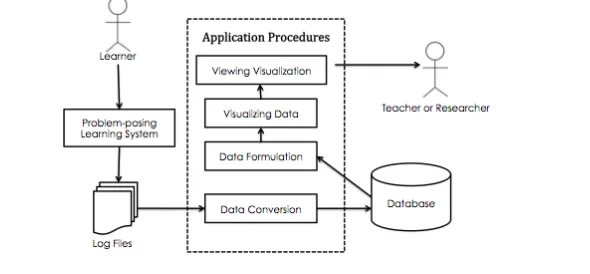
A web-based application is then developed to track students’ learning process data and to mine their patterns in term of arithmetic problem-posing learning process via Monsakun data log files. The application converts the log data to create a graphical representation for easier understanding. The graphical representation is then used to create a clear understanding towards students’ activity as well as their obstacles being faced when they learn arithmetic using Monsakun. The system architecture is depicted in Fig. 2.
106 JITeCS Volume 4, Number 1, 2019, pp 103-115
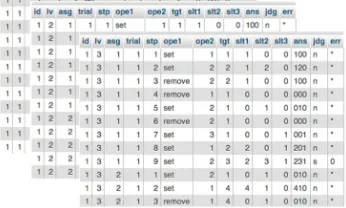
The Data Conversion Module collects the log files that represent students’ activity in Monsakun and then converts it into MySQL database attributes as shown in Fig. 3, this is meant to ease the querying process. The data visualization module then uses the database to visualize the raw data into graphics which able to convey information. The modules are separated into three parts, which are:
• Data Formulation Module: (a) extract and/or filters data from database based on
what visualization is needed and (b) manipulates such data and generate it into specific format to add more useful and meaningful information.
• Data Visualizing Module: transforms the data into a visualization which are
able to represent the information by integrating colors, data thickness to represent intensity, and adjusting its opacity.
• Viewing Visualization Module: Generates the visualization in the form of a
mapping process and specifies the parameters of the visualization, such as scale, position, and orientation. The users control the settings as they want to.
Fig. 3.Data convertion to database
Fig. 4 depicts the architecture being used on the application, in which it consists of three main components: the database component, the middle component, and the interface component. MySQL databased is used for data storage facility and it is integrated by using PHP and JavaScript. PHP is used to communicate with the server, while JavaScript is used to communicate with the users to increase interactivity. The software is run on a web server to control the system flow and a web browser to access such application.
4
Visual Representation
Ahmad Afif Supianto et al. , Web-based Application for Visual ... 107
Fig. 4.Web-based technology used on the application.
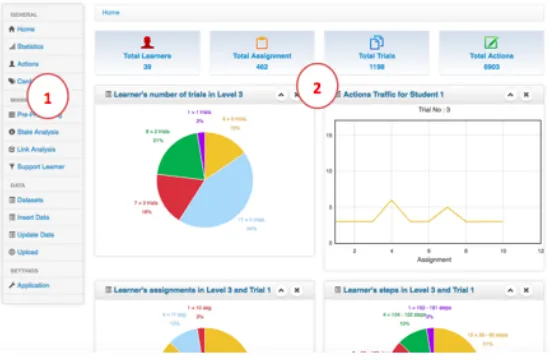
Fig. 5.The welcome page.
4.1 Activity Sequences
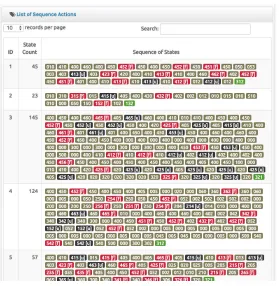
Fig. 6 depicts the steps and sequence of each students taken to finish a particular question or problem. Graphically, the data are represented in form of three indexes of number. Index with a value of 0 indicates that the slot was empty, an index of 240 depicts that 2nd sentence card was put on 1st slot and the 4th sentence card was put into
the 2nd slot. Such composition is called as a state. Each state are also color-coded.
108 JITeCS Volume 4, Number 1, 2019, pp 103-115
Fig. 6.Visualization of activity sequences.
4.2 Activity Tree
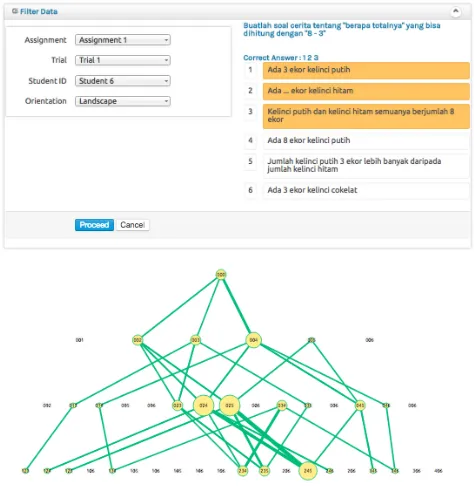
Fig. 7 represents a learning path that is being visualized into a tree structure. The visualization represents states that has been visualized on Fig. 6 into a more meaningful visualization which can be used to gather patterns. Such patterns that might emerges may include students’ learning approach in which the actions taken differs between each student. This data can be used as a supporting tool for teacher to improve learning experience by understanding students’ mistakes, avoided arrangements, as well as their thinking structure. The information on this part can be used by teachers to create a proper feedback based on each student’s performance.
Ahmad Afif Supianto et al. , Web-based Application for Visual ... 109
Due to its tree nature, the tree structure begins with state 000 as its root and continued based on students’ activities and action. The formulation and structure are represented based on the sentence chosen and its following sentences. An example of such sequences may be depicted as 000 à 001 à 012 à 124. The yellow circles shown in Fig. 7 represents the states being formed while green lines depict the change of action between each state. The size of the circle represents how many times such combination has been re-done or revised, while the thickness of the line shows the frequency of such part of the track being repeated.
5
Discussions
Monsakun have five (5) levels of difficulty which reflects different degree of thinking difficulty. Based on Table 1, level 1 and 2 uses a forward-thinking problem which the unknown numbers on the formula given in the question is the end result of the calculation. An example of this form of question is “Form a word problem that uses how much is the total that can be calculated from ‘4 + 12 = …’”. Meanwhile, level 3 to 5 uses a reverse-thinking problem in which the unknown number is part of the calculation, while the end-result is known. An example of this form of question is “Form a word problem that uses how much is the total that can be calculated from ‘4 + … = 10’”.
Table 1. Level of question types in Monsakun.
Level Questions Total Question Type Story Structure
1 12 Forward thinking problem Combination – Addition – Subtraction – Comparison 2 3 Forward thinking problem Combination – Addition 3 12 Reverse thinking problem Combination – Addition – Subtraction – Comparison 4 3 Reverse thinking problem Combination – Addition 5 12 Reverse thinking problem Combination – Addition – Subtraction – Comparison
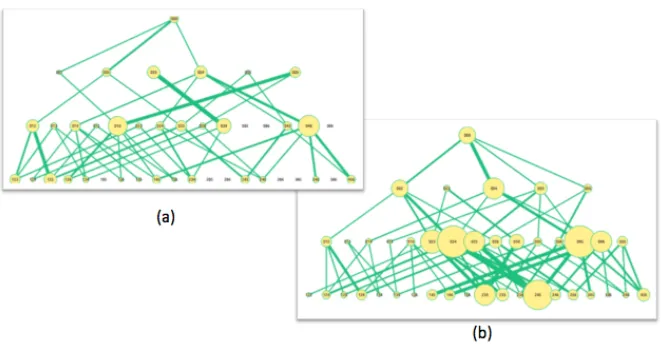
Result is shown via a visual data representation from level 1 to level 4 shows that the students have no meaningful problem on arranging the sentence cards to answer the question. As shown in Fig. 8(a)-(d), the steps taken are varied. But nevertheless, no problematic issue being faced by the students.
110 JITeCS Volume 4, Number 1, 2019, pp 103-115
Fig. 8.Visual representation of sequence of steps from level 1 to level 4.
Ahmad Afif Supianto et al. , Web-based Application for Visual ... 111
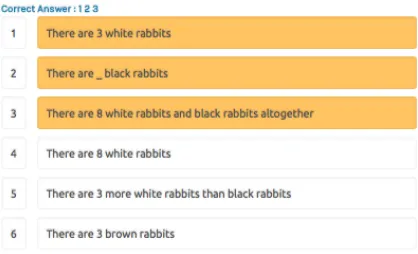
As being aforementioned before, level 5 uses reverse thinking problem. Fig. 10 depicts the question in which the question is to make a word problem about "How many are there overall" that can be solved by “8-3”. The question is structured with the unknown number in the formula is hidden, in which the hidden number is one of the operands of the calculation instead of end result. On this case, students need to learn and form a formula that involves the mentioned hidden number, such action needs the student to form the story with more than 2 number. On the context of the aforementioned question, the formula of “8-3” can be either “3+…=8” or “…+3=8”, hence the main challenge of this level is a strong basic understanding of how the calculation is being structured.
Fig. 10. Structure of level 5 based on question 1.
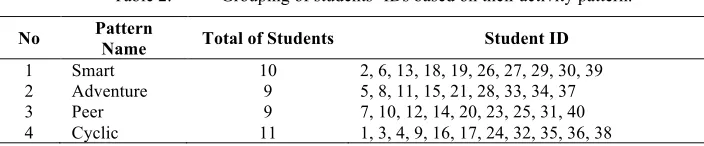
Based on the investigation of the level 5, student patterns in completing the question can be categorized into 4 types of patterns: smart pattern, adventure pattern, peer pattern, and cyclic pattern.
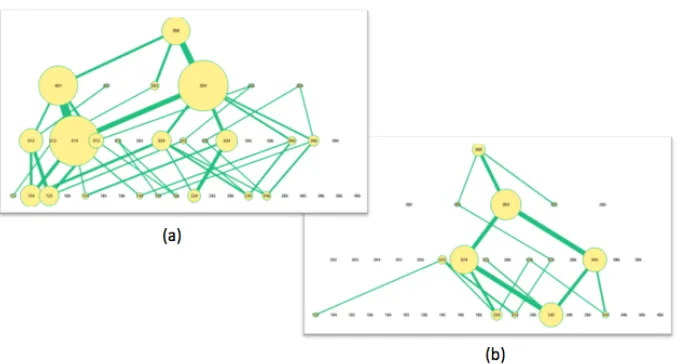
1. Smart pattern is the pattern in which the students have a clear grasp of the concept, hence the number of steps taken to finish the question is small as shown in Fig. 11. Students in this smart pattern category can easily recognize their mistake and recover from their mistake.
2. On the contrary to the smart pattern, the adventure pattern indicates that the student tries every possible composition of the sentence cards. As shown in Figure 12, the student tries to traverse each possible composition before actually finding the right answer for the question.
3. The peer pattern main defining characteristic is that students in this category tend to focus on 2 (two) main composition of sentence card structure in which the patterns are repeated multiple times, as shown in Figure 13, the repetition done increase the number of steps taken significantly.
112 JITeCS Volume 4, Number 1, 2019, pp 103-115
Fig. 11. Visual representations of smart patterns.
Ahmad Afif Supianto et al. , Web-based Application for Visual ... 113
Fig. 13. Visual representations of peer patterns.
Fig. 14. Visual representations of cyclic patterns.
114 JITeCS Volume 4, Number 1, 2019, pp 103-115
Table 2. Grouping of students’ IDs based on their activity pattern.
No Pattern Name Total of Students Student ID
1 Smart 10 2, 6, 13, 18, 19, 26, 27, 29, 30, 39 2 Adventure 9 5, 8, 11, 15, 21, 28, 33, 34, 37 3 Peer 9 7, 10, 12, 14, 20, 23, 25, 31, 40 4 Cyclic 11 1, 3, 4, 9, 16, 17, 24, 32, 35, 36, 38
6
Conclusions and Future Works
This research focuses on the creation of web-based application to visualize learning activity pattern of students in learning arithmetic with problem-posing approach as a way to deliver meaningful insight for researchers in educational domain and teachers towards a better understanding of student thinking process. By using the methods of this research, students’ sequence and learning activity when learning arithmetic by using problem-posing approach via Monsakun educational media can be visualized and useful insights can be inferred from the visualized data which can later be used as a base to deliver appropriate feedback. This feedback to each student is then adapted based on their pattern when the students are arranging the sentence cards, which the patterns are: smart pattern, adventure pattern, peer pattern, and cyclic pattern. Based on its pattern, it can be said that each pattern requires different approach for appropriate feedback.
The investigation of patterns in this research is done by inferring the visualization of students learning process data tracks and researchers’ perception. On the other hand, Educational Data Mining (EDM) allows multiple algorithmic approach which can group and categorize objects into multiple different classes. For future works, a further adaptation of EDM approach for pattern identification can be done by using more sophisticated methods such as sequential data mining, association rule mining, and clustering techniques.
Acknowledgment
This work was supported by DIPA FILKOM UB Grant Number 1999/UN10.36/PG/2018.
References
[1] E. A. Silver, “On mathematical problem posing. For the Learning of Mathematics,” 14(1), pp. 19-28, 1994.
[2] S. I. Brown and M. I. Walter, Problem posing: reflections and applications. Hillsdale: Lawrence Erlbaum Associates, 1993.
[3] L. D. English, “Children’s problem posing and problem solving preferences,” In J. Mulligan & M. Mitchelmore (Eds.), Children’s number learning, Adelaide: The Australian Association of Mathematics Teachers Inc., 1996, pp. 227-242.
Ahmad Afif Supianto et al. , Web-based Application for Visual ... 115
Conference of the International Group for the Psychology of Mathematics Education, vol. 5, Vancouver: PME, 2014, pp. 177-184.
[5] T. Hirashima, A. Nakano, and A. Takeuchi, “A diagnosis function of arithmetical word problems for learning by problem posing,” In R. Mizoguchi & J. Slaney (Eds.), PRICAI 2000 Topics in Artificial Intelligence (). Berlin: Springer, Berlin Heidelberg, 2000, pp. 745-755.
[6] T. Hirashima, T. Yokoyama, M. Okamoto, and A. Takeuchi, “Learning by problem-posing as sentence-integration and experimental use,” Artificial Intelligence in Education, 2007, pp. 254-261.
[7] T. Hirashima, T. Yokoyama, M. Okamoto, and A. Takeuchi, “Long-term use of learning environment for problem- posing in arithmetical word problems,” in the Proceedings of International Conference on Computers in Education, 2008, pp. 817-824.
[8] S. Yamamoto, T. Kanbe, Y. Yoshida, K. Maeda, and T. Hirashima, “A case study of learning by problem-posing in introductory phase of arithmetic word problems,” In the Proceedings of the 20th International Conference on Computers in Education, 2012, pp. 25-32.
[9] S. Yamamoto, T. Kanbe, Y. Yoshida, K. Maeda, and T. Hirashima, “Learning by problem-posing with online connected media tablets,” In Human Interface and the Management of Information. Information and Interaction for Learning, Culture, Collaboration, and Business. Berlin Heidelberg: Springer Berlin Heidelberg, 2013.
[10] T. Hirashima and M. Kurayama, “Learning by problem-posing for reverse-thinking problems,” Artificial Intelligence in Education, 2011, pp. 123-130.
[11] N. Hasanah, Y. Hayashi, and T. Hirashima, “Analysis of problem-posing process of arithmetical word problems as sentence integration: viewpoint of first selected sentence,” In G. Chen, V. Kumar, R. Hong, & S. C. Kong (Eds.), Emerging issues in smart learning. Berlin: Springer Berlin Heidelberg, 2015, pp. 85-88.
[12] A. A. Supianto, Y. Hayashi, and T. Hirashima, "An Investigation of Learner's Actions in Posing Arithmetic Word Problem on an Interactive Learning Environment," IEICE Transactions on Information and Systems 100, no. 11, 2017, pp. 2725-2728.
[13] A. A. Supianto, Y. Hayashi, and T. Hirashima, “Model-based analysis of thinking in problem posing as sentence integration focused on violation of the constraints,” Research and Practice in Technology Enhanced Learning, 12(1), 12, 2017.
[14] S. Card, J. Mackinlay, and B. Shneiderman, “Readings in information visualization: using vision to think. Burlington: Morgan Kaufmann, 1999.
[15] B. Shneiderman, “Inventing discovery tools: combining information visualization with data mining,” Information Visualization, 1(1), 5-12, 2002.
[16] A.A. Supianto, Y. Hayashi, and T. Hirashima, “Process-based Assignment-Setting Change for Support of Overcoming Bottlenecks in Learning by Problem-Posing in Arithmetic Word Problems.” In Journal of Physics: Conference Series, vol. 812, no. 1, p. 012004. IOP Publishing, 2017.