journal homepage: http://civiljournal.semnan.ac.ir/
The Study of EADAS Elliptical Steel Damper Function
in Seismic Resisting of Steel Frames
M. Najari Varzaneh1*, M. Hosseini2 and A. Akbarpoor3
1. M.Sc in Structural Engineering, Department of Civil Engineering, Faculty Member and the Instructor of RaghebEsfahani University.
2. Associate Professor of Structural Engineering Institute, International Institute of Earthquake Engineering and Seismology, IIEE, Tehran.
3. Assistant Professor of Structural Engineering, Department of Structural Engineering, azad Tehran south branch university.
* Corresponding author: [email protected]
ARTICLE INFO ABSTRACT
Article history:
Received: 14 September 2013 Accepted: 22 October 2014
The present article seek to investigate the function of elliptical steel damper function in steel frames seismic resisting. The elliptical damper is a kind of earthquake energy dissipater in structure which acts based on the steel yielding feature. Thus, this damper in frame lateral displacement mechanism is expected to have a satisfying hysteretic behavior in terms of energy absorption is on acceptable level. To study the EADAS (elliptical added damping and stiffness) elliptical damper function Abaqus software was used in seismic resisting of steel frames. To do the analysis one span- one floor which was modeled with eight kinds of suggested damper was used. The basis of the analysis method is based on the finite element method and a cyclic loading curve was used and the frame will be pushed to the failure of the dampers. The results of the present study indicates that through the addition of this damper with the damage focus in damper the structure elements remain in elastic zone and without any damage bear the lateral load. The damper causes an increase in ductility and the frame energy absorption hysteretic and it can be used for seismic resisting of steel frames.
Keywords: Elliptical damper, Hysteretic Energy, Seismic Resisting, Hysteresis curve.
1. Introduction
Earthquake is one of the most well-known natural disasters which causes that many researchers do some research and
carefully. Today, many researchers in the world in order to control structural vibrations against the earthquake force they have focused on input energy dissipation systems which also focused on non-linear deformation during earthquake in these systems which help the repair and optimization of structures [1]. Dampers belong to the category of passive control equipments and increase the structure damping and also control the response and the reduction of the seismic need and their most conspicuous feature is the ease of control and manufacturing due to the lack of high complexity in form and manufacturing technology and also the ease of changing these kinds of dampers after a sever earthquake is because of their damage [2]. The use of energy absorption dampers in structure seismic control during the earthquake has been noted for years [3]. The yielding metal dampers on self-focusing damage, other structural components kept in the elastic zone and reduce the structural dynamic responses [4], and they are also adequate equipments for seismic resisting of structures. And with low expenses and high- speed performance, the seismic behavior of structures will be [5]. Since the 1990s, many mechanisms have been introduced, fabricated and tested as a yielding metal damper [6], and some of them like ADAS and TADAS are commercial [7].
1. The use of EADAS metal
elliptical damper in frames resisting
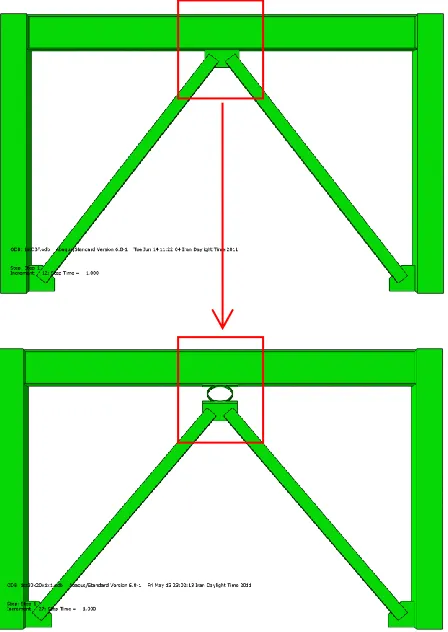
To use the elliptical damper in frames seismic resisting several options are suggested. Figure (1) is one of the suggested options and show how to use and install EADAS damper in the frame and the deformation mechanism in the frame equipped with this damper is in the form which during the earthquake and with the
movement of the ground in one direction, the floors of the structure shift to other place and the ring will be deformed as much as the shift in place in the same floor. With the change in the direction of earthquake force and the direction of the change in the place of the floor, the deformation of the ring is changed and the ring will be rotated to other direction. This point should be considered that the ring deformation in cyclic loads is the same as each other that this is one of the advantages of this damper usage.
Fig. 1.the way to place damper in steel frame
2. Software studies
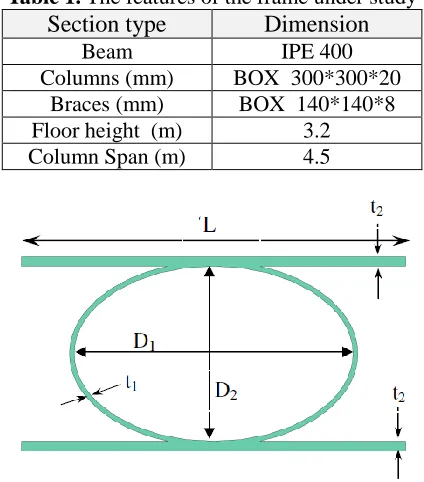
software studies have been used. Firstly, figure (1) frame was analyzed and designed by SAP2000 software [8], and the results of the design are presented in table (1). To study the damper application in the above frame, 8 kinds of damper which its features in figure (2) and table (2) are presented has been used. The frame has been modeled by this damper through Abaqus software [9], and has been analyzed through finite element.
Table 1. The features of the frame under study Section type Dimension
Beam IPE 400
Columns (mm) BOX 300*300*20 Braces (mm) BOX 140*140*8 Floor height (m) 3.2
Column Span (m) 4.5
Fig. 2. EADAS Damper
Table 2. EADAS Dampers' Dimensions
3. How to model with Abaqus
software
To analyze this frame the Abaqus V 6.8.1 finite element software has been used [9]. In order to model the frame in the above software in the above software act as it follows:
The beam with the length of 60cm in solid 3D has been meshed. For modeling the joined plates of the damper to braces solid 3D element has been used and the mesh of 2mm is considered for it. A brace with the length of 15cms with 3D solid element with 2mm mesh has been modeled. In modeling beam and column the 3D wire element with section features of beam have been used and also for modeling braces 3D wire element with section features of Truss which works only in tension and compress has been used. To mesh, four-binding elements have been used. To connect beam to solid element rigid Connection is used to have a more unifying beam behavior in reciprocal loading. A joint is considered in the connection of the end of columns to the end of the beams. In the connection point of solid braces and wire Truss braces, rigid Connection has been used to make changes in shapes, places and times in the connection point of solid element to Truss element the same and virtually the brace member will behave unifyingly. To connect brace to the column’s bottom joint connection is used. The damper is located between solid beam and Chevron type braces and its connection is considered like rigid to be able to observe its tension. Finally, a joint is used to define the column’s leg support. Since, in the connection point and also the column’s leg moment become zero and just frame behave exactly the same as simple frame in reciprocal cycle and the damper with changes in its non-linear shapes causes energy dissipation in system. For this purpose, the transmission in 1, 2, 3 are The Geometrical Properties
Damper
type L
closed (U1=U2=U3=0) and rotation are free (UR1=UR2=UR3≠0) but rotations are free to ban support from having moment. In figure (3) the modeled frame in Abaqus software and in figure (4) the mesh method on solid part is shown.
Fig. 3. Modeled frame in Abaqus software
Fig. 4. Mesh method on solid part
To investigate the frame behavior the cyclic load of figure (2) graph has been used and also the properties of the equipments which are used in the present research are defined as what is presented in table (3).
Fig. 5. The cyclic load curve Table 3. Material properties
Steel type ST-52
Young module (kg/cm2) 2.1×10⁶
Poison ratio 0.3
Stress-strain curve property
Plastic
strain 0 0.02
Yield
stress 2400 4500 Mass (kg/cm3) 7.8×10⁻⁶
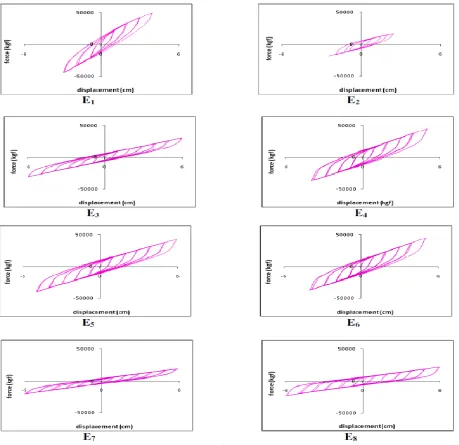
The hysteresis curves of the frames equipped with E1 to E8 type dampers are presented as it is explained in Figure (6).
4. The analysis results
thicker the ring diameter, the structure will be softer, in the way that with an increase in rings’ diameter, the hysteresis curve will be closer to the horizontal axiom and the first stiffness (Elastic stiffness) and also the second stiffness decreases. Therefore, it can be understood that the ring’s diameter is directly related to structure softness. Also,
by increasing the ring’s diameter, the structure bearing capacity will be reduced and will have a reverse correlation. In the investigation of the non-linear of the damper E4 type, it can be said that the frame in 2mm displacement will show a non-linear behavior of the damper in the frame.
5. Conclusion
In this paper, due to some studies and investigations on the impact of EADAS damper attachment to CHEVRON type brace steel frame we found that:
a) All works in elasto-plastic and plastic in damper have done and other members such as beam, columns and braces remain in the elastic region.
b) With the addition of EADAS damper to steel frame, the system damping will increase between the ranges of 17% to 26% which this percentage in E4 type reaches to its maximum that means 26%.
c) With a more exact study of the frames hysteresis curves we came to the conclusion that E4 curve is fatter than other curves, therefore, it shows a more energy dissipation in that frame.
In general it can be said that adding the damper ring to the desired structure can lead to the improvement of the seismic parameters of that frame in the time of earthquake. It is also possible to use this type of damper for resisting steel frames. Moreover, the damper is not a structural member. And with the focused damage on it, it can act like a structural fuse. After the earthquake, if the device (damper) damages, it can be replaced with lower cost and time.
REFERENCES
[1] Soong, T., Dargush, G.F. (1997). “Passive Energy Dissipation Systems in Structural Engineering”. John Willey & Sons Ltd., New York, USA.
[2] Kelly, J.M., Skinner, R.I. and Heine, A.J. (September 1972). “Mechanisms of Energy Absorption in Special Devices for use in Earthquake Resistant Structures”.
Bulletin of N.Z. Society for Earthquake Engineering, Vol.5, NO.3.
[3] Whittaker, A., Bertero, V., Alonso, J., Thompson C. (January 1989). “Earthquake Simulator Testing of Steel Plate Added Damping and Stiffness Elements”. Report No. UCB/EERC – 89/02, Earthquake Engineering Research Center, University of California, Berkeley.
[4] Hanson, R.D., Aiken, I.D., Nims, D.K., Richter, P.J., and Bachman, R.E. (1993). “State of the Art and Practice in Seismic Energy Dissipation”. Proceeding of ATC 17-1 Seminar on Seismic Isolation, Passive Energy Dissipation and Active Control, Applied Technology Council, 68-79, San Francisco, California.
[5] Stiemer, S.F., Godden, W.G., Kelly, J.M. (July 1981). “Experimental Behavior of Spatial Piping System With Steel Energy Absorbers Subjected to a Simulated Differential Seismic Input”. Report NO. UCB/EERC – 81/09, Earthquake Engineering Research Center, University of California, Berkeley, CA.
[6] Xia, C. and Hanson, R.D. (July 1992). “Influence of ADAS Element Parameters on Building Seismic Response” J, Structural Engineering, Vol. 118, NO.7. [7] Tsai, K.C., Chen, H.W., Hong, C.P. Su, Y.F.
(1993). “Design of Steel Triangular Plate Energy Absorbers for Seismic Resistant Construction, Earthquake Spectra”. 505-528, California, USA.
[8] SAP2000. Non-linear.Version 14. Computer Software. Computers and Structures, Inc. Berkley, CA.