_______________________________________________________
_________
Exploring simulated game worlds
Ethics in the No Man’s Sky Archaeological Survey
Flick, Catherine
De Montfort University, Centre for Computing & Social Responsibility.
Dennis, L. Meghan
University of York, Department of Archaeology.
Reinhard, Andrew
University of York, Department of Archaeology.
Corresponding Author: Catherine Flick, [email protected]
Abstract
No Man’s Sky is an open world space procedural exploration game which allows players to traverse space in space ships, land on and explore planets. A group of archaeogamers (archaeologists interested in video games for varying reasons) decided to treat the game as an archaeological site, and within the No Man’s Sky Archaeological Survey explore, catalogue findings, and analyze objects and constructs within the game from an archaeological perspective. One of the aspects of this activity was to create a Code of Ethics – this paper describes the creation of the Code, the difficulties in implementation of the Code, and offers some recommendations to game developers who wish to encourage similar archaeological exploration within their own games.
Keywords: video games, society, ethics, archaeology, archaeogaming
Introduction
Archaeogaming is a relatively new interdisciplinary field, crossing archaeology and study of video games. There are several levels to archaeogaming, with archaeology of games (the physical objects, such as discs, cartridges, consoles, etc., or the developed objects through patches, glitches, DLC, and other methods of amending the original artefact), critiquing the depiction of archaeology in games (such as in the Tomb Raider series), the creation of archaeological games, and archaeology within games (where archaeologists treat a game environment as a space for archaeological study as if it were a real physical space).
It is in this last context that the No Man’s Sky Archaeological Survey (Reinhard & Archaeogaming, 2015) came to be – a group of archaeogamers interested in exploring the
No Man’s Sky environment from all of these perspectives of archaeogaming. Since this was essentially a simulated universe, the team was interested in developing a Code of Ethics so that the archaeology conducted within the universe was done relatively realistically in “real world” terms. Initially, the team decided that Star Trek’s “Prime Directive” – that less technologically capable worlds should not be interfered with – would suffice, but realised quickly that this would not be sufficient for the work that they would be doing, as it did not deal with artefacts or significantly more technologically capable species that archaeonauts might encounter in the game universe.
The subset of the team interested in ethics was struck by the possibilities of this game for exploring simulated worlds and creating a useful, practical code of ethics that archaeonauts would want to follow within their exploration of this universe, as well as by the development of the game itself and the ethical norms and expectations the game developers had when creating the world. This paper will briefly touch on some of these issues as they affected the development of the Code of Ethics, particularly the problems with the explorer-as-colonist, in which the game actively encourages the player to rename planets, systems, flora and fauna to update an “Atlas” and allowing other players of the game to see where other explorers have travelled before. Additionally, the game mechanics such as mining, looting of “rare” items that upset the patrolling Sentinels, and other actions of imposition of the explorer’s norms, expectations, and behaviour on alien worlds, caused complications when working on a Code of Ethics that was based on a principle of non-interference where possible.
This paper describes the steps that the team went through to develop a Code of Ethics for the game prior to the release of the game; the usefulness of that Code of Ethics once the game came out; and archaeonauts’ reactions to the Code and its subsequent modifications to make it more helpful within the more restricted confines of the No Man’s Sky game universe. It discusses the expectations of a procedurally generated, infinite sandbox space game from an ethical perspective, the reality of the delivery of this game and its impact on the Code of Ethics, and the impact of player ethical agency on the Code. Finally, it discusses some of the outcomes of this activity and some recommendations to developers of open sandbox games that would allow archaeogamers and other “real world” role-players to better simulate ethical behaviour in game.
Creation of the Code
The Code of Ethics was created prior to the release of the game based on or inspired by several existing Codes of Ethics: the ACM Software Engineering Code of Ethics (Association for Computing Machinery, 2015), the Society for American Archaeology Principles of Archaeological Ethics (Society for American Archaeology, 1996), the Code and Standard of the Register of Professional Archaeologists (Register of Professional Archaeologists, 2017), and the American Anthropological Association Code of Ethics (American Anthropological Foundation, 2012). The team collaboratively edited the Code in a Google document, allowing for suggestions to be made and approved by the core team. There was no particularly strategic method used to create the Code – the team picked the parts they thought worked well from different styles and rewrote them to suit the purpose (often copying them directly where the wording seemed directly appropriate). Thus, as can be seen in Appendix 1, there is a ACM-style Preamble and structure, with the focus on different aspects of being an archaeonaut, and specific aspects that relate to artefacts from the Archaeological Codes, and bits and pieces picked out from the other codes as well.
Where there were specific aspects related to No Man’s Sky, however, these were written entirely. For example, in section 5b there is a direct discussion about the use of trading within the game, which instructs archaeonauts on the limitations for ethical trading of artefacts in the game. Similarly, 6c, on violence and protection of self, is unlikely to ever be mirrored in real life – the recommendation is for self-termination (and respawn in the game) before committing violent acts.
One example discussion that was had during the creation of the No Man’s Sky-specific aspects of the Code was on the mining of natural resources in the game and ways of progressing that didn’t involve being violent (there had been information released that fighting would be a significant mechanism in the game). A team member wrote at the time,
“So, it looks like we’ll need to “mine” various elements regardless of trade sides of things just to maintain our ships/suits/etc. I suppose if we are to do it “ethically” it would mean that we avoid needless other destruction and just extraction of materials we are likely to need (rather than perhaps ones that we want). However, if trade is a relatively non-lethal way of progressing, it might be a legit way of playing without crippling ourselves, so to speak.”
Another team member responded:
“Correct. We should mine in order to upgrade suit, ships, & tools. I guess mine other mats. for trade to increase rep & make upgrades affordable? I think we trade with NPCs & formal traders, not with indigenous pops.”
To which the original team member wrote:
“Yeah it looks like it. Interesting they say, “each trade has a story” - would “discoveries” by way of trade count as artefacts?”
And finally:
“Yes, but without earlier known object bio, like buying something at a flea market.” This led to the final wording about interaction with different items within the game in section 5 of the Code.
In the final game, on release, however, no tradeable objects had “stories” – they were simply materials that could be bought or sold in quantities without any individual identifiers or significance from any other tradeable items – they were not able to be considered significant artefacts within the game, even if the archaeonaut wished them to be. These challenges will be discussed further in the next section.
Challenges in Implementation
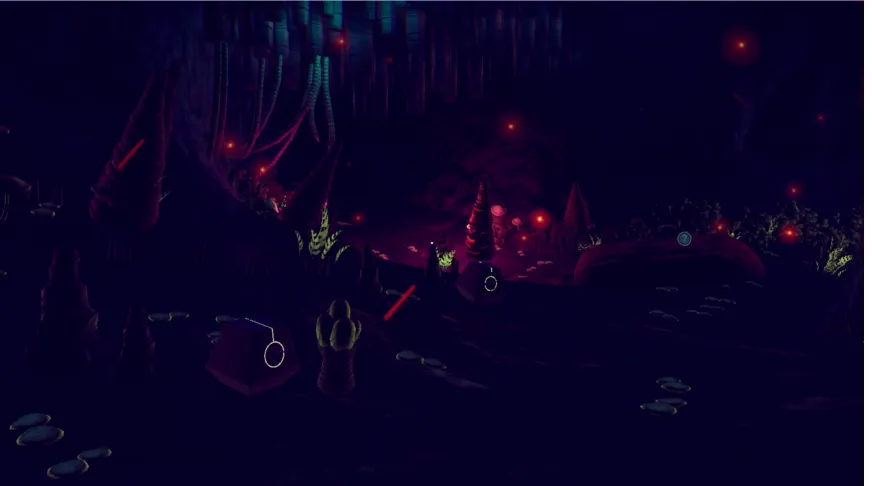
Opening “loot crates” was one of these tricky subjects. The items from the crates would be destroyed by the game unless the player had inventory space. These items, however, were usually common trade items or materials, despite some being described as “curiosities” or “relics”. In fact, the “Gek Relics”, which were classified as Trade Items seemed to be more like trinkets, described as “A metal statuette of a creature with a coin place in its beak. Popular with many traders who see it as an emblem of fair commerce and peace.” According to the original wording of the Code, such items would not be able to be traded, but should be identified, described, photographed and stored and then returned (for free) to the original owners of the items in the manner of good modern archaeological practice. However, it was impossible to “return” anything without selling it, and if the items were attempted to be simply placed back (“dropped”) where they were found, they simply disappeared from inventory and the gameworld, thus destroying the item. After some discussion with team members, one archaeological team member wrote: “Some goods are designed as "trade goods", things like the fascination orb and this mask thing that sounds like a drug. These are things that get dropped by the crates. If they are trade goods then can we assume that they are probably not 'artifacts' but still cultural. So worthy of noting but not preservation?” after which it was agreed that trading these items would be ethically okay, as long as their descriptive information was stored somewhere (a spreadsheet was set up for this purpose). However, it was decided, items that were deliberately placed in the world (Graviton Balls and Vortex Cubes, which were found lying around worlds), such as in Figure 1, were not to be interacted with in any way, as it caused the Sentinels to become hostile.
Figure 1: Vortex Cubes in situ
One team member wrote at the time: “I dunno if it was the same for you but I had an Aggressive world with a locked door and had to blast it down to get my hyperdrive plans. And you can’t break the door down quickly enough to avoid engaging with the sentinels. :(” Another team member wrote: “I broke down a door by hitting it with the hilt of my "gun" (q) and running away after 3 hits because the sentinels got alerted. Ran about 50m and waited for them to quit looking for me. Then repeat... worked pretty well but took like 10 attempts... I try not to shoot things…” This prompted a discussion and agreement that it would be okay in this instance to get through “gated” content by applying the normative expectations the developers put in place. Thus, in the Practice section of the Code, a specific exception was made for this eventuality.
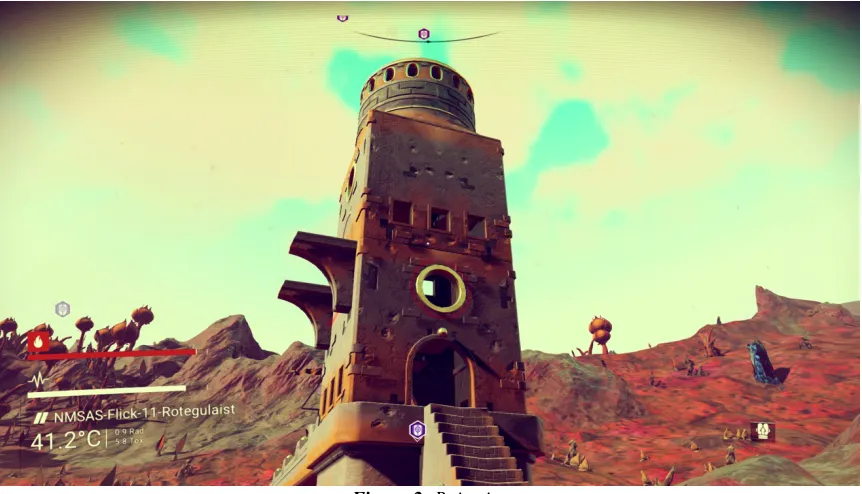
Another discussion was about context integrity, a must for real world archaeological sites. While archaeonauts can interact with certain “monolith” sites in game, there are other “ruin” sites which had archaeological items which were immovable, such as pots, broken parts of sculpture, and large gold balls (an example can be seen in Figure 2). The archaeonauts were disappointed that they could not pick up and inspect some of these objects, but it turned out some were accidentally interactable with: “I was walking around a big temple, one of those types with a big gold ball. I bumped into it and it rolled down the walkway. I moved it again and it fell over the side. And then I kind of played football with it.” To which another member wrote: “adds “do not play football with monoliths” to the list” (which can now be seen in the last item of the Practice section). However, this sparked the discussion about archaeological context integrity and how the game is extremely limiting when it comes to interaction with these types of monuments. “I couldn't believe I finally had agency”, said the original “footballer”.
Figure 2: Ruin site
working as professionals within a professional context. However, this didn’t mean that they weren’t within a simulated gameworld, with the ability to make ethical decisions as might relate to the in-game norms and expectations of the developers. However, games are not developed or played within a vacuum – players and developers bring their external values and norms into the interaction with or development of the game. It is the challenging of those ethical values that helps to brings moral relevance to a game (Sicart, 2009). So when one of the team asked the ethicist “Are you ok ethically with gamejacking, pushing the envelope to explore playing the game against its rules, establishing the boundaries of the game-as-site?”, the answer was in the positive – “counterplay” was fine as long as it was clear that the player was working outside of the original intent of the Survey. Thus it was important to delineate the scope of the use of the Code – when archaeonauts were participating officially within the Survey they were obliged to follow the code, but if they wished to experiment or enjoy other aspects of the game, such as violent interactions, they would have to set aside the Survey work for that period, and perhaps use different game save states for the unofficial play. This is a complex thing to do in real life, however, as there are not different “save game” states we can access, but one continuous life. Reflections on these activities are important, however, as they can challenge players to confront their own unethical behaviour, and why it is unethical behaviour, within the game as well.
Conclusions
This was an interesting exercise despite its challenges. The fact that video games are being seen as legitimate areas of archaeological exploration allows us to enjoy thinking about our ethical relationships with the games and our responsibility as players to challenge the ethical norms and values of the developers of the games as well as our own.
The limitations on the openness of the gameworld meant that the Code was not as helpful as it might have been – the mechanics of No Man’s Sky were extremely prescribed and there was little ability to interact with objects in ways that might be expected in the “real world”. However, we dig the site we get, and these limitations did not restrict the interest in applying the Code, though it was increasingly seen as a barrier to interaction with the game by some. It’s important to remember that accidents happen, and when you are starting a new game and “figuring stuff out” it’s okay to make mistakes and accidentally shoot a Sentinel. In fact, these interactions and reflecting on them with respect to the Code are extremely important to reinforce the intent and importance of the Code – feeling guilt for accidentally destroying an item or shooting a Sentinel or playing football with an artefact shows that there is an understanding of why these activities might be considered wrong in professional archaeology, society, and/or archaeogaming, and reflect real world norms of ethical behavior and responses to breaches of this behavior.
no gated content requiring violent activity or other social-norm-breaking (in the real world) behavior; and to allow for interaction with and replacement of items within the game (without destroying them).
Although there was much to be dealt with archaeologically within the game, from an ethical perspective the challenging, by the Code, of those pre-set boundaries is an important interaction within the game that allows the player to reflect on their behavior within a greater context both inside and outside the gameworld. In this way, the game itself as an open world, ethically challenging, external actor-influencing, and poetically constraining simulation is a good example of a Sicartian morally relevant game – the Code of Ethics developed by the NMS Archaeological Survey playing a significant role in the reflection process by archaeonauts within the context of the game.
Appendix 1: The Code
Preamble
No Man’s Sky is a procedurally-generated artificial universe in which the No Man’s Sky Archaeological Survey (“the Survey”) will take place. For the purposes of the Survey the universe (“in-universe” or “in-game universe”) is considered a simulation of a real, existing universe, and thus incursions into and exploration of this universe will raise ethical and social issues. This Code attempts to address potential ethical and social issues by presenting six Principles (“the Principles”) relating to the behaviour of those involved in the Survey within the game universe (“archaeonauts”), and in dealing with the data collected about the in-game universe.
Some of these Principles are not as realistic as we would like - in game mechanics prevent us from making real choices about how we interact with the in-game universe. Currently we are suggesting that archaeonauts spend their first few days upgrading their tools and ships and getting to grips with the game mechanics, however, in a sustainable way that adheres to the Principles as much as is possible.
These Principles are not intended to be followed in a dogmatic way but to guide in a thoughtful way: to allow those encountering ethical tensions guidance in reasoning through the potential impact of decisions they make. The Code provides an ethical foundation which can support decision making and to which can be appealed. Survey team members should bring any queries or complaints to the Ethics Board, which consists of the authors of this Code. Breaches of the code could result in disciplinary procedures, up to and including removal from the Survey team.
In brief, the Principles require archaeonauts to:
and, where possible, not interfering with the normal development of societies and cultures by introducing knowledge, strength, or technologies more advanced than their current levels.
2. Advance the integrity and reputation of the Survey consistent with the public interest.
3. Maintain integrity and independence in their professional judgement.
4. Release data publicly, and publish in the public interest, in line with open access principles, unless this conflicts with Principle 5.
5. Ensure the integrity of archaeological sites, humans and non-human people and animals, and archaeological artefacts where possible; work to ensure good stewardship of sites, peoples, and artefacts; and avoid and discourage activities that enhance the commercial value of archaeological artefacts. Interaction with artefacts in order to progress according to game mechanics is permissible; destruction or sale of artefacts for profit is not.
6. Only act against another human or non-human person or animal in self-defence where no other option is available (including avoidance of and/or escape from potentially hostile situations, and self-terminate with respawn).
Principles
1. The Public
Archaeonauts have a responsibility toward the worlds, people, animals, and other living beings found upon these worlds, and whose lives and cultures are studied. These obligations can supercede the goal of seeking new knowledge, and can lead to decisions not to undertake or to discontinue a research project when the primary obligation conflicts with other responsibilities, such as those owed to sponsors or clients. These ethical obligations include:
1. To avoid harm or wrong, understanding that the development of knowledge, strength, or technologies can lead to change which may be positive or negative for the sentient beings or animals worked with or studied.
2. To respect the well-being of human and non-human people and animals. 3. To consult actively with the affected individuals or group(s), with the goal of
establishing a working relationship that can be beneficial to all parties involved.
2. The Survey
Archaeonauts shall advance the integrity and reputation of the Survey consistent with the public interest. In particular, archaeonauts shall, as appropriate:
2. Promote public knowledge of the Survey.
3. Extend Survey knowledge by appropriate participation in meetings and publications.
4. Support, as members of the Survey, other archaeonauts striving to follow this Code.
5. Obey all laws governing their work, unless, in exceptional circumstances, such compliance is inconsistent with the public interest.
6. Express concerns to the archaeonauts involved when significant violations of this Code are detected unless this is impossible, counter-productive, or dangerous.
7. Be alert to the danger of compromising ethics as a condition to engage in Survey research, yet also be alert to proper demands of good citizenship or host-guest relations.
3. Judgement
Archaeonauts shall maintain integrity and independence in their professional judgement. In particular, archaeonauts shall, as appropriate:
1. Temper all professional judgements by the need to support and maintain human values.
2. Maintain professional objectivity in the evaluation of any collected data. 3. Disclose to all concerned parties those conflicts of interest that cannot
reasonably be avoided or escaped.
4. Data
Data collected shall be released publicly where in the public interest, and not in conflict with Principle 5a. In particular, archaeonauts shall, as appropriate:
1. Seriously consider all reasonable requests for access to their data and other research materials for purposes of research. They should also make every effort to insure preservation of their fieldwork data for use by posterity. This is enabled for the purposes of the Survey through the Open Context/NMS Archaeology database.
2. Ensure that their data is of high quality and follows the Survey protocol. 3. Where species encountered in the process of data collection are sentient,
determine in advance (if possible) whether they wish to remain anonymous or receive recognition, and make every effort to comply with those wishes. [This principle will be revised based on actual gameplay experience.]
5. Artefacts and archaeological record
Archaeonauts have a responsibility to act professionally as regards the exploration, collection and documentation of archaeological sites and artefacts. Archaeonauts are expected to recall that:
1. The archaeological record, that is, in situ archaeological material and sites, archaeological collections, records and reports, is irreplaceable. It is the responsibility of all archaeonauts to work for the long-term conservation and protection of the archaeological record by practicing and promoting stewardship of the archaeological record. Stewards are both caretakers of and advocates for the archaeological record for the benefit of all people; as they investigate and interpret the record, they should use the specialized knowledge they gain to promote public understanding and support for its long-term preservation.
2. Trading use of or interaction with archaeological artefacts to increase the archaeonaut’s capacity is only permitted where the artefact is artificially placed by another technologically-advanced race solely in order for said capacities to be increased. That is: interaction with crates (particularly Neutral crates which often give artefacts as rewards) is permitted, as is trade of these items. Interaction with in situ items, such as Vortex Cubes, however is not permitted.
6. Self
The archaeonaut is responsible for their own safety and security when conducting research for the Survey. It is reasonably expected for archaeonauts to:
1. Ensure their bodily and psychological integrity where possible in the “real world”.
2. Within the game, avoid potentially hostile situations, even if the potential for research is high.
3. If hostile situations cannot be avoided, or cannot be escaped, self-termination and respawning is preferred. Violence in self-defence against human or non-human entities should always be a last resort when all other possibilities have been exhausted.
Practice
Help! I’ve crashed on a planet and I want to get off! (Practical suggestions on beginning the game.)
1. Don’t panic.
Where possible try to avoid extracting iron from plant life. There should be rock formations you can get iron from.
3. It’s okay to interact with plant life to extract resources (e.g. platinum, zinc). These plants seem to continue existing after the extraction process.
4. It’s okay to interact with cargo drops/chests etc. and take the resources from those.
5. It’s okay (and encouraged) to interact with monoliths, beacons, knowledge stones and other interactable-with things that provide you with information. 6. It’s not okay to pick up (interact with) non-natural items that alert Sentinels
such as Vortex Cubes or Gravitino Balls for farming purposes if they have been left about on a world. Within this world these are considered precious by the Sentinels, so archaeonauts should respect them and leave them in situ. 7. If you upset Sentinels (by over-mining or on hostile worlds) it is best to hide
until the chase is dropped (you will be notified) rather than shooting the Sentinels. However, rare exceptions can be made if you need to progress in the game by entering a hostile world (i.e. where Sentinels are Aggressive) where it would be impossible to progress without engaging with Sentinels (e.g. getting hyperdrive blueprints). Hostile engagement with Sentinels is absolutely a last resort.
8. Breaking into locked buildings is only permissible when explicitly requested to by the story mechanics (e.g. for getting hyperdrive blueprints). We acknowledge that this is a limitation of the game and if there were other options we would recommend those instead.
9. Please, unlike in real life, feed the (friendly) animals.
10. If you encounter hostile creatures, you should not engage. Yes, it sucks to die, but you will respawn and be given the opportunity to find your “grave” and retrieve your stuff.
11. If you are scanned by hostile ships, you should not engage. You will respawn at a space station and be given the opportunity to go and collect your stuff from your “grave”.
12. Try to pick ethical responses (where applicable) to the challenges offered to you by aliens.
13. Some archaeologically significant structures are able to be physically manipulated. Moving and examining of items is okay as long as they are returned to the location and position they were originally in. Before interacting with an artifact or features, take screengrabs and video (if possible). Also, if possible, video your interaction with artifacts (excluding monoliths).
more details on the specifics of the principles that guide these suggestions read above.
References
American Anthropological Foundation. (2012, November 1). Principles of Professional Responsibility. Retrieved April 2, 2017, from
http://ethics.americananthro.org/category/statement/
Association for Computing Machinery. (2015). Software Engineering Code of Ethics and Professional Practice. Retrieved April 2, 2017, from http://www.acm.org/about/se-code#ful
Hello Games. (2016, December). Hello Games. Retrieved April 2, 2017, from https://www.nomanssky.com/
Klepek, P. (2016, August 18). Inside the Nasty Backlash Against “No Man”s Sky’. Retrieved July 6, 2017, from https://www.vice.com/en_us/article/dpkvnm/inside-the-nasty-no-mans-sky-backlash
Register of Professional Archaeologists. (2017). Code and Standards. Retrieved April 2, 2017, from http://rpanet.org/?page=CodesandStandards
Reinhard, A.Archaeogaming. (2015, March 2). No Man’s Sky Archaeological Survey (NMSAS). Retrieved April 2, 2017, from
https://archaeogaming.com/2015/03/02/no-mans-sky-archaeological-survey-nmsas/ Sicart, M. (2009). The banality of simulated evil: designing ethical gameplay. Ethics and
Information Technology, 11(3), 191–202. https://doi.org/10.1007/s10676-009-9199-5 Society for American Archaeology. (1996). Principles of Archaeological Ethics.
Retrieved April 2, 2017, from
http://www.saa.org/AbouttheSociety/PrinciplesofArchaeologicalEthics/tabid/203/De fault.aspx
Undust4able. (2017). “Where’s the NMS we were sold on?” front page stickied post disappears, original poster account deleted. Retrieved July 6, 2017, from