ISSN 2052-1499 (Print) www.ephemerajournal.org volume 17(3): 673-690
The
playable university
Stephen Turner, Anna Boswell, Niki Harré, Sean Sturm, Kirsten Locke
and Dominic da Souza Correa
Introduction
We have a problem with conventional academic modes of posing problems. Without wishing to rehearse the critical posture – and while acknowledging that our own response takes the form of a scholarly article that sits more or less comfortably inside the field of critical university studies – we note that there is an expanding international body of research devoted to critique of the neoliberal university (NLU). Professional academic critics (Beverungen et al., 2008; Bok, 2009; Brenneis, et al., 2005; Butler and Spoelstra, 2014; Giroux, 2002; Larner and Le Heron, 2005; Rhoades and Slaughter, 2004; Svensson, et al., 2010; Vernon, 2010) describe its drivers as the privatisation of education; the commercialisation of research to compensate for government disinvestment; and the prioritisation of applied ‘outputs’ relevant to end-users and measureable by funders. These drivers are said to foster corporatised governance and management; the ascendency of administrators and systems to index quality (‘excellence’) and productivity (‘efficiency’); the aggressive casualisation of academic work, which creates an underclass of adjunct academics; and the transfer of capital expenditure and operational costs to students, disadvantaging students of lesser means and promoting the pursuit of market-ready degrees.
(Ministry of Education, 1989), makes critical reflexivity a statutory obligation of the university. Further, the Universitas 21 ‘Statement on sustainability’ (2009) takes the university to be a microcosm, test-case and demonstration of social values. It thus behoves those who work in the university to examine its priorities and practices. In fact, critique of the NLU reminds us that academics are not powerless in the face of the ‘re-valuation’ of the university that its corporatisation demands.
In part, our concern is that critique should be taken as an object of reflection and matter of social concern. Yet if, as Bruno Latour argues, academics are enjoined to ‘bring the sword of criticism to criticism itself’ (2004: 227), we also wonder whether and how it is possible to avoid being immobilised by this operation. Is anything beyond critique? Objections to the NLU, for example, are primarily articulated through protest and publication. Student and academic protest actions, as recent experiences at our university indicate, may be vital and vitalising, but tend to draw directly on highly theoretical – and, thus, élite – modes of scholarly critique. And the publications that result count as outputs for their authors and towards the ranking of their universities. Though there is something playful about these strategies, the NLU can understand itself only as a
serious business. While students may treat the classroom as a game ‘where the
rules and pieces are all open to adjustment’ and the campus as a ‘playground’ to be explored (University for Strategic Optimism, 2012: 8, 20), those on the university payroll are not allowed to play.
The self-seriousness of the NLU is always at risk of being exposed. Vice-Chancellors play at being CEOs, taking their cue from counterparts at other ‘excellent’ universities globally, when they are really custodians of public educational institutions. Research and international ranking regimes make a game of publication, which universities ‘game’ through culling non-research-productive academic staff before audits and separating teaching and research. Criticising the NLU through publication would seem to enable academics both to ‘play the game’ (Butler and Spoelstra, 2014) and draw attention to the ‘gameness’ of that game. Indeed, there is a dark playfulness evident in recent publications in critical university studies. The editors of Zombies in the academy, for instance, explain that
But motifs of living death, disease, decay and apocalypse seem a peculiarly aestheticised response to the crisis of the NLU.
We perceive at least four problems with the tendency to criticise the NLU by means of conventional scholarship:
1. Universities are comprised of heterogeneous populations of workers and students unlikely to be engaged by the elitist theoretical discourse of many academic critics of the contemporary university. Thus, such criticism risks self-enclosure: speaking to an elite for people considered to be without a voice.
2. Universities’ role as critic and conscience excludes professional staff, other workers and students (and conflicts with the stipulation in university contracts that employees can’t bring the university ‘into disrepute’).
3. Academic critique has not to date been able to re-imagine the university, tending to deconstruct rather than reconstruct – and to preach to the converted: likeminded academics, Arts students, active union members and so on.
4. Academic critique is typically consensualist: as Stefano Harney and Fred Moten argue, ‘to be a critical academic in the university is to be against the university, and to be against the university is always to recognize it and be recognized by it’ (2013: 31). It does not question what makes its critique possible – and what distinguishes it from the feedback continually sought from academics by administrators.1
In describing social fields, Pierre Bourdieu invokes players being drawn
into a game:
Players are taken in by the game, they oppose one another, sometimes with ferocity, only to the extent that they concur in their beliefs (doxa) in the game and its stakes; they grant these a recognition that escapes questioning. Players agree, by the mere fact of playing, and not by way of a ‘contract’ that the game is worth playing […] and this collusion is the very basis of their competition. (Bourdieu and Wacquant, 1992: 99)
1 This same problem of feedback applies to protest actions. Easton and Walters (2015),
Academics, students and other workers in the university are expected to play the ‘university game’ – which includes the playful work of protest and published critique. If there is already engagement with play-as-critique in the NLU, here we aim to explore play-as-agency. Play-as-agency relies on making room for a certain play, or ‘give’, in academic and administrative processes in the NLU, in order to reveal what the university might otherwise be.2 This play allows for both the collective re-imagination and reconstruction of the rules of the university and ‘playful’ participation in university gatherings (meetings; courses and classes; orientation and training sessions, and so on). In particular, we ask about the value of games in the university, what games can tell us about the values of the university, and how the rules of the university game might be changed by playing it differently.
The university game
To this end, we developed a series of game workshops at the University of Auckland in July 2014. The workshops were conceived as part of a larger research project called ‘The liveable university’, 3 which considered the university’s potential to be socially responsible, pro-creative and sustainable, and thus liveable.The project drew on Ron Barnett’s (2011) idea of the university as an ‘ecology’, an intelligent system that works – or ought to work – for the flourishing of people and nourishing of place. Over a year, it undertook a range of activities: five workshops, a symposium on learning spaces (including a workshop on place-based pedagogy, a roundtable discussion on learning spaces and a campus
hikoi, or walk) and an interactive exhibition (including various artefacts and
performances, and the launch of a new journal, Argos Aotearoa [2014]). The
2 Here we draw on but extend the work of seminal play theorists Johan Huizinga and
Roger Caillois, and also Hans-Georg Gadamer and Jane McGonigal. Huizinga’s Homo ludens (1938) establishes the importance of the concept of play in human society and culture; Caillois’s Man, play and games (1961) distinguishes styles and types of games and play. More importantly for our argument, Gadamer, in Truth and method (1960), argues that it is neither the player nor the game being played, but rather the movement, to and fro, that exists between them that defines games. This movement is characteristic of our concept of play as ‘give’. McGonigal’s Reality is broken (2011) updates the theory of games for immersive (virtual) gameplay.
3 The ‘Liveable University’ project received seed funding from the Transforming Cities:
workshops were designed both to explore and embody the idea of a liveable university.
Liveability takes in a number of dimensions: ecology (sustainable building and living), health (economic and emotional well-being), belonging (commitment to the institution and one’s colleagues), and purpose (personal and social transformation). But it is an ambiguous idea. A large number of liveability surveys are conducted each year to produce league-tables that rank cities in terms of their living conditions – and used for marketing the cities and calculating relocation costs for new employees.4 And such indices are now being applied to the university (Gallup, 2014). Thus, while liveability promises transformative living, belonging and well-being, it has come to be taken as quantifiably measureable and marketable (‘econometric’ [Sturm and Turner, 2011]) – and its units of measure to serve as expressions of the value of the entity itself. The workshops gave voice to those most affected by economically driven – but emotionally taxing – changes affecting the liveability of the university: students facing large fee increases, administrators beset by wholesale restructuring, casual academics undergoing workload abuse, and workers demanding a living wage (though many responded that they were simply too hard-pressed to attend). For this reason, liveability strikes us as an apt means to address the norms and drivers that make up the lived experience of a NLU driven by econometrics. Indeed, part of the ‘play’ of our game is that it offers participants opportunities to re-imagine and reconstruct existing indices of value in the NLU in order to materialise a university of different – or greater – value. With these circumstances in view, one focus of the workshops was to collectively generate and evaluate an expanded range of ideas of liveability.
The workshops involved
1. a one-hour time-slot;
2. a number of players;
3. a physical space in which the players could gather;
4. materials including jellybeans, small plastic cups, marker pens, small squares of paper (‘cards’) in five different colours, a box for collecting the
4 For recent results see, for example, Monocle’s ‘Quality of life survey’ (2014); the
cards, and a table around which the players sat and on which to lay out the cards; and
5. a set of instructions that led players through four rounds.
The workshops hosted between 11-25 players; each game was conducted by an instructor, an observer and an usher. While the position and rank of the players remained unknown and their responses cannot be traced to individuals or groups, the broad proportions of categories of players can be estimated from their email signatures, which were visible to us when players registered (although some players represent more than one category). We estimate that the overall percentage of academics and postgraduate students was 51.6%, ranging in each game between 45.5% and 63.6%.5 The overall percentage of professional and administrative staff was 38.7%, ranging between 27.3% and 48%. The overall percentage of managers was 9.7% and of undergraduate students, 8.1%. All academic faculties and several key university-wide support services (HR, student and academic services, communications and IT divisions and so on) were represented.
On arrival, the players were invited by the instructor to take a seat around the table. Players were required to organise themselves in groups of 3-5 people, depending on the total number of players. In the first three rounds of the game, the groups were asked by the instructor to discuss the following questions:
Round one: What does the university value?
Round two: What affects (feelings, desires, anxieties) make up the experience of the university?
Round three: What strategies do you adopt, or do you see others adopting, to make the university liveable?
In each round, each group was allocated a set number of coloured cards on which to record their responses, one colour per round. The number of cards allocated per group per round in each game was determined by the usher according to the total number of players in the game and thus the size of each group. In each case, the ratio of cards to players was unequal (i.e. each group
5
received fewer cards than it had members), necessitating deliberation amongst group members. Groups were restricted to offering one value, affect or strategy per card.
Midway through each round, the cards were collected by the usher. Once all cards had been submitted, the response recorded on each card was read out by the usher and the cards were placed in columns on the game table, in random order, with any identical terms stacked together. If a group felt that there was a key response missing, they could supplement the responses with another (yellow) card. Each group was then allocated ten multi-coloured (but not white) jellybeans. The groups were asked to weight the responses by placing jellybeans on the card/s that they felt offered their preferred response/s to the question. Then, based on how many beans had been played on each card, the cards were ranked from highest to lowest (from the top to the bottom of the table). By the end of the third round, the table pictured the hierarchy of responses. After each round, players were invited to form new groups.
In the fourth and final round, the players were asked for their individual response to the following question:
Round four: What, in your view, would make the university more liveable?
If a player felt that there was a key response missing, they could supplement the responses with another (white) card. Each player was allocated five white jellybeans, each worth five coloured jellybeans, which they could use to trump previous responses. Finally, the cards were re-ranked from highest to lowest. (The choice of jellybeans both was and was not incidental. Jellybeans are humble, banal and edible, and their ability to colour-code responses to earlier and later phases of the game was especially useful. Their use blurred the lines between work and play, and distinguished the workshop from the normal round of classes and meetings – and also caused a number of participants to reflect on the activities of ‘bean-counters’ in the university.)
The format of the game was governed by four basic principles:
1. Inclusiveness and heterogeneity. An open invitation to participate in the
professional staff and academic staff as possible, resulting in a mix of participants from right across the university.
2. Democracy and anonymity. Because participants in the game were sought
who might ordinarily, given their positions in the university, find it difficult to give voice to their thoughts and feelings about it, the players were asked to introduce themselves to one another on a first-name basis only and to avoid referring to their surname, position or rank. A box was used to collect their responses to preserve their anonymity.
3. Deliberation and collaboration. The game was designed to produce
collaborative deliberation. It enabled players to think and talk about the university without feeling that any specialised language was necessary or that non-academic views were inferior to academic ones. And it allowed for a different mix of participants in each group in each round. More fundamentally, it relied on the collaboration of the players and their agreement to follow the game’s rules (or not): there was no way to win the game and nothing to gain by ‘winning’ it.6
4. Responsibility and responsiveness. Because the final, individual round of the
game was preceded by three rounds of collaborative deliberation, the higher value jellybeans were played in ways that responded to the game itself and to players’ re-imagination and reconstruction of their indices of value in the university.
Through these basic principles, the workshops were intended to develop the ‘play principle’. Our premise was that the NLU works to block the deliberative and collaborative exercise of value – the human capacity to be able to value – by its students and workers. In order to recognise and exercise this capacity, the workshops were based on the idea of play as the decisive link between rules and their application (Virno, 2011). Play is more than the playing of a game or the deliberate exercise of the rules of a game. For us, it is the give, or pliancy, of a practice or structure. (Why, we ask, is good policy always construed as ‘robust’ rather than pliant, and why, in organisational terms, is ‘compliance’ consistently valued over ‘risk’?). It is precisely this lack of play that defines the operation of the NLU, in which it is taken for granted that those who work there do not know what is best for it, and must be corralled by systems of measure that limit their agency. In such a context, being solicited to give feedback – as staff were in a
6
recent faculty administrative review at our university – is to be engaged in the manufacture of consensus through ‘consultation’. As with the unsolicited feedback of academic protest and publication, staff are required to play by the rules of the university game, rather than re-imagine and reconstruct its rules. In such circumstances, however the rules are figured (as excellence, innovation, sustainability, and so on), they can only be taken as given, rather than responsive to those who make them work. For this reason, staff resort to ‘clandestine’ strategies (Docherty, 2011) to make unliveable environments more tolerable, strategies that our game sought to foreground. The workshops, then, were designed to work athwart dominant modes of feedback that treat feedback as a closed loop. They aimed to determine the rules that are at work in the university, but cannot be asked after through its normal processes, to explore the dimensions of liveability that neoliberal econometrics miss by ignoring the human capacity to value. Our intention was that the ‘play’ of the game would accommodate both the value of workers and students, and the value that they place in their work and learning, and in the university. This would produce a different version of the university – a university, within the terms of our game, responsive to the give-and-take of its occupants, a ‘playable’ university – a university with give.7
Results of the game
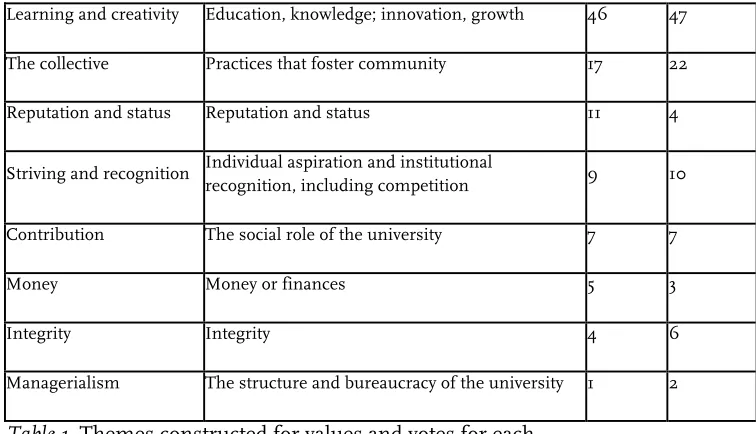
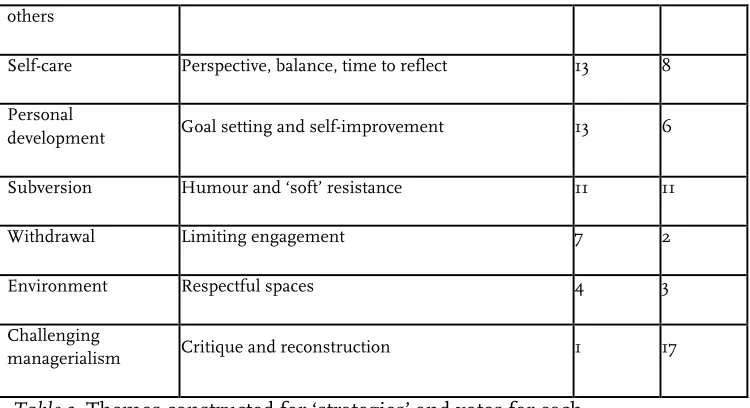
The first three rounds each focused on a different aspect of university life, as experienced by the players: round one on ‘values’, round two on ‘affects’, and round three on ‘strategies’. The final round, round four, took in all three aspects and focussed on what would make the university more ‘liveable’. It allowed players to supplement and trump their prior responses. To analyse the data, we identified the dominant themes of each aspect, working with the cards in play in round four of each workshop, and tested them against the data. We present these results in Tables 1-3, which show the themes for each aspect, a description of each theme, and the percentage of votes allocated to cards for each theme initially and with the final round added in. (Note that, for the initial round, players could cast votes only within an aspect; for the final round, on any card. Because the counts for the final round include those from earlier rounds, we created percentages that represent only the responses for each theme in Round 4.)
Theme Description
Initial Round %
Final Round %
7 As described by Julian Baggini, the Playable City Movement, launched in Bristol in
Learning and creativity Education, knowledge; innovation, growth 46 47
The collective Practices that foster community 17 22
Reputation and status Reputation and status 11 4
Striving and recognition Individual aspiration and institutional
recognition, including competition 9 10
Contribution The social role of the university 7 7
Money Money or finances 5 3
Integrity Integrity 4 6
Managerialism The structure and bureaucracy of the university 1 2
Table 1. Themes constructed for values and votes for each.
Theme Description
Initial Round %
Final Round %
Stress Stress, pressure, external demands 40 22
Excitement and stimulation
Joy and enthusiasm about research and the
university 28 49
Alienation Insecurity, disempowerment, and isolation from people and the institution 11 7
Belonging Affirmation of the individual’s place in the
university 9 15
Pride Pride in work and for university 6 2
Striving The demand for individual and institutional ‘success’ 5 3
Agency An individual’s ability to feel strong, connected
and mobile 2 3
Table 2. Themes constructed for affects and votes for each.
Theme Description
Initial round %
Final round %
others
Self-care Perspective, balance, time to reflect 13 8
Personal
development Goal setting and self-improvement 13 6
Subversion Humour and ‘soft’ resistance 11 11
Withdrawal Limiting engagement 7 2
Environment Respectful spaces 4 3
Challenging
managerialism Critique and reconstruction 1 17
Table 3. Themes constructed for ‘strategies’ and votes for each.
The top two values were Learning and creativity and The collective. Values shifted little between the initial and final round. One exception was Reputation and
status, which received some support in the initial round as a current value of the
university, but very little support in the final round as a value worth preserving – this despite our university branding itself as ‘New Zealand’s world-ranked university’. There was also a slight shift towards the value of The collective. Affects shifted significantly. First, Stress was the leading affect in participants’ current experience of the university, with 40% of the votes, but fell to 22% in the final round, when its contribution to the liveability of the university was considered. Second, Excitement and stimulation rose from 28% to 49%. This suggests that participants want to be positively aroused by their work. Third, Belonging also gained support. Strategy was dominated by Engaging with others,which was seen as both currently favoured and desirable for liveability. Personal development, Self-care and Withdrawal all lost support in the final round, and Challenging
managerialism went from last to second most favoured strategy by the end of the
game. Interestingly, play was offered in only one of the four workshops, as a value; critique, likewise, as a strategy. Nonetheless, a number of playful strategies operated as a critique of the rules of the university game: ‘Soft guerrilla warfare’, ‘Use of open space for idle behaviour’, ‘Little acts of subversion’, ‘Make jokes’, and ‘Strategise’. When we look at all three aspects of university life, we see that the game produced an increase in support for collaborative and political values, affects and strategies (The collective, Belonging, and Challenging managerialism), and a decrease in support for values, affects and strategies based on self-preservation, whether individual (Stress, Self-care) or institutional (Reputation and
status). This begs the question: does giving people the chance to play without
work in line with the values of the NLU into excited political agents prepared to work together to make the institution truly liveable?
The game evades the standard discursive formulations of professional critics of the NLU through its format and mix of participants. As against conventional modes of demonstration like protest and published criticism, the game is a ‘remonstration’: a way to field a complaint, to ‘have a problem’ with the rules at play in a situation, that enables us to re-imagine and reconstruct that situation with a different set of rules. With liveability, for example, it works by highlighting the social deficits of the NLU’s concept of liveability with a view to demonstrating how we might live otherwise. Its ‘possibilising’, or world-making, impulse produced in players a desire to produce a ‘good’ version of the university and to feel like good citizens for producing such a result. The values it produced were social in nature: collegiality, generosity and social interaction – in contrast with the values espoused by the university: world-ranked excellence, competitiveness and wealth. In part, this may well have been due to its rules fostering the movement of players between groups. But there is no doubt that players relished the opportunity to suspend the rules of the university game in order to imagine and construct a playable university.
The playable university
The game could be adapted in any number of ways. It could be played by more singular communities – of academics, or students, or managers, or professional staff, or by those affiliated with a particular faculty or campus or programme or organisational function. Games played by particular constituencies could well produce more striking or nuanced responses than games played by a mixed constituency. For example, would a game played by senior managers produce a liveable university that mirrored the existing one? What would a game played by undergraduate students produce (very few students, let alone undergraduates, participated in our games)? It could be argued that undergraduates – new to the university and its rules – would play in ways that most productively disturb the values of the NLU. As Harney and Moten put it, ‘there’s a kind of fear in the university [of] amateurism – immaturity, pre-maturity, not graduating, not being ready somehow – and the student represents that’ (2013: 116). Students at higher levels who criticise the NLU have already subscribed to sophisticated critical modes that make them proto-academics. However, what students new to the university value in the university or what they think its social role might be are questions that can transform the playable university – and the university’s mission. What would a game played at a different kind of tertiary institution or in a non-educational setting produce? For example, would not a game at a wānanga, or Māori institute of learning, likely produce a different differential between, say, the existing (collective) values of the wānanga and the regulations of the national regulatory body, the Tertiary Education Commission? Would not a game for participants in a non-educational setting reveal a differential between what those inside and outside tertiary education take the social value of the university to be?
It behoves us to conclude with a final set of principles that characterise the playable university:
1. The playable university makes the university a matter of experiment.
2. The playable university is created in the interaction of players. During the game, the players move from an individual focus to a collective one, perhaps through their private deliberative conversations that create a sense of community.
community, innovation and creativity. Thus, the experimental play of the playable university is an act of remonstration.
4. The playable university is necessarily ephemeral. The game ‘matters’ for as long as it is being played. The interaction of the players creates an ‘interval’ of intrinsic value, no matter what its consequences, whether in the data of the game or in the actions taken as a result of the game by players or the university. Indeed, the playable university may have no consequences at all – and certainly not in the form of manageable/measurable outputs.
5. The playable university addresses the social role and purpose of the university. The game does so because the interaction inherent in the game is social in nature and generated through collaborative deliberation. In the game, the norms of the university are suspended, with a view to their being transformed by the players – depending on what they think university should do or what it is for.
6. The playable university constructs or re-constructs the university. The play principle implies that all university activity conceals possible worlds that can be actualised by its participants through collaborative deliberation on norms, thereby returning to workers and students an agency and a capacity to value that have been usurped by managerialism and its econometrics. Seen in this way, the university could even be detached from campuses altogether and considered to be any site where such deliberation on norms takes place – were it not for the system of credentialising through which universities appropriate such activity for themselves.
7. The playable university produces a new subject of the university. The subject of the university is neither individual, rational nor self-interested; it is the aggregate subject of the social interaction of the game’s players and groups. It emerges at the edge of the existing parameters of knowledge that define the university, as a cross-section of subjectivities and values expressed by the players.
‘collective action problem’ of regulation and governance that is soluble if its participants are prepared to work together to make it truly liveable (Ostrom, 1990).8 Working together to create a liveable university thus requires that we take seriously the stipulation of the Education Act of 1989, the founding document of universities in Aotearoa/New Zealand, that a university consists of ‘its governing body, the chief executive, the teaching staff, general staff, the graduates and students, and such other people as the governing body may from time to time determine’ (Ministry of Education, 1989: 279, section 163.1) – although the governing body must be fully representative. The Playable University makes this possible.
references
Argos Aotearoa (2014) The university beside itself. Special issue of Argos Aotearoa, 1.
Baggini, J. (2014) ‘Playable cities: The city that plays together, stays together’, The
Guardian, 4 September.
[http://www.theguardian.com/cities/2014/sep/04/playable-cities-the-city-that-plays-together-stays-together]
Barnett, R. (2011) ‘The coming of the ecological university’, Oxford Review of
Education, 37(4): 439-455.
Beverungen, A., S. Dunne and B.M. Sorensen (2008) ‘University, failed’,
ephemera, 8(3): 232-237.
Bok, D. (2009) Universities in the marketplace: The commercialization of higher
education. Princeton, NJ: Princeton University Press.
Bourdieu, P. and L. Wacquant (1992) An invitation to reflexive sociology. Cambridge: Polity Press.
Brenneis, D., C. Shore and S. Wright (2005) ‘Getting the measure of academia: Universities and the politics of accountability’, Anthropology in Action, 12(1): 1-10.
8 In Governing the commons (1990: 90), Ostrom outlines the eight ‘design principles’ of
Butler, N. and S. Spoelstra (2014) ‘The regime of excellence and the erosion of ethos in critical management studies’, British Journal of Management, 25(3): 538-550.
Caillois, R. (1961) Man, play, and games, trans. M. Barash. New York, NY: Schocken Books.
Carse, J.P. (2012) Finite and infinite games: A vision of life as play and possibility. New York, NY: Free Press.
Docherty, T. (2011) ‘The unseen academy’, Times Higher Education, 10 November. [http://www.timeshighereducation.co.uk/418076.article]
Easton, P. and L. Walters (2015) ‘Protesters disrupt John Key Auckland appearance’, Stuff, 5 March
[http://www.stuff.co.nz/national/politics/66994165/protesters-disrupt-john-key-auckland-appearance]
Economic Intelligence Unit (2014) ‘Global liveability ranking and report’. http://www.eiu.com/public/topical_report.aspx?campaignid=liveability2014]
Gadamer, H.-G. (1960) Truth and method. London: Sheed and Ward.
Gallup (2014) ‘Great jobs, great lives: The 2014 Gallup-Purdue index inaugural national report’. [http://www.gallup.com/services/178496/gallup-purdue-index-inaugural-national-report.aspx]
Giroux, H.A. (2002) ‘Neoliberalism, corporate culture, and the promise of higher education: The university as a democratic public sphere’, Harvard Educational
Review, 72(2): 425-463.
Harney, S. and F. Moten (2013) The undercommons: Fugitive planning and black
study. New York, NY: Minor Compositions.
Huizinga, J.H. (1949) Homo ludens: A study of the play element in culture. London: Routledge and Kegan Paul.
Larner, W. and R. Le Heron (2005) ‘Neoliberalising spaces and subjectivities: Reinventing New Zealand universities’, Organization, 12(6): 843-862.
Latour, B. (2004) ‘Why has critique run out of steam? From matters of fact to matters of concern’, Critical Inquiry, 30(???): 225-248.
McGonigal, J. (2011) Reality is broken: Why games make us better and how they can
change the world. New York, NY: Penguin.
Mercer (2014) ‘Quality of living worldwide city rankings’.
Ministry of Education (1989) Education Act, 29 September. [http://www.legislation.govt.nz/act/public/1989/0080/latest/DLM175959.html]
Monocle (2014) ‘Quality of life survey’. [http://monocle.com/film/affairs/quality-of-life-survey-2014/]
OECD (2014) ‘Better life index’. [http://www.oecdbetterlifeindex.org]
Ostrom, E. (1990) Governing the commons: The evolution of institutions for collective
action. New York, NY: Cambridge University Press.
Rhoades, G. and S. Slaughter (2004) Academic capitalism and the new economy:
Markets, state, and higher education. Baltimore, MD: JHU Press.
Sturm, S. and S. Turner (2011) ‘The idea of the university’, Arena Magazine, 111(May): 16-19.
Svensson, P., S. Spoelstra, M. Pedersen and S. Schreven (2010) ‘The excellent institution’, ephemera, 10(1): 1-6.
Transforming Cities (2016) ‘About the transforming cities project: Archive’.
[http://www.creative.auckland.ac.nz/en/about/our-faculty/schools- programmes-and-centres/urban-research-network/transforming-cities-archive/AboutUs.html]
Universitas 21 (2009) ‘U21 statement on sustainability’.
[www.universitas21.com/relatedfile/download/165]
University for Strategic Optimism (2012) Undressing the academy or, the student handjob. London and New York, NY: Minor Compositions.
Vernon, J. (2010) ‘The end of the public university in England’. [https://www.insidehighered.com/blogs/globalhighered/the_end_of_the_publ ic_university_in_england]
Virno, P. (2011) ‘Wit and innovation’, in G. Raunig, G. Ray and U. Wuggenig (eds.) Critique of creativity: Precarity, subjectivity and resistance in the ‘creative
industries’. London: Mayfly Books.
Whelan, A., R. Walker and C. Moore (2013) Zombies in the academy: Living death
in higher education. Bristol and Chicago, IL: Intellect.
the authors
Anna Boswell (English, Drama and Writing Studies) teaches writing studies, and researches settler-colonial institutions, ecology and pedagogy in Aotearoa/New Zealand. Email: [email protected]
Dominic da Souza Correa (English, Drama and Writing Studies) majored in English and Writing Studies and graduated from the University of Auckland in 2015.
Email: [email protected]
Niki Harré (Psychology) teaches community and social psychology, and researches values, political activism and sustainability.
Email: [email protected]
Kirsten Locke (Critical Studies in Education) teaches and researches the philosophy and sociology of education through a poststructuralist and feminist lens.
Email: [email protected]
Sean Sturm (Centre for Learning and Research in Higher Education) teaches and writes about higher education, writing and the digital humanities, often with Stephen.
Email: [email protected]
Stephen Turner (English, Drama and Writing Studies) teaches writing studies, and researches higher education, writing and the digital humanities, often with Sean, and settler-colonialism in Aotearoa/New Zealand.