Volume 3, Issue 4, April 2014
Page 143
Abstract
In this paper, CdO/porous Si heterojunction have been fabricated by high vacuum thermal evaporation of Cd on porous has been presented and annealing with temperature (300C (). For the electrical properties of this structure have been studied and the optical properties of the CdO thin film are demonstrated. The electrochemical etching process has been used as a technique to control the porosity of silicon wafer by controlling the time of etching in the range (10,20,30,40) min. The results revealed that all our sample parameters are highly dependent on etching time. The minimum value of Filing Factor was (0.30) for the junction prepared by etching current density of (50mA/cm2 for 40 min). The results of efficiency showed that these junctions had two
depletion regions, the first one between CdO film and porous silicon layer, the second between the latter and the crystalline silicon. Minimum value efficiency was (1.61) for the junction prepared by etching current density of (50mA/cm2 for 40 min). Maximum value efficiency was (9.71) for the junction prepared by etching current density of (50mA/cm2 for 20 min).
Keywords
:
Porous Silicon, CdO thin films.1. Introduction
In the last years, the researches regarding the physical properties of the transparent conducting oxides (TCO) in thin films are intensively stimulated due to their wide applications in the field of the electronic and photovoltaic devices. Among other (TCO) materials, cadmium oxide (CdO) continues to attract attention due to their interesting characteristics such as high electrical conductivity and optical transmittance in the visible spectral region. These properties make them very useful for applications in optoelectronic devices such as photodetectors, solar cells, gas sensors, antireflection coatings, etc. Many physical and chemical preparation techniques such as pulsed laser deposition, sputtering, spray pyrolysis, sol–gel, chemical vapor deposition, reactive evaporation, etc. have been used in order to obtain (CdO) coatings with required properties Other simple method used for preparation of different (TCO) thin films is the thermal oxidation of deposited metallic films Studies on the different metallic oxides in thin films obtained by this technique revealed that by the modification both of the deposition parameters for metallic films and the conditions of their post-deposition oxidation, the structural, electrical and optical properties of respective films can be influenced. However, until now, not much attention has been paid to the preparation of the (CdO) thin films by thermal oxidation of metallic Cd thin films1.(CdO) is regarded as a material with many attractive properties such large energy band gap, high transmission coefficient in visible spectral domain, remarkable luminescence characteristics etc. Bulk (CdO) is an n-type broad band gap (2.3 eV) semiconductor; with an indirect band gap of (1.36 eV) it has wide range of applications as solar cells, windows, flat panel display, photo transistors etc. It was experimentally established that structural, electrical and optical properties are very sensitive to the film structure and deposition conditions Such transparent conductors are being used extensively in thin film solar cells and optoelectronic devices (CdO) 2 Transparent conducting oxides (TCO) constitute a unique class of materials which combine two physical properties together - high optical transparency and high electrical conductivity. These properties are generally considered to be mutually exclusive of each other since high conductivity is a property possessed by metals while insulators are optically transparent. This peculiar combination of physical properties is achieved by generating free electron or hole carriers in a material having a sufficiently large energy band gap (i.e., >_3.1 eV) so that it is non-absorbing or transparent to visible light. The charge carriers are usually generated by doping the insulator with suitable dopants and also by defects. It is no wonder that this unique material property makes (TCOs) technologically an important material and (TCOs) are widely used in commercial applications such as - in liquid crystal display (LCD), plasma and organic light emitting (OLED) displays; touch-screen sensors; thin film and organic photovoltaics, (OLED) lighting; low-e windows and smart windows; solar control film etc3.
2. Experimental Part
In this work, mirror-like p-type (boron doped) of (111) orientation mono-crystalline silicon wafers with electrical resistivity of (5) Ω.cm. Used First, the wafer scribed, cut into (1x1) cm2 and cleaned carefully (to remove dirt and oil). Porous silicon was performed by electrochemical etching (anodization) using an electrolyte containing 40% HF acid with several drops of ethanol to prevent bubbling for different etching time (10, 20, 30 and 40 min) with a constant etching current density (50mA/cm2). Optical Properties for CdO film prepared on glass are calculated after measuring the transmittance of the film using a Double beam spectrophotometer provided by Shimadzu-Japan Company. (See Figure 1) electrochemical cell consists of the Si substrates set as anode and high purity PT wire set as cathode (forward bias) located
I-V Characteristic of CdO/PS Heterojunction
Shatha Abdulla Taha1, Issam Mohamed Ibrahim2, Najim Abdullah Khaleafea3 1&3
University of Anbar
Volume 3, Issue 4, April 2014
Page 144
inside Teflon container filled with an electrolyte solution, power supply type was used to provide electric field. After etching the samples rinsed in water and ethanol, then do thin film was deposited on porous silicon and clean glass substrate by thermal evaporation technique as follows; high purity cadmium film (99.99%) provided from Aldrich Co. Was first deposited on Si using (Edward 216) coating system.Figure 1 Schematic diagram of electrochemical anodization system[4]
CdO/PS, heterojunction, ohmic contacts are performed by evaporating of an Aluminum with a purity of 99.99%. The contacts are made on CdO/PS heterojunction by evaporating thin film (semitransparent) and thick of Al on front side (CdO) and backside (silicon), respectively. Spiral tungsten boat is used as a source of evaporation.
3. Results and Discussions
3.1 Optical
properties:-3.1.1 Transmission spectra of CdO film:-
Optical study of CdO film was carried out in the wavelength range (300–1100) NM at room temperature for the films deposited on glass substrate. Figure (2) shows that the transmission spectra of CdO films at different annealing temperatures (573, 673, 773 K) as a function of wavelength. The transmission is seen to increase after annealing due to the increase in crystallite size.
Figure 2 the transmittance spectrum of CdO thin films at different tea.
All the films are highly transparent in the visible region with an average transmittance of 81%. The sharp rise in transmission is an identification of good crystallinity of films. It is observed that the films obtained at higher annealing temperature shows slightly increase of transmittance in the visible region as compared to the films obtained at a lower annealing temperature. These results cause slight decrease in the optical band - gap of the film and it may be due to the increasing of grain size of prepared samples.
3.1.2 Absorption coefficient
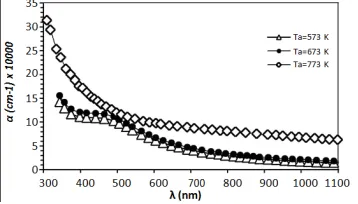
The dependence of the absorption coefficient on the wavelength for different annealing temperatures (Ta) shown in figure (3).
In the shorter wavelengths, the absorption coefficient (α) exhibits high values which means that there is a large probability of the allowed direct transition, and then (α) decreases with increasing of wavelength.
Volume 3, Issue 4, April 2014
Page 145
3.1.3 Optical band gap
The optical band gap Eg can be determined from transmittance data using Tauc relation 5]
Where (h ) is photon energy, (A) is a constant depending on the type of semiconductor, (n) is determined by the optical transition, and (α) is the absorption coefficient of the film can be calculated from transmission spectra by the relation (5) Where (d) is the thickness of the film. Eg is then determined by the extrapolation of the portion at (α =0) . The value of the optical energy gap decreases with increasing of Ta for all samples and this may be due to the increasing of grain size and the decrease in defect states near the bands and this in turn decreased the value of Eg [see table 1].
Figure 4 variation of (αhυ)2versus photon energy (hυ) for CdO thin film different Ta
Table 1 the energy band gap of CdO at different annealing temperature Annealing temperature Energy gap
573 2.3
673 2.04
773 1.95
3.1.4 Photoluminescence of CdO
The analysis of photoluminescence (PL) spectroscopy at room temperature reveals various peaks as shown in Figure (5). Using photoluminescence spectroscopy is to show the emission spectrum, since the most common radioactive transition in the semiconductor occurs between states at the bottom of the conduction band and the top of the valence band. The energy band gap can be determined from the photoluminescence spectrum of CdO film by using the following equation [6]:-
The room temperature photoluminescence spectra of CdO films at annealing (573, 673,773 K) is shown in Figure (5) at an excitation wavelength (340) nm . Three emission peaks are observed at 573K (625 nm), 673K (630 nm) and at 773K (630nm) for CdO thin film emission peak (Orange) refers to film in the region of the Visible. Red-shift from (1.98 to 1.96 eV) was caused by the formation of donor levels (Fermi levels) near the conduction band of the CdO.
Figure (5) Emission spectrum of CdO at 340 nm excitation
3.2 Electrical properties for CdO/PS Heterojunction 3.2.1 I–V Characteristics of CdO/PS/P-Si Heterojunction
Volume 3, Issue 4, April 2014
Page 146
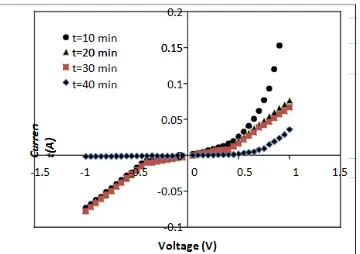
hertrojunction potential barrier at the CdO/PS interface. The rectification factor indicates to the ratio between forward and reverse current at a certain applied bias voltage. The figure illustrates that the current flow in the forward bias decreases with increasing of etching time. Due to the high density of states of the PS layer which will result in screening of internal field inside the PS layer, This result explains the lowering of flow current in forward bias with increasing of etching time, since the porosity of PS layer increases with etching time and hence the resistance of PS layer becomes too high which leads to low forward current. The values of ideality factor are found to be (9.05) at etching time (10 min) about (8.94) at (20 min) etching time, (11.34) at (30 min) etching time and (14.12) at (40 min) etching time see table (3). That increase in ideality factor with increasing of etching time attributed to the increase in the density of states. These layer values of ideality factor demonstrate that the (PS) layer has a high density of states, so that there is no depletion region occurred at the (metal/ PS) interface and this contest should behave almost in an ohmic manner 8. Again, due to the high density of states of the PS layer which will result in screening of internal field inside the PS layer. In the reverse bias, also, there are two regions; one at low voltage, where the current increases with the applied voltage and the generating current is dominant. In the second region, the current is dependent on voltage and the diffusion current is dominant. When etching time increases the porous layer and the porosity increase, so that the pore walls act as carriers trapped and caused high resistivity which causes decrease in current 9Figure 6 the I (V characteristics of dark for CdO/ PS (HJ) at different etching time
Table 2 the variation of ideality factor and potential Barrier with etching time.
Etching Ideality Potential Barrier
Time (min) Factor (eV)
10 9.05 0.564
20 8.94 0.57
30 11.34 0.587
40 14.12 0.608
Volume 3, Issue 4, April 2014
Page 147
Figure 7 The I–V characteristics under illumination for CdO/PS (HJ) with etching time(10min) of PS layersFigure 8 the I–V characteristics under illumination for CdO/PS (HJ) with etching time (20min)
Figure 9 the I–V characteristics under illumination for CdO/PS (HJ) with etching time (30min)
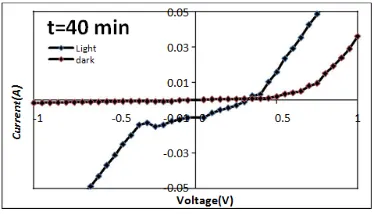
Figure 10 the I–V characteristics under illumination for CdO/PS (HJ) with etching time (40min)
Volume 3, Issue 4, April 2014
Page 148
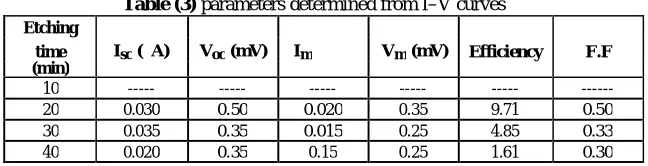
heterojunction between porous layer and Si substrate according to the quantum confinement model because of the larger band gap of PS layer compared to bulk silicon. The reduction of fill factor is a result of the lower electrical conductivity ofthe PS layer than silicon substrate which leads to a higher resistance of solar cells with PS layers 12.
Table (3) parameters determined from I–V curves
Etching
time Isc ( A) Voc (mV) Im Vm (mV) Efficiency F.F
(min)
10 --- --- --- --- ---
---20 0.030 0.50 0.020 0.35 9.71 0.50
30 0.035 0.35 0.015 0.25 4.85 0.33
40 0.020 0.35 0.15 0.25 1.61 0.30
4. Conclusions
CdO/PS/P-Si heterojunction was successfully fabricated by using electrochemical etching of silicon and thermal evaporation of CdO. The optical and electrical properties of growing CdO are investigated. The electrical characteristics of heterojunction are strongly dependent on the etching current density and etching time. The junction parameters are estimated as a function of etching time. The process used here is simple, cheap, reliable and promising.
References
[1] C.Dantus,G.G.Rusu,M.Dobromir,M. Rusu."Preparation and characterization of CdO thin films obtained by thermal oxidation of evaporated Cd thin films", Applied Surface Science 255 (2008) 2665–2670.
[2] Mahdi.H.Suhail,Issam.M.Ibrahim and G.Mohan Rao," Characteriza and gas sensitivity of cadmium oxide thin films prepared by thermal evaporation technique" ,Journal of Electron Devices, Vol. 13,( 2012), pp. 965-974.
[3] Hemant Dixit," First-principles electronic structure calculations of transparent conducting oxide materials,"University antwerpen, July, (2012).
[4] Raid A. Ismail, Nadir F. Habubi, Abdulla M. Ali," Structural and electrical properties of CdO/porous-Si heterojunction", Iraqi Journal of Physics, (2012).
[5] Dr.Azhar I. Hassan, Khawla S. khashan, Aseel A. Hadi," Optical and Structural Properties of Cdo Thin Film", Eng. &Tech. Journal .Vol31,Part (B), No. 5 , (2013)
[6] Asama Natik Naje," Optical Characteristics of CdO Nanostructure", 1Physics department, college of science, University of Baghdad, Iraq., Physical Review & Research International 3(4): 472-478, (2013).
[7] Alim.Mous,Selma M.H.Al-Jawad,Suad M.Kadhim Al-Shammari,"performance of A nanostructured PbS/Si Heterojunction Detector Deposited by CBD",international journal of semiconductor,Vol.3,Issue4,Oct 2013,11-18. [8] A. Stesmans, V.V. Afanas’ev, Phys. Rev. B 54 (1996), R11129.
[9] W.L. Warren, K. Vandheusden, J.R. Scwank, D.M. Fleetwood, P.S.Winokur, R.A.B. Devine, Appl. Phys. Lett. 68 (1996), 2993.
[10]A. Grove, "Physics and Technology of Semiconductor Devices", Jone Wiley and Sons, California, 1967.
[11]Uday Muhsin Nayef,"Fabrication and Characteristics of porous silicon for photoconversion,"138602-3737-IJBAS-IJENS@April (2013) IJENS