223
Copyright © 2016. Vandana Publications. All Rights Reserved.
Volume-7, Issue-1, January-February 2017
International Journal of Engineering and Management Research
Page Number: 223-227
Dealer Associations and Supply Chain Performance in Financial Services
Processes in Bangalore
Mallieswari R1, Aravinda Reddy M N2
1,2Assistant Professor, M S Ramaiah Institute of Management, INDIA
ABSTRACT
Supply chain management has increasingly been recognized as a key driver of overall operational and performance of financial services processes and an emerging subject within operational management research. Better supplier relations should result in improved supply chain performance. The relationship between supplier relations and supply chain performance is, in fact, nuanced and depends on what is being done under the umbrella of supplier relations and how it is being done. Using a sample of 50 financial services process, analysis and interpretation has been done by using the statistical tools and data’s are presented through tables and charts Hypothesis is tested using regression analysis, correlation analysis and Analysis of Variance.
Keywords– Supplier Associations, Supply chain management, Financial Services
I.
INTRODUCTION
Supply chain management has increasingly been recognized as a key driver of overall operational and performance of financial services processes (Hammer, 2001) and an emerging subject within operational management research (Pilkington, 2001 and Fitzgerald, 2006). As such, several studies have been investigated on various aspects of supply chain management, including supplier relations. Arguably, better supplier relations should result in improved supply chain performance. However, research has shown that this „obvious‟ relationship between supplier relations and supply chain performance is, in fact, nuanced and depends on what is being done under the umbrella of “supplier relations” and how it is being done (Baker and Faulkar, 1991;lambert and Knemeyer,2004).
In this paper, we empirically examined based on the observation of the relationship between suppliers relations and supply chain performance with a sample of 50 financial services process in Bangalore. The study is
unique because supplier relations and supply chain performance have previously been examined at the strategic business unit (SBU) or firm level rather than at the process level. This is particularly important for service processes because, unlike manufacturing, services are often not procured and managed centrally (Ellram et al., 2004). In this context based on the above set objectives this paper relates the process in a more appropriate level of analysis.
In fact, Silver (2004 )specifically calls for process level studies of supply chain management in the operations management literature. He argues that supply chains are really the integration of processes across boundaries of different organizations with many different supply chains with a firm managed at the process level.
In addition the most empirical supply chain studies have been done in a manufacturing context ( Narsimhan and Jayaram, 1998;Peterson et al.,2005; Saeed et al., 2005Sanders and Premus, 2005), while this study examines satisfaction with supplier performance in a service (i.e., financial services) context. Because the “product “ in financial services tends to be information rather than something more tangible(thereby, greatly impacting the ability of service processes to respond to demand uncertainty through the use of inventory), and specifications and performance criteria for intangible products are typically more ambiguous (Ellram et al., 2004, 2007) emphasizes the need to recognize the difference between manufacturing and services and develop models and empirical studies that focus specifically on service supply chains.
II.
SCOPE OF THE STUDY
Professionals in the financial services industry in Bangalore
224
Copyright © 2016. Vandana Publications. All Rights Reserved.
III.
OBJECTIVE OF THE STUDY
To predict a positive relationship between multidimensional construct of supplier relations and satisfaction with over all supplier performance in financial services processes To analyze the supplier efficiency and sensitivity To Study the use of information technology To suggest effective strategies in order to improve
supply chain performance in financial services.
IV.
LITERATURE REVIEW
Liker and choi (2004) suggest that strong partnerships are critical to successful supply chain management. Successful supply chain relationships also require the supervision of the suppliers, the development of compatible technical capabilities, and sharing information intensively. However, Lambert and Knemeyer (2004) suggest that good results often can be achieved without investing the extra human resources to form tight relationships with every supplier. For example, Wendy‟s consolidated its buying to 225 suppliers, but only the top 40 were worked with to create particularly strong partnerships (Lambert and Knemeyer, 2004)
Collaborative planning activities and information- sharing have been found to have a positive effect on supply chain performance, but the quality of information shared and the level of trust between the firms must be considered as well (Monczka et al., 1998; Peterason et al., 2005). Similarly, Mohr and Spekman (1994) find that coordination, commitment, trust, communication quality, and information-sharing are associated with the success of the partnerships between firms. Lee (2004) describes the best supply chains as agile, adaptable, and aligned, requiring a collaborative relationship and information- sharing among supply chain partners.
Ellram and Krause (1994) find that the duration of buyer-supplier relationships tends to be longer for manufacturing firms. In addition, they find that non-manufacturers believe that it would be more difficult to replace the supplier partner than do manufacturers. Together, these findings support the idea that these relationships tends to evolve into cooperative partnerships over time and require much effort to develop. However, Baker and Faulkner (19910 suggest that a long-term commitment is appropriate for only certain types of suppliers strategies for professional services, such as a relational strategy in which products and transactions are linked. In other types of supplier strategies, such as a transactional strategy, professional services are considered commodities, with frequent switching of suppliers.
Focusing on the professional services supply chain, in particular, Ellarm et al. (2004) point out that the service sector has less flexibility to deal with uncertain
demand (due, for example, to the inability to inventory services). Thus, information flows in the supply chain-including information-sharing and feedback-are especially important in services for managing this uncertainty. In fact, in Ellram et al.‟s (2004) services supply chain model, they identify information as critical for coordinating all activities within the service supply chain. Similarly, Baltacioglu et al. (2007) consider information flow and technology management to be essential for the successful coordination of all key functions in the service supply chain. In an empirical study, Sengupta et al.(2006) find support at the company level for a positive relationship between information-sharing and operational performance in service supply chains.
Other sources of uncertainty in services relate to the nature of the service product and the degree of customer contact. Because services are often intangible and produced after purchasing, actual service characteristics may be highly uncertain (Baltacioglu et al. 2007; Reimer and Kuehn, 2005). More specifically, service specifications (including expectations and performance criteria) are often difficult to develop, with many services agreements executed without clear specifications (Ellarm et al., 2004, 2007). In addition, many service processes involve a high degree of customer contact, and the involvement of the customer in the service creation and delivery process introduces uncertainty in both the process and product, including differing customer perceptions and evaluations of the delivered service (Chase, 1981; Harvey, 1998; Kellogg and Nie, 1995). While the uncertainty inherent in services increases the importance of managing information flows, it also makes it more difficult to design and implement effective operational processes at the supplier-customer interfaces of the service supply chain.
225
Copyright © 2016. Vandana Publications. All Rights Reserved.
V.
RESEARCH METHODOLOGY
This study focused on relationship between supplier relations and supply chain performance in financial services perspective at a process level of analysis Research Design: A research design is a framework or blueprint for conducting the business research project. It details the procedures necessary for obtaining the information needed to structure or solve business research problems.
Population: Professionals in the financial services industry in Bangalore
Sample: We selected a random sample of 50 professionals in the financial services industry from a population of Bangalore city, who were employed in the financial services industry, stock broking , KPO, Alumni of our institution.
First step was we requested the sample to furnish the basic information. For this we interacted and approved the questionnaire. In the second step a structured questionnaire was designed and pre tested through e-mail. The above said factors ended with imploring responses from a probability sample of financial services
professionals practically not viable. However, former students employed in the financial services industry were interested participants in this study.
Hypotheses:
HO1: There is a negative relationship between multidimensional construct of supplier relations and satisfaction with over all supplier performance in financial services processes
H11: There is a positive relationship between
multidimensional construct of supplier relations and satisfaction with over all supplier performance in financial services processes
HO2: There is a close association between supplier efficiency, sensitivity, feedback, and satisfaction
H12: There is a close association between supplier efficiency, sensitivity, feedback, and satisfaction
VI.
DATA ANALYSIS AND
INTERPRETATION:
Findings
Data Analysis and Interpretation:
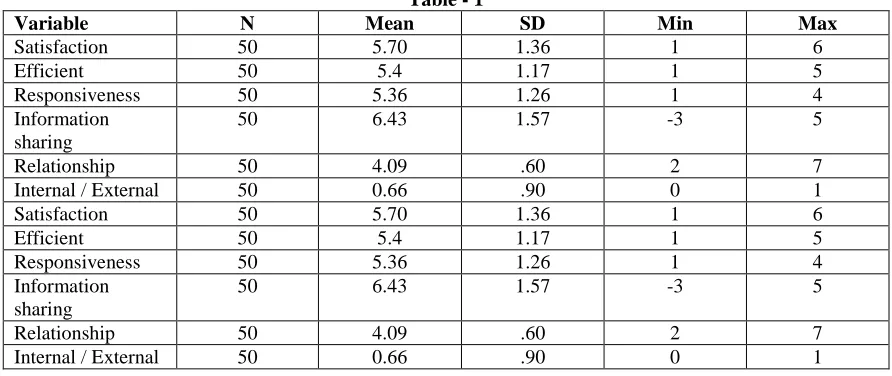
Table - 1
Variable N Mean SD Min Max
Satisfaction 50 5.70 1.36 1 6
Efficient 50 5.4 1.17 1 5
Responsiveness 50 5.36 1.26 1 4
Information sharing
50 6.43 1.57 -3 5
Relationship 50 4.09 .60 2 7
Internal / External 50 0.66 .90 0 1
Satisfaction 50 5.70 1.36 1 6
Efficient 50 5.4 1.17 1 5
Responsiveness 50 5.36 1.26 1 4
Information sharing
50 6.43 1.57 -3 5
Relationship 50 4.09 .60 2 7
Internal / External 50 0.66 .90 0 1
The data analysis for each of the variables is shown in using their average, standard deviations, minimum and maximum values. In addition, Table I also provides information about entity in the supplier relations construct, as well as association with the Supply chain performance and satisfaction.
1. Evidence of non-bias information towards a particular experience on the present economic scenario. Out of the entire sample process interacted the study has found that 35% response have been severely affected by the current economic scenario. When enquired about the extent of impact of financial services that they had been trading with nearly 10% have not been much impacted but those of 5% of the sample to total sample size have come out saying
that they were not been in a position to say the extent of impact on their outcome during the slowing down of the economy.
226
Copyright © 2016. Vandana Publications. All Rights Reserved.
33% of the samples have been neither satisfied nor dissatisfied somewhat satisfied and 33% of the samples are somewhat satisfied due to time factor and other delays in the process of management.
3. The extent of Information technology and process association in supply chain management. The findings with respect to IT are interesting. The use of IT in the respondents processes is positively associated with satisfaction with overall supplier performance but electronic information-sharing with suppliers is not associated with overall supplier performance. Information sharing within the buying firm and traditional communication methods are associated with precursors to improved product quality and firm financial performance, while advanced communication methods such as electronic information sharing is not. The effect of electronic information sharing on perceived supplier performance is increasingly negative as the use of IT in the respondents process increase. One possible explanation for this is as follows as the use of IT in the respondents process increases having the interface with the supplier being primarily electronic is likely to limit both customer and supplier human involvement in managing supply chain. Out of the total sample 27 samples have been using always and dependent on EDI.15 samples have come out with most of the time they have been using while 5 samples have rather been using sometimes and 3 samples rarely. Hence as a result this may reduce opportunities to readily discuss and resolve supply chain issues, there by being associated with lower satisfaction with supplier performance.
5. Nature of relationship and supplier type that is internal and external is not associated with satisfaction and overall supplier performance, suggesting that concerns with differing levels of service to internal versus external customers may not be an issue for financial services processes. In the interaction we found that no evidence of firm size being associated with satisfaction with overall supplier performance.
VII.
CONCLUSION
This research emphasizes the supply chain management implications by addressing the recognized need for process-level research focused on financial services supply chain management. With multiplicity of process and associated supply chains conducting research at the process-level has brought about better empirical results by testing relationship between supplier relations and satisfactions. This study is limited to financial services processes experimented the association between factors, such as firm size, services that impact supply chain management. Our research findings shed some light on the role of information systems in satisfaction with supply chain performance.
Finally, we more closely observed the components of supplier relations and supply chain performance in financial services perspective at a process level of analysis. In order to provide more specific managerial direction and insights for understanding and addressing the difficulties in designing and managing service supply chains and prescribe an effective strategy in order to improve supply chain performance in financial services.
REFERENCES
[1] Baker, W.E. and Faulkner, R.R. (1991), “Strategies for managing suppliers of professional services”, California management Review, Vol. 33 No. 4, pp. 33-45.
[2] Baltacioglu, T., Ada, E., Kaplan, M.D., Yurt, O. and Kaplan, Y.C. (2007), “A new framework for service supply chains”, The Service Industries Journal, Vol. 27 No. 2, pp. 105-24.
[3] Carr, A.S. and Kaynak, H. (2007), “Communication methods, information sharing, supplier development and performance: an empirical study of their relationships”, International Journal of Operations & Production Management, Vol. 27 No. 4, pp.346-70.
[4] Chase, R.B. (1981), “The customer contact approach to services: theoretical bases and practical extensions”, Operations Research, Vol. 29 No. 4, pp.698-706.
[5] Ellram, L.M. and Krause, D.R. (1994), “Supplier partnerships in manufacturing versus non-manufacturing firms”, The International Journal of Logistics Management, Vol. 5 No. 1, pp.43-53.
[6] Ellram, L.M., Tate, W.L. and Billington, C. (2004), “Understanding and managing the services supply chain”, The Journal of supply chain Management, Vol. 40 No. 4, pp.17-32.
[7] Ellram, L.M., Tate, W.L. and Billington, C. (2007), “Services supply management: the next frontier for improved organizational performance”, California Management Review, Vol. 49 No. 4, pp.44-66.
[8] Fynes, B., Voss, C. and de Burca, S. (2005), “ The impact of supply chain relationship quality on quality performance”, International Journal of Production Economics, Vol. 96 No. 3, pp.339-54.
[9] Hammer, M. (2001). “The superefficient company”, Harvard Business Review, Vo. 79 No. 8, pp.82-91. [10] Hausman, W.H., Montgomery, D.B. and Roth, A.V. (2002), “Why should marketing and manufacturing work together? Some exploratory empirical results”, Journal of Operations Management, Vol. 20 No. 3, pp. 241-57. [11] Heide, J.B. and John, G. (1992), “Do norms matter in marketing relationships?”, Journal of Marketing, Vol. 56 No. 2, pp. 32-44.
227
Copyright © 2016. Vandana Publications. All Rights Reserved.
and production management, Vol 28, No.2, 2008, PP 185 to 206
[13] Kellogg, D.L. and Nie, W. (1995), “A framework for strategic service management”, Journal of Operations Management, Vol. 13 No.4, pp 323-37.
[14] Lambert, D.M. and Knemeyer, A.M. (2004), “We‟re in this together”‟ Harvard Business Review, Vol.82 No. 12, pp.114-22.
[15] Liker, J.K. and Choi, T.Y. (2004), “Building deep supplier relationships”, Harvard Business Review, Vol. 29 No. 3, pp. 537-52.
[16] Monczka, R.M., Petersen, K.J., Handfield, R.B. and Ragatz, G.L. (1998), “Success factors in strategic supplier alliances: the buying company perspective”, Decision Sciences, Vol. 29 no. 3, pp. 553-78.
[17] Narasimhan, R. and Jayaram, J. (1998), “Causal linkages in supply chain management: an exploratory study of North American Manufacturing firms”, Decision Sciences, Vol. 29 No. 3, pp. 579-606..
[18] Peterson, K.J., Ragatz, G.L. and Monczka, R.M. (2005), “An examination of collaborative planning
effectiveness and supply chain performance”, Journal of supply chain management, Vol. 41 No.2, pp. 14-25. [19] Pilkington, A. and Fitzgerald, R. (2006), “Operations management themes, concepts and relationships; a forward retrospective of IJOPM”, International journal of operations and production management, Vol.26 No.11, pp. 1255-75.
[20] Prahinski, C. and Benton, W.C. (2004), “ supplier evaluations: communication strategies to improve supplier performance”, Journal of Operations Management, Vol. 22 No. 1, pp.39-62..
[21] Saeed, K.A., Malhotra, M.K. and Grover, V. (2005), “Examining the impact of interorganizational systems on process efficiency and sourcing leverage in buyer-supplier dyads”, Decision Sciences, Vol. 36 No.3 pp.365-96. [22] Sengupta, K., Heiser, D.R. and cook, L.S. (2006), “manufacturing and service supply chain performance: a comparative analysis”, journal of supply chain management, Vol.42 No.4, pp.4-15.