Adv. Fixed Point Theory, 8 (2018), No. 2, 144-173 https://doi.org/10.28919/afpt/3619
ISSN: 1927-6303
MODIFICATION OF VISCOSITY METHOD FOR STRICTLY
PSEUDO-CONTRACTIVE MAPPING AND EQUILIBRIUM PROBLEM WITH SOME APPLICATIONS
KATANYOO THAPTHAS, ATID KANGTUNYAKARN∗
Department of Mathematics, King Mongkut’s Institute of Technology Ladkrabang, Bangkok, Thailand
Copyright c2018 Thapthas and Kangtunyakarn. This is an open access article distributed under the Creative Commons Attribution License, which permits unrestricted use, distribution, and reproduction in any medium, provided the original work is properly cited.
Abstract. For the purpose of this article, we are using the concept of equilibrium problem and prove the strong convergence theorem by the viscosity approximation methods for finding a common element of the set of fixed points ofκi-strictly pseudo-contractive mappings and of a finite family of the set of solutions of equilibrium
prob-lems and variational inequality probprob-lems. Furthermore, we apply our main theorem for the numerical examples.
Keywords: viscosity approximation methods; strictly pseudo-contractive mapping; S-mapping; variational in-equality problems; the combination of equilibrium problems.
2010 AMS Subject Classification:47H09, 47H10, 47J20.
1.
Introduction
LetCbe a nonempty closed convex subset of a real Hilbert spaceHwith the inner producth·,·i
and the normk·k. A mappingT :C→Cis said to benonexpansiveifkT x−Tyk ≤ kx−yk, for
∗Corresponding author
E-mail address: [email protected] Received November 19, 2017
allx,y∈C. Recall thatT is a κ-strictly pseudo-contractive mappingif there exists a constant κ∈[0,1)such that
(1.1) kT x−Tyk2≤ kx−yk2+κk(I−T)x−(I−T)yk2, ∀x,y∈C.
Ifκ =0, then (1.1) reduces to nonexpansive mappings.
A pointx∈Cis called afixed pointofT ifT x=x. The set of fixed points ofT is denoted by
F(T) ={x∈C:T x=x}.
Recall that a mapping f :C→Cis said to becontractiveif there exists a constantη ∈(0,1)
such that, for allx,y∈H
kf(x)−f(y)k ≤ηkx−yk.
A mappingAofCintoH is calledα-inverse-strongly monotone if there exists a positive real
numberα such that
(1.2) hx−y,Ax−Ayi ≥αkAx−Ayk2, ∀x,y∈C.
LetA:C→H. The variational inequality problemsis to find a pointu∈Csuch that (1.3) hv−u,Aui ≥0, ∀v∈C.
The set of solutions of the variational inequality problems is denoted byV I(C,A).
Variational inequalities were introduced and investigated by Stampacchia [8] in 1964. It is well known that variational inequalities cover as diverse disciplines as partial differential equa-tions, optimal control, optimization, mathematical programming, mechanics and finance; see [9]−[11].
LetF :C×C→Rbe a bifunction. The equilibrium problem for F is to determine its equi-librium point, that is to find a pointx∗∈Csuch thatF(x∗,y)≥0, for ally∈C.
The set of all solution of equilibrium problem is denoted by (1.4) EP(F) ={x∈C:F(x∗,y)≥0,∀y∈C}.
In 2013, Suwannaut and Kangtunyakarn [15] introduced the combination of equilibrium problemwhich is to findx∈Csuch that
(1.5)
N
∑
i=1aiFi(x,y)≥0, ∀y∈C,
where Fi:C×C→Rbe bifunction and ai∈(0,1) with ∑Ni=1ai=1, for every i=1,2, ...,N. The set of solution (1.5) is denoted by
EP
N
∑
i=1aiFi=nx∈C: N
∑
i=1aiFi(x,y)≥0,∀y∈Co.
IfFi=F,∀i=1,2, ...,N, then (1.5) reduces to (1.4).
In 2007, Takahashi and Takahashi [5] proved the following theorem.
Theorem 1.1. Let C be a nonempty closed convex subset of H. Let F be a bifunction from C×C to Rsatisfying A1)−A4) and let S be a nonexpansive mapping of C into H such that F(S)∩EP(F)6= /0. Let f be a contraction of H into itself, let {xn} and {un} be sequences generated by x1∈H and
F(un,y) + 1
rnhy−un,un−xni ≥0, ∀y∈C,
xn+1=αnf(xn) + (1−αn)Sun,
for all n∈N,where{αn} ⊂[0,1]and{rn} ⊂[0,1]satisfy some control conditions. Then{xn}
and{un}converge strongly to z∈F(S)∩EP(F), where z=PF(S)∩EP(F)f(z).
The explicit viscosity method for nonexpansive mappings generates a sequence{xn}through the iteration process:
(1.6) xn+1=αnf(xn) + (1−αn)T xn, n≥0,
whereIis the identity ofH and{αn}is a sequence in(0,1). It is well known [6, 7] that under certain conditions, the sequence{xn}converges in norm to a fixed pointqof T which solves the variational inequality
whereSis the set of fixed points ofT, namely,S={x∈H:T x=x}.
Many authors proved a strong convergence theorem by using viscosity method; see, for in-stance, [5, 6].
In 2010, Kangtunyakarn [12] proved a strong convergence theorem of the iterative scheme (1.9) to a common fixed point ofq∈TN
i=1F(Ti).
Theorem 1.2. Let H be a Hilbert space, let f be anα-contraction on H and let A be a strongly
positive linear bounded self-adjoint operator with coefficientγ >0. Assume that 0<γ < γ
λ.
Let{Ti}N
i=1be a finite family ofκi-strict pseudo-contraction of H into itself, for someκi∈[0,1)
andκ=max{κi:i=1,2, ...,N}, withTNi=1F(Ti)6= /0. Let Sn be the S-mappings generated by
T1,T2, ...,TNandα1(n),α2(n), ...,αN(n), whereα(jn)= (α1n,j,α2n,j,α3n,j)∈I×I×I,I= [0,1],α1n,j+ α2n,j+α3n,j=1andκ<a≤α1n,j,α3n,j≤b<1, for all j=1,2, ...,N−1,κ<c≤α1n,N≤1,κ≤ α3n,N ≤d<1,κ ≤α2n,j≤e<1, for all j=1,2, ...,N. For a point u∈H and x1∈H, let{xn}
and{yn}be the sequences defined iteratively by
(1.8)
yn=βnxn+ (1−βn)Snxn,
xn+1=αnγ anu+ (1−an)f(xn)
+ (1−αnA)yn, n≥1,
where{βn},{αn}and{an}are sequences in[0,1]. Assume that the following conditions hold:
(i) lim
n→∞αn=0, ∞
∑
n=1αn=∞and lim n→∞
an=0;
(ii) ∞
∑
n=1α
n+1,j
1 −α
n,j 1
<∞,
∞
∑
n=1α
n+1,j
3 −α
n,j 3
<∞, for all j∈ {1,2, ...,N}and
∞
∑
n=1|λn+1−λn|<∞,
∞
∑
n=1|βn+1−βn|<∞,
∞
∑
n=1|an+1−an|<∞;
(iii) 0≤κ ≤βn<θ <1, for all n≥1, for someθ ∈(0,1).
Then both{xn}and{yn}strongly converges to q∈TN
i=1F(Ti)which solves the following
vari-ational inequality
(1.9) hγf(q)−Aq,p−qi ≤0, ∀p∈
N
\
i=1
F(Ti).
From Theorem 1.1 [5] and [15], we modify the viscosity methods as following:
For every i=1,2, ...,N, let Fi:C×C→R be bifunction which satisfyA1)−A4)andai∈
andκ=max{κi:i=1,2, ...,N}. For each j=1,2, ...,N, letαj= (α1j,α2j,α3j)∈I×I×I, where
I= [0,1]andα1j+α2j+α3j=1, forx1∈Cand sequencexngenerated by
(1.10)
N
∑
i=1aiFi(un,y) + 1
rnhy−un,un−xni ≥0,∀y∈C, xn+1=βn αnf(xn) + (1−αn)Sxn
+ (1−βn)PC(I−λA)un,∀n≥1,
whereA:C→H isα-inverse-strongly monotone mapping andS:C→CisS-mapping
gener-ated by a finite family of strictly pseudo-contractive mappings and a finite real numbers under suitable conditions of the parameters{βn},{αn},{rn} ∈[0,1]andλ ∈(0,2α).
Motivated by the above related literature, we prove a strong convergence theorem by modi-fying the viscosity methods for finding a common element of the set of solutions of equilibrium problems and variational inequality problems. Moreover, we apply our main result to obtain a strong convergence theorem for finding a common element of the set of fixed point ofκi-strictly pseudo-contractive mappings. Finally, we also give a numerical examples to support our main theorem.
2.
Preliminaries
In this section, we use some lemmas that will be used for our main result in the next section. LetC be a nonempty closed convex subset of a real Hilbert space H. We denote weak and strong convergence by 88*00 and88 →00, respectively, and let PC be the metric projection of H
ontoC, that is, forx∈H,PCx∈Csatisfies the property
kx−PCxk=min
y∈Ckx−yk
and it is well-known that, for allx,y∈H andt∈[0,1],
ktx+ (1−t)yk2=tkxk2+ (1−t)kyk2−t(1−t)kx−yk2
andPC is afirmly nonexpansive mappingofHontoC, that is,
Lemma 2.1. ([19]) For given z∈H and u∈C,
u=PCz⇔ hu−z,v−ui ≥0, ∀v∈C.
Lemma 2.2. ([16]) Each Hilbert space H satisfies Opial’s condition, i.e., for any sequence
{xn} ⊂H with xn*x, the inequality
lim inf n→∞ k
xn−xk<lim inf n→∞ k
xn−yk,
holds for every y∈H with y6=x.
Lemma 2.3. ([18]) Let{sn}be a sequence of nonnegative real numbers satisfying sn+1≤(1−αn)sn+δn,∀n≥0,
where{αn}is a sequence in(0,1)and{δn}is a sequence such that (1):
∞
∑
n=1αn=∞,
(2): lim sup n→∞
δn
αn
≤0or ∞
∑
n=1|δn|<∞.
Then, lim
n→∞
sn=0.
Lemma 2.4. ([19]) Let H be a real Hilbert space, let C be a nonempty closed convex subset of H and let A be a mapping of C into H. Let u∈C. Then, forλ >0,
u=PC(I−λA)u⇔u∈V I(C,A),
where PCis the metric projection of H onto C.
Lemma 2.5. ([21]) Let C be a nonempty closed convex subset of a real Hilbert space H and S:C→C be a self-mapping of C. If S is aκ-strict pseudo-contractive mapping, then S satisfies
the Lipschitz condition
kSx−Syk ≤ 1+κ
1−κ kx−yk,∀x,y∈C.
For solving the equilibrium problem for a bifunction F :C×C →R, let us assume that
(A2)F is monotone, i.e.,F(x,y) +F(y,x)≤0 for allx,y∈C; (A3) For eachx,y,z∈C,
lim
t↓0F tz+ (1−t)x,y
≤F(x,y); (A4) For eachx∈C,y7→F(x,y)is convex and lower semicontinuous.
Lemma 2.6. ([15]) Let C be a nonempty closed convex subset of a real Hilbert space H. For i=1,2, ...,N, let Fi:C×C→R be bifunctions satisfying (A1)−(A4)with TN
i=1EP(Fi)6= /0.
Then
EP
N
∑
i=1aiFi=
N
\
i=1
EP(Fi),
where ai∈(0,1), for every i=1,2, ...,N and∑Ni=1ai=1.
Lemma 2.7. [14]) Let C be a nonempty close convex subset of H and F be a bifunction of C×C intoRsatisfying(A1)−(A4). Let r>0and x∈H, then there exists z∈C such that
F(z,y) +1
rhy−z,z−xi ≥0,∀y∈C.
Lemma 2.8. ([17]) Assume that F :C×C →R satisfies (A1)−(A4). For r > 0, define a mapping Tr:H→C as follows:
Tr(x) =nz∈C:F(z,y) +1
rhy−z,z−xi ≥0,∀y∈C
o ,
for all x∈H. Then, the following hold:
(i) Tr is single-valued;
(ii) Tr is firmly nonexpansive, i.e., for any x,y∈H,
kTr(x)−Tr(y)k2≤ hTr(p)−Tr(y),x−yi;
(iii) F(Tr) =EP(F);
(iv) EP(F)is closed and convex.
Remark2.9. From Lemma 2.6 and 2.8, ([15]) prove the following results; (i) ∑Ni=1aiFisatisfyingA1)−A4);
(ii) F(Tr) =TN
wherer>0 andai∈(0,1), for everyi=1,2, ...,N with∑Ni=1ai=1.
In 2009, Kangtunyakarn and Suantai ([20]) introduced theS-mapping generated by a finite family ofκi-strictly pseudo-contractions and a finite real numbers. The definition can be seen below:
Definition 2.1. Let C be a nonempty convex subset of a real Hilbert space. Let {Ti}Ni=1 be
a finite family of κi-strictly pseudo-contractions of C into itself. For each j =1,2, ...,N, let
αj = (α1j,α2j,α3j)∈I×I×I, where I = [0,1] and α1j+α2j+α3j = 1. Define the mapping
S:C→C as follows:
U0=I,
U1=α11T1U0+α21U0+α31I,
U2=α12T2U1+α22U1+α32I,
U3=α13T3U2+α23U2+α33I,
.
.
.
UN−1=α1N−1TN−1UN−2+α2N−1UN−2+α3N−1I,
S=UN =α1NTNUN−1+α2NUN−1+α3NI.
This mapping is called an S-mapping generated by T1,T2, ...,TN andα1,α2, ...,αN.
Lemma 2.10. ([22]) Let C be a nonempty closed convex subset of a real Hilbert space H. Let {Ti}N
i=1 be a finite family of κi-strictly pseudo-contractive mapping of C into itself with
TN
i=1F(Ti)6= /0 andκ =max{κi:i=1,2, ...,N}and let αj= (α1j,α2j,α3j)∈I×I×I, where
I = [0,1],α1j+α2j+α3j =1,α1j,α2j ∈(κ,1), for all i=1,2, ...,N−1 and α1N ∈(κ,1],α3N ∈
(κ,1],α2j ∈(κ,1], for all j=1,2, ...,N, let S be the mapping generated by T1,T2, ...,TN and
3.
Main result
Theorem 3.1. Let C be a nonempty closed convex subset of a real Hilbert space H. For every i=1,2, ...,N, let Fi:C×C→Rbe bifunction with satisfy A1)−A4), Ti:C→C beκi-strictly
pseudo-contractive mapping and let A:C→H beα-inverse strongly monotone mapping with
F =TN
i=1EP(Fi)∩TNi=1F(Ti)∩V I(C,A)6= /0. Let S be S-mapping generated by T1,T2, ...,TN
andα1,α2, ...,αN, whereαj= (α1j,α2j,α3j)∈I×I×I,I= [0,1]withα1j+α2j+α3j=1andκ<
α1j,α3j<1, for all i=1,2, ...,N−1,κ<α1N≤1,κ≤α3N<1,κ≤α2j<1, for all j=1,2, ...,N,
whereκ=max{κi:i=1,2, ...,N}. Let the sequence{xn}generated by x1∈C and
(3.1)
N
∑
i=1aiFi(un,y) + 1
rn
hy−un,un−xni ≥0,∀y∈C,
xn+1=βn αnf(xn) + (1−αn)Sxn
+ (1−βn)PC(I−λA)un,∀n≥1,
where{βn},{αn} ⊆[0,1]andλ ∈(0,2α). Suppose the following conditions hold:
(i) ∞
∑
n=1αn=∞,lim
n→∞αn
=0,
(ii) 0<a≤βn,rn≤b<1, for all n≥1,
(iii) f :C→C beη-contraction,
(iv)
N
∑
n=1ai=1, where ai>0, for all i=1,2, ...,N,
(v) ∞
∑
n=1|αn+1−αn|<∞,
∞
∑
n=1|βn+1−βn|<∞,
∞
∑
n=1|rn+1−rn|<∞.
Then{xn}converges strongly to z=PF f(z).
Proof. First, we show that(I−λA) is a nonexpansive mapping. Let x,y∈C. Since A is α
-inverse strongly monotone andλ <2α, we have
k(I−λA)x−(I−λA)yk2=kx−yk2−2λhx−y,Ax−Ayi+λ2kAx−Ayk2 ≤ kx−yk2−2α λkAx−Ayk2+λ2kAx−Ayk2
=kx−yk2+λ(λ−2α)kAx−Ayk2
Then(I−λA)is a nonexpansive mapping. We will divide our proof into 5 steps.
Step 1: we show that the sequence{xn}is bounded. Since N
∑
i=1aiFi(un,y) + 1
rnhy−un,un−xni ≥0,∀y∈C.
Form Remark 2.9, we haveun=Trnxnand TN
i=1EP(Fi) =F(Trn).
Letz∈F. By nonexpansiveness of(I−λA)andTrn, we obtain
kxn+1−zk=βn αnf(xn) + (1−αn)Sxn
+ (1−βn)PC(I−λA)un−z
=βn αnf(xn) + (1−αn)Sxn−z
+ (1−βn) PC(I−λA)un−z
≤βn
αn f(xn)−z
+ (1−αn)(Sxn−z)
+ (1−βn)kPC(I−λA)un−zk
≤βn αnkf(xn)−f(z)k+αnkf(z)−zk+ (1−αn)kSxn−zk
+ (1−βn)kPC(I−λA)un−zk
≤βn αnηkxn−zk+αnkf(z)−zk+ (1−αn)kxn−zk
+ (1−βn)kun−zk
=βn
1−αn(1−η)
kxn−zk+αnkf(z)−zk
+ (1−βn)kxn−zk
≤max
kx1−zk,
kf(z)−zk
1−η
.
By induction we can prove that{xn}is bounded and so is{un}.
Step 2: we will show that limn→∞kxn+1−xnk=0. By definition ofxn, we have
kxn+1−xnk=
βn αnf(xn) + (1−αn)Sxn
+ (1−βn)PC(I−λA)un
−βn−1 αn−1f(xn−1) + (1−αn−1)Sxn−1
+ (1−βn−1)PC(I−λA)un−1
≤βn
αnf(xn) + (1−αn)Sxn
− αn−1f(xn−1) + (1−αn−1)Sxn−1 +|βn−βn−1| kαn−1f(xn−1) + (1−αn−1)Sxn−1k
+ (1−βn)kPC(I−λA)un−PC(I−λA)un−1k
+|βn−1−βn| kPC(I−λA)un−1k
≤βn αnkf(xn)−f(xn−1)k+|αn−αn−1| kf(xn−1)k
+ (1−αn)kSxn−Sxn−1k+|αn−1−αn| kSxn−1k
+|βn−βn−1| αn−1kf(xn−1)k+ (1−αn−1)kSxn−1k
+ (1−βn)kPC(I−λA)un−PC(I−λA)un−1k
+|βn−1−βn| kPC(I−λA)un−1k
≤βn αnηkxn−xn−1k+|αn−αn−1| kf(xn−1)k
+ (1−αn)kxn−xn−1k+|αn−1−αn| kSxn−1k
+|βn−βn−1| αn−1kf(xn−1)k+ (1−αn−1)kSxn−1k
+ (1−βn)kun−un−1k+|βn−1−βn| kPC(I−λA)un−1k
≤βn
|αn−αn−1|M+|αn−1−αn|M+ 1−αn(1−η)
kxn−xn−1k
+|βn−βn−1| αn−1M+ (1−αn−1)M+ (1−βn)kun−un−1k
+|βn−1−βn|M
=βn
2M|αn−αn−1|+ 1−αn(1−η)
kxn−xn−1k
+2M|βn−βn−1|+ (1−βn)kun−un−1k, (3.3)
whereM=maxn∈N
kf(xn)k,kSxnk,kPC(I−λA)unk . Sinceun=Trnxnand definition ofTrn, we obtain
(3.4)
N
∑
i=1aiFi(Trnxn,y) + 1
rn
hy−Trnxn,Trnxn−xni ≥0,∀y∈C
and (3.5)
N
∑
i=1aiFi(Trn+1xn+1,y) + 1
rn+1
From (3.4) and (3.5). It follow that
(3.6)
N
∑
i=1aiFi(Trnxn,Trn+1xn+1) +
1
rn
Trn+1xn+1−Trnxn,Trnxn−xn ≥0 and (3.7) N
∑
i=1aiFi(Trn+1xn+1,Trnxn) +
1
rn+1
Trnxn−Trn+1xn+1,Trn+1xn+1−xn+1
≥0.
From (3.6),(3.7) and the fact that N
∑
i=1aiFisatisfies (A2), we have
1
rn
Trn+1xn+1−Trnxn,Trnxn−xn
+ 1
rn+1
Trnxn−Trn+1xn+1,Trn+1xn+1−xn+1
≥0.
Which implies that
Trnxn−Trn+1xn+1,
Trn+1xn+1−xn+1
rn+1 −
Trnxn−xn rn
≥0.
It follows that
(3.8)
Trn+1xn+1−Trnxn,Trnxn−Trn+1xn+1+Trn+1xn+1−xn− rn
rn+1(Trn+1xn+1−xn+1)
≥0.
From (3.8), we obtain
Trn+1xn+1−Trnxn
2
≤
Trn+1xn+1−Trnxn,Trn+1xn+1−xn− rn
rn+1(Trn+1xn+1−xn+1)
=
Trn+1xn+1−Trnxn,xn+1−xn+ (1− rn
rn+1
)(Trn+1xn+1−xn+1)
≤
Trn+1xn+1−Trnxn h
kxn+1−xnk+|1−
rn
rn+1|
×Trn+1xn+1−xn+1 i
=Trn+1xn+1−Trnxn h
kxn+1−xnk+ 1
rn+1
|rn+1−rn|
×Trn+1xn+1−xn+1
i
≤
Trn+1xn+1−Trnxn h
kxn+1−xnk+ 1
d|rn+1−rn|
×Trn+1xn+1−xn+1 i
which yields
(3.9) kun+1−unk ≤ kxn+1−xnk+ 1
d|rn+1−rn| kun+1−xn+1k.
From (3.9), we have
(3.10) kun−un−1k ≤ kxn−xn−1k+1
d|rn−rn−1| kun−xnk.
By substituting (3.10) into (3.2), we have
kxn+1−xnk ≤βn
2M|αn−αn−1|+ 1−αn(1−η)kxn−xn−1k
+2M|βn−βn−1|+ (1−βn)kun−un−1k
≤βn
2M|αn−αn−1|+ 1−αn(1−η)
kxn−xn−1k
+2M|βn−βn−1|+ (1−βn) kxn−xn−1k+ 1
d|rn−rn−1| kun−xnk
= 1−βnαn(1−η)
kxn−xn−1k+2M|αn−αn−1|
+2M|βn−βn−1|+ (1−βn) 1
d|rn−rn−1| kun−xnk.
(3.11)
From (3.11), conditions (i),(v) and lemma 2.3, we obtain
(3.12) lim
n→∞
kxn+1−xnk=0.
Step 3: We will show that lim n→∞k
un−xnk = lim n→∞k
PC(I−λA)un−xnk= lim n→∞k
Sxn−xnk=0. SinceTrn is a firmly nonexpansive mapping, then we obtain
kz−Trnxnk
2
=kTrnz−Trnxnk
2
≤ hTrnz−Trnxn,z−xni
=1
2 kTrnxn−zk
2
+kxn−zk2− kTrnxn−xnk2 ,
which yields
By nonexpansiveness ofPC(I−λA),(3.13) and definition ofxn, we have
kxn+1−zk2=βn αnf(xn) + (1−αn)Sxn−z
+ (1−βn) PC(I−λA)un−z
2
≤βn
αn f(xn)−z
+ (1−αn)(Sxn−z)
2
+ (1−βn)kPC(I−λA)un−zk2
≤βnαnkf(xn)−zk2+βn(1−αn)kxn−zk2+ (1−βn)kun−zk2
≤βnαnkf(xn)−zk2+βn(1−αn)kxn−zk2
+ (1−βn) kxn−zk2− kun−xnk2
≤βnαnkf(xn)−zk2+kxn−zk2−(1−βn)kun−xnk2,
which implies that
(1−βn)kun−xnk2≤βnαnkf(xn)−zk2+kxn−zk2− kxn+1−zk2
≤βnαnkf(xn)−zk2+ kxn−zk+kxn+1−zk
kxn+1−xnk. (3.14)
By (3.12),(3.14), conditions (i) and (ii), we have
(3.15) lim
n→∞k
un−xnk=0.
Putwn=αnf(xn) + (1−αn)Sxn. By definition ofxn, we have
kxn+1−zk2=kβnwn+ (1−βn)PC(I−λA)un−zk2
=βn(wn−z) + (1−βn) PC(I−λA)un−z
2
≤βnkwn−zk2+ (1−βn)kPC(I−λA)un−zk2−βn(1−βn)
=βnkαnf(xn) + (1−αn)Sxn−zk2+ (1−βn)kPC(I−λA)un−zk2
−βn(1−βn)kwn−PC(I−λA)unk2
≤βn αnkf(xn)−zk2+ (1−αn)kSxn−zk2+ (1−βn)kun−zk2
−βn(1−βn)kwn−PC(I−λA)unk2
=βnαnkf(xn)−zk2+βn(1−αn)kxn−zk2+ (1−βn)kun−zk2
−βn(1−βn)kwn−PC(I−λA)unk2
≤βnαnkf(xn)−zk2+βn(1−αn)kxn−zk2+ (1−βn)kxn−zk2
−βn(1−βn)kwn−PC(I−λA)unk2
=βnαnkf(xn)−zk2+ (1−βnαn)kxn−zk2−βn(1−βn)
× kwn−PC(I−λA)unk2
≤βnαnkf(xn)−zk2+kxn−zk2−βn(1−βn)kwn−PC(I−λA)unk2.
Which yields
βn(1−βn)kwn−PC(I−λA)unk2≤βnαnkf(xn)−zk2+kxn−zk2− kxn+1−zk2
≤βnαnkf(xn)−zk2
+ kxn−zk+kxn+1−zk
kxn+1−xnk.
(3.16)
By (3.12),(3.16), conditions (i) and (ii), we have
(3.17) lim
n→∞k
wn−PC(I−λA)unk=0.
By the definition ofxn, we obtain
xn+1−PC(I−λA)un=βnwn−βnPC(I−λA)un
=βn wn−PC(I−λA)un
.
By (3.18), we have
kxn−PC(I−λA)xnk=kxn−xn+1+xn+1−PC(I−λA)un+PC(I−λA)un−PC(I−λA)xnk
≤ kxn−xn+1k+kxn+1−PC(I−λA)unk
+kPC(I−λA)un−PC(I−λA)xnk
≤ kxn−xn+1k+βnkwn−PC(I−λA)unk+kun−xnk. Form (3.12),(3.15) and (3.17), we have
(3.19) lim
n→∞
kxn−PC(I−λA)xnk=0. Since
kxn−PC(I−λA)unk=kxn−PC(I−λA)xn+PC(I−λA)xn−PC(I−λA)unk
≤ kxn−PC(I−λA)xnk+kPC(I−λA)xn−PC(I−λA)unk
≤ kxn−PC(I−λA)xnk+kxn−unk.
From (3.15) and (3.19), we have
(3.20) lim
n→∞k
xn−PC(I−λA)unk=0. By the definition ofxn, we obtain
xn+1−xn=βnαn f(xn)−xn
+βn(1−αn)(Sxn−xn)
+ (1−βn) PC(I−λA)un−xn
.
(3.21)
It follows that
βn(1−αn)kSxn−xnk ≤βnαnkf(xn)−xnk
+ (1−βn)kPC(I−λA)un−xnk+kxn+1−xnk. By (3.12),(3.20), conditions (i) and (ii), we have
(3.22) lim
n→∞
Step 4: We will show that lim sup n→∞
hf(z)−z,xn−zi ≤0, wherez=PF f(z).
To show this, choose a subsequence{xnk}of{xn}such that (3.23) lim sup
n→∞
hf(z)−z,xn−zi=lim sup k→∞
hf(z)−z,xnk−zi.
Without loss of generality, we can assume thatxnk*ω ask→∞, whereω ∈C.
From (3.15), we obtainunk*ω ask→∞.
Assume thatω∈/V I(C,A). SinceV I(C,A) =F PC(I−λA), we haveω 6=PC(I−λA)ω.
By nonexpansiveness ofPC(I−λA),(3.19) and Opial’s condition, we have
lim inf k→∞
kxnk−ωk<lim inf
k→∞
kxnk−PC(I−λA)ωk
=lim inf k→∞
kxnk−PC(I−λA)xnk+PC(I−λA)xnk−PC(I−λA)ωk
≤lim inf k→∞
kxnk−PC(I−λA)xnkk
+lim inf k→∞
kPC(I−λA)xnk−PC(I−λA)ωk
≤lim inf k→∞
kxnk−ωk.
This is a contradiction. Then we have
(3.24) ω∈V I(C,A).
Next, we will show thatω∈TNi=1F(Ti). By Lemma 2.10, we haveF(S) =TN
i=1F(Ti). Assume that ω 6=Sω. Using Opial’s condition, (3.22), we obtain
lim inf k→∞
kxnk−ωk<lim inf
k→∞
kxnk−Sωk
=lim inf k→∞
kxnk−Sxnk+Sxnk−Sωk
≤lim inf k→∞
kxnk−Sxnkk+lim inf k→∞
kSxnk−Sωk
≤lim inf k→∞
kxnk−ωk.
This is a contradiction. Then we have
(3.25) ω ∈F(S) =
N
\
i=1
Next, we will show thatω∈TNi=1EP(Fi). Since
N
∑
i=1aiFi(un,y) + 1
rnhy−un,un−xni ≥0,∀y∈Cand
N
∑
i=1aiFisatisfies condition (A1)-(A4), we obtain
1
rn
hy−un,un−xni ≥
N
∑
i=1aiFi(y,un),∀y∈C.
In particular, it follows that
(3.26)
y−unk,unk−xnk rnk
≥
N
∑
i=1aiFi(y,unk),∀y∈C.
From (3.15),(3.26) and (A4), we have
(3.27)
N
∑
i=1aiFi(y,ω)≤0,∀y∈C.
Put yt :=ty+ (1−t)ω, for allt ∈(0,1], we haveyt ∈C. By using (A1),(A4) and (3.27), we have
0=
N
∑
i=1aiFi(yt,yt)
=
N
∑
i=1aiFi yt,ty+ (1−t)ω
≤t
N
∑
i=1aiFi(yt,y) + (1−t) N
∑
i=1aiFi(yt,ω)
≤t
N
∑
i=1aiFi(yt,y).
It implies that
(3.28) 0≤
N
∑
i=1aiFi ty+ (1−t)ω,y,
for allt ∈(0,1]andy∈C.
From (3.28), takingt→0+and using (A3), we can conclude that
0≤ lim t→0+
N
∑
i=1aiFi ty+ (1−t)ω,y
≤
N
∑
i=1Therefore,ω∈EP
N
∑
i=1aiFi. By Lemma 2.6, we obtainEP
N
∑
i=1aiFi=
N
\
i=1
EP(Fi). It follows that
(3.29) ω ∈
N
\
i=1
EP(Fi).
From (3.24),(3.25) and (3.29), we can deduce thatω ∈F.
Sincexnk*ω ∈F and Lemma 2.1, we can conclude that
lim sup n→∞
hf(z)−z,xn−zi=lim sup k→∞
hf(z)−z,xnk−zi
=hf(z)−z,ω−zi
≤0,
(3.30)
wherez=PFf(z).
Step 5: Finally, we will show that the sequence{xn}converges strongly toz=PFf(z).
By nonexpansive ofSandPC(I−λA), we have
kxn+1−zk2=
βn αnf(xn) + (1−αn)Sxn
+ (1−βn)PC(I−λA)un−z
2
=βnαn f(xn)−z
+βn(1−αn)(Sxn−z) + (1−βn) PC(I−λA)un−z
2
≤
βn(1−αn)(Sxn−z) + (1−βn) PC(I−λA)un−z
2
+2βnαnhf(xn)−z,xn+1−zi
≤ βn(1−αn)kSxn−zk+ (1−βn)kPC(I−λA)un−zk
≤ (1−βnαn)kxn−zk
2
+2βnαnhf(xn)−f(z),xn+1−zi
+2βnαnhf(z)−z,xn+1−zi
≤ (1−βnαn)kxn−zk2+2βnαnkf(xn)−f(z)k kxn+1−zk
+2βnαnhf(z)−z,xn+1−zi
≤(1−βnαn)kxn−zk2+2βnαnηkxn−zk kxn+1−zk
+2βnαnhf(z)−z,xn+1−zi
≤(1−βnαn)kxn−zk2+βnαnηkxn−zk2+βnαnηkxn+1−zk2
+2βnαnhf(z)−z,xn+1−zi.
Which implies that
kxn+1−zk2≤
1−βnαnη−βnαn+2βnαnη
1−βnαnη
kxn−zk2
+ 2βnαn
1−βnαnη
hf(z)−z,xn+1−zi
=
1− βnαn
1−βnαnη
kxn−zk2+ 2βnαnη
1−βnαnη
kxn−zk2
+ 2βnαn
1−βnαnη
hf(z)−z,xn+1−zi
=
1− βnαn
1−βnαnη
kxn−zk2+ βnαn
1−βnαnη 2ηk
xn−zk2
+2hf(z)−z,xn+1−zi
.
Applying the conditions (ii),(3.30) and Lemma 2.3, we have the sequence {xn} converges strongly to z=PF f(z). From (3.15), we obtain{un}converges strongly to z=PFf(z).This
completes the proof.
Corollary 3.2. Let C be a nonempty closed convex subset of a real Hilbert space H. Let F :
C×C→Rbe a bifunction with satisfy A1)−A4), Ti:C→C beκi-strictly pseudo-contractive
mapping, for all i=1,2, ...,N and let A:C →H be α-inverse strongly monotone mapping
withF =EP(F)∩TN
i=1F(Ti)∩V I(C,A)6= /0. Let S be S-mapping generated by T1,T2, ...,TN
andα1,α2, ...,αN, whereαj= (α1j,α j 2,α
j
3)∈I×I×I,I= [0,1]withα j 1+α
j 2+α
j
α1j,α3j<1, for all i=1,2, ...,N−1,κ<α1N≤1,κ≤α3N<1,κ≤α2j<1, for all j=1,2, ...,N,
whereκ=max{κi:i=1,2, ...,N}. Let the sequence{xn}generated by x1∈C and
(3.31)
F(un,y) + 1
rnhy−un,un−xni ≥0,∀y∈C, xn+1=βn αnf(xn) + (1−αn)Sxn
+ (1−βn)PC(I−λA)un,∀n≥1,
where{βn},{αn} ⊆[0,1]andλ ∈(0,2α). Suppose the following conditions hold:
(i) ∞
∑
n=1αn=∞,lim n→∞αn
=0,
(ii) 0<a≤βn,rn≤b<1, for all n≥1,
(iii) f :C→C beη-contraction,
(iv) ∞
∑
n=1|αn+1−αn|<∞,
∞
∑
n=1|βn+1−βn|<∞,
∞
∑
n=1|rn+1−rn|<∞.
Then{xn}converges strongly to z=PF f(z).
Proof. TakeF =Fi,∀i=1,2, ...,N.By Theorem 3.1, we obtain the desired conclusion.
Corollary 3.3. Let C be a nonempty closed convex subset of a real Hilbert space H. Ti:C→
C be κi-strictly pseudo-contractive mapping, for all i=1,2, ...,N and let A:C →H be α
-inverse strongly monotone mapping withF =EP(F)∩TN
i=1F(Ti)∩V I(C,A)6= /0. Let S be
S-mapping generated by T1,T2, ...,TN andα1,α2, ...,αN, whereαj= (α1j,α2j,α3j)∈I×I×I,I=
[0,1] withα1j+α2j+α3j =1 and κ <α1j,α3j<1, for all i=1,2, ...,N−1,κ <α1N ≤1,κ ≤ α3N<1,κ≤α2j<1, for all j=1,2, ...,N, whereκ=max{κi:i=1,2, ...,N}. Let the sequence
{xn}generated by x1∈C and
(3.32) xn+1=βn αnf(xn) + (1−αn)Sxn
+ (1−βn)PC(I−λA)xn,∀n≥1,
where{βn},{αn} ⊆[0,1]andλ ∈(0,2α). Suppose the following conditions hold:
(i) ∞
∑
n=1αn=∞,lim
n→∞αn=0 ,
(ii) 0<a≤βn,rn≤b<1, for all n≥1,
(iv) ∞
∑
n=1|αn+1−αn|<∞,
∞
∑
n=1|βn+1−βn|<∞,
∞
∑
n=1|rn+1−rn|<∞.
Then{xn}converges strongly to z=PF f(z).
Proof. PutFi=0,∀i=1,2, ...,N.Then we haveun=PCxn=xn,∀n∈N. Therefore the conclu-sion of Corollary 3.3 can be obtained by Theorem 3.1.
4.
Application
In this section, we apply our main theorem to prove strong convergence theorems involving optimization problem.
Let us recall the standard constrained convex optimization problem as follows: (4.1) findx?∈Csuch thatg(x?) =min
x∈Cg(x),
whereg:C→Ris a convex, Frechet differentiable function,C is closed-convex subset ofH. The set of all solutions of (4.1) is denoted byΩg.
The following lemmas is important to prove Theorem 4.2.
Lemma 4.1. ([23]) (Optimality condition) A necessary condition of optimality for a point x?∈C to be a solution of the minimization problem (4.1) is that x?solves the variational inequality
(4.2) h∇g(x?),x−x?i ≥0, ∀x∈C.
Equivalently, x?∈C solves the fixed point equation
x?=PC x?−λ∇g(x?),
for every constantλ >0. if, in addition, g is convex, then the optimality condition (4.2) is also
sufficient.
all L≥0. Assume thatF =TN
i=1EP(Fi)∩TNi=1F(Ti)∩Ωg6= /0. Let S be S-mapping generated
by T1,T2, ...,TNandα1,α2, ...,αN, whereαj= (α1j,α2j,α3j)∈I×I×I,I= [0,1]withα1j+α2j+
α3j=1 andκ <α1j,α3j <1, for all i=1,2, ...,N−1,κ <α1N ≤1,κ ≤α3N <1,κ ≤α2j<1,
for all j=1,2, ...,N, whereκ=max{κi:i=1,2, ...,N}. Let the sequence{xn}generated by
x1∈C and
(4.3)
N
∑
i=1aiFi(un,y) + 1
rnhy−un,un−xni ≥0,∀y∈C, xn+1=βn αnf(xn) + (1−αn)Sxn
+ (1−βn)PC(I−λ∇g)un,∀n≥1,
where{βn},{αn} ⊆[0,1]andλ ∈(0,2L). Suppose the following conditions hold:
(i) ∞
∑
n=1αn=∞,lim
n→∞αn
=0,
(ii) 0<a≤βn,rn≤b<1, for all n≥1,
(iii) f :C→C beη-contraction, (iv)
N
∑
n=1ai=1, where ai>0, for all i=1,2, ...,N,
(v) ∞
∑
n=1|αn+1−αn|<∞,
∞
∑
n=1|βn+1−βn|<∞,
∞
∑
n=1|rn+1−rn|<∞.
Then{xn}converges strongly to z=PF f(z).
Proof. The conclusion of Theorem 4.2 can be obtained from Theorem 3.1 and Lemma 4.1.
5.
Example and Numerical Results
In this section, two examples are given to support Theorem 3.1 and Theorem 4.2, repectively.
Example 5.1. Let R be the set of real numbers and let the mapping A: R→R defined by
Ax= 2x3,∀x∈R. For alli=1,2, ...,N, let the mappingTi:R→Rdefined by
Tix= 6i6i+1x, ∀x∈R
and letFi:R×R→Rdefined by
Fi(x,y) =i(−7x2+xy+6y2),∀x,y∈R. Furthermore, letai= 76i+
1
N
∑
i=1aiFi(x,y) = N
∑
i=16
7i+ 1
N7N
i(−7x2+xy+6y2) =E(−7x2+xy+6y2),
where E =
N
∑
i=16
7i + 1
N7N
i, it is easy to check that ∑Ni=1aiFi satisfies all the conditions of Theorem 3.1. By the definition ofFi, we have
0≤
N
∑
i=1aiFi(un,y) + 1
rnhy−un,un−xni
=E(−7x2+xy+6y2) + 1
rn
(y−un)(un−xn)
=E(−7x2+xy+6y2) + 1
rn
(yun−yxn−u2n−unxn)
⇔
0≤Ern(−7x2+xy+6y2) + (yun−yxn−u2n−unxn) =6Erny2+Eunrny−7Eu2nrn+yun−yxn−u2n−unxn
=6Erny2+ (un−xn+Eunrn)y+ (−7Eu2nrn−u2n−unxn).
LetG(y) =6Erny2+ un(1+Ern)−xn
y−7Eu2nrn−un2−unxn. G(y)is a quadratic function of
ywith coefficienta=6Ern,b=un(1+Ern)−xnandc=−7Eu2nrn−u2n−unxn. Determine the discriminant∆ofGas follows:
∆=b2−4ac
= un(1+Ern)−xn2−4(6Ern)(−7Eu2nrn−u2n−unxn)
=u2n(1+Ern)2−2unxn(1+Ern) +xn2+168E2u2nr2n+24Eu2nrn−24Eunxnrn
=u2n+2Eu2nrn+E2u2nrn2−2unxn−2Eunxnrn+x2n+168E2u2nr2n+24Eu2nrn
−24Eunxnrn
=u2n+26Eu2nrn+169E2u2nrn2−2unxn−26Eunxnrn+x2n
=(un+13Eunrn)2−2xn(un+13Eunrn) +x2n
We know thatG(y)≥0,∀y∈R. If it has at most one solution inR, then∆≤0, so we obtain
(5.1) un= xn
1+13∑Ni=1
6 7i+
1 N7N
irn
, f or all n∈N.
For every j =1,2, ...,N, let α1j = 21j, α2j = 3j−116j , α3j = 1316j−7j . Thenαj=
1 2j,
3j−1 16j ,
13j−7 16j
, for all j=1,2, ...,N. LetS-mapping generated byT1,T2, ...,TN and α1,α2, ...,αN. From the definitionTi,AandFi, we have
{0}=
N
\
i=1
EP(Fi)∩ N
\
i=1
F(Ti)∩V I(C,A).
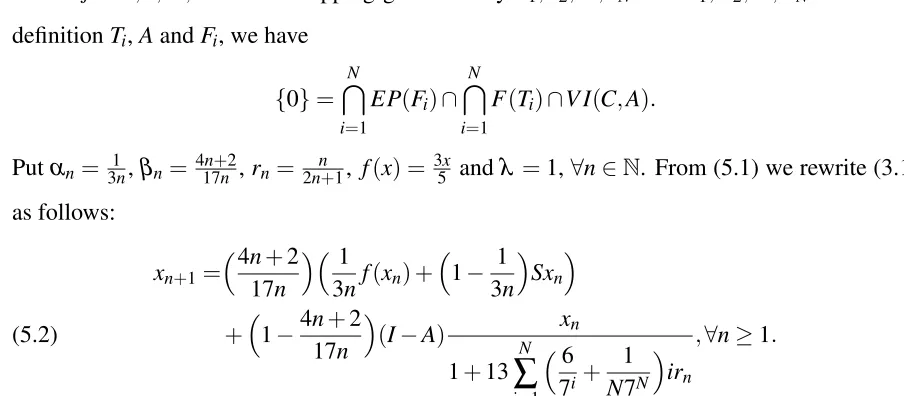
Putαn= 3n1,βn= 4n17n+2,rn= 2nn+1, f(x) = 3x5 andλ =1,∀n∈N. From (5.1) we rewrite (3.1) as follows:
xn+1=
4n+2
17n
1
3nf(xn) +
1− 1
3n
Sxn
+1−4n+2
17n
(I−A) xn
1+13 N
∑
i=16
7i+ 1
N7N
irn
,∀n≥1.
(5.2)
It is clear that the sequence{αn},{βn}and{rn}satisfy all the conditions of Theorem 3.1. From Theorem 3.1, we can conclude that the sequence{xn}and{un}converges strongly to 0.
Table 1 shows that values of sequences{xn} and{un}, wherex1=−5 andx1=5 and n=
x1=−5 x1=5
n un xn un xn
1 -0.825688 -5.000000 0.825688 5.000000
2 -0.241546 -1.706927 0.241546 1.706927
3 -0.070026 -0.525198 0.070026 0.525198
4 -0.019977 -0.154636 0.019977 0.154636
5 -0.005630 -0.044447 0.005630 0.044447 .
.
. ... ... ... ...
8 -0.000120 -0.000980 0.000120 0.000980 .
. .
. . .
. . .
. . .
. . .
11 -0.000002 -0.000020 0.000002 0.000020
12 -0.000001 -0.000006 0.000001 0.000006
13 -0.000000 -0.000002 0.000000 0.000002
14 -0.000000 -0.000000 0.000000 0.000000
TABLE1. The values of{un}and{xn}wheren=14.
(A)x1=−5 (B)x1=5
FIGURE 1. The convergence comparison of the sequences{xn} and{un} with different initial valuesx1.
Example5.2. In this example, we consider the same mappings and parameters as in Example 5.1 except the following mappingg:R→Rbe defined bygx=2x2+1. It is clear that
{0}=
N
\
i=1
EP(Fi)∩
N
\
i=1
Putλ = 18. From (5.1), we rewrite (4.3) as follows:
xn+1=
4n+2
17n
1
3nf(xn) +
1− 1
3n
Sxn
+1−4n+2
17n
(I−1
8∇g)
xn
1+13 N
∑
i=16
7i+ 1
N7N
irn
,∀n≥1.
(5.3)
It is clear that the sequence{αn},{βn}and{rn}satisfy all the conditions of Theorem 4.2. From Theorem 4.2, we can conclude that the sequence{xn}and{un}converges strongly to 0.
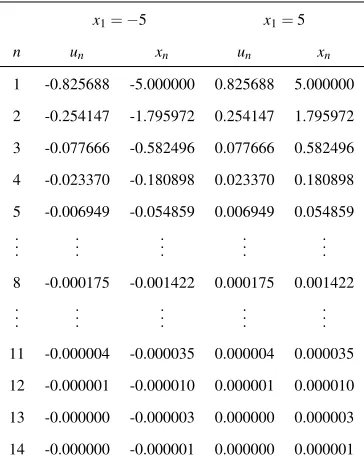
Table 2 shows that values of sequences{xn} and{un}, wherex1=−5 andx1=5 and n=
N=14.
x1=−5 x1=5
n un xn un xn
1 -0.825688 -5.000000 0.825688 5.000000
2 -0.254147 -1.795972 0.254147 1.795972
3 -0.077666 -0.582496 0.077666 0.582496
4 -0.023370 -0.180898 0.023370 0.180898
5 -0.006949 -0.054859 0.006949 0.054859 . . . . . . . . . . . . . . .
8 -0.000175 -0.001422 0.000175 0.001422 . . . . . . . . . . . . . . .
11 -0.000004 -0.000035 0.000004 0.000035
12 -0.000001 -0.000010 0.000001 0.000010
13 -0.000000 -0.000003 0.000000 0.000003
14 -0.000000 -0.000001 0.000000 0.000001
(A)x1=−5 (B)x1=5
FIGURE 2. The convergence comparison of the sequences{xn} and{un} with different initial valuesx1.
Conclusion
(1) Table 1 and Figure 1 show that{xn}and{un}converges to 0, where{0} ∈TN
i=1EP(Fi)∩
TN
i=1F(Ti)∩V I(C,A). The convergence of {xn}and{un}of Example 5.1 can be guar-anteed by Theorem 3.1.
(2) Table 2 and Figure 2 show that{xn}and{un}converges to 0, where{0} ∈TNi=1EP(Fi)∩
TN
i=1F(Ti)∩Ωg. The convergence of{xn}and{un}of Example 5.2 can be guaranteed by Theorem 4.2.
(3) From these Example, we obtain that the sequence{xn}in Example 5.1 converges faster than the sequence{xn}in Example 5.2.
Conflict of Interests
The authors declare that there is no conflict of interests.
AcknowledgementsThis paper was supported by the the Research and Innovation Services of King Mongkut’s Institute of Technology Ladkrabang.
REFERENCES
[2] Combettes, P.L., Hirstoaga, S.A.: Equilibrium programming in Hilbert spaces, J. Nonlinear Convex Anal., 6(1)(2005), 117-136.
[3] Plubtieng, S., Punpaeng, R.: A general iterative method for equilibrium problems and fixed point problems in Hilbert spaces, J. Math. Anal. Appl., 336(1)(2007), 455-469.
[4] Takahashi, W., Shimoji, K.: Convergence theorems for nonexpansive mappings and feasibility problems, Math. Comput. Model., 32(2000), 1463-1471.
[5] Takahashi, S., Takahashi, W.: Viscosity approximation methods for equilibrium problems and fixed point problems in Hilbert spaces, J. Math. Anal. Appl., 331(2007), 506-515.
[6] Moudafi, A.: Viscosity approximation methods for fixed-points problems, J. Math. Anal. Appl., 241(2000), 46-55.
[7] Xu, H.K.: Viscosity approximation methods for nonexpansive mappings, J. Math. Anal. Appl., 298(2004), 279-291.
[8] Stampacchia, G.: Formes bilineaires coercitives sur les ensembles convexes, C. R. Math. Acad. Sci. Paris, 258(1964), 4414-4416.
[9] Ceng, L.C., Yao, J.C.: Iterative algorithm for generalized set-valued strong nonlinear mixed variational-like inequalities, J. Optim. Theory Appl., 124(2005), 725-738.
[10] Yao, J.C., Chadli, O.: Pseudomonotone complementarity problems and variational inequalities, In: Handbook of Generalized Convexity and Monotonicity., (2005), 501-558.
[11] Glowinski, R.: Numerical Methods for Nonlinear Variational Problems, Springer, New York (1984). [12] Kangtunyakarn, A., Suantai, S.: Strong convergence of a new iterative scheme for a finite family of strict
pseudo-contractions, 60(2010), 680-694.
[13] Ceng, L.C., Guu, S.M., Yao, J.C.: Hybrid viscosity CQ method for finding a common solution of a variational inequality, a general system of variational inequalities, and a fixed point problem, Fixed Point Theory Appl., 2013(2013), Article ID 313.
[14] Blum, E., Oettli, W.: From optimization and variational inequilities to equilibrium problems, Math. Student, 63(1994), 123-145.
[15] Suwannaut, S., Kangtunyakarn, A.: The combination of the set of solutions of equilibrium problem for con-vergence theorem of the set of fixed points of strictly pseudo-contractive mappings and variational inequalities problem, Fixed Point Theory Appl., 2013(2013), Article ID 291.
[16] Opial, Z.: Weak convergence of the sequence of successive approximation of nonexpansive mappings, Bull. Amer. Math. Soc., 73(1967), 591-597.
[17] Combettes, P.L., Hirstoaga, S.A.: Equilibrium programming in Hilbert spaces, J. Nonlinear Convex Anal., 6(2005), 117-136.
[19] Takahashi, W.: Nonlinear functional analysis, Yokohama Publishers, Yokohama, (2000).
[20] Kangtunyakarn, A., Suantai, S.: Hybrid iterative scheme for generalized equilibrium problems and fixed point problems of finite family of nonexpansive mappings, Nonlinear Anal. Hybrid Syst., 3(2009), 296-309. [21] Marino, G., Xu, H.K.: Weak and strong convergence theorem for strict pseudo-contractions in Hilbert spaces,
J. Math. Anal. Appl., 329(2007), 336-346.
[22] Kangtunyakarn, A., Suantai, S.: Strong convergenc of a new iterative scheme for a finite family of strict pseudo-contractions, Comput. Math. Appl., 60(2010), 680-694.