137
Copyright © 2018. IJEMR. All Rights Reserved.
Volume-8, Issue-3, June 2018
International Journal of Engineering and Management Research
Page Number: 137-144
DOI: doi.org/10.31033/ijemr.8.3.17
Physiochemical Properties and Meat Quality Parameters of Wild Boar
Meat: A Review
S. Anand Kumar
Lecturer (Temporary), Department of Animal Science, Uva Wellassa University of Sri Lanka, SRI LANKA
Corresponding Author: [email protected]
ABSTRACT
Wild boar meat has well balanced with nutrients and comprised with unique sensory attributes and meat quality parameters, however, limited information and studies have been performed on nutritional quality and meat quality parameters. The proximate composition of wild boar meat, mainly protein and fat contents were ranged at 21.6-24.11% and 2.27-2.62% respectively. The composition of fatty acids in wild boar has obtained higher values for unsaturated fatty acids particularly mono unsaturated fatty acids; nonetheless, investigation on availability of essential amino acids was scarce. Wild boar meat was darker colour, less tender and pH ranged at 5.44-5.71. Further, sophisticated studies will promote the consumption rate of wild boar meat among consumers that ultimately provide an opportunity to industries to enhance their production.
Keywords— Meat Quality Parameters, Proximate Composition, Sensory Attributes, Wild Boar Meat
I.
INTRODUCTION
Wild animal’s meat is easily accessible in rural part of every country with the cheap price (Rao, 2002; Saadoun and Cabrera, 2008); however, slaughtering of wildlife resources is considered to be guilty of an offence in most of the countries. Moreover, wild meat is balanced with all required nutrients, particularly, a good protein source and recommended as a healthy (Hoffman and Wiklund, 2006; Soriano et al., 2006) and safe food (Strazdina et al., 2014; Russo et al., 2017). Currently, some developed countries have initiated farms to raise wild animals while provision of the same natural environment. The main objective of this project is to providing wild meat and meat products to local consumers without against rules and regulations. Therefore, the importance of wild meat consumption is
gradually increasing in the worldwide, among these; wild boar meat is getting more attention by the consumers.
Consumers has initiated to forecast towards the identification of food sources which could be obtained from the natural environment because researchers have proved that nutritional level of wild products are as equivalent as products produced from intensive farming systems. As the consequence, the consumption rate of meat originated from wild animals has shown phenomenal growth in the recent years, especially in developed countries. Accordingly, wild boar meat also plays a significant role in the contribution among other types of meat including venison, beaver, etc. Wild boar (Sus scrofa scrofa) is an omnivorous animal which consumes 90-95 % of plant originated foods and rest of the part derived from animal originated foods (Genov, 1981; Pinna et al., 2007). The foremost characteristic of wild meat other than nutritional value is unique sensory attributes such as smell, taste and texture, therefore, it widely attracts by consumers. (Soriano et al., 2006; Vergara et al., 2003; Szmańko et al., 2007)
138
Copyright © 2018. IJEMR. All Rights Reserved.
quality and lack of standardization in evaluation of meat quality parameters. Therefore, detail study on proximate composition and meat quality attributes of wild boar meat should be carried out in order to aware the consumers.
Furthermore, inclusion of meat of wild animals, including wild boar meat in diet is extensively auspicious for human health because polyunsaturated fatty acids are mostly abundant while it has lower content of SFA (Medeiros et al., 2002), lower caloric value (Szmańko et al., 2007) and higher in protein content (21-25%) (Skobrák et al., 2011). Moreover, trace minerals such as iron, zinc, copper, manganese, etc are enough available in wild meat, therefore, it is considered as an excellent source of minerals (Skobrák et al., 2011). According to Daszkiewicz et al. (2007); Fajardo et al. (2008); Jukna and Valaitienė (2012) have stated that wild meat commands a high price than other types of meat due to the presence of outstanding nutritional properties, health aspects and mainly the animals are not treated with any kind of hormones or steroids. However, limited information and studies have been performed on nutritional quality and meat quality parameters. Therefore, the review was written in an attempt to gather existing information available on wild boar meat and to compare with previous studies. This would be facilitated to identify integral characteristics of wild boar meat which could be applied in development of novel food products and also to identify potentials where future studies are needed.
II.
NUTRITIONAL VALUE
Protein Content
Protein source is required to effectively perform for a number of body functions and metabolism, growth and development, and reproduction (Murphy and Allen, 2003; Sandström et al., 1989). Strazdina et al. (2013) reported that wild boar meat had the richest protein level about 21.81 – 22.92% compared with deer and beaver meat. This result was similar with the finding of paleari et al. (2003), stated that the protein content of wild boar meat was 21.9%. Skobrák et al. (2011) stated there was no significant (p<0.05) difference between protein content (21.81%) of wild boar meat with respect to different management systems. Similar finding was observed by Szmańko et al. (2007) in wild boar meat (21.6%) from Poland. Wild boar meat has shown higher amount of protein content about 23.03% compared with other ruminant animals including cattle and sheep, however, slightly lower than commercially pork (24.11%) Jukna and Valaitienė (2012).
Amino acids profile
Investigation and interpretation on availability of amino acids in wild boar meat was scarce. Nevertheless, few studies have focused and reported amino acids profile in wild boar meat originated from different geographical
locations. (Strazdina et al., 2013) investigated the total content of essential amino acids in wild boar meat and stated that it contained approximately 24.14 g/100 g. However, the investigation has further mentioned that the sum of essential amino acids composition of beaver meat was more than double of wild boar meat and beaver meat was well-balanced in essential amino acids profile than wild boar meat. Further studies have to be performed to brief the amino acids profile in wild boar meat.
Fat Content
Fat content and composition of fatty acids in wild boar meat were deeply analyzed and reported in detail by a plenty of previous studies. Based upon that Strazdina et al. (2013) have stated the fat content of hunted wild boar meat was 2.82% obtained from Latvia, Europe. Further, Skobrák et al. (2011) mentioned that significant difference (p<0.05) was observed for fat content in wild boar meat collected from Hungary with regards to different management systems. Hence, the lowest fat content was detected in extensive farming system about 4.27% while the highest fat content was shown in semi-intensive farming system (14.12%). Jukna and Valaitienė (2012) have obtained 2.27% of intramuscular fat in wild boar meat which was equivalent to roe meat (2.28%). Further, the fat content of Sus scrofa ferus from musculus longissimus lumborum was 2.62% obtained by Szmańko et al. (2007). Zomborszky et al. (1996) reported the wild meat had the fattest meat with 5.3%, so, the study has shown a drastic difference in the total fat content wild boar meat than other previous findings. The dramatic difference in the total fat content might be increased due to high availability of feeding materials, individual variations and genetic factors. Moreover, the percentage of fat content was obtained higher values in adults than in young animals when analyzed physio-chemical properties of longissimus muscle in wild boar by Dannenberger et al. (1996). Fatty acids Profile
139
Copyright © 2018. IJEMR. All Rights Reserved.
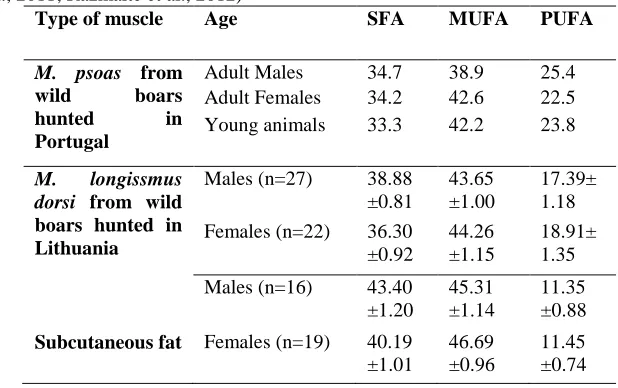
PUFA of wild boar with respect to age and type of muscles is shown in Table 1.
Table 1: Table 1 Fatty acid profiles of hunted wild boar meat from different anatomical locations (Source: Quaresma et al., 2011; Razmaite et al., 2012)
Type of muscle Age SFA MUFA PUFA
M. psoas from
wild boars
hunted in
Portugal
Adult Males 34.7 38.9 25.4 Adult Females 34.2 42.6 22.5 Young animals 33.3 42.2 23.8
M. longissmus dorsi from wild boars hunted in Lithuania
Males (n=27) 38.88 ±0.81
43.65 ±1.00
17.39± 1.18 Females (n=22) 36.30
±0.92
44.26 ±1.15
18.91± 1.35 Males (n=16) 43.40
±1.20
45.31 ±1.14
11.35 ±0.88
Subcutaneous fat Females (n=19) 40.19
±1.01
46.69 ±0.96
11.45 ±0.74
Moreover, Russo et al. (2017) reported age is greatly influenced the fatty composition in wild boar meat, accordingly, higher percentage of palmitic acid (C16:0), and caproic acid (C6:0) were obtained in young and sub-adult animals respectively. Additionally, hunting season was the most influencing factor on the fatty acid profile of meat due to no restriction on the diet; nonetheless, sex and hunting age have little impact on fatty acid composition (Russo et al., 2017).
Ratio of SFA/PUFA and ω-6/ω-3
A higher ratio of PUFA/SFA and lower ω-6/ ω-3 enriched meat products contribute to balance the fatty acid in consumer’s intake and also prevent from an increased risk of obesity, hypercholesterolemia and some cancers (Wood et al., 2008). The total content of omega 6 and omega 3 in hunted wild boar meat from Latvia, Europe were 13.89 and 2.89 respectively (Strazdina et al., 2013). Linolenic acid was highly contributed to omega 6 fatty acids than others (Strazdina et al., 2013). However, according to the world Health Organization (WHO), the ratio of ω-6/ ω-3 should be lower than 4. Wood et al. (2004) reported that the most abundant polyunsaturated fatty acid in wild boar meat is linolenic acid, thus causes high biological value for wild meat. Russo et al. (2017) stated the hunting month has a massive impact on PUFA/SFA (p=0.05) and ω-6/ ω-3 (p=0.01), however both values were widely deviated from recommended level by Wood et al. (2004).
Mineral content
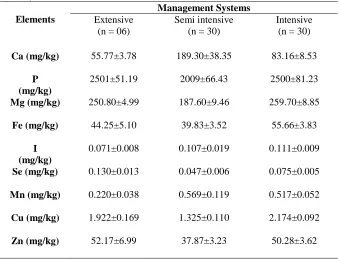
The mineral content of wild boar meat was 1.15% (Strazdina et al., 2013). Among these minerals, iron, zinc and copper were 3.44 mg/kg, 3.73 mg/kg and 0.07mg/kg respectively. The similar finding was observed by Jukna and Valaitienė (2012), the ash content was 1.12% and
140
Copyright © 2018. IJEMR. All Rights Reserved.
Table 2 Element content of wild boar meat (Source: Skobrák et al., 2011)
Elements
Management Systems
Extensive (n = 06)
Semi intensive (n = 30)
Intensive (n = 30)
Ca (mg/kg) 55.77±3.78 189.30±38.35 83.16±8.53
P (mg/kg)
2501±51.19 2009±66.43 2500±81.23
Mg (mg/kg) 250.80±4.99 187.60±9.46 259.70±8.85
Fe (mg/kg) 44.25±5.10 39.83±3.52 55.66±3.83
I (mg/kg)
0.071±0.008 0.107±0.019 0.111±0.009
Se (mg/kg) 0.130±0.013 0.047±0.006 0.075±0.005
Mn (mg/kg) 0.220±0.038 0.569±0.119 0.517±0.052
Cu (mg/kg) 1.922±0.169 1.325±0.110 2.174±0.092
Zn (mg/kg) 52.17±6.99 37.87±3.23 50.28±3.62
III.
MEAT QUALITY PARAMETERS
The meat quality parameters and also sensory attributes of meat is governed by the physical, chemical and morphological composition of the meat and by subsequent post-mortem processes amalgamated with the technology applied for an effective storage (Hofbauer et al., 2006).
Colour
The colour values of lightness (L*), redness (a*) and yellowness (b*) of wild boar meat gathered from different climatic conditions in Lithuania and observed 36 hours after slaughtering were 46.14, 19.38 and 9.12 respectively (Jukna and Valaitienė, 2012). As results revealed, wild boar meat has intense lightness value than other colour parameters. Borilova et al. (2016) have distinguished the colour values for shoulder and leg from wild boar meat obtained from Czech Republic, based on that leg part has shown comparatively higher values for L*, a* and b*. Nonetheless, L* and a* were did not significantly change with the different storage temperatures but b* has increased at the end of the storage period (21 days). Despite, Szmańko et al. (2007) stated that Poland wild boar meat was characterized by lower L*, but with higher values of a* and b* colour parameters compared with polish large white breeds. Marchiori and Flicio (2003) have reported the similar findings in wild boar meat collected from Brazil.
pH
The pH of wild boar meat and pork from farm pigs after 36 hours of slaughtering process were 5.48 and 5.44 respectively reported by Jukna and Valaitienė (2012). Borilova et al. (2016) have identified whether pH has impact on anatomical location of muscles and also different storage temperature, accordingly, pH of shoulder meat of wild boar meat was as equal as leg meat (5.70), however, fluctuations were observed in pH values over the different storage temperature and time duration combinations. pH value of fresh meat obtained from
141
Copyright © 2018. IJEMR. All Rights Reserved.
Figure 1: pH decline at various postmortem times for Longissimus dorsi (LD) and Semimembraneous muscles (SM)of wild boar and swine
(Source: Marchiori and Felício, 2003)
Texture
Fielder et al. (1998); Rahelic and pauc (1981); Sales and Kotrba (2013) proved that wild boar meat contains high amount of soft-twitch oxidative muscle fibers than domestic pigs, thus, meat ultimately gives either more tenderness or juiciness (Maltin et al., 2013) and more palatable. Tenderness of wild boar meat was 1.85 kg/cm2 after slaughtering which is as same as tenderness of cattle meat (1.84 kg/cm2) (Jukna and Valaitienė, 2012). Liu et al. (1996); Dransfield (1977) have proven that carcass weight of livestock has strong relationship with respect to meat texture and histology of their muscles. On the other hand, the histochemical
composition varies up to certain extent because of life style and differences in feeding pattern of wild boar meat compared with pigs (Ruusunen and Puolanne, 2004). The previous study Zochowska et al. (2005) have demonstrated that muscle meat from different anatomical locations and structure of muscle fibres could be able to impact on textural parameters with regards to different carcass weight. Accordingly, significant difference was found in textural parameters of wild boar meat especially on hardness, springiness and chewiness in biceps femoris muscles with respect to different carcass weight (Table 3) Zochowska et al. (2005).
Table 3: Mean values of textural parameters of the QF, SM and BF muscles of wild boars of different carcass weight (Adapted from: Zochowska et al., 2005)
Carcass weight (kg) Muscle Hardness (N) Cohesiveness (-) Springiness (cm) Chewiness (N
cm)
QF 33.25a,1±3.58 0.406 a,1±0.03 0.99 a,1±0.01 13.21 a,1±0.7
20 SM 36.93 ab,1±3.3 0.423 a,1±0.05 0.99 a,1±0.06 16.15 ab,1±1.6 BF 40.76 b,1±1.9 0.455 a,1±0.04 0.96 b,1±0.07 17.65 b,1±3.4 QF 41.80 a,2±2.9 0.430 a,1±0.02 0.93 a,1±0.11 16.72 a,2±2.6
60 SM 45.78 a,2±3.5 0.461 a,1±0.03 0.94 a,1±0.08 19.84 ab,1±3.0 BF 53.78 b,2±3.6 0.447 a,1±0.01 0.09 a,1±0.07 21.63 b,1±2.5 *QF.- m. quadriceps femoris; SM.- m. semimembranosus; BF. - m. biceps femoris.
a,b No significant differences within an animal group at the 0.05 level of probability. 1,2
142
Copyright © 2018. IJEMR. All Rights Reserved.
Water Holding Capacity and Cooking Loss
Water holding capacity (WHC) of wild boar meat (Sus scrofa ferus) was 56.63±2.47%, showed significant differences between different storage conditions (Szmańko et al., 2007). The similar finding was observed in wild boar from Lithuania after 36 hours of slaughtering, WHC was found about 57.07%, whereas, sheep meat has shown almost the same value (57.23%), however, the highest WHC has observed in cattle meat
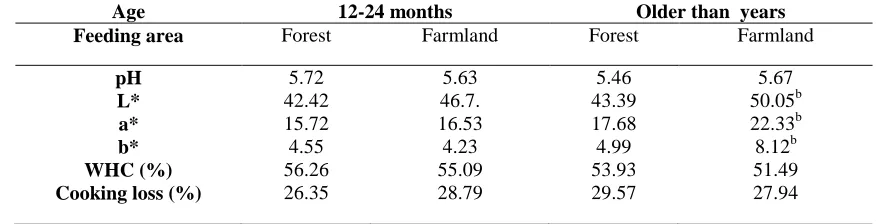
(62.91%) Jukna and Valaitienė (2012). WHC of 12-24 months of wild boar from both forest and farmland were similar result (Table 4) as same as Szmańko et al. (2007) findings. No significant differences in cooking loss with respect to anatomical location mainly shoulder part of wild boar meat (36.74%), nevertheless, leg has shown higher significant differences in cooking loss with the different storage conditions (Borilova et al., 2016).
Table 4: Meat quality parameters from Longissimus dorsi muscle in wild boar of different age and feeding area (Source: Pedrazzoli et al., 2017)
Age 12-24 months Older than years
Feeding area Forest Farmland Forest Farmland
pH 5.72 5.63 5.46 5.67
L* 42.42 46.7. 43.39 50.05b
a* 15.72 16.53 17.68 22.33b
b* 4.55 4.23 4.99 8.12b
WHC (%) 56.26 55.09 53.93 51.49
Cooking loss (%) 26.35 28.79 29.57 27.94
n=8 animals per each group performed in duplicate
Flavour
Flavor is one of the principal sensory attribute and plays a major role in the food products but which is known to be influenced by antemortem and postmortem factors (Gonzalez and Ockermann, 2000). Lammers et al. (2009) have detected fifty three volatile compounds in the Tenax cartridge of frying wild boar meat. Further, production of roasty note of fried meat samples was generated by the contribution of furfurylmercaptan and another maillard product detected in the study. Moreover, the amino acids and fatty acids were recognized as the major meat aroma precursors. However, the study has failed to identify volatile compounds which responsible for the characterization of typical wild boar meat odorants.
IV.
CONCLUSION
Wild boar meat has owned a number of beneficial nutritional and meat quality properties which could be able to create a stable platform for meat producers to attract consumers. Many studies have proven nutritional aspects regarding on protein, fat and fatty acids composition and micro nutrients, however, most of the researches did not give more priority to analyze essential amino acids profile. Meat quality and yield of wild boar will be significantly increased when follow proper hunting practices. Further, sophisticated studies will promote the wild boar meat among consumers that ultimately provide an opportunity to industries to enhance their production.
REFERENCES
[1] Banovic. M., Grunert. K.G., Barreira. M.M., & Fontes M.A. (2009). Beef quality perception at the point of purchase: A study from Portugal. Food Quality and Preference, 20(4), 335-342.
[2] Barreira, M. M., Brandao, A.R.W., Lemos, J.P.C., & Aguiar Fontes, M. (2009). Quality perception of PDO beef producers. Agricultural Economics Review, 10(2), 36-49.
[3] Borilova. G., Hulankova. R., Svobodova. I., Jezek. F., Hutarova. Z., Vecerek. V., & Steinhauserova I. (2016). The effect of storage conditions on the hygiene and sensory status of wild boar meat. Meat Science, 118, 71-77. Available at:
https://europepmc.org/abstract/med/27057754
[4] Dannenberger. D., Nuernberg. G., Nuernberg. K., & Hagemann. E. (2013). The effects of gender, age and region on macro- and micronutrient contents and fatty acid profiles in the muscles of roe deer and wild boar in Mecklenburg-Western Pomerania (Germany). Meat Science, 94(1), 39–46.
[5] Daszkiewicz. T., Janiszewski. P., & Wajda S. (2009). Quality characteristics of meat from wild red deer (Cervus elaphus L.) hinds and stags. Journal of Muscle Foods banner, 20(4), 428-448.
[6] Dransfield E. (1977). Intramuscular composition and texture of beef muscles. Journal of the Science of Food and Agriculture, 28(9), 833-842.
143
Copyright © 2018. IJEMR. All Rights Reserved.
swine (Sus Scrofa Domestica) meats by PCR analysis targeting the mitochondrial D-loop and the nuclear melanocortin receptor 1 (MC1R) genes. Meat Science, 78(3), 314-322.
[8]Fiedler, I. Rehfeldt, CH. Albert, E., & Henning, M. (1998). Histophysiological features of skeletal muscle and adrenal glands in wild-type and domestic pigs during growth (short communication). Arch. Tierz., 41(5), 489-495.
[9] Genov P. (1981). Food composition of wild boar in northeastern and western Poland. Acta Theriologica, 26(10),185–205.
[10] Gonzalez. C.B. & Ockerman H.W. (2000). Dry‐ cured mediterranean hams: Long process, slow changes and high quality: A review. Journal of Muscle Foods, 11(1), 1-17.
[11] Hofbauer P, Bauer F, & Paulsen P. (2006). Meat of chamois. A note on quality traits of the m. longissimus of chamois (Rupicapra rupicapra L.) in Austrian sub-alpine regions. Fleischwirtschaft, 86(7), 100–102.
[12] Hoffman. L.C. & Wiklund E. (2006). Game and venison – meat for the modern consumer. Meat Science, 74(1), 197–208.
[13] Chambaz A., Scheeder M. R. L, Kreuzer M., & Dufey P. A. (2003). Meat quality of angus, simmental, charolais and limousin steers compared at the same intramuscular fat content. Meat Science, 63(4), 491–500. [14] Lammers. M., Dietze. K., & Ternes W. (2009). A comparison of the volatile profiles of frying european and australian wild boar meat with industrial genotype pork by dynamic headspace‐ gc/ms analysis. Journal of Muscle Foods, 20(3), 255-274.
[15] Liu. A., Nishimura. T., & Takahashi K. (1996). Relationship between structural properties of intramuscular connective tissue and toughness of various chicken skeletal muscles. Meat Science, 43(1), 43-49. [16] Maltin. C., Balcerzak. D., Tilley. R., & Delday M. (2003). Determinants of meat quality: Tenderness.Proceedings of the Nutrition Society, 62(2), 337-347.
[17] Marchiori. A.F. & Felício P.E.D. (2003). Quality of wild boar meat and commercial pork. Scientia Agricola, 60(1), 1-5.
[18] Medeiros. L.C., Busboon. I.R., Field. R.A., Williams. I.C., Miller. G.I., & Holmes B. (2002).
Nutritional Content of Game Meat. Available at:
http://www.wyomingextension.org/agpubs/pubs/B920R.p df
[19] Müller. E., Moser. G., Bartenschilager. H., & Geldermann H. (2000). Trait values of growth, carcass and meat quality in Wild Boar, Meishan and Pietrain pigs as well as their crossbred generations. Journal of Animal Breeding and Genetics, 117(3), 189-202.
[20] Murphy. S.P. & Allen L.H. (2003). Nutritional importance of animal source foods. The Journal of Nutrition, 133(11), 3932S-3935S.
[21] Paleari. M.A., Moretti. V.M., Beretta. G., Mentasti. T., & Bersani C. (2003). Cured products from different animal species. Meat Science, 63(4), 485-489.
[22] Pedrazzoli. M., Dal Bosco. A., Castellini. C., Ranucci. D., Mattioli. S., Pauselli. M., & Roscini V. (2017). Effect of age and feeding area on meat quality of wild boars. Italian Journal of Animal Science, 16(3), 353-362.
[23] Pinna. W., Nieddu. G., Moniello. G., & Cappai M. (2007). Vegetable and animal ford sorts fund in the gastric content of Sardinian Wild boar (Sus scrofa meridionalis). Journal of Animal Physiolpgy and Animal Nutrition,91(5-6), 252–255.
[24] Quaresma. M.A.G., Alves. S.P., Trigo-Rodrigues. I., Pereira-Silva. R., Santos. N., Lemos. J.P.C., & Bessa R.J.B. (2011). Nutritional evaluation of the lipid fraction of feral wild boar (Sus Scrofa Scrofa) meat. Meat science, 89(4), 457-461.
[25] Rahelic. S. & Puac S. (1981). Fibre types in longissimus dorsi from wild and highly selected pig breeds. Meat Science, 5(6), 439-450.
[26] Ramanzin. M., Amici. A., Casoli. C., Esposito. L., Lupi. P., Marsico. G., Mattiello. S., Olivieri. O., Ponzetta. M.P., Russo. C., & Trabalza Marinucci M. (2010). Meat from wild ungulates: ensuring quality and hygiene of an increasing resource. Italian Journal of Animal Science, 9(3), 318–331.
[27] Rao M. (2002). Wild-meat use, food security, livelihoods, and conservation. Conservation Biology, 16(3), 580-583.
[28] Razmaite. V.J., Svirmickas. G., & Siukscius
.
A. (2012). Effect of weight, sex and hunting period on fatty acid composition of intramuscular and subcutaneous fat from wild boar. Italian Journal of Animal Science, 11(2), e32. Available at:https://www.tandfonline.com/doi/full/10.4081/ijas.2012.e 32?scroll=top&needAccess=true
[29] Russo. C., Balloni. S., Altomonte. I., Martini. M., Nuvoloni. R., Cecchi. F., & Profumo A. (2017). Fatty acid and microbiological profile of the meat (longissimus dorsi muscle) of wild boar (Sus Scrofa Scrofa) hunted in Tuscany. Italian Journal of Animal Science, 16(1), 1-8. [30] Ruusunen. M. & Puolanne E. (2004). Histochemical properties of fibre types in muscles of wild and domestic pigs and the effect of growth rate on muscle fibre properties. Meat Science, 67(3), 533-539.
[31] Sales. J. & Kotrba R. (2013). Meat from wild boar (Sus scrofa L.): A review. Meat science, 94(2), 187-201. [32] Saadoun. A. & Cabrera M. C. (2008). A review of the nutritional content and technological parameters of indigenous sources of meat in South America. Meat Science, 80(3), 570-581.
144
Copyright © 2018. IJEMR. All Rights Reserved.
[34] Skobrák. E.B., Bodnár. K., Jónás. E.M., Gundel. J., & Jávor A. (2011). The comparison analysis of the main chemical composition parameters of wild boar meat and pork. Scientific Papers Animal Science and Biotechnologies, 44(1), 105-112.
[35] Soriano. A., Cruz. B., Gómez. L., Mariscal. C., & Ruiz A.G. (2006). Proteolysis, physicochemical characteristics and free fatty acid composition of dry sausages made with deer (Cervus elaphus) or wild boar (Sus Scrofa) meat: A preliminary study. Food Chemistry, 96(2), 173-184.
[36] Strazdina. V., Jemeljanovs. A., Sterna. V., & Ikauniece D. (2013). Nutrition value of deer, wild boar and beaver meat hunted in Latvia. In 2nd International Conference on Nutrition and Food Sciences IPCBEE, 53, 71-76. Available at:
http://www.ipcbee.com/vol53/014-ICNFS2013-1018.pdf [37] Strazdina. V., Jemeljanovs. A., Sterna. V., & Ikauniece D. (2014). Nutritional characteristics of wild boar meat hunted in Latvia. Proceedings Foodbalt, 1, 32-36. Available at:
https://www.bior.lv/sites/default/files/publikacijas/241_F oodBalt_Proceedings_2014-32-36_0.pdf
[38] Szmańko. T. Górecka. J. Korzeniowska. M. Malicki. A., & Eeremenko E. (2007). Comparison of chosen quality parameters of meat from wild boar and domestic pigs. Polish Journal of Food Nutrition Science, 57(4), 523-528.
[39] Vergara. H., Gallego. L., Garcıa. A., & Landete-Castillejos T. (2003). Conservation of Cervus elaphus meat in modified atmospheres. Meat Science, 65(2), 779-783.
[40] Wood. J.D., Enser. M., Fisher. A.V., Nute. G.R., Sheard. P.R., Richardson. R.I., & Whittington F.M. (2008). Fat deposition, fatty acid composition and meat quality: A review. Meat science, 78(4), 343-358.
[41] Wood. J.D., Richardson. R.I., Nute. G.R., Fisher. A.V., Campo. M.M., Kasapidou. E., & Enser M. (2004). Effects of fatty acids on meat quality: A review. Meat
Science, 66(1), 21-32.
[42] Żochowska. J., Lachowicz. K., Gajowiecki. L.,
Sobczak. M., Kotowicz. M., & Żych A. (2005). Effects of carcass weight and muscle on texture, structure and myofibre characteristics of wild boar meat. Meat
Science, 71(2), 244-248.