The Thirty-Third AAAI Conference on Artificial Intelligence (AAAI-19)
Dependency Grammar Induction
with a Neural Variational Transition-Based Parser
Bowen Li, Jianpeng Cheng, Yang Liu, Frank Keller
Institute for Language, Cognition and ComputationSchool of Informatics, University of Edinburgh 10 Crichton Street, Edinburgh EH8 9AB, UK
{bowen.li, jianpeng.cheng, yang.liu2}@ed.ac.uk, [email protected]
Abstract
Dependency grammar induction is the task of learning de-pendency syntax without annotated training data. Traditional graph-based models with global inference achieve state-of-the-art results on this task but they requireO(n3)run time. Transition-based models enable faster inference withO(n)
time complexity, but their performance still lags behind. In this work, we propose a neural transition-based parser for dependency grammar induction, whose inference proce-dure utilizes rich neural features withO(n)time complex-ity. We train the parser with an integration of variational in-ference, posterior regularization and variance reduction tech-niques. The resulting framework outperforms previous un-supervised transition-based dependency parsers and achieves performance comparable to graph-based models, both on the English Penn Treebank and on the Universal Dependency Treebank. In an empirical comparison, we show that our approach substantially increases parsing speed over graph-based models.
Introduction
Grammar induction is the task of deriving plausible syntac-tic structures from raw text, without the use of annotated training data. In the case of dependency parsing, the syntac-tic structure takes the form of a tree whose nodes are the words of the sentence, and whose arcs are directed and de-note head-dependent relationships between words. Inducing such a tree without annotated training data is challenging because of data sparseness and ambiguity, and because the search space of potential trees is huge, making optimization difficult.
Most existing approaches to dependency grammar in-duction have used inference over graph structures and are based either on the dependency model with valence (DMV) of Klein and Manning (2004) or the maximum spanning tree algorithm (MST) for dependency parsing by McDon-ald, Petrov, and Hall (2011). State-of-the-art representa-tives include LC-DMV (Noji, Miyao, and Johnson 2016) and Convex-MST (Grave and Elhadad 2015). Recently, re-searchers have also introduced neural networks for feature extraction in graph-based models (Jiang, Han, and Tu 2016; Cai, Jiang, and Tu 2017).
Copyright c2019, Association for the Advancement of Artificial Intelligence (www.aaai.org). All rights reserved.
Though graph-based models achieve impressive results, their inference procedure requiresO(n3)time complexity.
Meanwhile, features in graph-based models must be decom-posable over substructures to enable dynamic programming. In comparison, transition-based models allow faster infer-ence with linear time complexity and richer feature sets. Although relying on local inference, transition-based mod-els have been shown to perform well in supervised parsing (Kiperwasser and Goldberg 2016; Dyer et al. 2015). How-ever, unsupervised transition parsers are not well-studied. One exception is the work of Rasooli and Faili (2012), in which search-based structure prediction (Daum´e III 2009) is used with a simple feature set. However, there is still a large performance gap compared to graph-based models.
Recently, Dyer et al. (2016) proposed recurrent neu-ral network grammars (RNNGs)—a probabilistic transition-based model for constituency trees. RNNG can be used ei-ther in a generative way as a language model or in a discrim-inative way as a parser. Cheng, Lopez, and Lapata (2017) use an autoencoder to integrate discriminative and genera-tive RNNGs, yielding a reconstruction process with parse trees as latent variables and enabling the two components to be trained jointly on a language modeling objective. How-ever, their work uses observed trees for training and does not study unsupervised learning.
possi-ble to use posterior regularization for neural variational in-ference with discrete latent variables. When evaluating on the English Penn Treebank and on eight languages from the Universal Dependency (UD) Treebank, we find that our model with posterior regularization outperforms the best un-supervised transition-based dependency parser (Rasooli and Faili 2012), and approaches the performance of graph-based models. We also show how a weak form of supervision can be integrated elegantly into our framework in the form of rule expectations. Finally, we present empirical evidence for the complexity advantage of transition-based models: our model attains a large speed-up compared to a state-of-the-art graph-based model. Code and Supplementary Material are available.1
Background
RNNG is a top-down transition system originally proposed for constituency parsing and generation. There are two vari-ants: the discriminative RNNG and the generative RNNG. The discriminative RNNG takes a sentence as input, and pre-dicts the probability of generating a corresponding parse tree from the sentence. The model uses a buffer to store unpro-cessed terminal words and a stack to store partially com-pleted syntactic constituents. It then follows top-down tran-sition actions to shift words from the buffer to the stack to construct syntactic constituents incrementally.
The discriminative RNNG can be modified slightly to for-mulate the generative RNNG, an algorithm for incremen-tally producing trees and sentences in a generative fash-ion. In generative RNNG, there is no buffer of unprocessed words, but there is an output buffer for storing words that have been generated. Top-down actions are then specified to generate words and tree non-terminals in pre-order. Though not able to parse on its own, a generative RNNG can be used for language modeling as long as parse trees are sampled from a known distribution.
We modify the transition actions in the original RNNG into a set of arc-standard actions for projective dependency parsing. In the discriminative modeling case, the action space includes:
• SHIFT fetches the first word in the buffer and pushes it onto the top of the stack.
• LEFT-REDUCE adds a left arc in between the top two words of the stack and merges them into a single con-struct.
• RIGHT-REDUCEadds a right arc in between the top two words of the stack and merges them into a single con-struct.
In the generative modeling case, theSHIFT operation is re-placed by aGENoperation:
• GEN generates a word and adds it to the stack and the output buffer.
1
https://github.com/libowen2121/ VI-dependency-syntax
Methodology
To build our dependency grammar induction model, we follow Cheng, Lopez, and Lapata (2017) and propose a dependency-based, encoder-decoder RNNG. This model in-cludes (1) a discriminative RNNG as theencoderfor map-ping the input sentence into a latent variable, which for the grammar induction task is a sequence of parse actions for building the dependency tree; (2) a generative RNNG as thedecoder for reconstructing the input sentence based on the latent parse actions. The training objective is the like-lihood of the observed input sentence, which is reformu-lated as an evidence lower bound (ELBO), and solved with neural variational inference. The REINFORCE algorithm (Williams 1992) is utilized to handle discrete latent variables in optimization. Overall, the encoder and decoder are jointly trained, inducing latent parse trees or actions from only unla-belled text data. To further regularize the space of parse trees with a linguistic prior, we introduce posterior regularization into the basic framework. Finally, we propose a novel vari-ance reduction technique to train our posterior regularized framework more effectively.
Encoder
We formulate the encoder as a discriminative dependency RNNG that computes the conditional probabilityp(a|x)of the transition action sequenceagiven the observed sentence
x. The conditional probability is factorized over time steps, and parameterized by a transitional state embeddingv:
p(a|x) =
|a| Y
t=1
p(at|vt) (1)
wherevtis the transitional state embedding of the encoder at time stept. The encoder is the actual component forparsing
at run time.
Decoder
The decoder is a generative dependency RNNG that mod-els the joint probabilityp(x, a)of a latent transition action sequenceaand an observed sentencex. This joint distribu-tion can be factorized into a sequence of acdistribu-tion and word (emitted byGEN) probabilities, which are parameterized by a transitional state embeddingu:
p(x, a) =p(a)p(x|a) =
|a| Y
t=1
p(at|ut)p(xt|ut)I(at=GEN)
(2)
whereI is an indicator function andutis the state embed-ding at time stept. The features and the modeling details of both the encoder and the decoder can be found in the Sup-plementary Material.
Training Objective
The maximum likelihood estimate of the model parameters is determined by the log marginal likelihood of the sentence:
logp(x) = logX a
p(x, a) (3)
Since the form of the log likelihood is intractable in our case, we optimize the ELBO (by Jensen’s Inequality) as follows:
logp(x)>logp(x)−KL[q(a)||p(a|x)] =Eq(a)[log
p(x, a)
q(a) ] =Lx
(4)
whereKLis the Kullback-Leibler divergence and q(a)is the variational approximation of the true posterior. This training objective is optimized with the EM algorithm. In the E-step, we approximate the variational distributionq(a)
based on the encoder and the observationx—q(a)is param-eterized asqω(a|x). Similarly, the joint probability p(x, a) is parameterized by the decoder aspθ(x, a).
In the M-step, the decoder parametersθ can be directly updated by gradient descent via Monte Carlo simulation:
∂Lx
∂θ =Eqω(a|x)[
∂logpθ(x, a)
∂θ ]
≈ 1
M
X
m
∂logpθ(x, a(m))
∂θ
(5)
whereM samplesa(m)∼q
ω(a|x)are drawn independently to compute the stochastic gradient.
For the encoder parametersω, since the sampling opera-tion is not differentiable, we approximate the gradients using the REINFORCE algorithm (Williams 1992):
∂Lx
∂ω =Eqω(a|x)[l(x, a)
∂logqω(a|x)
∂ω ]
≈ 1
M
X
m
l(x, a(m))∂logqω(a (m)|x)
∂ω
(6)
wherelis known as the score function and computed as:
l(x, a) = logpθ(x, a)
qω(a|x)
(7)
Posterior Regularization
As will become clear in the Experiments section, the basic model discussed previously performs poorly when used for unsupervised parsing, barely outperforming a left-branching baseline for English. We hypothesize the reason is that the basic model is fairly unconstrained: without any constraints to regularize the latent space, the induced parses will be arbi-trary, since the model is only trained to maximize sentence likelihood (Naseem et al. 2010; Noji, Miyao, and Johnson 2016).
We therefore introduce posterior regularization (PR; Ganchev et al. (2010)) to encourage the neural network to generate well-formed trees. Via posterior regularization, we can give the model access to a small amount of linguistic in-formation in the form of universal syntactic rules (Naseem et al. 2010), which are the same for all languages. These
rules effectively function as features, which impose soft con-straints on the neural parameters in the form of expectations. To integrate the PR constraints into the model, a setQof allowed posterior distributions over the hidden variablesa
can be defined as:
Q={q(a) :∃ξ, Eq[φ(x, a)]−b6ξ; ||ξ||β 6ε} (8) whereφ(x, a)is a vector of feature functions,bis a vector of given negative expectations,ξis a vector of slack variables,
εis a predefined small value and|| · ||βdenotes some norm. The PR algorithm only works ifQis non-empty.
In dependency grammar induction,φk(x, a)(thekth ele-ment inφ(x, a)) can be set as the negative number of times a given rule (dependency arcs, e.g., Root→Verb,Verb→
Noun) occurs in a sentence. We hope to bias the learning so that each sentence is parsed to contain these kinds of arcs more than a threshold in the expectation. The posterior reg-ularized likelihood is then:
LQ = max q∈QLx = logp(x)−min
q∈QKL[q(a)||p(a|x)]
(9)
Equation (9) indicates that, in the posterior regularized framework, q(a) not only approximates the true posterior
p(a|x)(estimated by the encoder networkqω(a|x)) but also belongs to the constrained setQ. To optimizeLQvia the EM algorithm, we get the revised E0-step as:
q(a) = argmax q∈Q
LQ = argmin
q∈Q
KL[q(a)||qω(a|x)]
(10)
Formally, the optimization problem in the E0-step can be de-scribed as:
min
q,ξ KL[q(a)||qω(a|x)]
s.t. Eq[φ(x, a)]−b6ξ; ||ξ||β6ε
(11)
Following Ganchev et al. (2010), we can solve the optimiza-tion problem in (11) in its Lagrangian dual form. Since our transition-based encoder satisfies the decomposition prop-erty, the conditional probabilityqω(a|x)can be factored as Q|a|
t=1qω(at|vt) in (1). Thus, the factored primal solution
can be written as:
q(a) = qω(a|x)
Z(λ∗) exp(−λ
∗Tφ(x, a)) (12)
whereλis the Lagrangian multiplier whose solution is given as λ∗ = argmaxλ>0−bTλ−logZ(λ)−ε||λ||
β∗2 and
Z(λ)is given as:
Z(λ) =X a
qω(a|x) exp(−λTφ(x, a)) (13) We also define the multiplier computed by PR as:
γ(a, x) = 1
Z(λ)exp(−λ T
φ(x, a)) (14)
2|| · ||β∗
In our case, computing the normalization termZ(λ)is in-tractable for transition-based dependency parsing systems. To address this problem, we view Z(λ)as an expectation and estimate it by Monte Carlo simulation as:
Z(λ) =Eqω(a|x)[exp(−λ
Tφ(x, a))]
≈ 1
M
X
m
exp(−λTφ(x, a(m))) (15)
Finally, we compute the gradients for encoder and decoder in the M-step as follows:
∂Lx
∂θ =
1
M
X
m
γ(x, a(m))l(x, a(m))∂logpθ(x, a (m))
∂θ
∂Lx
∂ω =
1
M
X
m
γ(x, a(m))l(x, a(m))∂logq(a (m))
∂ω
(16) wherelis the score function computed as in (7). Details of the derivation of the M-step can be found in the Supplemen-tary Material.
Variance Reduction in the M-step
Training a neural variational inference framework with dis-crete latent variables is known to be a challenging prob-lem (Mnih and Gregor 2014; Miao and Blunsom 2016; Miao, Yu, and Blunsom 2016). This is mainly caused by the sampling step of discrete latent variables which results in high variance, especially at the early stage of training when both encoder and decoder parameters are far from optimal. Intuitively, the score function l(x, a)weights the gradient for each latent samplea, and its variance plays a crucial role in updating the parameters in the M-step.
To reduce the variance of the score function and stabilize learning, previous work (Mnih and Gregor 2014; Miao and Blunsom 2016; Miao, Yu, and Blunsom 2016) adopts the
baseline method(RL-BL), re-defining the score function as:
lRL-BL(x, a) =l(x, a)−b(x)−b (17) where b(x) is a parameterized, input-dependent baseline (e.g., a neural language model in our case) andbis the bias. The baseline method is able to reduce the variance to some extent, but also introduces extra model parameters that com-plicate optimization. In the following we propose an alterna-tive generic method for reducing the variance of the gradi-ent estimator in the M-step, as well as another task-specific method which results in further improvement.
1. Generic Method The intuition behind the generic method is as follows: the algorithm takesM latent samples for each inputxand a scorel(x, a(m))is computed for each
samplea(m), hence the variance can be reduced by normal-ization within the group of samples. This motivates the fol-lowing normalized score functionlRL-SN(x, a):
lRL-SN(x, a) =
l(x, a)−¯l(x, a)
max(1,pVar[l(x, a)]) (18)
2. Task-Specific Method Besides the generic variance re-duction method which applies to discrete neural variational inference in general, we further propose to enhance the qual-ity of the score functionlRL-SN(x, a)for the specific depen-dency grammar induction task.
Intuitively, the score function in (16) weights the gradient of a given sample aby a positive or negative value, while
γ(x, a)only weights the gradient by a positive value. As a result, the score function plays a much more significant role in determining the optimization direction. Therefore, we propose to correct the polarity of ourlRL-SN(x, a)with the number of ruless(x, a) =−SUM[φ(x, a)]that occur in the induced dependency structure, whereSUM[]returns the sum of vector elements. The refined score function is:
lRL-PC(x, a) = |l
RL-SN(x, a)| ˆs(x, a)>0 −|lRL-SN(x, a)| ˆs(x, a)<0
(19)
wheresˆ(x, a) = s(x,a√)−s¯(x,a)
Var[s] .
Since sˆ(x, a) provides a natural corrective, we can ob-tain a simpler variant of (19) by directly usingsˆ(x, a)as the score function:
lRL-C(x, a) = ˆs(x, a) (20)
We will experimentally compare the different variance re-duction techniques (or score functions) of the reinforcement learning objective.
Experiments
Datasets, Universal Rules, and Setup
English Penn Treebank We use the Wall Street Jour-nal (WSJ) section of the English Penn Treebank (Marcus, Marcinkiewicz, and Santorini 1993). The dataset is prepro-cessed to strip off punctuation. We train our model on sec-tions 2–21, tune the hyperparameters on section 22, and evaluate on section 23. Sentences of length≤ 10are used for training, and we report directed dependency accuracy (DDA) on test sentences of length≤ 10(WSJ-10), and on all sentences (WSJ).
Universal Dependency Treebank We select eight lan-guages from the Universal Dependency Treebank 1.4 (Nivre et al. 2016). We train our model on training sentences of length ≤ 10 and report DDA on test sentences of length ≤ 15and≤40. We found that training on short sentences generally increased performance compared to training on longer sentences (e.g., length≤15).
Universal Rules We employ the universal linguistic rules of Naseem et al. (2010) and Noji, Miyao, and Johnson (2016) for WSJ and the Universal Dependency Treebank, respectively (details can be found in the Supplementary Ma-terial). For WSJ, we expand the coarse rules defined in Naseem et al. (2010) with the Penn Treebank fine-grained part-of-speech tags. For example,Verb is expanded asVB,
Model WSJ-10 WSJ
Random 19.1 16.4
Left branching 36.2 30.2
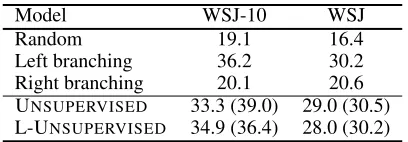
Right branching 20.1 20.6 UNSUPERVISED 33.3 (39.0) 29.0 (30.5) L-UNSUPERVISED 34.9 (36.4) 28.0 (30.2)
Table 1: Evaluation of the fully unsupervised model (without posterior regularization) on the English Penn Treebank. We report average DDA and the best DDA (in brackets) over five runs. “L-” denotes the lexicalized version.
Setup To avoid a scenario in which REINFORCE has to work with an arbitrarily initialized encoder and decoder, our posterior regularized neural variational dependency parser is pretrained with the direct reward from PR. (This will be discussed later; for more details on the training, see Supple-mentary Material.)
We use AdaGrad (Duchi, Hazan, and Singer 2011) to op-timize the parameters of the encoder and decoder, as well as the projected gradient descent algorithm (Bertsekas 1999) to optimize the parameters of posterior regularization.
We use GloVe embeddings (Pennington, Socher, and Manning 2014) to initialize English word vectors and Fast-Text embeddings (Bojanowski et al. 2016) for the other languages. Across all experiments, we test both unlexical-ized and lexicalunlexical-ized versions of our models. The unlexi-calized versions use gold POS tags as model inputs, while the lexicalized versions additionally use word tokens (Le and Zuidema 2015). We use Brown clustering (Brown et al. 1992) to obtain additional features in the lexicalized ver-sions (Buys and Blunsom 2015).
We report average DDA and best DDA over five runs for our main parsing results.
Exploration of Model Variants
Posterior Regularization To study the effectiveness of posterior regularization in the neural grammar induction model, we first implement a fully unsupervised model with-out posterior regularization. This model is trained with vari-ational inference, using the standard REINFORCE objective with abaseline(Mnih and Gregor 2014; Miao and Blunsom 2016; Miao, Yu, and Blunsom 2016) and employing no pos-terior regularization.
Table 1 shows the results for the unsupervised model, to-gether with the random and left- and right-branching base-lines. We observe that the unsupervised model (both the un-lexicalized and un-lexicalized versions) fails to beat the left-branching baseline. These results suggest that without any prior linguistic knowledge, the trained model is fairly uncon-strained. A comparison with posterior-regularized results in Table 2 (to be discussed next) reveals the effectiveness of posterior regularization in incorporating such knowledge.
Pretraining Unsupervised models in general face a cold-startproblem since no gold annotations exist to “warm up” the model parameters quickly. This can be observed in (16): the gradient updates of the model are dependent on the score
WSJ-10 WSJ
No Pretraining 47.5 (59.8) 36.7 (46.3) Pretraining 64.8 (67.1) 42.0 (43.7)
Table 2: Evaluation of the posterior-regularized model with and without pretraining on the WSJ. We report average DDA and best DDA (in brackets) over five runs.
RL-BL RL-SN RL-C RL-PC
µ 58.7 60.8 64.4 66.7
σ 1.8 0.6 0.3 0.7
Table 3: Comparison of models with different variance re-duction techniques (or score functions) on the WSJ-10 test set. We report the average DDAµand its standard deviation
σover five runs.
functionl, which in return relies on the model parameters. At the beginning of training we cannot obtain an accurately approximatedlfor updating model parameters. To alleviate this problem, one approach is to ignore the score function in the gradient update at the early stage. In this case, both the encoder and decoder are trained with the direct reward from PR (detailed equations can be found in the Supplementary Material). We test the effectiveness of this approach, which we callpretraining.
Table 2 shows the results of a standard posterior-regularized model compared to one only with pretraining. Both models use the unlexicalized setup. We find that the posterior-regularized model benefits a lot from pretraining, which therefore is a useful way to avoid cold start.
Variance Reduction Previously, we described various variance reduction techniques, or modified score functions, for the reinforcement learning objective. These include the conventional baseline method (RL-BL), our sample nor-malization method (RL-SN), sample nornor-malization with ad-ditional polarity correction (RL-PC), and a simplified ver-sion of the later (RL-C). We now compare these techniques; all experiments were conducted with pretraining and on the unlexicalized model.
The experimental results in Table 3 show that RL-SN outperforms RL-BL on average DDA, which indicates that sample normalization is more effective in reducing the vari-ance of the gradient estimator. We believe the gain comes from the fact that sample normalization does not introduce extra model parameters, whereas RL-BL does. Polarity rection further boosts performance. However, polarity cor-rection uses the number of universal rules present in a in-duced dependency structure, i.e., it is a task-specific method for variance reduction. Also RL-C (the simplified version of RL-PC) achieves competitive performance.
Model WSJ-10 WSJ UNIVERSALRULES 54.7(58.2) 37.8(39.3) L-UNIVERSALRULES 54.7 (56.3) 36.8 (38.1) WEAKLYSUPERVISED 66.7 (67.6) 43.6 (45.0) L-WEAKLYSUPERVISED 68.2(71.1) 48.6(50.2)
Table 4: Comparison of uniformly initialized (UNIVERSALRULES) and empirically estimated (WEAKLYSUPERVISED) rule expectation on the WSJ.
Model WSJ-10 WSJ
Graph-based models
Convex-MST 60.8 48.6
HDP-DEP 71.9 –
Transition-based models
RF 37.3 (40.7) 32.1 (33.1)
RF+H1+H2 51.0 (52.7) 37.2 (37.6) UNIVERSALRULES 54.7 (58.2) 37.8 (39.3) L-WEAKLYSUPERVISED 68.2 (71.1) 48.6(50.2)
Table 5: Comparison of our models (UNIVERSALRULES
and L-WEAKLYSUPERVISED) with previous work on the English Penn Treebank. H1 and H2 are two heuristics used in Rasooli and Faili (2012).
UNIVERSALRULES.
However, we can initialize the rule expectation non-uniformly, which allows us to introduce a degree of super-vision into the PR scheme. Here, we explore one way of doing this: we assume a training set that is annotated with dependency rules (the training portion of the WSJ), based on which we estimate expectations for the universal rules. We call this setting WEAKLYSUPERVISED.
The results of an experiment comparing these two settings is shown in Table 4. In both cases we use pretraining and the best performing score function RL-PC. Here we report re-sults using both unlexicalized and lexicalized settings. It can be seen that the best performing UNIVERSALRULESmodel is the unlexicalized one, while the best WEAKLYSUPER
-VISEDmodel is lexicalized. Overall, WEAKLYSUPERVISED
outperforms UNIVERSALRULES, which demonstrates that our posterior regularized parser is able to effectively use weak supervision in the form of an empirical initialization of the rule expectations.
Parsing Results
English Penn Treebank We compare our unsupervised UNIVERSALRULES model and its WEAKLYSUPERVISED
variant with (1) the state-of-the-art unsupervised transition-based parser of Rasooli and Faili (2012) 3, denoted as RF, and (2) two state-of-the-art unsupervised graph-based parsers with universal linguistic rules: Convex-MST (Grave and Elhadad 2015) and HDP-DEP (Naseem et al. 2010). Both of these are not transition-based, and thus not directly comparable to our approach, but are useful for reference.
3
Since we used different preprocessing, we re-implemented their model for a fair comparison.
The parser of Rasooli and Faili (2012) is unlexicalized and count-based. To reach the best performance, the authors employed “baby steps” (i.e., they start training on short sen-tences and gradually add longer sensen-tences (Spitkovsky, Al-shawi, and Jurafsky 2009)), as well as two heuristics called H1 and H2. H1 involves multiplying the probability of the last verb reduction in a sentence by10−10. H2 involves
mul-tiplying eachNoun→Verb,Adjective→Verb, and Adjec-tive→Noun rule by 0.1. These heuristics seem fairly ad-hoc; they presumably bias the probability estimates towards more linguistically plausible values.
As the results in Table 5 show, our UNIVERSALRULES
model outperforms RF on both WSJ-10 and full WSJ, achieving a new state of the art for transition-based de-pendency grammar induction. The RF model does not use universal rules, but its linguistic heuristics play a similar role, which makes our comparison fair. Note that our L-WEAKLYSUPERVISEDmodel achieves a further improve-ment over UNIVERSALRULES, making it comparable with Convex-MST and HDP-DEP, demonstrating the potential of the neural, transition-based dependency grammar induction approach, which should be even clearer on large datasets.
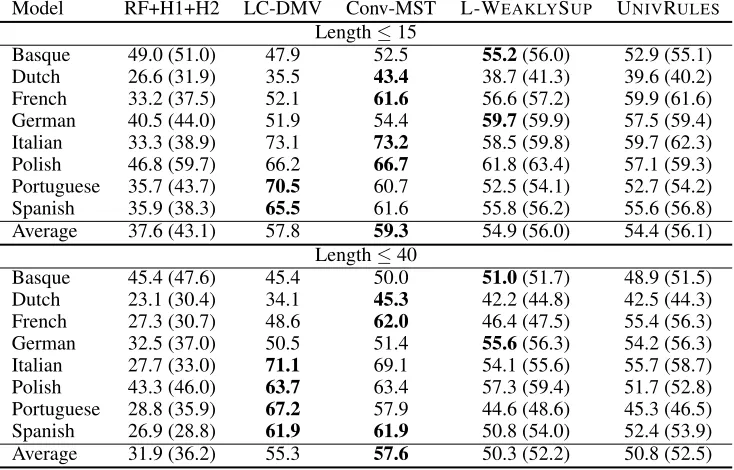
Universal Dependency Treebank Our multilingual ex-periments use the UD treebank. There we evaluate the two models that perform the best on the WSJ: the un-lexicalized UNIVERSALRULE model and lexicalized L-WEAKLYSUPERVISED model. We use the same hyperpa-rameters as in the WSJ experiments. Again, we mainly com-pare our models with the transition-based model RF (with heuristics H1 and H2), but we also include the graph-based Convex-MST and LC-DMV models for reference.
Table 6 shows the UD treebank results. It can be observed that both UNIVERSALRULESand L-WEAKLYSUPERVISED
significantly outperform the RF on both short and long sen-tences. The improvement of average DDA is roughly 20% on sentences of length≤40. This shows that although the heuristic approach employed by Rasooli and Faili (2012) is useful for English, it does not generalize well across lan-guages, in contrast to our posterior-regularized neural net-works with universal rules.
Parsing Speed To highlight the advantage of our linear time complexity parser, we compare both lexicalized and unlexicalized variants of our parser with a representative DMV-based model (LC-DMV) in terms of parsing speed. The results in Table 7 show that our unlexicalized parser re-sults in a 1.8-fold speed-up for short sentences (length ≤ 15), and a speed-up of factor 16 for long sentences (full length). And our parser does not lose much parsing speed even in a lexicalized setting.
Related Work
Model RF+H1+H2 LC-DMV Conv-MST L-WEAKLYSUP UNIVRULES
Length≤15
Basque 49.0 (51.0) 47.9 52.5 55.2(56.0) 52.9 (55.1) Dutch 26.6 (31.9) 35.5 43.4 38.7 (41.3) 39.6 (40.2) French 33.2 (37.5) 52.1 61.6 56.6 (57.2) 59.9 (61.6) German 40.5 (44.0) 51.9 54.4 59.7(59.9) 57.5 (59.4) Italian 33.3 (38.9) 73.1 73.2 58.5 (59.8) 59.7 (62.3) Polish 46.8 (59.7) 66.2 66.7 61.8 (63.4) 57.1 (59.3) Portuguese 35.7 (43.7) 70.5 60.7 52.5 (54.1) 52.7 (54.2) Spanish 35.9 (38.3) 65.5 61.6 55.8 (56.2) 55.6 (56.8) Average 37.6 (43.1) 57.8 59.3 54.9 (56.0) 54.4 (56.1)
Length≤40
Basque 45.4 (47.6) 45.4 50.0 51.0(51.7) 48.9 (51.5) Dutch 23.1 (30.4) 34.1 45.3 42.2 (44.8) 42.5 (44.3) French 27.3 (30.7) 48.6 62.0 46.4 (47.5) 55.4 (56.3) German 32.5 (37.0) 50.5 51.4 55.6(56.3) 54.2 (56.3) Italian 27.7 (33.0) 71.1 69.1 54.1 (55.6) 55.7 (58.7) Polish 43.3 (46.0) 63.7 63.4 57.3 (59.4) 51.7 (52.8) Portuguese 28.8 (35.9) 67.2 57.9 44.6 (48.6) 45.3 (46.5) Spanish 26.9 (28.8) 61.9 61.9 50.8 (54.0) 52.4 (53.9) Average 31.9 (36.2) 55.3 57.6 50.3 (52.2) 50.8 (52.5)
Table 6: Evaluation on eight languages of the UD treebank with test sentences of length≤15 and length≤40.
Sentence length ≤15 ≤40 All
LC-DMV 663 193 74
Our Unlexicalized 1192 1194 1191 Our Lexicalized 939 938 983
Table 7: Parsing speed (tokens per second) on the French UD Treebank with test sentences of various lengths. All ex-periments were conduct on the same CPU platform.
2005), and learning initial parameters from shorter sentences (Spitkovsky, Alshawi, and Jurafsky 2009). Among graph-based models, there is also some work conceptually related to our approach. Jiang, Han, and Tu (2017) combine a dis-criminative and a generative unsupervised parser using dual decomposition. Cai, Jiang, and Tu (2017) use CRF autoen-coder for unsupervised parsing. In contrast to these two ap-proaches, we use neural variational inference to combine discriminative and generative models.
For transition-based models, Daum´e III (2009) introduces a structure prediction approach and Rasooli and Faili (2012) propose a model with simple features based on this ap-proach. Recently, Shi, Huang, and Lee (2017) and Gomez-Rodriguez, Shi, and Lee (2018) show that practical dynamic programming-like global inference is possible for transition-based systems using a minimal set of bidirectional LSTM features. These models achieve competitive performance for projective or non-projective supervised dependency parsing but have not been applied to unsupervised parsing.
Conclusions
In this work, we propose a neural variational transition-based model for dependency grammar induction. The model
consists of a generative RNNG for generation, and a dis-criminative RNNG for parsing and inference. We train the model on unlablled corpora with an integration of neural variational inference, posterior regularization and variance reduction techniques. This allows us to use a small amount of universal linguistic rules as prior knowledge to regularize the latent space. We show that it is straightforward to inte-grate weak supervision into our model in the form of rule expectations. Our parser obtains a new state of the art for unsupervised transition-based dependency parsing, with lin-ear time complexity and significantly faster parsing speed compared to graph-based models.
In future, we plan to conduct a larger-sclae of grammar induction experiment with our model. We will also explore better training and optimization techiniques for neural varia-tional inference with discrete autoregressive latent variables.
Acknowledgments
We gratefully acknowledge the support of the Leverhulme Trust (award IAF-2017-019 to FK). We also thank Li Dong and Jiangming Liu at ILCC for fruitful discussions, Yong Jiang at ShanghaiTech for sharing preprocessed WSJ dataset, and the anonymous reviewers for the constructive comments.
References
Bertsekas, D. P. 1999. Nonlinear programming. Athena scientific Belmont.
Bojanowski, P.; Grave, E.; Joulin, A.; and Mikolov, T. 2016. Enriching word vectors with subword information. arXiv preprint arXiv:1607.04606.
and Lai, J. C. 1992. Class-based n-gram models of natural language.Computational linguistics18(4):467–479. Buys, J., and Blunsom, P. 2015. Generative incremental dependency parsing with neural networks. InProceedings of the ACL Conference.
Cai, J.; Jiang, Y.; and Tu, K. 2017. Crf autoencoder for unsu-pervised dependency parsing. InProceedings of the EMNLP Conference.
Cheng, J.; Lopez, A.; and Lapata, M. 2017. A generative parser with a discriminative recognition algorithm. In Pro-ceedings of the ACL Conference.
Daum´e III, H. 2009. Unsupervised search-based structured prediction. InProceedings of the ICML Conference. Duchi, J.; Hazan, E.; and Singer, Y. 2011. Adaptive subgra-dient methods for online learning and stochastic optimiza-tion.JMLR12(Jul):2121–2159.
Dyer, C.; Ballesteros, M.; Ling, W.; Matthews, A.; and Smith, N. A. 2015. Transition-based dependency parsing with stack long short-term memory. InProceedings of the ACL Conference.
Dyer, C.; Kuncoro, A.; Ballesteros, M.; and Smith, N. A. 2016. Recurrent neural network grammars. InProceedings of the NAACL Conference.
Ganchev, K.; Gillenwater, J.; Taskar, B.; et al. 2010. Pos-terior regularization for structured latent variable models.
JMLR11(Jul):2001–2049.
Gomez-Rodriguez, C.; Shi, T.; and Lee, L. 2018. Global transition-based non-projective dependency parsing. In Pro-ceedings of the ACL Conference.
Grave, E., and Elhadad, N. 2015. A convex and feature-rich discriminative approach to dependency grammar induction. InProceedings of the ACL Conference.
Headden III, W. P.; Johnson, M.; and McClosky, D. 2009. Improving unsupervised dependency parsing with richer contexts and smoothing. InProceedings of the NAACL Con-ference.
Jiang, Y.; Han, W.; and Tu, K. 2016. Unsupervised neural dependency parsing. InProceedings of the EMNLP Confer-ence.
Jiang, Y.; Han, W.; and Tu, K. 2017. Combining gener-ative and discrimingener-ative approaches to unsupervised depen-dency parsing via dual decomposition. InProceedings of the EMNLP Conference.
Kiperwasser, E., and Goldberg, Y. 2016. Simple and ac-curate dependency parsing using bidirectional lstm feature representations. InTACL.
Klein, D., and Manning, C. 2004. Corpus-based induction of syntactic structure: Models of dependency and constituency. InProceedings of the ACL Conference.
Le, P., and Zuidema, W. 2015. Unsupervised dependency parsing: Let’s use supervised parsers. InProceedings of the NAACL Conference.
Marcus, M. P.; Marcinkiewicz, M. A.; and Santorini, B. 1993. Building a large annotated corpus of english: The penn treebank.Computational linguistics19(2):313–330.
McDonald, R.; Petrov, S.; and Hall, K. 2011. Multi-source transfer of delexicalized dependency parsers. In Proceed-ings of the EMNLP Conference.
Miao, Y., and Blunsom, P. 2016. Language as a latent vari-able: Discrete generative models for sentence compression. InProceedings of the EMNLP Conference.
Miao, Y.; Yu, L.; and Blunsom, P. 2016. Neural variational inference for text processing. InProceedings of the ICML Conference.
Mnih, A., and Gregor, K. 2014. Neural variational inference and learning in belief networks. InProceedings of the ICML Conference.
Naseem, T.; Chen, H.; Barzilay, R.; and Johnson, M. 2010. Using universal linguistic knowledge to guide grammar in-duction. InProceedings of the EMNLP Conference. Nivre, J.; de Marneffe, M.-C.; Ginter, F.; Goldberg, Y.; Ha-jic, J.; Manning, C. D.; McDonald, R. T.; Petrov, S.; Pyysalo, S.; Silveira, N.; et al. 2016. Universal dependencies v1: A multilingual treebank collection. InLREC.
Noji, H.; Miyao, Y.; and Johnson, M. 2016. Using left-corner parsing to encode universal structural constraints in grammar induction. InProceedings of the EMNLP Confer-ence.
Pennington, J.; Socher, R.; and Manning, C. 2014. Glove: Global vectors for word representation. InProceedings of the EMNLP Conference.
Rasooli, M. S., and Faili, H. 2012. Fast unsupervised depen-dency parsing with arc-standard transitions. InProceedings of the Joint Workshop on Unsupervised and Semi-Supervised Learning in NLP.
Shi, T.; Huang, L.; and Lee, L. 2017. Fast(er) exact decoding and global training for transition-based dependency parsing via a minimal feature set. InProceedings of the EMNLP Conference.
Smith, N. A., and Eisner, J. 2005. Guiding unsupervised grammar induction using contrastive estimation. In Pro-ceedings of IJCAI Workshop on Grammatical Inference Ap-plications.
Spitkovsky, V. I.; Alshawi, H.; and Jurafsky, D. 2009. Baby steps: How “less is more” in unsupervised dependency pars-ing. NIPS: Grammar Induction, Representation of Lan-guage and LanLan-guage Learning.