MURDOCH RESEARCH REPOSITORY
http://dx.doi.org/10.1109/WIVC.1996.624646
Godfrey, K. and Attikiouzel, Y. (1996) Non-linear quantisation
effects in digital colour systems. In: First International
Workshop on Wireless Image/Video Communications, 4 - 5
September, Loughborough, UK, pp. 63-67.
http://researchrepository.murdoch.edu.au/18189/
Copyright © 1996 IEEE
Personal use of this material is permitted. However, permission to reprint/republish
this material for advertising or promotional purposes or for creating new collective
Non-linear Quantisation Effects in Digital Colour Systems
Keith Godfrey and Yiannis Attikiouzel
Centre
for
Intelligent Information Processing Systems The University of Western AustraliaNedlands, Western Australia, 6907
e-mail: [email protected]
Abstract
This paper shows that quantisation of colour pixels, essential to digital imagery, causes non-linear correlation in the permitted values of chromaticity coordinates in linear-intensity CIE colour spaces. It follows that colour video and image coding schemes based on these colour spaces will suffer an inherent preference for certain chromaticities.
Introduction
Colour video systems rely on the fact that any colour can be matched by an additive mixture of three primary components, red, green and blue [l]. In analysing colour, it is necessary to distinguish between our perceptual response to colour and the physical properties of the light. The radiant power or light intensity [2,3] is a physical property, defined as the integral of a spectral power distribution. When two or more light sources are mixed, their spectral power distributions add and hence their intensities add.
Grassmann’s laws for colour [4,5]1 are based on the intensities of each of the three primary components. If
C,
R, G and B are intensities, C i:j a unit-intensity light of unknown colour, R, G and B are unit-intensity lights of the red, green and blue primary colours,+
indicates additive mixing and E represents a visualcolour match, the laws are:
1. for any C and C there exists numbers R,G,B such that
C(C)
=
R(R)+
G(G)+
B(B)2.
if
C,(Cl) E R i m )+
G,(G) +Bl(B)Cz(C2) E R?(R)
+
G2(G) +B2(B)and
then Cl(C1) + C $ 3
=
(RI+R~)(R)+
(Gl+G)(G)+
( B I + B ~ ) ( B )then K ( C )
=
kh!(R)+
E ( G )+
kB(B)
3.
if
C ( C ) = R(R)+
G(G) +B(B)These laws of matchmg, mixing and scaling apply only in colour spaces that are linear in intensity. The eye uses three types of photo-receptor, based on the red, green and blue parts of the visible spectrum, but each responds non-linearly to intensity. Our concept of lightness is roughly logarithmic to the intensity and we can distinguish lights when their intensities have a relative difference of around 1% [ 6 ] .
Quantisation Model
6 4
A necessary feature of Cllgital colour images is that the red, green and blue values of each pixel are quantised. One consequence is an upper limit to the number of possible colours that can be represented.
.
The quantisation is typically 8 bits, giving quantised levels 0 through 255 and a gamut of 16,777,216
colours. Another consequence is that any colour video or image codmg scheme using these colour values will suffer image colour degradation due to the quantisation as well as the algorithm’s spatial coding.
It is the electrical signal that is quantised, not the light intensity. When the electronic signal is quantised linearly, the quantisation levels follow a gamma power law in intensity. This model is shown if Figure 1.
O h
0 Q6 I 0 4 6 1
4.&cf!
0
O M 1 O M 1 retinal
response analogue signal h e a r quantisation non-linear quantisation
linear intensity non-linear intensity hear intensity
Figure 1 Model of digtisation and reproduction of each primary colour signal.
It is interesting and very fortunate that our retinal response is roughly the inverse of the gamma law. The effect
of
linear quantisation of the electronic signal is barely visible ona
television display because thequantised levels appear to be roughly linear in lightness [8], The quantisation effects become apparent
in a
domain of linear intensity, as may be used for mage coding or computer graphics requiring Grassmann’s laws to model light interaction.
The effects will now be demonstrated in CIE spaces XZY and Yu’v’, the basis for the CIE L W and LAB. It will also be shown that an original colour Image, without spatial coding, can produce strong patterns of artefacts in its colour scatter plot.
Effects in Linear-Intensity CIE Spaces
The CIE spaces are based on chromaticity coordinates computed from the intensities of three primaries. For tristimulus intensity values R,G,B, the CIE chromaticity coordinates are:
R
R + G + B
r =
G
g = R + G + B
B
R + G + B b =
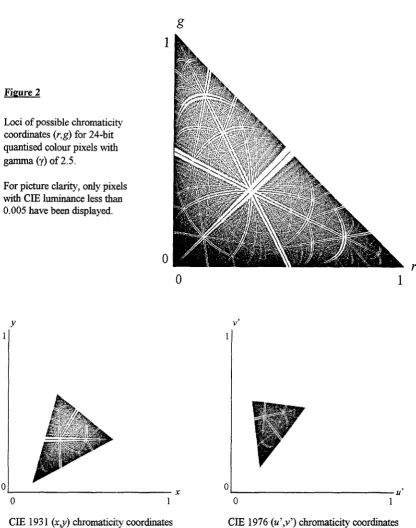
Qutisation of R, G and B, whether linear or not, wdl cause correlation in the quantised values of Y , g and b due to the denominator term. The non-hear power-law quantisation of R, G and B highhghts the interdependencies of the components. Figure 2 shows the discrete values of (r,g) permitted for 8-bit quantisation of R, G and B and gamma of 2.5. The pattem would be inhstinguishable if all 16,777,216
points were plotted, so only those pixels with a CIE luminance [9] less than 0.005, about 1% of the pixels, have been displayed. As luminance is linearly related to r, g and b, with greatest emphasis on g and lowest on b, the densities of points are greatest at the blue and red comers.
Fipure 2
Loci of possible chromaticity c o o r b t e s (r,g) for 24-bit quantised colour pixels witti gamma (y) of 2.5.
For picture clarity, only pixels
with CIE luminance less than
0.005 have been displayed.
0
c
1
0
X
r
1
0 1 0 1
C E
193 1 (xa) Chromaticity coordinates CIE 1976 (u’,v7) chromaticity coordinatesFigure 3 Loci of possible chromaticity coordinates (XJ) and (u7,v7) for 24-bit quantised colour
pixels with gamma (y) of 2.5. For picture clarity, only pixels
with
CIE luminance lessthan 0.002 have been shown.
A transformation from any set of RGB primaries to the CIE X Y Z primaries and (XJ) chromaticity
coordinates Will preserve the topology of the quantisation pattem because the transformation is based on linear multiplication by
a
3x3 matrix [4,9]. This paper uses the transformation from ITU Rec. 709 primaries [9]with
dayfight iiIurmlnant D65. The chromaticity coordinates (XJ) are obtained by division by6 6
The chromaticity coordmates (u’,v’) are the basis for the L W d o r m colour space defined by the CIE in 1976 [6] and they are obtained from ( x y ) by:
4.5y
(2)
V’ =
The pattems for (x,y) and (u’,v’) are shown in Figure 3. The pattem for (XT) has a similar topology to
(r,g) from Figure 2 as expected. The progression to (u’,v’) involves a sequence of two divisions, via equations 1 and 2, so the pattern of the loci of (U’,$) is permuted hrther
than
that for ( x y ) .2x
6~ - x
+
1.5U’ =
6 y - x
+
1.5Effects on Digital Images
The quantisation effect is clearly visible in the CIE Chromaticity c o o r h t e s of pixels from digital images. Figure 4 is an image of a group of colourful aircraft parked in a grass field in Perth. This image was
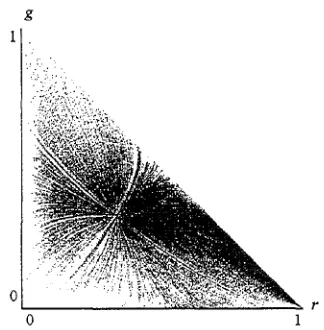
digitised to 24 bits per pixel, 8 bits per primary. The index of gamma correction (l/y) used by the digital scanner is unknown but estimated at 0.45. The scatter plot of ( r g ) chromaticity coordinates for this image is shown in Figure 5 . As the image contains 746x575 pixels, the scatter plot is dense and the exact pattern of quantisation cannot be seen easily. Thus Figure 6 shows only those pixels in the image with lumina= less
than
0.026 and Figure 7 shows their chromaticity coordixlates. The resulting scatter plot exhibits both the underlying pattern of Figure 2 and also a secondary effect, possibly due to quantisation by the scanner’s analogue to hgital conversion prior to gamma correction, but this remains unverified.Discussion
Colour video and lmage codmg schemes usually transform RGB pixel colours into modified colour spaces such as CIE L W or CCIR Y’CbCr prior to applying spatial coding algorithms. It has been shown that the quantisation of RGB causes intricate patterns of non-linar conelation in the permitted values of the chromaticity coordmates. Whilst the effect on colour image coding schemes has not yet been analysed fully, it can be expected that the chromaticity patterns wdl be preserved by spatial coding and data
compression because they are independent of pixel location. Algorithms based on Y’CbCr, such as
PEG
File Interchange Format [lo], may suffer reduced quantisation effects because the transformation from the digitised R, G and B to Y’, Cb and Cr signals is hear.The Y’CbCr space is linear in quantisation but non-linear in intensity [9].1
c
Figure 4 Image of coloured aircraft, digitised to 24
bits per pixel
with
lly estimated as 0.45.having CIE luminance less than 0.026.
Conclusion
coordmates of those pixels in Figure 6 .
Quantised RGB pixels from digital colour images produce intricate patterns of preferred chromaticites in linear-intensity CIE spaces such as xzY and Yu’v’. Patterns in the (r,g) chromaticity coordinates arise from division
of
non-linearly cpantised intensitiesR
and G by the sumR+G+B.
CIE
chromaticity coordinates ( X J ) are derived by a linear transformation &om primariesRGB
to X Y Z and exhibit the samequantisation pattern as (r,g). The pattem in the chromaticity coordinates (u’,v7) of the CIE uniform colour space LUV is complicated by another division involving x and y.
The quantisation effect has becm den”trated on ?a original digitised image, without coding or data
compression. Any coding algorithm applied to the image will further encode the internal pattern. The decoded image will then extub’it this encoded pattem whilst simultaneously conforming to the same quantisation grid pattern as the original and any other cllgital Image. Further investigation is required.
References
Robert M. Boynton, “Hunian Color Vision”, Holt, Reinhart and Winston, 1979. G. Wyszecki and W.S. Stiles, “Colour Science”, Wiley, 1982.
Charles A. Poynton, c6Pqynton7s Gamma FAQ”, accessible through the World Wide Web under www.inforamp .net/-poynton/Poynton-colour.html.
W.N. Sproson, “Colour Science in Television and Display Systems”, Hilger, 1983.
H. J. Trussell, “DSP Solutions Run the Gamut for Color Systems”, IEEE Signal Processing Magazine, April 1993, pp 8-23.
Commission Internationale de l’Eclairage, “Colorimetry, Second Edition”, CIE publication 15.2, Vienna, Austria, 1986.
LeRoy E. DeMarsh and Edward J. Giorgianni, “Color Science for Imaging systems”, Physics Today, September 1989, pp 44-52.
Hiroaki Ikeda, Wei Dai and Yasuhiko Higaki, “A Study on Colorimetric Errors Caused by Quantizing Color Information”, IEEE Transactions on Instrumentation and Measurement, Vol. 41,
No. 6, December 1992, pp 845-9..
Charles A. Poynton, “Po:ynton’s Colour FAQ”, accessible through the World Wide Web under
www.inforamp.net/-poyntofloynton-colour.html.