Journal of Sociology and Social Work 1(1); June 2013 pp. 22-41 Otieno & Nyangechi
Effectiveness of Internal Control Procedures
on Management Efficiency of Free Primary
Education Funds: a case of Public Primary schools in Kisii central District, Kenya
Simeyo Otieno
Jaramogi Oginga Odinga University of Science & Technology,
School of Business and Economics; Department of Finnce and Accounting,
P.O. Box 210 - 40601 Bondo-Kenya
Eliud Onyiego Nyangechi
P.O. Box 516 -40200 Kisii-Kenya
Abstract
Concerns over misappropriation and misuse of Free Primary Education funds have been raised by parents, the government and donors despite the increased funding. It is not clear the extent of use of internal control procedures in public primary schools are contributing to this state of affairs. Therefore, the purpose of this study was to establish the effectiveness of internal control procedures on management efficiency of FPE funds in public primary schools in Kisii Central District. The study was guided by the stewardship theory which advocates for integrity, transparency and accountability. The study targeted 267 respondents comprising of 132 head teachers, 132 SMCs chairpersons and 3 District Education staff in Kisii Central District, Kisii County, from which a random sample of 117 was taken for study. The findings of the study revealed that use of internal control procedures are effective on management efficiency of funds in schools and therefore recommends embracing enhanced internal control procedures in their resolve to efficient management.
Key Words: Internal Control Procedures, Management Efficiency, Education Funds
1.0
Introduction
The aspect of investment in Primary Education has been a key element in the development process worldwide. Primary Education improves the earnings of its graduates by 19% in Kenya and 13% in Tanzania. In such a noble process, there is always apparent social benefit that accrues from primary schooling, which includes reduced fertility, better health care and decreased child mortality. It is for this reason that most countries worldwide have prioritized primary education,( Knight and Sabot 1990). In United States of America, elementary schooling is free and compulsory to all children while in India Central government provides 80% of the financing of Free Primary Education (FPE), while the local states implement and provide the rest of the financing. African countries like Malawi, Uganda and Lesotho have implemented FPE.
Basic skills not only help individuals but also have an impact on the income, growth potential, population and public sector performance. Following the declaration of Free Primary Education in 2003 by the Government (Republic of Kenya, 2003) there has been an overwhelming influx of children to public primary schools. The ministry of Education through the government of Kenya has however, made tremendous efforts to raise funds from donors such as World Bank, UNICEF, European Union, USAID and Non Governmental Organizations (NGOs) like Plan International and CARE Kenya to finance FPE (Ministry of Education, 2007).
Kisii Central District has 132 Public Primary Schools which are performing the cardinal function of providing education to the children of Kenya. Since the introduction of FPE programme, Kisii Central District has been steadily receiving funding from the treasury budgetary allocations indicating the serious commitment the government places in attainment of universal access to basic education. Overall the government of Kenya in Financial Year (FY) 2010/2011 allocated 23.8% of its resources in the education sector of which 17.7% were earmarked to basic education. (Ministry of Finance estimates, 2010/2011). Table 1.1 illustrates FPE disbursements from FY 2007/2008 to FY2009/2010 in Kisii Central District.
For management efficiency of funds it is imperative that schools operationalize internal controls. Internal controls which influence management efficiency include the following: segregation of duties on approving of documents, trial balance and reconciliation statements extraction, payment procedures, staff accounting skills, computerized procedures and procurement and stores controls.
Explicit standards and performance measures must be established, because accountability requires clearly stated aims and efficiency requires attention to goals; and managers must be given powers to conduct hands-on professional management, because accountability requires clear assignment of
responsibility, not diffusion of power. However issues on management efficiency ever
since the introduction of the FPE programme keep on emerging. Free Primary Education is in serious trouble following cases of massive fraud at the Ministry of Education. Some donors have now stopped funding FPE until those who have stolen the free education money are arrested and prosecuted. The British government stopped funding FPE saying, it would not resume unless the over Kshs. 100 million stolen from the Kitty was recovered and the thieves prosecuted (Nyaegah, 2011).
Journal of Sociology and Social Work 1(1); June 2013 pp. 22-41 Otieno & Nyangechi
To achieve the goals and objectives of Universal Primary Education in Kisii Central District, schools need to bring up efficiency in their operations. Since strong internal control procedures lead to management efficiency, the extent to which schools are applying these control procedures is the main concern. It is against this background that this research aimed at assessing the effectiveness of internal control procedures on management efficiency of FPE Funds in public primary schools in Kisii Central District. The study therefore sought to answer the following questions;
i. To what extent are internal control procedures used in Public Primary Schools in Kisii Central District?
ii. What is the level of management efficiency of FPE funds in Public Primary Schools in Kisii Central District?
iii. Are internal control procedures effective on management efficiency of FPE funds in public primary schools in Kisii Central District?
2.0
Literature Review
2.1 The Concept of Internal Control
Procedures
Internal control is the process designed and implemented by those charged with governance, management, and other personnel, to provide reasonable assurance about the achievement of the entity’s objectives with regard to reliability of financial reporting, effectiveness and efficiency of operations and compliance with applicable laws and regulations (Gray, 2008) Power(1997), defines internal control as a process, effected by an entity’s board of directors, management, and other personnel, designed to provide reasonable assurance regarding the achievement of objectives in the following categories :effectiveness and efficiency of operations; reliability of financial reporting; and compliance with applicable laws and regulations.
Internal accounting controls are mechanisms through which an entity provides useful information which is important for decision making. Internal controls means all the policies and procedures adopted by the management of an entity to assist in achieving management’s objective of ensuring, as far as practicable, the orderly and efficient conduct of its business, including adherence to management policies, the safeguarding of assets, the prevention and detection of fraud and error, the accuracy and completeness of the accounting records, and the timely preparation of reliable financial information .
This also encompasses all those policies and procedures issued by the ministry of education on spending of FPE funds in public primary schools in Kenya. The internal control system extends beyond those matters which relate directly to the functions of the accounting system and comprises the control environment which means the overall attitude, awareness and actions of directors and management regarding the internal control system and its importance in the entity. The control environment has an effect on the effectiveness of the specific control procedures. A strong control environment, for example, one with tight budgetary controls and an effective internal audit function, can significantly complement specific control procedures. Factors reflected in the control environment include the function of the board of directors and its committees, management’s philosophy and operating style and the entity’s organizational structure and methods of assigning authority and responsibility. The internal controls employed in management of FPE funds will reflect the efficiency and effectiveness of the whole system of financial management.
Control procedures are those policies and procedures in addition to the control environment which management has established to achieve the entity’s specific objectives. Specific control procedures include reporting, reviewing and approving reconciliations. Checking the arithmetical accuracy of the records, maintaining and reviewing control accounts and trial balances. Approving and controlling of documents. Comparing internal data with external sources of information and finally comparing and analyzing the financial results with budgeted amounts.
The internal controls make it possible for the head teachers to make an effective and speedy check on the rate of expenditure and proper financial management. Internal control aspects include payment procedures, employee’s skills, computerized controls, procurement and stores control.
2.1.1
Maintenance of Books of AccountsBook keeping is the art of entering transactions in relevant books of accounts. One of the routine finance functions that can be delegated to junior staff in an organization is record keeping and safeguarding property and documents of an organization. All accounting transactions are journalized and then posted to relevant ledger accounts using the double entry system. In a school situation, book keeping is made possible through supporting documents in relation to all receipts and payments, (Pandey, 2008).
2.1.2
Staff Accounting SkillsPreparation of accounts is a complex process which requires that whoever is tasked with the responsibility of preparing of these accounts should have the requisite skills and professional experience. Errors, intentional or otherwise are committed by officers who do not have the skills in accounting.
Though the head teacher is the principal accounting officer in the school, the officers to whom he has delegated the responsibility of bookkeeping should be competent. The main concern however in the preparation of financial reports is whether the employees in the accounting department have the requisite skills and knowledge to prepare these statements.
2.1.3
Trial BalanceA trial balance is a list of balances of all the vote heads in the analyzed cash book. It is a summary of all transactions on the school account. It should be prepared at the end of every month. The trial balance helps to check the arithmetical accuracy of postings from source documents to ledgers. The bank statement and the cash book in the school are frequently reconciled and differences explained. The frequency with which these are extracted and reconciled tests the strength or otherwise of the internal control system.
2.1.4
Delegating of Staff ResponsibilitiesKoontz (1968) suggests that a clear and open system of segregation of duties and authority in an organization helps reduce ambiguities which in turn aids in its efficient management. The responsibility exacted for actions taken under authority delegated cannot be greater than that implied by the authority delegated, nor should it be less .In this regard the head teacher in liaison with school management committees should be the front runners in ensuring that delegation of authority is pervasive in the organization. The preparation, verification and authorization of payment vouchers should be clearly spelt out to avoid fertile ground of fraud.
2.1.5
Procurement Procedures and StoresControl
Journal of Sociology and Social Work 1(1); June 2013 pp. 22-41 Otieno & Nyangechi
The main items slated for procurement include: textbooks, exercise books, supplementary Readers and Reference materials, pencils, dusters chalk among others. The school head teacher and the SIMSC are required to familiarize themselves with procurement regulations as stipulated in the Exchequer and Audit Regulations 2001(public procurement), legal Notice No. 161 0f 2002.
The procurement of textbooks should be in line with the policy guidelines and regulations contained in the Primary Schools’ Instructional Materials Management Handbook which is issued to every school by the Ministry of Education. The local purchase order (LPO) is one of the crucial documents used on procurement process. Once the procedures have been strictly adhered to that is also a very important indicator of well managed FPE funds. Stores inventory cover all movable property in an organization purchased by use of public funds. All items procured become stores. The receipt voucher (the Goods Received Note) is prepared and certified by the receiving officer to confirm that the goods ordered have been received in the right condition and as per specifications.
2.1.6
Computerized ProceduresInstitutions which have embraced the use of computers in their organizations have had a positive influence in operations and hence efficient management. Computerization of departments increases coordination and cohesiveness and therefore leading to attainment of the organisation’s goals. Use of computers especially in the book keeping, generation of receipts and payment vouchers and stores control is key to management efficiency. Many computer systems have programs that test the reasonableness of a journal entry and account balance when recorded (Mwindi, 2005).
2.1.7
Monitoring and SupervisionVos , (2004) stresses that given the financial constraints Kenya faces, meeting EFA targets will require a more efficient resource allocation within the Education sector .Monitoring of funds basically implies that monies are utilized for the purpose for which they are meant for. This is implemented by the school management committees, the district quality assurance officers and the schools audit unit.
The Kamunge report of 1988, recommended that the school committee should establish sub-committees to guide and support heads of schools in the management of such schools. Therefore, head-teachers must be persons with appropriate academic professional qualifications, experience, ability, competence, integrity and initiative if the country is to realize millennium development goals especially in the education sector. They must also have undergone courses in institutional and financial management. School management committees (SMCs) are committees charged with the responsibility of ensuring that public primary schools are managed and run according to the Ministry Of Education’s regulation. Planning and execution of programme is implemented through school management committees by minutes indicating the action plan of the school in the subsequent year.
2.2
Management Efficiency of FPE funds2.2.1
School Audit ReportsAnnually every school is audited by the School Audit Unit but the District Quality Assurance and Standards Officers carry out regular assessments. The Provincial Directors’ office monitors 5% of the schools. Monitoring or tracking of the utilization of FPE funds is also carried out twice a year by the Primary School instructional materials Unit to cover 2.5% of the schools in the country (Ministry of Education, 2003).
The purpose of Monitoring is to determine whether proper procurement procedures were followed in obtaining instructional materials. Secondly, to ensure the purchased instructions materials are in the schools and are being properly used. Finally, to ensure proper care and storage of books is being adhered to. Education Officers in Kenya are judged with the responsibility of supervising education policies and programs in schools. Effective supervision of school programs by education officers ensures that they are efficiently and effectively implemented to achieve desired goals. In order to determine the effectiveness of Education Officers in supervision of FPE, the frequency of their visit to schools, their roles, purpose of visit to schools and frequency of the consultation with the head teacher was explored.
2.2.2
Financial ReportsFinancial reports also known as financial statements are the income statement and the balance sheet are supposed to be prepared by the heads of schools. The income statement is prepared to show the profitability of organization operations at the end of a particular financial period. The balance sheet shows the financial position of the enterprise at a particular date. In a school situation these financial statements convey information on the sources and uses of funds and also the financial position of the school at that particular period. Timely and honest preparation improves the accuracy and reliability of these reports.
2.2.3
Annual School BudgetsAn annual school budget is an essential tool for financial control. It enables comparison of actual performance with the plan. It is the responsibility of the head teacher to ensure that the annual budget is prepared in time. The inclusiveness of all stakeholders in budget preparation increases accountability and transparency of the whole process. The management accountant aids the control process by providing performance report that compares the actual with planned outcome for each responsibility centre (Cole, 2004).
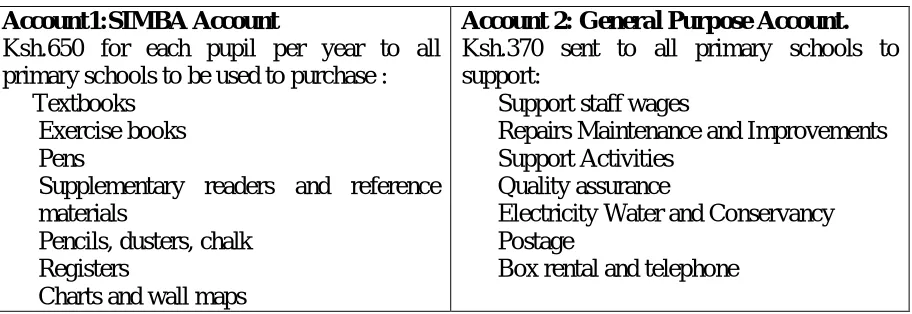
Head teachers are therefore tasked to prepare budgets which are in consonance with the ministry revised guidelines. Table 2.1 illustrates the votes heads unto which the FPE funds are adjudicated.
2.3 Stewardship Theory of Management
Stewardship theory stresses that managers, left on their own, will indeed act as responsible stewards of assets they control. The stewardship model is based upon the assumption that the manager will make decisions in the best interest of the organization, putting collectivist options above self-servicing options. This type of person is motivated by doing what’s right for the organization, because she believes that she will ultimately benefit when the organization thrives. Maslow (1943), asserts that Stewardship theory is anchored in psychology and assumes that individuals are self-actualizing and hence, individuals want to achieve organizational goals without coercion.
Journal of Sociology and Social Work 1(1); June 2013 pp. 22-41 Otieno & Nyangechi
The public primary school head teachers have the cardinal responsibility of being in charge of any kind of school property in trust for parents, students government and general public (Thompson et al,2005).
2.4 Empirical Literature
King (2009) discusses the importance of inter-sectoral factors in the success of educational investment programmes such as KESSP. The need for teachers to find second incomes, the increasing importance of non-meritocratic criteria for employment selection and issues of state capacity, good governance and corruption are important determinants of the results of educational investment whilst being outside the control of the sector. Issues of educational access, equity, quality, efficiency, financial sustainability, governance and management are thus inter-sectoral issues. Most independent observers agree that public sector organizations in poor African countries perform badly, even considering the difficult circumstances they operate in. To varying degrees they suffer from a number of well-known bureau pathologies: inefficiency, centralization, fragmentation, poor leadership, lack of capacity, patrimonialism, rent seeking, corruption, and poor accountability and legitimacy. He concludes that FPE requires a holistic approach and he emphasizes the importance of other sectors including agriculture, energy, transport and trade along with the need for strong national vision, good governance and government capacity building. Integrity, accountability and transparency can be improved by strengthening the internal controls in the institutions of learning.
Ramani (2003) pointed a number of factors that still remain a hurdle in the attainment of universal primary education goals in Kenya by 2015. Among the urban poor for instance; poverty, child labor, shortage of schools and teachers in slum areas remain the greatest impediment.
While some rural areas have adequate school buildings, there are many others that are having none, particularly peri-urban areas with large slum populations. Many rural schools also lack even the most basic amenities such as toilets, electricity and running water. These challenges require long term effective and efficient management techniques with strong institutions. Institutions with strong internal controls will ensure that funds allocated to these vulnerable schools are used optimally for the intended purpose.
Traditional audit and oversight mechanisms may be an insufficient one-sided approach to reduce abuse and corruption in the education system. Publication of survey findings and information dissemination can increase corrupt practices, as well as the ability of the public to monitor and challenge abuses and help combat the general culture of impunity (Muthwii, 2004). Liang (1996), noted that parent –teacher and school monitoring committees meetings held on regular basis provide support in addressing school issues and they succeed in enforcing some level of accountability in the sector. In Armenia, he identified the role of parent in education finance and management to be that of rising and monitoring of funds. He concluded that assignment of meaningful responsibilities and control over project resources to parents and community members led to accountability and efficiency in the school operations. Therefore strengthening internal control procedures will act as an effective tool of management efficiency.
His study shows that non availability of physical facilities in many schools may not necessarily be due to inadequate funds but due to inefficient management of the available funds. With decentralization of head teachers’ roles internal control procedures are likely to be intensely applied through maintenance of books of accounts, staff accounting skills and computerized controls making them more accountable and hence increasing management efficiency.
UNESCO (2005) report on the way FPE was implemented in the first year and the lessons for its future pointed out that FPE programme was a major milestone in the country's education system as it opened the doors for children, who would have otherwise missed a chance to access education and improve their lives. Pupils were provided with exercise and textbooks and for some that was the first time in their school life that they were able to carry home reading materials and do their homework assignments; revise on their own and read ahead of their teachers, thus making learning an enjoyable experience. Moreover, pupils were no longer missing lessons due to lack of fees as used to happen in the past.
However the study found out that FPE programme faces several challenges such as increased pupil population; shortage of teachers; lack of clear guidelines on admission; lack of consultation with teachers, parents and communities; delay in disbursement of funds; expanded roles that have overtaxed head teachers were cited as some of the major challenges attending to FPE. It was particularly noted that the implementation of the programme without prior consultation or preparation of teachers and lack of regular communication to sensitize the various stakeholders on their roles hampered the smooth implementation of FPE.
The study established that the main problem with FPE is lack of a clear policy that clarifies the roles of the various stakeholders, admission criteria, handling of discipline, as well as ways of involving parents and communities in school activities, among others. The report ignored the effect of internal control mechanisms in efficient management of FPE funds.
Omukoba (2011) in her study of Contribution of income generating activities to financing secondary school education in Kenya, recommended for the purposes of practice and policy implementation regarding the management of income generating activities as a source of additional funding in schools, that the Ministry of Education should mount training programmes in entrepreneurial skills for school managers in order to empower them to run these income generating activities. She recommended that proper auditing of Income Generating Activities should be done to ensure accountability and that Schools should ensure proper record management of Income Generating Activities and keep separate books of account to check their progress.
3.0 Methodology
Journal of Sociology and Social Work 1(1); June 2013 pp. 22-41 Otieno & Nyangechi Self-administered closed ended (structured)
questionnaires based on a 5-point Likert scale was used to collect primary data while Secondary data was gathered from existing literature. A correlation coefficient was obtained to obtain the reliability of the instrument subject to the rule of thumb of at least 0.5 (Polonsky and Welleer 2009). The descriptive statistics, frequency and percentages, weighted averages or summated average were used to analyze the data. The results were presented using tables.
4.0 Data Analysis and Discussion
4.1 Internal Control Procedures
The first question the study sought to answer was to what extent are internal control procedures used in Public Primary Schools in Kisii Central District? To answer this question, the respondents were required to rate the extent of use ,the frequency ,satisfaction and effectiveness of the various aspects of internal controls such as maintenance of books of accounts, extraction of trial balance, computerized procedures, procurement procedures and staff accounting skills.
4.1.1 Maintenance of Books of Accounts The results in table 4.1.1 indicate most schools maintain books of accounts in moderate extent of 3.8 aggregate mean. The receipt book was highly rated with a mean score of 4.07. The cash book was rated with a mean score of 4.03. On the maintenance of the ledger book this was rated by the respondents with a mean of 3.7 while payment vouchers were rated with a mean of 3.4.Maintenance of books of account is a strong indicator of management efficiency. Accountability and efficiency is hinged in good record keeping.
Updating Books of Accounts
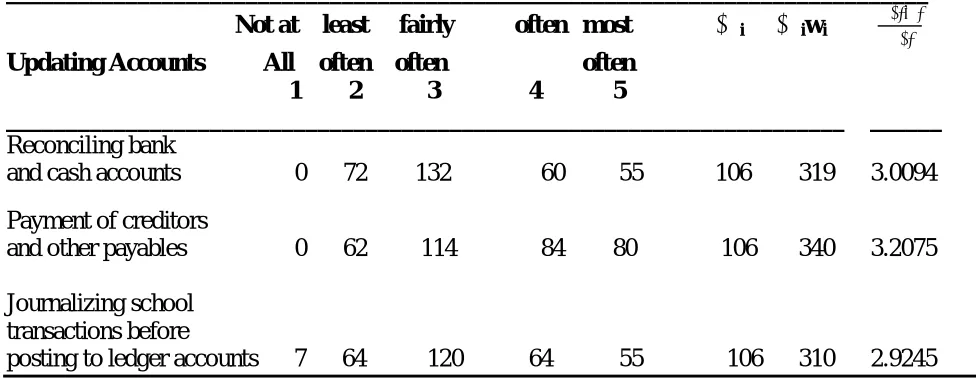
The result in table 4.1.2 indicates that schools on average update their books of account with an aggregate mean of 3.04 representing fairly often level.
Respondents indicated the highest rating on payment of creditors and other payables with a weighted average of 3.2. However the respondents felt that journalizing school transactions was least often updated with a mean of 2.9. The findings of the study reveal that schools often update their books of account which is an indicator of management efficiency of funds.
4.1.3 Extraction of Trial Balance
49% of respondents indicated half yearly basis of extraction of trial balance. 18.9% of the respondents say they extract the trial balance on a quarterly basis while 16.9% responded that they extract trial balance on a monthly basis. However 15.1% of the respondents indicate that the trial balance is extracted on a yearly basis. The findings of the study reveal that most schools extract trial balances on a half yearly basis which is not in tandem with good practice of accounting of monthly basis extraction, hence indicator of low level management efficiency. 4.1.4 Delegating of Responsibilities to Staff
The results shown in table 4.1.4 indicate that majority of the respondents are satisfied with delegation of responsibilities to staff with an aggregate mean of 3.1 representing satisfaction level. The respondents were more satisfied with delegation of stores control procedures with a highest mean of 3.3 while custodial of receipts and payment of vouchers is indicated by a mean of 3.1 of the respondents. The respondents were however less satisfied on delegation of book keeping with a mean of 2.9. The findings show that delegation of duties and responsibility influences management efficiency of funds in an institution.
4.1.5 Computerized Procedures
The aspect of use o f computerized procedures in budget management had a highest mean f 1.75 while stores management had the lowest rating of 1.65. The findings of the study show that most schools do not use computers in their operations signaling a low level of management efficiency.
4.1.6 Procurement Procedures and Stores Control
The results in table 4.1.6 above show the respondents were satisfied with an aggregate mean of 3.1 representing satisfied level on procurement procedures. Order delivery and invoicing information matched up aspects of procurement had a mean of 3.15 which was rated highest by respondents. Appropriate procedures for approving invoices for payment had a mean score of 3.01,while the lowest ranked was Budgetary checks over expenditure headings with a mean score of 2.5.The findings of this study reveal that adequate procurement procedures and stores control is an indicator of high levels of management efficiency.
4.1.7 Staff Accounting Skills
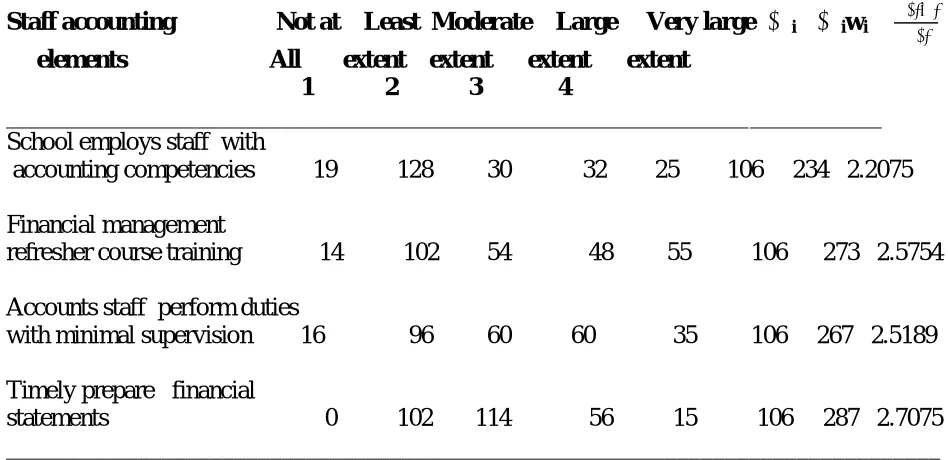
The table 4.7.1 shows that staffs accounting skills are low with an aggregate mean of 2.5 least extent in the likert scale. The aspect of preparation financial statements in time had a mean of 2.7 which was highest scored by respondents. However the aspect that the school employs staff with required accounting competencies scored the lowest mean of 2.21.This is in tandem with the respondents’ low levels of satisfaction in delegation of duties to staff as regard to book keeping. This is a relatively low score implying that preparation of books of accounts and final statements may not be appropriately done and this affects levels of management efficiency.
4.1.8 Monitoring and Supervision of FPE funds
The table 4.1.8 shows that the levels of monitoring and supervision of FPE funds was satisfactory with an aggregate mean of 3.0 representing satisfied level in the likert scale. The aspect that District Education officers consulting with the head teachers every time they visit the schools on FPE funds had the highest weighted mean of 3.2 indicating that the District Education Office is involved in monitoring of FPE funds in public primary schools. The assertion that the Education officers visit at least twice every term in school had the lowest satisfaction level as indicated by its lower weighted average of 2.8. The findings of the study reveal that monitoring and supervision of FPE funds is done by the District Education office though the frequency of the visits should be increased to enhance the level of management efficiency.
4.1.9 School Management Committees
Journal of Sociology and Social Work 1(1); June 2013 pp. 22-41 Otieno & Nyangechi
4.2.1 Annual School Budgets
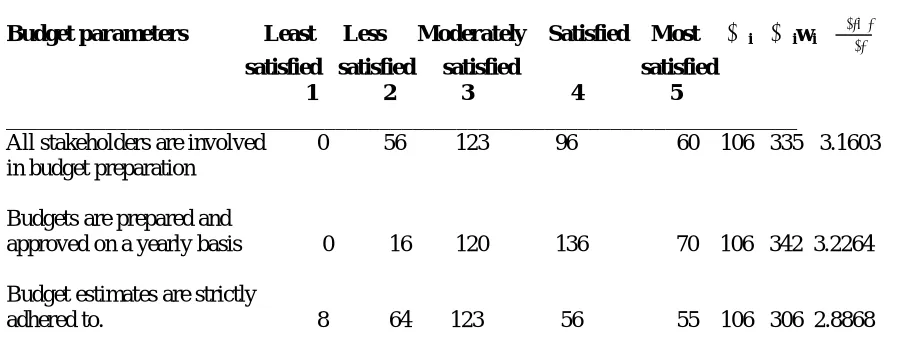
The results in table 4.2.1 shows annual school budgets as indicators of management efficiency had an aggregate mean of 3.1moderately satisfied on the likert scale. Majority of the respondents affirmed with a moderate satisfaction that budgets are prepared and approved on a yearly basis with a mean of 3.22.The aspect of all stakeholders involvement in budget preparation had a mean of 3.16, indicating that to moderately satisfied level stakeholders are involved in budget preparation. The aspect of budget estimates strictly adhered scored the lowest mean of 2.88. Budgets are actually the action plans for any organization. It is the basis on which actual results are compared against and variances explained.
4.2.2 Financial Reports
The results in table 4.2.2 indicate that financial reports adequately cover the aspects of financial reporting as indicated by an aggregate mean of 3.6 representing fairly effective level on the likert scale. They are more effective in decision making as indicated by its highest weighted mean score of 3.81. However such reports were least effective in timeliness as indicated by the lowest weighted mean of 3.37. When financial reports are not timely prepared and presented, they lose confirmatory and predictive values which are important in decision making.
4.2.3 Audit Reports
The results in table 4.2.3 of the analysis reveal that 54.7% of the respondents rated least often the visit of the District Audit team to schools. 34% of the respondents indicated not at all to the district audit team visit to schools. A fairly often visit of the school audit unit is a good indicator of strong internal controls hence efficient management. The findings show that schools with fewer visits from the audit office for collection of collaborative audit evidence indicates weak internal control leading to low management efficiency.
4.3 Effect of Internal Control Procedures on
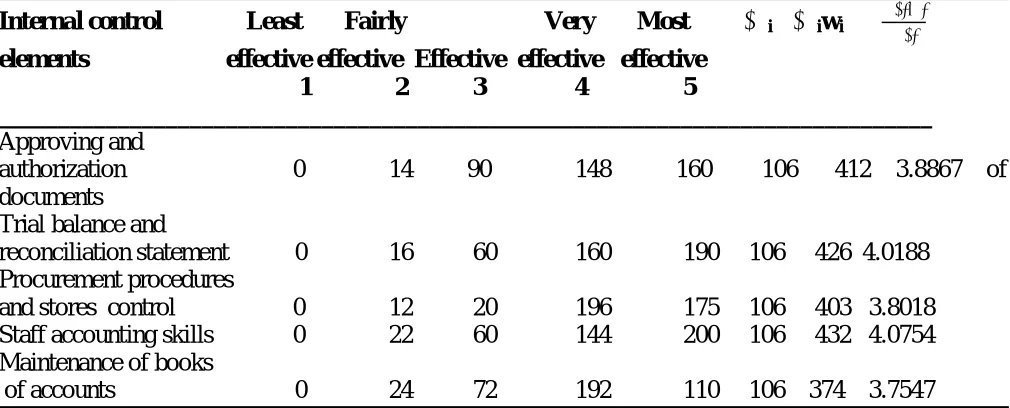
Management Efficiency of FPE FundsAre internal control procedures effective on management efficiency of FPE funds in public primary schools in Kisii Central District? This was the third question the study sought to answer. The respondents’ view on the effectiveness of internal control procedures on management efficiency of FPE funds was posted in table 4.3.1.The analysis shows that internal control procedures are effective on management efficiency with an aggregate mean of 3.9. Majority of the respondents were satisfied with the use of internal controls influence on management efficiency. Staff accounting skills play a key role in efficient management of schools and were rated highest with a weighted average of 4.07. However respondents rated lowest maintenance of books of accounts with a weighted average of 3.7. These results show that respondents perceive internal control procedures to be effective on management efficiency in schools.
4.4 District Education Office Staff Information
5.0 Conclusions and Recommendations
5.1Conclusions
The study set out to assess the effectiveness of internal control procedures on management efficiency of Free Primary education funds in Kisii Central District. The first question the study sought to answer was to what extent are internal control procedures used in Public Primary Schools in Kisii Central District? To answer this question, the respondents were required to rate the extent of use ,the frequency ,satisfaction and effectiveness of the various aspects of internal controls such as maintenance of books of accounts, extraction of trial balance, computerized procedures, procurement procedures and staff accounting skills. For maintenance of books of accounts the study established that adequate books of accounts are maintained in public primary schools with an aggregate mean of 3.8 representing moderate extent level and that fairly often these books of accounts are updated. From this finding it can be concluded that maintenance of books of accounts as an aspect of internal control procedure is done to a moderate extent in public primary schools. It can also be concluded that information contained in books of accounts can be relied upon for decision making as it is updated fairly often.
On the trial balance extraction the study established that most public primary schools extracted it on half yearly basis as was revealed by 49% of the respondents. This is not in tandem with good accounting practice of monthly basis extraction. For delegating of responsibilities to staff the study established delegation of responsibilities to staff was satisfactory especially in stores control and custodial of receipts. The respondents were however less satisfied on delegation of book keeping with a mean of 2.9.The findings show that clarity in delegation of duties and responsibility influences positively management efficiency of funds in an institution.
For staff accounting skills the study established that public primary schools rarely employ staff with the accounting competencies with an aggregate mean of 2.5 representing least extent in the likert scale . This is in tandem with the respondents’ low levels of satisfaction in delegation of duties to staff as regard to book keeping with a mean of 2.9. From the finding it can be concluded that timeliness in financial statement preparation and accounting staff performing their duties with minimal supervision is affected. Also it can be concluded that frequent training of staff on financial management improves management efficiency in public primary schools. On the use of computerized procedures the study established that most schools do not apply these procedures in book keeping, stores and budget management with an aggregate mean of 2.5 least extent level. It can be concluded from the finding of the study that schools not embracing computer use in public primary schools reduce the level of management efficiency.
In terms of procurement and stores control the study established these procedures are adequately used. For instance order, delivery and invoicing information matched up had a highest mean score of 3.15 indicating moderate satisfaction level from the respondents. The findings of this study reveal that adequate procurement procedures and stores control is an indicator of high levels of management efficiency. Generally the study indicated that internal control procedures were in use in public primary schools in Kisii Central District.
Journal of Sociology and Social Work 1(1); June 2013 pp. 22-41 Otieno & Nyangechi
The study also indicated that financial reports were generally effective in respect to accuracy, timeliness and decision making. It was also revealed that monitoring and supervision by District Education office was satisfactory. However visits by the district education audit office to schools were few. Generally the study established that to a large extent there is management efficiency of FPE funds in public primary schools.
Are internal control procedures effective on management efficiency of FPE funds in public primary schools in Kisii Central District? This was the third question. The study indicated that to a large extent various internal control procedures are effective on management efficiency with a mean of 3.9 satisfaction level.
5.2 Recommendations
Thefindings of the study have shown that use of internal control procedures improves management efficiency in schools .The study therefore recommends that school head teachers embrace and use internal control procedures in their resolve to efficient management. Schools achieving the goals of access to free primary education should appreciate the roles played by various stakeholders in monitoring and supervision of FPE funds and embrace them by working in co-ordination. The government should also increase its presence through capacity building in this sector.
References
Cole, G. (2004) Management Theory and Practice: (2nd Edition) Book power /ELST
Davis, J.H.,F.D. and Donaldson.(1997) “Stewardship theory or Agency Theory:CEO
Governance and shareholder Returns”, Australian Journal of Management Gray,I.,(2008), The Audit Process:
Principles,Practice and Cases. Patrick Bond
Ikoya P.O. (2005). Centralization and Decentralization of schools physical facilities in Nigeria : Abaraka Nigeria. KESIS: (2010) Kenya Educational Sector
Integrity Study: Transparency
International, Kenya.King, K., & Palmer, R. (2009). International Journal of Educational Development
Koontz H, Donnell O’ (1968) ,4th Ed.,
Principles of Management: An Analysis of Managerial Functions .McGraw-Hill, New York.
Kothari, S., A. Leone, and C. Wasley. (2005). “Performance Matched Discretionary Measures,” Journal of Accounting and Economics
Knight E, Sabot W (1990). Education, Productivity and Equity. Paris:Oxford University press.
Liang , X .(1996). Bangladesh Female Secondary School Assistance:World Bank ,Washington
Maslow,A.H.(1943) “A theory of Human Motivation”,Psychological
Review,Vol.50,pp370-396
Ministry of Education (2003).Financial Management Instructions. Nairobi: JKF Ministry of Education (2007). Ministry of
Education Handbook on FPE in Kenya. Nairobi: JKF
Muthwii, M. (2004). Free primary education: The Kenyan Journey since
Independence.
Mwindi ,D.(2005). Auditing:Focus Publishers, English Press,Nairobi
Nyaegah (2011). Challenges Facing
Management of Free Primary Education In Kenya: A Case of Nyamira County - Kenya. International Journal of Business and Management Tomorrow Vol. 1 No. 1
Omukoba H.O.,(2011),Contribution of Income Generating Activities to Financing Secondary School Education in Kenya: A case study of Eldoret municipality International
Pandey I.M.(2008) Financial Management(9TH Edition) Vikas Publishing House PVT Ltd.
Polonsky, M. J& Weller,D.S(2009).Designing And Managing A Research Project –A business Student Guide 5th Edition Tejeshwwar Singh , New Delhi
Power, (1997). The audit society: Rituals of verification. Oxford University Press. Ramani K (2003 November, 29th). Education
talks herald changes.
Republic of Kenya. (2003). Report of the Task Force on the Implementation of FPE. Nairobi: Jomo Kenyatta Foundation.
The Daily Nation Newspaper February 2, 2010. Thompson D.C.and Wood,R.C.(2005) Money
and Schools:(3rd Edition), Library Congress
UNESCO (2005). Challenges of implementing Free Primary Education in Kenya: Assessment Report. Nairobi.
Journal of Sociology and Social Work 1(1); June 2013 pp. 22-41 Otieno & Nyangechi
Table 1.1 FPE Disbursements in Kisii Central District 2007-2009
YEAR ACCOUNT TYPE TOTAL
SIMBA (SHS) GPA (SHS) (SHS)
2007 52064550 32250125 84314675
2008 28740480 33272990 62013470
2009 21275246 32755730 54030976
SOURCE: Kisii Central District Education Office, 2011
Table 2.1 Vote heads
Account1:SIMBA Account
Ksh.650 for each pupil per year to all primary schools to be used to purchase : Textbooks
Exercise books Pens
Supplementary readers and reference materials
Pencils, dusters, chalk Registers
Charts and wall maps
Account 2: General Purpose Account. Ksh.370 sent to all primary schools to support:
Support staff wages
Repairs Maintenance and Improvements Support Activities
Quality assurance
Electricity Water and Conservancy Postage
Box rental and telephone
Source: Ministry of Education, May 2003 Table 3.1 Sample Size
Category Target Population Sample
Headteachers 132 57
Chairperson SMCs 132 57
District Education Officer 1 1
District Quality Assurance and Standards Officer(DQASO) 1 1
District Audit Unit Officer 1 1
TOTAL 267 117
Source: Researcher (2012)
Table 4.1.1 Extent of Maintenance of Books of Accounts
_____________________________________________________________________________
Not at Least Moderate Large Very large ∑fi ∑fiwi
∑ ∑ Books of accounts all extent extent extent extent
1 2 3 4 5
_______________________________________________________________________ ______ Cashbook 0 12 78 128 210 106 428 4.0377 Ledger book 0 16 102 176 100 106 394 3.7169 Receipt book 0 0 66 216 150 106 432 4.0754 Payment vouchers 0 34 117 144 70 106 365 3.4434
Table 4.1.2 Frequency of updating Books of Accounts
_____________________________________________________________________________ Not at least fairly often most ∑fi ∑fiwi
∑ ∑ Updating Accounts All often often often
1 2 3 4 5
______________________________________________________________________ ______ Reconciling bank
and cash accounts 0 72 132 60 55 106 319 3.0094 Payment of creditors
and other payables 0 62 114 84 80 106 340 3.2075
Journalizing school transactions before
posting to ledger accounts 7 64 120 64 55 106 310 2.9245
Source: Field data (2012)
Table 4.1.4 Satisfaction Levels in regard to Delegating of responsibilities to staff
______________________________________________________________________________ Least Less Satisfied Very Most ∑fi ∑fiwi
∑
∑ elements of satisfied satisfied satisfied satisfied
delegating
1 2 3 4 5
Book keeping 6 60 123 80 45 106 314 2.9622 stores control 1 48 111 104 90 106 354 3.3396 custodial of receipts/
payments vouchers 4 54 129 88 50 106 325 3.0660 _______________________________________________________________________________
Table 4.1.5 Extent of use of Computerized Procedures
___________________[___________________________________________________________
Not at Least Moderate Large Very large ∑fi ∑fiwi
∑ ∑ Aspects all extent extent extent extent
1 2 3 4 5
_______________________________________________________________________________ Keeping accounting
records 65 48 24 20 20 106 177 1.6698 Stores management 69 36 27 28 15 106 175 1.6509 Budget management 62 42 36 36 10 106 186 1.7547 _______________________________________________________________________________
Journal of Sociology and Social Work 1(1); June 2013 pp. 22-41 Otieno & Nyangechi
Table 4.1.6 Satisfaction levels on Procurement procedures and stores control
________________________________________________________________________________ Not Least Satisfied Very Most ∑fi ∑fiwi
∑ ∑
Procedures Satisfied satisfied satisfied satisfied 1 2 3 4 5
Order, delivery and invoicing information
matched up 4 54 105 116 55 106 334 3.1509 Reconciliation of payable
balances to supplier
statements 7 44 126 92 60 106 329 3.103 Budgetary checks over
expenditure headings 9 60 114 72 55 106 270 2.9245 Appropriate procedures
for approving invoices
for payments 6 56 126 72 60 106 320 3.0189 ___________________________________________________________________________
Source: Field data (2012)
Table 4.1.7 Extent of Use of Staff Accounting Skills
__________________________________________________________________________
Staff accounting Not at Least Moderate Large Very large ∑fi ∑fiwi
∑ ∑ elements All extent extent extent extent
1 2 3 4
_________________________________________________________________________ School employs staff with
accounting competencies 19 128 30 32 25 106 234 2.2075
Financial management
refresher course training 14 102 54 48 55 106 273 2.5754
Accounts staff perform duties
with minimal supervision 16 96 60 60 35 106 267 2.5189
Timely prepare financial
statements 0 102 114 56 15 106 287 2.7075 ______________________________________________________________________________
Table 4.1.8 Levels of satisfaction on Monitoring and supervision of FPE funds
________________________________________________________________________
Not Least Satisfied Very Most ∑fi ∑fiwi
∑
∑ satisfied satisfied satisfied satisfied
1 2 3 4 5 Education officers
visit at least twice
every term in school. 10 64 111 84 30 106 299 2.8207
Organize frequent
seminars/workshops 4 54 126 104 35 106 323 3.0472 on management of FPE
Consult with the Head teachers every
time they visit the 0 36 147 136 25 106 344 3.2453 schools on FPE funds
_____________________________________________________________________________ Source: Field data (2012)
Table 4.1.9 Effectiveness of School Management Committees
___________________________________________________________________________
Effectiveness Least Less Moderately Effective Most ∑fi ∑fiwi
∑ ∑
Aspects Effective Effective Effective Effective 1 2 3 4 5
__________________________________________________________________________ SMCs are constituted
legally following the 2 12 105 192 75 106 386 3.6415 laid down procedures
SMCS are frequently
trained on management 16 76 96 48 40 106 142 2.6792 of FPE funds
SMCS in liaison with the
SIMSC always tender for 18 68 90 52 55 106 283 2.6698 instructional materials
Understand their roles
without overstepping 14 56 117 64 45 106 296 2.7924 their mandate
___________________________________________________________________________
Journal of Sociology and Social Work 1(1); June 2013 pp. 22-41 Otieno & Nyangechi
Table 4.2.1 Levels of management Satisfaction through Annual School Budgets ________________________________________________________________________
Budget parameters Least Less Moderately Satisfied Most ∑fi ∑fiwi
∑ ∑
satisfied satisfied satisfied satisfied 1 2 3 4 5
________________________________________________________________________
All stakeholders are involved 0 56 123 96 60 106 335 3.1603 in budget preparation
Budgets are prepared and
approved on a yearly basis 0 16 120 136 70 106 342 3.2264
Budget estimates are strictly
adhered to. 8 64 123 56 55 106 306 2.8868
______________________________________________________________________________
Source: Field data (2012)
Table 4.2.2 Effectiveness of Financial reports
Financial Not Less Fairly Effective Most ∑fi ∑fiwi
∑
∑ Aspects at all effective effective effective
1 2 3 4 5
Accuracy 0 30 123 132 85 106 370 3.4906 Timeliness 0 36 135 112 75 106 358 3.3773 Decision making 0 24 87 128 165 106 404 3.8113 ___________________________________________________________________________
Source: Field data (2012)
Table 4.2.3 Frequency of Visit of the District Audit team to school
Rating of visits Frequency %Frequency
Not at all 36 34%
Least Often 58 54.7%
Sometimes 8 7.5%
Often 4 3.8%
Most Often 0 -
Total 106 100%
Table 4.3.1 Effectiveness of Internal Control Procedures on Management Efficiency
Internal control Least Fairly Very Most ∑fi ∑fiwi
∑ ∑ elements effective effective Effective effective effective
1 2 3 4 5
______________________________________________________________________________ Approving and
authorization 0 14 90 148 160 106 412 3.8867 of documents
Trial balance and
reconciliation statement 0 16 60 160 190 106 426 4.0188 Procurement procedures
and stores control 0 12 20 196 175 106 403 3.8018 Staff accounting skills 0 22 60 144 200 106 432 4.0754 Maintenance of books
of accounts 0 24 72 192 110 106 374 3.7547
Table 4.4.1 DEO staff satisfaction levels on use of internal control procedures ____________________________________________________________________________
Internal Not at Least Moderately Satisfied Most ∑fi ∑fiwi
∑ ∑
control All satisfied satisfied satisfied elements 1 2 3 4 5
______________________________________________________________________________ Maintenance of adequate
books of accounts 0 1 1 1 0 3 9 3.00
The district audit team
visit individual schools in the process of
collecting audit evidence. 0 2 1 0 0 3 7 2.33 School budgets are
prepared in time. 0 0 1 2 0 3 11 3.67
The District Quality Assurance and Standards Office make at least two visits termly
to school for monitoring process 0 0 1 1 1 3 12 4.00 District Education Office
organizes frequent seminars
to update SMCs on their
roles in FPE Funds management 0 0 1 1 1 3 12 4.00 ______________________________________________________________________________