367 Volume-4, Issue-4, August-2014,ISSN No.: 2250-0758
International Journal of Engineering and Management Research
Available at:
Page Number: 367-371
Corporate Social Responsibility in MNC: A Global Analysis
Shweta1, Dr. Umesh Mohan2 1
Student, Kurukshetra University, Haryana, INDIA 2
Professor, Government College, Tohana, INDIA
ABSTRACT
The present paper identifies and structures external and internal influences on CSR Management of global companies. It suggests consequences for localization of different levels of CSR Management in the light of influencing factors such as stakeholder power, organizational culture and issues in question. In order to set the framework, general management approaches of global companies as a response to integration and responsiveness pressures and the most important dimensions of CSR management will be revised. In a second step, external and internal pressures on integration and localization strategies will be described and structured, leading to the identifications of three major aspects influencing CSR management of companies: Issues, key stakeholders, and strategic/organizational considerations. Based on this, possibilities of companies to localize their CSR approach within the different management dimensions and in the light the major forces on CSR management will be proposed.
Keywords---- Corporate social responsibility, community
development, competencies of CSR managers, multinational corporations, corporate-society relations.
I.
INTRODUCTION
For multinational corporations (MNCs) operating in emerging markets, the fast-growing wealth represents a tremendous opportunity. At the same time, these emerging markets also present a huge challenge to the MNCs due to underdeveloped institutional environment, weak public governance, widespread bribery and corruption, and lack of regulatory legislations and rules, public transparency, and respect for human rights. MNCs are likely to view foreign direct investment (FDI) in emerging economies as a major component of their cost minimization policies. As such, corporate social responsibility (CSR) initiatives, which are used by MNCs as a key source to gain sustainable competitive advantage in developed countries may get diluted in emerging economies. Such a myopic
view may enhance short-term profits, but would not ensure long-term sustainability. Most of the research on CSR has focused on the strategies of companies in the developed world. The literature on MNCs in developing economies and CSR is still embryonic. As CSR becomes increasingly important to MNCs, it is crucial to understand how MNCs’ subsidiaries approach CSR in emerging markets so as to realize the challenges MNCs’ subsidiaries face in aligning their CSR approach with local practices.
The questions of how MNCs’ subsidiaries approach CSR in emerging markets and how they adapt to local CSR practices remain largely under-explored. Another area of recent research pertains to MNC CSR in ‘conflict zones’ and their potential. Can the otherwise mutually conflicting objectives of Corporate Social Responsibility and Corporate Financial Performance be seen going hand in hand in such ‘conflict zones’? Can a cause-effect relationship be posited, especially in such conflict zones, with the success of the latter riding on a satisfactory performance of the former? This paper analyses the CSR practices followed by HUL in its unit in DoomDooma, Assam in the period 2001-2004, a period which was one of the most tumultuous periods in the history of HUL operation in India. The largest personal care products factory set up in DoomDooma to take advantage of the government’s concessions to encourage the region’s development, witnessed serious challenges in the form of local bandhs (closures), followed by an attack by the militant group, ULFA. Yet, the productivity contribution of the Assam factory was one of the highest and in fact was responsible for the company’s top line growth.
368 expectations of the local community. Thus, the company’s
CR initiatives helped in sustainable growth
II.
LITERATURE REVIEW
CSR is an extremely fluid term with varied definitions and understandings. It has been understood as firms 'voluntarily integrating the social and environmental expectations and concerns of stakeholders into their operations and their interactions with stakeholders' (Campbell, 2007), to being as broad as 'the idea of social responsibility supposes that the corporation has not only economic and legal obligations but also certain responsibilities to society which extend beyond these obligations' (McGuire, 1963). Society would include all the stakeholders ranging from the primary stakeholders like the shareholders to the secondary stakeholders like the suppliers. Therefore CSR reflects two key approaches-a shareholder approach based on the view that 'the social responsibility of business is to increase its profits' (Friedman, 1962) and a stakeholder approach which focuses on a multiple number of stakeholders' interests who are directly or indirectly affected by the decisions and the actions of the organizations (Freeman, 1984).
CSR Communication Irrespective of the approach to CSR what runs underneath and links the various CSR understandings, theories and approaches is that CSR needs to be communicated effectively by the organizations such that people within and outside the organizations are aware about the activities of the organization. Communication is important because discourses construct reality as they are constitutive and productive; they are political and may be employed for the purpose of enhancing or legitimizing a particular interest such that they are established as facts (Foucault, 1977). Kureshi (2003) aptly mentions states about the relevance of discourse by saying that 'after they have been told for a while, stories can turn into politics, into our institutions, and it is important that they seem just the way things are, and the way they have to go on being'. CSR communication is defined as 'a process of communicating the social and environmental effects of organizations' economic actions to particular interest groups within society and to society at large' (Gray et aI., 1996). Through CSR communication organizations are able to enter the public dialogue, present legitimacy claims and create positive relationships with the public that can influence their economic and institutional operating environment (Bostdorff and Vibbert, 1994) and delineate the corporations' rights, roles and responsibilities. So, for organizations to ensure that they are known as a responsible organization with multi stake holder concern, they not only engage in CSR but also communicate their CSR activities because it is commonly believed that those who 'talk the walk' also 'walk the talk'. Through the use of public communication the organizations 'attempt to shape the grounds for discussing social and political issues of the day' (Cheney and Christensen, 2001). So, the gains which CSR communication yields are favourable stakeholder
relationships, building a positive corporate image which in turn strengthens stake holder company relationships, and enhances stakeholders' advocacy behaviours (Du et aI., 2010). Yet, the main concern pertaining to CSR communication is the lack of awareness amongst the stakeholders because of which the organizations practicing CSR are unable to reap rightful benefits. Theories CSR Stakeholder Theory The CSR communication strategy proposed by Morsing and Schultz (2006), is based on the stakeholder approach and harps upon stakeholders in the communication process in the form of stakeholder information, stakeholder response and stakeholder involvement.
The analysis of CSR communication from the stakeholders' perspective shows how there can be both a positive as well as negative impact of CSR communication and it is important to keep in mind the environment for which the theory of sensemaking comes handy to have an effective understanding of the communication process. They suggest through empirical evidence that the managers involved in CSR communication should be constantly aware that CSR communication is like a 'double-edged' sword which may boomerang and therefore it is important that communication managers should try and involve stakeholders in the process ofCSR communication as a step towards 'pro-active' CSR endorsement.
III.
DIMENSIONS OF CSR
MANAGEMENT
CSR can be understood as a management concept „whereby companies integrate social and environmental concerns in their business operations and in their interaction with their stakeholders on a voluntary basis” (Commission of the European Communities, 2001, p. 6). A company acts responsible, if it aspires to achieve “an equilibrium between the demands and needs of different stakeholders which is acceptable for everybody involved” (Commission of the European Communities, 2002, p. 4). Essential components of the concept are the voluntary character (more than legal requirements), the orientation at expectations and values of company (Joyer/Payne, 2002, p. 300), and its cross functional nature. According to Goebel, CSR should therefore not be seen as a separate function, but as an integral part of general management (Göbel, 2006, p. 156).
As arguments for and against standardization usually refer to different dimensions of CSR management, the following dimensions of CSR management will be the basis of discussion of localization approaches of companies.
369 guiding principles, however – due to different
values systems around the globe - there might also be adaptations to local environments.
• Strategy: Based on a analysis of environmental forces and internal values and resources, it defines key stakeholders or target groups, issues, standards, projects and partnerships (Muenstermann, 2007, p. 20-21). Again, companies might follow an overall global CSR strategy focusing on global or home country stakeholder group, or they might take account for different pressing issues or expectations of local stakeholders.
• Organization: Strategy needs to be reflected in adequate organizational structures and processes. Structures determine information flows and reporting lines as well as the location of responsibility and budgets. Processes define the way of strategy formulation, criteria for CSR decisions, target setting and controlling, incentives (Yip, 1992, p.181).
• (External) CSR communication: It consists in a permanent stakeholder-dialog for detecting stakeholder demands and general trends and building legitimacy and the CSR reporting via homepages, reports, media etc. Companies need to decide about the geographic focus of stakeholder-dialog as well as about localization or standardization of CSR reporting.
IV.
GLOBAL APPROACHES TO
CSR MANAGEMENT
Influencing factors
Based on the discussion in the previous chapters three main factors that are shaping the CSR approach of globally active companies are derived: The issue in question, the character and distribution of major stakeholder groups and the general organizational approach and culture of a company:
Issues are areas of key areas of concern that a company should take care for, as for example issues in the field of environmental protection (climate, water,
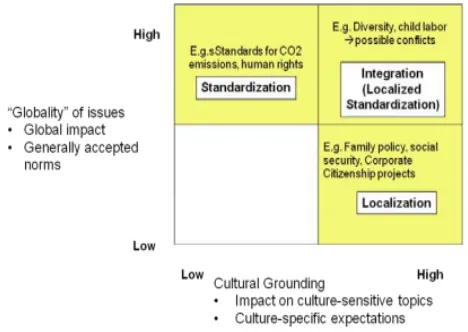
biodiversity), the wellbeing of employees (work live balance, human rights, diversity) or the community and civil society in general (reduction of poverty, education etc.).19 Especially when global public goods are concerned, a uniform approach of companies seems to be sensible, as there is an inherent incentive for companies to deviate from a cooperative approach. The lack of internal common standards would alleviate contributing only selectively in some countries and overuse the public good in other countries. Also, global issues are usually backed by global stakeholder groups with an interest for a standardized approach. On the other hand, there are issues which are characterized by a strong cultural grounding and which would require the adaptation to the local environment. Family policy, social security or corporate citizenship projects are examples for that (Hartard, 2008). Different regulative frameworks and different opinions about social responsibilities of companies ask for different approaches in employee or community related questions. Finally, there might be issues where there seem to be a common understanding of what is desired by the “global community”, however, different interpretations of these globally valid values or rights lead to potential conflicts of a standardized approach. Examples for that are (gender) diversity issues or child work. Companies need to find the right balance between formulating general principles but at the same time letting some lee ways for local modification. Figure 2 summarizes the influence of the character of issues on localization strategies of companies:
370 Global companies are facing both global and local
stakeholder groups, where local stakeholders can further be divided into stakeholders of the headquarter country and local stakeholders of other countries of operation. Depending on the industry, the location of the headquarter/the subsidiaries, the character and size of operations abroad and the composition of major shareholders, these stakeholder groups have different power potential and are affected to a different degree by company activities (Aguilera/Yip, p. 2004). An Asian company with a dominant share of revenues coming from the United States faces different pressures from its stakeholder groups than a similar company with most of its sales in Asia.
The distribution and character of stakeholders is therefore one of the major influencing factors for the CSR approach of companies.
V.
DISCUSSION
It is important that insistence on publication of sustainability reports should be made because the internationally accepted format of publishing social information is balanced and ensures that organizations quantify and present detailed information about all categories--economic, environment, society, human rights and labour practices and product responsibility, each of which appeals to a set of stakeholders. Further there is a scope of self-declaration, third-party authorization as well as benchmarking against a standardized set of parameters (GR3 Indicators) accepted by the international community which ensures uniformity and credibility upon the disclosed information. In developing nations like India, where a majority of the companies fall in the category of Small and Medium Enterprises (SMEs) questions are raised about the suitability of adoption of CSR and subsequent reporting especially in accordance with the GRI framework is a question because of the limitation of resources in tenns of awareness, time and cost. Companies need to be sensitized and made aware about the advantages that CSR holds for SMEs would help both in incorporating CSR and its reporting as well. CSR adoption should be adopted not for reasons of pressure from external or
internal stakeholders but because it holds business sense and encourage growth for business. CSR adoption and reporting establishes a positive and competitive tone of doing business and leads to an enhanced status of the company and its products. If CSR reporting becomes a part of the national business conscience then it would not be far when Indian companies as a whole would be able to catch up with the companies operating in the international arena. The current level of limited CSR reporting is happening because neither the primary nor the secondary stakeholders understand or comprehend or are interested in CSRrelated activities in which organizations are involved; thus the scope for change and enhancement in the depth and the range of CSR reporting is likely to see very little change and growth. Only large Indian companies like Tata Consultancy Services (TCS) and Infosys which have operations abroad in the form of overseas clients or customers seem to be communicating CSR activities which are at par with the top end MNCs. The top few Indian companies convey CSR related activities in its entirety using all channels of communication-websites, annual reports and sustainability reports effectively. Further evolution of CSR reporting even for large companies can happen if CSR communication is also understood and aspired by organizations as a two-way process where the corporations receive feedback about their CSR related activities from the stakeholders. Both the quantity and the quality of CSR communication needs to be enhanced.
The electronic medium of reporting is still static and largely one-way for both the Indians and the MNCs. Further for the Indian companies it is even important to post more information since very little is conveyed about CSR by the Indian firms. Websites release a separate sustainability which adheres to the internationally desired reporting standards-Global Reporting Initiatives (GRI, 2006), indicating that a lack of legal regulations is the prime cause for low sustainability reporting and there is a distinct need for a public policy framework or industry driven initiatives which should motivate and monitor the organizations to adhere to the international sustainability reporting practices and also try and outperform them by taking further initiatives like the Cll has taken regarding the issue of corporate governance. Internationally, cutting through sectors and countries across the globe, there has been a rise in reporting in 20 10 and the GRI conference in 20 I 0 was a success which further enhanced the reporting parameters to incorporate issues like carbon disclosure and water disclosure, providing opportunities for increa ed transparency, reporting and stakeholder awareness. The focus is shifting from questioning the importance of reporting to bringing out ways of effective reporting. The 'whether to report or not' is giving way to 'how' to report.
VI.
CONCLUSION AND RESEARCH
IMPLICATIONS
371 line is the achievement of win-win situation among the
three entities. From the social point of view, CSR should benefit community because the latter has a very complex structure as it consists of individuals with various levels of control of resources physically and intangibly. The analysis on the theories allows the understanding of CSR that goes beyond its traditional meanings; therefore, CSR necessitates a multidisciplinary approach in its perspective and practice. Since the current meaning of CSR is complex, knowing the theories allows scholars to have a better understanding about corporation-society relations, in which theories and practices of CSR are influenced by numerous economic and non-economic as well as internal and external forces. Roles of CSR in CD refer to the ways the responsible behavior is perceived by community of stakeholders and how impacts are felt by them. The analysis shows that CSR proved to have many roles and the brought impacts to the community as follows: Closer ties and interdependencies between corporations and community, sharing the costs the society has to pay due to environmental degradation, transfer of technology from international companies to developing countries, environmental protection measures that done together by corporation and the communities, poverty alleviation in the communities, human right advocacy, and helps in data gathering by ICT firms to facilitate public organization functions. For many corporation leaders, it is difficult to know where their responsibilities begin and end in relation to building infrastructure, creating economic opportunities, and access to core services such as health, education and poverty alleviation. Experience has made one thing certain that sustainable CSR solutions at community, provincial and national levels are based on partnerships between government, civil society and business. It is also concluded that skills needed by CSR managers do vary due to the diverse disciplines involved and also the complexity of the roles and responsibilities of a CSR initiative. There are no specific qualifications required for this field. Because the field is new, transferable skills and knowledge from other related specializations such as environmental management, business ethics, transfer of technology, human resource management and community development, are valued.
In short, the skills required by CSR managers are classified as business skills, people skills and technical skills; and the specific skills required are further determined by the mission and vision of the organizations where the CSR managers serve. CSR organizations in many developing countries including Malaysia consist of local and international firms. As such, this analysis suggests that comparative studies should be conducted on the differences between strategies adopted by the two firms in terms of emphases and orientations in CSR, the specific roles of CSR programs to community and society at large, and specific business, people as well as technical skills that the CSR managers should possess. It is also suggested that studies on how CSR firms strive during the present economic crisis are worthwhile to embark on; however, they should be aware of the fact that moving
towards achieving firms’ economic goals should be without jeopardizing the social goals.
REFERENCES
[1] Amaeshi, K., Adi, A. B. C., Ogbechie, C. and Amao, O. O. 2006. Corporate Social Responsibility in Nigeria: Western Mimicry or Indigenous Influences? Journal of Corporate Citizenship, 24(Winter): 83-99.
[2] Andriesse, E. and van Helvoirt, B.J. 2010. Regional business systems and private sector development in Southeast Asia. Asia Pacific Business Review, 16(1-2): 19–36
[3] Baskin, J. 2006. Corporate Responsibility in Emerging Markets. Journal of Corporate Citizenship, 24: 29-47 [4] Behnam, M. and Maclean, T. 2011. Where is the Accountability in International Accountability Standards? A Decoupling Perspective. Business Ethics Quarterly, 21(1):45-72
[5] Birch, D. and Moon, J. 2004. Introduction, Journal of Corporate Citizenship, Vol.Special Issue 13, pp.18-23 Carney, M.; Gedajlovic, E.; Yang, X. 2009. Varieties of Asian capitalism: Toward an institutional theory of Asian enterprise. Asia Pacific Journal of Management, 26: 361-380.
[6] Chapple, W. and Moon, J. 2005. Corporate Social Responsibility (CSR) in Asia: A Seven Country Study of CSR Website Reporting , Business and Society, 44 (4): 415-441.
[7] Chatterji A. and Levine, D. 2006. Breaking down the Wall of Codes: Evaluating Non Financial Performance Measurement. California Management Review, 48(2). [8] Chaudhri, V. and Wang, J. 2007. Communicating Corporate Social Responsibility on the Internet: A Case Study of the top 100 IT companies in India. Management Communication Quarterly, 21: 232-247.
[9] Tipton, F.2009. Modelling National Identities and Cultural Change: The Western European, Japanese and United States Experiences Compared. International Journal of Cross Cultural Management. 9(2):145-168.
[10] Welford R. 2005. Corporate social responsibility in Europe, North America and Asia: 2004 results. Journal of Corporate Citizenship 17: 33–52.
[11] Whitely R. 1999. Divergent capitalisms: The social structuring and change of business systems. Oxford: Oxford University Press.