553
Copyright © 2011-15. Vandana Publications. All Rights Reserved.
Volume-5, Issue-3, June-2015
International Journal of Engineering and Management Research
Page Number: 553-557
Crop Water Requirement Estimation by using CROPWAT Model: A Case
Study of Halali Dam Command Area, Vidisha District, Madhya Pradesh,
India
Vishal Kumar Pandram1, Prof. M.K. Choudhary2
1
Research scholar, Department of Civil Engineering, Maulana Azad National Institute of Technology, Bhopal, INDIA
2
Associate Prof. Department of Civil Engineering, Maulana Azad National Institute of Technology, Bhopal, INDIA
ABSTRACT
This paper is focuses on analyzing the irrigation water requirement and irrigation scheduling of wheat crop for rabi season using 9 year (2005-2013) climatic data of Halali dam command area in Vidisha district of Madhya Pradesh state, India. The effective rainfall was calculated using USDA S.C. Method. Reference crop evaporation was calculated by meteorological data viz Temperature, Relative humidity and Sunshine hr which is collected from meteorological station Vidisha district. Four type of soils existed in command area are considered. Soil depth and physical characteristics viz maximum infiltration rate, moisture holding capacity are also considered for better crop yield and crop irrigation requirement. Crop coefficient Kc value was taken according to crop growing stages as per given by the FAO Technical Paper “Irrigation and Drainage paper No. 24”. Effective rainfall and crop water requirement was used for determining net irrigation water requirement. Byconsidering the losses due to infiltration into the subsoil and conveyance losses, net irrigation water requirement was estimated. The total crop water requirement of wheat is 209.7 mm due to recurrence of rainfall. It is found that the irrigation scheduling graph of wheat in Loam soil (210) is present different from other Clay Soils 379, 399, 412, while respective clay soils are representing slightly difference from each other in aspect of irrigation scheduling
Keywords— CROPWAT, Crop coefficient, Climatic data, Crop evapotranspiration, Crop water requirement, Penman method, and Reference evapotranspiration.
I.
INTRODUCTION
Water is becoming precious and scarce due to its increasing demand in agriculture and industrial sector.
Agriculture being the mainstay of population and exploitation of available water resources to meet the agricultural need requires its scientific management. An important aspect of agricultural planning is to work out requirements of water for crops. The water requirement of crop vary widely from crop to crop and also during the entire crop growth period of individual crop. The main parameter which is required to be determined for estimating the crop water requirements is reference crop evapotranspiration (ETo) which when multiplied with the crop factor Kc gives the value of water required by the crop.
II.
STUDY AREA
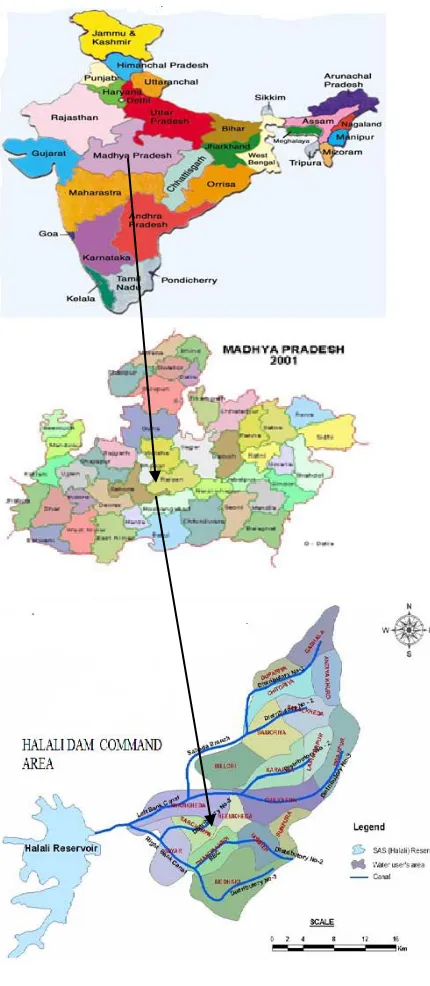
Halali dam command area lies on Vidisha district. Command is also lies on Vindhya Plateu, Agro-climatic zone of Madhya Pradesh. The dam is constructed across Halali river which is tributary of Betwa river. Area is located at 23°20′N latitude and 77°30′E longitude and is about 458 meters above mean sea level. Dam is located about 40 km from Bhopal the capital of Madhya Pradesh.
The topography of Halali command area is almost plain some part is terrain and well irrigated through canals. The gross command area of the project is 37,419 ha. and the cultivable command area is 27,924 ha. Cropping area of wheat crop in Halali Command is 13155 Hectare. The major crops grown in this district include wheat, rice, gram, soybean, mustard
The climate of the district is dry and hot in summer and cold in winter. Winter temperature varies from 100C to 250C and summer temperature varies from 250C to 420
The land of Halali command is plain and favourable for productivity .There are four different soil in
554
Copyright © 2011-15. Vandana Publications. All Rights Reserved.
area loam and three type Clay having different infiltration capacity and soil depth. The soils are ideal for crops like wheat, rice, soybean, vegetables etc.
Fig.1 Location of Command Area
III.
MATERIALS AND
METHODOLOGY
Penman-Monteith (PM) method is ranked first for estimating ET0
(
)
(
)
(
2)
2
34
.
1
273
900
408
.
0
U
e
e
U
T
G
R
ET
a s n
o
+
+
∆
−
+
+
−
∆
=
γ
γ
where solar radiation (SSH) data are available (Jenson et al.1990). The Penman-Monteith equation was adopted to calculate reference crop evapotranspiration due to it accurate output by using different meteorological variables in the study area. In order to compute the crop water requirement (CWR), crop coefficient (Kc) values for the wheat crop were obtained and multiplied with the potential evapotranspiration.
𝐸𝐸𝑇𝑇𝑜𝑜 - reference evapotranspiration (mmday-1), 𝑅𝑅𝑛𝑛 - net
radiation at the crop surface (MJm-2day-1), 𝐺𝐺 - soil heat
flux (MJm-2day-1), 𝑇𝑇̅ - mean daily air temperature at 2 m
height (°C), 𝑈𝑈2 - wind speed at 2 m height (ms-1), 𝑒𝑒𝑠𝑠-
saturated vapour pressure (kPa), 𝑒𝑒𝑎𝑎 - actual vapour pressure (kPa), 𝑒𝑒𝑠𝑠−𝑒𝑒𝑎𝑎 saturated vapour pressure deficit
(kPa), Δ - slope of vapour pressure curve (kPa) and 𝛾𝛾
-psychrometric constant (kPa °C-1)
The crop coefficient values of wheat crop for Halali command are as follows
TABLE I
Crop coefficient values of mustard crop
growth stage crop coefficient
initial 0.29
mid-season 1.15
late-season 0.40
IV.
RAINFALL DATA
Effective rainfall is estimated by empirical formula developed by USDA Soil Conservation Service.
P = P*(125 - 0.6*P)) /125 for P <= (250 /3) mm
P = (125 / 3) + 0.1 * P for P > (250 / 3) mm
Where, P is effective rainfall (ER) in mm. The amount of irrigation water is dependable factor on rainfall, soil and crop water requirement means these decides the amount of water or how much water has to be applied. The effective rainfall is subtracted from the crop water requirement to calculate the irrigation water requirements (IWR).
555
Copyright © 2011-15. Vandana Publications. All Rights Reserved.
Net irrigation water requirements (NIWR) are the total amount of water to be supplied to the crops during their whole life span, considering the losses due to deep-percolation and conveyance losses. Based on soil characteristics, field losses and conveyance losses are assumed as 30% of the irrigation water requirements for crops and considering field efficiency is 70% and field is irrigate as per assume 100% critical depletion condition.
NIWR = IWR + LOSSES (30% of IWR)
In the present study, the net irrigation water requirements have been computed as per growing stage basis. CROPWAT gives the IWR values in litre/sec/hectare are converted into discharge units (million cubic meters).
Fig.2 Monthly rainfall distribution pattern for Vidisha district (2005-2013)
The monthly variations in rainfall and the climatic
parameters at Vidisha for 9 years (2005 to 2013) are
presented in Fig. 2
The monthly variations in the climatic parameters for Vidisha district presented in fig.3
Fig. 3 Monthly variations in climatic parameters for Vidisha district (2005-2013)
V.
SOIL DATA
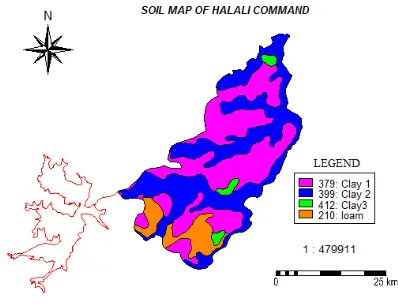
Soil characteristics affecting the irrigation scheduling according to their moisture holding capacity, max. Infiltration rate etc. In the Halali command area four different types of soil exist. Each soil having its different infiltration capacity and soil depth. Soil data collected from soil map prepared by National Bureau of Soil Survey and Land Use Planning (ICAR) Nagpur. The soil-code of soils are 210-Loam, 379-Clay1, 399-Clay2, 412-Clay3. Soil property is collected from Indian institute of soil science, Bhopal. Map of command area is presented in fig.4
Fig.4 Soil map of Command area
As per local cropping pattern it is assume that the sowing period of wheat crop starts from mid of Oct. to the bingeing of Nov. and harvesting process starts from mid of March to April mid.
For that initial soil moisture depletion of loam soil taken as a 10%, and 5% for clay soil, but the infiltration rate of soil are different from each other. The screen shots generated by CROPWAT for soils are shown below.
556
Copyright © 2011-15. Vandana Publications. All Rights Reserved.
VI.
RESULT AND DISCUSSION
Crop Water Requirement
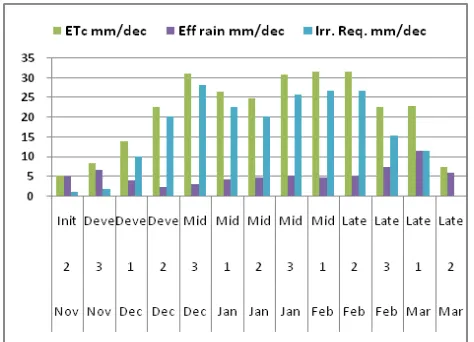
From the Rainfall subtracted by (ETc) crop evapotranspiration the irrigation water requirement (IWR) is calculated. The simulated values of irrigation water requirement (IWR) for the wheat crop in Halali command are shown in graph.
Fig. 5 Monthly variations in climatic parameters for Vidisha district (2005-2013)
Irrigation Scheduling
As wheat is grown in Rabi season the amount of rainfall is very less so the crop water requirement of wheat is directly dependent on irrigation water requirement.
The total avg. rainfall occurred from Nov. to March is 71.7 mm. By assuming 70% field efficiency the net irrigation water requirement to refill the soil up to field capacity as per soil characteristics is shown in graph.
Irrigation scheduling for wheat in loam soil(210)
557
Copyright © 2011-15. Vandana Publications. All Rights Reserved.
Irrigation scheduling for wheat in Clay soil (399)
Irrigation scheduling for wheat in Clay soil (412)
VII.
CONCLUSION
An attempt has been made to compute the crop water requirements and irrigation scheduling of wheat crop in different soil type of halali command using CROPWAT 8.0 model of FAO and comparing their irrigation interval with the available soil type of the district. The present study shows that irrigation scheduling for wheat in Loamy soil is completely different from other three type of Clay soil, While the irrigation scheduling for wheat crop in Clay 379, 399 and 412 are slightly different from each other. The first irrigation applied for wheat in loam soil (210) is after 51 days due to recurrence of rainfall in November and December, while in case of other soil the first irrigation applied for wheat after 89, 86, 84 days in Clay soil 379, 399, 412 respectively
.
REFERENCES
[1] C. Bernadette et al “Evaluation of Evapotranspiration using FAO Penman-Monteith Method in Kano Nigeria” International Journal of Science and Technology Volume 3 No. 11, November, 2014, 698-699
[2] Detailed project report on samrat Ashok Project (Halali dam-project) Chambal Betwa Basin, Bhopal.
[3] FAO (1997) “Guide lines for predicting crop water requirements. Irrigation and Drainage paper 24” (revised
ed.), Food and Agricultural Organisation of United Nations, Rome, Italy.
[4] FAO Technical paper “Guide lines for computing crop water requirement Irrigation and Drainage Paper 56”, Food and Agricultural Organisation of United Nations, Rome, Italy.
[5] Gaurav Pakhale et al. “Crop And Irrigation Water Requirement Estimation By Remote Sensing And GIS: A Case Study Of Karnal District, Haryana, India” International Journal of Engineering and Technology Vol. 2(4), 2010, 207-21.
[6] U.Surendran et al. “Modelling the crop water requirement using FAO-CROPWAT and assessment of water resources for sustainable water resource management: A case study in Palakkad district of humid tropical Kerala, India”